On this page
- In Brief
- Munduk Waterfalls at a Glance
- The Five Munduk Waterfalls, Easiest First
- Getting to Munduk: About an Hour from Lovina
- When to Go: First Light, and May to June or November
- What to Wear: Closed Shoes with Grip Come First
- Coffee After the Falls: Munduk's Plantations
- Where to Stay in Munduk: Ridge Guesthouses to Plantation Hotels
- A Guide Helps at Golden Valley and Banyu Wana Amertha
- A Munduk Waterfall Morning from the Coast
- How to Fit It In
- Practical Notes
- FAQ
- Sources
In Brief
Munduk Waterfall is about a ten-minute walk down from its parking area in Munduk village, in the highlands of north Bali's Banjar district. Four more falls are close by. Melanting and Golden Valley are in the Munduk area, and Banyumala Twin and Banyu Wana Amertha are a short drive east at Wanagiri.
Go from first light, before the mist lifts and the tour groups arrive, and wear closed shoes with grip. Each gate takes a small conservation payment in cash. Munduk Waterfall is about an hour's drive from Singaraja, just east of Lovina, and staying in the village puts the falls before breakfast.
Munduk Waterfalls at a Glance
- What: five waterfalls around the highland village of Munduk, in Banjar and Sukasada districts
- The easy pair: Munduk (Red Coral) and Melanting, short walks on maintained paths
- The longest walk: Banyu Wana Amertha, three falls in a village forest, 3 to 4 hours round trip
- Entry: a small conservation payment in cash at each gate
- Time of day: first light through the early morning
- Best months: May to June, or November
- From Singaraja: about 34 km, roughly an hour
- From the airport: about 54 km, roughly two hours
- Guide: optional for Munduk, Melanting and Banyumala, worth hiring for Golden Valley and Banyu Wana Amertha
The Five Munduk Waterfalls, Easiest First
Munduk, a former Dutch colonial retreat high in Bali's central highlands, sits among a cluster of waterfalls.
Three are in and around Munduk village, and two more are a short drive east at Wanagiri. The air is markedly cooler than on the coast, the morning mist hangs in the coffee plantations, and the tourism infrastructure is minimal. Many visitors see one fall and drive back down, but two or three fit into a single morning.
1. Munduk Waterfall (Air Terjun Munduk)
- Also called: Red Coral Waterfall, for the red stones around it, and locally Tanah Barak
- Where: Munduk village, Banjar district
- Difficulty: easy
- Time needed: 1 to 1.5 hours round trip
- Entry: a small conservation payment in cash at the gate
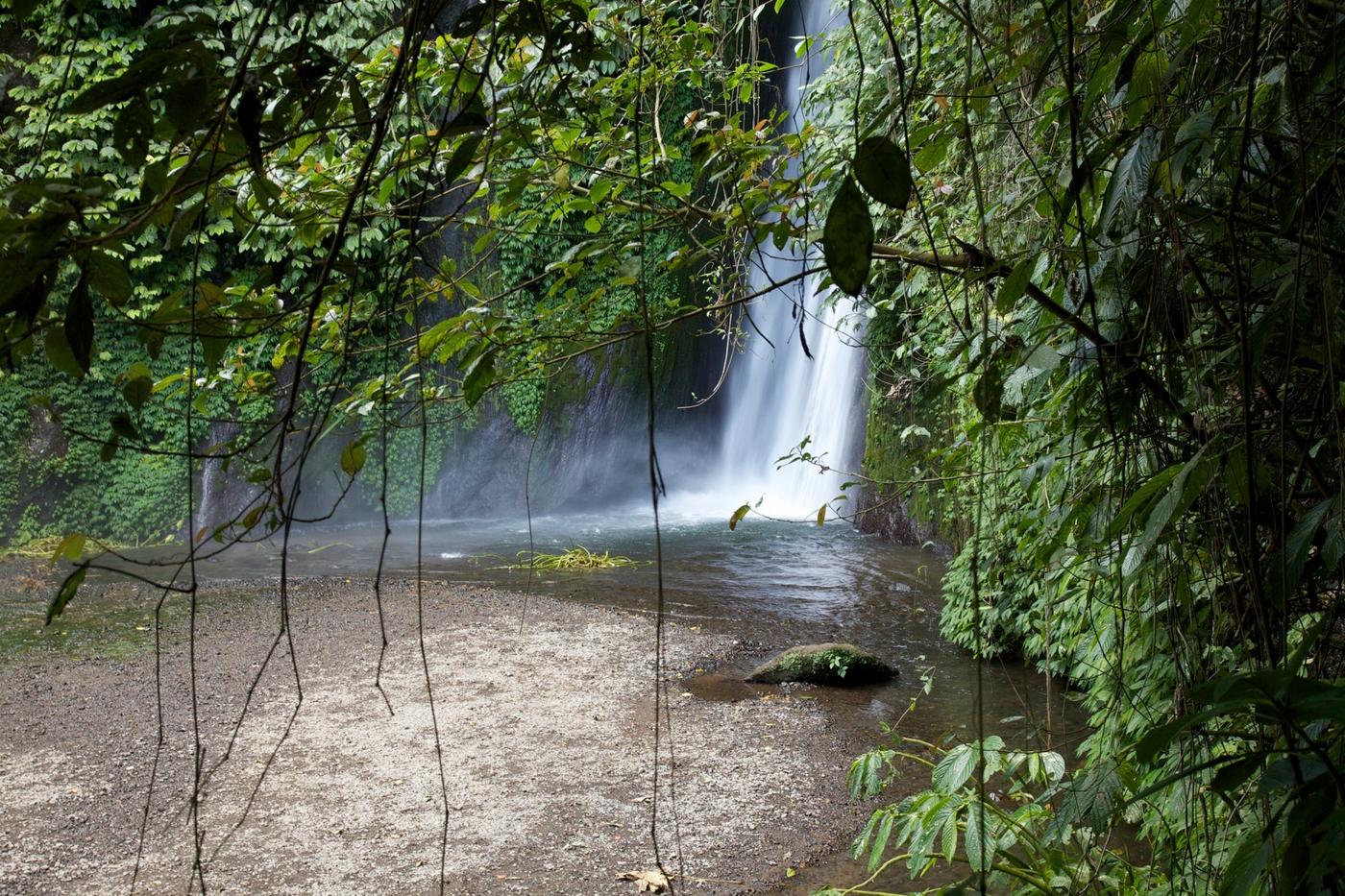
Munduk Waterfall is the namesake and the best known of the five.
detikBali puts the walk from the parking area at about ten minutes, down a sloping path and steps. The approach runs through clove and coffee gardens, and you smell the harvest before you see the trail.
The falls drop into a natural amphitheatre carved into the hillside. There is room to sit on the rocks and let the mist cool you down without getting soaked.
Why go: an easy, well-kept trail to a dramatic view, with the coffee gardens that make up the highlands all around it.
The catch: it is the most visited of the five. By mid-morning you share the viewing area with tour groups, so arrive soon after first light.
2. Melanting Waterfall (Air Terjun Melanting)
- Where: Munduk village, run by its own local managers (Visit North Bali listing)
- Difficulty: easy
- Time needed: 45 minutes to an hour round trip
- Entry: a small conservation payment in cash at the gate
Melanting is about a 20-minute walk from Munduk Waterfall (Tatkala), and many visitors skip it after seeing its neighbour.
It drops between rock walls into a pool at the bottom of the plantation gully. A magazine feature republished by the Buleleng culture and tourism office found the pool about chest-deep on an adult. Ask the managers before swimming, because Tatkala reported in 2025 that visitors cannot swim there.
Why go: the light. The falls face east and catch the morning sun, so the moss glows and the mist turns into visible rays. For photographers, this is the golden-hour stop.
The catch: it has the lowest water volume of the five. In the late dry season, September to October, it can thin to a trickle, so visit earlier in the year.
3. Golden Valley Waterfall
- Height: about 15 metres, per the Buleleng culture and tourism office, which places it in the Munduk area of Banjar district
- Difficulty: moderate
- Time needed: 2 to 2.5 hours round trip
- Entry: a small conservation payment in cash at the gate
Golden Valley lies off the main tourist path, at the end of a 30-minute hike through dense jungle and bamboo forest.
Tour buses do not reach it, and no souvenir stalls line the approach. The Buleleng culture and tourism office notes it is growing more popular and has an eco café beside the falls. Early on a weekday, you may still have it to yourself.
The water pours into a narrow canyon with golden-brown rock walls, which give the fall its name. The pool is deep enough for a proper swim, and cold enough to feel it.
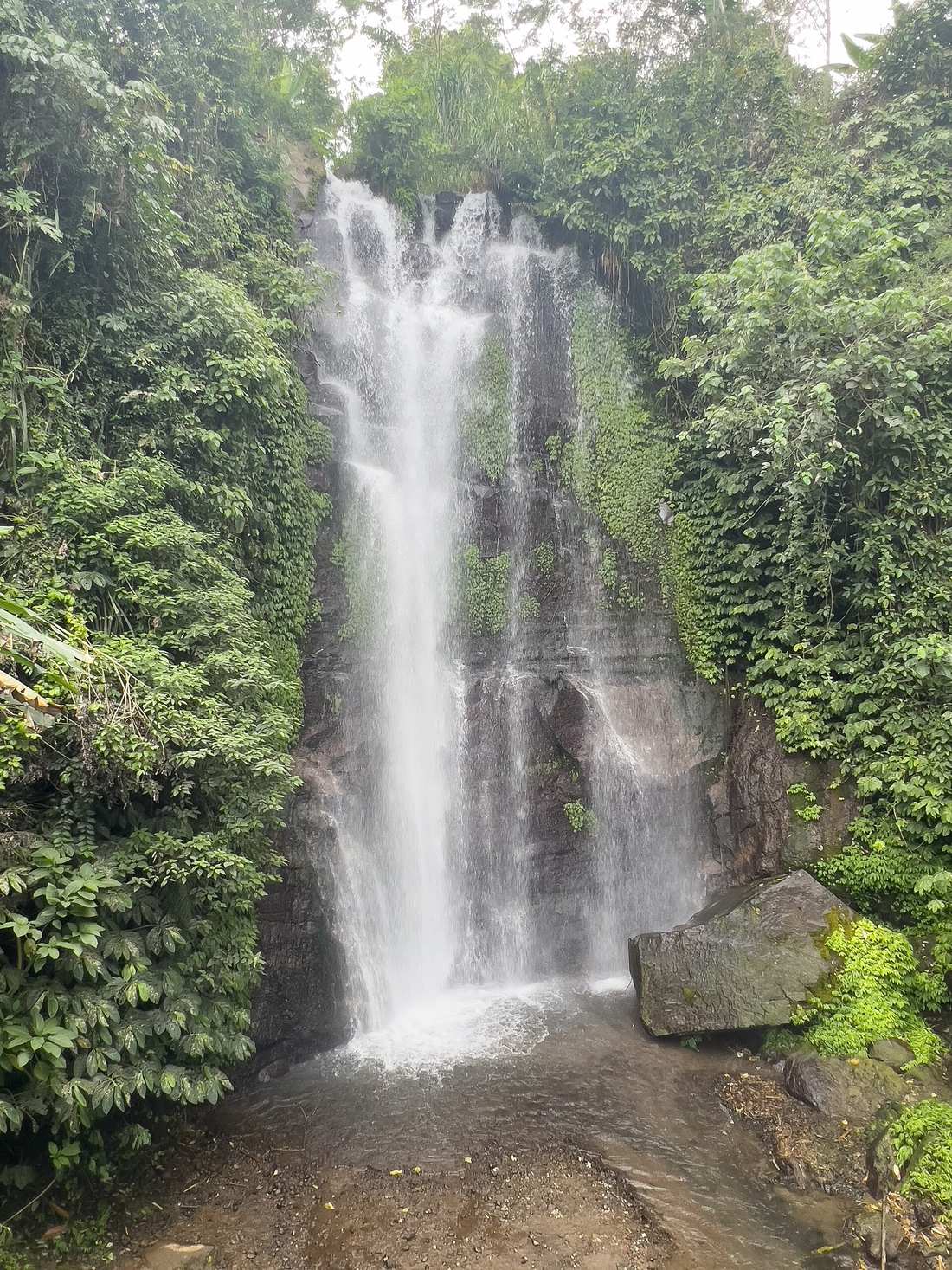 Golden Valley waterfall near Munduk. Photo: Stefan Fussan / Wikimedia Commons (CC BY-SA 3.0)
Why go: quiet. The hike keeps casual visitors away, and the setting feels untouched.
The catch: the trail is rougher and poorly marked. Local guides know the way and Google Maps does not, so allow time for navigation and wear proper hiking shoes.
4. Banyumala Twin Waterfall (Wanagiri)
- Where: Wanagiri village, Sukasada district, in the hills above Lake Buyan, a short drive east of Munduk
- Difficulty: moderate
- Time needed: 2 to 3 hours round trip
- Entry: a small conservation payment in cash at the gate
Banyumala is in Wanagiri, outside Munduk, and it is a different fall from Red Coral, the Munduk Waterfall above.
Two streams fall side by side down a creeper-covered cliff, with a thinner third beside them, into a round pool you can swim in. It is one of the most photogenic scenes in the highlands, and the Banyumala Twin Waterfall guide has the full visit.
The walk down takes 15 to 30 minutes through forest and clove gardens, then down steps cut into the slope. A bamboo walkway with railings leads to the pool. You feel the distance on the climb back up.
Why go: the twin falls make a natural frame, and the pool is swimmable. Of the falls on the highland circuit, this one most reliably feels worth the walk.
The catch: more articles feature Banyumala each year, and the crowds follow. The quiet hike can end at a busy pool, so go early.
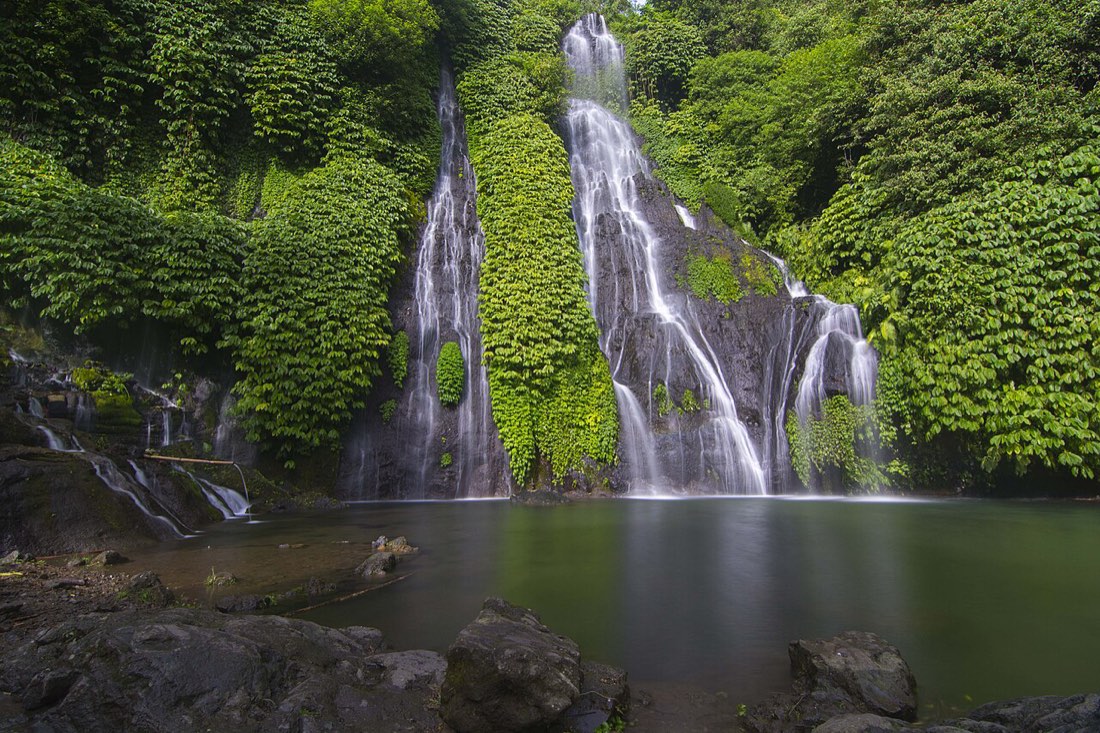 The Banyumala twin falls. Photo: Made agus devayana / Wikimedia Commons (CC BY-SA 4.0)
5. Banyu Wana Amertha (Wanagiri)
- What it is: three waterfalls in a village forest at Wanagiri, Sukasada district, managed by a community group
- Difficulty: moderate
- Time needed: 3 to 4 hours round trip
- Entry: a small conservation payment in cash at the gate
Banyu Wana Amertha is three waterfalls, each in a different spot in the village forest. By the listing's measure they lie about 1.2 kilometres from the parking area.
The Buleleng culture and tourism office's own article describes an easy trek among trees and streams, with pools to soak in below the falls. Local people hold the place as spiritually significant, so keep your visit quiet.
The path winds through forest and across small streams. Wear proper shoes, and leave the flip-flops behind.
Why go: the walk as a whole. None of the three matches Banyumala for drama, but three falls in continuous forest add up to a real morning in the highlands.
The catch: it is the longest walk of the five, and forest paths turn slippery after rain. Bring more water than you think you need.
Getting to Munduk: About an Hour from Lovina
From Lovina or Singaraja
Munduk Waterfall is about 34 kilometres from Singaraja, by the Buleleng culture and tourism office's figures. The drive takes about an hour on a road that climbs the whole way, and Lovina sits just west of the town.
The road rises from the coast through Banjar village, where the hot springs make a good stop on the way back. The air cools and the vegetation changes as you climb. Leave early and you can be back at your villa by lunch, waterfalls done.
From the South
Munduk's own village listing gives about two hours from the airport, and an older tourism office feature two and a half. From Ubud, Seminyak or Canggu it is nearer three hours, depending heavily on traffic.
The road comes via Bedugul and Lake Bratan, a beautiful drive. Leave before dawn, or traffic pushes your arrival at the falls into mid-morning.
From the south, Munduk fits a full-day highland loop: the Jatiluwih rice terraces, the Munduk waterfalls and the Bedugul temples, then back down.
Staying in Munduk Itself
For the waterfalls, staying in Munduk is the best option. You wake in the cool air, walk to the falls before breakfast and can still reach the warm coast in the afternoon.
When to Go: First Light, and May to June or November
Time of Day
- Best: from first light through the early morning
- Fine: the rest of the morning
- Avoid: the middle of the day, when the tour groups arrive, the light goes flat and the climb back out is hard work
Morning matters more in Munduk than at waterfalls by the sea. The highland mist burns off by mid-morning, and the falls lose much of their atmosphere with it.
The cool early hours turn warm by noon, and the shaded trails become exhausting in the afternoon heat. Start early.
Time of Year
- Wet season (November to March): the most water, with the falls at full roar and the jungle at its greenest. Trails are slippery, some sections may be impassable after heavy rain, and the morning mist can hide the view.
- Dry season (April to October): clearer skies, drier trails and steadier conditions. The falls are spring-fed as well as rain-fed, so they run thinner but still impress. Flows are lowest in September and October.
- The sweet spot: May to June, or November. These transitional months bring water in the falls without the trail hazards.
What to Wear: Closed Shoes with Grip Come First
Footwear is the most important choice you make for these trails.
Closed-toe shoes with grip are a must. Hiking sandals such as Tevas or Chacos work on the easier trails. Banyu Wana Amertha and Golden Valley need proper hiking shoes or trail runners.
Leave the flip-flops, fashion sneakers and anything you cannot get wet. The trails cross streams, the rocks are slippery, and a fall here can do real harm.
Dress for a cool, damp start that turns warm and damp:
- Lightweight, quick-dry trousers or shorts
- Layers for the morning chill, which is real at that altitude before the sun is up
- Swimwear underneath if you plan to swim
- A rain jacket or poncho, optional but wise
Leave a change of clothes in the car for the drive back.
What to Pack
Essential:
- Water, 1.5 litres or more per person for the longer hikes
- Cash in small notes for entry, local guides and snacks
- A waterproof bag for phone and camera
- Sunscreen
- Basic first aid, since the trails can scrape
Useful:
- Light snacks
- A sarong for changing and for sitting on wet rocks
- A dry bag for valuables
- Insect repellent
- A headlamp if you start before sunrise
Leave heavy camera bags and anything you cannot afford to drop at your hotel.
Coffee After the Falls: Munduk's Plantations
Munduk is coffee country. The highlands grow arabica, and the plantations surround the waterfalls on every side.
Do the waterfalls first, while the trails are cool and quiet. Then stop at a plantation in the middle of the morning, on the way back to the village.
Munduk Moding Plantation is a resort with a working plantation, guided tours and a restaurant overlooking the coffee groves. Larger operations like it run paid guided tours, so ask them directly about cost.
Local smallholders are smaller farms you can see from the road, so stop and ask. Their coffee is often better than the packaged kind, and they make their money on the beans you buy.
A plantation visit takes 30 to 60 minutes. Expect a walk through the growing and drying process, a tasting of several varieties and the chance to buy beans direct. It may also include a Kopi Luwak demonstration, which raises ethical concerns you may want to weigh first.
Cloves Share the Hillsides
The second scent in the air is cloves, grown on the same steep slopes as the coffee. In harvest season, which a local account puts between May and August, they dry on tarps by the roadside. Ask the farmers about them, as they are proud of the crop.
Where to Stay in Munduk: Ridge Guesthouses to Plantation Hotels
A night in the village puts the waterfalls before breakfast, with no two-hour drive to start the day. The cool evening air comes at the end of it.
The village has guesthouses and boutique hotels, many on ridgelines with views across the coffee plantations:
- Guesthouses, at the lower end of the village range, are small properties on the ridges. Many are family-run, with simple rooms, a good breakfast and owners who know the waterfall trails personally.
- Mid-range hotels add restaurants and guided activities. Puri Lumbung Cottages in Munduk and Munduk Moding Plantation in neighbouring Gobleg offer the highland setting with comfort built in, and their rates are on their own sites.
- At the top end, luxury here is understated: private villas with views and infinity pools looking over cloud forest.
Stay in or near Munduk village for easy waterfall access, since properties toward Bedugul are farther from the main circuit.
Nights are cool at this altitude, so ask for an extra blanket, and check for hot water, which some rooms lack. For dinner, eat at your hotel or at the simple warungs in the village.
A Guide Helps at Golden Valley and Banyu Wana Amertha
Munduk and Melanting have clear paths and good signage, and Banyumala has a well-kept trail of steps.
On those three a guide is optional, unless you want company or background on the area. Hire one for these:
- Golden Valley: the trail is not obvious, and a guide saves time and wrong turns.
- Banyu Wana Amertha: the three falls are spread through the village forest, and a local knows the paths between them and which are passable after rain.
- Multi-waterfall days: a guide who knows how the trails connect can build routes Google Maps cannot suggest.
Finding a Guide
At the waterfalls, guides wait at the main parking areas. Agree the rate, the route and the time before you start, and carry cash.
Through your accommodation, hotels and guesthouses in Munduk can arrange a guide in advance. It costs slightly more, and is more reliable, usually with better English.
On a day trip from the coast, a driver for the day can bring you up for the walk to Munduk Waterfall, through clove and coffee trees. The day can go on to a coffee plantation and the Wanagiri viewpoint over the twin lakes. You hire the trail guide at the parking area.
Before you set off, ask the guide:
- Which waterfalls they know, since not every guide covers every route
- How long the whole walk will take
- Whether the fee includes the entrance fees
- Whether they can stop where you want, such as a coffee plantation or a viewpoint
A Munduk Waterfall Morning from the Coast
This plan suits anyone staying on the north coast, in Lovina or Pemuteran, with a driver.
- Before dawn: a light breakfast at your villa, or wait until you are back.
- First thing: leave with your driver and climb from the coast into the highlands.
- About an hour up: park at Banyumala in Wanagiri and start down while the trail is cool and empty.
- Half an hour later: reach the twin falls as the morning light arrives. Swim if you are ready for the cold and take your photographs in the soft light, ahead of the crowds.
- An hour in: climb back up, slower than the descent, resting when you need to.
- Then: drive west along the ridge road past the lakes to Munduk village and take the short descent to Munduk (Red Coral) Waterfall.
- Late morning: at the Munduk falls viewpoint, the crowds arrive as you finish.
- After that: a coffee stop at one of the plantations between Munduk and the main road, for a tasting, a tour if you want one and beans to take home.
- Before noon: leave for the coast.
- Around midday: back at your villa for a late breakfast or early lunch, then the pool.
Three ways to change it:
- For quiet: swap Munduk Waterfall for Golden Valley, and add 30 minutes.
- For photographs: skip the coffee stop and add Melanting.
- For a full day: all five waterfalls plus coffee. Pack lunch and expect to be tired by the end.
How to Fit It In
One waterfall is a stop, two make a morning, and the full circuit takes a day.
Base yourself with the complete Munduk guide. Add Sekumpul and Fiji Waterfall for more of the north's big falls, and see the best waterfalls in Bali for how they compare.
Practical Notes
- Entry: a small conservation payment in cash at each gate
- Cash: small notes for entry, guides, snacks and coffee
- Footwear: closed shoes with grip, hiking shoes for Golden Valley and Banyu Wana Amertha
- Timing: start at first light, before the mist lifts and the groups arrive
- Guides: at the parking areas or through your accommodation, rate agreed before you start
- Nights in Munduk: cool, so ask for an extra blanket
FAQ
How many waterfalls are there at Munduk? Five are within reach on a normal visit. Munduk Waterfall (also called Red Coral), Melanting and Golden Valley are in and around Munduk village. Banyumala Twin and Banyu Wana Amertha, which is itself three falls in one village forest, are a short drive east at Wanagiri. Most visitors do two or three in a morning.
Which Munduk waterfall is the best? Banyumala Twin for drama, Munduk Waterfall for ease, Golden Valley for solitude and Banyu Wana Amertha for a proper walk. If you have one morning and want the photograph, go to Banyumala.
How hard are the Munduk waterfall hikes? Munduk and Melanting are easy walks on maintained paths. Banyumala is a maintained but steep descent with a real climb back out. Golden Valley has a rougher, poorly marked trail, and Banyu Wana Amertha is the longest walk, through forest and across small streams. Each one is steeper on the way back than it looks on the way down.
Do you need a guide for the Munduk waterfalls? Not for Munduk, Melanting or Banyumala, where the paths are clear. A guide helps at Golden Valley, where the trail is not obvious, and for linking the three falls at Banyu Wana Amertha.
What is the best time of day to visit? As early as you can. The highland mist burns off through the morning, the tour vans arrive in the middle of the day, and the climb back out is much harder in afternoon heat.
What should I wear for the Munduk waterfall trails? Closed shoes with grip, quick-dry clothing, a layer for the cool start and swimwear underneath if you plan to get in. Flip-flops are a common mistake here.
How far is Munduk from Lovina? Munduk Waterfall is about 34 kilometres and an hour from Singaraja by the mountain road, and Lovina sits just west of the town. From the airport, allow two to two and a half hours via Bedugul, traffic permitting, by the village listing and an older tourism office feature.
Sources
- Dinas Kebudayaan dan Pariwisata Kabupaten Buleleng, Air Terjun Munduk: Temukan Kedamaian dalam Keindahan Alam Buleleng (Munduk Waterfall, also called Red Coral for its red stones, in Munduk village; about 34 km and an hour from Singaraja), Indonesian, read September 2026
- Dinas Kebudayaan dan Pariwisata Kabupaten Buleleng, Menikmati Hening dan Sejuk Desa Munduk (a 2013 Garuda inflight magazine feature republished by the office: the Dutch retreat and first guest house, the chest-deep pool at Melanting, the clove harvest from May to August), Indonesian, read September 2026
- Dinas Kebudayaan dan Pariwisata Kabupaten Buleleng, Golden Valley Waterfall (about 15 metres, in the Munduk area of Banjar district), Indonesian, read September 2026
- Dinas Kebudayaan dan Pariwisata Kabupaten Buleleng, Air Terjun Banyuwana Amertha (three falls reached by an easy forest trek, pools to soak in, a place of spiritual value to local people), Indonesian, read September 2026
- Buleleng Regency, Visit North Bali, Melanting Waterfall (in Munduk village, with its own local managers), English, read September 2026
- Buleleng Regency, Visit North Bali, Banyumala Waterfall (in Wanagiri village, Sukasada district, run by the village tourism group), English, read September 2026
- Buleleng Regency, Visit North Bali, Banyuwana Amertha Waterfall (three falls in a community-managed village forest at Wanagiri, about 1.2 km from the parking area), English, read September 2026
- Buleleng Regency, Visit North Bali, Munduk Tourism Village (about 54 km and two hours from the airport), English, read September 2026
- detikBali, Menjelajahi Air Terjun Tanah Barak di Desa Munduk (the Tanah Barak name and the ten-minute descent from the parking area), Indonesian, read September 2026
- Puri Lumbung Cottages, own site, and Munduk Moding Plantation, own site (their own descriptions; Munduk Moding's location in Gobleg and its coffee plantation tours), read September 2026
- Tatkala, Tiga Air Terjun yang Eksotik, Pemikat Wisata di Desa Munduk-Buleleng, September 2025 (Melanting a 20-minute walk from Tanah Barak, and no swimming there), Indonesian, read October 2026
- Photographs credited in full at each caption: Jean-Marie Hullot, Stefan Fussan and Made agus devayana, Wikimedia Commons
Read next: the Munduk area guide, coffee plantations at Munduk, and the north Bali waterfalls guide.