On this page
- In Brief
- Munduk at a Glance
- Munduk Is a Small Ridge Village among Spice Gardens
- Three Waterfalls: Two in the Village, One a Short Drive East
- Coffee and Clove Gardens, Walked with the Families Who Farm Them
- The Twin Lakes and Wanagiri: Go Early, before the Coaches
- Day Trips from Munduk
- Where to Stay: Lodges, Guesthouses and Villas along the Ridge
- When to Go: April to October Is Dry, June to September Clearest
- How to Get There: About an Hour from Lovina, by the Bedugul Road from the South
- How to Fit Munduk into a Trip
- Practical Notes
- FAQ
- Sources
In Brief
Munduk Bali is a highland village in Banjar district, in the central mountains of north Bali. It sits high enough to carry the nickname the village above the clouds. Waterfall trails, coffee and clove plantations and the twin lakes of Tamblingan and Buyan are all within easy reach.
Two nights covers the waterfalls, a plantation walk and an early morning over the lakes, before the day-trip vans arrive. Come to slow down in cool mountain air, and bring a layer for the evenings.
Munduk at a Glance
- Where it is: the central mountains of north Bali, in Banjar district, Buleleng
- Known for: waterfall trails, coffee and clove plantations, the twin lakes (Tamblingan and Buyan) and the Wanagiri viewpoints
- Vibe: a cool, slow, walkable highland village
- The waterfalls: Munduk Waterfall (also called Red Coral) and Melanting, both in the village. Banyumala Twin Waterfall is a short drive east at Wanagiri
- How long: two nights is ideal, with one day for the waterfalls and one for the lakes and plantations
- Climate: cool all year, with fresh mornings and evenings, so pack a layer
- Best time: the dry season, April to October, clearest from June to September
- Getting there: about an hour from Lovina, and about two and a half hours from the airport via Bedugul
Munduk Is a Small Ridge Village among Spice Gardens
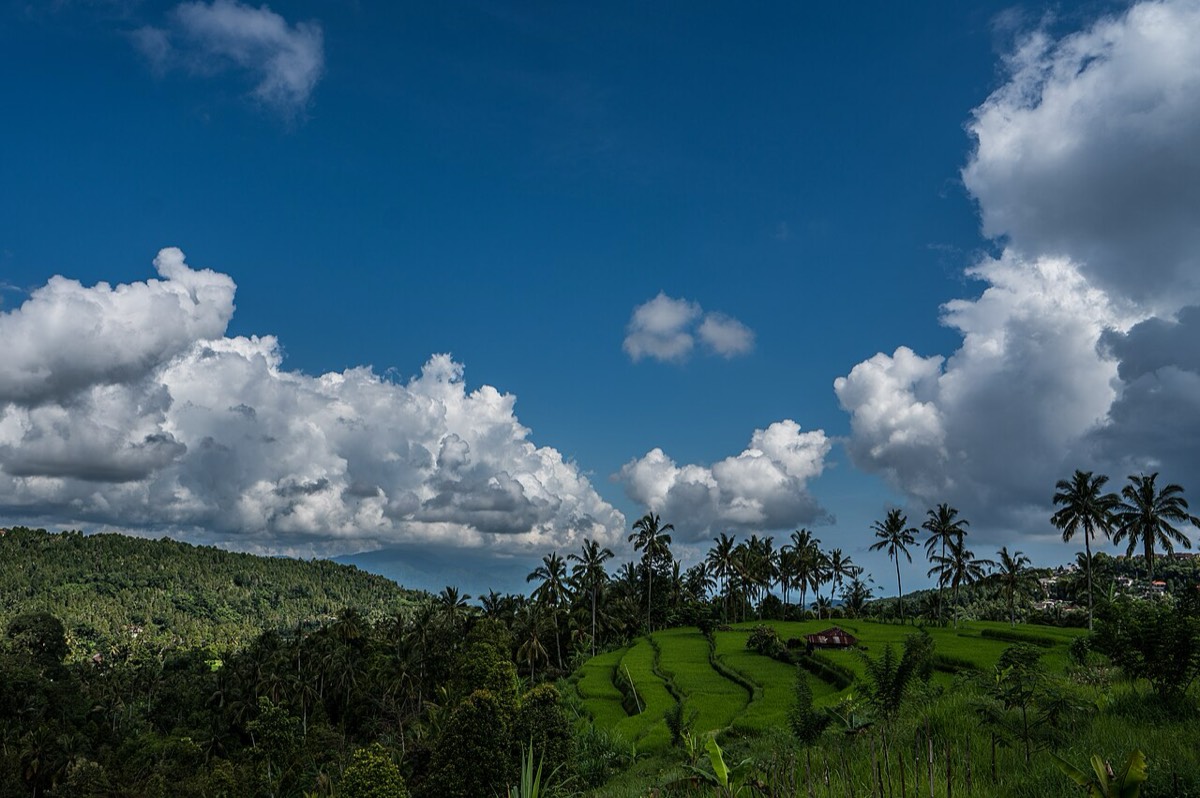
Munduk is a small village in the mountains of north Bali, high on a ridge that faces the sea.
The air is cooler than on the coast, and the roads narrow between hedges of tree fern and wild ginger. The hills around the village are planted with clove and coffee, vanilla and cocoa.
The village itself is a string of small family compounds along one road, with a handful of guesthouses and a few warungs. The draw is the country outside it. A cluster of waterfalls is within walking distance, and agrotourism trails run through the plantation gardens. Two volcanic crater lakes, Tamblingan and Buyan, sit just below the ridge to the west.
Those lakes, with the viewpoints above them at Wanagiri, are some of the most photographed scenery in Bali. Most day-trippers from the coast stop at the viewpoints and turn back. If you stay in Munduk, you have the lakes in the morning before the tour vans arrive.
Cool air, easy walking and highland scenery make Munduk a place to slow down.
Three Waterfalls: Two in the Village, One a Short Drive East
Two falls sit inside the village itself, and a third is a short drive east.
Most of the island's well-known falls each need their own drive. Here you can string the two village falls into a single morning, and Munduk waterfalls and hiking has more on the trails.
Munduk Waterfall, Also Called Red Coral
Munduk Waterfall is in Munduk village itself. It is also called Red Coral Waterfall, for the red stones around it. Locally it goes by Tanah Barak as well, for the red soil around the car park.
The walk in passes clove and coffee gardens. The Buleleng culture and tourism office lists swimming in the natural pool and hiking around the fall among the things to do there, with small restaurants close by.
detikBali describes a descent of about ten minutes from the parking area, on a sloping path and steps. It ends at a clear stream and a pool that is not large.
Melanting Waterfall
Melanting Waterfall is also in Munduk village, run by its own local managers.
A magazine feature republished by the Buleleng culture and tourism office describes the way in. You follow signposts off the village road, then walk 20 to 30 minutes on a footpath beside a stream and through clove gardens. In places the rock is slippery and mossy, above a steep slope.
The path passes working plantation on both sides. That is part of the reason to walk it with a guide on an agrotourism walk, and not hire a driver and go in alone.
Banyumala Twin Waterfall, at Wanagiri
Banyumala Twin Waterfall is not in Munduk. It is at Wanagiri, in the hills above Lake Buyan, where two streams fall side by side down a creeper-covered cliff. The pool below is one you can swim in.
Add it if you have wheels and a spare half-morning. The Banyumala Twin Waterfall guide covers the walk down, the swim and the climb back out.
For the falls beyond Munduk, the north Bali waterfalls guide covers the whole region. Sekumpul, one of the most spectacular falls in Bali, is around an hour from Munduk. It is its own half-day, and best visited from Lovina.
Coffee and Clove Gardens, Walked with the Families Who Farm Them
The hillsides around Munduk have been planted with spice and cash crops for generations.
Coffee is the most visible, in small-holder plots across the slopes. Clove and vanilla, cocoa and fruit trees grow in between. Local families run agrotourism trails through their own land.
A plantation walk shows the growing and processing stages. You see the coffee cherries on the tree and the drying racks, and there is a tasting at the end.
A magazine feature republished by the Buleleng culture and tourism office put the village's clove, coffee and cocoa gardens at around a thousand hectares. That is about the same as its forest, so there is plenty of working ground to walk through.
The best walks are arranged directly with families in the village, not through resort desks, and what you pay is settled with them. An hour is usually enough. A guide who works slowly through the spice gardens can stretch a morning walk to two hours without it feeling forced.
More on the farms is in coffee plantations at Munduk.
The Twin Lakes and Wanagiri: Go Early, before the Coaches
Danau Tamblingan and Danau Buyan are two volcanic crater lakes below the Munduk ridge, separated by a narrow neck of land.
Tamblingan is the smaller and higher of the two, and the quieter and more scenic. Less road access has kept it relatively undeveloped, and the forest at its edge is natural rainforest, not managed land. Buyan is larger and sits on the main road between Munduk and Bedugul.
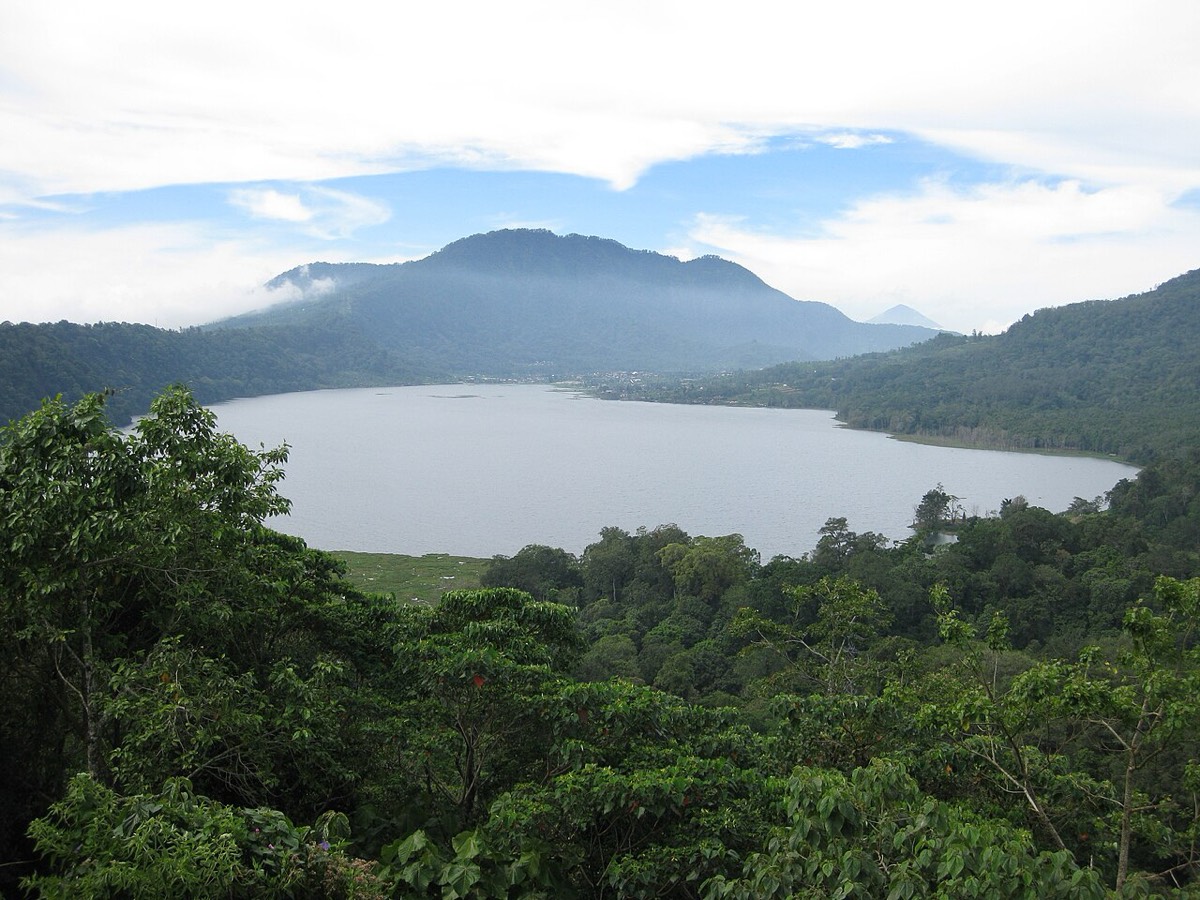 Lake Tamblingan from the Munduk ridge. Photo: Dave / Wikimedia Commons (CC BY 2.0)
The Wanagiri viewpoint is on the road above the lakes. Tour groups stop there for the famous photograph, looking down over both lakes through the tree canopy.
Go early, before seven in the morning if you can manage it. At that hour the cloud sits in the valley below the ridge, with the lakes hidden beneath it. The light is quite different by ten, when the coach parties arrive, and by mid-morning on most days haze and crowds thin the experience.
From Munduk, the lakes are a short drive. For the unhurried version of the visit, walk down to the Tamblingan shore and go out on a jukung, the traditional wooden boat. The guide to the twin lakes Buyan and Tamblingan has more.
Day Trips from Munduk
The country around the village fills two full days without leaving the highlands. Beyond it, these are within easy reach:
- Lovina: the north coast base, about an hour down. A day at the dolphin beach and Banjar Hot Springs makes sense if you are staying in the highlands and want a half-day of warmth and flat water.
- Banjar Hot Springs: natural sulphur pools in a jungle garden, on the road between Munduk and the coast. Easy to include on any drive between the two.
- Sekumpul Waterfall: one of the most spectacular waterfalls in Bali, around an hour from Munduk. Better as a dedicated half-day than a quick stop.
- Bedugul and Danau Beratan: the larger lake complex to the south, with the photographed water temple. You pass it on the drive from the south, so it needs no detour from Munduk.
The north Bali waterfalls guide maps the inland trail network across the whole region.
Where to Stay: Lodges, Guesthouses and Villas along the Ridge
Places to stay in Munduk are highland lodges, small family guesthouses and a handful of private villas, spread along the ridge road.
They run from simple rooms to well-designed boutique properties with large windows and valley views. For a private house in the hills, Palm Living's hillside villas cover the slopes between the coast and the ridge.
The best-placed properties sit outside the village centre, on the ridge, with views over the valley toward the coast.
Book two nights, not one. With a single night you arrive in the afternoon and leave after the waterfalls the next morning. That skips the plantation and the early-morning lake visit, the parts that tend to become the memory.
Pack a layer or two in any season. Evenings and early mornings on the ridge are cool, though not cold. A light jacket or long sleeves is useful, and a warm shower becomes something you want.
When to Go: April to October Is Dry, June to September Clearest
The dry season runs from April to October, with the clearest skies and the best light over the lakes.
June to September is the reliable window. Morning cloud then tends to lift by mid-morning and does not hang all day. The highland light in these months is exceptional, most of all at sunrise.
The wet season runs from October to April, with October and April as changeover months (Bali provincial government). It brings more dramatic cloud. The valley below Wanagiri can look extraordinary when cloud fills it at dawn.
Trails become slippery in these months, above all the steps down to the falls, and afternoon visits to the falls often meet heavy rain. The waterfalls are full and loud in the wet season, which some people prefer.
Munduk stays cooler than the coast all year, so bring layers whenever you go.
How to Get There: About an Hour from Lovina, by the Bedugul Road from the South
Munduk is roughly an hour from Lovina on the coast.
By the Buleleng tourism office's reckoning, it is about an hour and 34 kilometres from Singaraja. From the south, most people come by the Bedugul road, which passes Danau Beratan before climbing to the ridge. Allow two to two and a half hours from the airport on a clear run, by the village listing and an older tourism office feature.
A private driver is the practical option. The mountain roads are single-lane in places, and the route from Lovina climbs steeply through a series of bends where you cannot count on overtaking.
Confident riders can hire a motorbike, though the road surface and the gradient make it a different ride from the flat coast roads. Public minibuses, called bemo, connect the major towns. They stop far short of a highland guesthouse, which is awkward with luggage.
From Lovina, the standard day trip is a private driver for the day, with Munduk in the morning, the lakes at midday and the coast again by afternoon. It works well.
How to Fit Munduk into a Trip
Munduk works in two ways.
As a night or two between south Bali and the north coast, it breaks the mountain drive. Stopping here, and not pushing straight through to Lovina, turns a long travel day into a highlight of the trip.
As a destination of its own within a north Bali trip, two nights is enough. That gives one day for the waterfalls, one for the lakes and plantations, and both mornings for the cloud over the ridge.
The classic loop runs from south Bali to Munduk for two nights, then to Lovina for three, then to the airport or back south. It covers the highlands and the coast without doubling back on any road.
With only a day for the hills from a base on the coast, hire a driver for the day. The morning fits Munduk Waterfall and a coffee plantation, and the Wanagiri viewpoint over the lakes follows.
See the complete north Bali guide for how Munduk connects to the wider region.
Practical Notes
The details below change. Confirm locally before visiting.
- Waterfall entry: each fall is run by its own local managers and charges its own entry at the site. Bring cash.
- Plantation tour cost: set per person by the family running the plantation and paid in cash. It is modest, and worth every rupiah for an hour with someone who grew up in the trees.
- Boats on Tamblingan: the traditional jukung go out from the shore. Ask there.
- Stays: simple family guesthouses at the bottom of the range and boutique ridge properties at the top. Rates sit on each property's own page.
- Driver from Lovina: hired by the day for a Munduk trip, with the rate agreed before you set off.
- Getting around locally: you can walk between the village and its two falls, Munduk (Red Coral) and Melanting. Banyumala at Wanagiri and the lakes need wheels.
- Connectivity: mobile data works in the village and is patchy on the trail descents.
- What to pack: a light jacket or fleece for evenings, and walking shoes or trail footwear for the waterfall paths. Good grip matters on wet stone.
FAQ
Is Munduk worth visiting? Yes, above all if you want something beyond the beach and the standard temple circuit. Cool air, walkable waterfall trails and the crater lakes nearby make it one of the most rewarding inland stops in north Bali.
How many days do you need in Munduk? Two nights is the working number. One day covers the main waterfall trails, and the second covers the plantation walk and the lakes. A single night gets you the falls and not much else.
How do you get to Munduk from Lovina? It is about an hour by road through the mountains. A private driver is the practical choice, since the roads are narrow and hilly. Arrange the driver the evening before if you are doing it as a day trip.
Is Munduk cold? It is cool, not cold. High on the ridge, evenings and early mornings are fresh, and more so outside the dry season. A light jacket is enough for most visitors.
Can you walk between the Munduk waterfalls? Munduk Waterfall (also called Red Coral) and Melanting Waterfall are both in Munduk village and can be walked. Banyumala Twin Waterfall is a separate trip at Wanagiri, east along the ridge, and you need a vehicle to reach the village where its path starts. Allow a half-day for the two village falls at a comfortable pace.
What is the best waterfall near Munduk? Inside the village, Munduk Waterfall (Red Coral) and Melanting are the two to walk to. A short drive east, Banyumala Twin Waterfall at Wanagiri has two streams falling side by side into a pool you can swim in. Sekumpul is one of the most spectacular falls on the island, and the north Bali waterfalls guide covers them all.
Sources
- Dinas Kebudayaan dan Pariwisata Kabupaten Buleleng, Air Terjun Munduk: Temukan Kedamaian dalam Keindahan Alam Buleleng (Munduk Waterfall, also called Red Coral for the red stones around it, in Munduk village; about an hour and 34 km from Singaraja; swimming, hiking, restaurants nearby), Indonesian, read September 2026
- Dinas Kebudayaan dan Pariwisata Kabupaten Buleleng, Menikmati Hening dan Sejuk Desa Munduk (a 2013 Garuda inflight magazine feature republished by the office: clove, coffee and cocoa gardens of about 1,000 hectares, the signposted 20 to 30 minute path to Melanting), Indonesian, read September 2026
- Dinas Kebudayaan dan Pariwisata Kabupaten Buleleng, Keindahan Alam Danau Tamblingan (jukung, the traditional wooden boats on Lake Tamblingan), Indonesian, read September 2026
- Buleleng Regency, Visit North Bali, Munduk Tourism Village (Banjar district; clove, coffee, vanilla and cocoa), English, read September 2026
- Buleleng Regency, Visit North Bali, Melanting Waterfall (the fall in Munduk village and its local managers), English, read September 2026
- detikBali, Menjelajahi Air Terjun Tanah Barak di Desa Munduk (Munduk Waterfall's other names, the ten-minute descent from the parking area, the village's nickname), Indonesian, read September 2026
- Palm Living, hillside villas (stays between the coast and the hills), read September 2026
- Bali Provincial Government, Tarubali, Iklim tropis laut di Bali (dry season April to October, rainy season October to April, October and April as changeover months), Indonesian, read October 2026
- Photographs: Rice terrace in Munduk and Lake Tamblingan, Wikimedia Commons, credited in full at each caption
Read next: Munduk waterfalls and hiking, the twin lakes Buyan and Tamblingan, and coffee plantations at Munduk.