On this page
- In Brief
- Sekumpul at a Glance
- Sekumpul Is Seven Falls Set into One Jungle Canyon
- A Village Guide Is Required, and Included in the Gate Fee
- The Trek Takes 20 to 30 Minutes Down and 30 to 45 Back Up
- The Cafe on the Ridge Looks Straight Across at the Falls
- What to Wear and Bring: Shoes with Grip, a Dry Bag and Cash
- Best Time to Visit: Dry-Season Mornings
- Getting There: About an Hour from Lovina, Three from the South
- How to Fit It In: Pair Sekumpul with Aling-Aling, and Add Gitgit on the Way Back
- Practical Notes
- FAQ
- Sources
In Brief
Sekumpul waterfall is a group of up to seven falls in a jungle canyon, about an hour inland from Lovina. You can swim in the cold pool at the base of the main drop.
Reaching it means a guided trek down a steep canyon and a real climb back out, roughly 90 minutes to two hours all in. A local guide is required and included in the fee at the gate.
With time for one waterfall in the north, make it this one. Come in the morning, wear shoes with grip and bring cash.
Sekumpul at a Glance
- Where it is: Sekumpul village, Sawan district, Buleleng, about 45 minutes to an hour inland from Lovina
- What it is: a group of seven separate falls, of which two can be reached closely
- Height: the regency's own pages give the main drop as anything from about 80 to 150 metres
- Entry and guide: set by the village and paid in cash at the gate, with the local guide included. Ask the rate at the gate, and do not rely on a figure online
- Trek time: 20 to 30 minutes down, 30 to 45 minutes back up
- Time to allow on site: 90 minutes minimum, two hours is comfortable
- Difficulty: Moderate to hard (steep descent, full staircase climb out)
- Drive from Lovina: 45 to 60 minutes by car or scooter
- Drive from the south (Ubud, Seminyak, airport): around 3 hours
- Swimming: Yes, a cold clear pool at the base of the main drop
- Best time: Dry season, April to October, and mornings year round
Sekumpul Is Seven Falls Set into One Jungle Canyon
The falls are in Sekumpul village, Sawan district, in the hills of Buleleng.
The Sawan district office counts seven separate falls, set well apart, and only two of them can be approached closely. How many you see at once depends on where you stand and how high the rivers are running.
The regency's own offices give different heights for the main drop. The culture and tourism office gives roughly 80 metres and the district around 100. The communications office goes up to 150, so treat it as tall and not precisely measured.
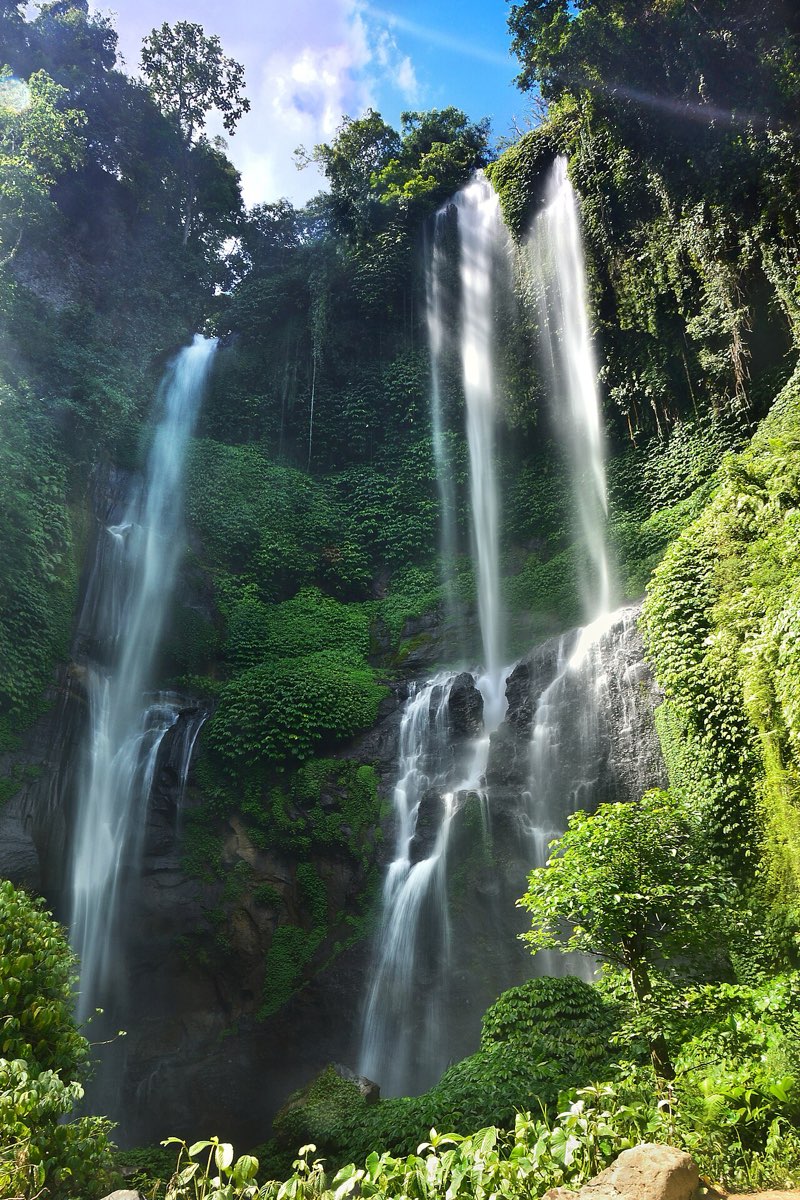
The rock wall behind the main drop is covered in fern and moss. The mist carries far, and you feel it before you see the falls themselves.
Sekumpul is often called the most beautiful waterfall in Bali. Among the north's well-known falls, Gitgit is pretty and easy to reach, and Aling-Aling has the cliff jumps and slides. Sekumpul is the one you visit for its scale.
The Canyon Is the Effort, and Most of the Experience
The falls sit at the bottom of a canyon. Reaching them takes a real descent, a river crossing or two and a climb back out.
The local system requires a guide, and has for years. The trek down is most of the experience, and the waterfall is what waits at the bottom.
Make it a morning trip. Leave Lovina early enough to be walking down before the heat and before the tour vans arrive.
A Village Guide Is Required, and Included in the Gate Fee
Entrance to Sekumpul runs through a local guide cooperative, and going with a guide is not optional.
The village manages the trail access and the parking area, and a guide is included in what you pay at the gate. The system supports the local community and keeps the trail safe.
Guides handle the route and the river crossings, and they know when the water level makes a section impassable. After heavy rain the river at the canyon floor can rise fast. A guide reads that correctly, and a solo hiker without local knowledge may not.
The guides at Sekumpul are experienced and the trail is well worn. If it rained overnight, ask yours about water levels before you descend.
You Pay in Cash at the Village Gate
Entry is charged at the village gate and includes the local guide. The cooperative sets the rate, and your driver will know the current one. Bring cash, as card payment is not available at the entrance.
"Sekumpul Without a Guide" Is Out of Date
Some older blogs describe sneaking in from the far side of the canyon. The village system has tightened since, and the back routes are neither reliable nor respectful of the local arrangement. Pay at the gate and take the guide.
The Trek Takes 20 to 30 Minutes Down and 30 to 45 Back Up
The trail runs from the parking area to the main falls. The times depend on pace, group size and how often you stop. It goes in four stages:
-
The village terraces. The descent starts as a clear path through the terraces of the village.
-
The canyon steps. The path then drops sharply into the canyon. Stone steps, some cut and some improvised, take you most of the way. The last section before the river crossing is loose and steep, and your guide moves ahead to show footing.
-
The river crossing. You wade once or several times, depending on the route your guide picks. The water is deeper in the wet season.
-
The canyon floor. Here the falls open up. The main drop fills the canyon wall ahead, and secondary falls are visible to the side. The swimming area at the base is cold and clear.
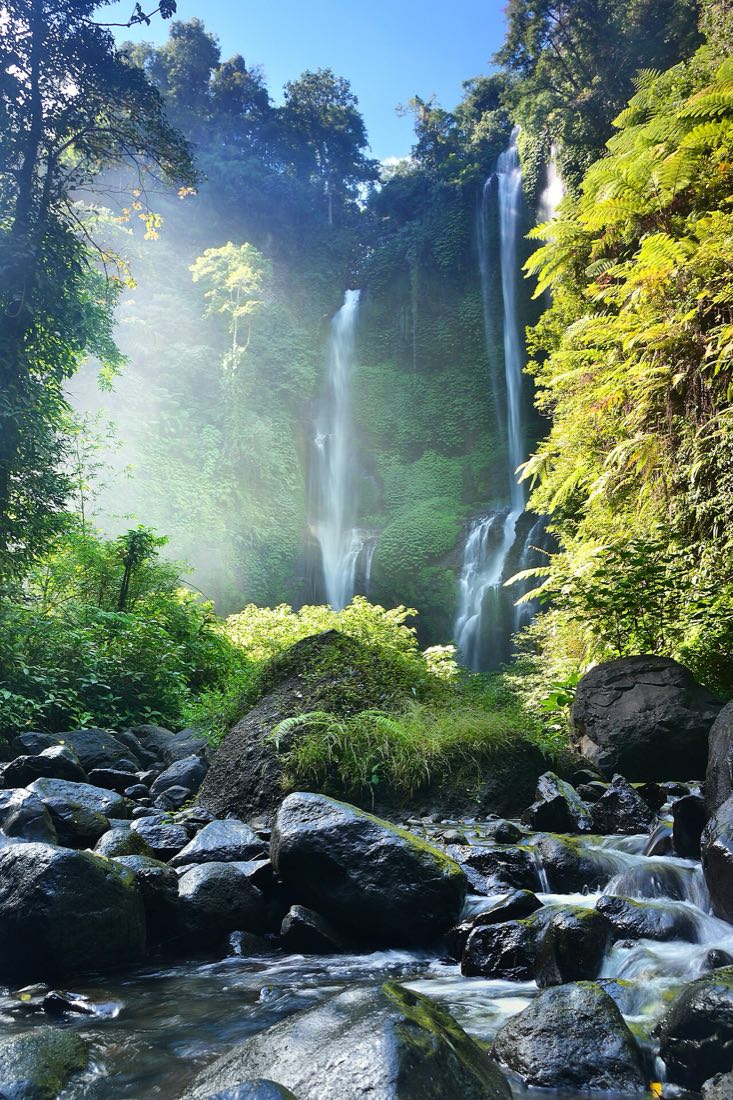 Spray and sun in the Sekumpul canyon. Photo: Putu Andika Panendra / Wikimedia Commons (CC BY-SA 4.0)
Allow at least 90 minutes in total at the site, including the trek down, time at the falls and the climb back out. Two hours is more comfortable. Groups with children, or anyone with limited mobility, should allow more.
The ascent is hard, a full staircase climb back to the parking area. Pace yourself on the way down, because you will want energy for the return.
The Cafe on the Ridge Looks Straight Across at the Falls
Before the descent, the ridge above the canyon has a cafe and a viewing deck looking straight across at the falls.
It is the postcard view, the one with the full spread of drops on the opposite wall. For some visitors it is enough on its own, without the trek down.
The cafe serves drinks and simple food, and the deck is a fair rest stop before or after the climb. Settle at the gate, before you go in, whether the deck is covered by the trek payment or charged separately.
Anyone in your group who is not up for the canyon descent can wait here, with the whole view in front of them.
What to Wear and Bring: Shoes with Grip, a Dry Bag and Cash
The descent to the falls and the climb back out are steep. Sections of the trail are muddy after rain, and you will cross at least one river, possibly knee deep depending on conditions.
Flip-flops are a poor choice and thin sandals are borderline. Closed shoes with grip, or sport sandals you can grip and get wet in, are what work.
Useful to bring:
- Sturdy shoes with grip: expect wet rock and mud
- Dry bag for phone and camera: the mist near the main falls is heavy enough to soak an unprotected camera
- Change of clothes: worth having in the car for the drive back, especially if you plan to swim
- Small towel: if you plan to swim
- Insect repellent: the canyon is shaded and humid
- Cash only: there are no ATMs near the site
Light clothing is fine for temperature. The canyon is shaded, and the mist keeps it cool near the falls even in high season.
Best Time to Visit: Dry-Season Mornings
The dry season gives the most accessible conditions. BMKG, Indonesia's meteorological agency, forecasts its start fresh each year.
In those months the trails are firmer, the water levels are predictable and the canyon is clear of debris. Many visitors come then.
The wet months change the experience. The falls run fuller, often dramatically so, and the canyon looks greener. The trade-off is the trail, because the descent becomes slippery after overnight rain and the river crossing can be deep enough to close access.
If it has rained in the past 24 hours, check with your guide or the entrance team before committing to the descent.
Morning beats afternoon at Sekumpul in any season. The trail is cooler and the light in the canyon is softer before noon. Crowds build through the morning, and heat builds on the climb back up if you leave the descent too late.
For the wider seasonal picture, see the best time to visit north Bali.
Getting There: About an Hour from Lovina, Three from the South
There is no regular public transport from the coast, so a private driver or a scooter is the practical option.
From Lovina: 45 Minutes to an Hour
Sekumpul village sits up in the hills above Lovina, in Sawan district. The mountain roads wind up to it through rice terraces and coffee plantations.
By car with a driver, the journey takes about 45 minutes to an hour, depending on stops and road conditions. Scooter riders should allow the same and be comfortable on narrow mountain roads with moderate inclines. The final stretch of road before the village parking area is the steepest part.
Sekumpul is close enough to the Lemukih falls that the two are sometimes confused. The regency puts around two kilometres between them.
A private driver from Lovina for a return trip with waiting time is the simplest way to do it, with no planning on your side.
From Ubud and the South: Fold It into the Drive North
From Ubud, Sekumpul is roughly a two and a half to three hour drive north through the central highlands. From Seminyak, Canggu or the airport, allow around three hours.
Many visitors crossing from south to north pass near Bedugul and the lakes. That puts the waterfall in range as a stop on the way to the coast, with no separate trip needed.
From a base in the south, the efficient move is to fold Sekumpul into the journey north and stay a night or two in Lovina. A long day return is the harder way to do it.
The Lovina area guide covers how to structure that crossing. The north Bali itinerary places Sekumpul within a full few days in the region.
With a Tour or a Driver: the Canyon Is the Same Either Way
A tour buys you convenience, with the transport, the timing and the entrance logistics handled.
Tours and drivers from Lovina can pair the falls with other stops on the way. Two common ones are Aling-Aling, with the falls beside it at Sambangan, and the old harbour in Singaraja.
A tour does not change the canyon itself. The descent runs through the same village cooperative and the same local guides whichever way you arrive.
To set your own pace, take a private driver for the day. It lets you leave early and keeps the day open for a second waterfall. From the south, a single long day only works with a tour or a driver taking on the three-hour crossing each way.
How to Fit It In: Pair Sekumpul with Aling-Aling, and Add Gitgit on the Way Back
The three main waterfalls of north Bali form a loose triangle inland from Lovina.
Gitgit sits closest to the coast road, and Sekumpul is the furthest up. A single day can cover two of them without rushing, or all three if you start early and move efficiently.
Sekumpul and Aling-Aling Are the Practical Pair
Both take a guide and both are canyon falls, and each has its own mood. You go to Sekumpul for the scenery and to Aling-Aling for the cliff jumping and slides. The full Aling-Aling guide covers what that trek involves.
Gitgit Is the Short Stop on the Way Down
Gitgit is easier and much shorter, a short trail with no canyon descent. It fits well as a stop on the way back down to Lovina, and does not need a dedicated half day. The Gitgit guide covers the access in full.
A Workable Day from Lovina
-
Leave straight after breakfast and drive up to Sekumpul.
-
Make the descent and the climb out while it is cool.
-
Drive across to Aling-Aling for the swimming and jumping around the middle of the day.
-
Be back on the coast with the afternoon still free.
The north Bali waterfalls guide maps all of them together, with notes on the routes between each site.
Practical Notes
Rates and conditions below can change. Confirm locally before you go.
- Entry and guide fee: paid in cash at the gate, guide included, at the rate the village sets
- Trek difficulty: Moderate to hard. The descent is steep and the return is tiring. Not suitable for anyone with knee or mobility limitations.
- Time to allow: 90 minutes minimum at the site, two hours comfortable
- Driver from Lovina: a return trip with waiting time is charged as a day rate. Agree the figure before you set off
- Leave early: first thing after breakfast, to be on the trail before the coach groups and the midday heat
- Parking: Available at the entrance, managed by the cooperative
- Mobile signal: Unreliable in the canyon. Download offline maps before you go.
- After-rain protocol: Check with the guide at the gate if it rained overnight. The river crossing can close access on safety grounds.
FAQ
How far is Sekumpul Waterfall from Lovina? About 45 minutes to an hour by car. The road climbs into the mountains and is winding in sections, so the distance on a map understates the drive time. There is no public transport, so plan on a driver or a scooter.
How do you get to Sekumpul from Ubud? Sekumpul is roughly a two and a half to three hour drive north from Ubud through the central highlands, often passing near Bedugul and the lakes. Many visitors see it on the way to Lovina, which is easier than a day return. A private driver is the most practical option, as there is no direct public transport.
How tall is Sekumpul Waterfall? Buleleng's own government pages give the main drop as anything from roughly 80 metres to 150, so the honest answer is very tall and not precisely settled. Sekumpul is a group of seven falls, two of them approachable, so the canyon shows several drops at once depending on the water level.
Do you need a guide for Sekumpul? Yes. The site is managed by a local guide cooperative, and independent access to the trail is not permitted. A guide is included in the entry fee. The arrangement supports the village community and keeps the trail safe.
How much is the entrance fee for Sekumpul? Entry and the included guide are paid in cash at the gate, at a rate set by the village cooperative. Ask your driver for the current figure on the way up. There are no ATMs near the site, so bring enough cash for entry plus your driver.
How hard is the Sekumpul hike? Moderate to hard. The descent is steep with uneven steps and can be muddy, and the climb back out is a full staircase ascent that takes most visitors 30 to 45 minutes. Closed shoes with grip are essential.
Can you swim at Sekumpul? Yes. The pool at the base of the main falls is cold, clean, and deep enough to swim in. Bring a towel and a dry bag for your phone.
Is there a cafe at Sekumpul? Yes. The ridge above the canyon has a cafe and viewing deck looking across at the falls, and it is the place to wait for anyone not making the descent. It serves drinks and simple food.
Is Sekumpul worth visiting in the rainy season? The falls are bigger and more dramatic, with the caveat that trail conditions and river crossings are harder to predict. Check conditions at the gate before descending, and go in the morning regardless of season.
How long does a visit take? Allow at least 90 minutes from the parking area, covering the trek down, time at the falls, and the climb back. Two hours is more comfortable, especially if you want to swim.
Can you combine Sekumpul with Gitgit or Aling-Aling in one day? Yes, without rushing if you start early from Lovina. Sekumpul and Aling-Aling pair well, with Gitgit added as a short stop on the way back to the coast. The north Bali waterfalls guide covers the routes between all three.
Is a Sekumpul waterfall tour worth it? A tour handles the transport, the timing and the gate, which matters most from the south, where the drive is three hours each way. From Lovina, a tour booked through where you stay and a private driver both work, and the driver lets you set your own pace. The on-site experience is the same either way, because every visitor descends with the same village-cooperative guides.
Sources
- Buleleng culture and tourism office, Eksplorasi Keindahan Air Terjun Sekumpul and its infographic on Sekumpul (seven falls, the main drop at about 80 metres, the steep access, a local guide advised, mornings for clearer weather and fewer visitors, and the location in Sawan district), Indonesian, read September 2026
- Sawan district office, Buleleng, Air Terjun Sekumpul (seven separate falls of which two can be approached closely, a height of about 100 metres, the location in Desa Sekumpul, and the roughly two kilometres between Sekumpul and the Lemukih falls), Indonesian, read September 2026
- Buleleng culture and tourism office, Air Terjun Sekumpul, Wisata Alam Tersembunyi di Bali (seven falls with only two close to the path, the location in Sawan district about 20 kilometres from Singaraja, and morning as the time to trek), Indonesian, read September 2026
- Buleleng communications office, Pesona Air Terjun Pemuatan, Sekumpul (Air Terjun Pemuatan on the Lemukih and Sekumpul village boundary, its estimated height of up to 150 metres, and the steep stairway down), Indonesian, read September 2026
- BMKG, Indonesian Agency for Meteorology, Climatology and Geophysics, seasonal prediction (the yearly dry-season forecast), Indonesian, read September 2026
Read next: Fiji Waterfall for the triple fall in the next valley, Aling-Aling for the jumps and slides that pair with this trek, and the north Bali waterfalls guide for every fall in the region with honest effort levels.