On this page
- In Brief
- BPJS at a Glance
- BPJS Is Two Agencies With Separate Jobs
- Work Here for Six Months and You Must Join
- How to Join and Use BPJS Kesehatan, in Five Steps
- What BPJS Kesehatan Does Not Pay For
- BPJS Ketenagakerjaan Covers You at Work
- Keep Private Insurance for What BPJS Leaves Out
- BPJS Membership Was Added to the Driving Licence Documents
- Practical Notes
- FAQ
- Sources
In Brief
BPJS for foreigners is compulsory once you work in Indonesia. Law 24 of 2011 says every person, including a foreigner who has worked in Indonesia for at least six months, must be a participant. The same law puts the duty to register workers on the employer.
BPJS stands for Badan Penyelenggara Jaminan Sosial, the Social Security Administering Bodies, and there are two:
- BPJS Kesehatan runs the national health insurance, JKN. It covers you when you fall ill.
- BPJS Ketenagakerjaan runs the work programmes: work accident, death, old-age savings and pension. It covers you when you are hurt on the job.
BPJS Kesehatan treats you through a clinic or community health centre you choose, which refers you on to hospitals. In an emergency, any hospital must take you. It does not pay for treatment abroad or evacuation, so private international cover is still worth keeping.
BPJS at a Glance
- What it is: Indonesia's state social security system, set up under Law 24 of 2011
- BPJS Kesehatan: national health insurance (JKN, Jaminan Kesehatan Nasional)
- BPJS Ketenagakerjaan: work accident (JKK), death (JKM), old-age savings (JHT) and pension (JP)
- Who must join: everyone, including foreigners who have worked in Indonesia for six months or more
- Who registers you: your employer, if you are employed
- Family: a worker's spouse and up to three children join on the worker's health membership
- Not covered: treatment abroad, evacuation, non-partner hospitals outside an emergency
- North Bali office: BPJS Kesehatan, Singaraja branch (Map)
BPJS Is Two Agencies With Separate Jobs
Law 24 of 2011, the BPJS law, created both bodies. Articles 5 and 6 split the work between them:
- BPJS Kesehatan runs the health insurance programme.
- BPJS Ketenagakerjaan runs four programmes: work accident insurance, old-age savings, pension and death benefit.
A fifth work programme, job-loss insurance (JKP), was added later. Its regulation, Government Regulation 37 of 2021, limits it to Indonesian citizens. A foreign worker is not a JKP participant.
Work Here for Six Months and You Must Join
Article 14 of the BPJS law is short.
Every person, including a foreigner who works in Indonesia for at least six months, must be a participant in the social security programme.
The same six-month test appears in the definition of a participant in both the BPJS law and the health insurance regulation, Presidential Regulation 82 of 2018.
The obligation lands mainly on employers. Article 15 requires them to register themselves and their workers, with complete and correct data on the workers and their families. Article 17 sets the sanctions for an employer who does not: a written warning, a fine, and loss of certain public services.
Three cases, and what to do in each
For foreigners in Bali, the rule leads to one of three cases.
-
You are employed here on a work permit. Your employer should register you with both agencies. Ask for your membership numbers.
-
You run your own Indonesian company. You are the employer, and the registration duty is yours.
-
You do not work here. This is the case on a retirement, second-home or visitor permit. The six-month rule in the law is framed around work, so ask BPJS Kesehatan directly whether you can join. Check what health insurance your own permit requires as well. The Bali visa guide covers the permits.
How to Join and Use BPJS Kesehatan, in Five Steps
The health cover runs in order: registration first, then your clinic, then the hospital.
1. Get registered, with three documents
For an employee, the employer registers you. A foreign employee joins as a wage-earning worker (in BPJS terms, PPU). The contribution is split between employer and worker, and the employer pays the larger share.
BPJS Kesehatan also runs an administrative service over WhatsApp called PANDAWA. Its homepage lists new registration of foreign nationals among the services it handles.
In person, the Singaraja branch serves Buleleng and Jembrana (Map). It offers PANDAWA for members in both regencies, NusaBali reported. Bring your passport, stay permit (KITAS or KITAP) and work permit.
Contribution rates are set by presidential regulation and revised from time to time. Check the current rates on the BPJS Kesehatan website or with your employer.
2. Know who joins on your membership
Under Article 5 of Presidential Regulation 82 of 2018, a worker's membership covers a legal spouse and children, up to four people in all. Stepchildren and legally adopted children are included.
Children stay on until 21, or 25 if still in formal education, as long as they are unmarried and have no income of their own. A fourth child onward, parents and parents-in-law can also be added (Article 5).
3. Choose your first-level clinic with care
When you register, you choose a first-level health facility. It can be a puskesmas (community health centre), a clinic or a family doctor that works with BPJS.
That facility is your first stop for everything that is not an emergency. It treats what it can and refers you to a hospital for the rest, so it is your gateway to hospital referrals. You can change your first-level facility after three months (Article 7).
Around Lovina, the nearest government community health centre is Puskesmas Buleleng 2 at Tukadmungga. The hospitals are in Singaraja, and healthcare in north Bali lists them.
Members manage their account, change their clinic and check their history in the Mobile JKN app.
4. In an emergency, go straight to any hospital
Article 63 lets a member in a genuine emergency go straight to any hospital, whether or not it works with BPJS. The treating doctor decides, and the regulation defines an emergency as one of these:
- a threat to life
- a problem with airway, breathing or circulation
- loss of consciousness
- a need for immediate treatment
Article 68 bars any hospital, partner or not, from charging a member for emergency care. Once you are stable, a non-partner hospital must transfer you to one that works with BPJS.
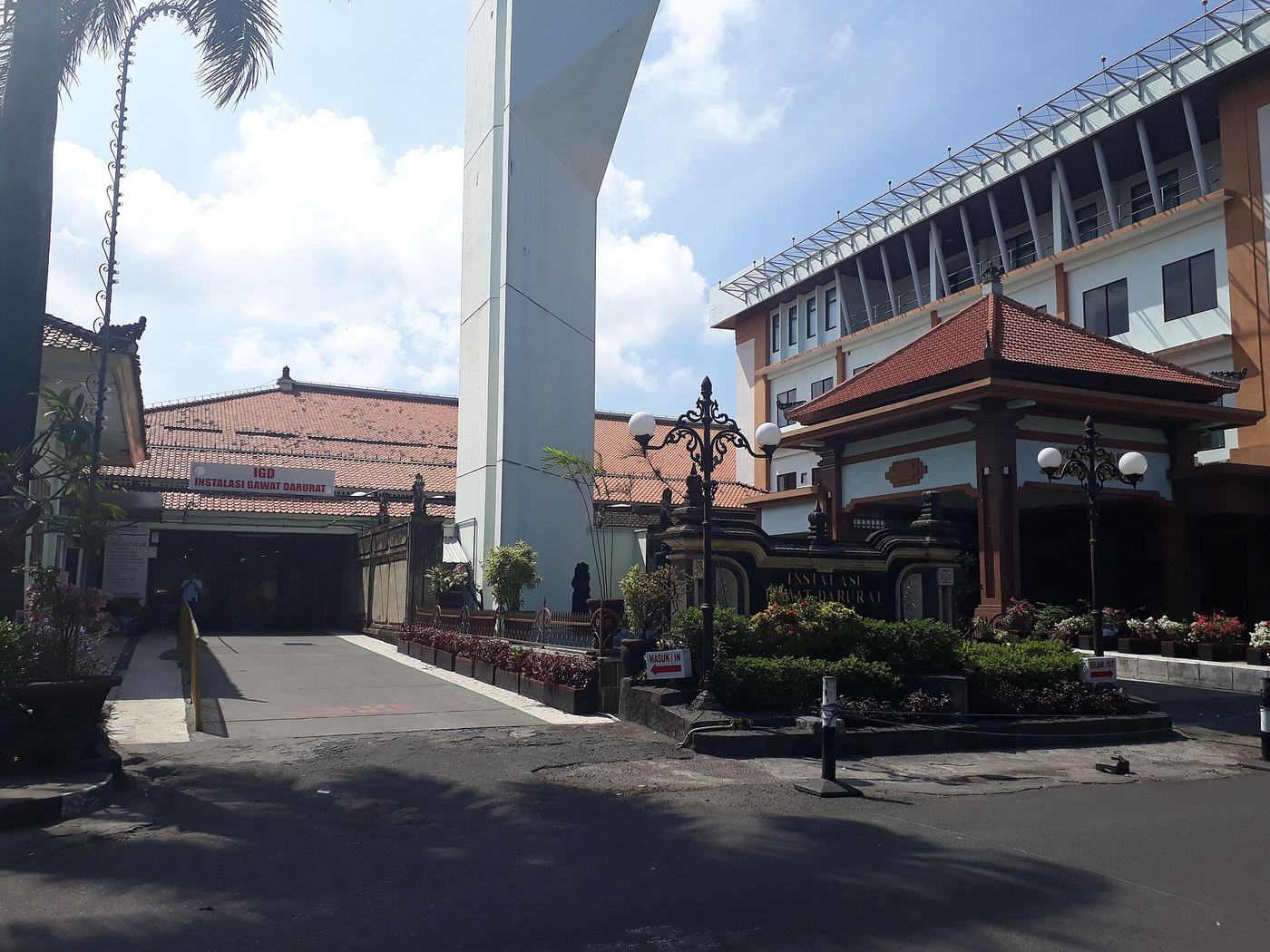 The emergency entrance at Sanglah, now RSUP Prof. Ngoerah, Bali's referral hospital in Denpasar. Photo: Davidelit / Wikimedia Commons (CC BY-SA 4.0)
5. Ask the hospital which ward you get
Inpatient care is moving to a single standard ward, the Kelas Rawat Inap Standar (KRIS), under Presidential Regulation 59 of 2024. The regulation sets minimum criteria such as a partition between beds, an oxygen outlet and a bathroom in the ward. Ask the hospital which ward your membership gives you.
Article 51 of the 2018 regulation lets a member upgrade to a higher level of care, such as a better room or an executive outpatient clinic. You pay the difference yourself or through supplementary health insurance.
What BPJS Kesehatan Does Not Pay For
Article 52 lists what the health scheme does not cover. These points matter most to a foreigner:
- treatment abroad, and so any evacuation home
- care at facilities that do not work with BPJS, except in an emergency
- injuries from a work accident already covered by the work accident programme
- road-accident care up to the amount paid by the compulsory traffic-accident scheme
- cosmetic treatment, orthodontics and fertility treatment
- harm from dangerous hobbies
BPJS Ketenagakerjaan Covers You at Work
The employment agency covers what happens at and around work. A foreign worker takes part in four of its programmes, as detikFinance set out with reference to the BPJS law:
- Work accident insurance (JKK): treatment and compensation for injury at work.
- Death benefit (JKM): a payment to the family if a member dies.
- Old-age savings (JHT): a savings account built from employer and worker contributions.
- Pension (JP): a monthly pension later in life.
The employer registers the company first, then its workers. For a foreign worker, the documents include a copy of the passport.
Take your old-age savings when you leave for good
The old-age savings are yours to take when you leave Indonesia for good. Minister of Manpower Regulation 4 of 2022 (Articles 12 and 13) pays the JHT balance to a foreign member who leaves Indonesia permanently. You can claim either before or after departure.
The claim goes to BPJS Ketenagakerjaan with three papers:
- your membership card
- your passport
- a signed statement that you will no longer work in Indonesia
Keep Private Insurance for What BPJS Leaves Out
BPJS covers care inside Indonesia, at partner facilities, through the referral system. It is compulsory if you work here. For a foreigner, the two kinds of cover do different jobs:
- BPJS through your job: care in Indonesia.
- An international health policy: private hospitals of your choice, treatment abroad and medical evacuation.
The UK government's health advice for Indonesia, quoted in healthcare in north Bali, is blunt that evacuation can cost tens of thousands of pounds.
If you are weighing up a move, moving to north Bali and the cost of living in north Bali cover the rest of the budget. Palm Living lists villas for longer stays, most of them around Lovina.
BPJS Membership Was Added to the Driving Licence Documents
A 2023 amendment to the police licence regulation added active BPJS Kesehatan membership to the documents for a new or renewed Indonesian driving licence. The change was trialled in Bali among other provinces. Driving licence in Bali explains the licence and what to bring.
Practical Notes
- Employed here? Ask your employer for both membership numbers in your first month.
- Choose your clinic carefully at registration. It is your gateway to hospital referrals.
- In an emergency, go to the nearest hospital and show your card. The regulation bars it from charging you for emergency care.
- Keep private cover for evacuation and treatment outside Indonesia.
- Before you leave for good, claim your JHT old-age savings with your card, passport and statement.
- Check contribution rates on the official BPJS sites.
FAQ
Is BPJS mandatory for foreigners? For foreigners who work in Indonesia, yes. Article 14 of Law 24 of 2011 says every person, including a foreigner who has worked in Indonesia for at least six months, must be a participant. The employer must register its workers.
Can a foreigner who does not work in Indonesia join BPJS Kesehatan? The law's obligation is framed around work. The regulations define a participant as a person, including a foreigner who has worked here at least six months, who has paid contributions. If you are retired or here on a non-working permit, ask BPJS Kesehatan directly whether you can register. You can reach it through its PANDAWA service or the Singaraja branch.
What does BPJS Kesehatan cover? Care at partner clinics and hospitals in Indonesia, reached through a first-level clinic that refers you on, and emergency care at any hospital. It does not cover treatment abroad, evacuation, cosmetic treatment, or care at non-partner facilities outside an emergency.
Is BPJS enough, or do I need private health insurance? BPJS works inside Indonesia only, at partner facilities. For private hospitals of your choice, treatment abroad and medical evacuation, you need international insurance as well.
What is the difference between BPJS Kesehatan and BPJS Ketenagakerjaan? BPJS Kesehatan is health insurance. BPJS Ketenagakerjaan covers work accidents, death benefit, old-age savings and pension. A foreign employee should be registered with both.
Can foreigners withdraw their BPJS Ketenagakerjaan savings? Yes. Minister of Manpower Regulation 4 of 2022 pays the old-age savings (JHT) to a foreign member who leaves Indonesia permanently. You claim with the membership card, passport and a statement that you will not work in Indonesia again.
Sources
- BPJS Ketenagakerjaan, Law 24 of 2011 on the Social Security Administering Bodies, Articles 1, 5, 6 and 14 to 17, read September 2026 (in Indonesian)
- JDIH BPK, Presidential Regulation 82 of 2018 on health insurance, Articles 1, 4 to 7, 30, 51, 52, 63 and 68, read September 2026 (in Indonesian)
- Presidential Regulation 59 of 2024, third amendment to the health insurance regulation, on standard inpatient wards (KRIS), read September 2026 (in Indonesian)
- JDIH BPK, Government Regulation 37 of 2021 on job-loss insurance, participant requirements, read September 2026 (in Indonesian)
- Ministry of Manpower, Minister of Manpower Regulation 4 of 2022 on JHT payments, Articles 5, 12 and 13, read September 2026 (in Indonesian)
- BPJS Kesehatan, official website, for the PANDAWA service and new registration of foreign nationals, read September 2026 (in Indonesian)
- NusaBali, BPJS Kesehatan opens the Pandawa service, on the Singaraja branch, its area and the WhatsApp administrative service, 26 September 2020, read September 2026 (in Indonesian)
- detikFinance, Can foreign workers join BPJS Ketenagakerjaan?, 19 June 2024, read September 2026 (in Indonesian)
Read next: healthcare in north Bali, moving to north Bali and driving licence in Bali.