On this page
- In Brief
- Investing in North Bali at a Glance
- What a Foreigner Can Legally Hold in Bali
- Why North Bali: A Coast Still at Early Prices
- How the North Compares With the South
- What It Costs: Learn How Each Cost Is Quoted
- Rental Yields in the North: The Advertised Number Is Gross
- Five Risks Worth Taking Seriously
- How to Buy, Step by Step
- Where to Invest in the North: Three Areas
- Practical Notes
- FAQ
- Sources
In Brief
A foreigner can invest in north Bali by lease, by a right of use for a home or through a foreign-owned company. Land is a fraction of Canggu or Uluwatu prices, and the lifestyle that draws long-stay guests is still intact.
North Bali is the early-stage version of the investment story that already played out in the south. The trade-off is honest. Rental demand in the north is thinner and more seasonal than in the south, and exits take longer.
The legal ground rules are the same everywhere in Indonesia, and foreigners cannot own land outright.
If you want proven, liquid, high-occupancy yield today, the south still has it, along with rising land costs and a real oversupply problem. The case for north Bali is buying into the coast before it prices in, with eyes open about a longer hold.
Investing in North Bali at a Glance
- What a foreigner can hold: a lease (Hak Sewa), a right of use for a home (Hak Pakai), or a right-to-build title through a foreign-owned company (PT PMA)
- What a foreigner cannot hold: freehold (Hak Milik), which is for Indonesian citizens only
- How land is priced: per are, a unit of 100 square metres
- How a build is quoted: per square metre, by finish level
- Rental demand: lower and more seasonal occupancy than in the south
- Resale: a thinner market than the south, so assume a longer hold
- Where: Lovina and surrounds, Pemuteran and the northwest, Munduk and the highlands
- Who checks the deal: an independent Indonesian notary (notaris), never the seller's
This page gives you the law with its sources and the mechanics of how a purchase works. It deliberately does not quote land prices, build rates or yield percentages. Those move faster than any page can follow, and a stale figure in an investment decision is worse than no figure. Where a number matters, we point you at the live listings or at the person whose books hold it.
What a Foreigner Can Legally Hold in Bali
A foreigner can buy property in Bali, with one caveat: no freehold land title.
That caveat applies across all of Indonesia. The right route depends on whether you want a home, an income property or a business.
The ground rules are national. They are set out in Government Regulation No. 18 of 2021 on management rights, land rights, apartment units and land registration, which implements the Job Creation Law. The accompanying ministerial regulation from ATR/BPN, the agrarian affairs ministry and national land agency, carries the procedure.
There are four routes, and three of them are open to a foreigner:
- Right of use (Hak Pakai). This is the route most guides skip. A foreign national who holds the proper Indonesian immigration documents may own a home, under Articles 69 to 73 of the regulation. The home can be a house on Hak Pakai land, including Hak Pakai granted over privately owned land by a deed before a land deed official (PPAT). It can also be an apartment unit on Hak Pakai or Hak Guna Bangunan. The right is limited by a minimum price, the plot size, the number of plots or units and residential use only, with the detail set by ministerial regulation. It can pass to heirs.
- Leasehold (Hak Sewa). You lease the land and what sits on it for a fixed term, often with a pre-agreed extension. The simplest route for a personal villa or a long hold. A lease is a private contract, so the protection is only as strong as the drafting.
- Foreign-owned company (PT PMA). An Indonesian company you own can hold a right-to-build title (Hak Guna Bangunan) and legally operate rentals. This is the route for anyone running a villa as a business. Its business licensing runs through the government's OSS system, and it carries setup cost, reporting and tax obligations.
- Freehold (Hak Milik). Full ownership, available to Indonesian citizens only. Foreigners cannot hold it.
The one shortcut to avoid. "Nominee" arrangements put the freehold title in a local person's name. They are a well-known way to lose everything. Avoid them.
These structures are documented national law rather than local opinion. The specifics of any deal belong with an independent Indonesian notary (notaris), never the seller's:
- term lengths
- extension clauses
- zoning
- tax
The full breakdown of each structure is in the Bali property ownership guide for foreigners, and the lease question in leasehold vs freehold in Bali.
Why North Bali: A Coast Still at Early Prices
The north has the same volcanic coastline as the south, with a fraction of the development.
It has the dolphins at Lovina, the diving at Pemuteran and the highlands around Munduk. Land still trades at early prices.
For an owner, that means less competition for guests. A property with genuine character has more room to stand out, and the community is not yet saturated with absentee owners.
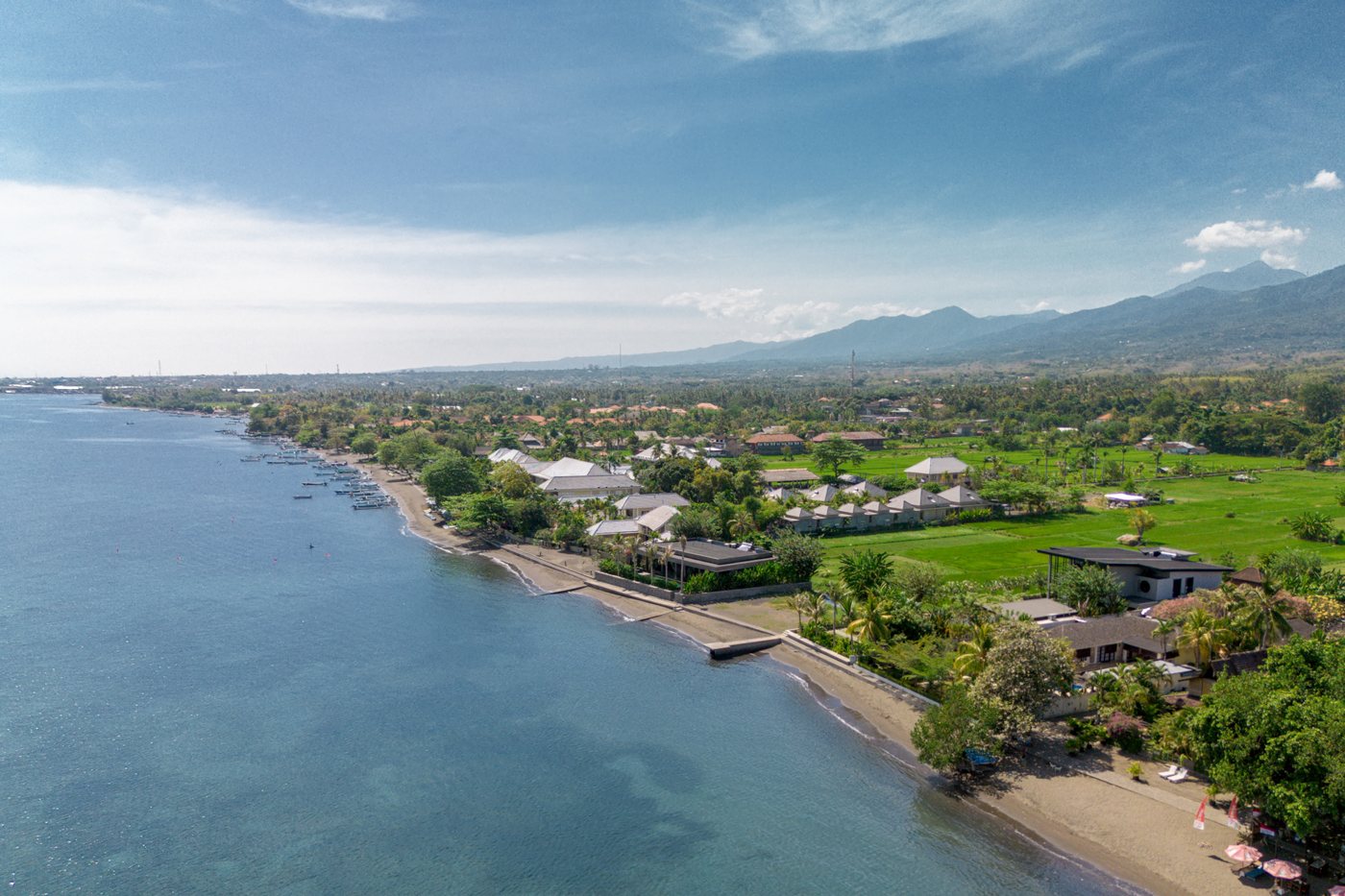 The Lovina shoreline from the air, villages and fields behind the beach. Photo: Palm Living archive.
The honest counterweight is that the north is quieter for a reason. Visitor numbers are lower, and the season is more pronounced. A villa here is a longer-term bet on the coast maturing, rather than a turnkey cash machine.
How the North Compares With the South
The south of Bali built the template, in Canggu, Seminyak and Uluwatu.
It works, and the numbers there are real. It is also where the strain now shows. The post-pandemic building boom left parts of the south oversupplied with near-identical villas. That pushes management quality and occupancy pressure onto new owners.
Land prices in the south have climbed to a point where the entry math is far less forgiving than it was five years ago. The north is the other end of that curve.
A direct north-versus-south comparison, with the real entry and yield differences, sits in the Lovina vs Canggu investment breakdown.
What It Costs: Learn How Each Cost Is Quoted
Knowing how each cost is quoted matters more than a headline figure, because it lets you compare two offers.
- Land is priced per are, a unit of 100 square metres. North-coast land trades well below south-coast rates, with beachfront and view plots taking the premium. What a plot costs depends on the zone far more than on the region. Read the live land listings beside the area-by-area picture in land prices in north Bali.
- Build is quoted per square metre. The spread between a standard and a premium finish is the single biggest lever in the whole budget. Get any quote itemised by finish level rather than accepting a rate. The detail is in build costs in Bali.
- The lease, where you are leasing, is priced by term as well as by area, so a cheap-looking lease is often a short one. Compare the annualised cost over the term, not the headline.
- The costs around the deal are the ones people forget: notary fees, transfer tax, and for a PT PMA the setup and ongoing reporting. Ask for the all-in figure before you compare anything.
Treat any headline price as the start of due diligence rather than the end.
Rental Yields in the North: The Advertised Number Is Gross
This is where marketing and reality diverge most, so read the numbers carefully.
You will be shown two numbers. An advertised yield is almost always gross, calculated on peak-season rates and an optimistic occupancy. The number you will live with is net, after six costs:
- management
- vacancy
- tax
- licensing
- maintenance
- the pool guy
The gap between the two is wide enough that a headline figure tells you nothing on its own.
Occupancy in the north is also lower and more seasonal than in the south, which shifts the whole calculation. It is the reason the entry price is lower.
So when someone quotes you a yield, ask three questions:
- Is it gross or net?
- Over what occupancy?
- From whose actual books?
A villa with a strong concept and proper management performs up here. An average villa competing on price does not. The north-coast yield picture, with real occupancy patterns, is in rental yields in north Bali.
The north rarely offers the highest yield today. It offers a lower entry, a longer runway and the upside of buying a coast before it prices in.
Five Risks Worth Taking Seriously
The careless money in Bali loses, so take each of these five seriously before you buy.
- Oversupply. Concentrated in the south, but a warning for the north too: build something generic and you compete only on price.
- Leasehold protection. A lease is a private contract under Indonesian law, with less statutory protection than buyers expect from their home countries. The drafting, the extension clause and the notary do the protecting.
- Rental licensing and zoning. Short-term letting requires the right zoning (zona) and licensing, and the rules are enforced. A plot zoned green or agricultural may never be legally rentable. Bali's provincial spatial planning information system publishes the province's spatial plan, and a specific plot's zoning is something to confirm in writing before you buy.
- Infrastructure. Water, waste, and road access are real constraints on parts of the coast, and they shape both build cost and guest experience.
- Liquidity. The north is a thinner resale market than the south. Plan the exit before the entry, and assume a longer hold.
How to Buy, Step by Step
-
Define the goal: personal use, income, or business. This decides leasehold versus PT PMA.
-
Shortlist by zone before price. Confirm the land's zoning allows what you intend to do.
-
Engage an independent notary (notaris). Yours, not the seller's.
-
Run due diligence: title and zoning check, access and utilities, encumbrances, and for a lease, the full term and extension terms in writing.
-
Structure correctly: leasehold contract or PT PMA, drafted and reviewed before any money moves.
-
Use protected payment: never transfer capital against a handshake or a nominee promise.
A villa build adds its own track on top of this. The build costs guide covers the sequence.
Where to Invest in the North: Three Areas
- Lovina and surrounds: the established base of the north coast, dolphins, black-sand beaches, the most developed visitor infrastructure of the region. Start with the Lovina area guide.
- Pemuteran and the northwest: quieter, diving-led, drawing a specific and loyal visitor. See the Pemuteran guide.
- Munduk and the highlands: cool-climate, eco and wellness-leaning, a different guest and a different build. See the Munduk guide.
The ranked, area-by-area investment view is in best areas to invest in north Bali.
Practical Notes
These figures change and are north-specific. Confirm locally before acting on any of them.
- Lease term: ask for the term and the extension clause in writing, and compare the annualised cost rather than the headline
- Land price by area: quoted per are and varying sharply by zone. Read the live listings rather than any published figure.
- Build cost: quoted per square metre, standard vs premium finish. Get the quote itemised, because the finish level is where budgets move.
- Net rental yield: ask whether a quoted yield is gross or net, over what occupancy, and from whose books
- Always: independent notary, written lease terms, zoning confirmed for your intended use.
See what is actually for sale. Palm Living, which develops this guide, lists its property for sale here on Northbound. There are three pages: land for sale in north Bali, villas for sale and hotels and restaurants for sale. Reading live listings next to this guide is the quickest way to test the numbers against the market.
None of the risks above argues against north Bali. They argue for buying carefully, with local counsel, on a realistic timeline.
FAQ
Is north Bali a good place to invest in property? It suits a specific investor: one buying land or a villa at early-stage prices, with a longer hold and realistic, north-coast yield expectations, rather than chasing the proven high-occupancy returns of the south. The entry is lower and the competition lighter. The trade-off is thinner, more seasonal demand and a less liquid resale market.
Can a foreigner buy property in Bali? Yes, but not freehold land. Foreigners use a leasehold (Hak Sewa), typically 25 to 30 years, or an Indonesian company (PT PMA) holding a right-to-build title for a rental business. Freehold (Hak Milik) is for Indonesian citizens only, and nominee arrangements are a serious risk.
How much does it cost to buy or build a villa in north Bali? Less than the south, and by how much depends on the zone rather than the region. We do not publish a figure here because they move too fast to be useful. Read the live land and villa listings, and see build costs in Bali for how construction is quoted per square metre by finish level.
Can a foreigner own a house in Bali under Hak Pakai? Yes, under conditions. Government Regulation No. 18 of 2021 allows a foreign national holding the proper Indonesian immigration documents to own a home. That means a house on Hak Pakai land or an apartment unit on Hak Pakai or Hak Guna Bangunan. It is subject to a minimum price, limits on plot size and number, and residential use only, with the detail set by ministerial regulation. Take it to an independent notary before relying on it.
What rental yield can you expect in north Bali? Ask whoever quotes you one whether it is gross or net, at what occupancy, and from whose books, because advertised yields are gross and calculated optimistically. The north runs lower and more seasonal occupancy than the south, which is the reason its entry price is lower. See rental yields in north Bali.
What is the biggest risk of buying property in Bali? For most foreign buyers, the legal structure: weak lease drafting, nominee freehold arrangements, or buying land that is not legally zoned for short-term rental. Independent legal counsel and proper due diligence remove most of it.
Sources
- Government of Indonesia, Peraturan Pemerintah No. 18 Tahun 2021 on management rights, land rights, apartment units and land registration, with the full text on the BPK legal database (the land-rights framework under the Job Creation Law, which replaced the earlier rules on foreign home ownership; Articles 69 to 73 on homes for foreign nationals, the rights they may hold, and the limits on price, plot size, number and use), Indonesian, read September 2026
- Ministry of Agrarian Affairs and Spatial Planning / National Land Agency (ATR/BPN), Permen ATR/BPN No. 18 Tahun 2021 (the procedure for establishing management rights and land rights), Indonesian, read September 2026
- Government of Indonesia, Online Single Submission (OSS) (the risk-based business licensing system a PT PMA uses), Indonesian, read September 2026
- Bali Provincial Government, Sistem Informasi Wilayah dan Tata Ruang Bali (the province's spatial planning information, including the provincial spatial plan), Indonesian, read September 2026
- Palm Living's own listings on Northbound, land for sale in north Bali, villas for sale and hotels and restaurants for sale (live listings, refreshed daily, and the current market prices this page deliberately does not fix in text), read September 2026
Read next: Bali property ownership for foreigners for the structures in detail, leasehold vs freehold in Bali for the lease question, and the best areas to invest in north Bali for where on the coast.