On this page
- In Brief
- Money in Bali at a Glance
- The Rupiah: Drop Three Zeros to Read a Price
- Cash or Card: A Card for the Formal, Cash for the Rest
- Where to Exchange Money Safely: Licensed Changers and Banks
- ATMs: Use Bank-Branch Machines and Withdraw Once
- QRIS: Useful If Your Banking App Supports It
- Tipping in Bali: Appreciated, Not Obligatory
- North Bali: Withdraw in Lovina or Singaraja First
- Practical Notes
- FAQ
- Sources
In Brief
The Bali currency is the Indonesian rupiah (IDR), and a single dinner can read in the hundreds of thousands. Cards work in malls, hotels and bigger restaurants. Cash pays for the rest, from warungs and markets to drivers, temples and waterfalls.
Change money only at authorized money changers with a posted licence, or at a bank. Count the notes yourself before you leave the counter.
Use ATMs attached to bank branches. Cash matters more inland and on the north coast, so withdraw in town before you head for the coast or the mountains.
Money in Bali at a Glance
- Currency: Indonesian rupiah, written IDR or Rp
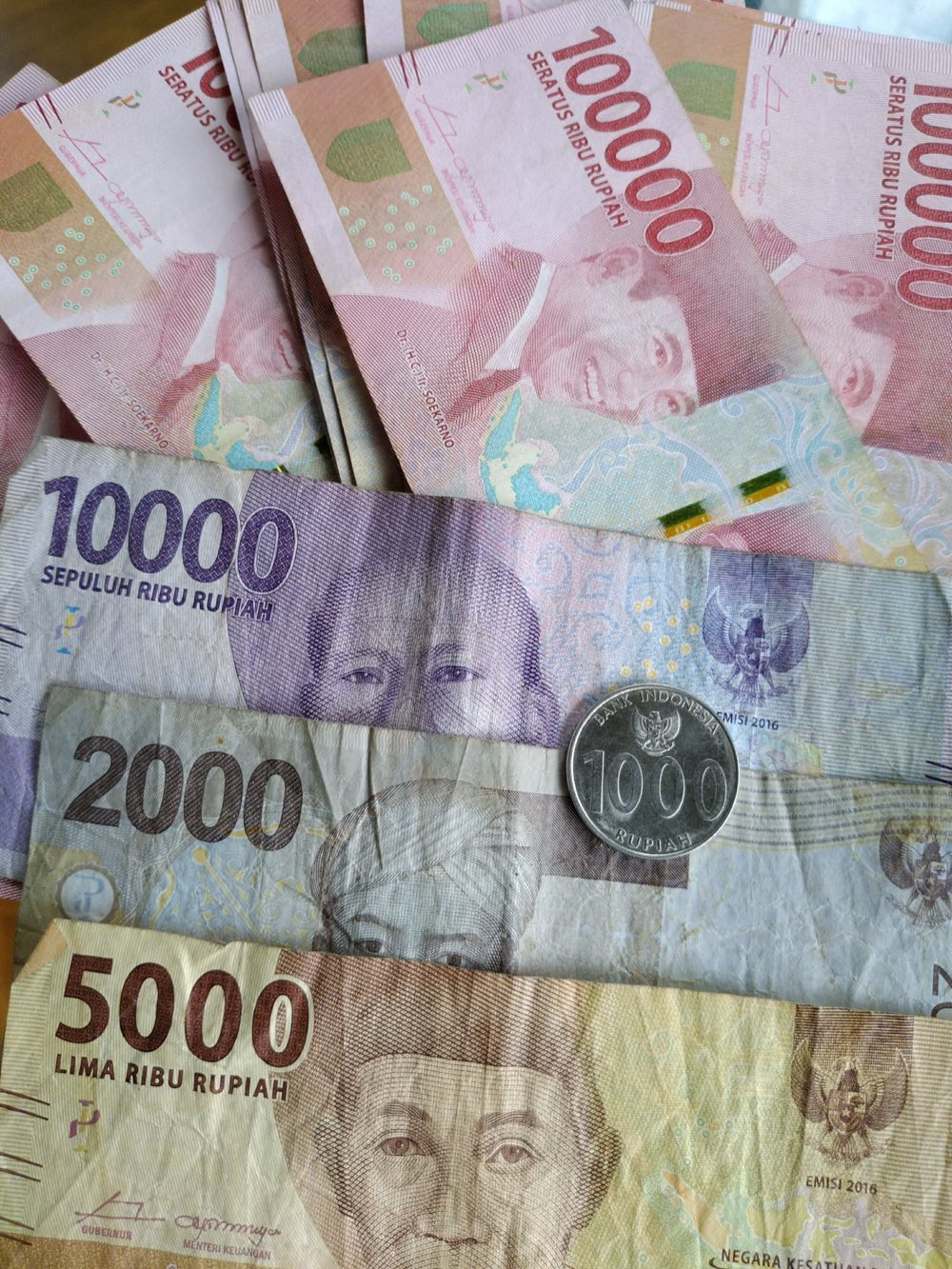
- Common notes (rupiah): 1,000 / 2,000 / 5,000 / 10,000 / 20,000 / 50,000 / 100,000
- Exchange rate: Rates move daily. Check a live IDR rate for your own currency on the morning you change money, and do not rely on a printed figure
- Cash or card: Card in malls, hotels and established restaurants, cash for most other things
- Where to exchange: Authorized money changers with a posted licence, or banks, and not street touts
- ATM withdrawal limit: Capped per transaction, with the cap set by the bank and by the note the machine dispenses
- Local ATM fee: A flat fee charged by the Indonesian bank on each withdrawal, on top of your home bank's foreign fee
- Digital payments: QRIS QR-code payments are widespread in the south and growing elsewhere
- Tipping: Not obligatory, and appreciated. Rounding up and small notes go a long way
- North Bali: ATMs and changers thin out fast outside Lovina and Singaraja, so carry cash
The Rupiah: Drop Three Zeros to Read a Price
The Indonesian rupiah is a high-denomination currency, and prices carry a string of zeros. A coffee, a day's scooter rental and a good dinner read in the thousands or the hundreds of thousands. A bowl of noodles can look like a luxury purchase until your eye adjusts.
Many travelers drop the zeros and do rough math from there. Knock three zeros off a price of 50,000 and you have 50, which you then convert from your own currency. Within a day or two the figures stop looking alarming.
Notes come in seven denominations, from 1,000 up to 100,000, in different colors and sizes. Bank Indonesia lists the current series. The 100,000 note is the workhorse for anything substantial.
Coins exist, from 100 up to 1,000, but matter little day to day. At minimarts, small change is often rounded or handed back as a sweet or two.
Keep a stash of smaller notes, a habit that pays off across the island. Drivers, warungs and parking attendants rarely break a fresh 100,000 note, and temple donation boxes need small notes too. "No change" is a real and frequent answer.
Check a Live Rate the Morning You Change Money
Exchange rates move daily, so no figure is printed here. Check a live rate on the morning you change money. Then use the money changer's board as a number to compare against it.
A fair changer's rate sits close to the mid-market rate you see online, with a small spread. A rate that looks far better than everyone else's is the classic bait for a short-change setup, described below.
Cash or Card: A Card for the Formal, Cash for the Rest
Bali runs on both, each in its own lane.
Cards work cleanly at:
- malls and supermarkets
- established restaurants
- hotels
- dive operators
- larger tour companies
Visa and Mastercard are widely accepted, and American Express far less so. Many places that take cards add a surcharge of a few percent, sometimes posted and sometimes not. Ask before you assume the card costs nothing extra.
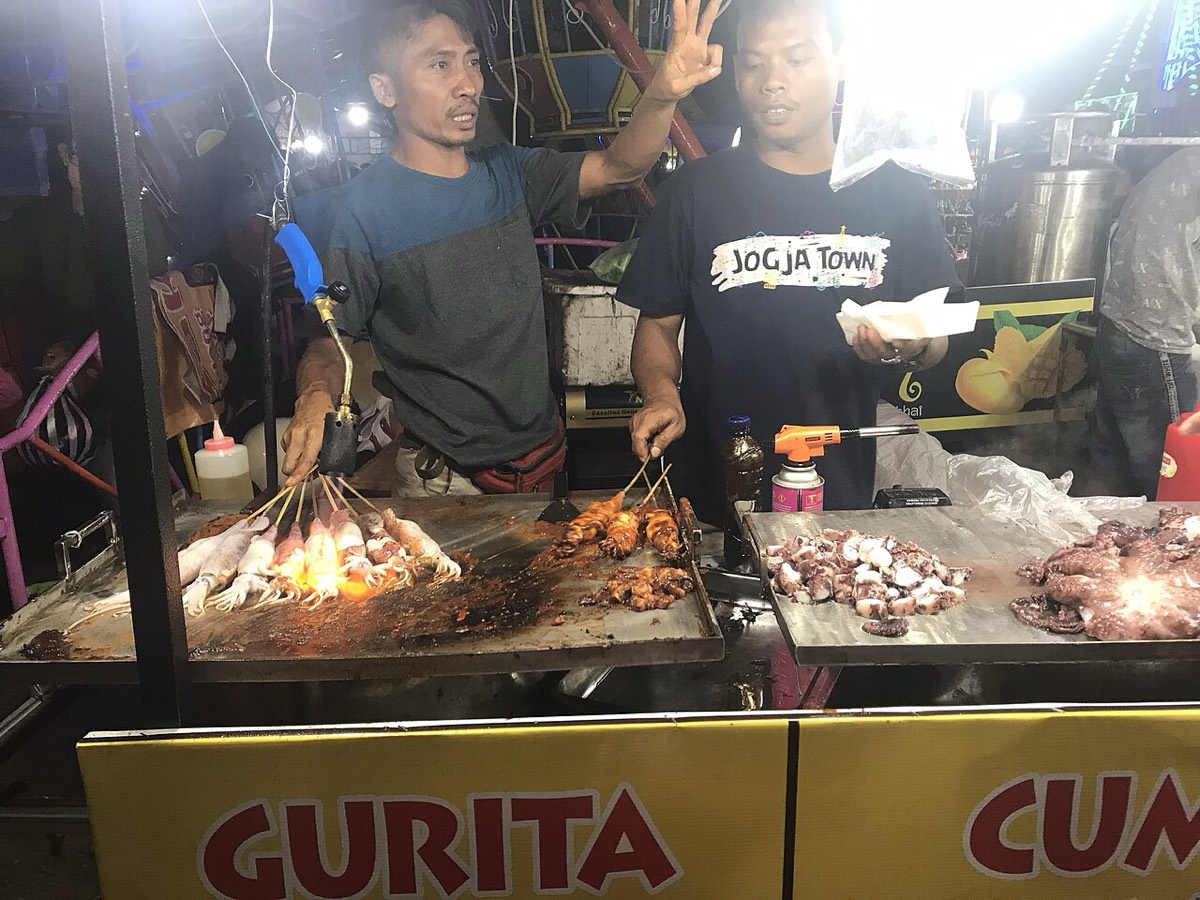 Night-market stalls like this one, in Ubud, run on cash. Photo: Julia Kado / Wikimedia Commons (CC BY-SA 4.0)
Cash is the default for:
- warungs and roadside food
- local markets and small shops
- scooter rentals and most drivers
- parking
- temple entries and waterfall gates
- massages
Many of these places take only cash.
The practical setup is a mix. Keep a card for the big and the formal, and a working float of cash for the rest of the day. A money belt or a divided wallet helps, since you do not want to show a thick stack of notes at a roadside warung.
A card terminal may offer to charge you in your home currency instead of rupiah, which is called dynamic currency conversion. Decline and pay in IDR, because that "convenience" rate is reliably worse than your bank's.
Where to Exchange Money Safely: Licensed Changers and Banks
This is where travelers lose money in Bali, and the loss is almost always avoidable.
Use authorized money changers. According to Bank Indonesia's Bali office, a licensed one displays its BI licence certificate and the official licensed-changer logo. It also shows the words "Authorized Money Changer" with the company name.
PT Central Kuta and BMC are two long-established chains people recognize, and plenty of smaller licensed offices are perfectly good. Banks change money too, at slightly worse rates and with no drama.
Avoid the small dark-window kiosks down side streets that advertise a rate beating everyone on the strip. That gap is the lure. The better the rate looks, the more likely the counter is set up to claw it back.
The Four Short-Change Tricks to Watch
Money-changer scams in Bali follow a few well-worn scripts:
- The recount shuffle. The cashier counts your money out in front of you, correctly. Then they "recount" or restack it and palm a couple of large notes during the second pass. You walk out short.
- The calculator distraction. A second person, a phone or a "wait, the rate changed" interruption pulls your attention off the pile at the moment notes go missing.
- The thin-note rate. A rate too good to be real is used to get you inside, then made up for through one of the moves above.
- The folded-note count. Notes are counted folded or in fast riffles, so the total looks right when it is short.
Count It Yourself: Four Steps at the Counter
The defense is boring and effective.
-
Count the money yourself, slowly, after it is handed to you and before you hand over anything.
-
Do not let the cashier take the stack back once you have counted it.
-
If anyone rushes you, take that as the signal to slow down further.
-
Use a busy, licensed office, and ideally not the one with the suspiciously good rate.
ATMs: Use Bank-Branch Machines and Withdraw Once
ATMs are common across south and central Bali (Kuta, Seminyak, Canggu, Ubud, Denpasar). They are present but sparser as you move into the north and the interior. Five habits keep the fees low and your card safe.
Use machines attached to a bank branch. Branch machines are restocked, monitored and less likely to have been tampered with than freestanding ones in dim corners. Cover the keypad when you enter your PIN, and give the card slot a quick wobble to check for skimmers.
Expect a low limit on each withdrawal. Indonesian ATMs cap a single withdrawal, and the cap depends on the bank and on the note the machine loads. Machines that dispense the larger note let you take out more each time. If one machine gives you a disappointing amount, the next one along may give more.
Withdraw once, because fees stack. You typically pay two layers of fees. The local Indonesian bank charges a flat fee on each withdrawal, and your own bank adds its foreign transaction or out-of-network charge.
Both are charged per transaction, so one larger withdrawal beats several small ones. Stay within the machine's limit and within what you are comfortable carrying.
Wait for both your card and your cash. Some machines dispense cash first and return the card after, and others do the reverse. A common loss is walking off the second the cash appears and leaving the card behind.
Tell your bank, and carry a backup card. Tell your home bank you are travelling, or your card may get frozen on the first foreign withdrawal. Carry a backup card from a different network, kept separately, in case one gets eaten or blocked.
QRIS: Useful If Your Banking App Supports It
QRIS (pronounced "kris") is Indonesia's unified QR-code payment standard, and it has spread fast. Across the south, the black-and-white QRIS square appears at cafes, warungs, market stalls and even some parking spots. You scan it from a payment app, the amount is entered and you confirm.
For most foreign travelers the catch is access. QRIS runs through Indonesian bank accounts and local e-wallets such as GoPay, OVO and DANA. These generally need a local number, and sometimes a local account, to set up.
A growing number of foreign banking apps can now pay Indonesian QRIS codes through Bank Indonesia's cross-border QRIS links with partner countries. The list keeps widening, so check whether your app is on it before you arrive.
If you can use it, QRIS is convenient and avoids the change problem. If you cannot, you lose nothing essential, since QRIS merchants still take cash. Treat it as a bonus and plan around cash.
Tipping in Bali: Appreciated, Not Obligatory
Tipping is not built into the culture in Bali the way it is in the United States, and nobody will chase you for it. It is welcomed, and on local wages even a small tip counts for a lot.
These are the rough norms travelers tend to settle on:
- Restaurants: Many mid-range and upper places already add a service charge, often listed as "++" (service plus tax). If service was good and nothing is added, rounding up or leaving five to ten percent is generous.
- Drivers and guides: For a full-day private driver, a note on top of the agreed fare is well received, more for a long day or an unusually good one.
- Spa and massage: Rounding up or leaving a small note is a kind gesture, given how little the therapist often keeps.
- Hotel staff and porters: A small note for real help.
- Warungs and street food: No tip is expected, and rounding up is plenty.
Keep small notes for this. A tip you intend to leave is easy to abandon when the smallest thing in your wallet is a 100,000 note.
North Bali: Withdraw in Lovina or Singaraja First
North Bali runs mostly on cash. Lovina and Singaraja have ATMs and a money changer or two, enough to top up. Beyond the two towns, machines get scarce and card terminals scarcer still, in places such as:
- the villages around Munduk
- the Sekumpul and Aling-Aling waterfalls
- Pemuteran and Menjangan in the far northwest
- the quieter east coast
Waterfall gates and local guides in these areas take cash only as a matter of course, and so do warungs and small homestays.
Withdraw what you need while you are still in a town with reliable ATMs, before you head into the hills or up the coast. It saves a wasted afternoon. Carry more than you think a day needs, in mixed denominations, and keep a reserve separate from your spending float.
If you are crossing from the south, sort your cash before the drive north, and do not count on finding a machine along the way. Getting to north Bali explains how that journey works. The Lovina area guide has where the reliable ATMs and changers in the north are.
Practical Notes
Rates, fees, and limits change often. Confirm a live rate and your own bank's charges before you change money.
- Currency: Indonesian rupiah (IDR / Rp), high-denomination. Drop three zeros to start your mental math
- Carry: A working cash float in mixed notes, plus a card for malls and hotels
- Change money at: Authorized, licensed money changers or banks only, and not street kiosks with miracle rates
- At the counter: Count it yourself, slowly, and do not let it be taken back after you count
- ATMs: Use bank-branch machines, cover the keypad and take both card and cash. Expect low per-transaction limits and stacked fees
- Pay in IDR: Decline a card terminal's offer to charge in your home currency
- QRIS: Convenient if your app supports it. Otherwise cash does the job
- North Bali: Withdraw in Lovina or Singaraja before heading inland or up the coast
FAQ
What currency does Bali use? The Indonesian rupiah, written as IDR or Rp. It is a high-denomination currency, so everyday prices run into the tens and hundreds of thousands. Notes range from 1,000 to 100,000, and the 100,000 note does most of the heavy lifting.
How much is the rupiah worth against the dollar or euro? Rates move daily, so no number is printed here. Check a live rate the morning you exchange money and use it to judge the changer's board. A board close to the live mid-rate, with a small spread, is honest. Anything far better than the mid-rate is a classic lure.
Should I use cash or card in Bali? Both, each in its own lane. Cards work at malls, hotels and established restaurants. Cash runs the warungs, markets, drivers, parking, temples, waterfalls and small shops. Keep a card for the formal and a cash float for the rest, and carry more cash the further north or inland you go.
Where is the safest place to exchange money in Bali? Authorized money changers with a posted licence and a proper storefront, or banks. Recognized chains like PT Central Kuta and BMC are reliable, and plenty of smaller licensed offices are fine. Avoid side-street kiosks advertising rates that beat everyone else, since that gap is usually the bait for a short-change trick.
What are the common money changer scams? Four recur. They are the recount shuffle (notes palmed during a second count), the calculator or phone distraction, an impossibly good rate used to lure you in, and notes counted folded so the total looks right. Count the money yourself, slowly, refuse to let it be taken back, and walk away from anyone who rushes you.
How much can I withdraw from an ATM in Bali? Less than you might expect. Indonesian ATMs cap a single withdrawal, and the cap depends on the bank and on which note the machine is loaded with. Machines loaded with the larger note let you take more per withdrawal.
What ATM fees should I expect? Two layers usually apply. The local Indonesian bank charges a flat fee on each withdrawal, and your own bank adds its foreign or out-of-network charge. Both are per transaction, so one larger withdrawal beats several small ones, within the machine's limit and what you are happy carrying.
Is it safe to use ATMs in Bali? Generally yes, with sensible care. Use machines attached to a bank branch, cover the keypad, check the card slot for anything loose, and wait to collect both your card and your cash. Tell your home bank you are travelling so the card is not frozen, and carry a backup card kept separately.
Can I pay with QRIS as a tourist? Sometimes. QRIS QR-code payments are widespread in the south, but they run through Indonesian accounts and e-wallets that usually need a local number to set up. Cross-border QRIS support in foreign banking apps is spreading, so check yours before the trip. If you cannot use it, QRIS merchants take cash anyway.
Do I need to tip in Bali? It is not obligatory, and nobody will pursue you for it, but it is appreciated and counts for a lot on local wages. Many restaurants already add a service charge. For drivers, guides, spa therapists and helpful staff, a small note or rounding up is a kind and normal gesture. Keep small denominations so you have something to leave.
Do I need cash in north Bali? Yes. Lovina and Singaraja have ATMs and changers, but machines thin out fast around Munduk, the waterfalls, Pemuteran and the quiet east coast. Guides, gates and warungs there are cash-only. Withdraw in town before you head inland or up the coast. See getting to north Bali and the Lovina area guide.
Sources
- Bank Indonesia, Bank Indonesia and the Government launch the 2022 rupiah banknotes, read September 2026 (in Indonesian)
- Bank Indonesia, QRIS Cross-Border, read September 2026
- detikBali, Dear travellers, here is how to recognise a licensed money changer, read September 2026 (in Indonesian)
For what a trip costs, see Bali trip cost and north Bali on a budget. For the paperwork side of arriving, see the Bali visa guide.