On this page
- In Brief
- North Bali at a Glance
- Where Is North Bali? It Is Buleleng Regency
- What North Bali Is Like: a Calm Coast with Cool Highlands Behind
- What to Do in North Bali
- The Towns and Districts, West to East
- The Highlands: Munduk, the Lakes and Bedugul
- Where to Base Yourself: Lovina, Munduk or Pemuteran
- When to Go: June to September Is Driest
- Getting There and Getting Around
- How Many Days You Need: Three at Least, a Week for the Whole Region
- Practical Notes
- FAQ
- Sources
In Brief
North Bali is Buleleng regency, the island's north coast and the hills behind it, up to the lakes of Buyan and Tamblingan. It covers close to a quarter of the province, with 157 kilometres of shore from West Bali National Park to the Karangasem border. Its capital is Singaraja.
The usual bases are Lovina on the central coast, Munduk in the highlands and Pemuteran in the far west. Flights land at Ngurah Rai in the far south, so a trip north starts with a drive of about three hours over the mountains. Give it three nights at least, and aim for June to September, the driest months on the regency's own rainfall record.
North Bali at a Glance
- What it is: Buleleng regency, the north coast of Bali and its highlands
- Where: from West Bali National Park in the west to the Karangasem border in the east, with the central mountains to the south
- Capital: Singaraja
- Where people stay: Lovina, Munduk and Pemuteran
- Next door: Amed, just over the eastern border in Karangasem, pairs well with the north
- From the airport: about 100 kilometres by road, roughly three hours
- Driest months: June to September
- How long: three nights at least, a week to see most of it
Where Is North Bali? It Is Buleleng Regency
Buleleng runs along the island's northern side from west to east. Its borders are:
- North: the Bali Sea
- East: Karangasem
- West: Jembrana
- South, along the mountains: Jembrana, Tabanan, Badung and Bangli
For the regency itself, its capital and its districts, see Buleleng Regency explained. To see where each place sits, use the north Bali map.
Buleleng also takes in the small islands of Menjangan and Tabuhan. Its coast measures 157 kilometres, and nearly 77 of those are in Gerokgak, the western district. No other district in Bali has a longer shoreline.
Behind a strip of low coast, the ground rises fast into hills and dormant mountains. The highest, Gunung Tapak, reaches 1,903 metres. Two lakes lie inside Buleleng, Buyan and Tamblingan, while the third highland lake, Beratan, sits just over the border in Tabanan.
Ubud, Sidemen and Mount Batur are outside Buleleng. So is Amed, though it sits close enough to the eastern border for many trips to join the two. If you can reach a place from Ubud without crossing the mountains, it is not the north.
What North Bali Is Like: a Calm Coast with Cool Highlands Behind
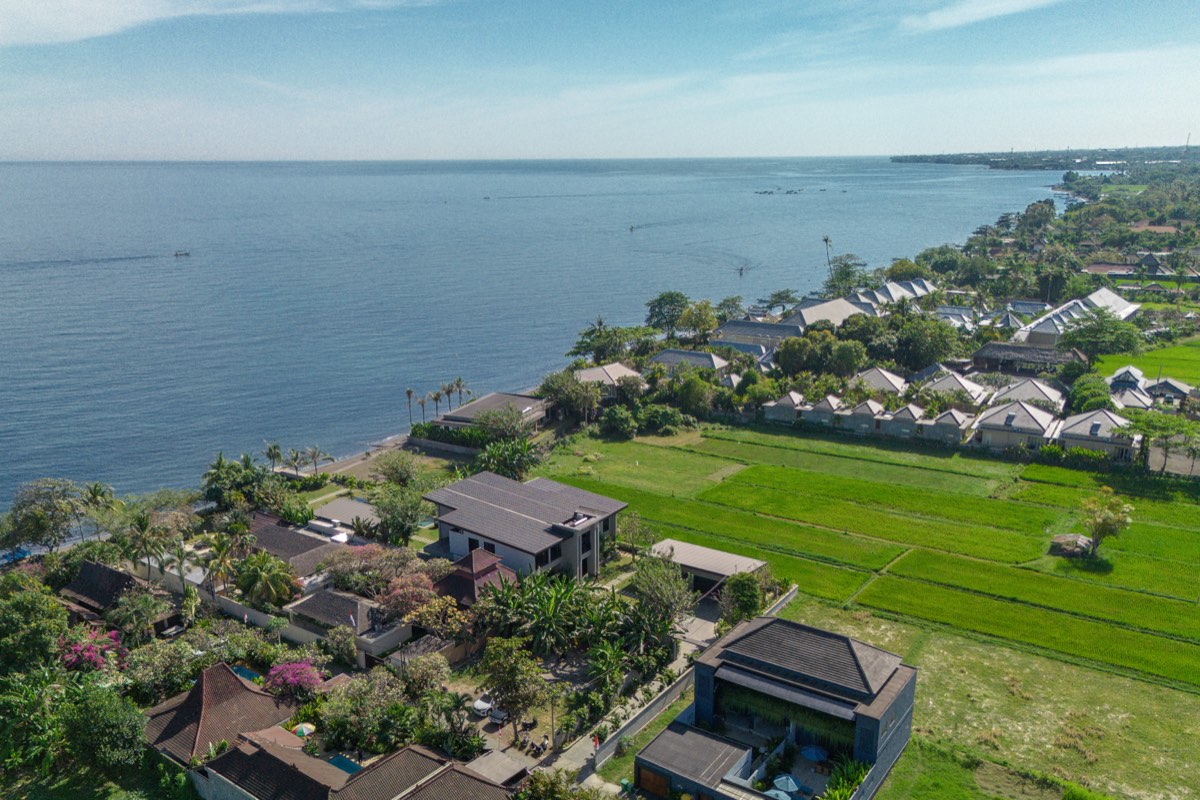
The beaches here are black volcanic sand, backed by fishing villages and hills.
The water in front of them is usually calm. At Pemuteran, the coral-restoration group notes the area has no strong currents or big waves, so its shallow reefs are easy to snorkel. The sea is made for swimming and snorkelling, and surfers go elsewhere.
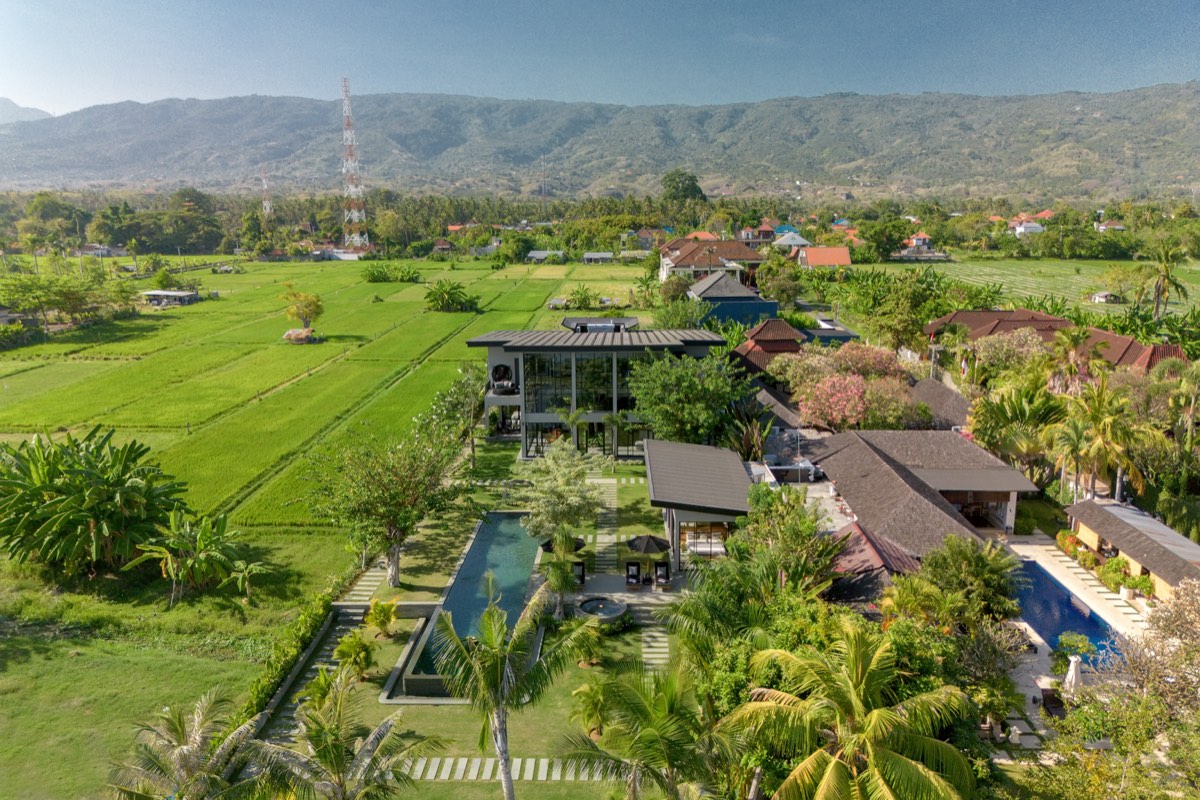 Rice fields run straight from the coast road to the hills. Photo: Palm Living archive.
Within an hour of the beach, the road climbs into the highlands, among lakes, forest and farms. The lake temple at Beratan stands at 1,200 metres. The coast is hot, and up at the lakes the air is cool.
Buleleng covers a quarter of Bali, and its visitors are spread thinly through villages where people still fish and farm. Evenings are quiet, and past the mountain pass the roads are open.
The long drive from the airport is the price of this quiet, and much of the reason it has lasted.
If you are choosing between regions, north Bali vs the south and north Bali vs Ubud set them side by side. Why the north is different tells the longer story.
What to Do in North Bali
These are the north's six main days out, each with a guide of its own.
Watch the Dolphins at Dawn
Lovina's best-known morning is a traditional boat trip at dawn to watch dolphins play offshore. They are wild animals, so no sighting is guaranteed, and that is part of it. The Lovina dolphins guide explains how the boats work.
Walk to the Waterfalls
Sekumpul is often called the most beautiful waterfall in Bali. The path down has hundreds of steps and a river crossing, and it turns slippery in rain.
Aling-Aling, Gitgit and Fiji share the same hills, and Banyumala falls near the lakes above them. The north Bali waterfalls guide maps them, with honest effort levels and how to chain them in a day.
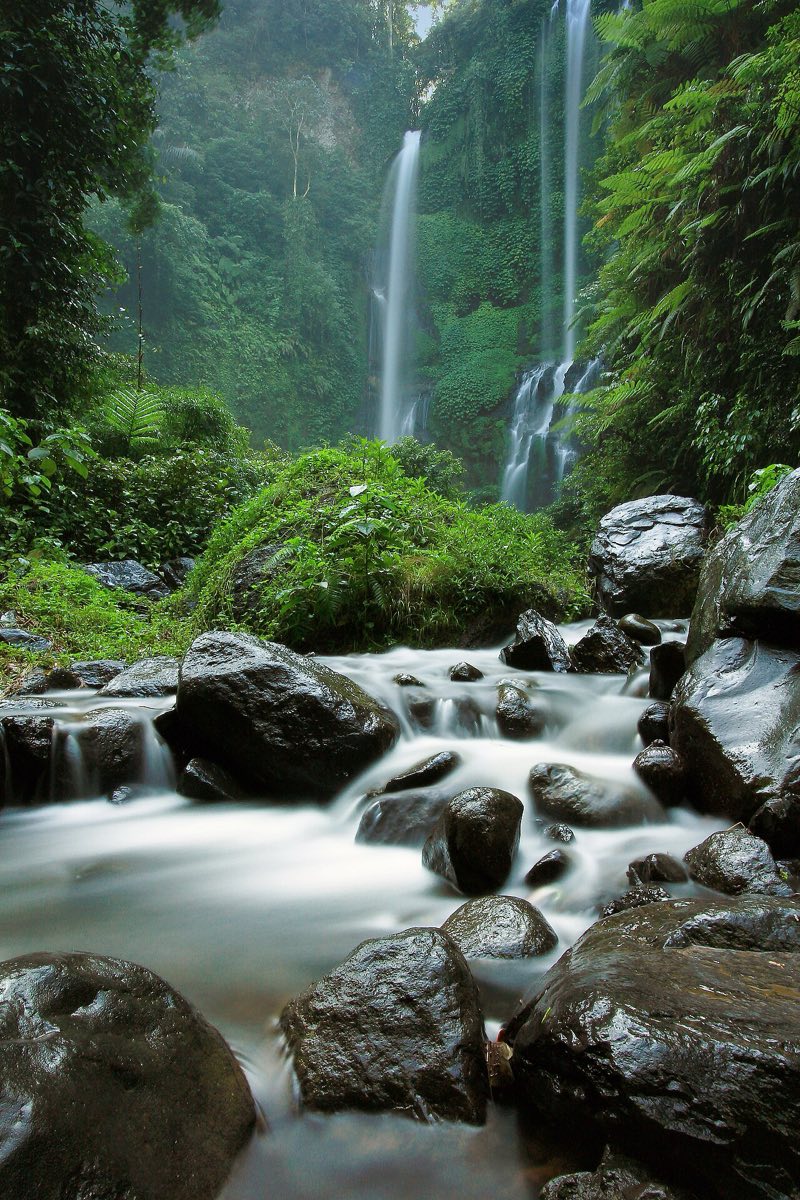 Sekumpul's twin falls and river canyon. Photo: Nyoman Gita Astadi / Wikimedia Commons (CC BY-SA 4.0)
Snorkel the Reefs and Dive Menjangan
Pemuteran's reefs were once badly damaged by bomb and cyanide fishing. Since June 2000, the village has grown coral back on Biorock structures, steel frames laid in three to seven metres of water.
They sit 50 to 100 metres from the beach and now form a snorkelling trail. The project describes itself as the largest of its kind in the world.
Boats also cross from the west coast to Menjangan Island, and the dive centres and lodges in Pemuteran run the trips. Snorkelling in north Bali covers the reefs, and diving and snorkelling in Pemuteran covers the bay.
Soak in the Hot Springs
The Banjar hot springs are an easy half-day from Lovina. The Buddhist monastery next door makes a quiet second stop.
Visit the Northern Temples
The north carves its temples in its own style. Pulaki stands on the western shore and Beji at Sangsit, while Meduwe Karang and Ponjok Batu keep the east. The best temples in north Bali tells their stories, and temple etiquette is worth reading before you go.
Swim a Black-Sand Beach
Lovina's calm water makes for an easy swim. The best beaches in north Bali lists the quieter bays east and west of it.
The longer list is in things to do in north Bali.
The Towns and Districts, West to East
Buleleng is divided into nine districts, and seven of them reach the sea.
Busungbiu and Sukasada are the two inland. Singaraja, in Buleleng district, is the capital and the most populous part of the regency. Beyond it, the north is villages and small towns on one coast road, and this tour follows that road from west to east.
Gerokgak: Pemuteran, Pulaki and the National Park
Gerokgak is the largest district, a quarter of the regency. At its western end it meets West Bali National Park, which lies partly in Buleleng and partly in Jembrana. The park is the last wild home of the Bali starling, a white bird found nowhere else on earth.
On the shore at Banyupoh, about 53 kilometres from Singaraja, stands Pura Pulaki, beside the Singaraja to Gilimanuk road. Hindus across Bali hold it sacred, and its story follows the journey of the priest Dang Hyang Nirartha from Java. Pemuteran is its neighbour, and Menjangan Island lies offshore.
 The Pemuteran coast from the hills behind the village. Photo: Lamacchiacosta / Wikimedia Commons (CC BY-SA 4.0)
Past the park, the road ends at Gilimanuk, in Jembrana. It is the ferry port for Java, with boats across the Bali Strait to Ketapang, and the way in for anyone arriving overland.
Seririt and Busungbiu
Seririt sits on the coast road where the scenic route from Munduk comes down to the sea, about 20 minutes west of Lovina. Busungbiu is the hill district behind it, one of the two with no coast. More on the town in the Seririt guide.
Banjar: Hot Springs, a Monastery and Munduk
Banjar Hot Spring lies about 5 kilometres southwest of Lovina, in tropical gardens. Sulphurous spring water pours into its tiered bathing pools through carved dragon spouts. The pools were developed further during the Japanese occupation.
The Brahmavihara Arama Buddhist monastery is 1.5 kilometres east of the springs. Uphill, Munduk and Lake Tamblingan are in Banjar district too. More in the Banjar hot springs guide.
Buleleng: Lovina and Singaraja
The name Lovina was coined for tourism in the 1950s to cover a string of traditional villages along the black sand. For the beach itself, see the Lovina beach guide.
In 1991, people digging a swimming pool behind a hotel just inland of Kalibukbuk found small clay stupas. Later digs uncovered a Buddhist temple complex, which archaeologists date to around the eighth century. It was excavated between 1994 and 2002.
Singaraja, a few minutes east, was the seat of the kings of Buleleng, then of the Dutch and Japanese administrations. After independence in 1945 it was the capital of the province of Sunda Kecil. That province was split in 1958, and Singaraja stayed Bali's capital until a Home Affairs decision of 23 June 1960 moved it to Denpasar (Bali provincial government).
Bugis, Arab and Chinese traders once settled along its shore. The old harbour, the Arab quarter behind it and the Gedong Kirtya library of palm-leaf manuscripts are still there. Read Singaraja's old town and the history of north Bali.
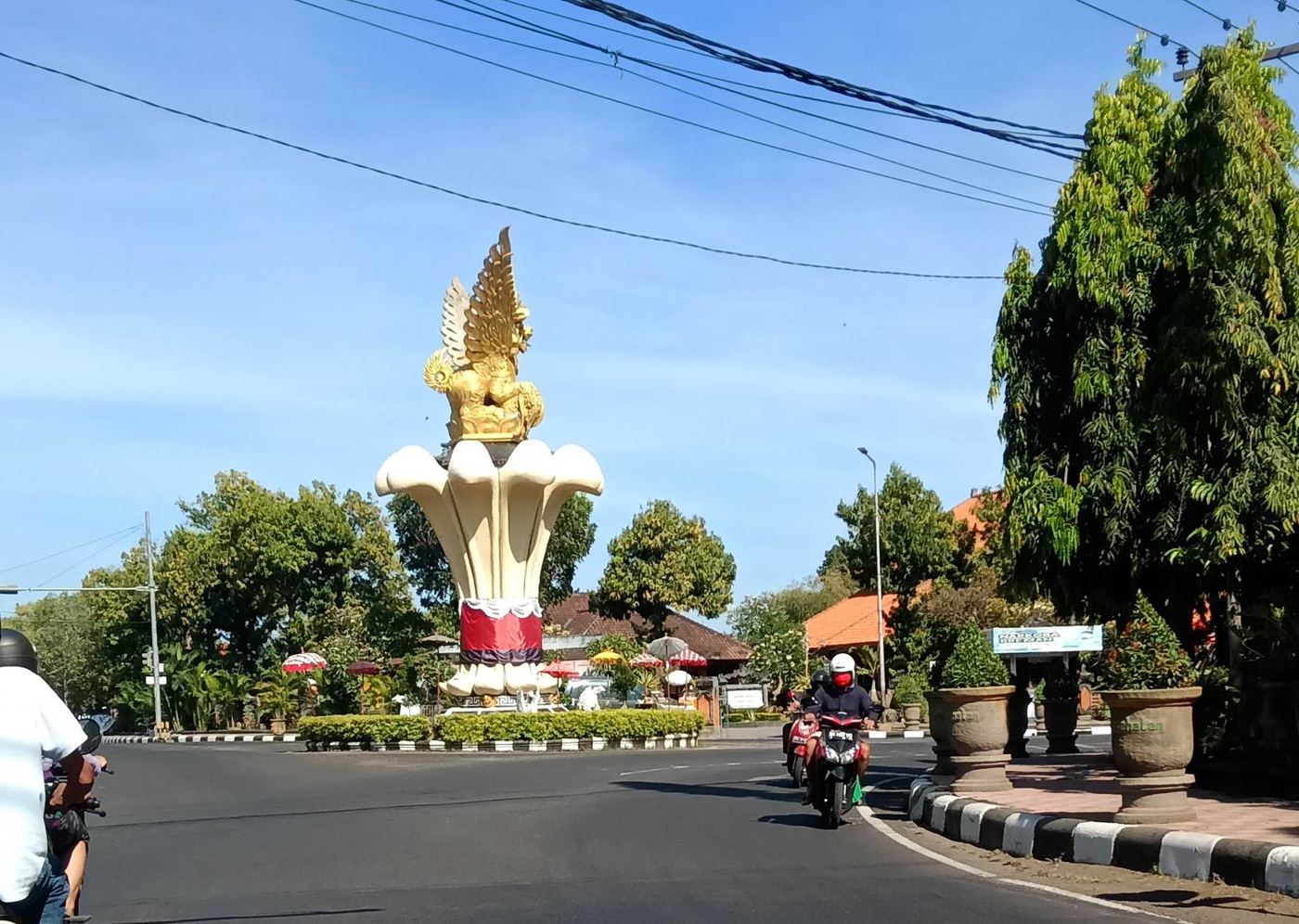 Singa Ambara Raja, Singaraja's winged lion, at its road junction. Photo: Anggabuana / Wikimedia Commons (CC BY-SA 4.0)
Sukasada: the Road from the Lakes
Sukasada is the inland district south of Singaraja, where the main road from Bedugul comes down to the coast. It holds Lake Buyan and the regency's highest mountain, Gunung Tapak. The highlands section below covers the stops on the way.
Sawan: Sekumpul and Sangsit
Sekumpul lies in the hills about 20 kilometres from Singaraja. It is a valley of seven waterfalls, the tallest 80 metres or more by official figures, and you can walk down to two of them. See the Sekumpul waterfall guide.
On the coast at Sangsit, about 8 kilometres east of Singaraja, stands Pura Beji. It is carved in the north's own style and faces west.
Kubutambahan and Tejakula: the Quiet East
Kubutambahan is where the road from Kintamani meets the coast, about 12 kilometres east of Singaraja (regency heritage record). Its temple, Pura Meduwe Karang, carries a famous relief of the Dutch artist Nieuwenkamp on a bicycle whose wheels have lotus-flower spokes. The cold springs of Air Sanih are a little further east.
Tejakula is the quiet eastern end of the coast, the last district before Karangasem. At Julah stands Pura Ponjok Batu, a temple for all of Bali, ranked alongside Pulaki.
Its story goes back to Dang Hyang Nirartha's arrival in the fifteenth century. Read Tejakula village.
Amed, Over the Border in Karangasem
Amed belongs to east Bali, in Purwakerti village, Abang district, Karangasem. Its coast has coral reef close to shore, fishing boats and traditional salt-making, two and a half to three hours from Lovina along the coast road.
Many visitors put the two together. See the Amed guide and where to stay in Amed.
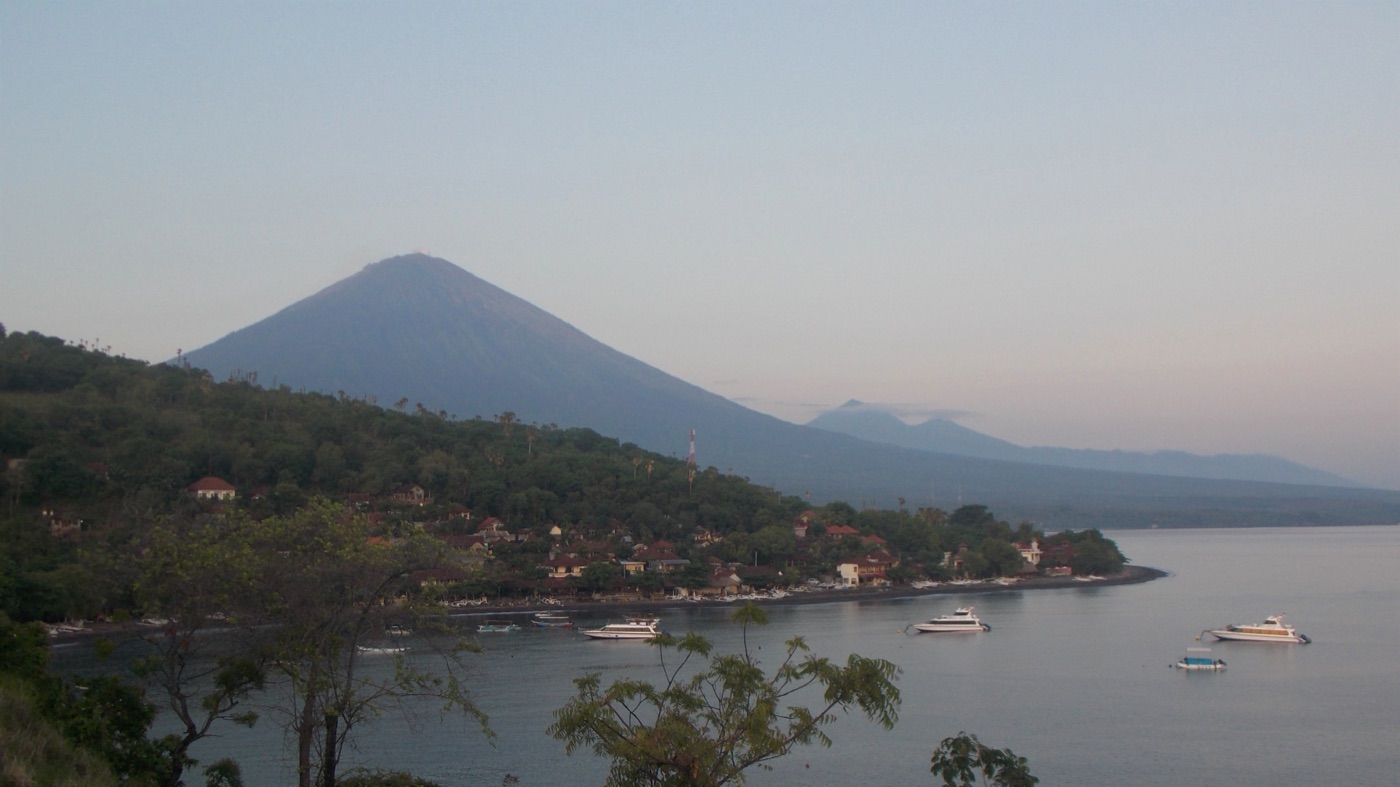 Mount Agung from Amed, with boats moored in the bay below the village. Photo: Lalalalabpi / Wikimedia Commons (CC BY-SA 4.0)
The Highlands: Munduk, the Lakes and Bedugul
From the south, the main road climbs to Bedugul and Lake Beratan.
Pura Ulun Danu Beratan, the temple on the water, stands at 1,200 metres in Candikuning village, Tabanan. It is about 60 kilometres from the airport.
On the hill above the lake is the Bali Botanic Garden, founded in 1959. The Bedugul guide covers the market and the rest of the stop.
Over the pass you are in Buleleng. The golf resort at Handara describes its setting as the crater of a dormant volcano. It calls its split stone gateway one of the most recognisable landmarks on the island. More in the Handara Gate guide.
Then come the two lakes, Buyan and Tamblingan, of 360 and 110 hectares, in forested hills.
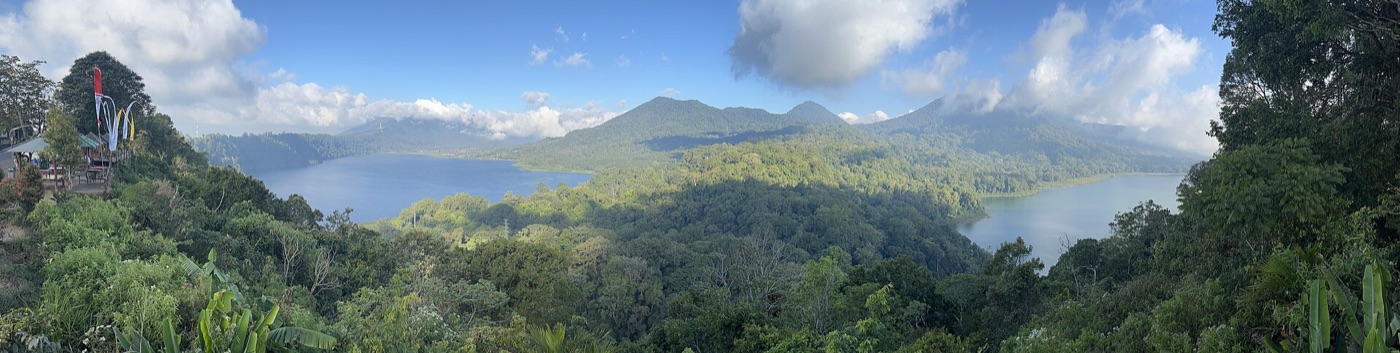 Buyan and Tamblingan from the Wanagiri ridge, one valley split by a green seam. Photo: Stefan Fussan / Wikimedia Commons (CC BY-SA 3.0)
Banyumala, a twin waterfall in the same hills, falls into a clear pool you can swim in. Munduk sits at the western end of the ridge, and from there the road winds down to Seririt on the coast.
Where to Base Yourself: Lovina, Munduk or Pemuteran
Pick your base by what you came for: the sea at Lovina, the hills at Munduk or the reefs at Pemuteran.
Lovina: the Base for the Whole North
Lovina is a string of beach villages west of Singaraja, centred on Kalibukbuk. It has black sand, calm water and the dawn dolphin boats.
The waterfalls, hot springs and highlands are all within about an hour, so it suits anyone exploring the north. Many stay in one of the villas along the Lovina coast. Start with the Lovina area guide and the best things to do in Lovina.
Munduk: the Highland Village for Walkers
Munduk is the highland village above the lakes, on the ridge road west of Bedugul, in Banjar district. You go there to walk.
Paths lead to the waterfalls in the valleys around the village, around Lake Tamblingan and through farms of clove, coffee and cocoa on the slopes. The Munduk coffee guide covers the farms you can visit, and the full picture is in the Munduk guide.
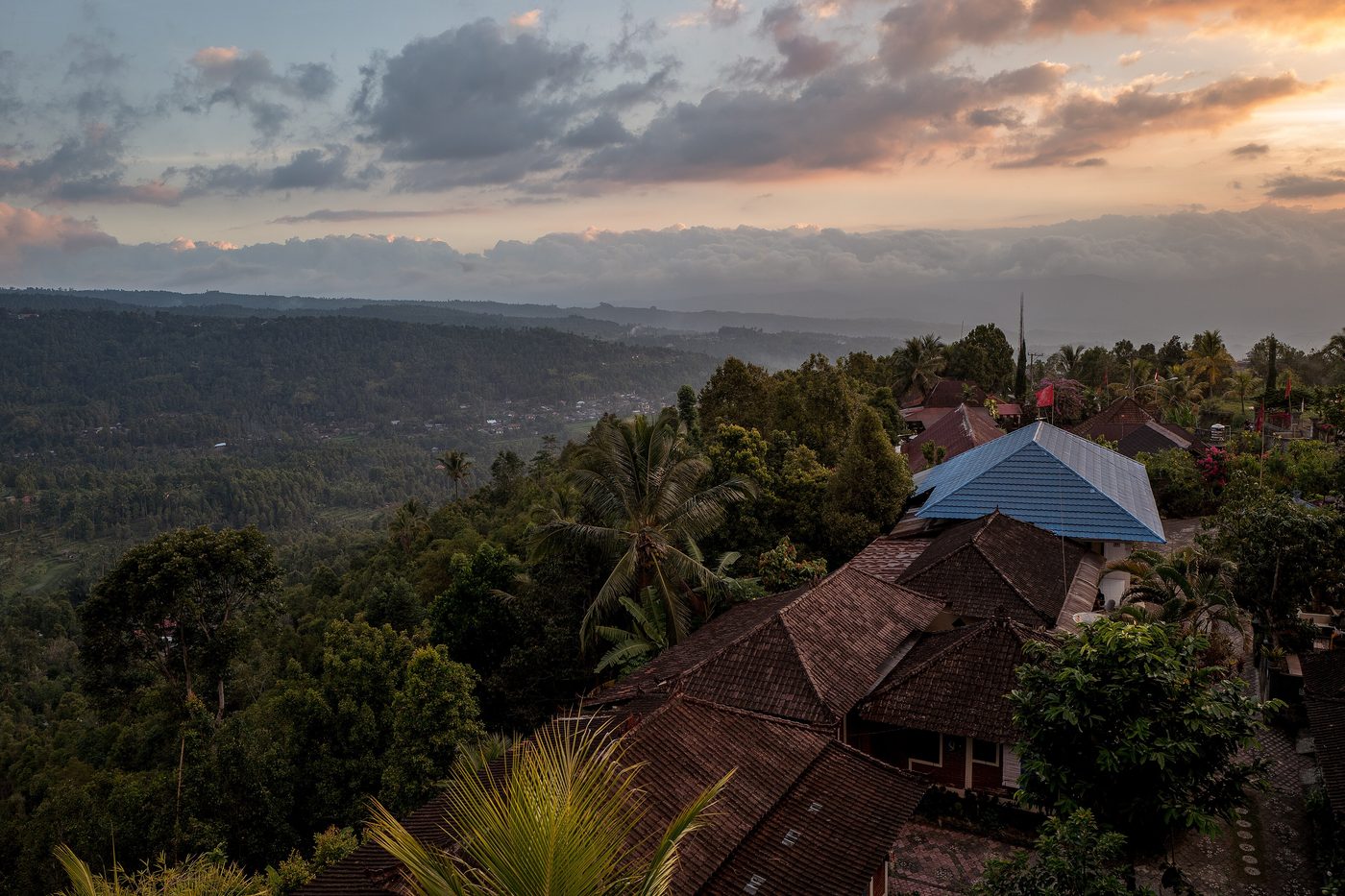 The view from Munduk over the valleys toward the coast. Photo: Dr. Matthias Ripp / Wikimedia Commons (CC BY 2.0)
Pemuteran: Reefs in the Far West
Pemuteran is an old village in Gerokgak, about 57 kilometres west of Singaraja. It sits on a black-sand bay with reefs close to shore.
The Biorock coral trail starts from the beach, and boats leave this coast for Menjangan Island. See the Pemuteran guide.
Where to stay in north Bali compares the three bases, and the quieter coast in between, area by area.
When to Go: June to September Is Driest
Buleleng has two seasons, dry and wet, and rain can fall in almost any month.
The regency's climate page gives a year of monthly rainfall. Rain is lowest from June to September, least of all in September, and highest in February. Those four dry months are the reliable window for boat trips, waterfall paths and clear views over the lakes.
The wet months have their own reward. The waterfalls run fuller, and the hills behind Pemuteran, bare in the dry season, turn green. Paths get slippery, so go to the falls in the morning and take a local guide at Sekumpul.
The coast is warm all year and the highlands are cool. Before you fix a travel day, check the date of Nyepi, Bali's day of silence. The best time to visit north Bali goes month by month.
Getting There and Getting Around
Flights land at I Gusti Ngurah Rai International Airport in the south.
From there, Lovina is about 100 kilometres by road. The drive takes roughly three hours, up through the central highlands, past the Bedugul lakes and down the far side to the coast. From Ubud allow about two hours, and from Bedugul about one.
Other roads come in from each side:
- Through Munduk: the scenic route turns west at Lake Buyan and runs through Munduk to Seririt.
- From the east: the coast road from Amed reaches Lovina in two and a half to three hours.
- From Kintamani: a quieter road comes down to the coast at Kubutambahan.
- From the west: the coast road runs from Gilimanuk through Pemuteran to Lovina, about an hour and a half from Pemuteran.
A private driver is the simplest way to cross the mountains. It lets you treat the drive as part of the trip, with a stop at Lake Beratan or a waterfall on the way. Private drivers in north Bali explains how to book one, and getting to north Bali covers each route in detail.
Shuttle buses also run to Lovina from the main tourist areas, and you book them a day ahead. Local minibuses called bemos run to Singaraja from Ubung terminal in Denpasar.
Once you are there, you can hire cars and motorbikes in Lovina, and Kalibukbuk is the place to look. Bemos ply the coast road between Singaraja and Lovina. For day trips into the hills, many people keep a driver.
How Many Days You Need: Three at Least, a Week for the Whole Region
Three days is the right minimum for a first visit.
From a single base in Lovina, three days covers:
- a dawn dolphin trip
- a waterfall day
- the Banjar hot springs
- one slow day by the sea
A week opens up the whole region. Keep Lovina as a base and add Munduk and Pemuteran as day trips or short overnight stops, with time left to do nothing.
If the north is one leg of a larger Bali loop, two nights is the bare minimum. Any less, and the three-hour drive eats much of what you came for.
The 3-day itinerary, 7-day itinerary and 10-day itinerary lay out the plans day by day. How many days in north Bali weighs the options.
Many people fit the north in as a leg of three or four nights. Others make it a loop, crossing the mountains from the south or Ubud and coming back a different way.
Is north Bali worth visiting? is an honest answer on who it suits. For those who end up wanting to stay longer, the thread starts with investing in north Bali.
Practical Notes
- Drive from the airport: about 100 kilometres and roughly three hours over the mountains. Allow more in rain or heavy traffic.
- Private transfers: priced as a one-way trip, more with sightseeing stops. Ask your villa or the driver for the current rate.
- Getting around: a hired driver for day trips, a scooter or bemo for short hops along the coast road.
- Cash: ATMs in Lovina and Singaraja. Carry cash for warungs, boat trips and entry at the gates.
- Entry fees: each waterfall, temple and hot spring sets its own and takes it at the gate. At Sekumpul, a viewpoint ticket and the guided treks are sold separately.
- Temples: cover your legs with a sarong and sash. The etiquette guide explains the rest.
- Best months: June to September, the driest of the year.
FAQ
Where is north Bali? North Bali is the regency of Buleleng, on the island's north coast facing the Bali Sea. It runs from West Bali National Park in the west to the Karangasem border in the east. The central mountains and the lakes of Buyan and Tamblingan lie to the south. Its capital is Singaraja, and Lovina is about 100 kilometres by road from the airport.
Is north Bali worth visiting? Yes, if you want a quiet side of the island. The coast is calm, with dolphins at dawn and reefs you can snorkel from the beach, and canyon waterfalls and cool highlands rise behind it. The cost is a three-hour drive from the airport, so it rewards a few unhurried nights over a rushed stop. Is north Bali worth it? gives the full answer.
What are the main towns in north Bali? Singaraja, the regency capital, sits in its most populous district. On the coast, Pemuteran and Seririt lie in the west, and Lovina, meaning Kalibukbuk and the villages around it, sits just west of Singaraja. Sangsit, Kubutambahan and Tejakula lie to the east. In the highlands, Munduk is the usual place to stay.
What is north Bali like? Slow and quiet, with black-sand beaches, fishing villages, a calm sea and highlands within an hour of the coast. The sea is too calm for surfing, and nightlife is thin. Days are spent outdoors, from dawn dolphin trips to waterfall walks in the hills.
Does north Bali have good beaches? For swimming and snorkelling, yes. The sand is black and volcanic, and the water off Lovina and Pemuteran is usually calm, with reefs close to shore. Lovina's beach is the best known, and the best beaches in north Bali lists the quieter bays.
How do you get to north Bali? By road over the central mountains, roughly three hours from Ngurah Rai airport past the Bedugul lakes. A private driver is the simplest option. From Java, ferries cross from Ketapang to Gilimanuk, and the coast road runs east from there through Pemuteran to Lovina.
How many days do you need in north Bali? Three days from a base in Lovina covers the dolphins at dawn and a day at the waterfalls. It also leaves time for the hot springs and a slow day by the sea. A week lets you add Munduk and Pemuteran, and two nights is the minimum if the north is one leg of a longer trip.
Sources
- Pemerintah Kabupaten Buleleng, Geografis dan Iklim (area and share of the province · land on Bali, Tabuhan and Menjangan · 157.05 km of coast, 76.89 km in Gerokgak, the longest of any district in Bali · every district but Busungbiu and Sukasada on the coast · hills to the south and lowland along the shore · Gunung Tapak at 1,903 m · Lake Buyan at 360 ha and Tamblingan at 110 ha · lowest rainfall June to September, highest in February), Indonesian, read September 2026
- Badan Riset dan Inovasi Daerah Buleleng, Letak Geografis Kabupaten Buleleng (the nine districts and the regency's borders) and Selayang Pandang Kabupaten Buleleng (the largest of Bali's nine regencies, Singaraja as capital, population share by district), Indonesian, read September 2026
- Pemerintah Kabupaten Buleleng, Pusaka Budaya Bali Utara (Singaraja as seat of government under the kings, the Dutch and the Japanese, capital of Sunda Kecil after 1945 and the 1958 division · Pura Pulaki at Banyupoh on the Singaraja to Gilimanuk road · Pura Beji at Sangsit · the Kalibukbuk Buddhist site, its 1991 discovery and 1994 to 2002 excavation), Indonesian, read September 2026
- Buleleng Tourism Office, Visit North Bali: Munduk Tourism Village, Lovina Beach, Banjar Hot Spring, Sekumpul Waterfall, Tamblingan Lake and Banyumala Waterfall, English, read September 2026
- Buleleng Culture and Tourism Office, Muter-muter Desa Pemuteran (Pemuteran as an old village of Gerokgak, its distance from Singaraja, the seasonal hills, the reef recovery), Indonesian, read September 2026
- Kecamatan Tejakula, Pura Ponjok Batu (Julah village, Dang Kahyangan status, Dang Hyang Nirartha in the fifteenth century), Indonesian, read September 2026
- Direktorat Jenderal KSDAE, Kementerian Kehutanan, Profil TN Bali Barat (the park in Jembrana and Buleleng · the Bali starling, endemic and now confined in the wild to the park), Indonesian, read September 2026
- Pemerintah Kabupaten Karangasem, Jemeluk, Amed (Purwakerti village, Abang district · reefs, fishing and salt-making), Indonesian, read September 2026
- Karang Lestari Pemuteran, About Us (Biorock structures since June 2000, their depth and distance from shore, the calm conditions at Pemuteran), English, read September 2026
- DTW Ulun Danu Beratan, official site (1,200 m altitude, Candikuning in Tabanan, distance from the airport), English, read September 2026
- Handara Golf & Resort Bali, Handara Iconic Gate, via the Internet Archive copy of October 2025, read September 2026
- I Gusti Ngurah Rai International Airport, official site, read September 2026
- Wikipedia, Bali Botanic Garden (location in Tabanan, founded 1959) and Port of Gilimanuk (Jembrana regency, the ferry to Ketapang in Java), read September 2026
- Wikivoyage, North Bali (drive times and routes, shuttle buses and bemos, hiring in Lovina, the 1950s origin of the Lovina name, Singaraja's Arab quarter, Pura Meduwe Karang and Air Sanih, Sekumpul's separate viewpoint and trek tickets and its local guides), read September 2026
- Bali Provincial Government, Selayang Pandang Provinsi Bali (the Home Affairs decision of 23 June 1960 that moved Bali's capital to Denpasar), Indonesian, read October 2026
- Road distances measured on OpenStreetMap routing (OSRM), September 2026 · drive times are rough allowances for the mountain roads
- Palm Living, villas for rent (stays on the Lovina coast), read September 2026
- Photographs: Palm Living archive, and Wikimedia Commons files by Dr. Matthias Ripp, Lamacchiacosta, DayakSibiriak, Lalalalabpi, Stefan Fussan and Nyoman Gita Astadi, licences in each caption
Read next: the Lovina area guide, where to stay in north Bali, and the 3-day north Bali itinerary.