On this page
In Brief
Boreh is a traditional Balinese paste of ground spices, roots and rice, spread on the body and left to dry before it is washed off. Applying it is called meboreh. The everyday kind, boreh anget, is a warming paste of ingredients such as ginger, turmeric, kencur, cloves and nutmeg, bound with rice.
In Balinese tradition it is used to warm the body and to ease aching muscles and bones, chills, fever and headache. Two other kinds, boreh miyik from flowers and boreh tis from fruit and vegetables, are used as body scrubs. Spas across Bali, a few on the north coast among them, offer boreh as a treatment.
Boreh anget is made for adults. A pharmacy study in Badung found it too hot for children. Leave out any ingredient you are allergic to, and see a doctor for anything more than a mild ache.
Boreh at a Glance
- What it is: A paste of ground spices, roots and rice, spread on the skin and left to dry
- The word: Boreh is the paste, and meboreh is putting it on
- Three kinds: Boreh anget (warming), boreh miyik (flowers) and boreh tis (fruit and vegetables)
- Warming ingredients: Ginger, turmeric, kencur, cloves and nutmeg, with rice to bind
- Mixed with: Water, vinegar or arak, in a study of the lontar Taru Pramana
- Traditional uses: Warming the body, aching muscles and bones, chills, fever, headache
- Ground on: A grinding stone and pestle
- Not for: Children (boreh anget is too hot), or anyone allergic to an ingredient
- In north Bali: On a few spa menus around Lovina
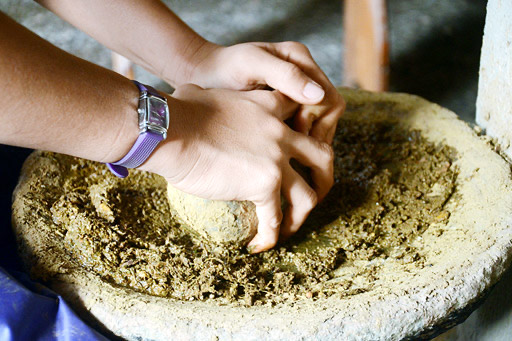 Boreh paste being ground by hand on a stone grinding plate. Photo: Palm Living.
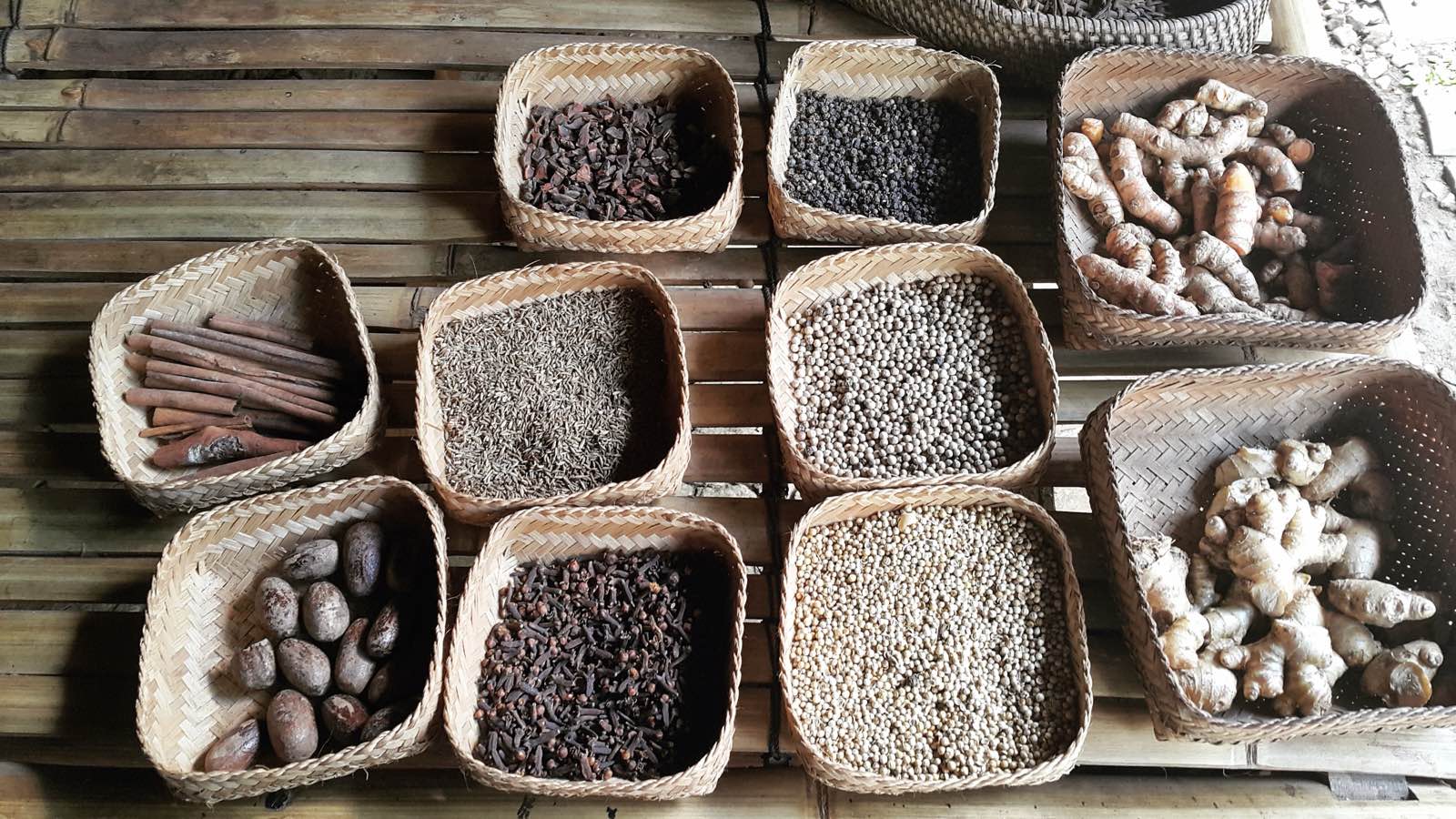 Spices for sale in Bali, among them cloves, nutmeg, ginger and turmeric, which go into boreh anget. Photo: Christine Anggeline / Wikimedia Commons (CC BY-SA 4.0)
Boreh Is a Spice Paste Left to Dry on the Skin
For the Balinese, boreh is whatever is spread on the body and left until it dries, whatever it is made of.
That is how anthropologists from Universitas Udayana define it in a 2024 study of Senganan village in Tabanan. The act of putting it on is meboreh. The same study notes a similar practice in Java, where it is called bobok.
A 2026 review from Universitas Pendidikan Ganesha in Singaraja calls boreh a traditional herbal paste used on the skin. It is used to keep the body healthy and warm, to ease aches, to help small wounds recover and to care for the skin. The knowledge passes down through families and communities.
Boreh is old written medicine too. The lontar Taru Pramana is a palm-leaf manuscript on medicinal plants, and a study in Jurnal Kajian Bali counted how its remedies are prepared. Boreh accounts for 23.61% of them, second only to loloh, the herbal drink, at 33.8%. The study describes boreh as a ground mixture, mixed with water, vinegar or arak to use. Citing an earlier paper by the same researcher, Bali Post names loloh and boreh as the two remedies Balinese people make most often.
Balinese herbal drinks are covered in jamu and loloh. Singaraja's Gedong Kirtya library keeps lontar manuscripts of this kind.
Bali Knows Three Kinds of Boreh
The three kinds differ in their effect on the body. A 2012 study by pharmacists from Sanata Dharma University, in Jurnal Farmasi Sains dan Komunitas, lists them:
- Boreh anget, the warming kind, which the study calls the original Balinese boreh. It is used to warm the body, help circulation and ease muscle and bone pain, fever, chills and headache.
- Boreh miyik, the fragrant kind, made from flowers such as jempiring (gardenia), lavender and rose. The Senganan study describes it as relaxing and cleansing, used at night before sleep, as a body scent or in bath water.
- Boreh tis, the cooling kind, made from avocado, papaya, cucumber, carrot and bengkuang (yam bean). It is used as a lulur, a body scrub, to calm and moisturise the skin.
What Goes Into Boreh Anget
There is no fixed recipe, and each family keeps its own.
A Senganan villager, Gusti Putu Sumarsini, told the Udayana researchers that anything warming will do:
- turmeric
- kencur (aromatic ginger)
- ginger
- cloves
- nutmeg
- sindron and jangu
- rice
Rice goes in almost every time, she said, because it cools the skin and binds the paste.
Weti, a boreh maker who exhibited at the World Water Forum in Nusa Dua in May 2024, named nutmeg, cloves, mesui bark and red rice. Bali Post reported that they are ground together with a little water. In the Badung study, people who wanted more heat simply added more ginger.
Cloves are a cool-country crop, the Badung study notes. In north Bali they grow in the clove gardens around Munduk.
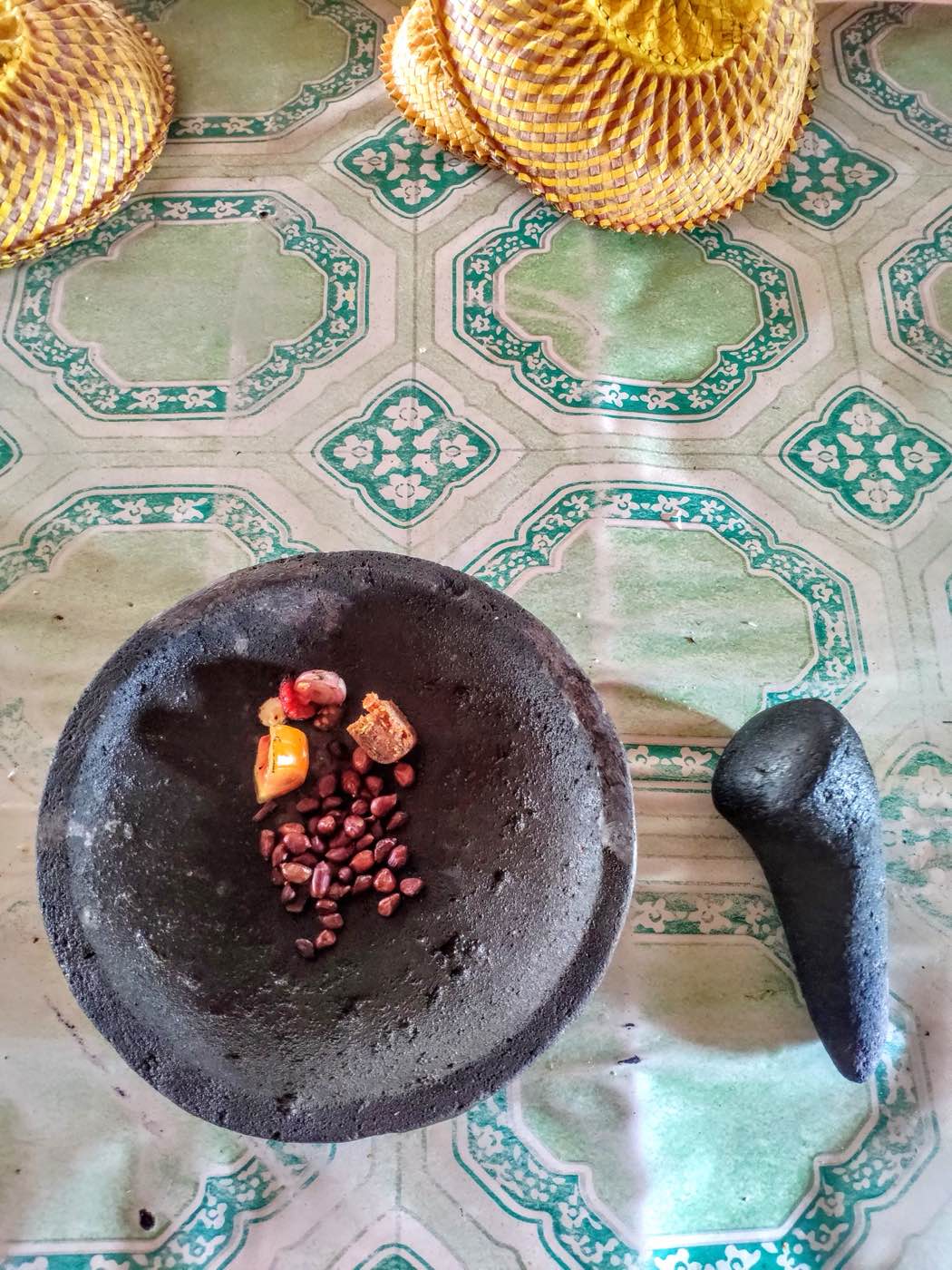 A lava-stone grinding plate and pestle with spices, photographed in a Balinese kitchen. Boreh too is ground on stone. Photo: Ekaterina Kvelidze / Wikimedia Commons (CC BY-SA 4.0)
A Boreh for Wounds in Tenganan
In the village of Tenganan Pegringsingan, boreh is rubbed on the cuts left by the perang pandan, a tradition in which participants are cut by thorny pandan leaves. A detik video report shows young women making it from turmeric, galangal, bengle and vinegar. The Undiksha review gives a different list for the same village: turmeric, ginger, cloves and cinnamon.
How Boreh Is Made and Worn at Home
In Senganan, almost every family owns a grinding stone for boreh, the batu borehan, with its pestle, the anak batu borehan. The stones are kept outside the house. Washed after use, they are covered with a leaf or cloth when it rains.
The ingredients are ground fine and spread over the whole body, or on one part of it. A farmer, Wayan Kresna, described the routine to the researchers:
-
Make the boreh in the afternoon, after work in the rice fields.
-
Spread it over the body at night and sleep on a mat.
-
By morning the paste has dried, and in his account the aches have eased.
In Senganan, a boreh that dries well on the skin is a sign it has done its work.
Freshness matters. In the Badung study, most people made boreh themselves, to be sure it was clean and free of mould and insect dirt. They found it best used straight after making, though it keeps for a day in the fridge.
Boreh at a Spa
Spa boreh grew from the same village remedy.
A Bali producer told Bali Post in 2022 that her spa boreh uses 41 plants. She measures it so it is less hot on the body than the boreh anget of the elders. Her ingredients are dried, pounded in a stone mortar, smoked dry over a fire, ground fine and mixed with liquid.
Bali's provincial culture office has worked to revive the tradition. In 2022 it held a boreh-making competition as part of Jantra Tradisi Bali. Entries had to be made the traditional way, without preservatives, and based on oral tradition or Balinese manuscripts.
In north Bali, boreh is on the menu at a few spas around Lovina. The best spas in north Bali lists them in their own words. For the massage that can follow it, see Balinese massage.
Who Should Avoid Boreh, and When to See a Doctor
The sources set out a few limits, mostly for boreh anget.
- Children: The Badung study found boreh anget was made only for adults, because it is too hot for children. Bali's culture office, for its part, recalls parents making boreh for children who were ill. Ask before using any boreh on a child.
- Allergies: Senganan villagers choose their ingredients freely, as long as the person using it is not allergic to any of them.
- Freshness: Use boreh freshly made, clean and free of mould.
- Real illness: At the 2022 competition, Ida Bagus Alit Suryana of the provincial culture office said medical treatment is still needed. He described remedies from the lontar usada as a way to treat yourself when only mildly unwell.
- Packaged boreh: If you buy a packet to take home, Indonesia's food and drug agency, BPOM, asks shoppers to check the packaging, label, registration and expiry before buying. Registered products can be looked up on cekbpom.pom.go.id.
How to Fit It In
Boreh anget belongs to cool weather. The Undiksha review notes it is used most in cold places such as Senganan, and a Lovina spa offers it especially in the cold, rainy months.
On the coast, book it at a Lovina spa after a morning on the water. Inland, Munduk is cool highland country, the kind of climate boreh anget was made for. For the healers behind the tradition, traditional healers in north Bali explains the balian who work from the lontar usada.
Practical Notes
- Ask how hot it is. Makers set the warmth themselves, and one spa producer makes hers milder than village boreh anget.
- Let it dry, then wash it off. Drying on the skin is part of the treatment.
- Expect a strong smell. The provincial culture office suggests the aroma is one reason fewer people use boreh today.
- Tell the therapist about allergies before the paste goes on.
- Packets: check the BPOM registration before you buy.
FAQ
What is boreh? Boreh is a traditional Balinese paste of ground spices, roots and rice, spread on the body and left to dry. The warming kind, boreh anget, is used to warm the body and ease aches, chills and fever. Flower and fruit versions are used as body scrubs.
What does boreh mean in English? There is no single English word. It is usually called a Balinese herbal paste, or a spice paste or body rub. In Balinese, meboreh means putting it on.
What is a boreh scrub? A body scrub made from boreh. Bali Post describes boreh miyik, from flowers, and boreh tis, from fruit and vegetables, as the kinds used for scrubs (lulur). One spa producer also makes a milder boreh anget for treatments.
What is boreh made of? Boreh anget is made from warming spices and roots such as ginger, turmeric, kencur, cloves and nutmeg, with rice to bind it. It is ground on stone and mixed with water, and a study of the lontar Taru Pramana also names vinegar and arak.
Is boreh Balinese or Javanese? Boreh is Balinese. The Udayana study notes a similar practice in Java, where it is called bobok.
Who should not use boreh? A pharmacy study found boreh anget too hot for children, so ask before using it on a child. Anyone allergic to an ingredient should leave it out. For a real illness, see a doctor. Bali's culture office says medical treatment is still needed, and keeps traditional remedies for mild complaints.
Sources
- Febriana, Polin and Aliffiati (Universitas Udayana), Meboreh Ne Malu: boreh anget in Senganan village, Tabanan, Balale Jurnal Antropologi 5(2), 2024, read October 2026 (in Indonesian)
- Hartayu and Widiasih (Sanata Dharma University), Understanding of boreh anget in Pererenan, Badung, Jurnal Farmasi Sains dan Komunitas 9(2), November 2012, read October 2026 (in Indonesian)
- Arsana, Medicinal plants in the lontar Taru Pramana, Jurnal Kajian Bali 9(1), April 2019, read October 2026 (in Indonesian)
- Wicaksana, Citrawathi and Dewi (Universitas Pendidikan Ganesha), Boreh in contextual biology teaching, July 2026, read October 2026 (in Indonesian)
- Bali Post, Boreh, Bali's own skin care, 3 June 2022, read October 2026 (in Indonesian)
- Bali Post, Bali farmers show boreh and spiced arak at the World Water Forum, 21 May 2024, read October 2026 (in Indonesian)
- detik, Boreh for wounds in Tenganan Pegringsingan, video, 15 July 2025, read October 2026 (in Indonesian)
- Dinas Kebudayaan Provinsi Bali, Boreh-making competition revives traditional remedies, June 2022, read October 2026 (in Indonesian)
- Badan POM, Cek KLIK: packaging, label, registration and expiry, April 2023, and Cek BPOM product search, read October 2026 (in Indonesian)
Read next: the best spas in north Bali, Balinese massage, jamu and loloh and traditional healers in north Bali.