On this page
Building on the north coast runs in an order, and the order matters more than the budget: the land, then the structure you hold it through, then the permits, then the builder. This is the sequence, with the laws, registers and portals each stage runs through.
In Brief
A villa build in north Bali starts with a plot and a certificate, and the certificate is checked against the national land agency's records rather than taken on trust. How a foreign owner holds that land is settled next, because Indonesian law reserves freehold for Indonesian citizens and the answer decides whether the house sits on a lease, on a right of use, or in a company. Permits follow: a business identity number and risk-based licensing through the government's OSS system if a company owns or lets the house, then the building approval, PBG, through the public works ministry's SIMBG portal, and the certificate of function, SLF, once the house is finished. The builder comes after all of that, not before.
Building in North Bali at a Glance
- Check the land: the national land agency, ATR/BPN, with its Sentuh Tanahku app and the BHUMI interactive land map
- Decide how you hold it: a lease, Hak Pakai (right of use), or a PT PMA company holding Hak Guna Bangunan (right to build)
- Company and licensing: the OSS system, Indonesia's risk-based business licensing portal, run by the investment ministry, BKPM
- Building approval: PBG, applied for on SIMBG, the public works ministry's building system, and processed by the regency
- On completion: SLF, the certificate that the finished building is fit for use
- Land listings in the north: north Bali land at bali-information.com
- Costs: see what it costs to build a villa in Bali; no figures are quoted here because they move
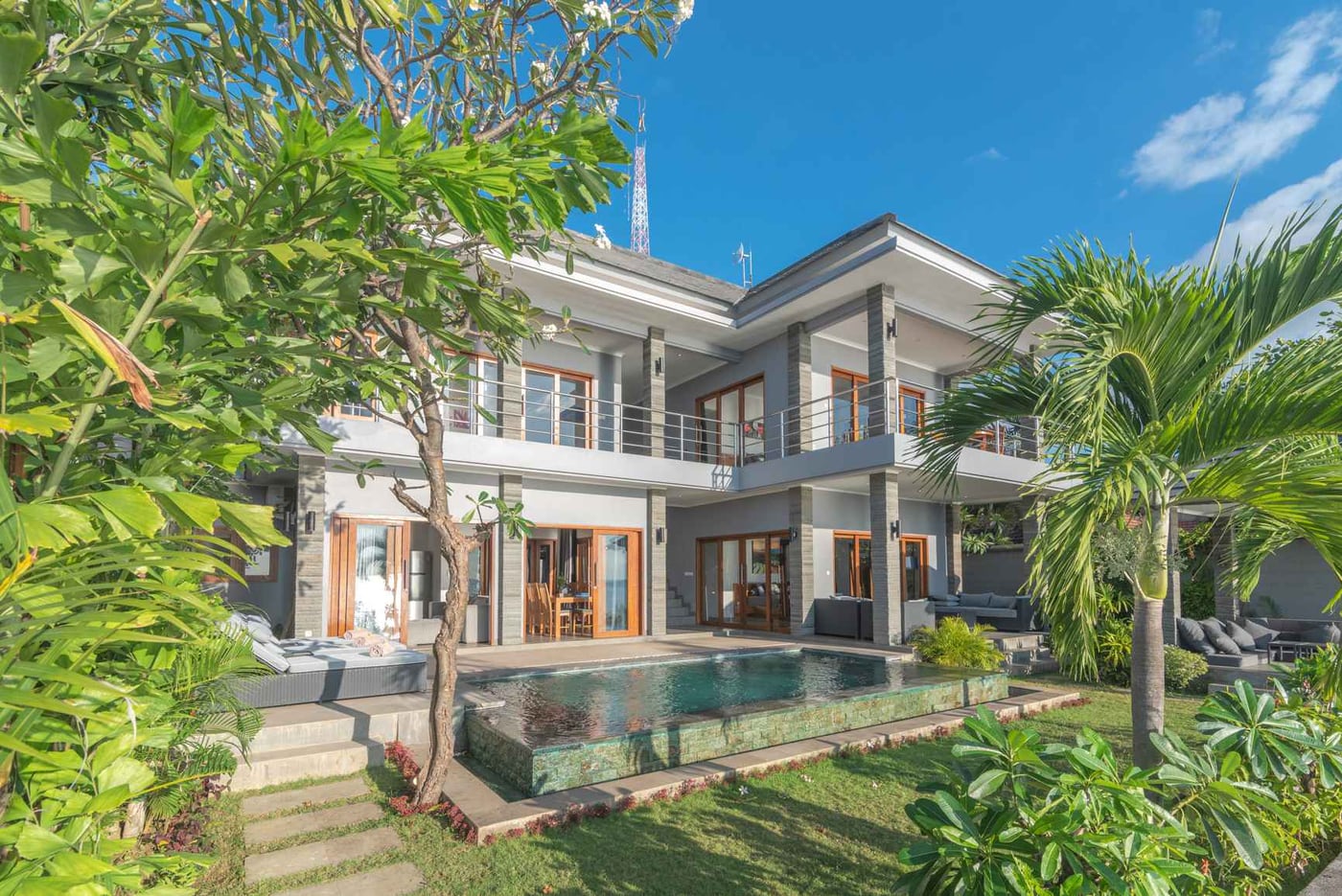
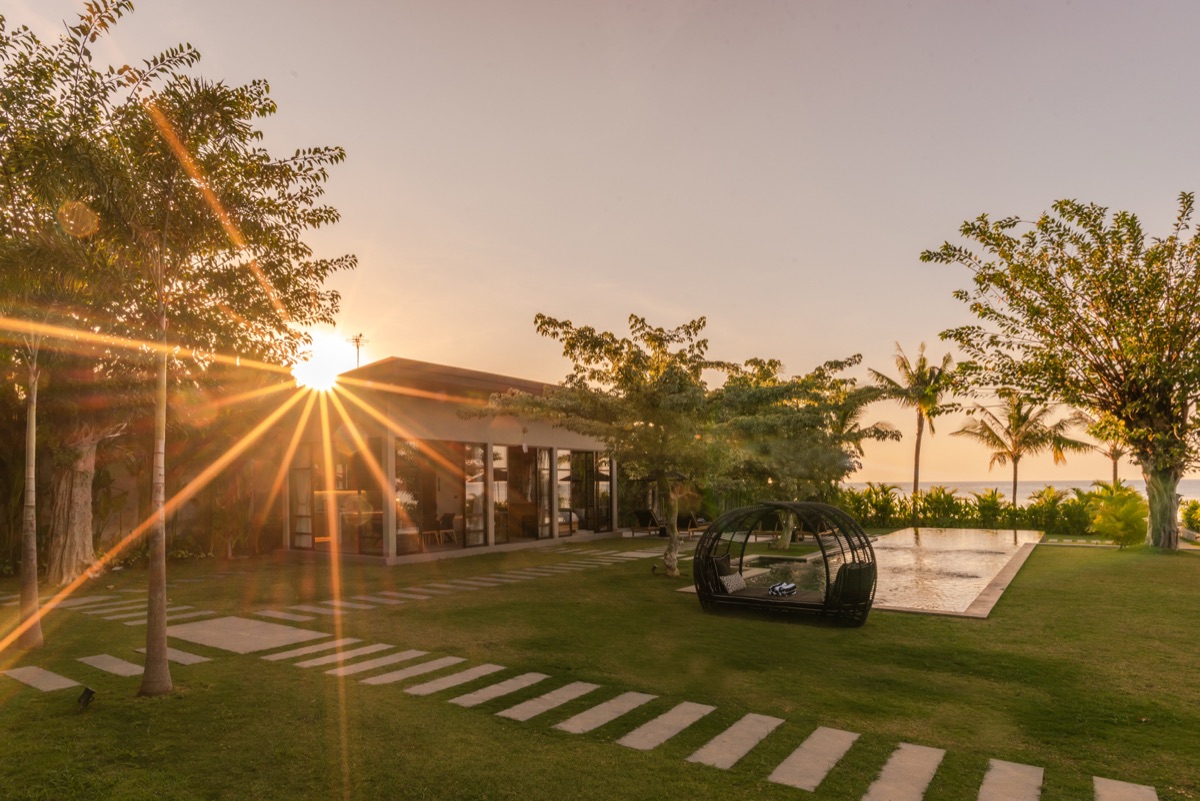 What a finished north-coast build delivers. Photo: Palm Living archive.
Stage One: The Land
Everything downstream depends on getting this right.
Check the certificate against the register, not the seller. Indonesia registers land through the Ministry of Agrarian Affairs and Spatial Planning and the National Land Agency, ATR/BPN. Its Sentuh Tanahku app includes a parcel check and a map of registered parcels, and BHUMI is the ministry's interactive land map. Ask the land deed official, the PPAT, who will draw up the transfer to check the certificate at the land office as well. Do both.
Watch for old proofs of ownership. SIMBG, the building permit portal, warns that under Government Regulation 18 of 2021, traditional proofs of land ownership such as Letter C, girik and petok D are no longer valid on their own, and tells applicants relying on them to register the land at the local land office. A plot offered on one of these papers needs registering before anything else happens.
Read the boundaries on the ground. Walk the boundaries with the seller, the neighbours and the village head present, and compare what you see with the parcel on the map.
Confirm what may be built there. SIMBG will not take a building application until you hold two prerequisite documents: an environmental document and a spatial use permit. The spatial permit comes through ATR/BPN or the regency's spatial planning office, and it is the step that tells you whether a house is allowed on the plot at all. Establish this before money moves.
Check access, water and power. A road wide enough for a concrete truck, a legal right of way in writing, a water source and a realistic distance to a power connection are four separate questions. Ask each one before you commit.
For what land costs by area, see land prices in north Bali; for which areas suit which purpose, the best areas to invest in north Bali. Palm Living's sister site lists plots at north Bali land.
Stage Two: How You Will Hold It
The Basic Agrarian Law of 1960 sets the rules. Only Indonesian citizens can hold Hak Milik, Indonesian freehold. That leaves a foreign owner three routes:
- A lease. The same law recognises a right to lease land from its owner for building, paid once or in instalments.
- Hak Pakai, a right of use. Foreigners domiciled in Indonesia may hold it. Government Regulation 18 of 2021 lets a foreigner with the required immigration documents own a house on Hak Pakai land, including Hak Pakai granted over freehold land by a PPAT deed.
- A PT PMA holding Hak Guna Bangunan. The right to build can be held by a company established under Indonesian law and domiciled in Indonesia, and the Investment Law of 2007 requires foreign investment to take the form of exactly such a company, a PT PMA.
Each route has different tax, renewal, resale and exit consequences, and the choice shapes the build contract, so settle it with a lawyer or notary before the build. Check that the term you hold is long enough for the house you plan to build on it.
Property ownership in Bali sets out each route, and leasehold versus freehold covers the comparison in detail. For background from the north Bali side, Palm Living's sister site keeps a buyer's page on Indonesian ownership laws.
One warning worth repeating: a nominee arrangement, where freehold is held in an Indonesian friend's name for a foreigner, is not a structure. The Basic Agrarian Law says any transfer meant to pass freehold to a foreigner, directly or indirectly, is void by law and the land falls to the state.
Stage Three: The Permits
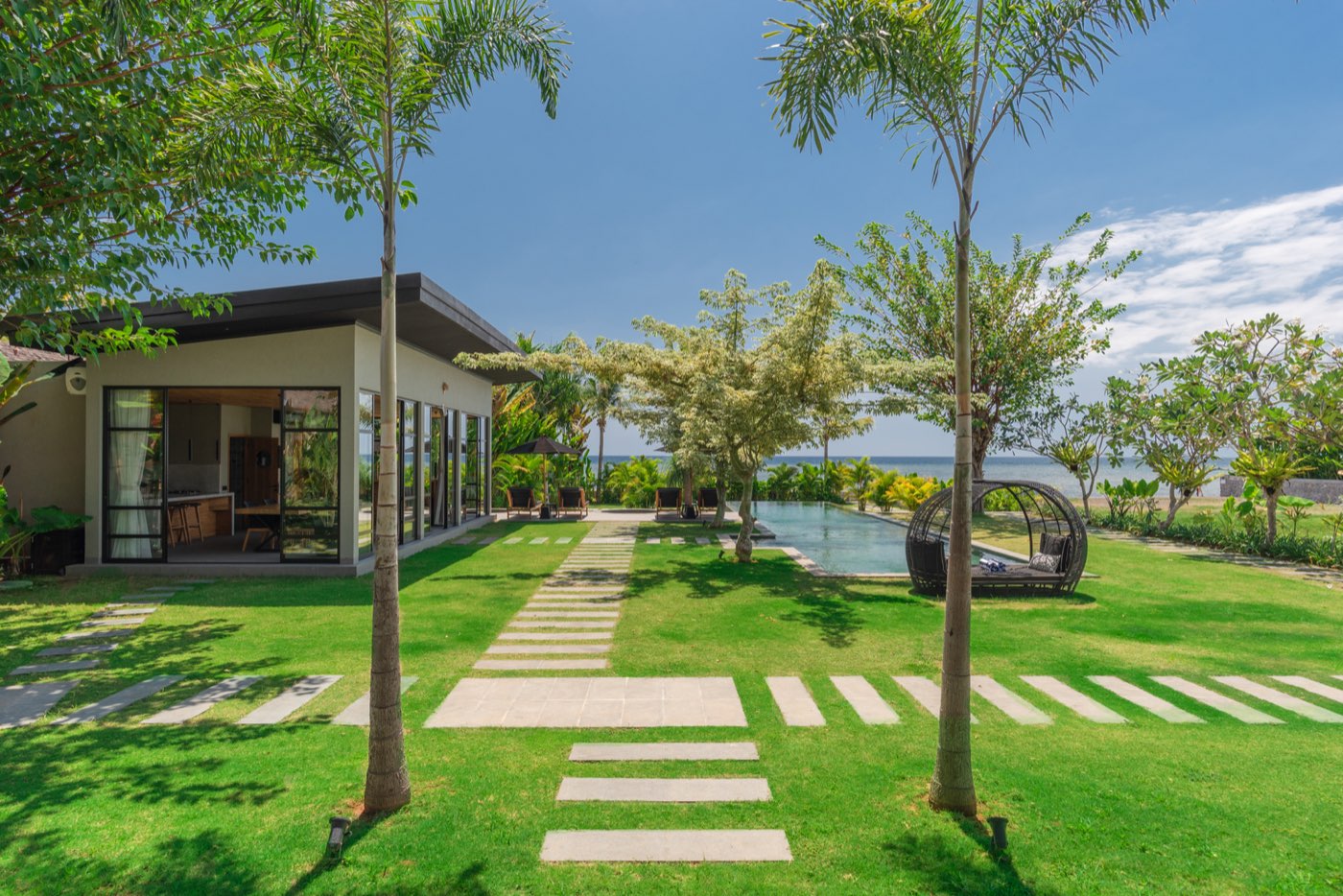 Photo: Palm Living archive.
Indonesia runs business and building approvals through national online systems, and the two that matter for a villa are OSS and SIMBG.
OSS, for the company and the licence. The Online Single Submission system issues the NIB, the business identification number that is the official identity for starting or running a business in Indonesia, and sorts business activities into four risk levels that decide which permits and obligations apply. The portal also lets you check that an NIB is valid. A PT PMA, or a house let to guests as a business, runs through it. BKPM, the investment ministry, describes OSS as the one-stop route to risk-based business licences.
SIMBG, for the building approval. PBG, Persetujuan Bangunan Gedung, is the approval that confirms a design meets the technical standards and lets construction begin. Applications go through SIMBG, the web-based building information system of the Ministry of Public Works, which handles PBG, SLF, SBKBG and RTB under Government Regulation 16 of 2021. The regency's building and licensing offices process the application for the place where the house will stand. Soil investigation is required for buildings over two storeys or on unstable ground. Once PBG is issued, the construction schedule has to reach the regency's technical office within six months or the approval is revoked.
SLF, at the end. Sertifikat Laik Fungsi is issued when construction is finished, and it is the document that declares the building fit for use. For a building that already stands without a permit, SIMBG processes PBG and SLF together through an SLF application for an existing building.
Checking a permit is genuine. SIMBG says each PBG and SLF decision carries a QR code, and scanning it should open a page on the official domain, simbg.pu.go.id, over HTTPS. A link to any other address is a warning sign.
Keep every approval document, and get the permits in the name of whoever will own the house.
Stage Four: Choosing Who Builds It
Three practical points.
See finished work, not renderings. Ask for two or three completed houses in the area and visit them. Ask the owners what the builder was like at month seven, not month one.
Get a contract with a schedule of payments tied to stages. Payment against completed stages, with a retention held until defects are closed, protects both sides.
Decide who supervises. An architect or project manager acting for you and visiting regularly is worth budgeting for, especially for an owner who is not living on site.
Stage Five: The Build
Plan the work around the seasons: the dry season runs roughly April to October, and when to visit north Bali sets out the pattern. Ask the builder which village ceremony days fall inside the programme and how they affect the crew, and build them into the schedule rather than discovering them.
Expect the site to be part of the village while it runs. The banjar, the community association that organises ceremonies and village decisions, is the body to know; how the banjar works explains it. Talk to the village about access and working hours before the first truck arrives.
For the money side, stage by stage, see what it costs to build a villa in Bali.
Stage Six: Handover, and the First Guests
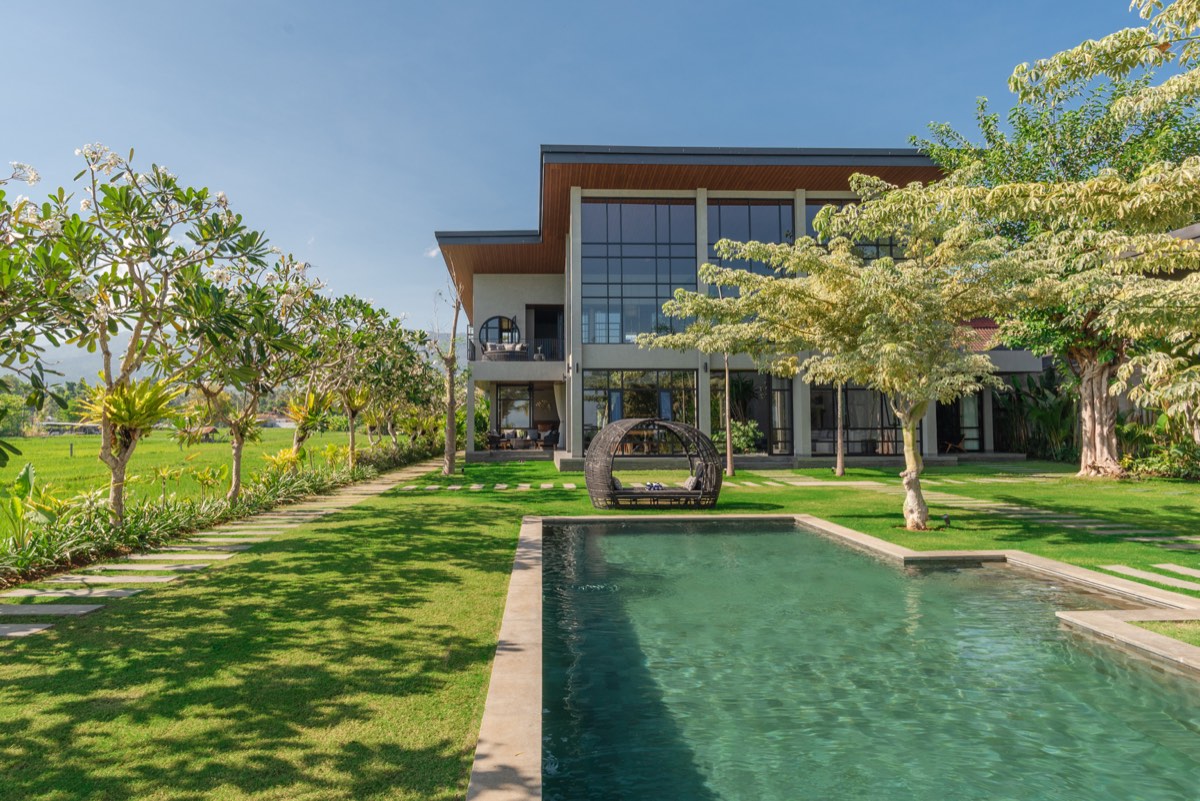 Pool, lawn and rice-field edge near Lovina. Photo: Palm Living archive.
Handover is a snagging list, the as-built drawings, the SLF, and the manuals and warranties for everything mechanical. Pool plant, pumps, water treatment and air conditioning need a maintenance arrangement from day one.
Then the question of what the house is for. A holiday house used a few weeks a year still needs someone to look after it. A house let to guests is a business, and a business starts with an NIB through OSS. Rental yields in north Bali covers what the numbers look like, long-term rentals covers the alternative, and Palm Living lets houses along this coast through its villa rental collection.
Why invest in north Bali sets out the wider case, and moving to north Bali covers living here while the build runs.
Practical Notes
- Use a PPAT you chose, rather than the seller's.
- Keep every document in both languages and know which version governs.
- Photograph the build weekly, dated, including what goes underground.
- Register utilities in the right name from the start.
- Allow for the drive. The road from Ngurah Rai airport crosses the mountains, which shapes every site visit and every delivery.
- Ask about the ground before you design a basement or a deep pool; SIMBG requires soil investigation above two storeys or on unstable ground.
FAQ
Can a foreigner build a villa in north Bali?
A foreigner cannot hold Hak Milik, Indonesian freehold. The house is built on a lease, on Hak Pakai, which a foreigner with the required immigration documents may hold, or on land held by a PT PMA under Hak Guna Bangunan. The structure is decided before the build starts.
What permits does a villa in Bali need?
PBG, the building approval, through the SIMBG portal before construction, after the environmental document and the spatial use permit are in hand, and SLF, the certificate of function, when the building is finished. If a company owns the house or it is let as a business, the company and its licences run through OSS.
How do I check a Bali land certificate is genuine?
Check the plot against the national land agency's own records using the Sentuh Tanahku app and the BHUMI land map, and have the PPAT check the certificate at the land office. Do not rely on a copy supplied by the seller.
What is PBG and where do I apply for it?
PBG, Persetujuan Bangunan Gedung, is the approval that a building design meets the technical standards, and it is needed before construction starts. Applications go through SIMBG, the Ministry of Public Works building information system, and the regency processes them.
Does a PBG expire?
SIMBG says the construction schedule must be submitted to the regency's technical office within six months of the PBG being issued, or the approval is revoked. A PBG for a finished building stays valid as long as the building is not changed.
What happens if a house was built without a permit?
SIMBG handles a standing building without an IMB or PBG through an SLF application for an existing building, which issues PBG and SLF together. Before you buy an existing house, ask for both documents and scan their QR codes.
Sources
- Kementerian ATR/BPN, Sentuh Tanahku (parcel check, registered-parcel map and certificate features) and BHUMI (the ministry's interactive land map), Indonesian, read September 2026
- Kementerian Pekerjaan Umum, SIMBG (PBG, SLF, SBKBG and RTB under Government Regulation 16 of 2021; prerequisite environmental and spatial documents; regency processing; soil investigation; six-month construction schedule; SLF for existing buildings; QR-code check; traditional land proofs under Government Regulation 18 of 2021), Indonesian, read September 2026
- Lembaga OSS, OSS (NIB, four risk levels, NIB validity check), Indonesian, and Kementerian Investasi dan Hilirisasi/BKPM, OSS (one-stop risk-based business licensing), read September 2026
- JDIH BPK, Law 5 of 1960 on Basic Agrarian Principles (Articles 21 and 26 on freehold and void transfers to foreigners, 36 on Hak Guna Bangunan, 42 on Hak Pakai, 44 on leases for building), Indonesian, read September 2026
- JDIH BPK, Government Regulation 18 of 2021 (Articles 69 and 71 on houses owned by foreigners on Hak Pakai), Indonesian, read September 2026
- JDIH BPK, Law 25 of 2007 on Investment (Article 5: foreign investment in the form of a limited company under Indonesian law), Indonesian, read September 2026
- BPI / Palm Living, north Bali land for sale and Indonesian ownership laws (Palm Living's sister site, plot listings and a buyer's FAQ), read September 2026
- Palm Living, villas for rent, read September 2026
Next: what it costs to build a villa in Bali, property ownership in Bali for the structure, and land prices in north Bali for the plot.