On this page
- In Brief
- The Bali Customs Declaration at a Glance
- The Declaration Is Now a Section of the Arrival Card
- Every Passenger Files, and a Family Can File Together
- How to File It: Five Steps From the Portal to the Customs Checkpoint
- What You Have to Declare: Anything Over an Allowance, or Controlled
- Duty-Free Allowances Are Set Per Passenger, by Age and Type of Goods
- The Declaration Covers Your Goods, and the Visa Covers Your Entry
- Practical Notes
- FAQ
- Sources
Last updated: September 2026
In Brief
The Bali customs declaration is filed online, inside the All Indonesia arrival card at allindonesia.imigrasi.go.id. Immigration and Customs have folded it into that one government form. The card carries the immigration, customs, health and quarantine questions together, and returns the QR code you show on arrival.
Every traveller arriving in Indonesia files one before passing through customs at the airport. Submit it no earlier than three days before you land, save the QR code offline, and declare anything above the duty-free allowance.
The declaration is not your visa. The only sites worth using are the government ones linked on this page.
The Bali Customs Declaration at a Glance
- What it is: the customs declaration section of Indonesia's arrival card, the digital replacement for the old paper customs form
- Where to file it: the official All Indonesia portal run by the Directorate General of Immigration, which combines immigration, customs, health and quarantine
- Customs' own portal: the e-CD site now sends air and sea arrivals to All Indonesia, and keeps its standalone form for land crossings
- Who files: every passenger and crew member bound for Indonesia, Indonesian citizens and foreign nationals alike
- When: up to three days before arrival
- Families: one customs declaration can cover the goods of a family travelling together, and the arrival card takes group submissions
- What you get: a QR code, shown to officers when you arrive at Ngurah Rai (DPS)
- What you declare: goods over the duty-free allowance, currency at or above the reporting threshold, commercial goods, plants and animal products, medicines and restricted items
- Not the same as: your visa or visa on arrival
The Declaration Is Now a Section of the Arrival Card
The paper customs card is gone. For years, arrivals filled in a small card on the plane and handed it to an officer at the airport.
The declaration moved online, and then it moved again. Immigration now runs a single arrival card, All Indonesia. The Ministry of Foreign Affairs describes it as immigration, customs, health and quarantine brought together in one form, filled in once, before or on arrival.
Your customs declaration is a section inside that card, with no separate errand to run.
Customs keeps its own portal for land crossings and the rules on goods
Indonesian Customs still runs its own e-CD portal, and for arrivals by air and sea it points straight to All Indonesia. Customs keeps its own form for land crossings.
Its customs declaration page is still worth reading before you pack. It sets out the full list of what must be declared and the duty-free allowances. Treat Customs as the authority on anything to do with goods.
Every Passenger Files, and a Family Can File Together
Everyone files. All Indonesia has an arrival card for Indonesian citizens and one for foreign visitors. Customs states that every passenger and crew member bound for Indonesia files the customs declaration through it.
There is no tourist exemption. It makes no difference whether you come for a week on the beach, to relocate or on business.
Children are travellers too, and their details go into the submission. The arrival card can be submitted for a group as well as individually, and Customs lets you declare your family's goods together in one customs declaration.
Some parties are less simple, such as a mixed group or people on separate bookings. For those, check the portal's help centre, which has a section on group submissions, before you guess.
How to File It: Five Steps From the Portal to the Customs Checkpoint
The process is short: one online form, then one QR code to show at the airport.
1. Wait until you are three days from landing
The arrival card can be completed up to three days before your scheduled arrival, the Ministry of Foreign Affairs notes. Trying to finish it weeks ahead, with the rest of your trip admin, gets you nowhere.
The reason is the flight detail. The form ties to your specific arrival, so file once your flight is locked and you are inside the window. The day before you fly is the simplest moment.
2. Open the government portal, and no other site
Use the government domains and nothing else. The arrival card is at allindonesia.imigrasi.go.id, and anything about goods is on Customs' ecd.beacukai.go.id.
Around any country's arrival process there are copycat sites that charge a service fee to fill in an official form for you. Immigration's own e-visa site warns that such sites are not endorsed by or associated with the Indonesian government.
3. Enter your details and answer the questions
Immigration offices explain the order. You enter your personal and passport details, your flight and where you are staying. Then you answer the customs and health questions and submit.
The customs questions are the standard ones. They ask who in your family is travelling with you, and whether you are carrying anything that needs declaring. The section on what to declare, below, has the full list.
4. Save the QR code where it opens without a signal
The portal returns a QR code as soon as you submit. Screenshot it or download it, so it sits in your phone's gallery and opens without a signal.
Airport wifi at arrivals is not something to rely on, and reloading a website while the queue builds behind you is a poor start. Printing the code is a fine backup if you prefer paper. The portal also has a retrieve page if you lose it.
5. Show the code at the customs checkpoint
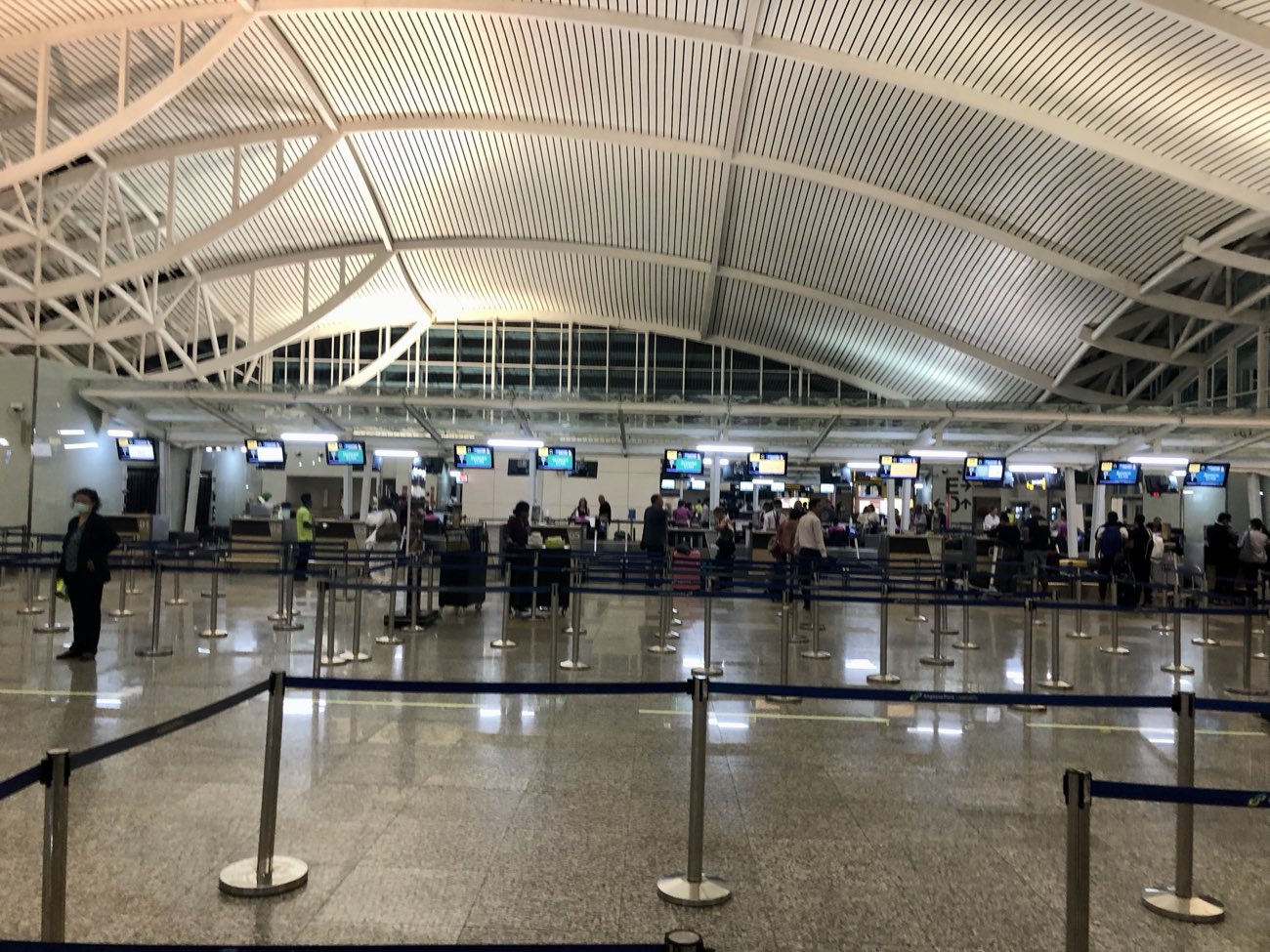
At the airport you land, clear immigration and collect your bags, then reach the customs checkpoint on the way out. An officer scans your QR code. If you have nothing to declare, that is usually the whole interaction.
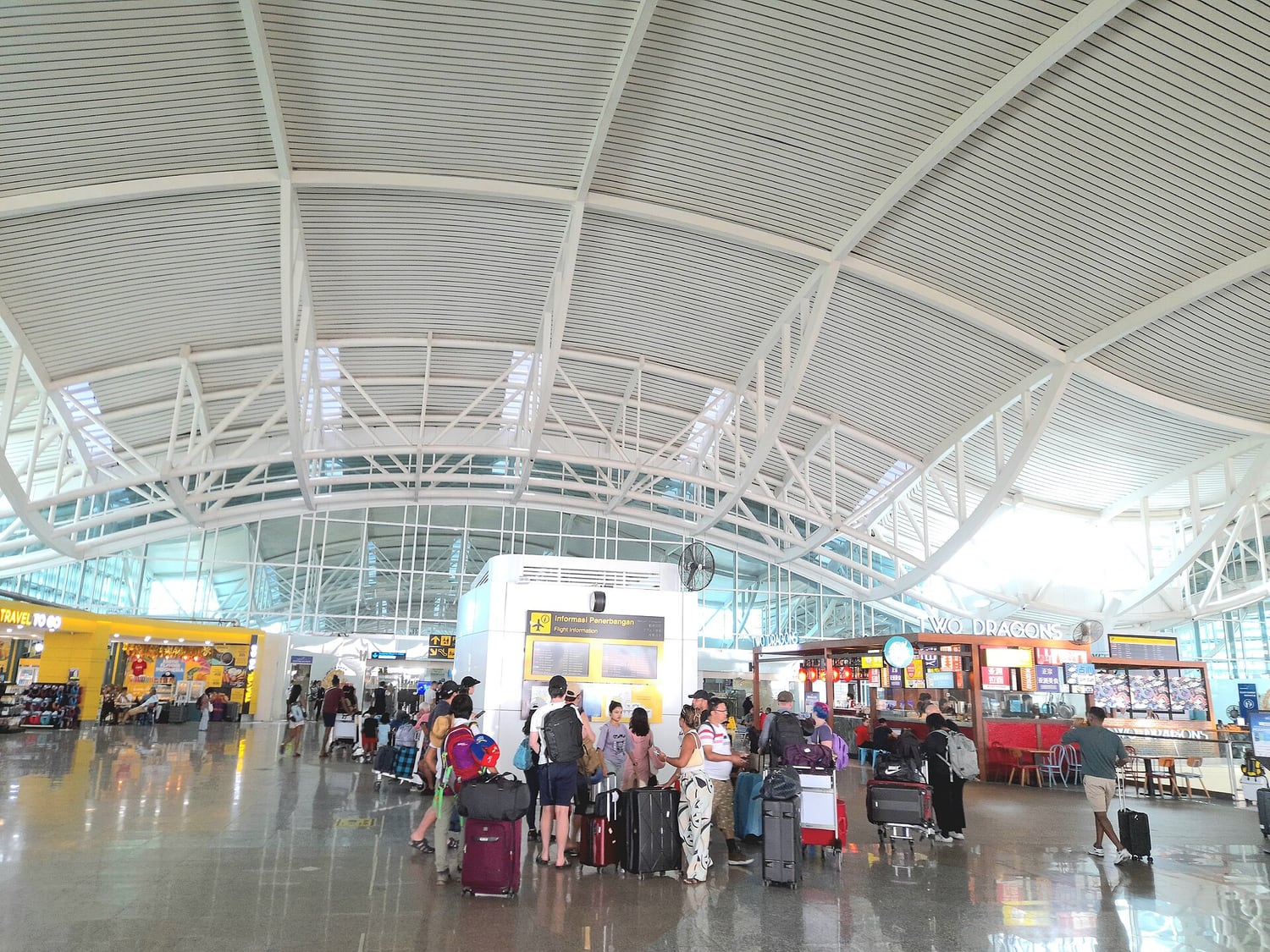 The international terminal at Ngurah Rai, where the arrival card QR code is scanned. Photo: Ardfeb / Wikimedia Commons (CC BY-SA 4.0)
Filing on arrival is allowed, and slow
You may fill in the card after you land. Completing the form in a moving queue with a tired family is the slow way to do it. Get the QR code before you fly.
What You Have to Declare: Anything Over an Allowance, or Controlled
Most holiday travellers have nothing to declare, and the honest answer to the form's questions is a clean pass. You still file the declaration, and you answer no to the items that do not apply.
You declare when you exceed an allowance or carry something controlled. Customs' declaration page lists what counts:
- Goods over the duty-free allowance: alcohol and tobacco above the per-person limits, and personal goods bought abroad above the value cap
- Currency at or above the reporting threshold: cash or other payment instruments, in rupiah or foreign currency, above the rupiah figure Customs publishes on that page
- Commercial goods or merchandise intended for sale, not for personal use
- Animals, fish and plants, and products made from them: quarantine is one of the four services now inside the arrival card
- Medicines, narcotics and psychotropics: Customs states plainly that carrying narcotics or illegal drugs is a violation and is sanctioned, so this is not a category to be casual about
- Weapons, ammunition and explosives
- Phones and tablets bought abroad that you will use on an Indonesian mobile network: report them to Customs at the arrival terminal
Over a limit: duty on goods, destruction for alcohol and tobacco
What happens when you are over a limit depends on the item. Personal goods above the value cap are charged import duty and tax on the excess.
Alcohol and tobacco above the allowance are not taxed and waved through. Customs states that the excess is destroyed by its officers.
The real problem is failing to declare something you should have. A false declaration carries its own sanctions, so when in doubt, declare it.
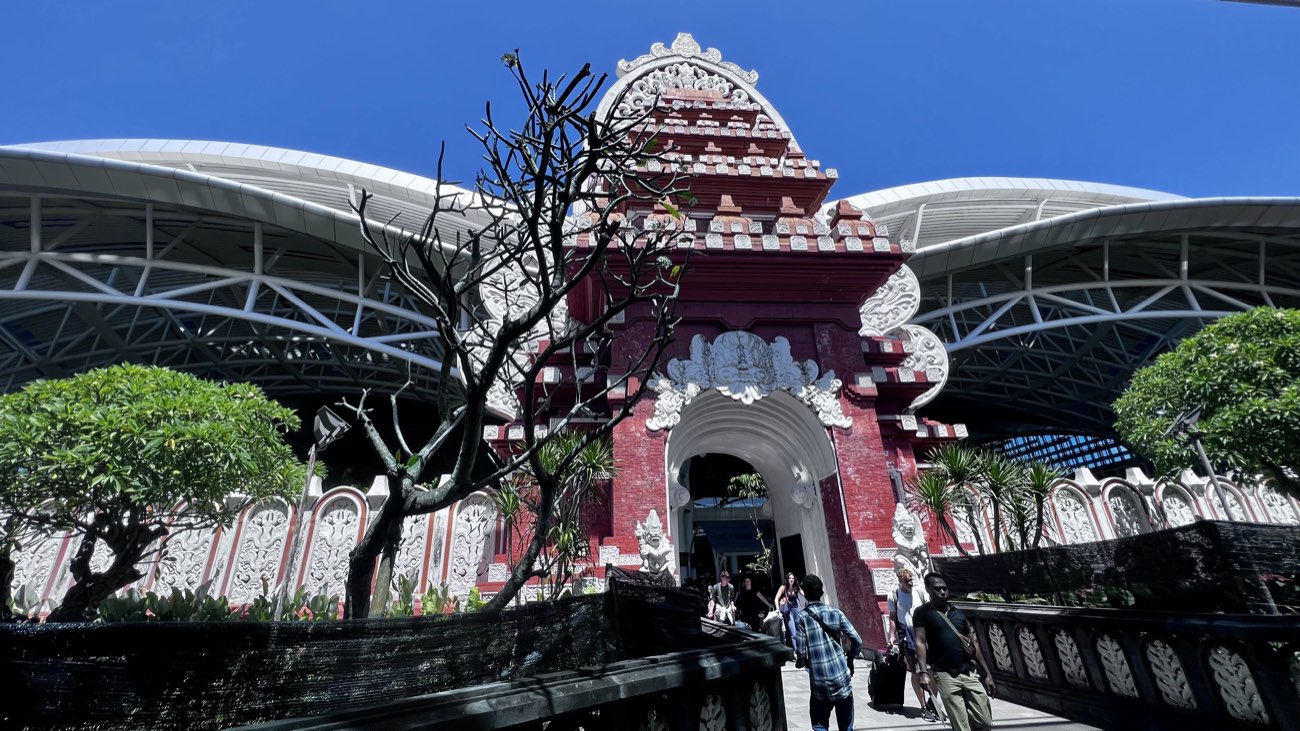 The gate entrance at Ngurah Rai. Photo: Pinterpandai.com / Wikimedia Commons (CC BY-SA 3.0)
Duty-Free Allowances Are Set Per Passenger, by Age and Type of Goods
The personal duty-free allowance covers what an ordinary traveller brings for their own use. Customs publishes the figures on its declaration page and in its passenger FAQ. The numbers are best read there, and the structure is worth understanding first:
- Alcohol. A volume limit per passenger aged 21 or over.
- Tobacco. A per-passenger limit for those aged 18 or over, set separately for cigarettes, cigars, sliced tobacco, other tobacco products and e-cigarettes. If you bring more than one kind, the allowance is applied proportionally across them, and is not granted in full for each.
- Other personal goods. A value cap per person, set in US dollars, on goods bought or obtained overseas that will stay in Indonesia. Above the cap, duty and tax apply to the excess.
- Crew. Allowances are lower than passenger allowances, which occasionally catches out people arriving on a working flight.
The goods allowance is given to each passenger's own baggage, so one traveller cannot claim the family's combined limit.
Outdated figures also circulate widely on travel sites, including some that look authoritative. Confirm the current numbers with Customs before you pack anything close to a limit.
The Declaration Covers Your Goods, and the Visa Covers Your Entry
Travellers often blur several separate steps into one, and each does a different job.
The customs declaration is about your goods, meaning what you are carrying into the country. It sits inside the arrival card and produces the QR code you show on arrival.
The arrival card is the wrapper. Since Immigration merged the steps, the health and quarantine questions that used to live on separate passes are answered inside it too. A normal arrival no longer has a separate health form to chase. If conditions change, Immigration and the health ministry announce it on their own sites.
A visa or visa on arrival is your permission to enter. It is a different process with its own fee, handled at immigration or pre-arranged on the official e-visa site. Filing the customs declaration does not cover your visa, and holding a visa does not cover your declaration.
Bali also charges a separate tourist levy on foreign visitors. It is its own payment, with nothing to do with customs.
The Bali visa guide covers the entry side, and the Indonesia arrival card page covers the form itself in detail. For the levy, see the Bali tourist tax.
Practical Notes
- File inside the three-day window, from your phone or laptop, before you leave home or at the departure airport.
- Use the group submission if you are travelling as a family, in place of one card per person.
- Save the QR code offline, and keep a second copy somewhere you can reach without a signal.
- Answer honestly. The declaration questions are simple, and Customs sanctions any false declaration.
- Check allowances at source if you are carrying duty-free drink, tobacco, gifts, or electronics beyond your own devices.
- Allow time on arrival. Ngurah Rai is busy at the overnight arrival peak, and the drive north to Lovina takes around three hours after that.
Once you are through, getting to north Bali and the north Bali travel guide cover the road, the transfer options and what to arrange ahead.
FAQ
Is the Bali customs declaration mandatory? Yes. Every passenger and crew member bound for Indonesia files a customs declaration, and it now sits inside the All Indonesia arrival card. It applies to tourists, residents and Indonesian citizens, with no exemption for a short holiday.
Where do I fill in the Bali customs declaration? On the official All Indonesia portal at allindonesia.imigrasi.go.id, run by the Directorate General of Immigration. Customs' own ecd.beacukai.go.id sends air and sea arrivals there and keeps its standalone form for land crossings. Use only those government sites. Third-party pages that charge a service fee to file for you are unofficial.
When should I complete the customs declaration? Within three days before you arrive in Indonesia. The arrival card can be completed up to three days ahead, so the day before you fly is the simplest moment.
Do I need to print the QR code? No. A screenshot or saved image on your phone works. Save it offline so it opens without a signal at the airport. A printout is a fine backup, and the portal's retrieve page finds a lost card.
Does each person file a separate declaration? Not necessarily. The arrival card can be submitted for a group, and Customs lets a family declare its goods together in one declaration, children included. Solo travellers file their own. Check the portal's help centre if your group is split across bookings.
What happens if I forget to file before I land? The arrival card can be filled in on arrival as well as before, but doing it in the queue slows you down. Filing before you fly and arriving with the QR code ready is the smoother path.
What do I have to declare on arrival in Bali? Goods over the duty-free allowance, currency at or above the reporting threshold, commercial merchandise, animals, fish and plants and their products, medicines, and restricted items such as weapons. Phones and tablets bought abroad for use on an Indonesian network are reported too. Most holiday travellers have nothing to declare.
What is the duty-free allowance for Bali? Indonesia sets a volume limit on alcohol for passengers aged 21 or over, tobacco limits for those aged 18 or over, and a value cap in US dollars on other personal goods. Excess alcohol and tobacco is destroyed, not taxed. Customs publishes the current figures on its declaration page. Check them there and not on a travel site, since outdated numbers circulate widely.
Do I still need a separate health declaration for Bali? Not for a normal arrival. The health and quarantine questions were merged into the All Indonesia arrival card along with customs, which is the point of the single form. If requirements change, Immigration and the health ministry publish it on their own sites.
Is the customs declaration the same as the visa on arrival? No. The declaration covers the goods you carry and produces the QR code you show on arrival. The visa on arrival is your permission to enter, paid and processed separately. They are different steps with different portals.
Sources
- Directorate General of Immigration, Republic of Indonesia, All Indonesia arrival card portal, with its help centre and retrieve pages (the arrival cards for Indonesian citizens and foreign visitors, the group-submission help topic, and retrieving a submitted card), read September 2026
- Ministry of Foreign Affairs, Republic of Indonesia, Embassy in Madrid, All Indonesia: Simplifying Passenger Arrival (immigration, customs, health and quarantine combined in one form, filled once before or on arrival, up to three days ahead, individually or in groups), read September 2026
- Immigration Office Cirebon, Directorate General of Immigration, All Indonesia (Indonesia Arrival Card) (the submission steps, the customs and health questions, and the QR code), Indonesian and English, read September 2026
- Directorate General of Customs and Excise, e-CD portal and its Customs Declaration (BC 2.2) page (all passengers and crew file the customs declaration through All Indonesia, the land-crossing form, one declaration for a family's goods, the goods to declare, the currency reporting threshold, the duty-free allowances with their age limits, proportional tobacco allowance and lower crew allowances, destruction of excess alcohol and tobacco, phone and tablet reporting, and sanctions for false declarations), Indonesian, read September 2026
- Directorate General of Customs and Excise, Frequently Asked Questions (personal goods, the per-person US-dollar value cap, duty and tax on the excess, and the crew allowance), Indonesian, read September 2026
- Directorate General of Immigration, official e-visa information on the visitor visa (the visa step, separate and paid, and the warning about unofficial sites that charge a service fee), read September 2026
Read next: the Indonesia arrival card for the form itself step by step, the Bali visa guide for your permission to enter, and getting to north Bali for the drive once you are out of the terminal.