On this page
- In Brief
- Meditation in Bali at a Glance
- In Bali You Can Sit at a Working Monastery or a Secular Centre
- Five Formats, From a Drop-In Class to Ten Silent Days
- Five Places to Meditate, Each From Its Own Site
- On a Ten-Day Silent Retreat, You Stop Talking and Hand In Your Phone
- Choose by Your Experience and What You Want
- The North Has a Monastery and Residential Retreat Centres
- Practical Notes
- FAQ
- Sources
In Brief
A Bali meditation retreat runs from a drop-in class to ten days of full silence. Ubud's yoga and wellness centres run drop-in guided classes. Bali Meditation Center in Sukawati runs donation-based half-day, one-day and three-day retreats led by Thai Buddhist monks.
Dhamma Geha, a Vipassana centre in Bangli, holds ten-day silent courses in S.N. Goenka's method, also on donations. In the north, Brahmavihara Arama, which calls itself Bali's largest Buddhist monastery, hosts half-day retreats. Bali Silent Retreat, in the Tabanan rice fields, offers a gentler, self-directed kind of quiet.
Choose by depth: a class for a taste, a day retreat to learn the basics, and a ten-day course only when you are ready for real intensity.
Meditation in Bali at a Glance
- For a taste: drop-in guided meditation, breathwork and sound sessions at Ubud's yoga centres
- For a day: half-day and one-day retreats with Buddhist monks, in Sukawati and at Brahmavihara Arama in the north
- For full silence: ten-day Vipassana courses at Dhamma Geha, Bangli
- For quiet on your own terms: a nature sanctuary such as Bali Silent Retreat, Tabanan
- Cost model: the Buddhist and Vipassana retreats run on donations. Private retreats and yoga centres set their own rates on their sites.
- Pair with: yoga, sound healing, a wellness retreat
- For a quiet setting: the north coast and hills. See meditation retreats in north Bali.
In Bali You Can Sit at a Working Monastery or a Secular Centre
Most Balinese are Hindu, and the island's Hinduism carries long Buddhist threads. Buddhist communities keep their own monasteries, so you can sit at a working religious site as well as at a secular retreat centre. The guide to Balinese Hinduism explains the background.
Ubud has the densest scene, with meditation classes, sound baths, breathwork and retreats, often folded into the yoga and wellness world.
Outside Ubud, the serious practice happens in quieter places: rural Bangli, the rice fields of Tabanan and the north coast. Quiet surroundings make the practice easier, and that is why the dedicated centres sit where they do.
Five Formats, From a Drop-In Class to Ten Silent Days
Guided meditation classes. Drop-in sessions at yoga and wellness centres, above all in Ubud, suit beginners. They are the easy way to start or keep up a practice while you travel.
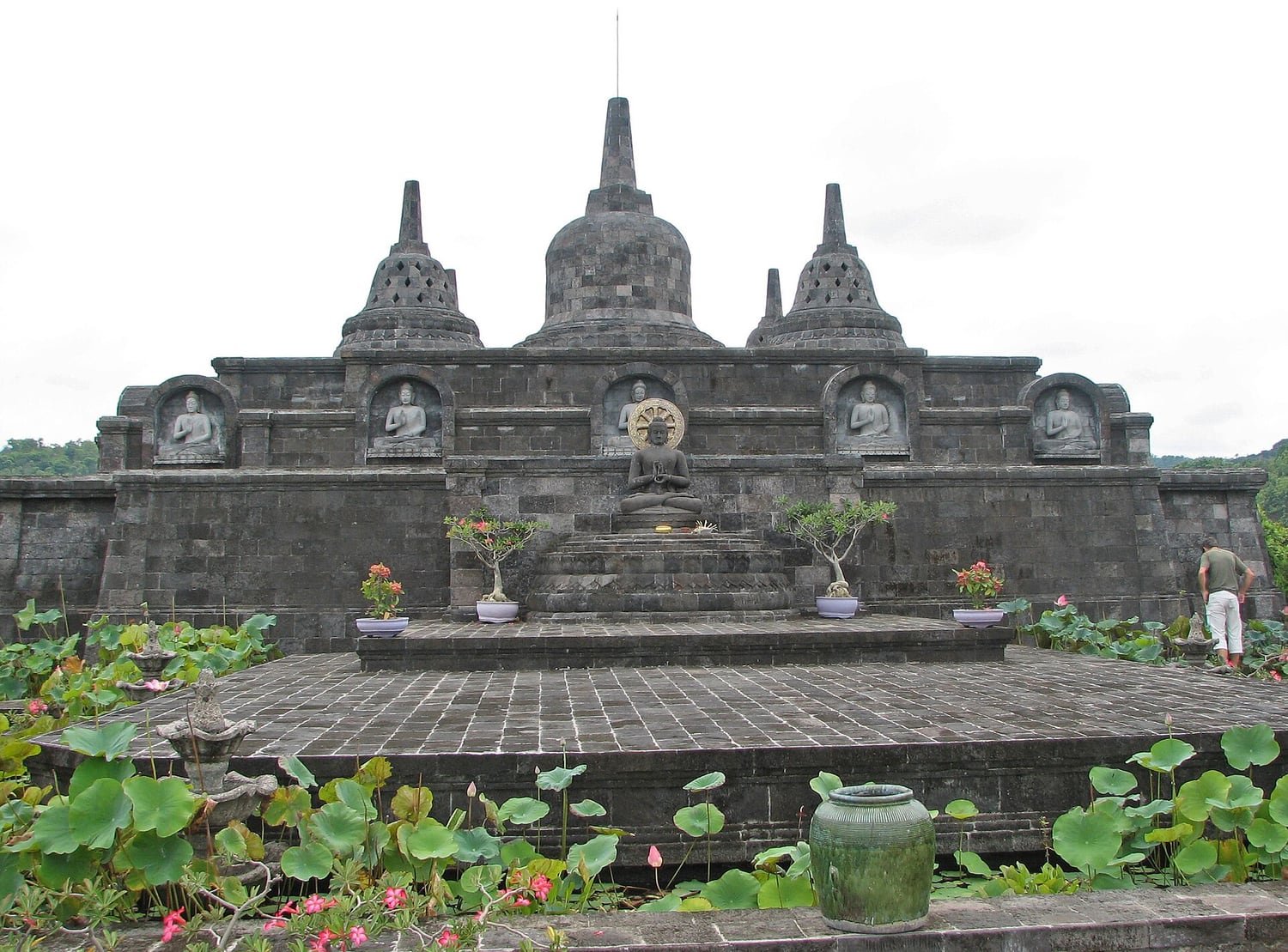
Half-day and one-day retreats. These give you a structured day of sitting and walking meditation with a teacher, often with a talk. Bali Meditation Center runs them near Sukawati, and at Brahmavihara Arama above Lovina it runs a half-day retreat that ends in a sunset gathering. They suit a first proper retreat, or anyone searching for a one-day silent retreat.
Multi-day retreats. Three days with the monks at Sukawati, or a week or more at a private retreat centre, give you more depth. They stay manageable for a committed beginner.
Ten-day Vipassana courses. The deep end is ten full days in Noble Silence, on a fixed timetable that starts before dawn. In Bali these courses are held at Dhamma Geha in Bangli.
Nature sanctuaries. These are places built for quiet, where you set your own pace, with optional classes and no enforced silence. They are restful more than rigorous.
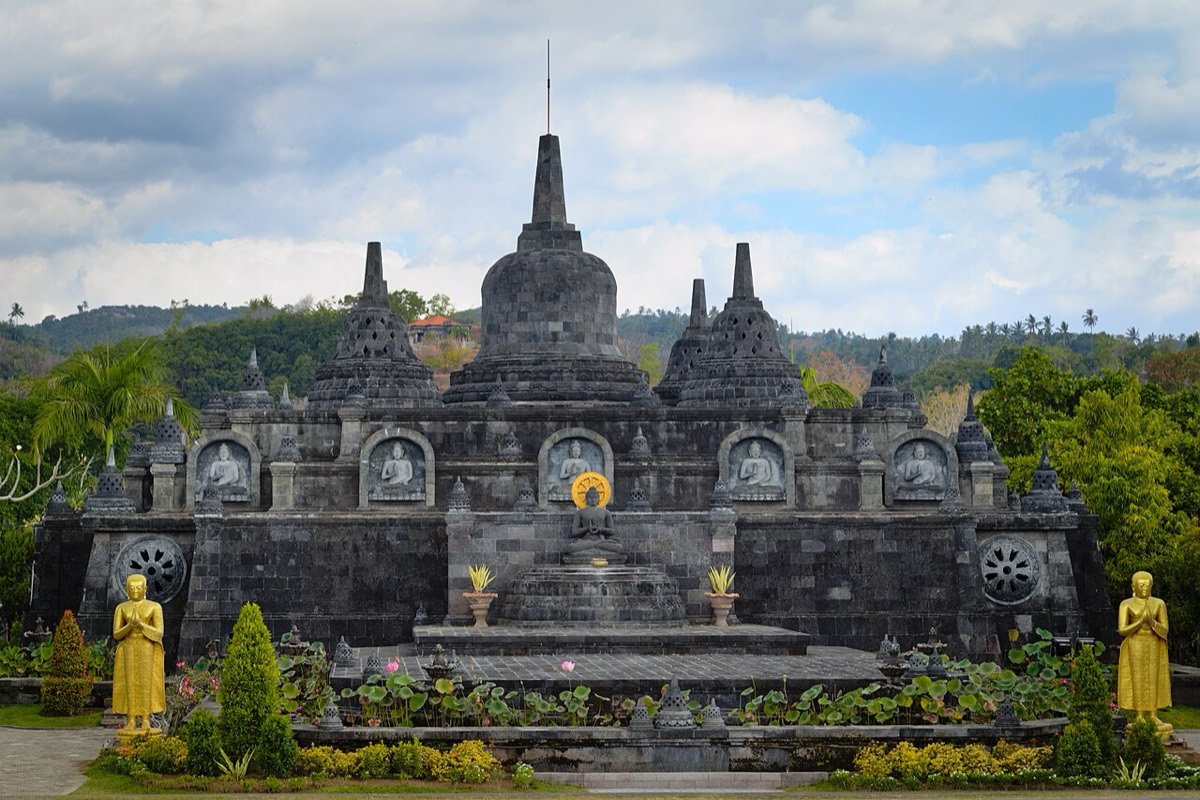 The Borobudur replica at Brahma Vihara Arama. Photo: Enrico Strocchi / Wikimedia Commons (CC BY-SA 2.0)
Five Places to Meditate, Each From Its Own Site
The five run from the most demanding to the most relaxed. Dates, fees and booking are on each centre's own site.
Dhamma Geha Vipassana Centre, Bangli
Setting: Rural countryside at Susut in Bangli regency, among bamboo forest and farmland. The centre describes the temperature as mild to cool.
What it is: Bali's centre for Vipassana as taught by S.N. Goenka in the tradition of Sayagyi U Ba Khin, part of the worldwide dhamma.org network. It is a non-profit charity run by volunteers. The Indonesian Vipassana association says construction finished in December 2021 and courses began in January 2022.
What they offer: Ten-day courses taught in English, plus short one- to three-day courses for old students. The centre has separate men's and women's compounds, single rooms with shared bathrooms and a large meditation hall. Volunteers cook simple vegetarian food.
What to know: Courses in this tradition run solely on donations, and only people who have finished a ten-day course may donate. You apply online for a specific course and wait for confirmation by email. Places fill, so apply when a course opens.
Best for: Anyone ready for the full ten days.
Bali Meditation Center, Sukawati
Setting: A retreat centre in Sukawati, Gianyar, south of Ubud.
What it is: A centre where, in its own words, retreats are guided by Thai Buddhist monks.
What they offer: A half-day retreat to learn basic meditation, and a one-day retreat. There is also a three-day mindfulness retreat with guided meditation, mindful movement and teachings from the monks. The centre also organises the half-day retreats at Brahmavihara Arama in the north.
What to know: The retreats are donation-based and open to beginners and experienced meditators. Upcoming dates are on the centre's retreats page.
Best for: A first real retreat, or a single day of practice within easy reach of Ubud.
balimeditation.org · Map · Bali Meditation Center on Instagram
Brahmavihara Arama, Banjar (north Bali)
Setting: In the hills above Banjar, west of Lovina.
What it is: The monastery's own account calls it Bali's largest Buddhist monastery, a Theravada community founded in 1958. Its mission is to provide a place for Vipassana meditation and the study of the Dharma. Retreats have long been taught in English as well as Indonesian.
What they offer: Half-day retreats with a sunset peace gathering, organised with Bali Meditation Center and open to all nationalities and religions. They are listed on the events page. Outside those dates, you can visit and sit quietly in the grounds.
What to know: For the retreats, wear white clothing that covers shoulders and knees, bring your own mat or cushion, and register in advance. Visitors are asked to dress modestly and keep silence in the upper courtyards.
Best for: A contemplative day at a living monastery. The Brahma Vihara Arama guide covers a visit.
Bali Silent Retreat, Penatahan, Tabanan
Setting: Six hectares of nature in Tabanan, surrounded by the Jatiluwih rice fields, jungle and mountains.
What it is: A nature sanctuary for prayer and meditation. On its own site, it describes most of its guests as solo travellers on an inner journey of rest and self-discovery.
What they offer:
- daily movement and meditation led by Balinese teachers
- weekly sessions, including meditation basics and a sound bath
- a labyrinth, a library and garden paths for time alone
- an organic vegetarian buffet
Rooms are wooden bungalows and single rooms without air conditioning.
What to know: Despite the name, it is a place to be quiet at your own pace rather than a structured silent course. It has Wi-Fi and a co-working space.
Best for: Rest and reflection without a strict timetable.
balisilentretreat.com · Map · Bali Silent Retreat on Instagram
The Yoga Barn, Ubud
Setting: A large yoga and wellness centre in Ubud with several studios.
What it is: In its own words, one of the world's largest and most varied yoga and wellness centres.
What they offer: A daily programme of yoga, meditation, breathwork, sound healing, movement and dance. Casual drop-in classes run for beginners through experienced practitioners, alongside retreats and workshops.
What to know: The current class schedule is on its site. It is busy, which suits a taste of practice more than deep silence.
Best for: A guided session or two while you are in Ubud.
theyogabarn.com · Map · The Yoga Barn on Instagram
On a Ten-Day Silent Retreat, You Stop Talking and Hand In Your Phone
The ten-day Vipassana course is the clearest model of what "silent" means, because its code of discipline is published in full.
- Noble Silence. Silence of body, speech and mind: no talking, and no gestures, sign language or notes to other students, from the start of the course until the morning of the last full day. You may speak with the teacher and the management.
- Separation. Men and women are kept completely apart, and couples, friends and family do not contact each other during the course.
- No devices. Phones and other electronics are handed in until the end. There is no reading, writing, music or note-taking.
- The day. A wake-up bell well before dawn, long blocks of sitting in the hall or your room, simple meals, and an evening discourse from the teacher.
It is mentally demanding, especially in the first days. Read the whole code before you apply, and treat it as training rather than a holiday. Shorter retreats, such as the one- and three-day retreats at Sukawati, ask far less and are the sensible first step.
Choose by Your Experience and What You Want
Match the format to your experience and intent.
- Curious, no experience: a drop-in class in Ubud or a half-day retreat.
- Some practice, want to learn properly: a one-day or three-day retreat with the monks at Sukawati.
- Ready for the real thing: a ten-day Vipassana course at Dhamma Geha, applied for well ahead.
- Tired and want quiet: a nature sanctuary, where silence is your choice.
- A day at a working monastery: Brahmavihara Arama in the north.
Whatever you pick, read the facilitator's own description of the format before you commit. Intensity varies widely, and the word "silent" covers everything from ten days without speech to a quiet garden with Wi-Fi.
The North Has a Monastery and Residential Retreat Centres
The north's quiet suits inner work. Around Lovina and the Munduk highlands there is space and stillness, and Brahmavihara Arama is there for a contemplative day.
The north also has residential retreat centres near Lovina and along the east coast. Meditation retreats in north Bali covers them one by one, and wellness in north Bali gives the wider picture.
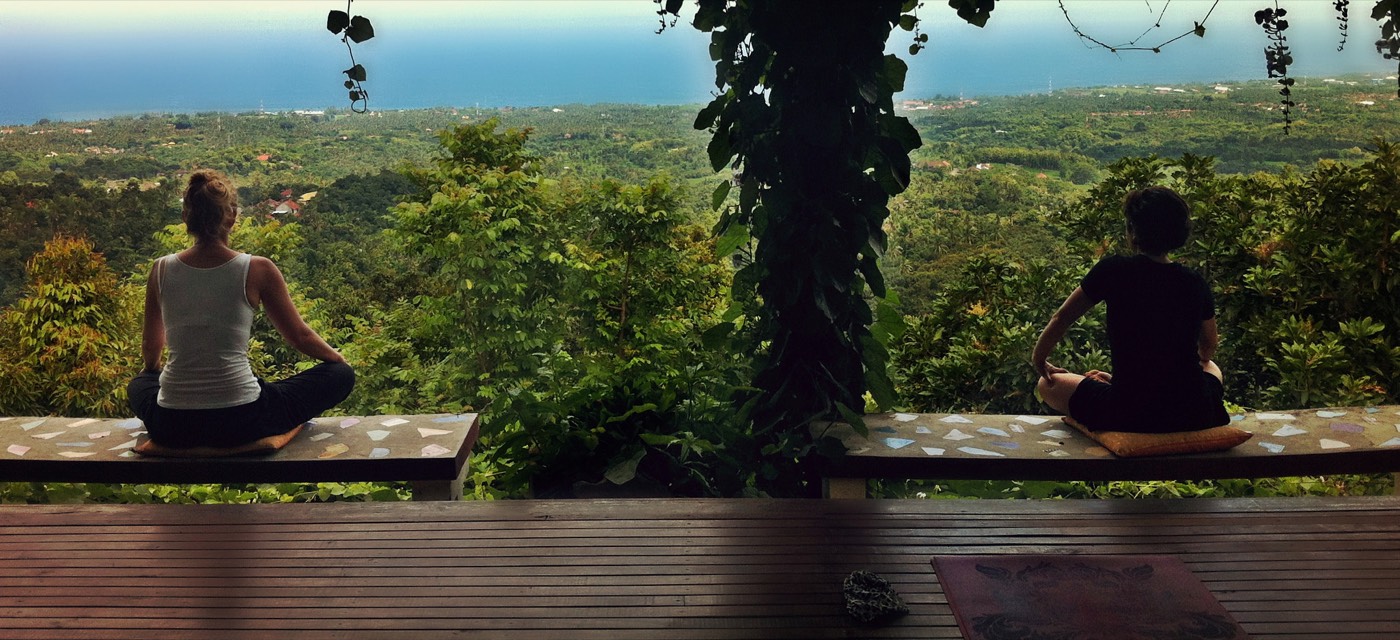 Meditation above the canopy, sea on the horizon. Photo: Bali Real Estate / Wikimedia Commons (CC0)
To keep your own base and visit the monastery for the day, look at Palm Living's villas for rent around Lovina, on the same stretch of coast.
Practical Notes
- Book ahead: Vipassana courses open for applications on a set date and fill. The monk-led retreats and the monastery's half-days ask you to register in advance.
- Donations: at the Vipassana and monk-led retreats, give what you can at the end. Nothing is charged up front.
- Dress: modest clothing at monasteries, and white for the Brahmavihara Arama retreats. Wear loose, quiet clothes for any retreat.
- Health: tell the organisers about any medical or mental-health condition when you apply. Long silent retreats are hard on the mind.
- Getting there: Sukawati and Bangli are within an hour or so of Ubud. Brahmavihara Arama is near Lovina on the north coast.
FAQ
Where can you do a meditation retreat in Bali? Ubud's yoga centres run drop-in guided meditation. Bali Meditation Center in Sukawati runs half-day to three-day retreats with Thai Buddhist monks. Dhamma Geha in Bangli holds ten-day Vipassana courses. In the north, Brahmavihara Arama above Lovina hosts half-day retreats, and there are residential retreat centres along the coast.
Is there a Vipassana centre in Bali? Yes. Dhamma Geha at Susut, Bangli, teaches Vipassana as taught by S.N. Goenka, with ten-day courses in English and short courses for old students. You apply for a specific course through dhamma.org.
Are there one-day or weekend silent retreats in Bali? Yes. Bali Meditation Center runs half-day, one-day and three-day retreats, and Brahmavihara Arama hosts half-day retreats on set dates. Short courses at Dhamma Geha are open only to people who have finished a ten-day course.
How much does a meditation retreat in Bali cost? It depends on the model. The Goenka Vipassana courses and the monk-led retreats at Sukawati run on donations, with nothing charged up front. Private retreat centres and yoga studios set their own rates, which you will find on their sites.
What is a silent retreat like? On a ten-day Vipassana course: no talking or gestures to other students, men and women separated, devices handed in, no reading or writing, and a long day of meditation from before dawn, with simple vegetarian meals. Shorter retreats are gentler, and nature sanctuaries leave silence up to you.
Do you need experience to do a meditation retreat? No for classes, half-days and the one- and three-day retreats, which welcome beginners. A ten-day Vipassana course is open to new students too, but it is demanding. Many people start with a shorter retreat first.
Is there meditation in north Bali? Yes. Brahmavihara Arama, the Buddhist monastery above Banjar near Lovina, hosts half-day retreats and welcomes quiet visitors, and there are residential retreat centres on the north and east coasts. See meditation retreats in north Bali.
Sources
- Vipassana Meditation (dhamma.org), Dhamma Geha, Bali: course schedule and centre information (location at Susut, Bangli; Goenka tradition; English instructions; separate compounds, single rooms, vegetarian food; non-profit run by volunteers; how to apply), read September 2026
- Vipassana Centres in Indonesia, Bali (construction completed December 2021, courses since January 2022), read September 2026
- Vipassana Meditation (dhamma.org), The Code of Discipline (Noble Silence, separation of men and women, devices, reading and writing, course timetable, donation-only finances), read September 2026
- Bali Meditation Center, Meditation Retreats (Sukawati, Gianyar; half-day, one-day and three-day retreats guided by Thai Buddhist monks; donation-based; beginners welcome), read September 2026
- Brahmavihara Arama, About (largest Buddhist monastery in Bali, Theravada, founded 1958, mission for Vipassana and Dharma study, retreats in English and Indonesian) and Events (half-day retreats with Bali Meditation Center, white clothing, registration in advance, visitor guidelines), read September 2026
- Bali Silent Retreat, home page and programmes page (six hectares by the Jatiluwih rice fields, Penatahan, Tabanan; daily and weekly programmes; vegetarian buffet; rooms; Wi-Fi and co-working space), read September 2026
- The Yoga Barn, Daily classes (Ubud; daily programme including meditation, breathwork and sound healing; drop-in classes for all levels), read September 2026
Read next: meditation retreats in north Bali for the retreats on the quiet coast, Brahma Vihara Arama for a visit to the monastery, and Bali wellness retreats if you want meditation inside a broader programme.