
On this page
- In Brief
- Balinese Hinduism at a Glance
- Balinese Hinduism Grew From Indian Ideas and Bali's Older Traditions
- Tri Hita Karana: Three Harmonies Shape Daily Life
- Canang Sari Is the Offering Made Each Day
- The Pura Is an Open-Air Temple of Three Courtyards
- The Main Ceremonies Follow Two Calendars
- Priests and Healers Lead the Rituals
- Ngaben: A Cremation Is a Duty and an Honour
- Five Terms Explain Much of What You See
- How to Be a Respectful Guest at Temples and Ceremonies
- FAQ
- Sources
In Brief
Balinese Hinduism is the form of Hinduism practised in Bali, officially called Agama Hindu Dharma. It honours one supreme principle, Sang Hyang Widhi Wasa, a formless reality expressed through many gods.
The religion puts more weight on right practice than on right belief. Family shrines receive offerings each day, usually in the morning and again in the late afternoon. Each customary village keeps at least three temples, and each temple holds its festival once in 210 days.
Its guiding philosophy is Tri Hita Karana: harmony with God, with other people and with nature.
As a visitor you can enter a temple's outer areas in a sarong and sash, with your shoulders covered. The middle and inner courtyards are for worshippers in Balinese dress.
Balinese Hinduism at a Glance
- Official name: Agama Hindu Dharma
- Supreme principle: Sang Hyang Widhi Wasa, expressed through many gods, with Brahma, Vishnu and Shiva revered
- Roots: Hindu and Buddhist ideas that came mainly by way of Java, joined to Bali's older ancestor veneration and sacred landscape
- Philosophy: Tri Hita Karana, harmony with God, with other people and with nature
- Temples: Commonly estimated at more than 20,000, with at least three in each customary village
- Daily practice: The canang sari offering, usually in the morning and again in the late afternoon
- Calendars: The 210-day Pawukon cycle and the lunar Saka year
- Main holy days: Galungan and Kuningan, Nyepi and each temple's odalan
- Who leads ritual: Pedanda, the high priests, and pemangku, the temple priests
- For visitors: A sarong and sash at temples, and the outer courtyard only unless you have come to pray in Balinese dress
Balinese Hinduism Grew From Indian Ideas and Bali's Older Traditions
Hindu and Buddhist ideas reached the Indonesian archipelago as early as the first century CE, through long-distance trade.
Some of the evidence is in north Bali. Archaeologists have found traces of Indian trade from that period at Sembiran, a village in Buleleng.
The ideas came to Bali mainly by way of Java, and they did not replace what was already here. The Balinese kept their ancestor veneration, their animism and their sacred landscape, and folded the new gods into them.
Majapahit and the Priest Nirartha Gave It Its Form
The formative period came later. The Javanese kingdom of Majapahit conquered Bali in 1343.
As Islamic states rose on Java in the late fifteenth century, Hindu-Javanese priests, artists and nobles moved to Bali. They brought court culture, Old Javanese literature and temple architecture.
The priest Dang Hyang Nirartha came from Java at the end of the fifteenth century and is credited as the great reformer of Balinese Hinduism. He introduced the padmasana, the empty stone throne to the supreme god that now stands in temples across the island.
One Supreme Principle, Expressed Through Many Gods
The supreme principle is Sang Hyang Widhi Wasa, a formless reality expressed through many gods. Brahma, Vishnu and Shiva are revered, with Shiva often the most prominent.
Agama Hindu Dharma is the name the religion took after Indonesian independence. Balinese religious leaders then set out its beliefs to meet the state's requirement of faith in one God.
Today the Hindu council, Parisada Hindu Dharma Indonesia, guides the religion nationally. Temples are still run by their own congregations and villages.
Four Things Set It Apart From Indian Hinduism
Ancestor veneration is central. Families honour their deified ancestors at their own shrines and temples. In Balinese understanding the dead reach the heavenly realm only through purification rites performed by the living, above all cremation.
Spirits and forces of chaos share the world with people and gods. Not all of them are benevolent, and they are acknowledged with offerings and ritual. The aim is balance between constructive and destructive forces, with neither one removed.
The mountains and the sea give Bali its sacred axis. The mountains, above all Mount Agung, are honoured as the abodes of the gods. The sea is associated with powerful and potentially chaotic forces.
Temples, homes, villages and even seating arrangements are laid out between kaja, toward the mountain and sacred, and kelod, toward the sea.
Caste works differently. Bali has a system of wangsa with Sanskrit names: Brahmana, Satria, Wesia and Sudra. It has not worked as the rigid hierarchy of Indian caste.
Sudra Balinese, the great majority, take full part in temple worship. Today caste shows mostly in names, titles and levels of speech.
Tri Hita Karana: Three Harmonies Shape Daily Life
At the heart of Balinese Hinduism is Tri Hita Karana, "the three causes of well-being".
The three are harmony with God, with other people and with nature. Together they are a working framework as much as a philosophy, and they shape village layout, the rice fields and daily conduct. The full story is in Tri Hita Karana.
Parahyangan: Harmony With God
People keep their relationship with the divine through prayer, offerings and ceremony, and the island's temples exist for it. Bali has tens of thousands of temples, commonly estimated at more than 20,000.
Each level of society keeps its own. Families and clans have theirs, and so do irrigation associations, villages and the old kingdoms.
Each customary village has at least three, the Kahyangan Tiga. The Pura Puseh is for Vishnu, the Pura Desa for Brahma and the Pura Dalem for Shiva or Durga. The rule goes back to reforms under King Udayana and his priest Mpu Kuturan, around the turn of the eleventh century.
Above them stand the Sad Kahyangan Jagad, the "six sanctuaries of the world", the holiest temples of the island. There are always six, though the list varies by region.
Pawongan: Harmony With Other People
Village life runs through the banjar, the neighbourhood association, and the desa adat, the customary village.
Balinese are expected to give their labour, time and resources to both and to their temples. Taking part in rituals and communal work is a religious duty as well as a social one.
Failing in it is seen less as a private failing than as a disturbance of social and cosmic balance.
Palemahan: Harmony With Nature
In Balinese understanding land, water and animals are spiritually alive. People are expected to keep a respectful, sustainable relationship with them.
The clearest expression is the subak, the cooperative irrigation system of the rice terraces. It goes back to the ninth century and is run through a network of water temples.
In 2012 UNESCO listed it as a World Heritage cultural landscape. The listing's title is "the Subak System as a Manifestation of the Tri Hita Karana Philosophy".
The listed area reaches into Buleleng, where it includes the forests and the two lakes of Tamblingan and Buyan in the north's highlands. More in the subak rice terraces.
Canang Sari Is the Offering Made Each Day
Canang sari are small trays woven from palm leaf, filled with flowers and set on shrines, on the ground and at doorways.
They are the simplest daily household offering, made to thank Sang Hyang Widhi Wasa and the nine guardian gods of the directions.
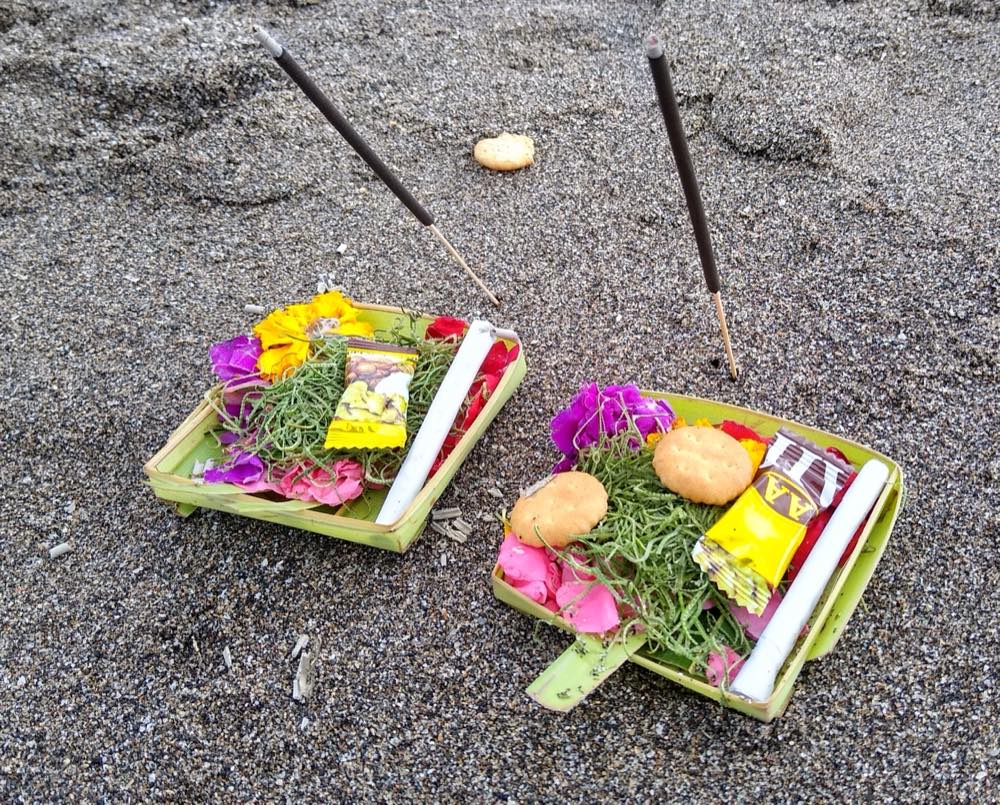 Canang sari, set out fresh each morning. Photo: Mx. Granger / Wikimedia Commons (CC0)

What Goes Into a Canang
- The tray (ceper), made from palm leaf.
- The core (peporosan): betel leaf, lime, gambier and betel nut, which stand for the three great gods: lime for Shiva, betel nut for Vishnu, gambier for Brahma.
- Flowers set by colour and direction: white pointing east for Iswara, red pointing south for Brahma, yellow pointing west for Mahadeva, and blue or green pointing north for Vishnu.
- A coin or a note laid on top, the essence (sari) that gives the offering its name.
- Incense, lit as the offering is presented.
When and Where Offerings Are Placed
Family shrines receive offerings each day, usually in the morning and again in the late afternoon. More elaborate ones are made on special days such as Kajeng Kliwon, the full moon (Purnama) and the dark moon (Tilem).
A woman of the household usually presents the canang, in ceremonial dress. She carries it on a tray with a burning incense stick and wafts its essence toward the shrine with her hand.
There is a humbler round too. When the day's rice is first cooked, small portions are set on squares of banana leaf and sprinkled with salt. They are laid at points around the compound: the kitchen, the shrines, the well and the entrances.
Canang are not made at all when there has been a death in the family or community.
The Effort Is the Gift
The point of a canang is the effort. The philosophy behind it is self-sacrifice, so the time and care it takes to make is the gift. In Balinese understanding, making offerings brings good karma to everyone who helps.
The full picture, from canang to the great ceremonial towers of fruit and cake, is in Balinese offerings explained.
For visitors: offerings on the ground are common, including on pavements and busy streets. Step around them where you can, never kick one aside, and do not photograph them in a way that mocks them.
The Pura Is an Open-Air Temple of Three Courtyards
A Balinese temple (pura) is an open-air place of worship inside walls, laid out in courtyards linked by carved gates. It is designed to be walked through, from the everyday world toward the sacred.
The Three Courtyards Lead From the Sea Side to the Mountain Side
Nista mandala (jaba pisan), the outer courtyard. It lies toward the sea and is joined to the world outside. Often it is an open field or garden, used for secular activity, dance performances and preparations during festivals. Its gate is usually the candi bentar, the split gate.
Madya mandala (jaba tengah), the middle courtyard. The congregation's activity happens here, among the supporting pavilions:
- the slit-drum tower (bale kulkul)
- the gamelan pavilion (bale gong)
- the meeting hall (wantilan)
- the temple kitchen
Utama mandala (jero), the inner courtyard. This is the holiest zone, closest to the mountain. It holds the padmasana throne for Sang Hyang Widhi Wasa, the meru towers and the offering pavilions. It is reached through the kori agung, the tall roofed gate.
Bali's provincial government now bars foreign tourists from the middle and inner courtyards unless they are worshippers in traditional Balinese dress. As a visitor you will usually see the inner shrines from outside. Bali temple etiquette has the rules in full.
Meru Towers Stand for the Mountain of the Gods
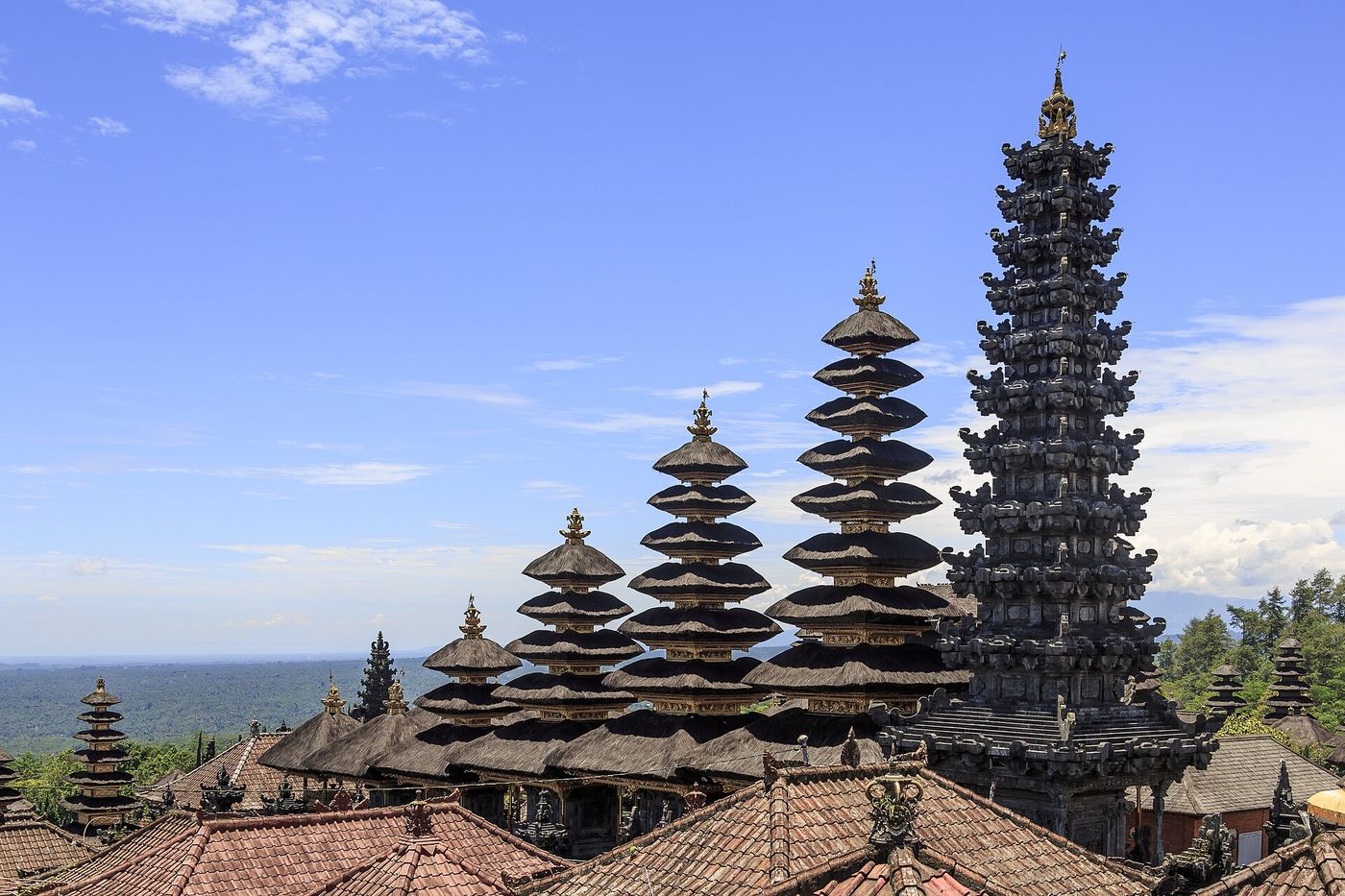
The meru are pagoda-like towers of stacked thatched roofs. They stand for Mount Meru, the mountain of the gods in Hindu cosmology.
Meru stand in the inner courtyard. Each is dedicated to a particular god, a deified ancestor or the spirit of a place.
The number of roofs is always odd and reflects the status of the deity. Three tiers is the lowest and usually honours a deified ancestor. Eleven is the most prestigious, usually for the highest gods.
The thatch is ijuk, the black fibre of the sugar palm.
Other Structures You Will See
- Candi bentar: the split gate at the entrance to the outer courtyard
- Kori agung (paduraksa): the roofed tower gate between the middle and inner courtyards
- Padmasana: the lotus throne of Sang Hyang Widhi Wasa, the shrine Nirartha brought to Bali's temples
- Bale: open-sided pavilions for meetings, gamelan and preparing offerings
- Pelinggih: the general word for a shrine
For the north's own great temples, see the best temples in north Bali.
The Main Ceremonies Follow Two Calendars
Balinese ritual life runs on two calendars at once: the 210-day Pawukon cycle and the lunar Saka year.
Temple anniversaries, harvests, life events and purification rites all fall on one or the other. The Balinese calendar explains how they mesh.
Galungan Returns Once in 210 Days
Galungan, one of the most important recurring festivals, celebrates the victory of dharma over adharma. It falls on the Wednesday of the eleventh week of the Pawukon, so there are often two in one solar year.
The spirits of cremated ancestors come back to visit their homes, and the living welcome them with prayers and offerings.
The sign you cannot miss is the penjor: tall bamboo poles set up beside the roads, curving over the street with offerings hung from the tip.
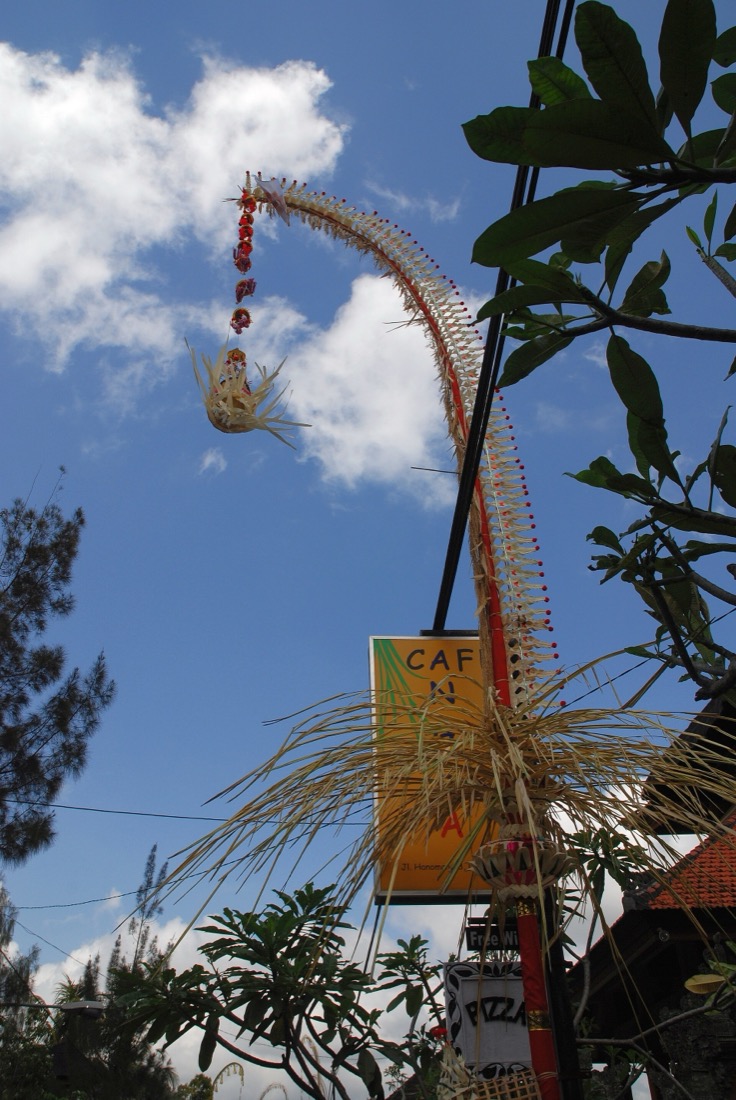 A penjor over the road before Galungan. Photo: Tigerente / Wikimedia Commons (CC BY-SA 4.0)

Kuningan Closes the Festival Period
Ten days after Galungan, on Kuningan, the ancestral spirits return to heaven and the festival period closes. More on both days in Galungan and Kuningan.
Nyepi Is the Day of Silence, Usually in March
Nyepi, the Day of Silence, begins the Saka year and usually falls in March.
On the evening before, most villages parade their ogoh-ogoh. These are demon figures of bamboo, papier-mâché and cloth that stand for negative forces. After the parade they are burned in the cemeteries.
Then the island stops. From 6 a.m. to 6 a.m. the next day there is:
- no fire or light
- no work
- no travel
- no entertainment
Bali's airport closes, nobody is allowed on the beaches or streets, and visitors stay inside their hotels. The only people outside are the pecalang, the village watchmen who patrol to see the rules kept.
The day after is Ngembak Geni, when families visit each other to ask forgiveness. The full guide is Nyepi, Bali's day of silence.
Odalan Is a Temple's Birthday
Each temple celebrates its birthday, the odalan, on the Pawukon date it was founded, so once every 210 days. The village invites the gods to visit for three days or more, with processions, offerings, music and dance.
Bali has thousands of temples and at least three in each village, so an odalan is happening somewhere on the island almost every day. Odalan are the ceremonies visitors are most likely to meet.
Priests and Healers Lead the Rituals
Bali's ritual specialists fall into two ranks.
The dwijati, "twice-born", have gone through a great purification that marks a second birth. The ekajati, "once-born", have undergone a lesser one.
Pedanda Are the High Priests
Pedanda is the umbrella term for the high priests of the dwijati rank. They are not usually attached to one temple. They serve the families and communities linked to them by lineage.
Pedanda prepare the most potent holy water (tirta) for great temple festivals. They also officiate at the major rites of passage, such as tooth filing and cremation, using mantras and sacred hand gestures (mudra).
Most follow a Shaivite tradition, and a smaller number, the pedanda Buda, follow a Buddhist one. Pedanda historically came from Brahmana families, though the priesthood is no longer restricted to them.
Pemangku Are the Temple Priests
Pemangku are the temple priests of the ekajati rank, dressed in white and drawn from any caste other than Brahmana.
They lead the temple's daily and periodic rituals, consecrate offerings and prepare holy water. At the end of prayers they sprinkle it on worshippers.
Balian Are the Traditional Healers
Balian are healers, diviners and mediums. Through the spiritual power called taksu they may go into trance, and gods or ancestors speak through them.
People consult a balian to diagnose an illness, to find the spiritual cause of misfortune and sometimes to learn which ancestor has been reborn in a child.
If you want to meet one, go with a local recommendation and someone to translate. Traditional healers in north Bali explains how.
Ngaben: A Cremation Is a Duty and an Honour
A cremation (ngaben) comes with music, a crowd in its best clothes and a towering structure carried through the village. It can look more like a festival than a funeral.
Why Cremation Is a Celebration
In Balinese understanding the body is only a temporary container for the soul. It must be burned before the soul can leave it completely and move on toward rebirth.
An elaborate cremation shows respect to a soul that is destined to become a god, with real power over those left behind. That is why a cremation is a duty and an honour as much as a loss.
The Cremation Has Four Stages
-
Waiting. A quick cremation is best, but it is expensive. Families often bury the body for a time, usually near the village's Pura Prajapati, until they have gathered the funds.
-
The tower (bade). Once an auspicious day is chosen, the family builds the bade that carries the body in procession to the cremation ground.
-
The burning. There the body is placed in a lembu, a coffin shaped like a bull or another mythical animal, or in a temple-shaped wadah. The pyre is lit while a baleganjur ensemble plays a battle song for the soul's fight to reach the upper realm.
-
The sea. Twelve days later the family gathers the ashes into a coconut shell and carries them to the sea, returning the remains to the elements.
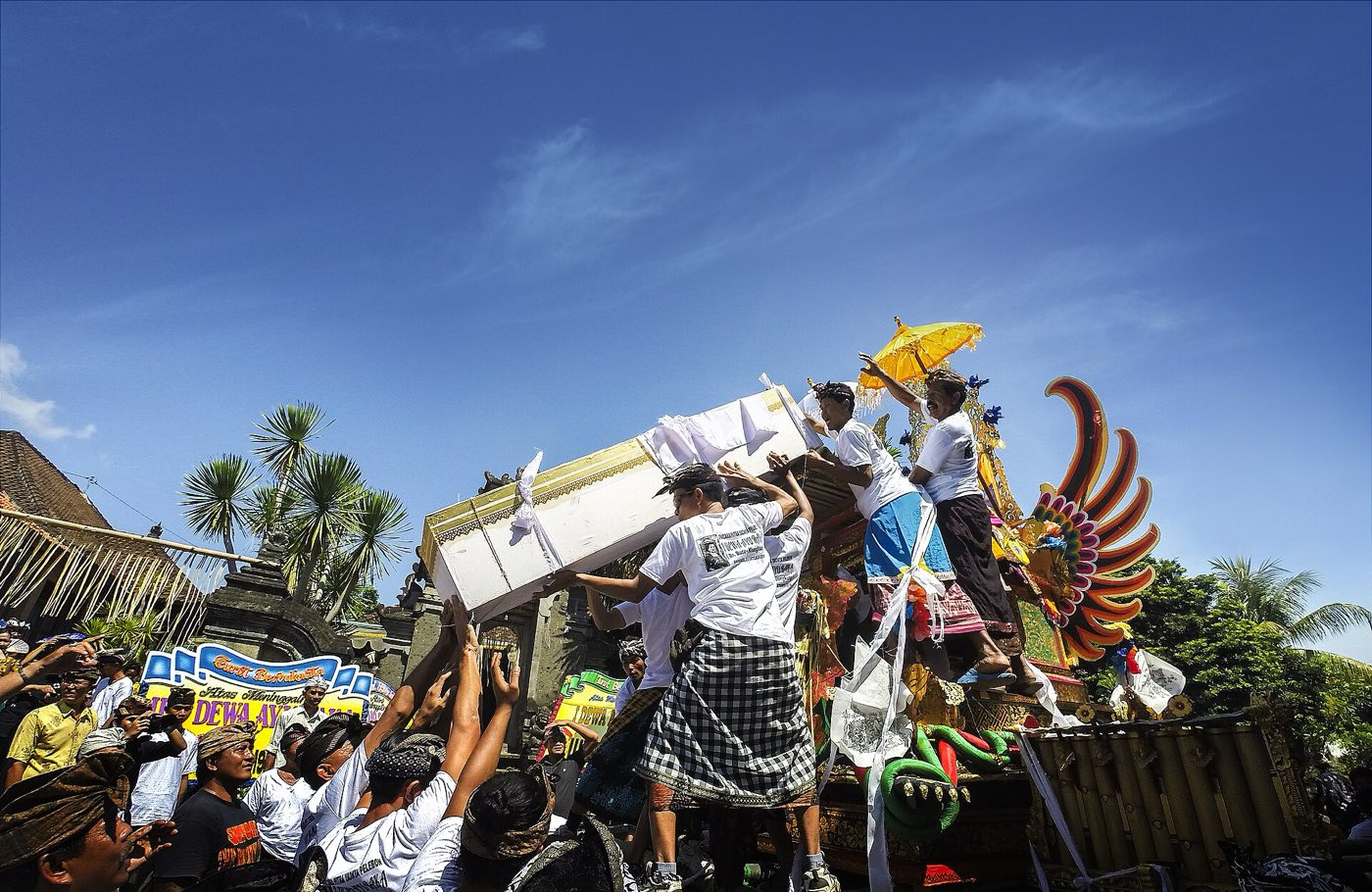 The coffin raised onto the bade at a pelebon. Photo: trezy humanoiz / Wikimedia Commons (CC BY 2.0)

Villages Share the Cost in Mass Cremations
Because a cremation costs so much, many villages hold community cremations. Families pool resources and share the cost, and many of the recently dead are cremated together on the same day. More in Ngaben, the Balinese cremation.
For visitors: you may meet a cremation procession on the road. Pull over and wait. If a local friend invites you to watch, it is a privilege. Wear a sarong and sash, keep to the edges and follow your host's lead.
Five Terms Explain Much of What You See
Taksu: Spiritual Power
Taksu is spiritual power, the charge through which a balian goes into trance and the gods or ancestors speak.
Dance and music in Bali are understood first as offerings to the gods, performed at temple festivals and rites of passage. So the teaching reaches from the healer's house to the temple stage. North Bali's dance and music shows where to see it.
Sekala and Niskala: The Seen and the Unseen
Sekala is the visible world, what can be seen and touched. Niskala is the unseen world of gods, ancestors and spirits.
Balinese Hinduism treats the two as inseparable and constantly interacting. Offerings, ritual and right behaviour are how people keep the relationship in balance.
Karma Phala: The Fruit of Action
Karma phala is the fruit (phala) of action (karma). Every action bears fruit that returns to the one who acted.
It is one of the five core beliefs of Balinese Hinduism, the Panca Sradha. The other four are belief in:
- God
- the soul (atman)
- rebirth (punarbhawa)
- liberation (moksha)
Dharma: Your Sacred Duty
Your dharma is your sacred duty, the part you play in keeping the order of things.
In Bali it shows up as correct practice: making the offerings, attending the ceremony, doing your share for the banjar. The religion puts more weight on right practice than on right belief.
Rwa Bhineda: The Balance of Opposites
Rwa Bhineda is the Balinese teaching of duality. Opposing forces such as good and evil, light and dark, exist in necessary balance. Ritual aims to keep that balance, with neither side wiped out.
It is why offerings go to disruptive spirits as well as to gods. The full teaching is in Rwa Bhineda.
How to Be a Respectful Guest at Temples and Ceremonies
Balinese Hinduism is organised around practice, which you can watch and, with humility, sometimes join.
You meet it at temples and ceremonies, and in the offerings and village life around you. Here is how to be a good guest at each.
Dress: Cover Your Legs and Shoulders
For temples and ceremonies, wear three things:
- A kamen or sarong wrapped around the lower body
- A selendang, the sash, tied at the waist
- A top that covers the shoulders. Balinese women wear a kebaya, and men often wear a headcloth (udeng)
Many temples lend sarongs and sashes at the entrance, though your own is more comfortable. White and yellow are the usual colours of purity at temple ceremonies, and darker clothes are preferred at cremations.
In Temples: Follow the Provincial Government's Rules
Bali's provincial government sets out what foreign visitors may and may not do in a circular to tourists. In summary:
- Stay out of the middle and inner courtyards unless you have come to pray in full Balinese dress.
- Menstruating women may not enter those sacred areas, a rule of ritual purity.
- Do not climb sacred trees, shrines or monuments, and take no disrespectful photographs at religious sites.
- Stay lower than people who are praying, and do not walk in front of them.
- Do not touch offerings, shrines or sacred objects, and ask before photographing people at prayer.
- When in doubt, watch what the Balinese do and follow their lead.
At a Ceremony: Come Dressed, Bring a Gift, Stay for the Prayers
If a local friend or your host invites you to a ceremony:
- Arrive properly dressed (see above).
- Bring a small gift (punia) for the offering box. There is no fixed amount, so give what feels fair, in small notes.
- Follow the prayers as best you can.
- Ask before photographing any particular moment.
- Stay through the prayers or leave quietly between them.
The prayers end with holy water and rice, in this order:
-
The priest sprinkles holy water (tirta) three times.
-
You receive it in your right hand and sip it three times.
-
You splash it on your forehead three times.
-
Then comes bija, rice soaked in holy water. Eat a few grains and press the rest onto your forehead.
See bija, the rice on the forehead.
In Daily Life: Give Offerings and Processions Their Space
- Step around offerings on the ground.
- Ask before photographing someone making or placing an offering.
- Do not interrupt someone praying at a small shrine.
- Give way to processions: pull over and wait.
FAQ
What is Balinese Hinduism? Balinese Hinduism is the form of Hinduism practised in Bali, officially called Agama Hindu Dharma. It grew from Hindu and Buddhist ideas that reached the archipelago from the first century CE, mainly via Java. These blended with older Balinese traditions of ancestors, spirits and sacred mountains. It emphasises ritual practice, communal duty and balance between the seen and unseen worlds.
How is Balinese Hinduism different from Hinduism in India? It centres on a single supreme principle, Sang Hyang Widhi Wasa, expressed through many gods. It gives ancestor veneration and local spirits a central place, and it organises temples and homes between the mountain and the sea. Its caste system has not worked as a rigid hierarchy, and Sudra Balinese, the great majority, take full part in temple worship.
Who is the supreme god in Balinese Hinduism? Sang Hyang Widhi Wasa, a formless supreme reality. Brahma, Vishnu and Shiva are revered as expressions of it, with Shiva often the most prominent.
Why do Balinese make offerings every day? To thank Sang Hyang Widhi Wasa and the gods, honour the ancestors and keep the spirits in balance. The daily canang sari is the simplest offering, and the time and care taken to make it is the gift. Family shrines usually receive offerings in the morning and again in the late afternoon.
Can tourists enter Balinese temples? Yes, the outer areas, dressed in a sarong and sash with shoulders covered. Under the provincial government's rules for tourists, visitors who are not there to pray in Balinese dress may not enter the middle and inner courtyards. Menstruating women may not enter those sacred areas.
What is Nyepi? Nyepi is the Balinese Day of Silence, which begins the Saka new year and usually falls in March. For 24 hours from 6 a.m. there is no fire or light, work, travel or entertainment. The airport closes and visitors stay in their hotels.
Sources
- Wikipedia, Balinese Hinduism, for the history (Sembiran, Majapahit, Nirartha), Sang Hyang Widhi Wasa, ancestors, sekala and niskala, kaja and kelod, offerings, priests and balian, caste, the Panca Sradha, dress, cremation, Galungan and Nyepi, and the Hindu council, read September 2026 (in English)
- Wikipedia, Balinese temple, for the three courtyards, the gates, the Kahyangan Tiga and the Sad Kahyangan Jagad, read September 2026 (in English)
- Wikipedia, Meru tower, for the tiers and ijuk thatch, read September 2026 (in English)
- Wikipedia, Canang sari, for the parts of the offering and the flower directions, read September 2026 (in English)
- Wikipedia, Galungan, Nyepi, Odalan and Ngaben, for the festivals and the cremation rite, read September 2026 (in English)
- Wikipedia, Subak (irrigation), for the subak's age and its 2012 UNESCO listing, read September 2026 (in English)
- Love Bali (Bali Provincial Government), Governor Koster issues new regulations for foreign tourists, Circular No. 7 of 2025, for the temple rules, read September 2026 (in English)
Go deeper into the practice: Balinese offerings and canang sari, the Balinese calendar, Tri Hita Karana and Panca Yadnya, the five offerings behind every ceremony.