On this page
- In Brief
- Bali Wellness Retreats at a Glance
- Five Types of Retreat, From Daily Yoga to Spa-Led Rest
- Nearly Every Retreat Includes a Bed, Meals and Daily Sessions
- Where to Go: Ubud for Choice, the South for Active and Social, the North for Quiet
- In the North: An Ayurvedic Resort, a Two-Site Retreat and a Monastery
- How to Choose a Retreat, in Six Steps
- Why Bali Has So Many Retreats: An Official Push on an Older Culture
- Practical Notes
- FAQ
- Sources
In Brief
A Bali wellness retreat is a fixed-length stay where your room, your meals and the day's practice are arranged for you. The daily programme is usually yoga, meditation, detox or holistic healing. Ubud holds the largest concentration of centres and teachers, and the north coast and the Munduk highlands hold the quiet ones.
Indonesia's tourism ministry is promoting Bali as a global wellness destination, and the sector is large, varied and uneven. Choose by your goal first: movement, rest, a body reset or inner work. Then read the operator's own programme page for what is included and who is teaching your dates.
The facilitator matters more than the venue, and only the operator's own site tells you who that is.
Bali Wellness Retreats at a Glance
- Main centre: Ubud, for the deepest concentration of studios, teachers and retreat weeks
- Quiet option: the north coast around Lovina and the Munduk highlands
- Types: yoga, detox and cleanse, meditation and silent, holistic healing, spa-led rest
- Length: a single day up to a month
- Usually included: a bed, meals and the daily sessions, while excursions, treatments and transfers vary
- Choose by: your goal, the named facilitators for your dates, group size, and location
- Visa: a visa on arrival gives 30 days and can be extended once for another 30, which caps a single-visa stay at 60 days
- Book through: the centre's own site, where the programme and teachers are listed
Five Types of Retreat, From Daily Yoga to Spa-Led Rest
Retreats in Bali come in five types, and your goal decides which one fits.
Yoga retreats. You get daily practice plus accommodation and food. This is one of the most common types and often the easiest to judge, because the timetable and the teachers are normally published. See yoga in Bali.
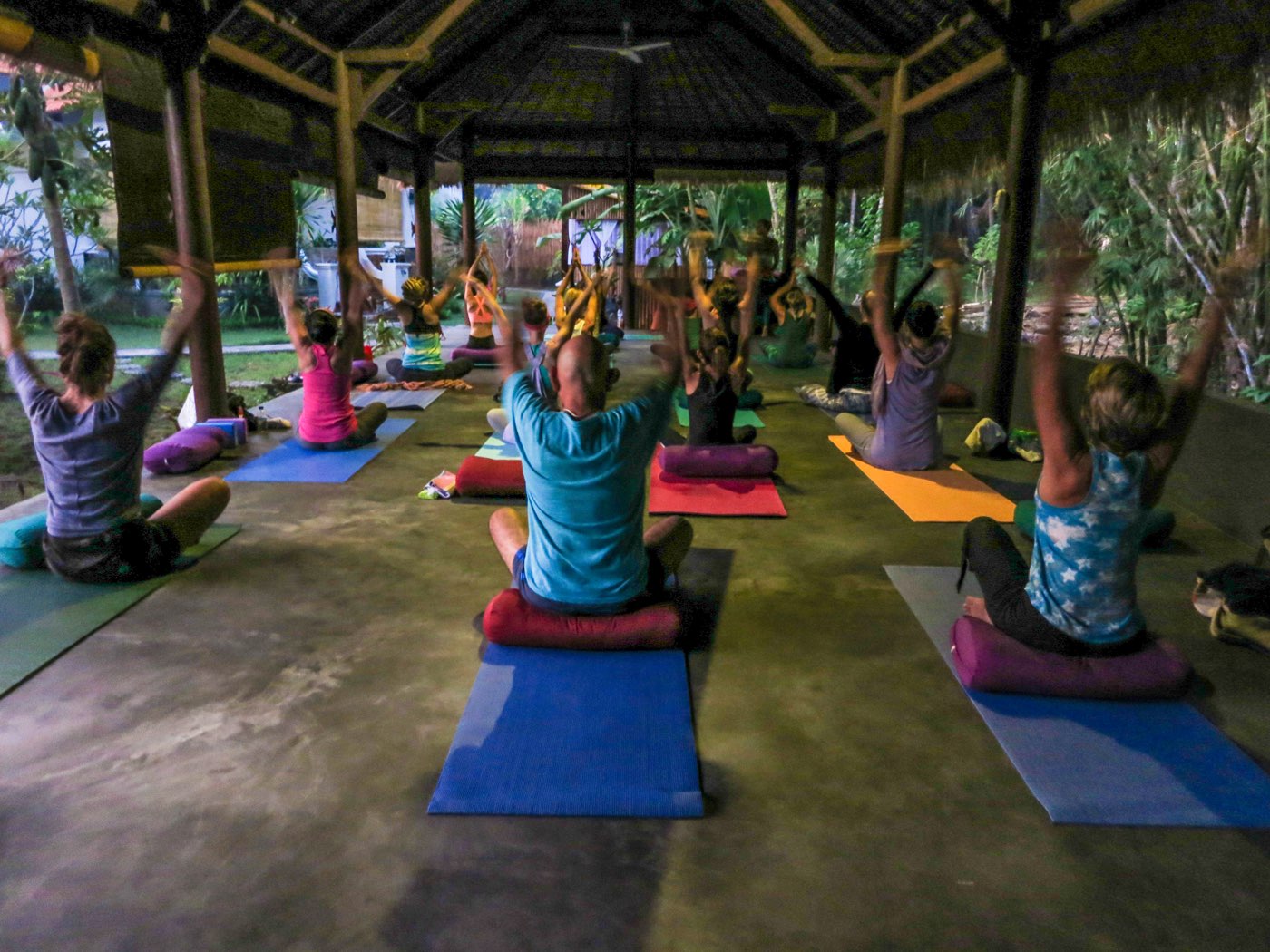 Morning yoga in an open shala, Amed. Photo: Tjioeke / Wikimedia Commons (CC BY-SA 4.0)
Detox and cleanse retreats. These build on juice fasting, raw food and gut resets, a strand of Bali wellness tourism in its own right. The medical claims vary in seriousness, so read the programme carefully and take your own advice on anything invasive. The detail is in Bali detox retreats.
Meditation and silent retreats. These run from guided sitting practice to a genuine silent course with no phone and no talking. People either love these retreats or leave early. See meditation retreats in Bali.
Holistic healing retreats. Sound healing, breathwork, energy work and Balinese traditional treatment are usually combined in one programme. The north has a quiet strand of this, set out in wellness in north Bali and sound healing.
Spa-led rest. This is less a programme than a stay built around treatments, a pool and good food. It is honest about what it is, and often the right answer. See best spas in Bali and, for the north, the best spas in Lovina and north Bali.
Nearly Every Retreat Includes a Bed, Meals and Daily Sessions
Everything past those three is where the listings differ, and where people get caught out.
Read the operator's own programme page for:
- The sessions. Check how many there are a day and how long they run. Ask whether a healing session, a treatment or a temple visit is in the price or sold on top.
- The food. Check which meals are included, and whether the kitchen cooks to the diet the retreat is built around. Good kitchens say where their food comes from. The Yoga Barn's Garden Kafe cooks raw, vegan and vegetarian food from local, seasonal produce and names its partnership with local farms. Zen Resort's kitchen draws on its own farm.
- The room. Retreat pricing often quotes a shared room, with a private one as an upgrade. Some centres house guests on site, some in nearby hotels.
- Transfers. Airport pickup matters more here than it sounds. The north coast is three hours or more from the airport, which Zen Resort states plainly on its own travel page.
- The teachers for your dates. This is the one thing a brochure photograph cannot tell you. Good centres publish the facilitator for each retreat week by name.
If a programme page will not tell you who is teaching, treat that as the answer.
Where to Go: Ubud for Choice, the South for Active and Social, the North for Quiet
Ubud is the centre of gravity. The Yoga Barn is a well-known example of the model. It opened in 2007 with two studios, a small vegan café and four classes a day, and it now has:
- eight studios averaging more than 25 classes a day
- a Center for Wellness
- on-site accommodation
- one- and three-day retreat packages
- a separate retreat centre, the Yogi's Garden, on a working farm outside Ubud
Ubud's density is the point. You can try five teachers in a week and build your own retreat without committing to one programme.
The south, around Canggu and Seminyak, runs more active and more social retreats.
The north is the quiet option, and the reason this site exists. It has few people, long distances and a handful of places that have been doing this since before Bali wellness was a category.
In the North: An Ayurvedic Resort, a Two-Site Retreat and a Monastery
Three places anchor the north, each described here from its own site.
Zen Resort Bali, Ume Anyar
Zen Resort Bali, at Ume Anyar west of Lovina, runs Ayurvedic and yoga programmes. Its Ayurveda page describes a resident Ayurvedic doctor overseeing every consultation, supported by Balinese spa therapists.
The resort has its own Amaris Spa, yoga and meditation practice, and private villas. Its kitchen draws on the resort's own organic farm and herb gardens. Map
Gaia Oasis, Tejakula
Gaia Oasis, at Tejakula east along the coast, runs as two linked properties. Pantai is a beach resort, and Abasan is a mountainside retreat it calls its spiritual core.
Food at Abasan is vegetarian, and the kitchen caters for vegan, raw, dairy-free and gluten-free diets on request. Gaia Oasis also welcomes group leaders running yoga, meditation and other retreats of their own.
The Buleleng tourism office lists the mountain retreat in its Visit North Bali directory. Map
Brahma Vihara Arama, Banjar
Brahma Vihara Arama, in the hills above Banjar, describes itself as Bali's largest Buddhist monastery. It was founded by the Balinese monk Bhikkhu Girirakkhito, and its community is dedicated to the practice of Vipassana meditation.
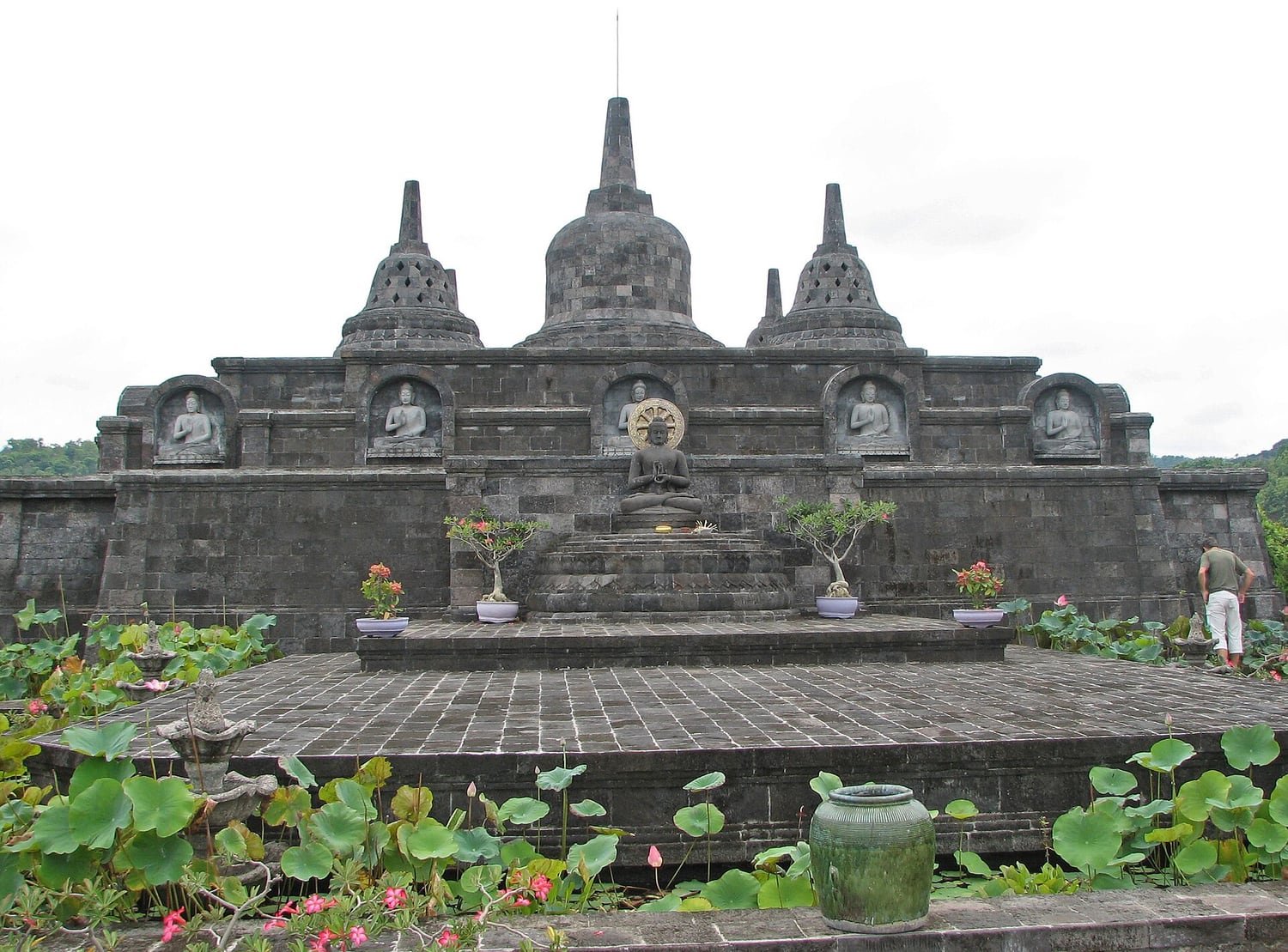 The miniature Borobudur and lotus pond at Brahma Vihara Arama monastery near Banjar. Photo: Eric Bajart / Wikimedia Commons (CC BY-SA 3.0)
The monastery holds meditation gatherings open to all, and its own site lists the dates and takes enquiries about a visit. The full guide is Brahma Vihara Arama. Map
For the wider highland option, Munduk sits above the coast in cloud forest. Lovina is the base many visitors use for the north.
How to Choose a Retreat, in Six Steps
The word "retreat" covers a spa week and a ten-day silent course, run by teachers whose experience varies enormously. Nobody licenses the word, so choosing well is the whole task.
-
Name your goal. Decide whether you want to move, rest, reset the body or go inward. That one decision rules out most of the listings you will find.
-
Pick the location for the energy you want, and let that outweigh the prettiest photograph. Ubud is for choice and company, the north for quiet, the south for active and social.
-
Read the operator's own programme page before any aggregator listing. Aggregators sell dates, and the centre publishes the substance.
-
Look up the named facilitators for your actual dates.
-
Check group size and intensity. A twenty-person shala and a six-person course are different holidays.
-
Book direct where you can. The centre's own site is where the current programme lives.
Why Bali Has So Many Retreats: An Official Push on an Older Culture
Indonesia's Ministry of Tourism has publicly set out to strengthen Bali's position as a leading global destination for health and wellness tourism. In the same release, the organisers of Bali's wellness expo point to the quality of the island's spas. They also point to its yoga and meditation centres, visited in numbers by foreign travellers.
That official push sits on top of something older. Balinese Hinduism already organises daily life around balance and purification. The practices a retreat offers, such as ritual bathing, herbal medicine, massage and offerings, are the ones the island runs on anyway.
Read Tri Hita Karana for the philosophy underneath, and traditional healers in north Bali for the practitioners who were here first.
Practical Notes
- Visa. A visa on arrival gives a 30-day stay. As Immigration explains, it can be extended in the country for another 30 days, so a single visa caps you at 60 days. Check the current fee and process on Indonesia's official e-visa site, and see the Bali visa guide for the wider picture. A month-long retreat fits, and two back to back may not.
- Season. The dry months are calmer for outdoor practice and open-sided shalas. The wet season is greener, and a warming boreh wrap makes more sense in it.
- Getting there. Factor the transfer into day one. Three hours in a car undoes a lot of the first evening, so an overnight near the airport before a north-coast retreat is worth considering.
- Health. Tell the centre about injuries, pregnancy, medication and anything cardiac before you book, not on arrival. Detox programmes in particular should be cleared with your own doctor.
- Bring a light layer for early mornings in the hills, insect repellent, and cash for tips and village purchases.
FAQ
Is Bali good for a wellness retreat? Yes, and the depth is the reason. Indonesia's tourism ministry is working to strengthen Bali's place as a global wellness destination. The island already has experienced teachers, purpose-built centres and a culture that organises itself around balance and purification. The catch is uneven quality, since nothing regulates the word "retreat".
Where is the best place for a retreat in Bali? Choose Ubud if you want the widest choice of teachers and the option to try several. Choose the north coast around Lovina, Ume Anyar and Tejakula if you want quiet and space. Canggu and the south suit you if you want something more active and social.
How much does a wellness retreat in Bali cost? Rates move too often to publish, and what a retreat includes varies more than the headline figure does. Read the centre's own programme page, and check whether the price is per person in a shared room. Before you compare two retreats, confirm which sessions, meals, treatments and transfers are inside each price.
What types of retreat can you do in Bali? There are five: yoga, detox and cleanse, meditation and silent, holistic healing (sound, breathwork, energy work, Balinese treatment), and spa-led rest. Lengths run from a single day to a month.
How do you choose a good Bali retreat? Start with your goal, then read the operator's own site before any aggregator. Look up the facilitators teaching your specific dates. The teacher makes the retreat, and the venue is the easy part.
Are there wellness retreats in north Bali? Yes. Zen Resort Bali at Ume Anyar runs Ayurvedic and yoga programmes under a resident Ayurvedic doctor. Gaia Oasis at Tejakula runs a beach resort and a mountain retreat that host visiting retreat groups. Brahma Vihara Arama above Banjar is a monastery dedicated to Vipassana meditation. See wellness in north Bali for the full picture.
Do I need a special visa for a long retreat? Not for a month. A visa on arrival covers 30 days and extends once to 60, which fits a retreat of up to a month. Anything longer than 60 days needs a different visa, and the official e-visa site is the place to start.
Sources
- Ministry of Tourism, Republic of Indonesia, Wamenpar: Bali Siap Jadi Destinasi Wellness Dunia (the ministry's aim to strengthen Bali as a leading global health and wellness destination; Bali's yoga, meditation and spa centres), Indonesian, read September 2026
- The Yoga Barn, About, Retreats, Yogi's Garden and Garden Kafe (opening in 2007, studios and daily classes, Center for Wellness, accommodation, retreat packages, the farm retreat centre, the café's local produce and farm partnerships), read September 2026
- Zen Resort Bali, website, Ayurveda and Travel Information (Ume Anyar location, resident Ayurvedic doctor, Amaris Spa, villas, own farm and herb gardens, drive time from the airport), read September 2026
- Gaia Oasis, website, Our Story, Abasan Mountain Retreat and Seminar Leader (the beach resort and mountain retreat, vegetarian kitchen and diets catered for, visiting group leaders), read September 2026
- Buleleng tourism office, Visit North Bali listing for Gaia Oasis Mountain Retreat (official district listing), read September 2026
- Brahma Vihara Arama, official site (the monastery, its founder, its Vipassana practice and its gatherings open to all), read September 2026
- Directorate General of Immigration, Republic of Indonesia, official e-visa information (the 30-day visitor visa), and Immigration Office Yogyakarta, Extending Indonesia Visa on Arrival (one 30-day extension, 60 days in total), read September 2026
Read next: wellness in north Bali for the practitioners and places up here, meditation retreats in Bali for the silent end of the spectrum, and the best villas in Lovina if you would rather build your own quiet week. Palm Living rents villas around Lovina for stays of a week or longer: villas for rent.