On this page
- In Brief
- Brahma Vihara Arama at a Glance
- A Working Theravada Monastery, Open to Quiet Visitors
- It Began in 1958 as a Meditation Circle Beside the Hot Springs
- What to See: Terraced Gardens and a Small Borobudur
- You Can Meditate Here, Arranged with the Monastery
- Dress and Behave as You Would at Any Sacred Site in Bali
- Go in the Morning, and in the Dry Season for Clear Views
- How to Get There: 20 to 30 Minutes Uphill from Lovina
- How to Fit It In: Pair It with the Banjar Hot Springs
- Practical Notes
- FAQ
- Sources
In Brief
Brahma Vihara Arama is a Theravada Buddhist monastery in the hills above Banjar, a 20 to 30 minute drive up from the Lovina coast. It describes itself as the largest Buddhist monastery in Bali. Monks live and practise here, and respectful visitors are welcome in the public areas.
Allow about an hour for the terraced gardens, the meditation halls and the small replica of the Borobudur stupa near the top. Entry is by cash donation at the gate, and you dress as you would for a Hindu temple, in a sarong with your shoulders covered. Visitors often pair it with the Banjar hot springs, about 10 minutes away.
Brahma Vihara Arama at a Glance
- What it is: a Theravada Buddhist monastery, the largest in Bali by its own account, with a Borobudur-style stupa
- Where it is: Banjar Tegeha village, Banjar district, about 19 km west of Singaraja
- Founded: a meditation circle from 1958, and the present monastery opened on 21 May 1971
- Setting: quiet and contemplative, with garden terraces and sea views
- Dress: sarong and covered shoulders, the same as a Hindu temple
- Entry: a donation at the gate, in cash
- How long: about an hour
- Getting there: 20 to 30 minutes uphill from the Lovina coast
- Pair with: Banjar Hot Springs, 10 minutes away
A Working Theravada Monastery, Open to Quiet Visitors
Brahma Vihara Arama is a Buddhist monastery on an island where most people are Hindu, which makes it unusual in Bali.
It follows the Theravada school and is a living place of practice, with resident monks, meditation halls and a school. Visitors are welcome in the public areas as long as they respect the quiet.
The monastery stands in Banjar Tegeha village in Banjar district, about 19 kilometres west of Singaraja. It describes itself as the largest Buddhist monastery in Bali.
The Name Means "a Noble Place of Dwelling"
The monastery's own account reads Brahma as the noble, Vihara as a way of life and Arama as a dwelling place. Together they make "a noble place of dwelling".
The name points to the four brahmavihara of the Pali Canon:
- loving-kindness
- compassion
- appreciative joy
- equanimity
It Began in 1958 as a Meditation Circle Beside the Hot Springs
Buddhism and Hinduism have coexisted in Bali for centuries, and many Balinese ceremonies carry both threads.
The monastery itself is recent. Its own history begins in 1958 with Ida Bagus Giri, a man from Banjar who later ordained in Bangkok as Bhikkhu Girirakkhito Mahathera. He led a small circle that meditated beside the Banjar hot springs, on borrowed land.
When the group outgrew the springs, he bought quieter ground in the hills at Banjar Tegeha. Building began in November 1970, and the monastery opened on 21 May 1971. The miniature Borobudur at the top was added in 1999 in his honour.
So the monastery is a modern expression of an older coexistence. Balinese practitioners come here for retreat and study, and visitors meet the quieter, contemplative side of the island's faith. Balinese Hinduism explained sets the wider religious context.
What to See: Terraced Gardens and a Small Borobudur
The grounds climb the hillside in terraces planted with frangipani and bougainvillea.
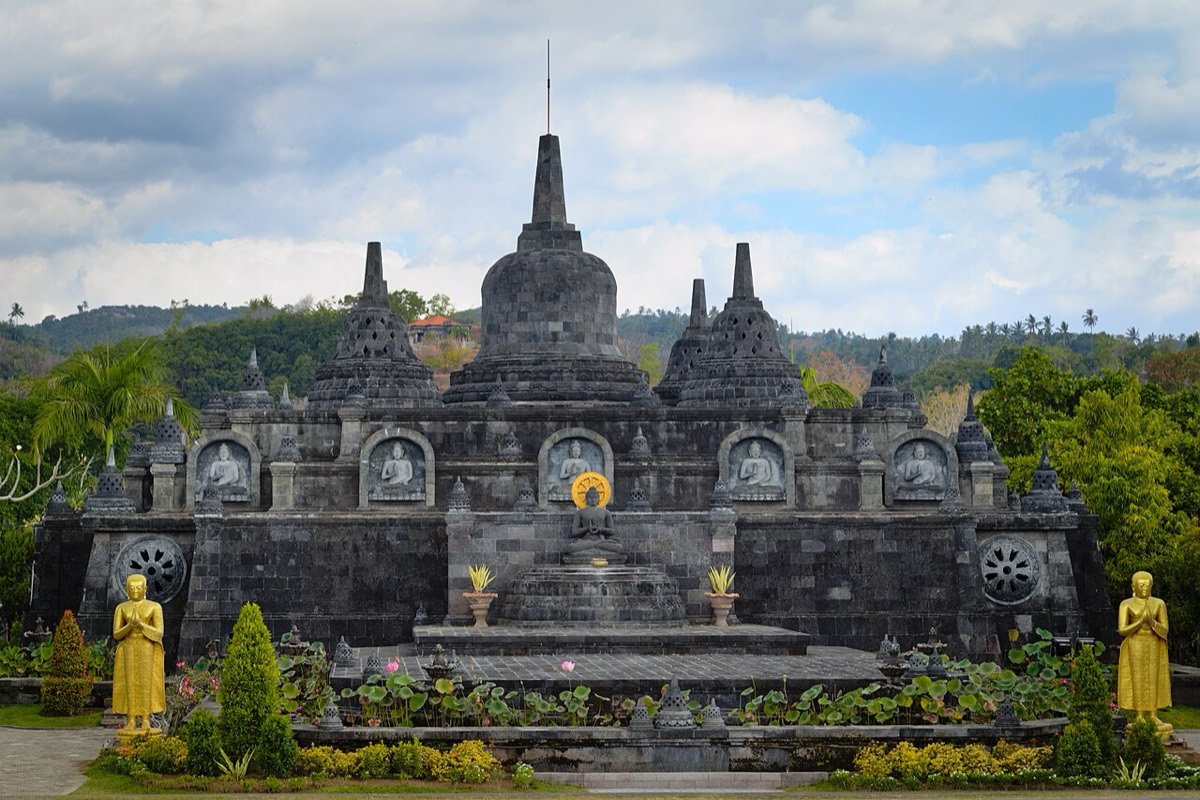
Near the top stands the feature many people come to see, a small replica of the great stupa at Borobudur in Java. Bell-shaped stupas and seated Buddha figures ring it. The replica is not large, and that is part of its charm.
The stupa is the centrepiece, and the walk up through the gardens is as much the visit as the monument. Take it slowly.
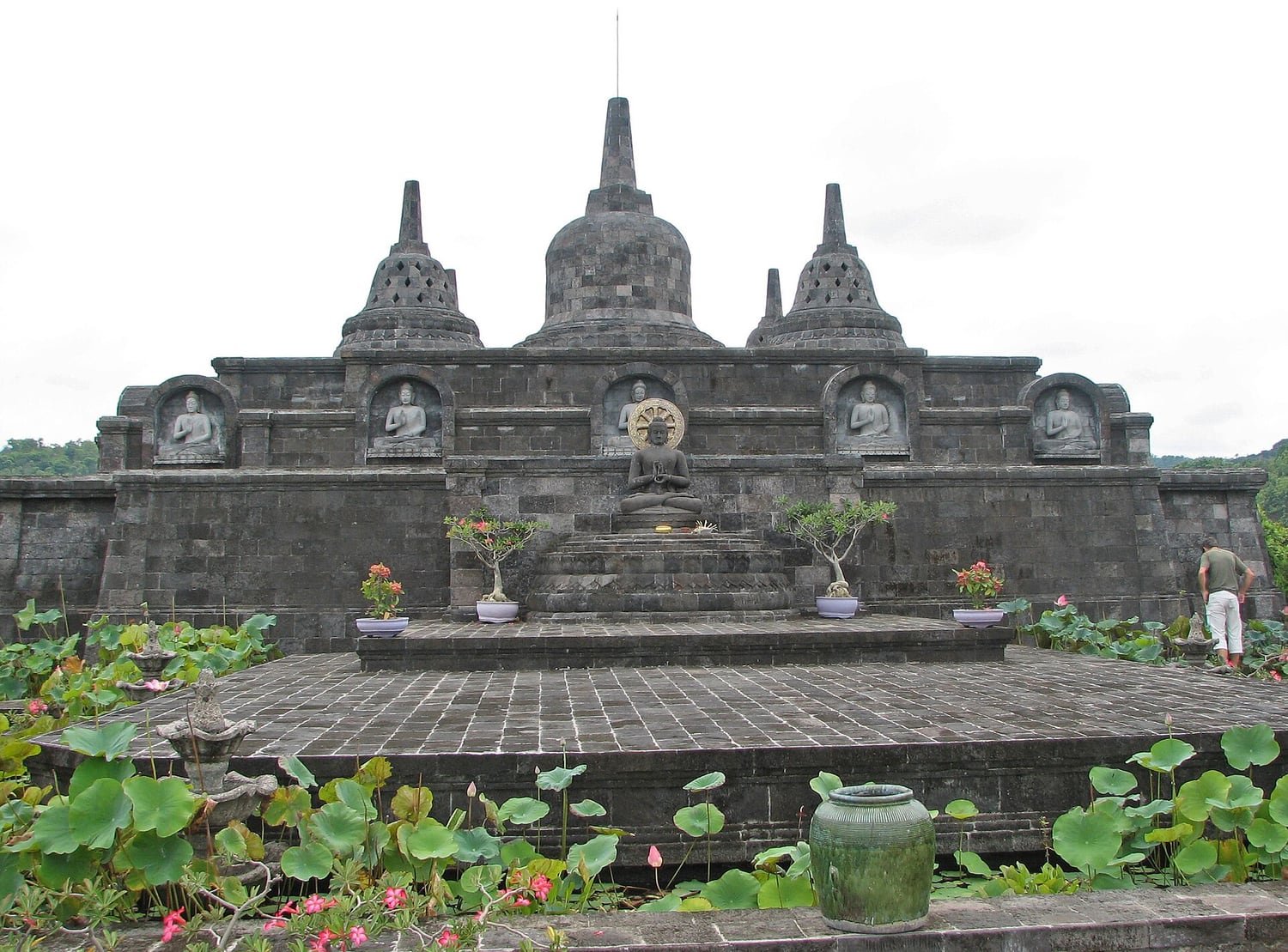 The miniature Borobudur and lotus pond in the courtyard. Photo: Eric Bajart / Wikimedia Commons (CC BY-SA 3.0)
From the upper terraces the hills fall away toward the coast and the Bali Sea. Early morning and late afternoon are the calmest hours, and the most beautiful.
You Can Meditate Here, Arranged with the Monastery
The monastery has meditation halls and a long association with insight practice.
It gives its mission as a place for vipassana and the study of the Dharma. It also says its retreats have long been taught in English as well as Indonesian. Buleleng's heritage record describes insight-meditation courses of seven to seventeen days.
Arrange anything of that kind with the monastery directly, and not through an agent. Even without a formal session, the grounds are made for sitting quietly.
Dress and Behave as You Would at Any Sacred Site in Bali
The monastery asks of you what a Balinese temple does:
- Wear a sarong and cover your shoulders.
- Keep your voice low, since this is a working monastery and people are practising.
- Do not climb on the stupas or statues.
- Ask before you photograph monks.
The Bali temple etiquette guide has the full set of customs. It was written for Hindu temples, and it applies in spirit at this Buddhist site.
Go in the Morning, and in the Dry Season for Clear Views
Morning is the time to go, for the cool air, the soft light and the quiet before any tour traffic. The dry season, April to October, gives the clearest views over the hills.
The monastery is peaceful all year. On Buddhist holy days such as Waisak it is busier with practitioners, so ask locally before you set out.
How to Get There: 20 to 30 Minutes Uphill from Lovina
The monastery is in the hills above Banjar, a 20 to 30 minute drive up from the Lovina coast.
You can go by scooter or with a driver. The road climbs but is straightforward. Getting to north Bali has the detailed routes.
How to Fit It In: Pair It with the Banjar Hot Springs
The Banjar Hot Springs are about 10 minutes away, with sulphur pools in a jungle garden.
For an easy and varied half-day, see the monastery in the cool of the morning and go to the hot springs after it. Then have lunch back in Lovina.
For a longer day, run the pairing the other way round. Start with a morning walk through the rice fields of Mayong village, inland from Seririt. Swim at the springs next, and keep the monastery for last.
Practical Notes
Details change. Confirm locally before you go.
- Entry: a cash donation at the gate
- Dress: shoulders and knees covered. The monastery lends sarongs at the entrance and asks for silence in the meditation areas.
- Time to allow: about an hour, longer if you sit to meditate
- Pair with: Banjar Hot Springs (10 minutes), Lovina (20 to 30 minutes)
- Getting there: scooter or driver up from the coast
- Respect: this is a working monastery, so keep noise low and ask before photographing monks
FAQ
What is Brahma Vihara Arama? It is a working Theravada Buddhist monastery in the hills above Banjar, near Lovina, and by its own account the largest in Bali. It has meditation halls, terraced gardens and a small replica of the Borobudur stupa. Respectful visitors are welcome.
Why is there a Buddhist monastery in Bali? Buddhism and Hinduism have coexisted in Bali for centuries, and the two threads run through much of Balinese spiritual life. The monastery is a modern expression of that older coexistence. Bhikkhu Girirakkhito Mahathera began it as a meditation circle in 1958, and it opened on its present site in 1971.
How do you get to Brahma Vihara Arama? Drive 20 to 30 minutes uphill from the Lovina coast, to the hills above the village of Banjar. A scooter or a private driver both work. The Banjar hot springs are nearby, so the two fit into one outing.
What should you wear? A sarong and a top that covers your shoulders, the same as for a Hindu temple. Keep your voice low, since it is a place of practice.
Can you meditate there? Yes. The monastery exists for vipassana practice and has long taught retreats in English as well as Indonesian. Buleleng's heritage record describes courses of seven to seventeen days. Arrange a retreat with the monastery directly. Even without a formal session, the gardens are made for quiet sitting.
Is there an entrance fee? A donation is asked at the gate. Bring cash.
Who founded Brahma Vihara Arama, and when? Bhikkhu Girirakkhito Mahathera, born Ida Bagus Giri in Banjar. He began leading meditation beside the Banjar hot springs in 1958. Building on the present site began in November 1970, and the monastery opened on 21 May 1971. That makes it young by Balinese standards, which is why it feels tended rather than ancient.
What does the name mean? The monastery translates it as "a noble place of dwelling". Brahma is the noble, Vihara a way of life and Arama a dwelling place. The name points to the four brahmavihara, the boundless states of the Pali Canon.
What can you combine it with? The Banjar Hot Springs, about 10 minutes away, are the obvious pairing. Both sit a short drive above Lovina, so the monastery, the springs and a Lovina lunch make a relaxed half-day.
Sources
- Brahmavihara Arama, About the Monastery (the meaning of the name, the 1958 meditation circle beside the Banjar hot springs, the founder Bhikkhu Girirakkhito Mahathera, building from November 1970 and opening on 21 May 1971, the miniature Borobudur of 1999, largest Buddhist monastery in Bali, vipassana retreats in English and Indonesian, dress and silence, sarongs lent at the entrance), English, read September 2026
- Pemerintah Kabupaten Buleleng, Pusaka Budaya Bali Utara (Banjar Tegeha village in Banjar district, about 19 km west of Singaraja, the move from the hot springs, insight-meditation courses of seven to seventeen days, the Waisak ceremony ground), Indonesian, read September 2026
- Buleleng tourism office, Visit North Bali: Brahma Vihara Banjar (the buildings of the complex and the request for modest dress and a low voice), English, read September 2026
- Enrico Strocchi, Brahmavihara-Arama Temple, Wikimedia Commons (CC BY-SA 2.0)
- Eric Bajart, Temple bouddhiste de Brahma Vihara Ashrama (Banjar), Wikimedia Commons (CC BY-SA 3.0)
Read next: Banjar Hot Springs, the best temples in north Bali, and wellness in north Bali.