On this page
- In Brief
- Sapi Gerumbungan at a Glance
- It Began as the Farmers' Thanks for a Good Harvest
- How a Pair Is Dressed and Driven: Bells, a Yoke and a Long Pole
- Judges Score the Harmony of the Pair's Steps Above All
- A Gerumbungan Bull Is Known From Birth and Tended Every Day
- Village Groups Across Buleleng Keep It Alive
- How to See It: Watch the Festival Calendars
- Practical Notes
- FAQ
- Sources
In Brief
Sapi Gerumbungan is a traditional bull contest from Buleleng, north Bali, called sampi gerumbungan in Balinese. Farmers in Kaliasem village, near Lovina, started it around a hundred years ago to give thanks for a good harvest.
Two bulls are yoked together, each with a large bell, the gerumbungan, at its neck, along with bright ornaments and small leg bells. A driver stands at the back of a long pole fixed to the yoke. Judges score the bulls, their ornaments and above all the harmony of their steps. The contest looks more like a parade than a race.
A handful of village groups across Buleleng keep it alive today. It is shown mainly at festivals, including Singaraja's anniversary and the Lovina Festival.
Sapi Gerumbungan at a Glance
- What it is: A contest for pairs of decorated bulls, judged on beauty and harmony of step
- Where it comes from: Kaliasem village, Banjar district, just west of Lovina
- How old: First held around 1923, according to VIVA Bali
- The name: Gerumbungan is the large bell hung on each bull's neck
- Official standing: A regency tradition by decree of the Regent of Buleleng since 2002
- Who keeps it: Village livestock groups in west, central and east Buleleng
- When to see it: At festivals, especially Singaraja's anniversary and the Lovina Festival. Check the regency's events listings
- Nearby cousin: Makepung in Jembrana, west Bali, which races buffalo for speed
It Began as the Farmers' Thanks for a Good Harvest
The tradition began in Buleleng's rice fields.
The regency's culture and tourism office describes it as the farmers' expression of joy at an abundant harvest. VIVA Bali dates the first contests to around 1923 in Kaliasem, where the work of ploughing with a pair of cattle inspired them.
For some families it is still a way to pay a vow. The leader of one village group told Tatkala what his elders passed down. A farmer would bring out his bulls to fulfil a promise made for a good harvest, and some still do.
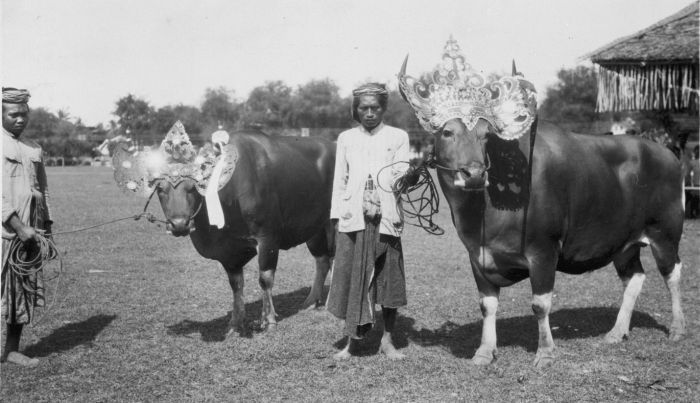 The winning pair of bulls at a ploughing competition near Munduk, photographed between 1910 and 1925. Photo: Unknown author, Wereldmuseum Amsterdam / Wikimedia Commons (CC BY-SA 3.0)
Only bulls take part, and only strong ones. The village livestock groups choose them and train them young. The aim is a pair that moves as one, with matching steps, tails curved up and heads held high.
How a Pair Is Dressed and Driven: Bells, a Yoke and a Long Pole
With bells at neck and leg, a pair in motion is heard before it is seen.
The Bells Give the Contest Its Name
Gerumbungan means a large bell, and one hangs from each bull's neck. The tourism office notes it is also called keroncongan, and it gives a deep, particular sound as the bulls move. VIVA Bali adds the gongseng, small bells worn on the legs.
The Driver Stands on a Pole Behind the Yoke
A wooden yoke, the uga, joins the two bulls. A pole about three metres long is fixed to the middle of the yoke, and the driver stands at its back end to steer the pair.
Palm Living, based in Lovina, gives the same description of the yoke, the pole and the standing driver.
Bulls and Driver Both Dress for the Day
The bulls wear their bells and ornaments, and the driver dresses up too. The tourism office says the jockey must be neatly and attractively turned out.
Judges Score the Harmony of the Pair's Steps Above All
Judges look at the type of bull entered and its accessories, and above all at the harmony of the pair's steps.
That is where the driver's skill shows, and a driver who can add a trick of his own earns extra points. VIVA Bali sums up the criteria as beauty, harmony and the completeness of the bulls' ornaments.
Makepung in Jembrana Is the Buffalo Race, Run for Speed
West Bali has its own cattle contest, and the two are easy to confuse. Makepung, in Jembrana, races pairs of water buffalo, and the fastest pair wins.
The Buleleng tourism office draws the contrast itself. In Sapi Gerumbungan the pair is trained for uniform steps, curved tails and raised heads. In Makepung at Negara the buffalo are driven to be the fastest.
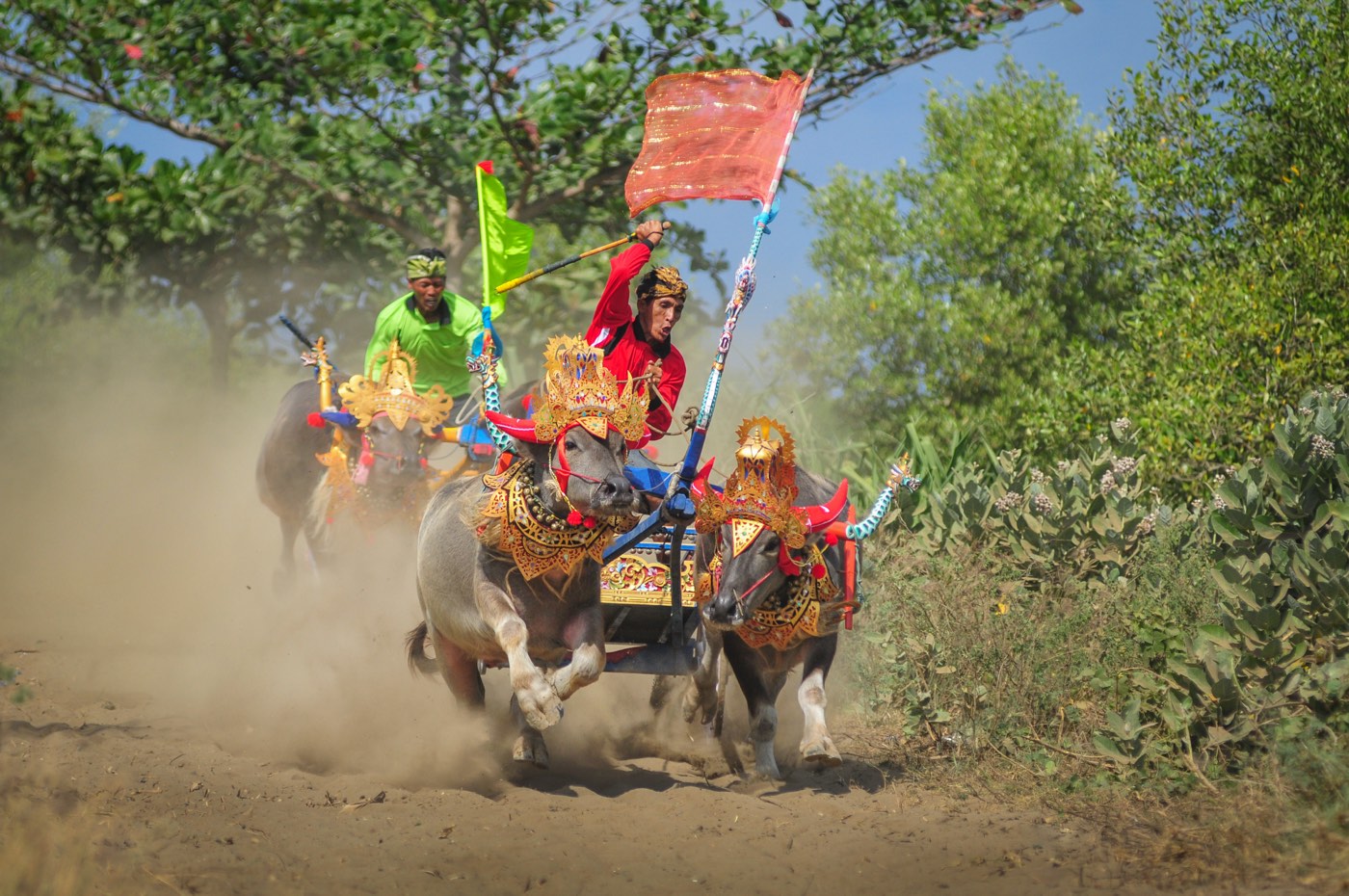 Makepung buffalo racing in Jembrana, the west's speed-first cousin of the north's contest. Photo: Imadedana / Wikimedia Commons (CC BY-SA 4.0)
So the north's contest is judged on elegance, and the west's on speed. For more of what is particular to the north, read why north Bali is different.
A Gerumbungan Bull Is Known From Birth and Tended Every Day
Ketut Susila leads the Pasupala group in Lemukih village. He told Tatkala that a gerumbungan bull shows its character from birth, in how it moves its head, holds its tail and places its feet.
Owners massage and stroke their bulls every day, put them in the morning sun and bathe them at midday. A bull is ready to perform from about a year old.
His group practises every two weeks, and every other day before a big event.
Village Groups Across Buleleng Keep It Alive
Sapi Gerumbungan is at risk. Balinese farmers have moved from ploughing with cattle to ploughing with tractors, so fewer families keep working bulls. Tatkala warns that the tradition has lately come close to dying out.
In 2002 a decree of the Regent of Buleleng made it an official regency tradition, so that contests could run regularly. Since then it has been held above all for Singaraja's anniversary, with the Regent's Cup as the prize.
Groups still keep it in several parts of the regency. Tatkala lists them:
- West: Kaliasem and Pedawa, in Banjar district
- Centre: Panji and Sambangan in Sukasada district, and Banjar Tegal in Singaraja
- East: the Baga Sebali group, drawn from Sawan, Menyali, Lemukih, Galungan and Bebetin
Five groups from east, central and west Buleleng brought their bulls to an exhibition at the Lovina Festival.
How to See It: Watch the Festival Calendars
Sapi Gerumbungan is not a weekly show.
The tourism office describes it as a short morning event held on Sundays in August. In recent years it has appeared mostly at festivals, where it is one item on a larger programme. There are three ways to find it:
- Watch the festival calendars. The Lovina Festival on the beach and Singaraja's anniversary celebrations are the likeliest stages, and the Buleleng Festival is the regency's other big showcase. Our north Bali events calendar lists festivals as they are announced, and the regency tourism office posts its own event news.
- Ask locally. In Lovina, ask your host or driver whether a village group is showing its bulls. Kaliasem is on the coast road just west of central Lovina.
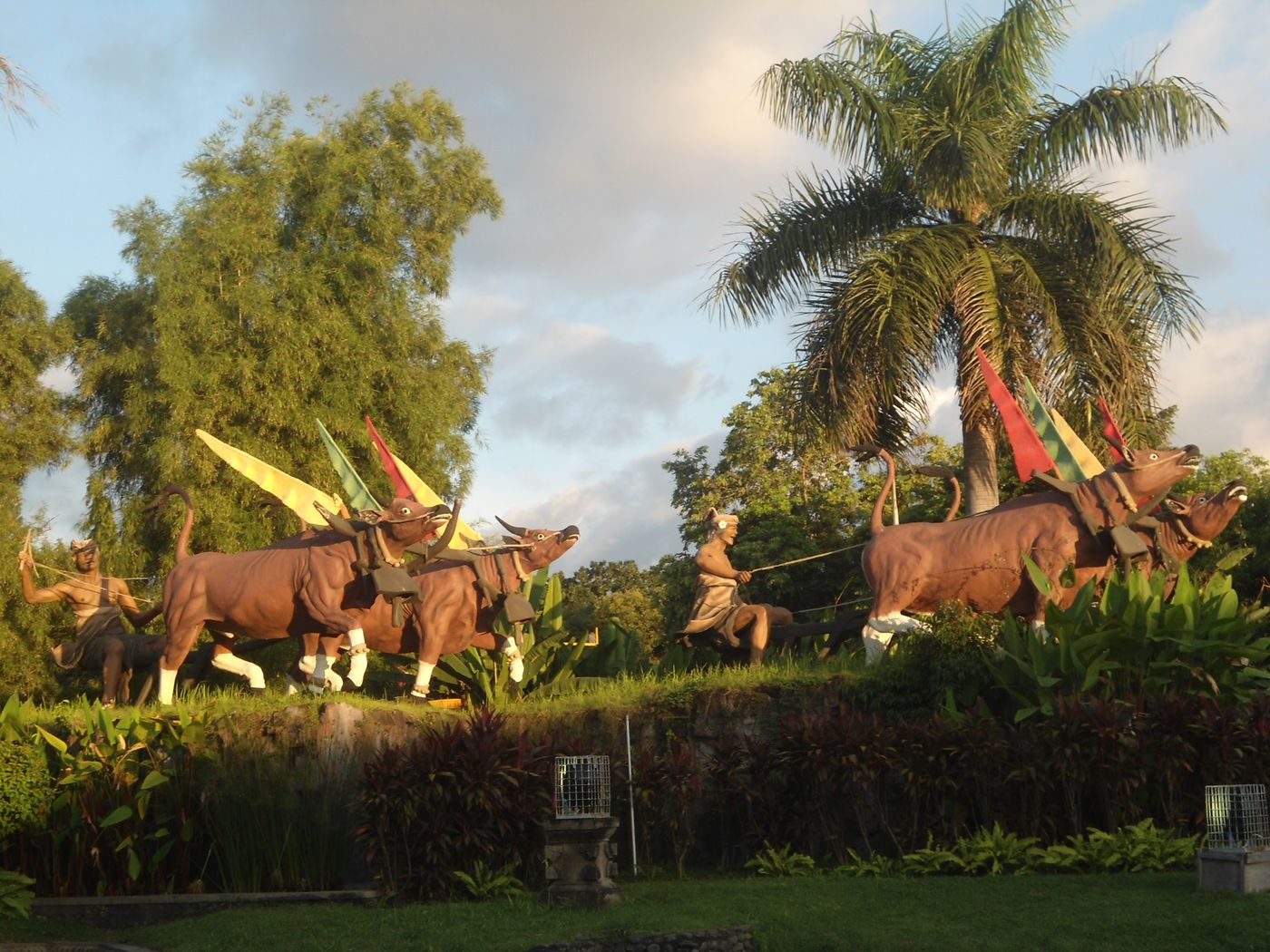
- See the monument. Whatever the date, the cattle-racing monument at the Banyuasri roundabout in Singaraja shows yoked pairs of bulls with their drivers.
At some shows, the tourism office notes, a visitor can try driving a pair under the owner's guidance, since the bulls are trained and calm.
Practical Notes
- Dates: set each year. Check festival announcements or ask in Lovina close to the time.
- Where to stand: where the crowd stands, well clear of the track.
- Photographs: ask before photographing owners and their bulls up close. These animals are years of daily work.
- Driving a pair: ask the owner first, and only when they offer.
- The rest of the morning: things to do in Lovina covers what else is close by.
- Staying nearby: Palm Living's villas for rent are around Lovina, a short drive from Kaliasem.
FAQ
What is Sapi Gerumbungan? Sapi Gerumbungan is north Bali's traditional bull contest, from Kaliasem near Lovina. Pairs of decorated bulls with large neck bells (gerumbungan) are yoked together and driven by a man standing on a pole behind them. Judges score beauty, ornaments and the harmony of the pair's steps.
How old is Sapi Gerumbungan? VIVA Bali dates it to around 1923, when farmers in Kaliasem began showing their bulls as thanks for a good harvest. The Regent of Buleleng made it an official regency tradition by decree in 2002.
How is it different from Makepung? Makepung, in west Bali's Jembrana, races water buffalo and the fastest pair wins. Sapi Gerumbungan uses bulls and is judged on elegance: matching steps, raised heads and curved tails, the ornaments and the driver's skill.
When can you see Sapi Gerumbungan? It was traditionally held on Sunday mornings in August, and now appears mostly at festivals such as Singaraja's anniversary and the Lovina Festival. Dates are set each year, so check festival announcements or ask in Lovina close to the time.
What does gerumbungan mean? A large bell. One hangs from each bull's neck and gives the contest its sound and its name. It is also called keroncongan.
Can visitors take part? The Buleleng tourism office and Palm Living both note that visitors can sometimes try driving a pair under the owner's guidance, since the bulls are trained. Ask the owner first, and only when they offer.
Sources
- Buleleng Regency Culture and Tourism Office, Budaya dan tradisi Sapi Gerumbungan di Buleleng (origin in the harvest, the meaning of gerumbungan and keroncongan, bulls only, the uga yoke and three-metre pole, judging criteria, the 2002 Regent's decree, Singaraja's anniversary and the Regent's Cup, the August Sunday tradition, visitors trying as driver), in Indonesian, read September 2026
- VIVA Bali, Warisan budaya petani yang menggaung lewat tradisi Sampi Gerumbungan (origin in Kaliasem, Banjar district, around 1923; gongseng leg bells; contests at Singaraja's anniversary and the Lovina Festival; judging on beauty, harmony and ornaments), in Indonesian, read September 2026
- Tatkala, Sapi Gerumbungan: wujud rasa syukur petani Buleleng di musim panen (the Pasupala group of Lemukih, vows for a good harvest, how the bulls are chosen and cared for, training, the groups across Buleleng, five groups at the Lovina Festival, the decline with tractors), in Indonesian, read September 2026
- Palm Living, Sapi Gerumbungan (Kaliasem, the bell, the uga and pole, the standing jockey, visitors trying with a guide), read September 2026
- Images: Wereldmuseum Amsterdam (Tropenmuseum collection), Winning pair of bulls at a ploughing competition near Munduk (CC BY-SA 3.0); DayakSibiriak, Cattle racing statue, Singaraja (CC BY-SA 4.0); Imadedana, Mekepung (CC BY-SA 4.0), Wikimedia Commons
More of the north's living traditions: the Buleleng Festival in Singaraja, Balinese dance and gong kebyar, and the Lovina Festival on the beach nearby.