
On this page
- In Brief
- Gong Kebyar and North Bali Dance at a Glance
- Gong Kebyar Is the Sound of Modern Bali, and It Began in Buleleng
- A Gamelan Shimmers Because Its Instruments Are Tuned in Pairs
- Kebyar Spread Across Bali Through the Island's Competitions
- Ten Dances North Bali Created or Keeps
- Legong, Barong and Kecak Have Their Own Guides and Southern Stages
- Where to See Dance in North Bali
- At a Ceremony You Are a Guest
- Practical Notes
- FAQ
- Sources
In Brief
Gong kebyar is the fast, explosive style of gamelan behind modern Balinese dance, and it was born in north Bali, the regency of Buleleng. Its first public performance was at a gamelan competition in Jagaraga in December 1915. Another account dates the first kebyar pieces to Bungkulan, in 1914.
The word kebyar means to flare up or burst open, and the music does exactly that.
Ten dances tie the north to that sound and to its older rites. Each was born in Buleleng or is kept by one of its villages:
- Trunajaya, the solo created in Jagaraga
- Wiranjaya, west Buleleng's answer to it
- Palawakya, a kebyar dance for a dancer who is also a musician
- Nelayan, the fishermen's dance from Kedis
- Joged Bumbung, the social dance of Buleleng's farmers
- Wayang Wong, the masked Ramayana of Tejakula
- Sanghyang, the trance dances of Sidetapa and Bungkulan
- Rejang, with fourteen forms in Sidetapa alone
- Baris, the warrior dance of Cempaga and Pedawa
- Pendet, danced by six in Cempaga's village temple
In the north you see dance at temple ceremonies, village rehearsals and the regency's festivals. There are no nightly tourist shows. The island-wide picture, with its three genres and UNESCO's nine dances, is in the guide to Balinese dance.
Gong Kebyar and North Bali Dance at a Glance
- The origin: Gong kebyar was born in north Bali (Buleleng). Its first public performance was at Jagaraga, December 1915
- The other claim: Bungkulan, where the first kebyar pieces are dated to 1914
- What "kebyar" means: "to flare up or burst open", for the sudden changes in tempo and volume
- The first kebyar dance: Kebyar Legong, created in Jagaraga in 1915 by Pan Wandres
- Why it matters: It reshaped Balinese gamelan and dance island-wide
- The instruments: Bronze gongs, metallophones, drums (kendang), cymbals, played in tuned pairs
- Dances born in Buleleng: Trunajaya, Wiranjaya, Palawakya, Nelayan, Joged Bumbung
- Dances kept by northern villages: Wayang Wong in Tejakula, Sanghyang in Sidetapa and Bungkulan, and Rejang, Baris and Pendet in the Bali Aga villages
- UNESCO: Wayang Wong of Tejakula is Buleleng's dance among the nine in "Three genres of traditional dance in Bali", inscribed 2015
- Where to feel it: Temple ceremonies, village rehearsals, Buleleng's festivals
- Kecak: Mostly performed in the south, at Uluwatu, Tanah Lot and Ubud
Gong Kebyar Is the Sound of Modern Bali, and It Began in Buleleng
Buleleng's culture and tourism office calls gong kebyar a masterpiece of north Bali's artists.
In the office's words, it was a new force that broke the stagnation of the island's gong music. From Buleleng it swept across Bali and became the dominant form of Balinese music and dance.
Gamelan is a shimmering, interlocking metal sound that seems to surge and stop on a knife-edge. Kebyar broke the older ceremonial gamelan open with:
- sudden bursts of sound
- dramatic shifts in tempo and volume
- interlocking patterns played at a speed no single player could manage
- the whole ensemble igniting and falling silent as one
The style grew up in village competitions, a century ago, in villages a short drive from Lovina.
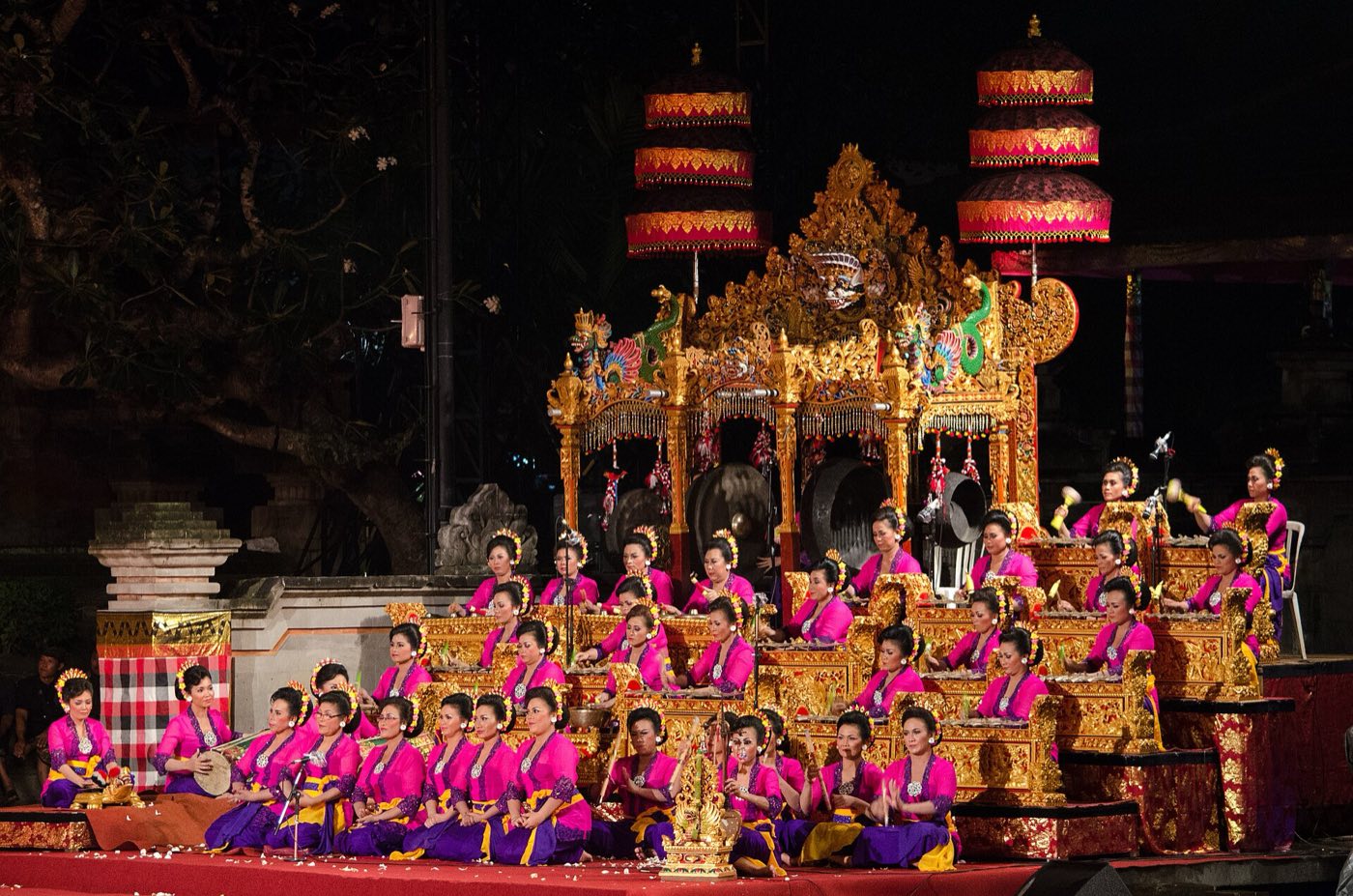 A gong kebyar ensemble in full flight. Photo: Benjamin Hollis / Wikimedia Commons (CC BY 2.0)

Jagaraga hosted the first public kebyar, in December 1915
Kebyar was first documented in north Bali in the early 1900s.
Its first public performance was in December 1915, at a gamelan competition in Jagaraga. The village lies east of Singaraja and is better known for its stand against the Dutch, told in the Jagaraga war.
The date comes from the composer Colin McPhee's Music in Bali. McPhee wrote that he had it from an interview with A.A. Gde Gusti Jelantik, a former regent of Buleleng, as Buleleng's culture office notes. The office reads 1915 as the year of the first competition, so the clubs taking part had been composing kebyar for some time before it.
Bungkulan has its own claim, from 1914
The same office records a second account. The music teacher I Nyoman Rembang had it from I Gusti Bagus Sugriwa, a man of Bungkulan.
According to that account, I Gusti Nyoman Panji composed the first kebyar pieces in Bungkulan in 1914. Ngakan Kuta, who lived in the village, tried dancing to them. Bungkulan lies in the same Sawan district as Jagaraga, as the village's own site shows.
The question is still open. Pande Made Sukerta of ISI Denpasar, the arts university, writes that no seminar or gathering has yet settled where and when gong kebyar was created.
Kebyar Legong was the first kebyar dance
In 1915 a Jagaraga musician and dancer, I Wayan Paraupan, created a duet called Kebyar Legong. He was known as Pan Wandres, and his duet mixed the movements of Baris, Jauk and Legong.
The regency's culture office names I Gede Manik and his partner Mangku Ongka as its first dancers. In 1925 Manik made his own shorter version, the solo that became Trunajaya.
Kebyar Legong was danced in mebarung, the north's tradition of rival gamelan clubs sharing one stage. The ISI Denpasar lecturer Kadek Suartaya calls it the main inspiration for the kebyar dances of both halves of Buleleng.
A Gamelan Shimmers Because Its Instruments Are Tuned in Pairs
A Balinese gamelan is a bronze orchestra, made up of:
- rows of tuned metallophones and gongs
- paired drums, the kendang, driving the rhythm
- cymbals
- flutes
The heart of it is the technique called kotekan. Two players interlock lightning-fast patterns so tightly that they sound like a single impossible stream of notes. One part, the polos, falls mostly on the beat, and the other, the sangsih, falls mostly off it.
The instruments come in male and female pairs. Each pair is tuned slightly apart, the female a little lower. Played together they beat against each other, a pulsing the Balinese call ombak, the wave, and that is the shimmer you hear.
Gong kebyar uses a five-tone scale called pelog selisir, and its range runs across five octaves. At the bottom is the great gong, never damped and heard far beyond the village. At the top are the piercing keys of the smallest metallophones.
A gamelan belongs to its village
There is no standard pitch in Balinese music. A set of instruments is made and tuned together. So a gamelan belongs to its village or club, and an instrument cannot simply be borrowed from another set.
The north builds its own kind of kebyar set, with differently shaped keys, as the guide to Balinese gamelan explains.
The temple comes first and the audience second
Kebyar is now required at temple anniversaries (odalan) and major holy days, where it accompanies the sacred dances. It is also proper at life-cycle rites such as weddings.
Kebyar Spread Across Bali Through the Island's Competitions
The Dutch colonial government sponsored island-wide gamelan competitions, which ran until the Japanese occupation. Those competitions carried kebyar south.
Buleleng's culture office counts 1925 as one of kebyar's high points. That year, in Tabanan, the dancer I Ketut Marya first performed Kebyar Duduk. Known as I Mario, he danced the solo almost entirely from a seated position, to the new kebyar music.
It is all in the eyes, hands, face and torso, in dazzling dialogue with the music. Mario drew on the Kebyar Legong that had come out of the north. He later added the trompong, a long row of kettle gongs, for a version called Kebyar Trompong.
A troupe danced it at the Paris Colonial Exposition in 1931. In 1952 Mario went on to create Oleg Tamulilingan, a duet of two bumblebees, for the impresario John Coast's tour of Europe and the United States.
Ten Dances North Bali Created or Keeps
Each dance below has a sourced tie to the north. Five were born in Buleleng, most of them for the gong kebyar. Five are kept by northern villages as part of their own ceremonies.
1. Trunajaya, Jagaraga's solo named by Sukarno
The solo portrays a young man on the edge of adulthood: hot-tempered, emotional and energetic, with a gentle side. It is a strong male role, often danced by women, the Buleleng culture and tourism office notes.
I Gede Manik of Jagaraga created it in 1925 from the Kebyar Legong of 1915. At first it was called simply Kebyar Dangin Enjung, and for years it had no fixed name.
Around 1950, President Sukarno saw it performed at a hotel in Denpasar. He named it Tarunajaya, the victorious youth, according to the culture office. Jagaraga still claims it with pride.
Where to see it. Trunajaya is passed on in Bali's arts schools, institutes and sanggar, and it is a regular piece in Balinese dance competitions. As an entertainment dance it can be staged anywhere, from a temple's outer courtyard to an open stage.
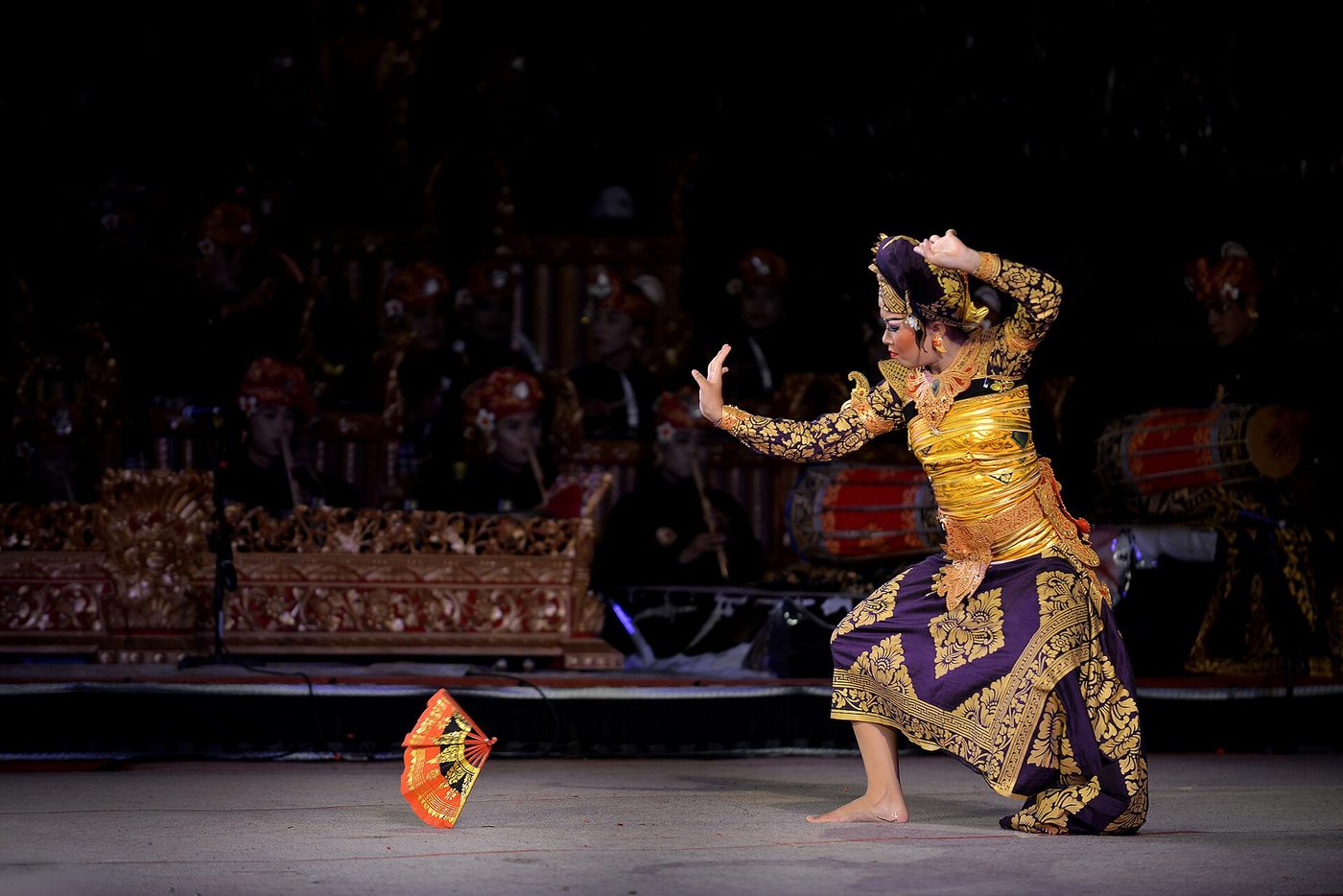 A Trunajaya dancer, the fierce solo created in Jagaraga. Photo: Hendri Suhandi / Wikimedia Commons (CC BY-SA 4.0)

2. Wiranjaya, west Buleleng's answer
In the 1950s, Trunajaya was the pride of Dangin Enjung, east Buleleng. Dauh Enjung, the west, had its own kebyar dance, Wiranjaya, and the two met head to head at gamelan contests.
Ketut Merdana and Putu Sumiasa of Kedis, in Busungbiu district, created Wiranjaya in 1958. It shows the Pandawa knights practising archery, in costume drawn from the shadow-puppet theatre. Both dances grew from Kebyar Legong, so its structure and music sound close to Trunajaya's, as Kadek Suartaya of ISI Denpasar describes.
Trunajaya went on to be taught at the arts schools in Denpasar, and Wiranjaya faded. ISI Denpasar staged the two side by side again in 2011, at a temple anniversary in Sukawati.
3. Palawakya, a dance for a dancer who is also a musician
Palawakya is a kebyar dance created by I Gede Manik of Jagaraga, the maker of Trunajaya. Buleleng's culture office calls it a symbol of the punggawa, the holders of power.
Its dancer must master literature and play music as well as dance. In the office's reading, that range of skill stands for a complex and noble knowledge.
Palawakya is known as an intricate dance, and its dancer needs a fine feeling for it, passed on by teachers. The music is gong kebyar, in kebyar-style pieces.
Where to see it. Buleleng's culture office has filmed Jaya Kusuma, Jagaraga's legendary gong kebyar club, performing Palawakya. Ask at a festival or a sanggar near Singaraja whether a group is dancing it.
4. Nelayan, the fishermen's dance from Kedis
I Ketut Merdana, one of Wiranjaya's two creators, made Tari Nelayan, the fishermen's dance, in 1960 in Kedis, Busungbiu, as tatkala.co reports. His village lies not far from the coast.
It is usually danced by one man and two women, to gong kebyar. Their movements follow a fisherman's day:
- rowing
- casting the net
- being pricked by a fish's spine
- working together to bring in the catch
The Buleleng culture office counts it among the kebyar dances, since the music was born in the same regency.
In the 1960s and 1970s Nelayan often opened performances of drama gong, the popular Balinese theatre, tatkala.co adds. The dance master Ni Ketut Arini has long taught it to children at her studio in Denpasar.
5. Joged Bumbung, the social dance of Buleleng's farmers
Joged is the party. Indonesian Wikipedia places its beginning in Buleleng in the 1940s, as a social dance farmers made up to relax after work. Tempo, citing the culture ministry, names the village of Kalopaksa, in the Seririt district.
A woman dances to a bamboo gamelan. Then she invites a man from the audience, with a touch of her fan or sash, to dance with her. The steps are improvised, and it is considered impolite to refuse.
The bamboo xylophones are called grantang. They are especially popular in northern and western Bali, where ensembles often tune to the pelog scale.
UNESCO lists Joged Bumbung under Jembrana, in west Bali, in its nomination file. The full story, from the bamboo gamelan to the province's campaign against joged jaruh, is in the guide to joged bumbung.
Where to see it. Joged belongs to weddings, harvest celebrations, holy days and village festivals.
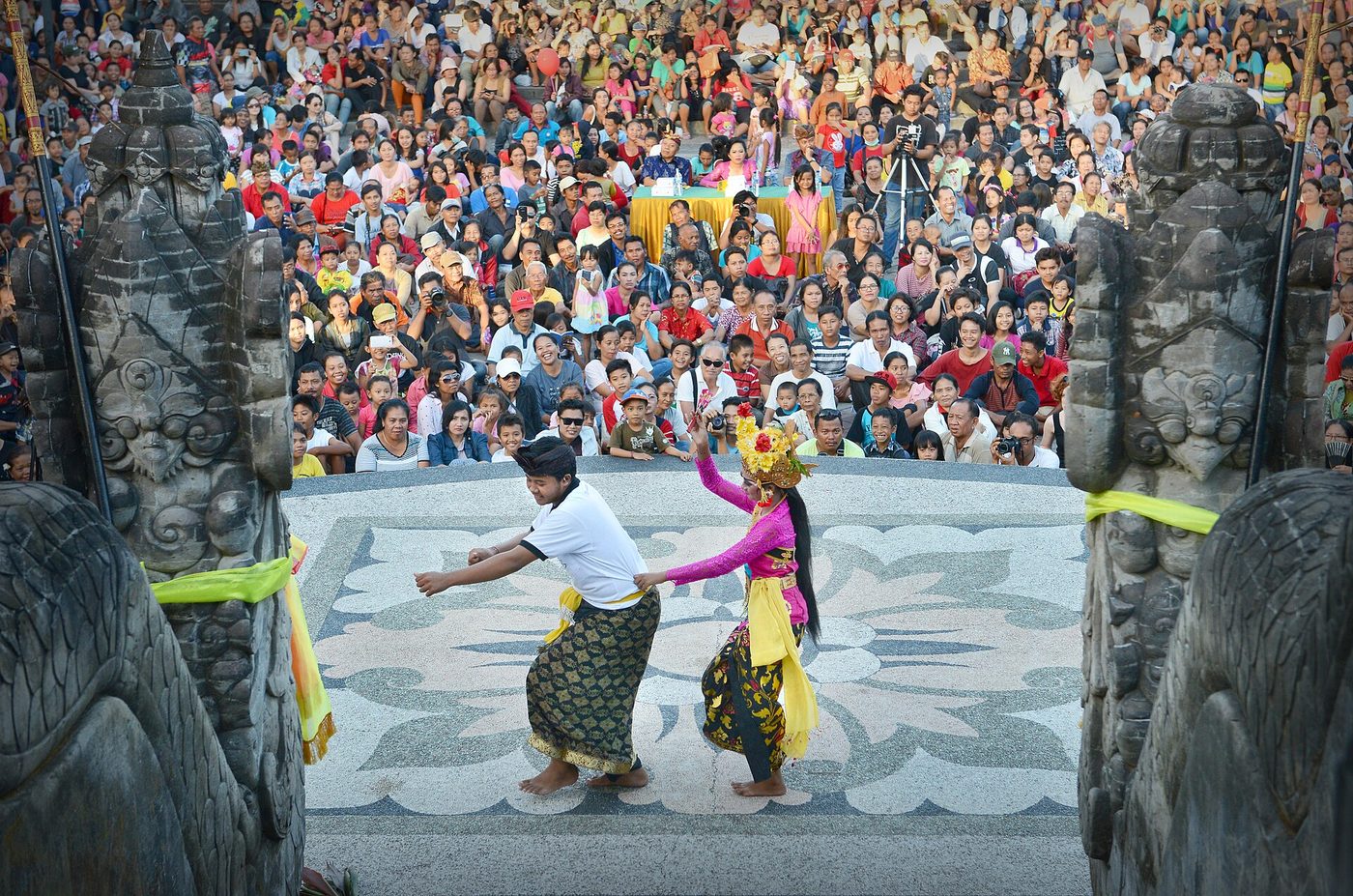 Joged Bumbung, the dancer and a volunteer partner, before a village crowd. Photo: Manik Agung / Wikimedia Commons (CC BY-SA 4.0)

6. Wayang Wong, Tejakula's masked Ramayana
Wayang Wong in the village of Tejakula is a Ramayana dance-drama, and Buleleng's dance among the nine in the UNESCO listing. Tejakula's district office puts it at more than three centuries old.
It is danced with a set of 175 carved masks, among them:
- Rama
- Laksamana
- Sugriwa
- Rahwana
- Kumbakarna
- the giants
- the clowns
Only villagers chosen for it may dance. As one of its dancers puts it, a villager who is chosen cannot refuse.
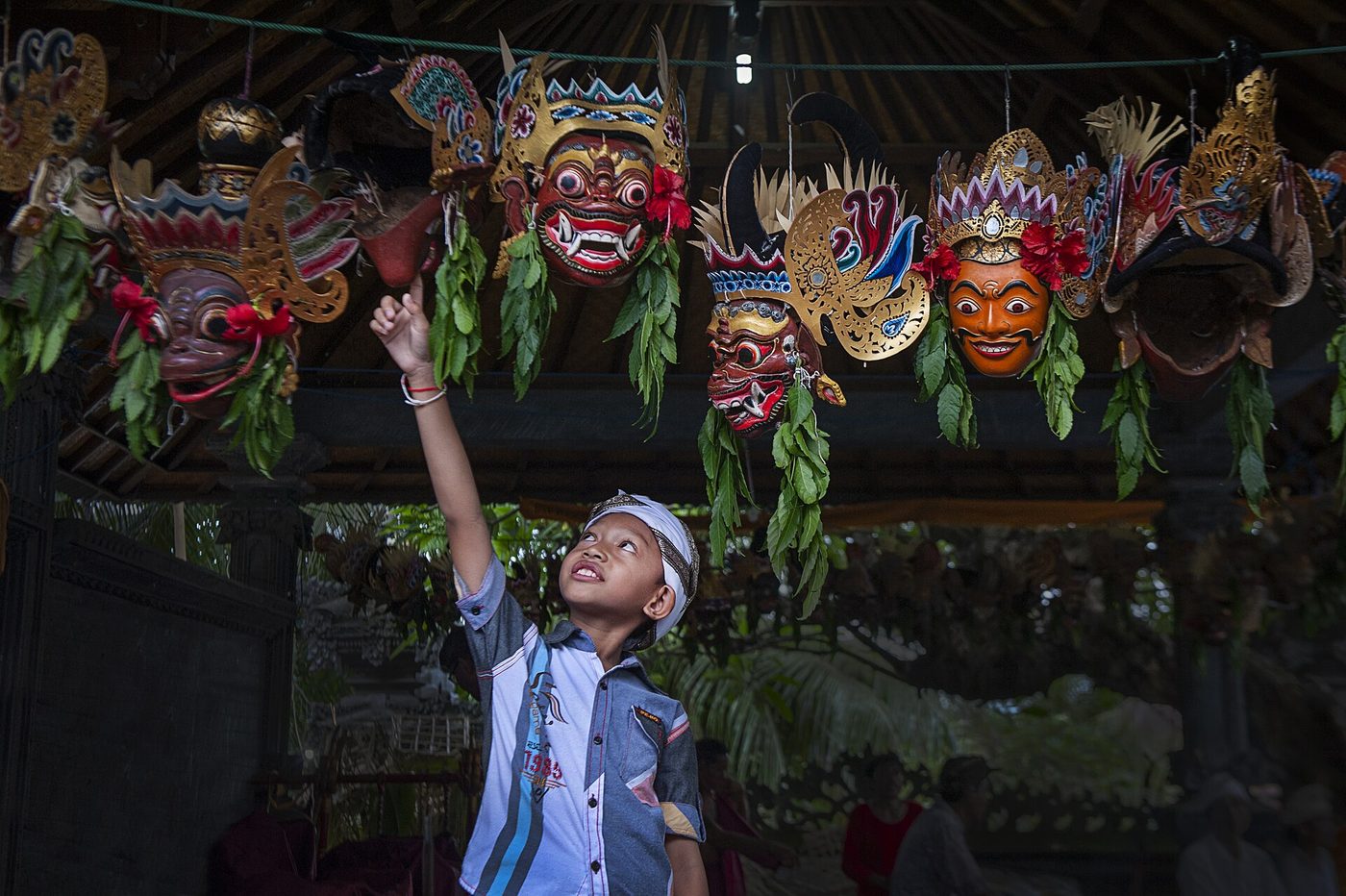 Wayang Wong masks hung ready for a performance in Tejakula. Photo: Imadedana / Wikimedia Commons (CC BY-SA 4.0)

Where it is danced. Wayang Wong is danced in Tejakula's village temples, the Kahyangan Tiga, during their temple anniversaries. So it follows the temple calendar, and there is no show to buy a ticket for.
Ask in the village before you go. For the village itself, see the Tejakula guide.
7. Sanghyang, the trance dances of Sidetapa and Bungkulan
Sanghyang dances are sacred, and in Balinese understanding they turn harm away from a village. The north keeps at least two of its own.
In Sidetapa, one of the old Bali Aga villages, the Sanghyang Gandrung is part of a 42-day ceremony held every three years. It falls in the Balinese months of karo and ketiga, around August and September, according to Buleleng's culture office.
Two unmarried young women dance the Sanghyang as dedari, heavenly maidens. Two young men, dressed as women, dance the Gandrung, which stands for the bhuta kala, the unseen forces the ceremony sets at rest. In the village's understanding, the Gandrung entertains those forces so they bring no harm. The Gandrung comes first, and the Sanghyang follows, in the temple's outer courtyard.
Sidetapa's village government adds that the ceremony was once held every year. It moved to every three years because of days the calendar rules out.
In Bungkulan, the people of Banjar Badung keep the Sanghyang Jaran, the horse trance dance. The village's own account calls it a heritage from before Hinduism. It is danced over two days, before and on the full moon of the sixth Balinese month, usually in December, to protect the village from illness.
The dancer is chosen by descent and dances bare-chested, with bells at the wrists and ankles. The villagers' chants, sung in everyday Balinese, call the horse spirit into the dancer.
Where to see them. These are rites of the village, held on its own calendar. Visit only if the village welcomes you. In Bungkulan the horse spirit is held to be sensitive to light, so keep phones and cigarettes dark.
8. Rejang, with fourteen forms in Sidetapa alone
Rejang is danced by lines of women and girls in temple dress, moving slowly toward the shrines during a temple anniversary. It is an offering, never a show, and it cannot be moved to a stage.
The Bali Aga villages of the north keep their own. Sidetapa has fourteen rejang, its former customary head Ketut Arka told the village government, and their meanings link one to the next:
- Rejang Penundun wakes the village's girls to dress for the sacred dances.
- Rejang Papag Rurung fetches the dancers.
- Rejang Legong Bantes, the last, marks the limit of the dancing.
Children and young people dance the first eleven. Seven adult dancers perform the last three, standing for the heavenly maidens. They are danced at Galungan and at the temple anniversaries of Sidetapa's temples. The village's school of religion trains its children for them.
In Cempaga, the regency's research agency records fourteen rejang of the village's own. They are danced at the Pura Puseh Agung from night until morning, as the ceremony draws to a close.
The full story is in Rejang, Bali's sacred offering dance. The villages themselves are in the Bali Aga villages of north Bali.
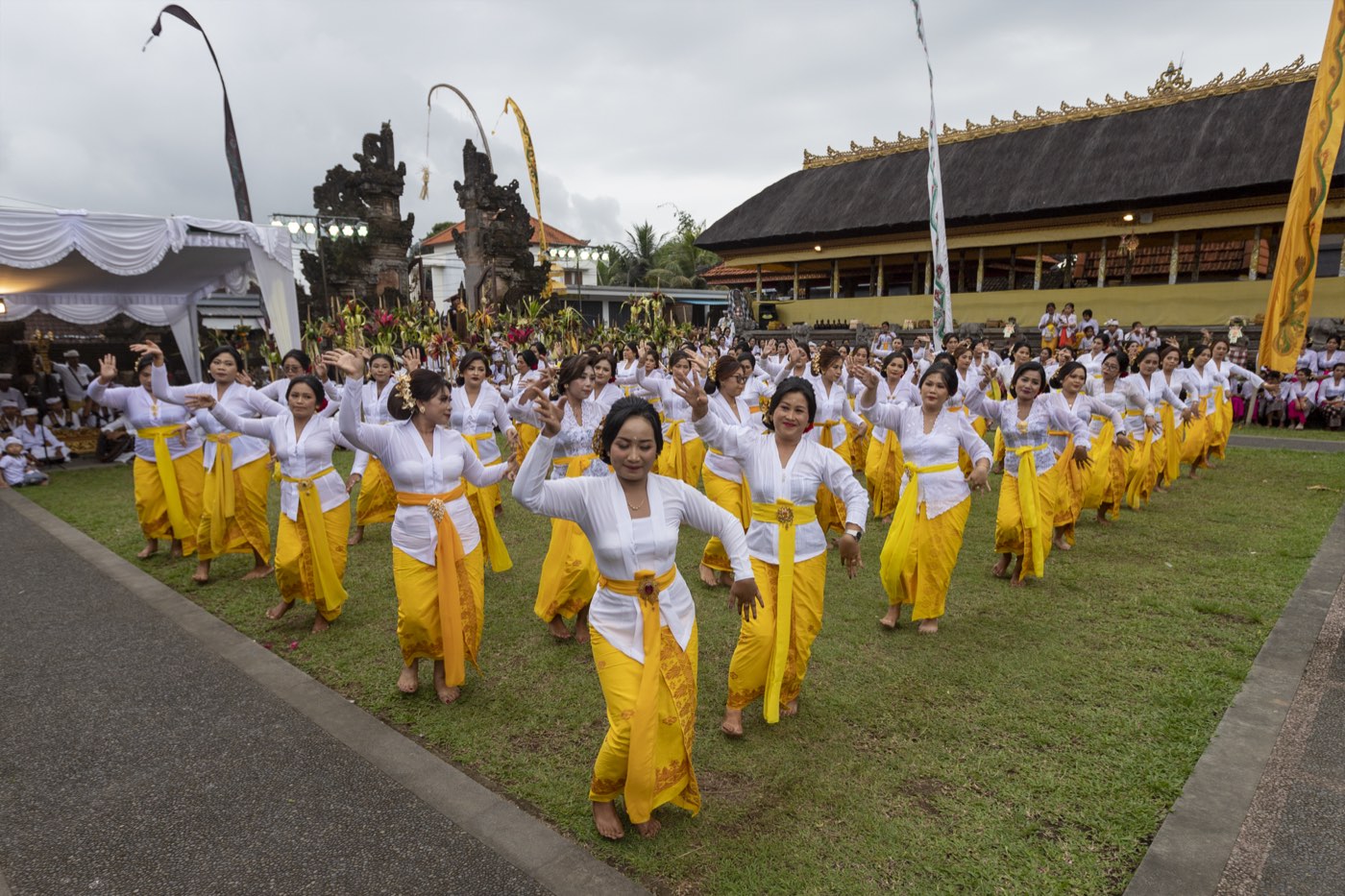 The village's women dancing rejang together at a temple ceremony. Photo: Ebi Triastika / Wikimedia Commons (CC BY-SA 4.0)

9. Baris, the warrior dance of Cempaga and Pedawa
The name comes from bebarisan, a line or file of soldiers.
The solo form, Baris Tunggal, is often the first dance a boy learns. It shows a young fighter's pride and nerves before battle. The costume is made of layered cloth panels and a shaking triangular headdress. There are more than thirty ritual group forms, some with spears, shields or kris, and they belong to temple ceremonies.
Cempaga keeps two sacred forms, the Banjar district office records:
- Baris Jojor, a solo for a grown man, carrying a warrior's dignity in every step
- Baris Dadap, a group of grown men, standing for warriors who fight to make the dharma win
Masked dancers, the Tari Tapel, often accompany Baris Dadap to calm the bhuta kala. In Pedawa, Baris Dadap is danced once every five years, at the Ngusabha Ngelemekin ceremony, according to a study of the dance in Pedawa.
The north has danced Baris a long time. The photograph below was taken in Singaraja in the 1860s.
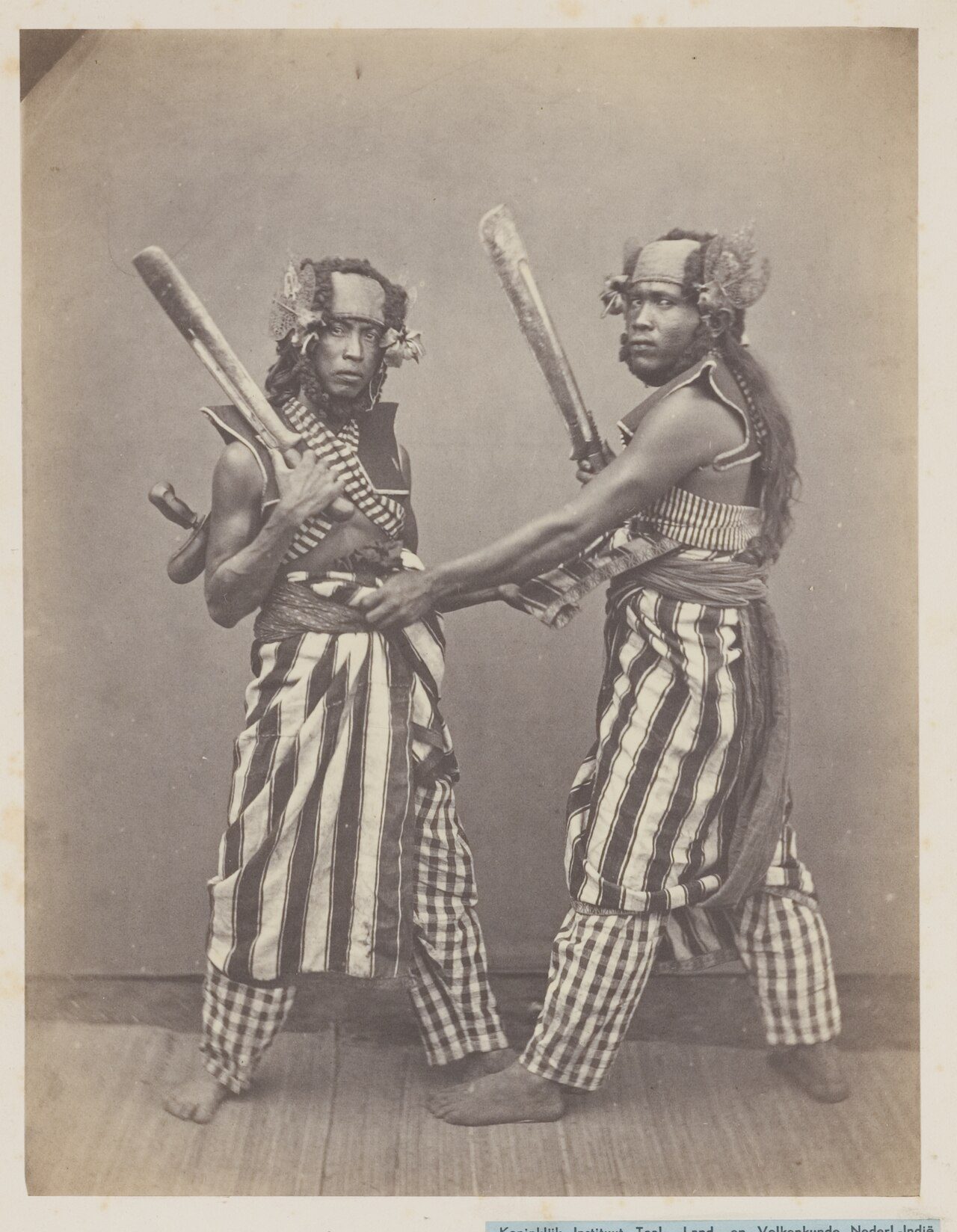 Baris Demang dancers of Buleleng, photographed at Singaraja in 1865 to 1866. Photo: Isidore van Kinsbergen / Wikimedia Commons (public domain)
10. Pendet, as Cempaga dances it
In Cempaga, Pendet is an act of worship at the village temple, the Pura Desa. It welcomes and guides the five deities, the Panca Dewata, down to the world.
Six dancers perform it, by the Banjar district office's account. Two pairs come out first, then a solo jauk, then a woman dancing the condong. So Cempaga's Pendet joins several dances into one.
Across Bali, girls carry small silver bowls of petals and move from shrine to shrine. They scatter the flowers as a welcome to the gods and to the guests.
Pendet began as a temple offering. In the 1950s I Wayan Rindi and Ni Ketut Reneng set the choreography as a four-dancer welcome dance. I Wayan Beratha reworked it for five dancers in 1961. In 1962 more than 800 dancers performed a mass Pendet at the opening of the Asian Games in Jakarta.
The secular welcome dance made in 1971 to spare the temple forms is Panyembrama, which has opened Buleleng's festivals as a mass dance.
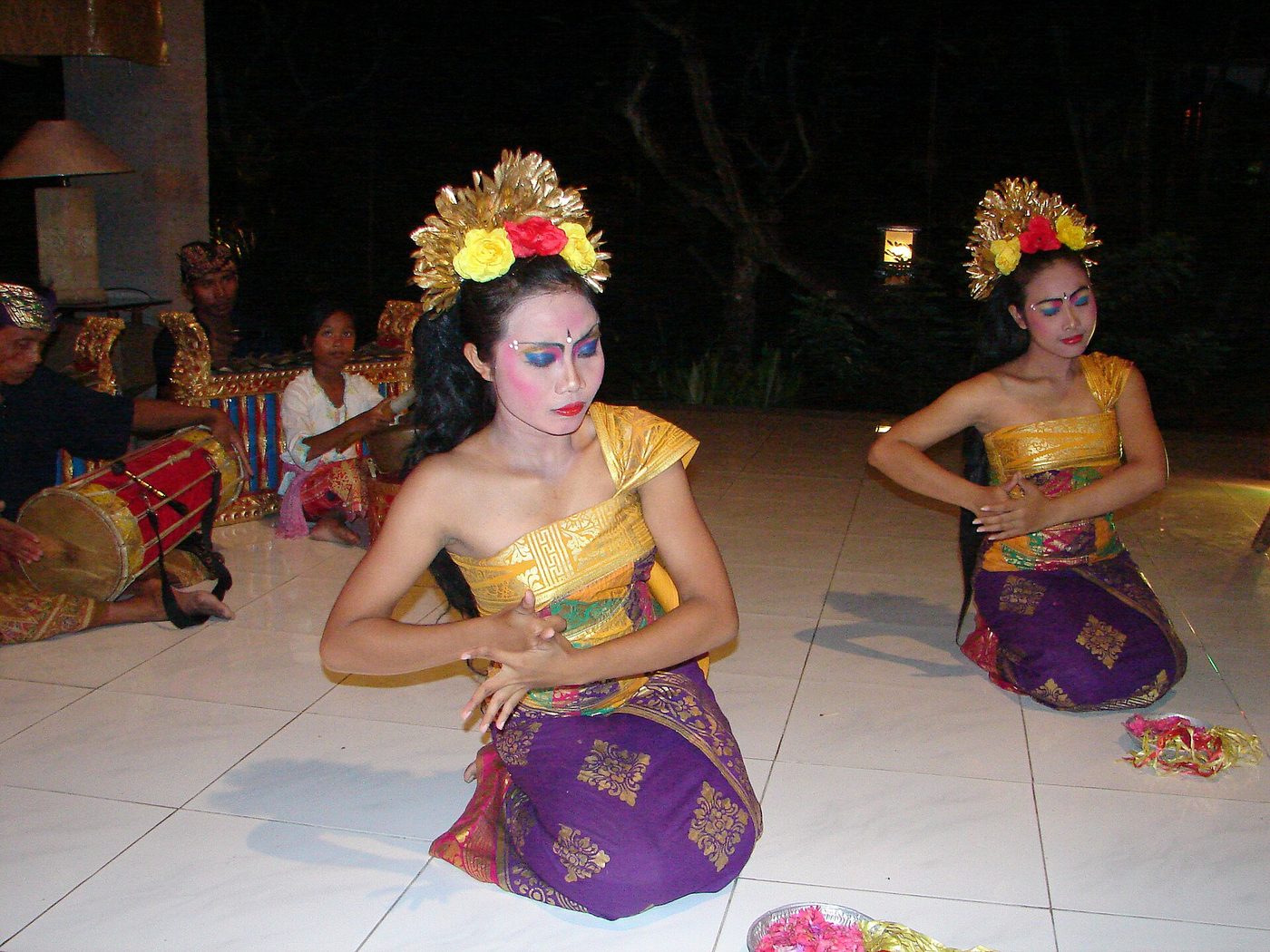 Pendet dancers with their offering bowls. Photo: Philip Nalangan / Wikimedia Commons (CC BY 4.0)

More dances the north keeps
The ten are a start. The same sources record more:
- Jangkang, in Cempaga, danced by children who have lost their milk teeth. It comes at Kuningan, at the village temple, and portrays warriors of dharma against adharma (Banjar district).
- Selir, or Darot, in Cempaga, danced in trance (kerauhan) at the height of Kuningan or a great ceremony. For that reason, the district office notes, it can hardly be taught.
- Megoak-goakan, in Panji, about 6 kilometres south of Singaraja. Teams of eleven try to catch the last player of the other line, like a crow after its prey, around Nyepi. It honours Ki Barak Panji Sakti, the founder of the kingdom of Buleleng (Sukasada district, Buleleng culture office).
- Cendrawasih, the bird-of-paradise duet, in I Gede Manik's own version, first performed in Sawan. His pupil Luh Menek, a dancer from Jagaraga, has danced it again in public (Buleleng culture office).
Legong, Barong and Kecak Have Their Own Guides and Southern Stages
Bali's best-known stage dances each have their own guide, and their nightly shows are in the south.
Legong is the refined dance of intricate finger movements, complicated footwork and darting eyes. It probably began in the nineteenth century as court entertainment.
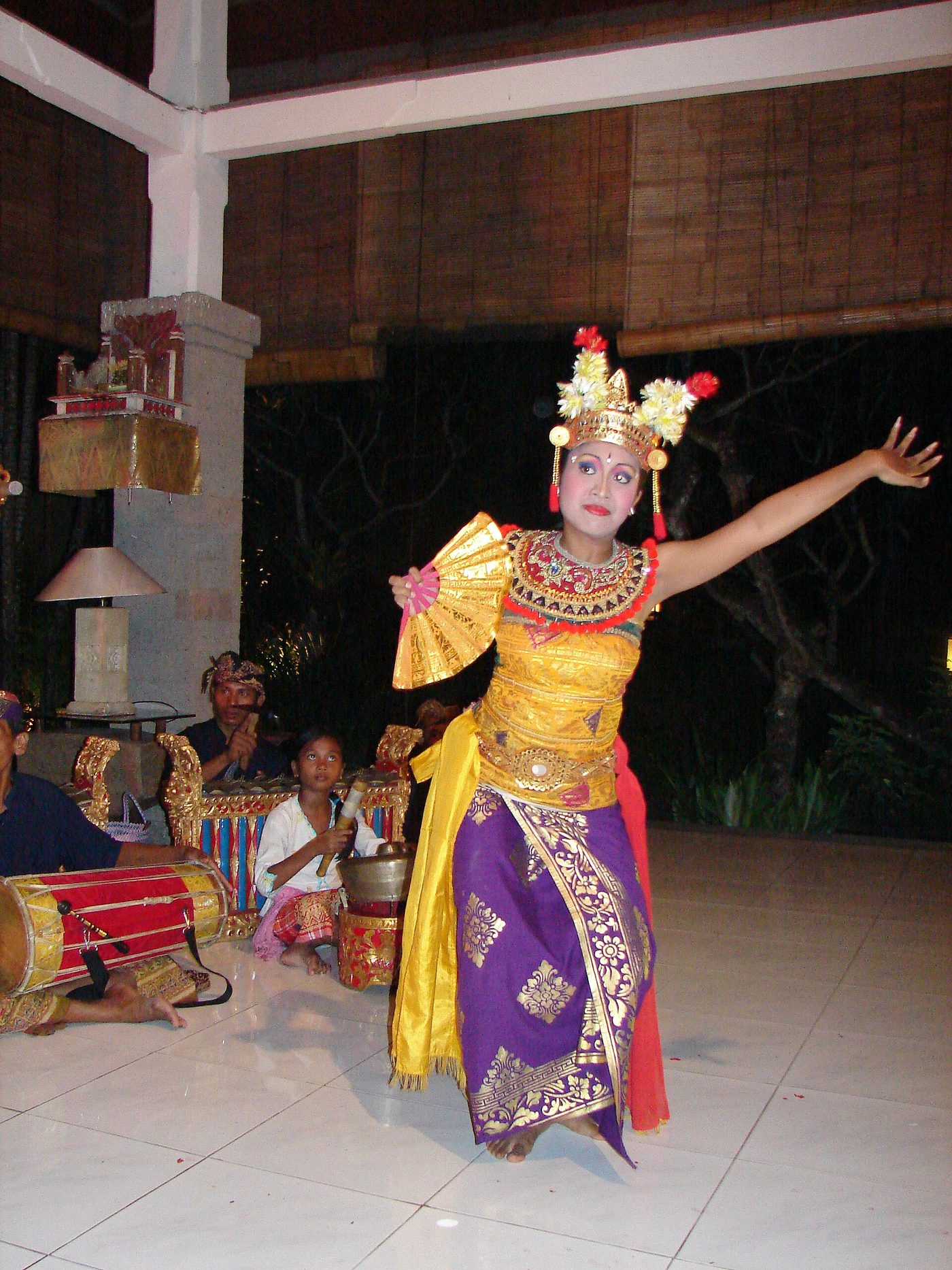 A Legong dancer mid-phrase, the gamelan close behind. Photo: Philip Nalangan / Wikimedia Commons (CC BY 4.0)

The Barong is a lion-like protector spirit, the king of the spirits. In the Calon Arang drama he answers the magic of Rangda, the demon queen, to restore balance. That is the idea at the core of rwa bhineda.
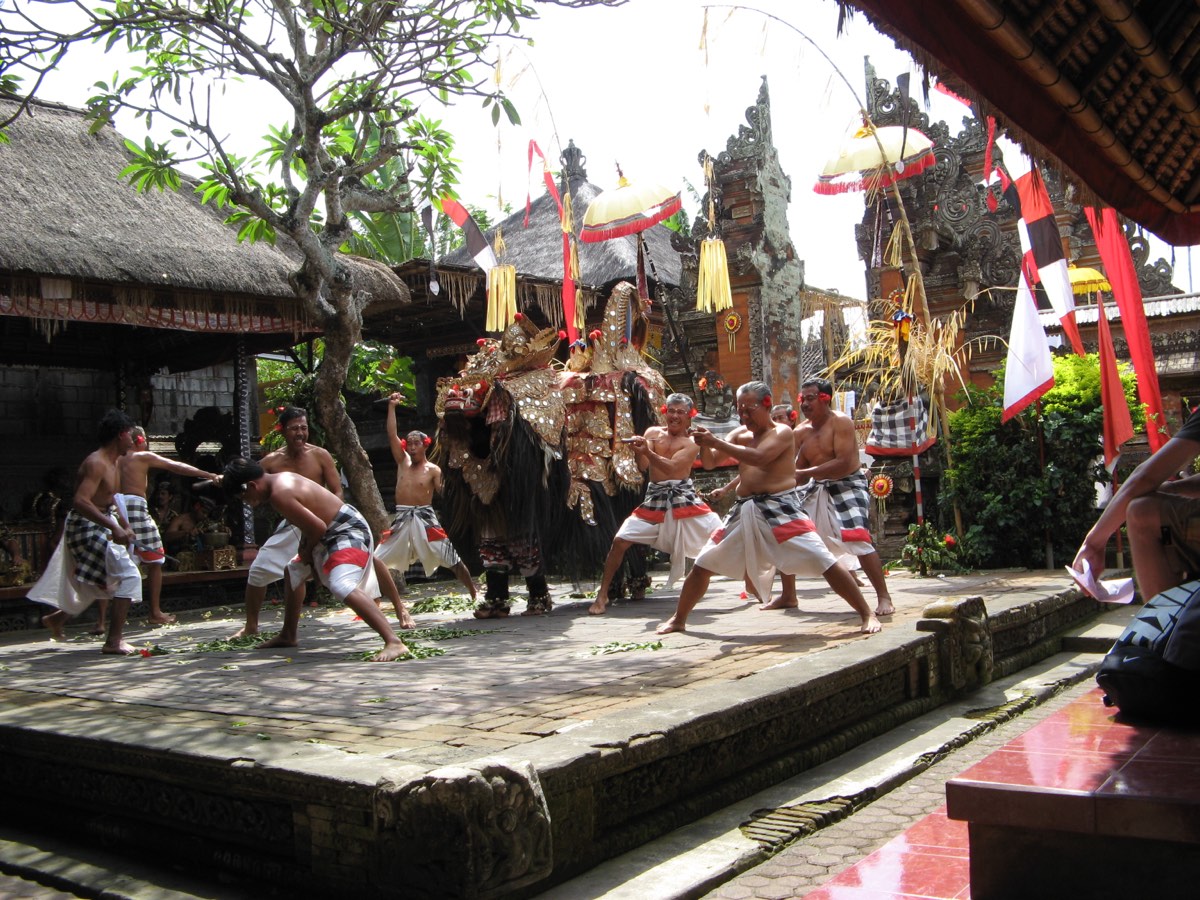 The Barong and its kris dancers, wrapped in the poleng that carries the philosophy, Batubulan. Photo: Michael Gunther / Wikimedia Commons (CC BY-SA 4.0)

Kecak is the chant with no instruments. A circle of bare-chested men chants "cak" while dancers act out the Ramayana. Its roots are in sanghyang, the trance ritual the north still keeps, and the dance-drama took shape in the 1930s.
The well-known evening shows are at Uluwatu temple and Tanah Lot, with dedicated kecak stages in Ubud and Batubulan. Research for this guide found no regular kecak show in Buleleng. From a base in the north, plan kecak as part of a trip south.
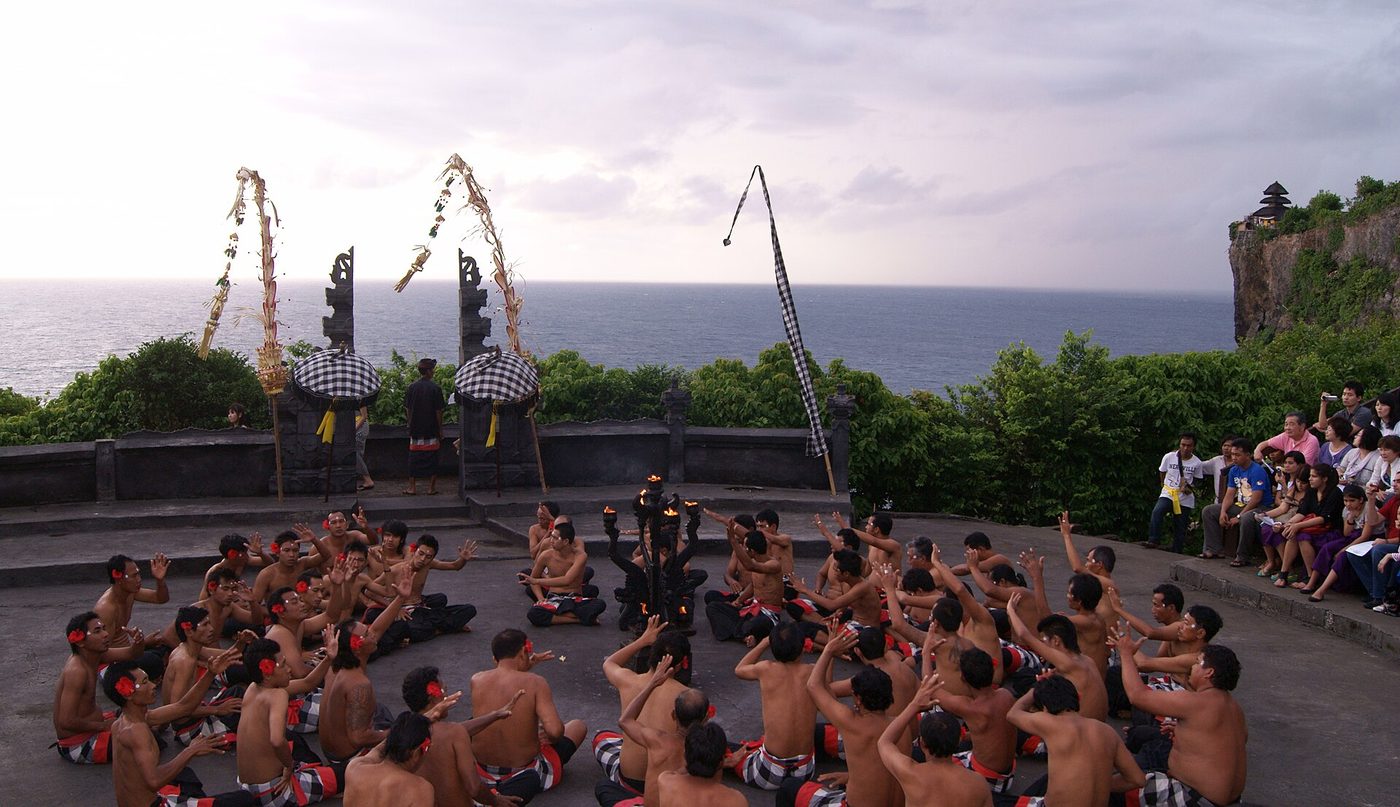 The kecak chorus at the cliff-top amphitheatre of Pura Luhur Uluwatu. Photo: Midori / Wikimedia Commons (CC BY 3.0)

Where to See Dance in North Bali
In the north, you meet music and dance at the real thing. There is no nightly tourist circuit.
- A temple ceremony (odalan). If your visit coincides with a temple anniversary or festival, you may hear and see gamelan and dance as it is meant to be, as worship. Ask locally what is on, check the north Bali events calendar, and attend respectfully (see Bali temple etiquette).
- A village rehearsal. On many evenings, the banjar halls ring with gamelan practice. Listen respectfully from outside.
- The Buleleng Festival. Bulfest in central Singaraja puts Gong Kebyar, drama gong and mass dance on stage every night of the festival, usually for about a week in August. See the Buleleng Festival guide.
- The Lovina Festival. Gamelan troupes and dance groups from across Buleleng perform on the beachfront at Kalibukbuk over a few days in late July. See the Lovina Festival guide.
- The Buleleng Rhythm Festival. Every March, local gamelan troupes share Lovina's beach with visiting percussion groups. See the rhythm festival guide.
- Sanggar, the dance studios. Buleleng's arts studios (sanggar) train children and perform at regency events. Ask your villa or guide whether one near Lovina or Singaraja is performing or open to visitors during your stay.
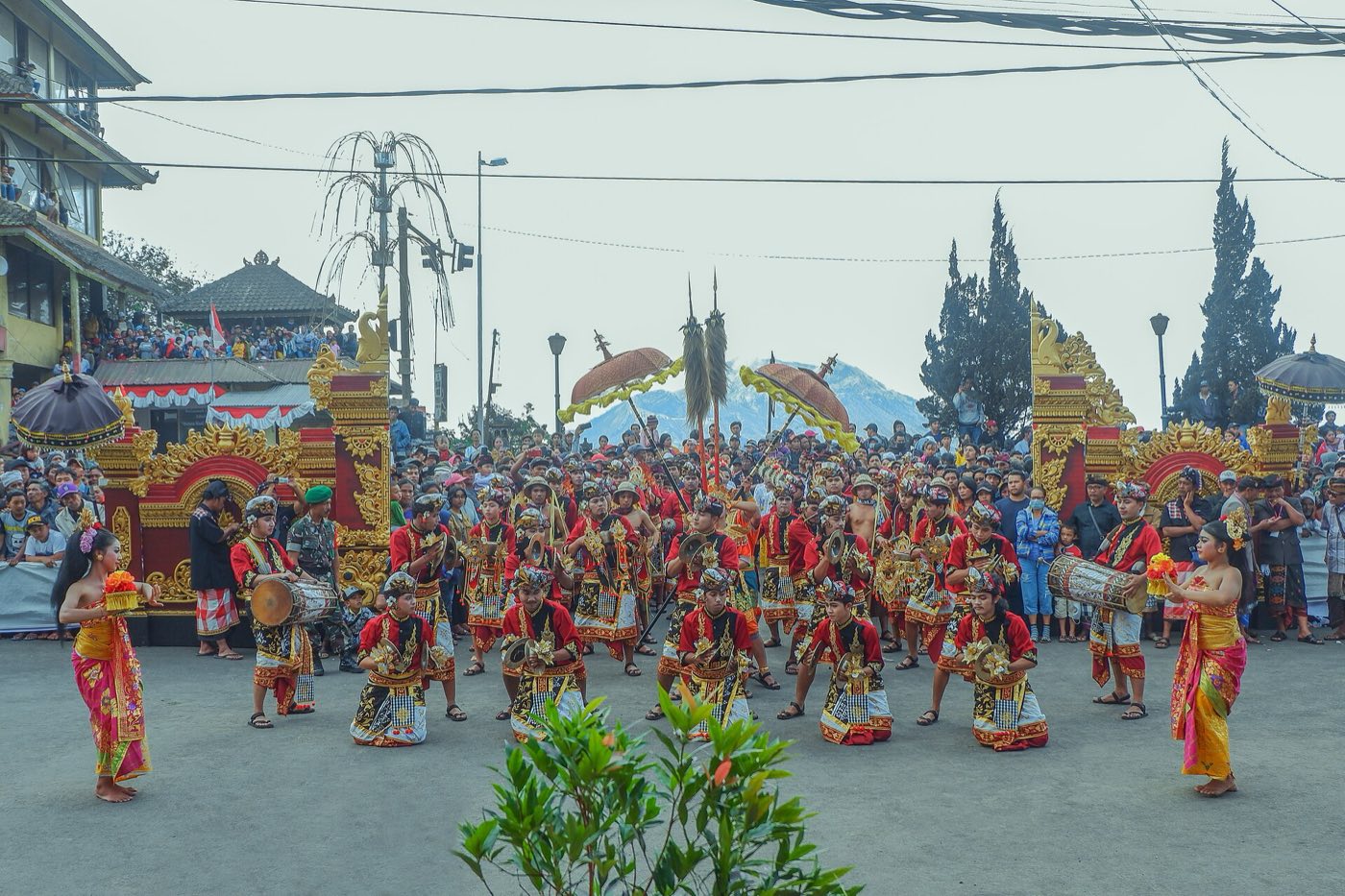 Baleganjur, the processional style built for the street. Photo: I Kadek Jaya Wiguna / Wikimedia Commons (CC BY-SA 4.0)

Singaraja, the old cultural capital, is the heart of the north's arts heritage, and it has its own guide to Singaraja. The bronze-working behind the instruments is covered in north Bali's traditional crafts.
At a Ceremony You Are a Guest
In Bali, dance and music belong to religion. The performances exist because the ceremonies need them, and the beauty is an offering.
Balinese dance divides into three circles. Wali dances are sacred rites for the gods, bebali accompany ceremonies, and balih-balihan are made for an audience. UNESCO inscribed the three genres of traditional dance in Bali in 2015, and the guide to Balinese dance explains each one.
The circle a dance belongs to tells you how to behave around it. A Trunajaya on a stage is made for you to watch. A Rejang in a temple courtyard is made for the gods, and you are a guest at it.
When the music and dance are part of a ceremony:
- Dress in temple attire.
- Sit low and at the back.
- Stay quiet.
- Don't block worshippers or the performers.
- Be discreet with photography.
Honour it as devotion, because that is what it is. The wider context is in Balinese Hinduism explained, and the ritual life in Balinese ceremonies.
Practical Notes
Performances at ceremonies follow the Balinese calendars and village decisions, so dates move. Confirm locally before planning an evening around one.
- Temple dress (sarong and sash, covered shoulders) is expected at any ceremony, and appreciated at festival stages in temple grounds.
- Flash photography during a sacred dance is intrusive. Turn it off, and never step into the dancing space for a shot.
- Bali Aga villages such as Sidetapa, Cempaga and Pedawa keep their own ceremonial calendars. Ask the village before you come.
- Festival stages in Singaraja and Lovina are free to watch and busiest after dark.
- Kecak and nightly Legong or Barong shows are a south Bali experience. Book them for a day in Uluwatu or Ubud.
- Your villa host can tell you about a ceremony or rehearsal nearby this week.
FAQ
Where did gong kebyar come from? Gong kebyar, the explosive modern style of Balinese gamelan, was first documented in north Bali (Buleleng) in the early 1900s. Its first public performance was at a gamelan competition in Jagaraga in December 1915, and another account dates the first kebyar pieces to Bungkulan in 1914. Island-wide competitions under Dutch rule spread it south, and it went on to define modern Balinese music and dance.
What does "kebyar" mean? It means to flare up or burst open. The word describes the music's sudden, explosive bursts of sound and dramatic shifts in tempo and volume.
What is a gong kebyar gamelan? A bronze orchestra of tuned metallophones, gongs, drums and cymbals. It is famous for its interlocking patterns (kotekan) and its shimmer, which comes from pairs of instruments tuned slightly apart. It is made first for temple ceremonies and only second for the stage.
Which Balinese dances come from north Bali? Trunajaya, Wiranjaya, Palawakya and Nelayan were created in Buleleng for gong kebyar, and Joged Bumbung is traced to Buleleng's farmers in the 1940s. UNESCO's 2015 listing names one Buleleng dance, the masked Wayang Wong of Tejakula. Northern villages also keep their own Sanghyang, Rejang, Baris and Pendet.
Who created the Trunajaya dance? I Gede Manik of Jagaraga created it in 1925, from the Kebyar Legong that Pan Wandres made in 1915. Around 1950 President Sukarno saw it in Denpasar and named it Tarunajaya, the victorious youth.
Where can I see kecak dance? Kecak is performed mainly in south Bali, with well-known evening shows at Uluwatu temple and Tanah Lot and dedicated stages in Ubud and Batubulan. It was developed in the 1930s by I Wayan Limbak and Walter Spies from the sanghyang trance ritual.
Where can you see dance in north Bali? At temple ceremonies, at village gamelan rehearsals, and at Buleleng's festivals: the Buleleng Festival in Singaraja, the Lovina Festival and the Buleleng Rhythm Festival. Local dance studios (sanggar) also perform at regency events. Wear temple dress at a ceremony, sit low and at the back, and be discreet with photos.
Sources
-
UNESCO, nomination file for Three genres of traditional dance in Bali, which regency each of the nine dances is listed under, read September 2026
-
UNESCO Intangible Cultural Heritage, Three genres of traditional dance in Bali, inscribed 2015, read September 2026 (in English)
-
Buleleng Culture and Tourism Office, Tari Truna Jaya, for Pan Wandres, Kebyar Legong, I Gede Manik, Sukarno's naming, Sukarno's Buleleng mother and where Trunajaya is danced, read September and October 2026 (in Indonesian)
-
Buleleng Culture and Tourism Office, Sejarah Gong Kebyar, for McPhee's source and the Bungkulan account of 1914, read October 2026 (in Indonesian)
-
Buleleng Culture and Tourism Office, Kesenian Gong Kebyar, for kebyar as the north's masterpiece and the high point of 1925, read October 2026 (in Indonesian)
-
Buleleng Culture and Tourism Office, Tari Palawakya and its video of Jaya Kusuma of Jagaraga, read October 2026 (in Indonesian)
-
Buleleng Culture and Tourism Office, Tari Nelayan, Tari Sanghyang Gandrung di Sidatapa, Tradisi Megoak-goakan and Tari Cendrawasih khas Buleleng, read October 2026 (in Indonesian)
-
ISI Denpasar, Pande Made Sukerta, Fenomena dibalik kejayaan Gong Kebyar, January 2010, on the open question of kebyar's birthplace, read October 2026 (in Indonesian)
-
ISI Denpasar, Kadek Suartaya, Tari asal Bali Utara berduel mesra di Bali Selatan, June 2011, for Kebyar Legong in mebarung, Trunajaya and Wiranjaya, read October 2026 (in Indonesian)
-
tatkala.co, Belajar Tari Nelayan bersama maestro Ni Ketut Arini, June 2023, for Kedis, the movements and drama gong, read October 2026 (in Indonesian)
-
Buleleng Research and Innovation Agency, Unique and sacred dances of the Bali Aga villages of Buleleng, for Cempaga's rejang, read October 2026 (in Indonesian)
-
Banjar District, Buleleng Regency, Tarian sakral Desa Cempaga, for Baris Jojor, Baris Dadap, Tari Tapel, Pendet, Jangkang and Selir, read October 2026 (in Indonesian)
-
Sidetapa Village Government, Masa lalu Desa Sidetapa, April 2018, for the fourteen rejang and the Sanghyang Gandrung, read October 2026 (in Indonesian)
-
Bungkulan Village Government, Tarian Sanghyang Jaran Bali Utara, April 2021, read October 2026 (in Indonesian)
-
Ni Luh Sumawati, Peran pemuda dalam pementasan Tari Baris Dadap di Desa Pedawa, Jurnal Widya Sastra Pendidikan Agama Hindu, February 2022, read October 2026 (in Indonesian)
-
Sukasada District, Buleleng Regency, Tarian rakyat Megoak-goakan, read October 2026 (in Indonesian)
-
Tejakula District, Buleleng Regency, Wayang Wong Tejakula, Buleleng's cultural asset for the world, for the masks, the age of the tradition and where it is danced, read September 2026 (in Indonesian)
-
Wikipedia, Gamelan gong kebyar, for the 1915 Jagaraga performance, the Dutch-era competitions, kotekan, paired tuning and the ceremonial role, read September 2026 (in English)
-
Wikipedia, Balinese dance, for the nine dances in the UNESCO listing and their regencies, read September 2026 (in English)
-
Wikipedia, Kebyar duduk and Oleg dance, for I Mario, 1925, Paris 1931 and John Coast's 1952 tour, read September 2026 (in English)
-
Wikipedia, Legong, Barong, Kecak, Baris dance and Pendet dance, for the history of each dance, read September 2026 (in English)
-
Wikipedia, Joged dance, Gamelan joged bumbung and Joged Bumbung, for the invitation to dance, the bamboo grantang and the Buleleng origin in the 1940s, read September 2026 (in English and Indonesian)
-
Tempo, The origins of joged bumbung, for Kalopaksa, read October 2026 (in Indonesian)
Read next: Balinese dance, its three genres and nine UNESCO dances, the Bali Aga villages, the Jagaraga war and the Buleleng Festival.