On this page
- In Brief
- Bulfest at a Glance
- Bulfest Is the Week the Old Capital Celebrates Itself
- It Opens in the Days After Independence Day
- Each Edition Has a Theme, and the Theme Decides the Food
- The Festival Spreads Across Three Zones of Central Singaraja
- An Opening Parade, Then Stages and Markets Every Night
- The Music Bill Pairs National Acts With Gong Kebyar and Mass Dance
- Bulfest Carries the Civic Pride of Bali's Old Capital
- How to Get There From Lovina, and What the Street Closures Mean
- FAQ
- Sources
In Brief
The Buleleng Festival, known locally as Bulfest, is north Bali's biggest arts and culture festival. It fills central Singaraja for about a week each August, in the days that follow Indonesia's Independence Day.
The festival spreads across zones around the Singa Ambara Raja monument, at the city's zero kilometre point. Each edition takes a theme from Buleleng's heritage, with exhibitions and a curated market of village food built around it.
Entry is free and the evenings are the prime hours. Singaraja is twenty minutes from Lovina, so the parades, nightly stages and village food fit into one evening.
The regency announces the dates, the theme and the music bill on its own site and on the festival's Instagram, both linked below.
Bulfest at a Glance
- When: About six days in August, running on from Independence Day on 17 August. The festival is strongest after dark
- Where: Central Singaraja, in zones around the Singa Ambara Raja monument at the city's zero point
- Theme: A different one each edition, drawn from Buleleng's own heritage
- Cost: Free
- Scale: More than sixty local arts groups at a recent edition, with mass dance, parades, exhibitions and a curated food and craft market
- Food rule: Stalls are curated, and the regency has pressed hardest on natural ingredients, nothing frozen and nothing preserved
- Getting there: Twenty minutes from Lovina. The central streets close fully on festival days, so plan the drop-off
- Running since: 2013, in the city Raja Panji Sakti founded in 1604
- Current dates and line-up: Posted by the regency at bulelengkab.go.id and on the festival's Instagram
Bulfest Is the Week the Old Capital Celebrates Itself
Singaraja, founded by Panji Sakti in 1604, was once the capital of Bali. Bulfest is the week when the old capital remembers it.
Performing troupes, artists and cooks from villages across the regency pour into the city centre for six days of parades, stages and markets.
The festival began in 2013 under the theme My City, My Pride, and each year since has taken a new theme. It ran through that decade, then went quiet for five years before coming back.
For a recent edition the regency funded almost all of it through corporate partners. That kept public money for the arts and culture programme itself.
It Opens in the Days After Independence Day
The timing lines up with the national holiday.
Bulfest opens in the days straight after 17 August, Indonesia's Independence Day. By then Singaraja is already dressed in red and white, and the celebratory mood is running.
If you are in the north that week, the 17th belongs to the flags and the neighbourhood ceremonies. The evenings after it belong to Bulfest.
August is also dry season, the north's most reliable weather. More on the seasons is in the best time to visit north Bali.
Each Edition Has a Theme, and the Theme Decides the Food
The Regent of Buleleng announces each edition's theme in an official festival briefing on the regency's site.
One recent briefing set the theme as Uriping Rasa, reviving the flavour of Buleleng as it was. The theme shapes what is cooked.
The stalls go through a curation process rather than a first-come sign-up. Applicants are judged on quality, menu and fit against the theme. One rule is pressed hardest: natural ingredients only, nothing frozen and nothing preserved.
For a visitor, the result is the rarest part of the festival: Buleleng village dishes that seldom appear at any tourist table. Look for:
- Laklak kelor: the little green rice-flour pancakes finished with palm sugar and coconut
- Jukut buangit and undis: the vegetable and black pigeon-pea dishes of the northern villages
- Siobak: Singaraja's beloved Chinese-Balinese braised pork under a dark sweet-spiced sauce
Siobak exists because Singaraja was a port with the whole world walking through it. There is more of that kitchen in what to eat in Bali.
The Festival Spreads Across Three Zones of Central Singaraja
Bulfest spreads across central Singaraja rather than sitting inside one venue, so it reads as a city celebrating. A recent edition was laid out as three zones with three different characters.
Old Buleleng. The northern Praja Mandala area around the monument carries the tempo dulu, or old-times, concept. The main stage of the whole festival sits here, among:
- heritage kitchens
- traditional arts
- a layar tancap, the vintage open-air cinema of Indonesian village evenings
- small story houses built to walk visitors through the tales of old Buleleng
The modern city. Around the regency parliament building and the Regent's official residence, the programme turns contemporary and creative. Here the young city answers the old one.
Living culture. At Catus Pata, the crossroads south of the monument, the stages belong to folk performance. That means joged social dance, bondres comedy and community arts under a sustainability banner.
An Opening Parade, Then Stages and Markets Every Night
The opening parade. This is the single strongest spectacle. Costumed troupes, gamelan on the move and community groups from across the regency process through central Singaraja.
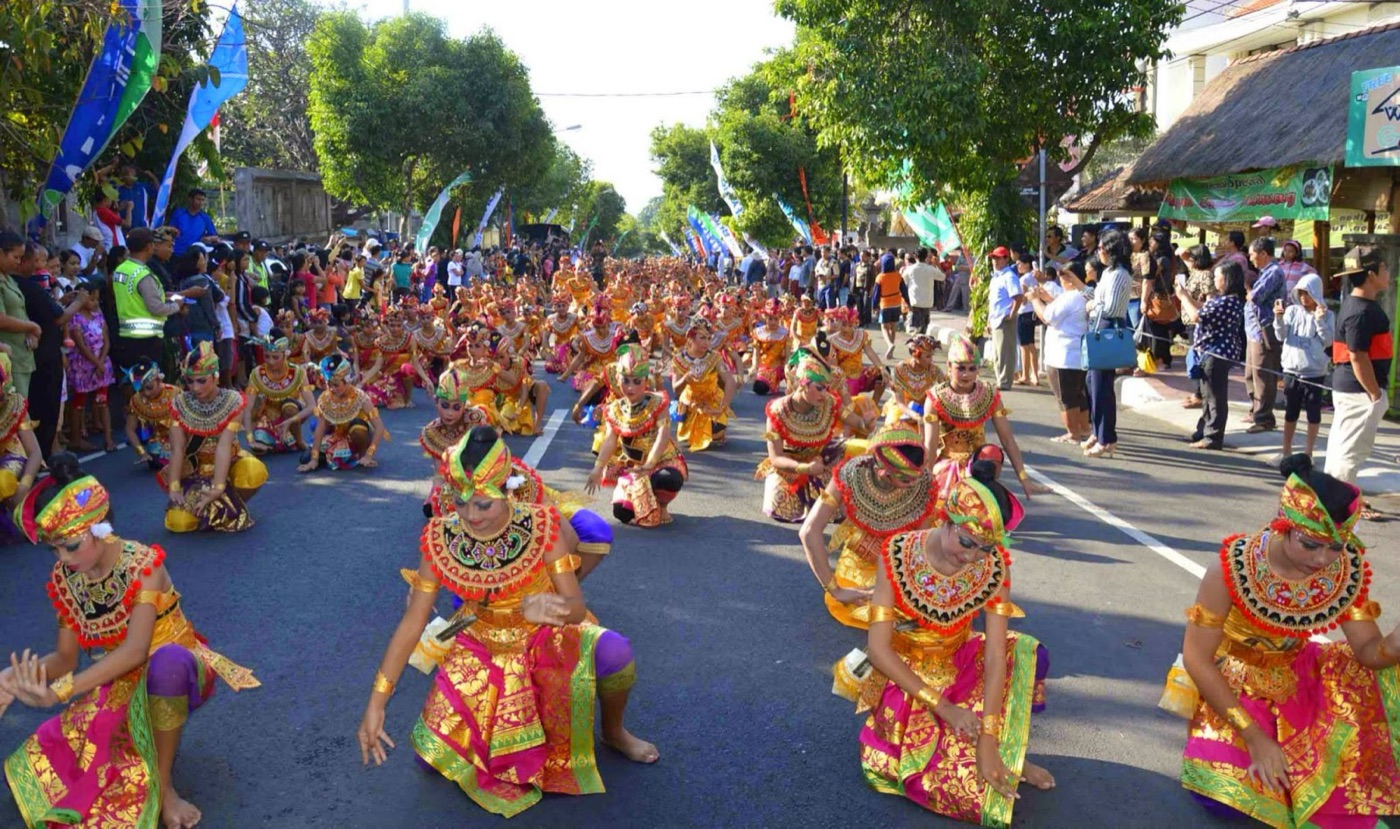 Photo: Palm Living archive.
Stages every night. Across the zones, each night brings:
- dance and mass choreography
- theatre fragments
- bondres comedy
- Gong Kebyar
Buleleng is the birthplace of Gong Kebyar, the explosive modern gamelan style that went on to conquer the whole island. Hearing it in its home city is the point. The background is in north Bali's dance and music traditions.
Markets into the night. The curated stalls run food, craft and produce. Treat the whole festival as a regency-wide night market with performances threaded through it, and arrive hungry.
A working city celebrating. Singaraja is a working city, and Bulfest is staged for its own people. You are a guest at the north's own party, and you may be one of the few foreign faces there.
The Music Bill Pairs National Acts With Gong Kebyar and Mass Dance
The regency announces the music programme in pieces over the weeks beforehand. A recent bill shows the pattern:
- a national headline act, KLa Project
- Balinese bands, Dialog Dini Hari and Lolot
- younger Indonesian acts that bring a different crowd each night
Alongside it ran the traditional programme of Gong Kebyar, drama gong and colossal dances with hundreds of dancers from local studios. This is the half that could not happen anywhere else.
Names and stage times land on the festival's Instagram as they are confirmed. Check there rather than assuming a night.
Bulfest Carries the Civic Pride of Bali's Old Capital
The deeper current of the festival is civic pride. It shows in the winged lion of Singaraja, the Panji Sakti stories and the north's sense of itself as Bali's proud, independent-minded coast.
Singaraja was a trading port, an education centre and the island's administrative capital. For that setting, read Singaraja old town and the history of north Bali.
How to Get There From Lovina, and What the Street Closures Mean
Base in Lovina and come in for the evenings. Palm Living, the company behind Northbound, rents villas around Lovina if you want a house for the week.
The drive is about twenty minutes, and getting to north Bali covers the routes from the south.
Plan the arrival properly, because the centre changes during the festival. At a recent edition the transport office closed the streets around the venue fully for the run of the festival. Jalan Veteran, Jalan Pahlawan and Jalan Ngurah Rai were affected and traffic was rerouted around the core, so expect the same.
In practice:
- Get dropped off. Have your driver drop you as close to the monument area as the diversions allow, rather than hunting for parking.
- Agree a pickup point for the ride home.
- Expect the last stretch on foot, through streets that have turned into the festival itself.
FAQ
When is the Buleleng Festival?
In August, across about six days, starting in the days after Independence Day on 17 August. The regency publishes the exact dates on its own site and on the festival's Instagram ahead of each edition. Street closures are announced alongside them.
What is the Buleleng Festival?
North Bali's biggest arts and culture festival, first held in Singaraja in 2013. Dozens of local arts groups, parades, themed exhibitions and curated food markets celebrate the heritage of Buleleng regency, on the site of Bali's former capital city.
Is the Buleleng Festival free?
Yes. The parades, performances, zones and markets are free and open to everyone.
Where is the festival held?
Across central Singaraja, in zones around the Singa Ambara Raja monument. The monument is the city's zero kilometre point and holds the main stage. The other zones are the parliament and Regent's residence area and the Catus Pata crossroads. Singaraja is about twenty minutes east of Lovina.
Who plays at Bulfest?
A national headline act, Balinese bands, and younger Indonesian pop, indie and folk acts, alongside the traditional programme of Gong Kebyar, drama gong and mass dance. The line-up changes with each edition and is announced on the festival's Instagram in the run-up.
What food should I try at Bulfest?
The heritage stalls are the reason to come hungry: laklak kelor pancakes with palm sugar, jukut buangit and undis from the village kitchens, and Singaraja's signature siobak. Every stall has to pass a curation that asks for natural, fresh ingredients.
Can you visit Bulfest as a day trip from Lovina?
Easily. Come in for the late afternoon and evening, when the parades and the stages run, and drive back after. Lovina, twenty minutes away, makes the easier base.
Sources
- Buleleng Regency, Bulfest 2026 brings back the taste of old Buleleng, 13 August 2026 (in Indonesian): the theme, the three zones, the stall curation and the natural-ingredients rule, CSR funding, KLa Project
- Buleleng Regency, History of the city of Singaraja, read September 2026 (in Indonesian)
- Bali Post, Buleleng Festival 2026 opens with 150 dancers, 18 August 2026 (in Indonesian)
- atnews, Old-time Singaraja: Bulfest 2026 revives the old city through nostalgic food, read September 2026 (in Indonesian): more than 60 arts groups, the colossal dances, Gong Kebyar and drama gong, the music bill
- detikBali, Bulfest 2026 traffic scheme in Singaraja, 11 August 2026 (in Indonesian)
- Koran Buleleng, Bulfest, nostalgia and hope for Buleleng, 4 August 2019 (in Indonesian): the first edition in 2013
- Koran Buleleng, After five years off, Bulfest returns in August 2025, 10 June 2025 (in Indonesian)
- Buleleng Festival, official Instagram
- Palm Living, Bali Villas for Rent, read September 2026