On this page
In Brief
The Bali Aga villages are the homes of the Bali Aga, the "original Balinese". They are the island's indigenous communities, and they kept their own customs while the later Hindu-Javanese kingdoms reshaped the rest of Bali.
Seven of these villages are in Buleleng, north Bali. Five sit in the hills of Banjar district behind Lovina. The other two, Sembiran and Julah, are in Tejakula district, east along the coast.
Each village differs from mainstream Bali, and from its neighbours, in architecture, ceremony and social structure. Death rites differ too. Some villages bury their dead instead of cremating them, and the famous village of Trunyan, in central Bali, lays the dead out in the open.
You can visit, with deep respect and ideally with a local guide.
Bali Aga at a Glance
- Who: The Bali Aga, also called Bali Mula, the indigenous, original Balinese
- Where in the north: Seven villages in Buleleng. Sidetapa, Cempaga, Tigawasa, Pedawa and Banyuseri are in Banjar district. Sembiran and Julah are in Tejakula
- What is different: Older customs, and their own architecture, ceremony and social order
- Death rites vary: Some villages bury their dead instead of cremating them. Trunyan, in central Bali, lays the dead out
- No two alike: Each village carries its own tradition
- Visiting: With deep respect, ideally with a local guide
- Why it matters: A living window into Bali before the kingdoms
The Bali Aga Kept the Customs Bali Had Before Majapahit
The Bali Aga are the island's indigenous people, also called Bali Mula, "original Bali".
Much of Bali's culture as visitors know it came with the Majapahit, the Hindu-Javanese kingdom that reshaped the island from the 14th century. The caste system, the great cremations and much of the courtly art arrived with it. The Bali Aga are the communities who held to their older, pre-Majapahit ways.
They live mostly in remote mountain and hill villages. In these villages you see a Bali that predates the temples and kingdoms most visitors associate with the island.
Seven Bali Aga Villages Are in Buleleng
Buleleng holds more Bali Aga villages than any other regency.
An anthropologist from STAH Mpu Kuturan Singaraja listed seven of them on the regency's own site. Five are in Banjar district, in the hills behind Lovina, and are grouped together as the Panca Desa:
- Sidetapa
- Cempaga
- Tigawasa
- Pedawa
- Banyuseri
The other two, Sembiran and Julah, are in Tejakula district, east along the coast.
One practice runs through all of them. Before a ceremony, the rest of Balinese Hinduism consults a sulinggih, a consecrated high priest. These villages consult the balian desa, the village's own ritual specialist, so the authority stays local.
Each Village Keeps Its Own Tradition
Balinese tradition is intensely local.
The deep ceremonial life is run village by village, and each Bali Aga village preserves its own customs in four areas:
- Architecture. House and village layouts follow each village's own rules in place of the standard compound plan. Many use older bamboo-and-timber forms and stone walls.
- Ceremony and dance. Each village has its own ritual calendar and sacred dances, such as Cempaga's Rejang, run by its own customary law (awig-awig).
- Social structure. Many Bali Aga villages reject or downplay the caste system. They organise by seniority and council, an older, more egalitarian order.
- Crafts. Each village has its own. Tigawasa is a centre of bamboo weaving and makes the sokasi offering basket among much else.
Even neighbouring villages differ. A village like Les runs its customs differently from Lovina, and both differ again from the hill villages above them.
What Each Village Is Known For
Each village holds one or two traditions of its own, and they are worth knowing before you go.
Sidatapa Keeps the Old Earthen Houses
Sidatapa is in the hills of Banjar district, behind Lovina. Buleleng's culture and tourism office estimates its founding at around 785. No dated record stands behind the figure, so hold it loosely.
The same office describes Sidatapa's surviving houses as built of earth and divided into parts. A middle space is for daily life, cooking and weaving. A room at the very back keeps the ceremonial implements and family heirlooms.
Across the Panca Desa these houses go by different names, Bale Gajah Tumpang Salu, Bandung Rangki or Saka Roras. Each serves a spiritual purpose as well as a domestic one.
Some of these houses still stand, so ask a local guide whether one can be visited.
Pedawa Marries by Melaib
Pedawa makes palm sugar, like its Panca Desa neighbours. It is known above all for Melaib, the village's name for its marriage rites.
The best-known form is melaib ngemaling, marriage by elopement. The couple agree to it, and it follows rules the village still keeps. The village's own account gives the order:
-
The couple meet at an agreed place.
-
The man sends a messenger to the woman's family to say that they have run.
-
If nothing stands in the way, the village elders can make the marriage valid the same night. The customary head, the village head and the villagers witness it.
Melaib ngemaling gives the woman the right to make her own choice. The village witnesses the marriage and does not arrange it.
Pedawa recognises several other forms, each with its own circumstances and ceremonial requirements. One is melaib ngidih, marriage by formal asking. An old form, melaib mapekirang, has been set aside by the village because it violated the rights of the people involved.
Tigawasa Buries Its Dead
Tigawasa buries its dead, one of the sharpest differences between the Bali Aga and the rest of the island.
The village does hold a ngaben, as Buleleng's culture and tourism office notes, but the body is buried, with no burning. Research on the village's practice, published in a Hindu religious education journal at Singaraja, records what sets the rite apart:
- The body is bathed with sembung leaves and rolled in a mat with white cloth. No coffin is used.
- No auspicious day is sought for the burial, because village law forbids keeping the body at home for more than a day.
- The grave is dug only once the body reaches the cemetery.
- The bamboo, wood and leaves needed for it are gathered within the cemetery itself. None are brought from the house of mourning.
The author links the practice to the Sambhu sect, one of the streams of Hinduism in Bali before Majapahit.
Tigawasa differs in other ways too. Like the rest of the Panca Desa, it keeps a way of speaking distinct from standard Balinese. Its craft is bamboo weaving, the sokasi offering basket above all.
Sembiran Is Called the Oldest Village in Bali
Sembiran is in Tejakula district, east of Singaraja. Buleleng's culture and tourism office calls Sembiran the oldest village in Bali and reckons Julah, on the coast nearby, from around 800.
The office counts some 40 ancient implements from the stone and iron ages in Sembiran. It also counts 20 bronze inscriptions recording the village's early history. All are kept in an old house in the village.
The village keeps its sacred dances and its old ceremonial order. Access to the finds and to ceremonies is at the village's discretion, so arrange a visit through the village before you come.
Cempaga Holds the Mecacar Ceremony After Midnight
Cempaga belongs to the same Banjar district cluster. It holds the Mecacar ceremony in its village temple around one in the morning. The occasions are Galungan, Kuningan and Muayon, as documented by the Banjar district office.
An offering of rice is made for every member of the village, and they take it home the next morning. Cempaga also keeps its own sacred Rejang dance, danced through the night at the village temple.
Julah Makes Its Offerings With Leaves
Julah is on the coast near Sembiran. It buries its dead instead of cremating them, and it still governs itself by an old village order.
Its offerings differ too. A Julah canang holds areca nut, betel and intaran leaves in place of arranged flowers. After prayer, an intaran leaf goes behind the ear where others would tuck a flower.
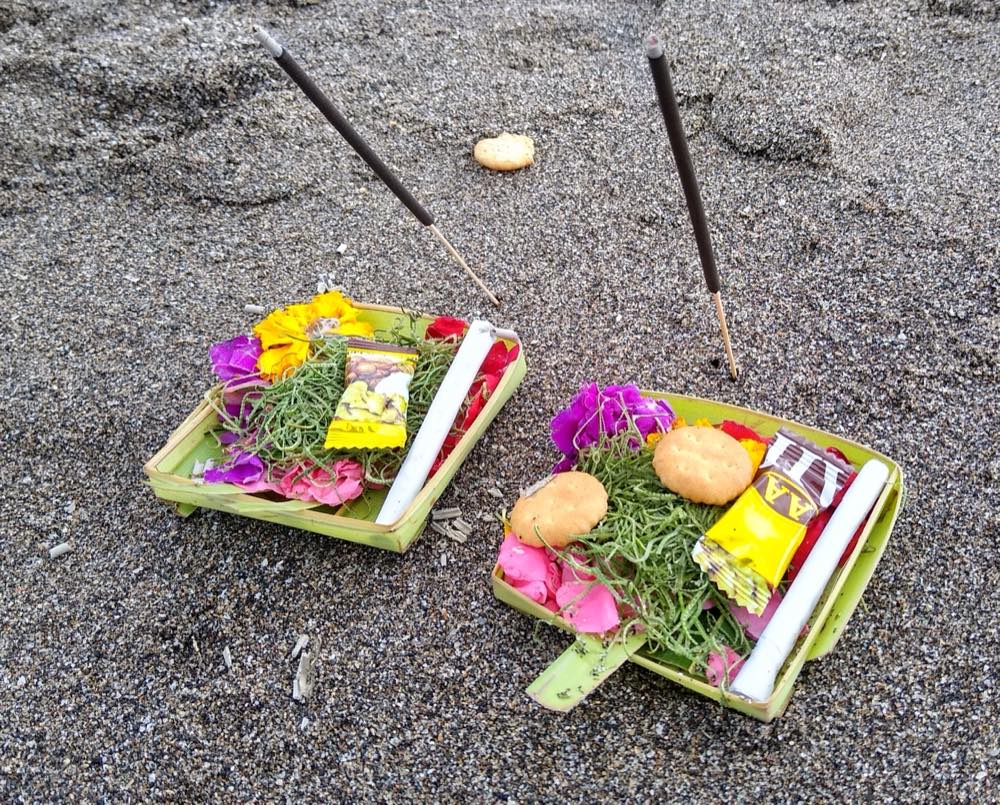 Offerings in the standard Balinese form. In Julah the canang holds areca nut, betel and intaran leaves instead. Photo: Mx. Granger / Wikimedia Commons (CC0)

Death Rites Differ From Village to Village
How a village treats its dead shows the differences plainly.
Mainstream Bali cremates in the great Ngaben ceremony, releasing the soul through fire. Some Bali Aga villages keep an older practice and bury their dead. Tigawasa and Julah are the clearest examples in the north, and in Tigawasa the burial follows within a day of death.
Trunyan, the Bali Aga village on the shore of Lake Batur, is in central Bali. It leaves its dead above ground and does not bury them, a contrast the Tigawasa study itself draws. Trunyan lies outside the north, so read about it from a Bangli source.
Each rite reflects a village's own ancient understanding of the soul, the ancestors and the land, held faithfully for centuries. Approached with respect, it is humbling.
How to Visit a Bali Aga Village Respectfully
These are living communities with their own customary law, and a good visit follows a few rules.
- Go with a local guide who knows the village and can secure a proper welcome. Treat this as essential.
- Follow the village's rules on dress, photography and where you may go. They may differ from the rest of Bali, so ask first.
- Be a humble guest. Do not treat ceremonies, death rites or cemeteries as a spectacle. Some places welcome respectful visitors and others are private, so honour the line.
- Support the village by buying its crafts or paying a fair guide, which sustains the tradition.
- Start from the coast. The hill villages sit inland from the north coast, reachable from Lovina and the Singaraja area.
The villages pair with the wider history of north Bali. They also deepen the picture of how a Balinese village works.
FAQ
Who are the Bali Aga? The Bali Aga are the indigenous, original Balinese, also called Bali Mula. They kept their pre-Majapahit customs as Hindu-Javanese kingdoms reshaped the rest of the island. They live mostly in remote mountain and hill villages, several in north Bali's Buleleng highlands.
Which are the Bali Aga villages in north Bali? The Buleleng Regency government's site counts seven. Sidetapa, Cempaga, Tigawasa, Pedawa and Banyuseri are in Banjar district, and Sembiran and Julah are in Tejakula. Each preserves its own distinct customs.
What is each Bali Aga village known for? Sidatapa is known for its old earthen houses and Pedawa for the Melaib elopement marriage. Tigawasa is known for burying its dead and for its bamboo weaving. Sembiran has its stone-age and iron-age finds and bronze inscriptions, and Cempaga its after-midnight Mecacar ceremony. Julah is known for burying its dead and for offerings made of areca nut, betel and intaran leaves.
Do all Balinese cremate their dead? No. Mainstream Bali cremates in the Ngaben ceremony, but some Bali Aga villages bury their dead instead. The village of Trunyan, in central Bali, lays the dead out in the open under a sacred tree. Death rites vary village by village.
Why are Bali Aga villages different? They held to older, pre-kingdom customs. So they differ in architecture, ceremony, social structure (often without the caste system), crafts and death rites, both from mainstream Bali and from each other.
Can you visit Bali Aga villages? Yes, respectfully and ideally with a local guide who can arrange a proper welcome. They are living communities with their own customary law. Follow the village's rules on dress, photography and access, and never treat ceremonies or death rites as spectacle.
Is Trunyan in north Bali? No. Trunyan is on Lake Batur in central Bali (Bangli), though it is the most famous Bali Aga village for its open-air funerary tradition. North Bali's Bali Aga villages are in the Buleleng hills.
Sources
- Buleleng Regency government, "Bali Aga" Kental Akan Tradisi Namun Menerima Perkembangan Globalisasi (Buleleng as the regency with the most Bali Aga villages; the seven villages and their districts, as listed by STAH Mpu Kuturan anthropologist Dr I Putu Mardika; the balian desa consulted in place of a sulinggih; burial rather than cremation; seniority as the social order; Julah's offerings), Indonesian, read September 2026
- Buleleng culture and tourism office, 7 Desa Bali Aga di Bali (Sidatapa's estimated founding and its earthen houses, Cempaga's Rejang, Sembiran's ancient implements and bronze inscriptions, Julah's reckoned age, burial practice and old village order), Indonesian, read September 2026
- Buleleng culture and tourism office, Desa Tua Tigawasa (Tigawasa's ngaben by burial rather than cremation, its bamboo weaving), Indonesian, read September 2026
- Buleleng culture and tourism office, Desa Bali Aga di Buleleng (the five Banjar-district Bali Aga villages, Sidatapa, Cempaga, Tigawasa, Pedawa and Banyuseri), Indonesian, read September 2026
- Buleleng regional research and innovation agency, Mengenal Desa Bali Aga di Kabupaten Buleleng (the Panca Desa grouping, its distinct language, its house forms and their names, its crafts and palm sugar), Indonesian, read September 2026
- Banjar district office, Buleleng, Upacara Mecacar di Desa Bali Aga Cempaga (the Mecacar ceremony at Cempaga's village temple, its timing and occasions), Indonesian, read September 2026
- Buleleng Regency government, Dikenal Sebagai Sentral Anyaman Bambu, Pengrajin Tigawasa Buat Beragam Motif Kerajinan (Tigawasa as a bamboo-weaving centre, and the sokasi among its crafts), Indonesian, read September 2026
- Desa Pedawa, Upacara Melaib atau Pawiwahan di Desa Pedawa (the forms of Melaib, how melaib ngemaling proceeds, and the form set aside), Indonesian, read September 2026
- Dewa Nyoman Sucita, Tradisi Penguburan Mayat Umat Hindu di Desa Tigawasa, Jurnal Widya Sastra Pendidikan Agama Hindu 4(1), 2021, also indexed on Garuda (Tigawasa's burial rites, the rule against keeping the body more than a day, the link to the Sambhu sect, and the comparison with Trunyan), Indonesian, read September 2026
Read next: north Bali history for the kingdoms these villages predate, Balinese ceremonies for the mainstream practice they diverge from, and ngaben for the cremation Tigawasa does not perform.