
On this page
- In Brief
- Balinese Ceremonies at a Glance
- Two Calendars Set the Dates
- An Odalan Is a Temple's Anniversary Festival
- Galungan and Kuningan Welcome the Ancestors Home
- A Procession Has the Right of Way
- Ngaben, the Cremation, Is Held as a Celebration
- Rites of Passage Follow a Life From Before Birth to After Death
- How to Behave as a Visitor
- In North Bali, Ceremonies Are Held for the Village
- Practical Notes
- FAQ
- Sources
In Brief
Most Balinese ceremonies are open to respectful visitors who dress correctly and follow the lead of the people around them. Their dates come from two calendars, the Gregorian year and the 210-day Pawukon cycle.
A visitor is most likely to meet four kinds:
- Odalan, a temple's anniversary festival
- Galungan and Kuningan, the island-wide holidays
- Processions through the streets, often toward water for purification
- Ngaben, the cremation
Wear a sarong and sash, stay lower than anyone praying and ask before you photograph. When a procession crosses your road, pull over and wait.
For the faith underneath all of it, read Balinese Hinduism explained. For the small palm-leaf trays you will see everywhere, see Balinese offerings explained.
Balinese Ceremonies at a Glance
- What they are: The public rites of Agama Hindu Dharma, Bali's living Hinduism
- How often: Somewhere on the island almost every day
- What sets the dates: The Gregorian year and the 210-day Pawukon cycle
- Open to respectful visitors: Temple odalan and public processions
- By invitation: Cremations, tooth-filings and other family rites
- What to wear: A sarong to the ankles, a sash at the waist and a top that covers the shoulders
- On the road: A procession has the right of way
- Island-wide days: Galungan and Kuningan, about twice in a Gregorian year, and Nyepi, once a year
Two Calendars Set the Dates
The calendar drives everything.
Bali runs on two systems at once: the Gregorian year you already know and the traditional Pawukon cycle of 210 days. Major ceremonies fall on dates set by these calendars, whatever the season.
Bali has more than 20,000 temples, and each marks its own anniversary once in the 210-day cycle. So a festival is under way somewhere at almost any time. On a given day a village may be blessing a new shrine, or a family welcoming its ancestors home.
The calendar is the structure of Balinese life. It sets when a child passes into adulthood and when a village purifies itself.
A ceremony is rarely a single event. It is one beat in a long sequence: the preparation, the day itself and the rites that follow.
How the two calendars interlock is set out in the Balinese calendar explained.
An Odalan Is a Temple's Anniversary Festival
An odalan is a temple's birthday.
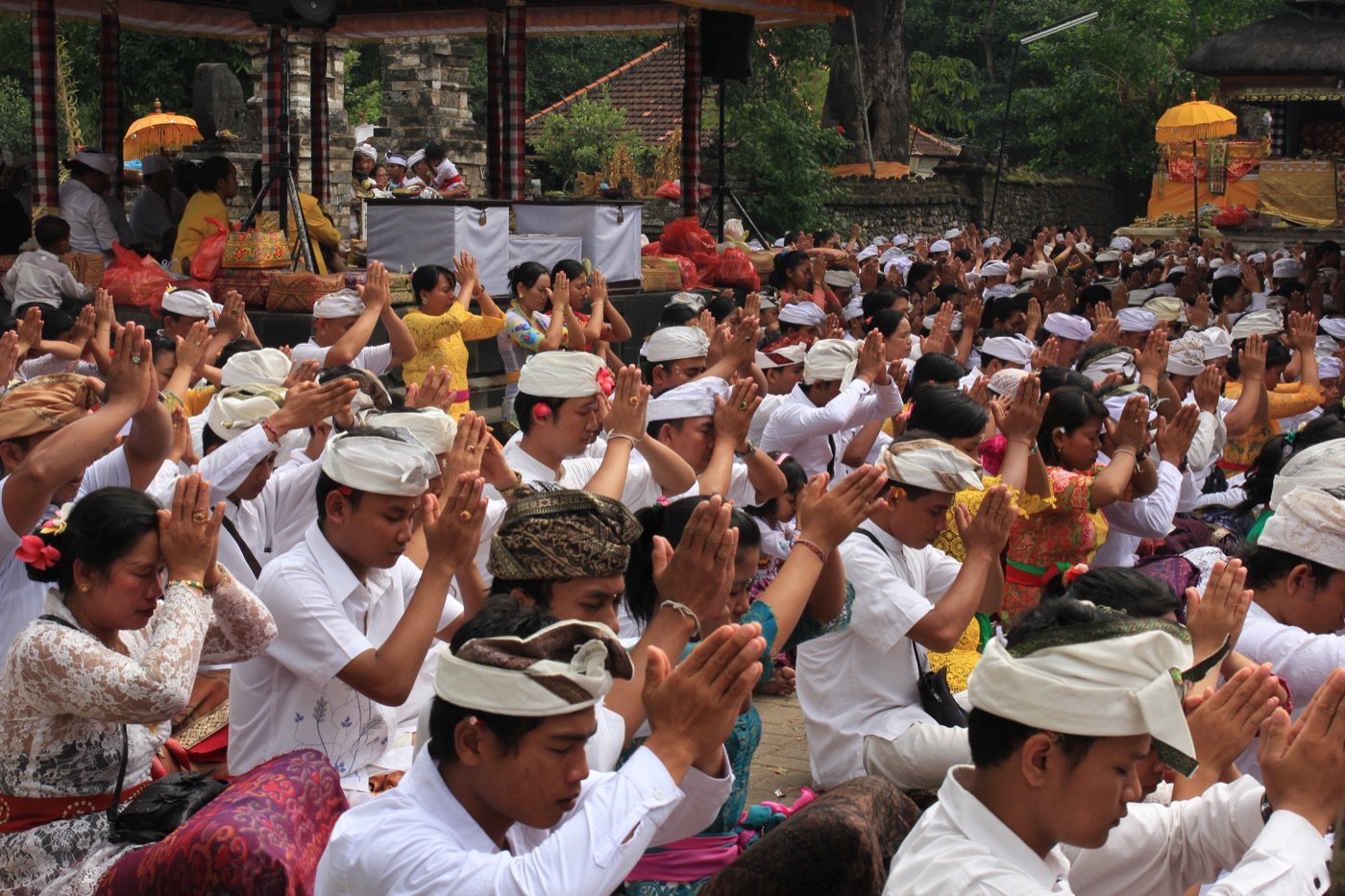
A temple celebrates the anniversary of its consecration on the Pawukon cycle, so odalan happen constantly across the island. The temple comes alive with offerings stacked high, gamelan music and dance. In Balinese understanding, the deities who make that temple their home descend for the festival.
Festivities often run for several days. These are the ceremonies you are most likely to be welcome at, provided you arrive properly dressed and behave with care.
Galungan and Kuningan Welcome the Ancestors Home
Galungan and Kuningan are the two holidays the whole island keeps.
Galungan marks the victory of dharma over disorder. On this day the ancestral spirits return to their former homes, and families welcome them with prayer and offerings.
In the days before, villages raise the penjor, tall curved bamboo poles hung with palm fronds and offerings. They line the roads in an avenue of arching gold and green. Each part of the pole is explained in the penjor guide.
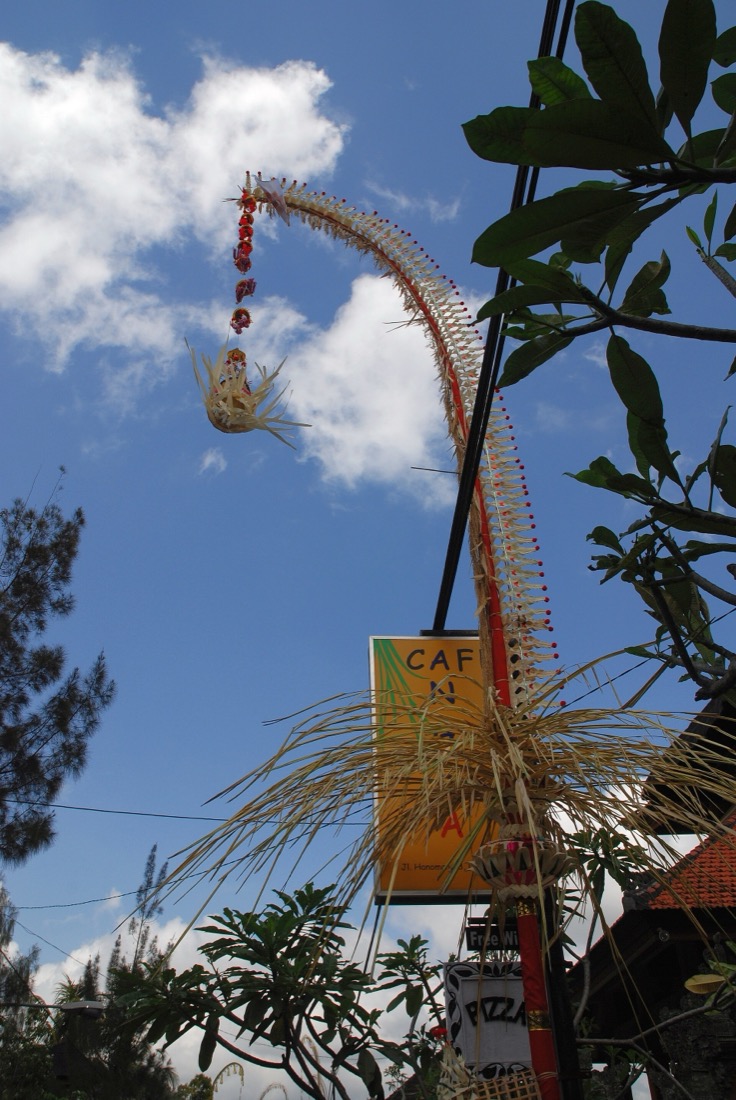 A penjor over the road in the days around Galungan. Photo: Tigerente / Wikimedia Commons (CC BY-SA 4.0)

Ten days later, Kuningan marks the ancestors' departure. They are sent back with yellow rice and special prayers.
Between the two holidays families gather, and the island feels turned toward the sacred.
A Procession Has the Right of Way
Processions are the part of Balinese ceremony you will meet without planning to.
Columns of villagers in white and bright sashes carry offerings, sacred objects or a temple's deities toward water for purification. They move slowly, with music, and they have the right of way.
When one crosses your path, pull over, wait and let it pass. It is one of the easiest forms of respect to offer.
Ngaben, the Cremation, Is Held as a Celebration
A Balinese cremation often confuses a first-time visitor.
The music is festive, people are laughing, and a towering structure shaped like a bull or a mythical lion is carried through the streets. It looks like a celebration because it is one.
In Balinese understanding, death is a transition and the soul is eternal. The cremation, ngaben, releases the soul from its attachment to the body so it can reincarnate, ideally within the same family.
A larger, more elaborate cremation is held to ease the soul's journey and speed its return. Grief is real, and it sits alongside the joyful duty of sending a loved one onward in the proper way.
The cremation in four steps
-
The body is carried in a multi-tiered tower called a bade, hoisted by dozens or even hundreds of men.
-
The procession may spin the tower at intersections, to confuse any spirits that might follow.
-
At the cemetery the body is transferred to an animal-shaped sarcophagus and burned.
-
The ashes are later carried to the sea or a river.
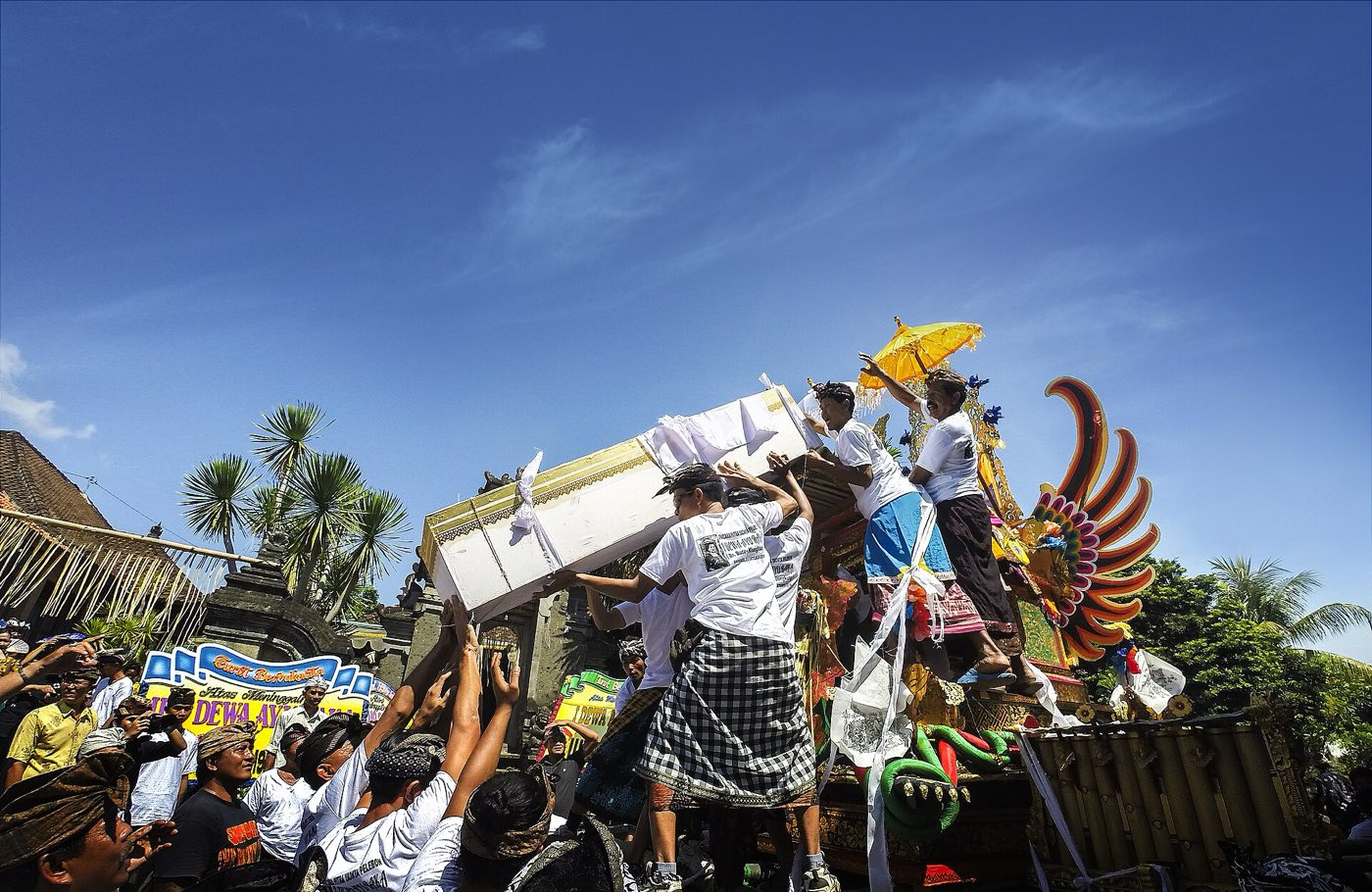 Raising the coffin onto the cremation tower at a pelebon. Photo: trezy humanoiz / Wikimedia Commons (CC BY 2.0)

A full cremation is costly. So villages periodically organise mass cremations, where families share the expense and still give proper rites. These are larger again.
If you meet one
You may meet a cremation procession on the road, and the rule is the same: pull over and wait.
If a local contact invites you to observe one, treat it as a privilege. Dress in sarong and sash, stay unobtrusive and follow your host in everything.
Rites of Passage Follow a Life From Before Birth to After Death
Beyond the temple calendar, Balinese ceremony tracks a human life from before birth to after death.
Each stage has its rite, and many are private family affairs. Early in life come ceremonies for the newborn, for the first time a baby's feet touch the ground and for the milestones of childhood.
Tooth-filing, metatah, is among the most important. A young person's canine teeth are smoothed, which stands for filing away the coarser human impulses such as greed and anger. The rite marks the passage into adulthood.
Families often hold it alongside other ceremonies to share the considerable cost, and it is a proud, festive occasion.
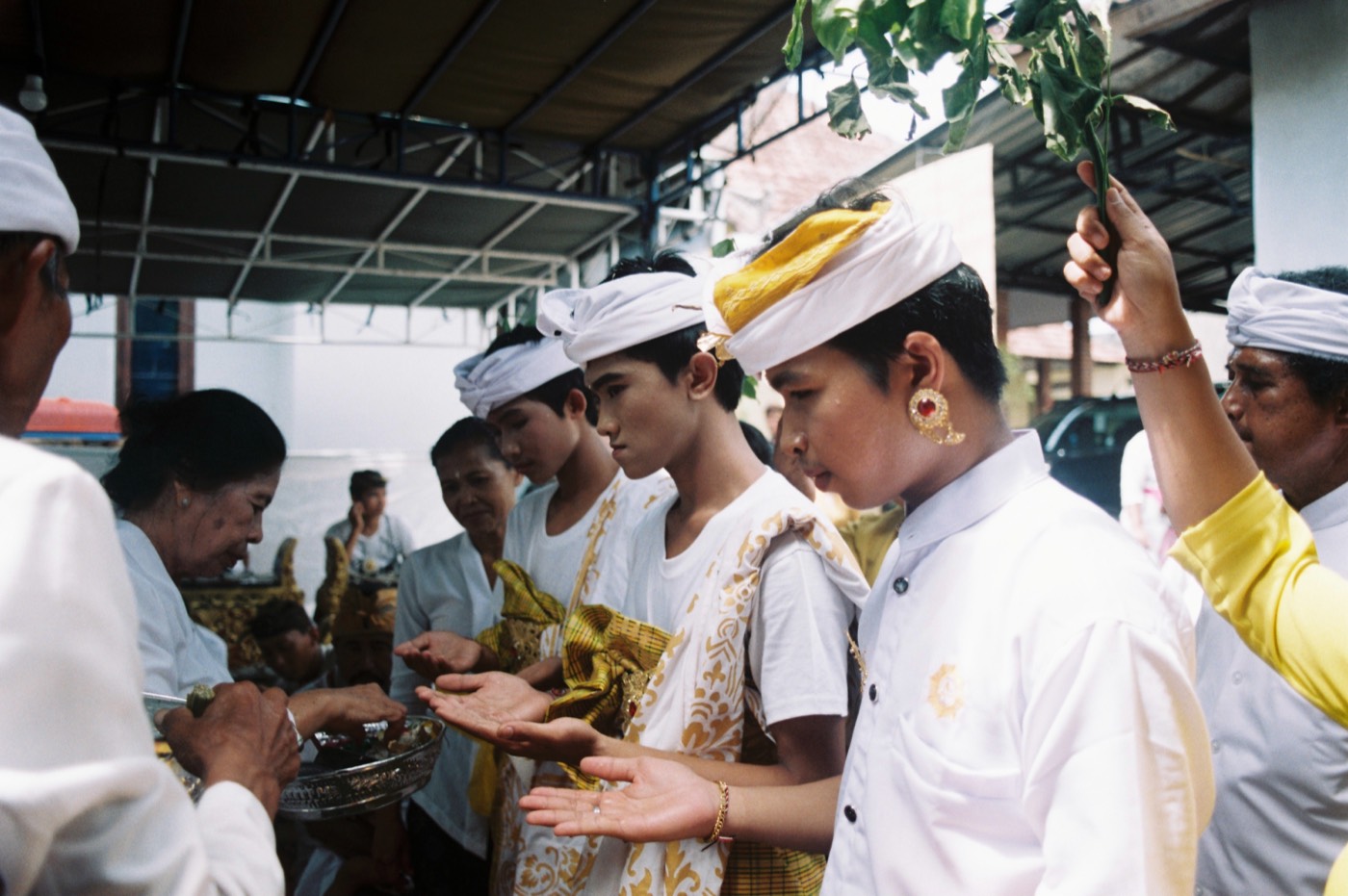 Initiates blessed at a mepandes ceremony. Photo: Ening Megumi Laksmiati / Wikimedia Commons (CC BY-SA 4.0)

A wedding joins two families and two lines of ancestors, and it carries its own sequence of offerings and blessings.
Each of these rites keeps the family in right relationship with the gods and the ancestors who watch over it. If you are invited to one, you are being shown real trust.
How to Behave as a Visitor
Good conduct at a Balinese ceremony comes down to deference.
You are a guest inside someone's living faith. When in doubt, watch what the Balinese do and follow.
A few rules hold almost everywhere:
- Wear a sarong and sash. A sarong wrapped to the ankles and a sash tied at the waist are required at temples and ceremonies, over a top that covers your shoulders. Many temples lend or rent them, though having your own is appreciated. White or light colours suit most occasions.
- Never stand higher than people who are praying, or higher than a priest or a sacred object. During prayers, sit or lower yourself. Do not walk in front of someone in prayer.
- Ask before photographing people, priests or sacred moments, and never use flash during a ceremony. Keep your distance and stay quiet. A ceremony is an act of worship.
- By custom, women avoid temples while menstruating. This is treated as a matter of ritual purity, and many temples post a note about it.
- Do not touch offerings or shrines. Step over an offering on the ground, and never step on one or kick it aside.
- Give a procession the right of way. Pull over and wait.
If you are invited to a ceremony, arrive correctly dressed and bring a small offering or contribution. Should you receive holy water and rice, accept them respectfully and follow your host's lead.
A priest may also tie a tridatu around your wrist at the close of a blessing. It is a blessed thread of red, black and white, the three colours honouring the Hindu trinity. Wear it until it falls away on its own.
In North Bali, Ceremonies Are Held for the Village
In north Bali, few ceremonies are arranged around visitors.
A procession through a village in the hills above Lovina, or an odalan at a small temple near Singaraja, happens because the calendar calls for it. No audience is expected, and you may be the only outsider present.
There is no rope line to stand behind and no guide narrating. So your own care and deference carry more weight, and the responsibility to behave well is greater.
Ask your villa staff or a local contact what is happening nearby and how to approach it. People who have lived here for decades know which ceremonies welcome a respectful guest and which are best watched from a distance.
The region itself is covered in the complete north Bali guide.
Practical Notes
Confirm locally before you plan around any ceremony. Dates shift with the Pawukon cycle and many rites are arranged at short notice within a family or village.
- Galungan and Kuningan run on the 210-day cycle. Galungan falls on Budha Kliwon Dungulan, the Wednesday of the Dungulan week, and Kuningan follows ten days later on the Saturday of the Kuningan week. The cycle is shorter than a solar year, so both come round about twice in a Gregorian year. Check the dates close to your trip. See Galungan and Kuningan.
- Nyepi, the Balinese day of silence, comes once a year and shuts down the entire island for a full day, airport included. Plan travel around it. See Nyepi, the day of silence.
- Odalan festivals happen somewhere almost daily, so you are likely to encounter one without planning. Ask your villa staff what is on near you.
- Cremations are scheduled by the family and announced locally. They are not published in advance.
- Bring a sarong and sash in your bag if you expect to be near any temple or ceremony.
- Hire a local guide or ask your hosts before attending anything beyond a public procession. An invitation and a knowledgeable companion make the difference.
FAQ
What are the main Balinese ceremonies?
The ones a visitor is most likely to see are odalan, Galungan and Kuningan, street processions and ngaben. Odalan is a temple's anniversary festival, held once in each 210-day cycle. Galungan and Kuningan are the island-wide holidays marking the victory of dharma and the return and departure of ancestral spirits. Processions often head toward water for purification, and ngaben is the cremation. Rites of passage such as tooth-filing and weddings are more often private family ceremonies.
Can tourists attend Balinese ceremonies?
Yes, many ceremonies welcome respectful visitors, especially temple odalan and public processions. You must dress correctly in a sarong and sash, never stand higher than people praying, ask before photographing, and follow the lead of those around you. Private rites such as cremations and tooth-filings are best attended only by invitation, with a local host to guide you.
What is a Balinese cremation (ngaben)?
Ngaben is the cremation ceremony that releases the soul from the body so it can reincarnate. In Balinese understanding death is a transition, so the cremation is treated as a celebration. There is festive music, and a towering bull- or lion-shaped structure is carried through the streets. The ashes are later carried to the sea or a river.
What should you wear to a Balinese ceremony?
A sarong wrapped to the ankles and a sash tied at the waist, worn over a top that covers your shoulders. White or light colours suit most occasions. Many temples lend or rent sarongs, and avoiding revealing clothing is essential everywhere.
What is Galungan?
Galungan is one of Bali's most important holidays, celebrating the victory of dharma over disorder. In Balinese understanding, the ancestral spirits return to their former homes and are welcomed with prayer and offerings. Tall decorated bamboo poles called penjor line the roads, and ten days later Kuningan marks the ancestors' departure.
Sources
- Kecamatan Buleleng, Kabupaten Buleleng, Hari Raya Galungan dan Kuningan (Galungan on Budha Kliwon Dungulan every 210 days as the victory of dharma over adharma, Kuningan ten days later on the Saturday of wuku Kuningan, both twice in a Gregorian year), Indonesian, read September 2026
- Bagian Kesejahteraan Rakyat, Setda Kabupaten Buleleng, Makna penjor Galungan yang dipasang saat penampahan (the penjor raised on Penampahan Galungan, what the bamboo and its decorations stand for), Indonesian, read September 2026
- Kantor Wilayah Kementerian Agama Provinsi Bali, Penjor, simbol manifestasi istana Tuhan (an opinion column on the ministry's Bali site reading the penjor as Gunung Agung and the naga), Indonesian, read September 2026
- Dinas PUPR Perkim Kabupaten Buleleng, Makna Hari Raya Galungan dan Kuningan (what Galungan and Kuningan mean, the yellow-rice offerings of Kuningan, and the 42-day span of the whole Galungan series), Indonesian, read September 2026
- ANTARA, Bali Airport announces 24-hour operational suspension during Nyepi (all regular flights at Ngurah Rai suspended for the 24 hours of Nyepi), English, read September 2026
- Photographs credited in full at each caption: penjor at Galungan, Ubud, mepandes at Tabanan and a ngaben cremation, Wikimedia Commons
Read next: the anatomy of a Balinese ceremony, Balinese offerings explained, and Bali temple etiquette.