_.jpg)
On this page
In Brief
Lawar is a Balinese dish of finely chopped meat, vegetables and grated coconut mixed with a rich spice paste; some versions are coloured and flavoured with fresh blood. Most lawar uses meat that has been grilled or boiled first. Lawar plek is the exception: a speciality of Ketewel village in Sukawati, Gianyar, made from raw meat minced fine and mixed with spices and a little chopped young jackfruit. According to Ketewel's village head, interviewed by researchers from Singaraja's Universitas Pendidikan Ganesha, it was once a special offering for religious ceremonies, eaten only by the people of Ketewel. Raw pork and raw pig's blood can carry Streptococcus suis, a bacterium that causes meningitis, and Bali has recorded outbreaks linked to raw lawar. Health officials advise cooking pork to at least 70 °C.
Lawar Plek at a Glance
- What it is: Lawar made with finely minced raw meat, spices and a little young jackfruit
- Where it comes from: Ketewel village, Sukawati district, Gianyar
- Origin: A ceremonial offering, once eaten only in Ketewel, now sold to visitors
- Lawar in general: Chopped meat, vegetables and coconut in spice paste; usually made with cooked meat
- Red and white: Lawar merah (red) contains blood; lawar putih (white) does not
- The risk: Streptococcus suis meningitis from raw or undercooked pork and blood
- Official advice: Cook pork to at least 70 °C; avoid raw blood
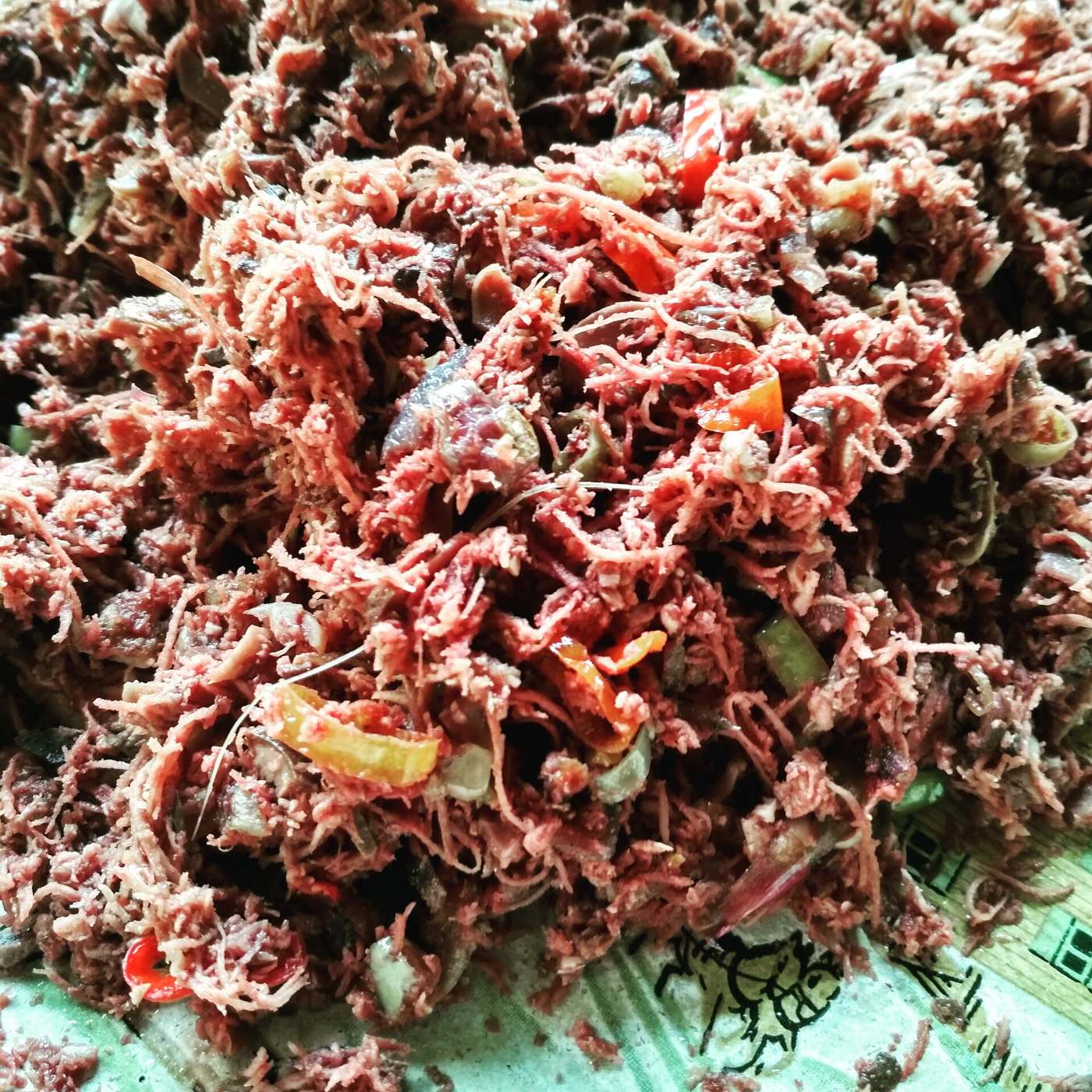 Lawar getih, blood lawar: grated coconut, minced meat and chilli coloured red with fresh blood. Photo: Komang arie / Wikimedia Commons (CC BY-SA 3.0)
What Lawar Is
Lawar is a mixture of vegetables, coconut and minced meat bound with herbs and spices, found in warungs and restaurants all over Bali, as Wikipedia's entry on lawar describes it. Despite all the vegetables, it is rarely vegetarian. It takes its name from what goes in: chicken lawar, pork lawar, young-jackfruit lawar. It is also named by colour. Lawar merah, red lawar, is made with blood; lawar putih, white lawar, is made without.
The base is the Balinese spice paste, base genep, and the mixing is done by hand. detikFood describes the method as a matter of knives and clean hands: the ingredients are kneaded together so that the blood spreads evenly and does not clot.
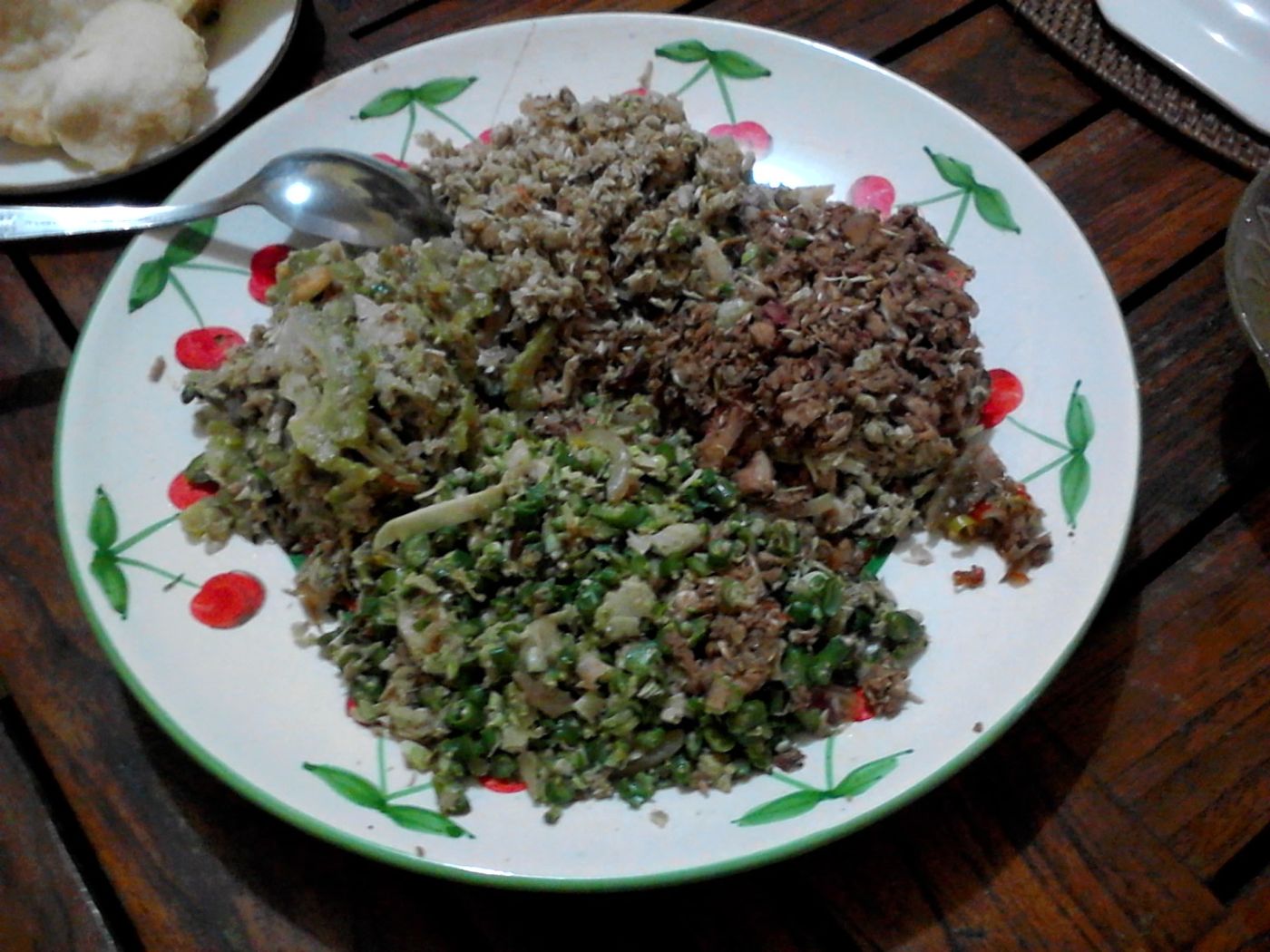 Lawar looks like vegetables and coconut, but is usually made with meat. Photo: ちちゃ / Wikimedia Commons (CC BY 2.1 JP)

Lawar is feast food. The Balinese call the work of preparing it mebat, and a health ministry article from Bali's referral hospital, RSUP Prof. Ngoerah, ties it to the preparations for Galungan in particular. detikFood notes lawar's role as an offering at Galungan. On the north coast, cooking lawar at home also produces its own drink: the drinks of north Bali describes rujak yeh kuwud, made from the coconut water left over from lawar.
Lawar Plek: the Ketewel Style
Ketewel is a village in Sukawati district, Gianyar. Its lawar is different from the lawar of the rest of Bali in one essential way. A 2023 study of lawar plek by Hadi Purwanata, Damiati and Ida Ayu Putu Hemy Ekayani at Universitas Pendidikan Ganesha in Singaraja puts it plainly: most lawar uses minced meat that has been grilled or boiled first, while lawar plek uses meat that is raw.
The study describes it as raw meat chopped fine, then mixed with spices and a little coarsely chopped young jackfruit. In an interview for the study, the head of Ketewel village, I Putu Gede Widya Kusuma Negara, explained that lawar plek was once a dish made as a special offering for religious ceremonies and eaten only by the people of Ketewel.
It has since become a local speciality that people travel for. The Undiksha researchers surveyed buyers in Ketewel and found them keen to buy because it is unique and Balinese, drawn by its distinctive taste, and reassured when the food on sale looked clean and tidy.
Not every lawar plek is pork. NusaBali described a Ketewel warung making its lawar plek from raw chicken mixed with goat skin, young jackfruit, coconut and its own spice blend, with no pork at all. Raw chicken carries its own risks, among them Salmonella, which detikFood lists alongside Streptococcus as the dangers of raw meat and blood.
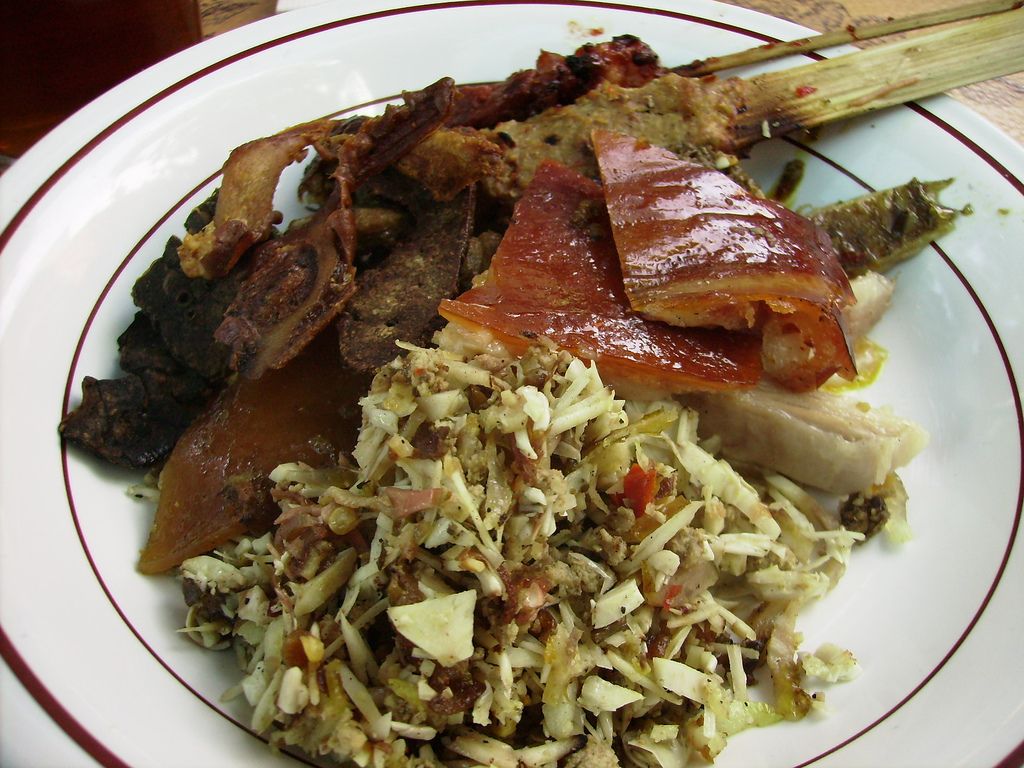 Lawar beside babi guling on a warung plate. Photo: ybs / Wikimedia Commons (CC BY 2.0)

The Food-Safety Facts: Raw Pork, Raw Blood and S. suis
The health concern with raw lawar is specific and well documented in Bali.
The bacterium. Streptococcus suis lives in pigs and passes to people through undercooked pork and through handling infected pigs, including through small cuts on the hands. In people it mainly causes meningitis, an infection of the membranes around the brain and spinal cord, and it can also cause sepsis, arthritis and heart infection, according to Buleleng's regency health office.
The Bali record. A study in the US Centers for Disease Control and Prevention journal Emerging Infectious Diseases reviewed 44 confirmed cases of S. suis meningitis in Bali between 2014 and 2017. Almost nine in ten patients were men, and about one in ten died. The authors concluded that eating raw meat with fresh blood from sick or apparently healthy infected pigs may be a major route of infection on the island. A separate report in the journal One Health traced a cluster in Badung in March 2017: 18 people admitted to hospital and 21 treated as outpatients after sharing red lawar and komoh, a soup of fresh pig's blood, at a village celebration. Everyone admitted to hospital recovered after antibiotic treatment.
The advice. The official advice is to cook pork thoroughly:
- Cook pork to at least 70 °C, the temperature the RSUP Prof. Ngoerah article gives for killing the bacteria. Buleleng's health office says the bacterium dies from 56 °C, and advises against eating any part of the pig raw or half-cooked.
- Avoid raw blood in lawar and soups.
- Wash hands with soap and running water, and wear gloves if you have cuts, when handling raw pork.
- Buy fresh pork, pink and firm.
The warning signs. Fever with headache and a stiff neck, and sometimes hearing loss or confusion, after eating raw or undercooked pork or blood, need a hospital quickly. Tell the doctor what you ate. The CDC study credits early antibiotics with the low rate of lasting hearing loss among Bali's patients. In the north, the hospitals are in Singaraja; see healthcare in north Bali.
Eating Lawar Safely as a Visitor
Lawar is one of the great dishes of Bali, and most of it is made with cooked meat. Order with a couple of questions in mind:
- Ask if it is barak (red) or putih (white). Red means blood.
- Ask whether the meat is cooked (matang). Lawar plek, by definition, is not.
- Eat it fresh. Wikipedia's entry notes that lawar, rich in coconut and sometimes blood, spoils within about half a day.
For lawar in context, with babi guling, sate lilit and the rest of the island's cooking, see what to eat in Bali. For where to eat on the north coast, the best warungs in north Bali lists the local kitchens, and Bali belly covers everyday stomach troubles. The ceremonies that bring out the lawar are explained in Galungan and Kuningan.
Practical Notes
- Lawar plek means raw meat. Know that before you order it.
- Red lawar means blood. White lawar does not contain it.
- Symptoms after eating raw pork (fever, headache, stiff neck): go to hospital and say what you ate.
- Ketewel is in Gianyar, in the south of the island, a long drive from the north coast.
FAQ
What is lawar plek? Lawar plek is a style of lawar from Ketewel village in Gianyar, made from finely minced raw meat mixed with spices and a little young jackfruit. Most other lawar uses meat that has been grilled or boiled first.
Where does lawar plek come from? From Ketewel, a village in Sukawati district, Gianyar regency. The village head told researchers it was once a special ceremonial offering eaten only by the people of Ketewel.
Is lawar plek safe to eat? Raw pork and raw pig's blood can carry Streptococcus suis, which causes meningitis, and Bali has had outbreaks linked to raw lawar. Health officials advise cooking pork to at least 70 °C and avoiding raw blood. Raw chicken versions carry other risks, such as Salmonella.
What is the difference between red and white lawar? Red lawar (lawar merah or barak) contains fresh blood, which colours and flavours it. White lawar (lawar putih) has none.
Is lawar made with blood? Some lawar is. Red lawar is mixed with fresh blood, usually pig's or chicken's; white lawar is made without it.
Is lawar vegetarian? Rarely. Despite the vegetables and coconut, most lawar is mixed with minced meat and sometimes blood. Ask for the ingredients if you do not eat meat.
Sources
- Purwanata, Damiati and Ekayani, Consumer perceptions of lawar plek in Ketewel village, Gianyar, Jurnal Kuliner, Universitas Pendidikan Ganesha, April 2023, read September 2026 (in Indonesian)
- Buleleng Regency Health Office, Meningitis suis and its treatment, read September 2026 (in Indonesian)
- Ministry of Health, RSUP Prof. Ngoerah, Safe mebat, free of Streptococcus suis meningitis, at Galungan in Bali, July 2023, read September 2026 (in Indonesian)
- Susilawathi and others, Streptococcus suis-associated meningitis, Bali, Indonesia, 2014 to 2017, Emerging Infectious Diseases, December 2019, read September 2026 (in English)
- Tarini and others, A large cluster of human infections of Streptococcus suis in Bali, Indonesia, One Health, 2022, read September 2026 (in English)
- detikFood, Five facts about lawar plek, June 2025, read September 2026 (in Indonesian)
- NusaBali, Pan Dodol serves Ketewel-style lawar plek, 17 November 2021, read September 2026 (in Indonesian)
- Wikipedia, Lawar (food), read September 2026 (in English)
Read next: what to eat in Bali, the best warungs in north Bali and healthcare in north Bali.