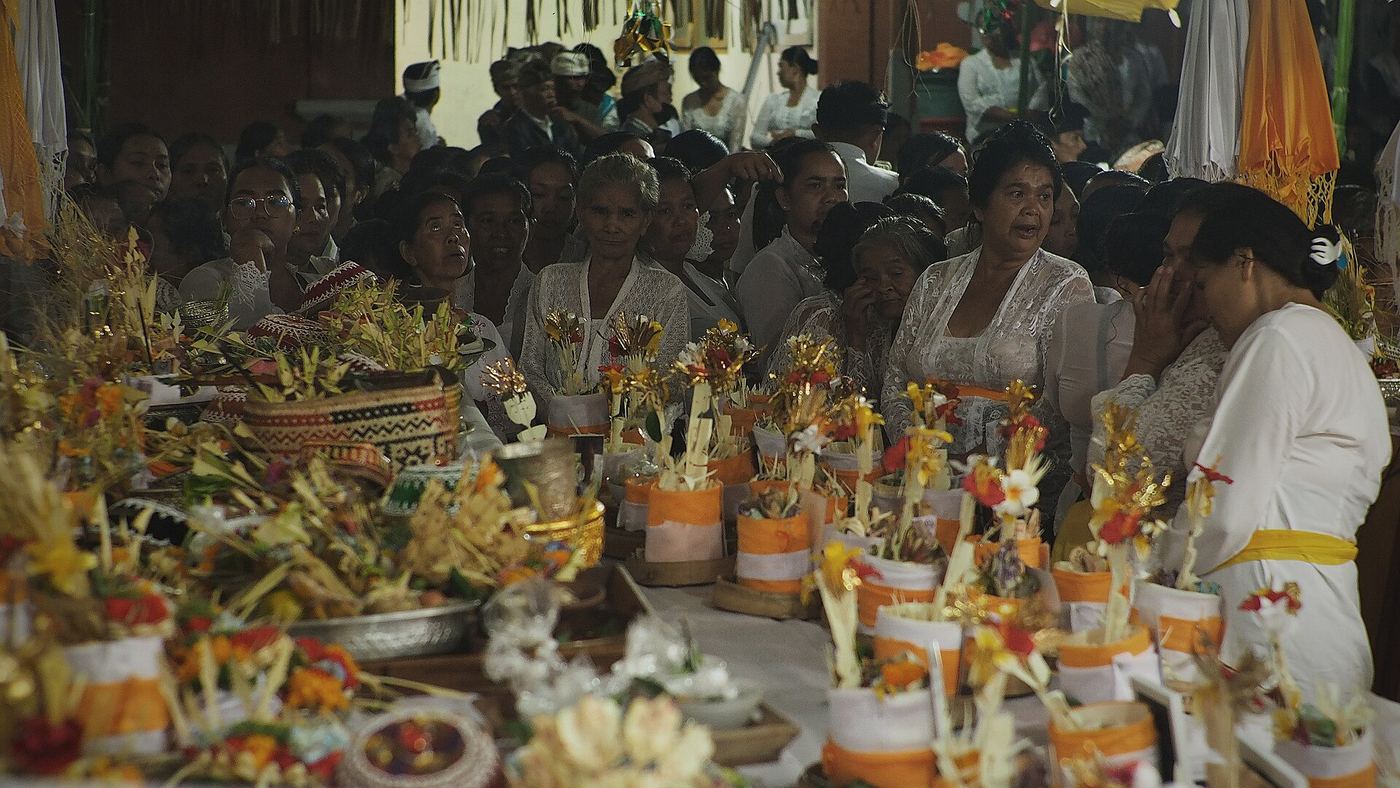

On this page
In Brief
Balinese culture grows from Balinese Hinduism, a religion of practice more than doctrine, built on community duty, the honouring of ancestors and the balance between the seen and unseen worlds, sekala and niskala. Its frame is the customary village, the desa adat, and its neighbourhood units, the banjar, which run ceremonies under their own written rules. Time follows a 210-day ritual calendar, the pawukon, alongside a lunar year, so holy days such as Galungan can come round twice in one year. Daily offerings, life-cycle rites and temple festivals fill that calendar. Dance and gamelan music belong to the temple as much as the stage: UNESCO inscribed three genres of traditional Balinese dance as intangible heritage in 2015. For a visitor, the rules are few and clear: dress modestly, respect temples and ceremonies, and never step on an offering.
Balinese Culture at a Glance
- Religion: Balinese Hinduism, practised through ritual, offerings and ancestor veneration
- Core ideas: Tri Hita Karana (harmony with God, people and nature), Rwa Bhineda (balance of opposites), sekala and niskala (the seen and the unseen)
- Community: The desa adat (customary village) and its banjar, governed by their own rules, the awig-awig
- Time: The 210-day pawukon calendar and the lunar saka year
- Heritage status: Traditional Balinese dance, UNESCO intangible heritage (2015); the subak rice landscape, a UNESCO World Heritage cultural landscape
- Language: Balinese, with speech levels by status and setting, alongside Indonesian
- The north: More Bali Aga (old Balinese) villages than any other regency, its own festivals, and its own painting tradition
Religion: Balinese Hinduism
Almost everything else starts here. Wikipedia's overview of Balinese Hinduism sums it up as a religion that puts ritual practice before doctrine, with communal religious duty, veneration of ancestors, and the balance between the visible world, sekala, and the invisible, niskala. Space carries meaning too: the mountains, Gunung Agung above all, are the seat of the gods, the sea the home of powerful and unruly forces, and temples, houses and villages are laid out between the two, kaja toward the mountain and kelod toward the sea.
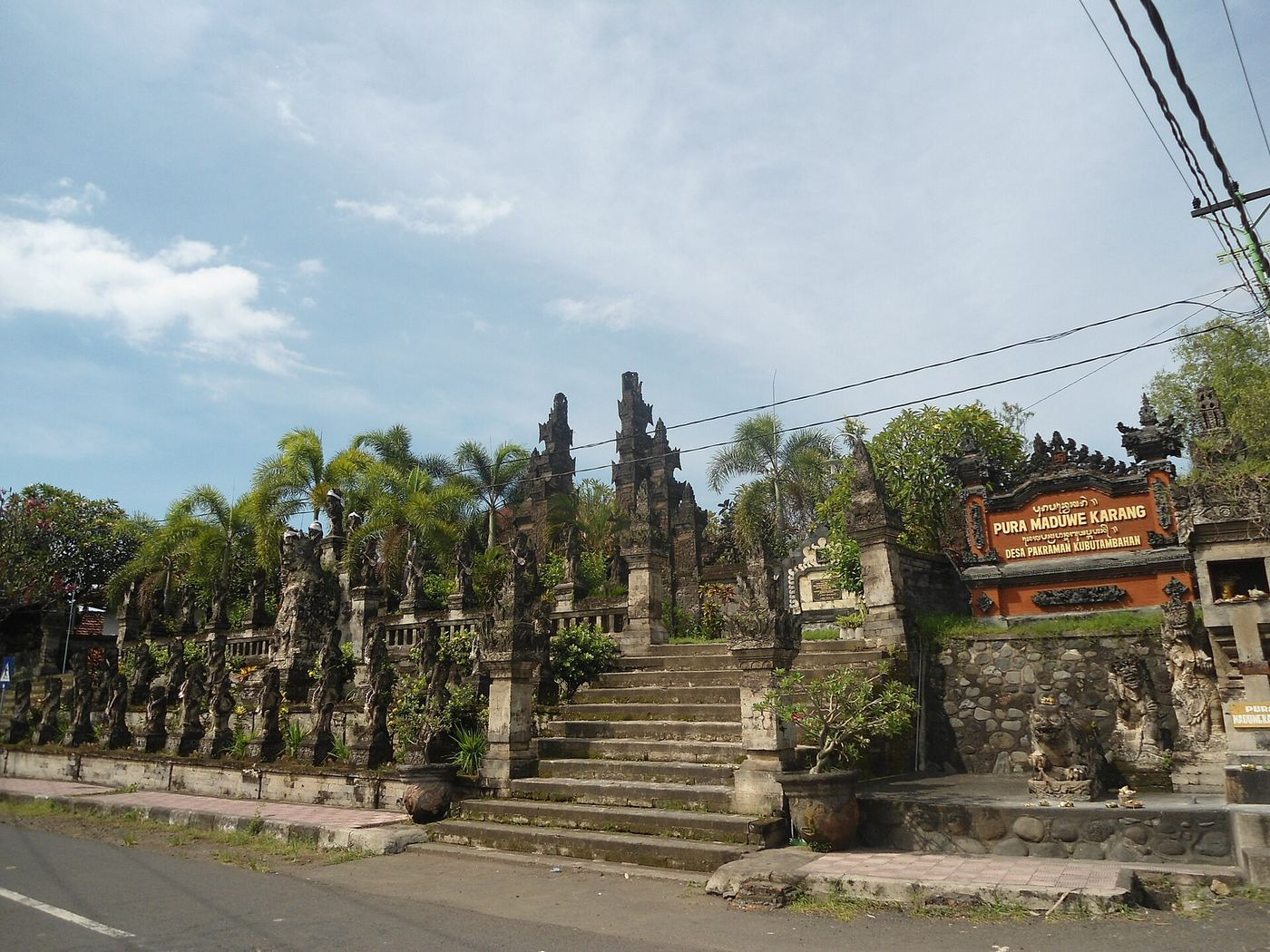 Pura Maduwe Karang at Kubutambahan, in Buleleng. Photo: DayakSibiriak / Wikimedia Commons (CC BY-SA 4.0)

Go deeper:
- Balinese Hinduism explained: the gods, the priests, the five tenets of belief and the temples
- Tri Hita Karana, Rwa Bhineda and sekala and niskala: the three ideas that explain most of what you see
- Balinese mythology: the turtle beneath the island, the Barong and Rangda, and the legends of the north
- The best temples in north Bali and Pura Pulaki on the north-west coast
Other faiths are part of the island too. The north has its own churches and a Buddhist monastery in the hills near Lovina.
The Village and the Banjar
The unit of Balinese life is the village. Bali's provincial regulation on customary villages defines the desa adat as a community under customary law with its own territory, traditions, property and inherited ways of living together, bound to its temples, with the right to run its own affairs. The banjar adat, also called the banjar suka duka, the banjar of joy and sorrow, is a part of it. Both make their own rules, the awig-awig, which apply to members and to newcomers living in the village alike.
In practice the banjar is who turns up: for a wedding, a cremation, a temple festival, or the building of an effigy before Nyepi. The Balinese banjar explains how it works, traditional Balinese architecture how house compounds are laid out, Balinese names why so many people are called Wayan, Made, Nyoman and Ketut, and the subak how farmers share the water for the rice.
The north keeps older forms too. Buleleng has more Bali Aga villages than any other regency, seven by the count of an anthropologist from STAH Mpu Kuturan Singaraja, reported by the regency: Sidetapa, Cempaga, Tigawasa, Pedawa and Banyuseri in Banjar district, and Sembiran and Julah in Tejakula. In his account, Bali Aga communities bury their dead rather than cremate them, and turn to a village balian rather than a high priest when they hold a ceremony. The Bali Aga villages of the north covers each one.
The Balinese Calendar
Bali runs two calendars at once. The pawukon is a 210-day cycle made of ten concurrent weeks, from one day long to ten, and most holy days, temple anniversaries and birthdays are fixed by it. The saka calendar follows the moon and runs close to the solar year; Nyepi, the New Year, belongs to it. Because 210 days is shorter than a year, the big pawukon feasts can fall twice in one Western year.
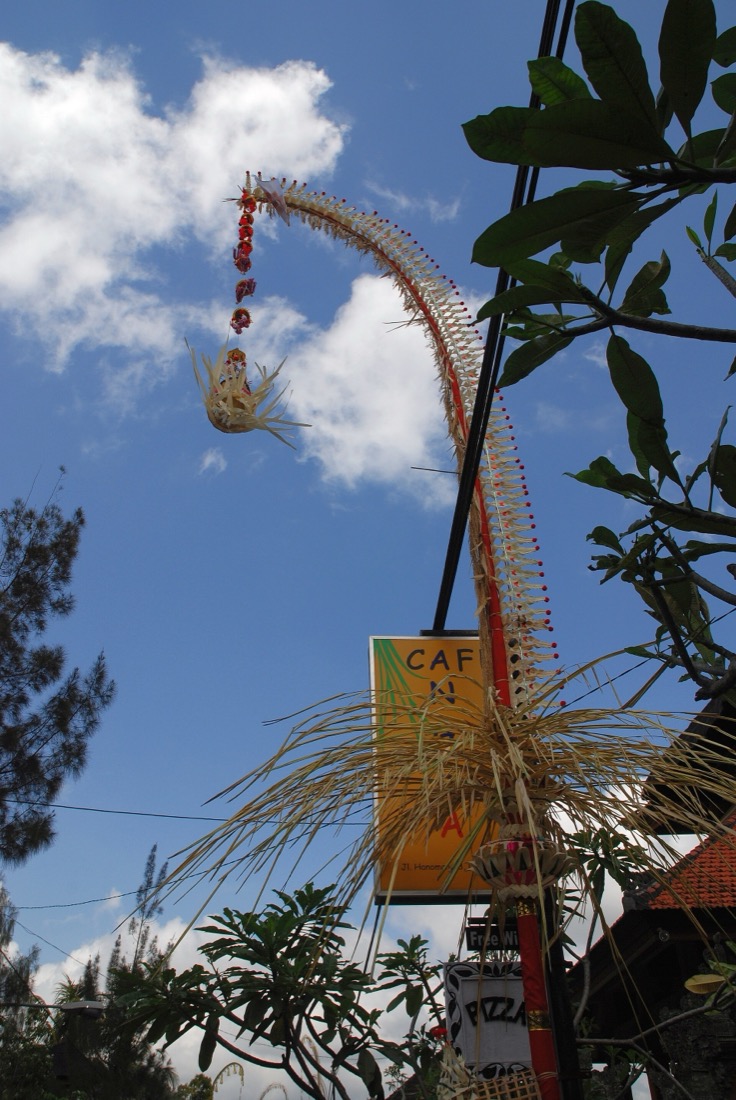 Penjor arching over the road in the days before Galungan. Photo: Tigerente / Wikimedia Commons (CC BY-SA 4.0)

- The Balinese calendar explained: how the two fit together and how to read a date
- Galungan and Kuningan: the ten days when the ancestors visit, with penjor poles arching over every street
- Pagerwesi: the day of the iron fence, which Buleleng keeps on the scale of Galungan
- Nyepi, the Day of Silence, and the night before it, when the ogoh-ogoh effigies are paraded
- Otonan: the Balinese birthday, which comes round every 210 days
Ceremonies
Balinese ritual is sorted into five classes, the Panca Yadnya: offerings to the gods, to the ancestors, to the sages, to people through the life-cycle rites, and to the lower forces. The Balinese ceremonies guide is the place to start, and what the ceremony elements mean explains the holy water, flowers and offerings you will see at any of them.
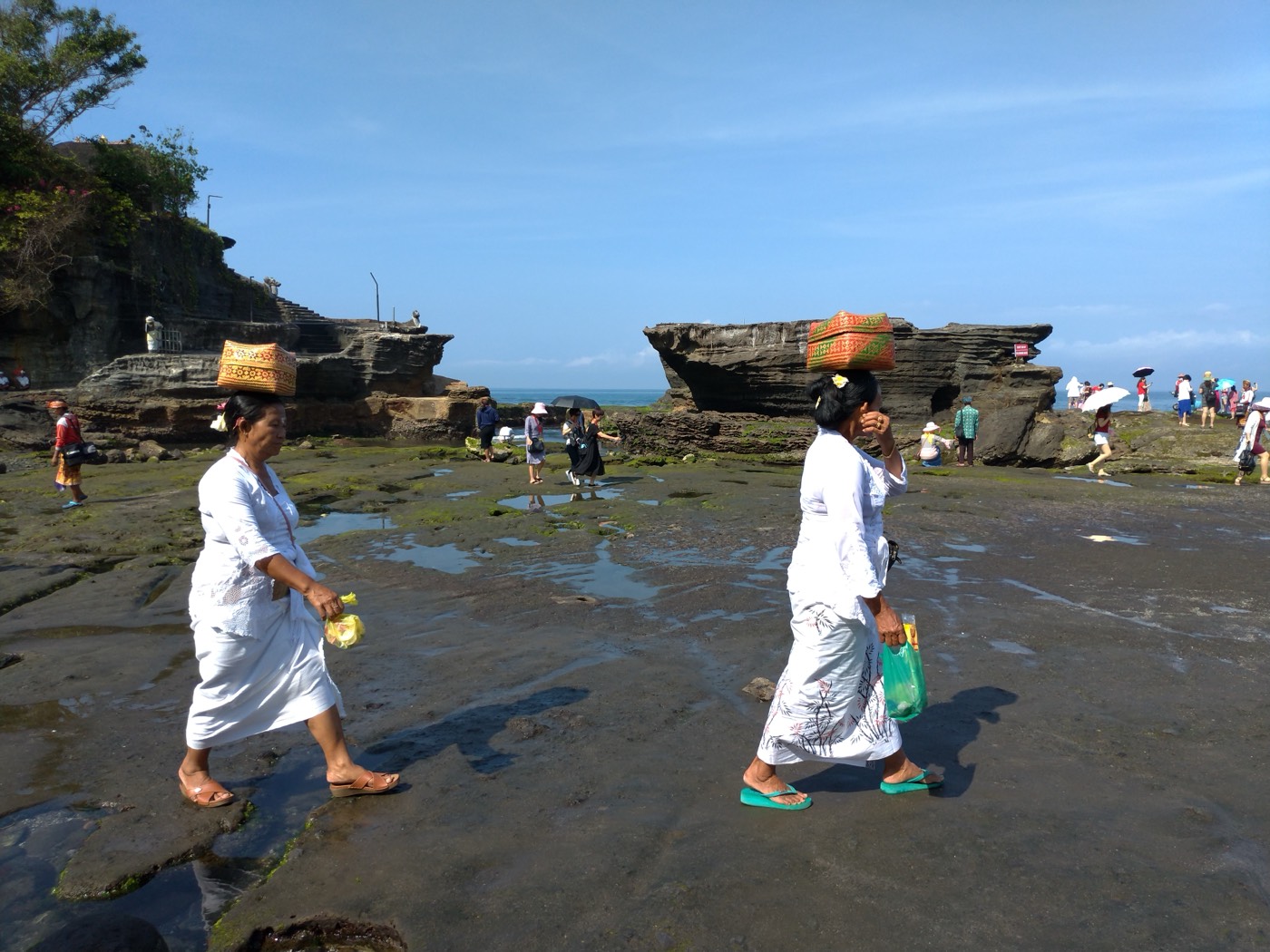 Offering baskets crossing the reef at Tanah Lot. Photo: IrmaRosalina / Wikimedia Commons (CC BY-SA 4.0)

The life-cycle rites, from birth to death:
- Otonan, the 210-day birthday
- Metatah, the tooth filing that marks coming of age
- The Balinese wedding
- Ngaben, the cremation that frees the soul
And the rites of cleansing and balance: melukat, purification with holy water; mecaru, the offerings that restore harmony with the forces of nature; and the small signs a visitor notices after prayer, the rice on the forehead and the red, white and black tridatu thread.
Offerings
The daily offering is the most visible part of Balinese culture: a small palm-leaf tray of flowers, rice and incense, the canang sari, set out on shrines, doorsteps and dashboards each morning, with smaller offerings on the ground. Balinese offerings explained takes them apart piece by piece, and sekala and niskala explains why they are made.
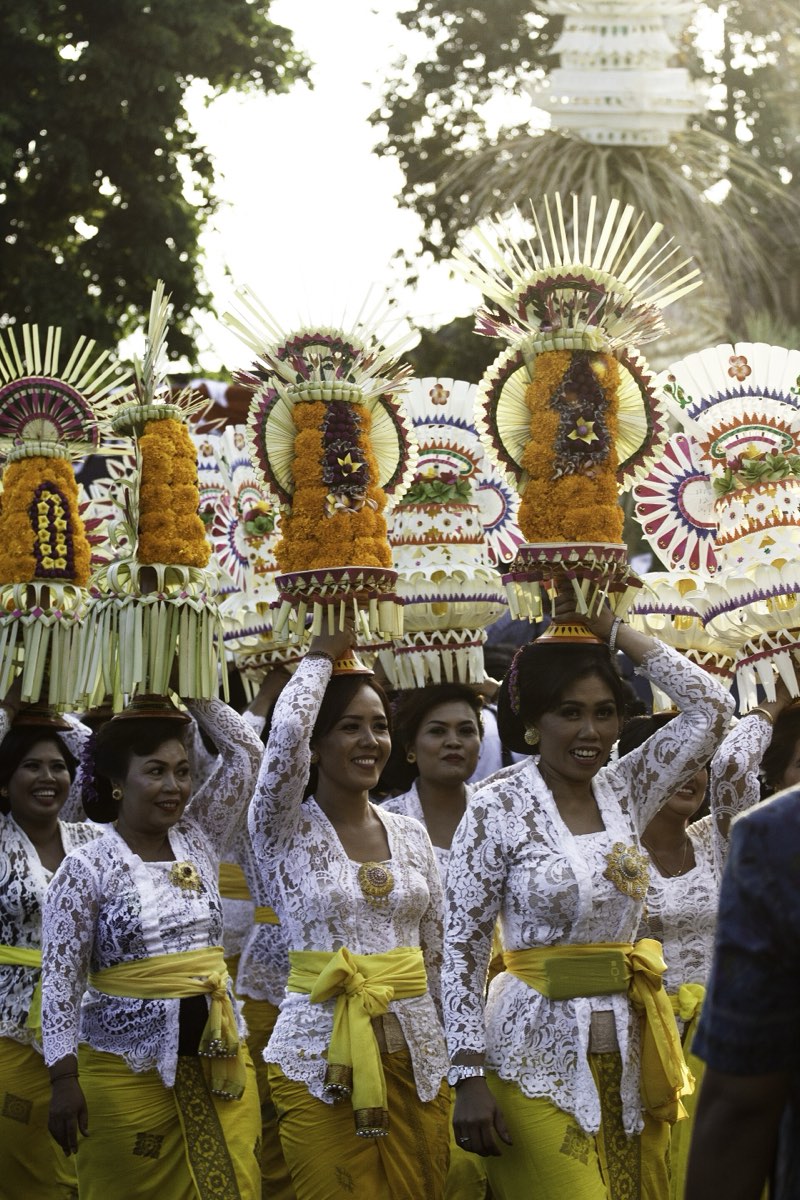 Gebogan towers carried to the temple, balanced and blessed. Photo: Tijden / Wikimedia Commons (CC BY-SA 4.0)

Even offerings differ by village. In Julah, the regency's report notes, the canang is filled with areca nut, betel and intaran leaves in place of the usual flowers, and people tuck an intaran leaf behind the ear after prayer instead of a blossom.
Dance, Music and Drama
Dance in Bali belongs to the temple as much as to the stage. When UNESCO inscribed three genres of traditional dance in Bali in 2015, it described them as sacred, semi-sacred and dances for the enjoyment of the community, all accompanied by gamelan, learned informally in childhood, and asking of a dancer technical skill, charisma, humility, discipline and a special spiritual energy.
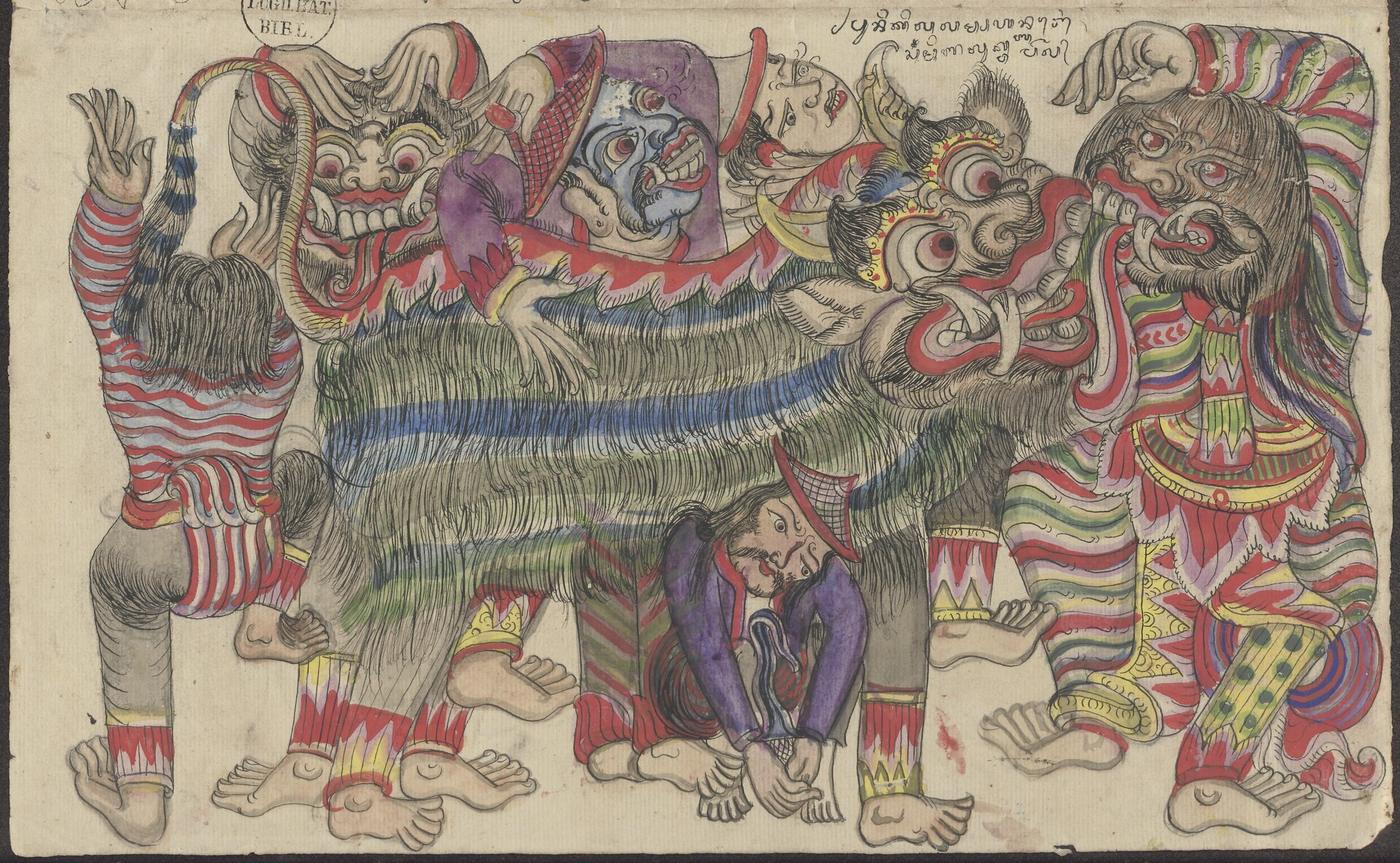 A barong and its performers, drawn by I Ketut Gedé of Singaraja for the scholar H.N. van der Tuuk in the late nineteenth century. Photo: I Ketut Gedé / Wikimedia Commons (public domain)
- The dance and music of north Bali, including the north's own traditions
- Rejang, the temple dance of women and girls
- Legong, the classical court dance for girls
- The Barong, the guardian beast, and Rangda, his opposite
- Kecak, the chanted circle of voices
- Balinese gamelan, the orchestras of gongs and metallophones
- Balinese songs, from children's songs to the kidung sung in the temple
The north's big stages are the Buleleng Festival in Singaraja and the Lovina Festival on the beach.
Food and Drink
Balinese food is ceremonial as well as daily, and much of it is cooked for offerings and shared after them. What to eat in Bali covers the dishes, from lawar to babi guling, and Bali street food the snacks. For cooking it yourself, see cooking classes in Bali.
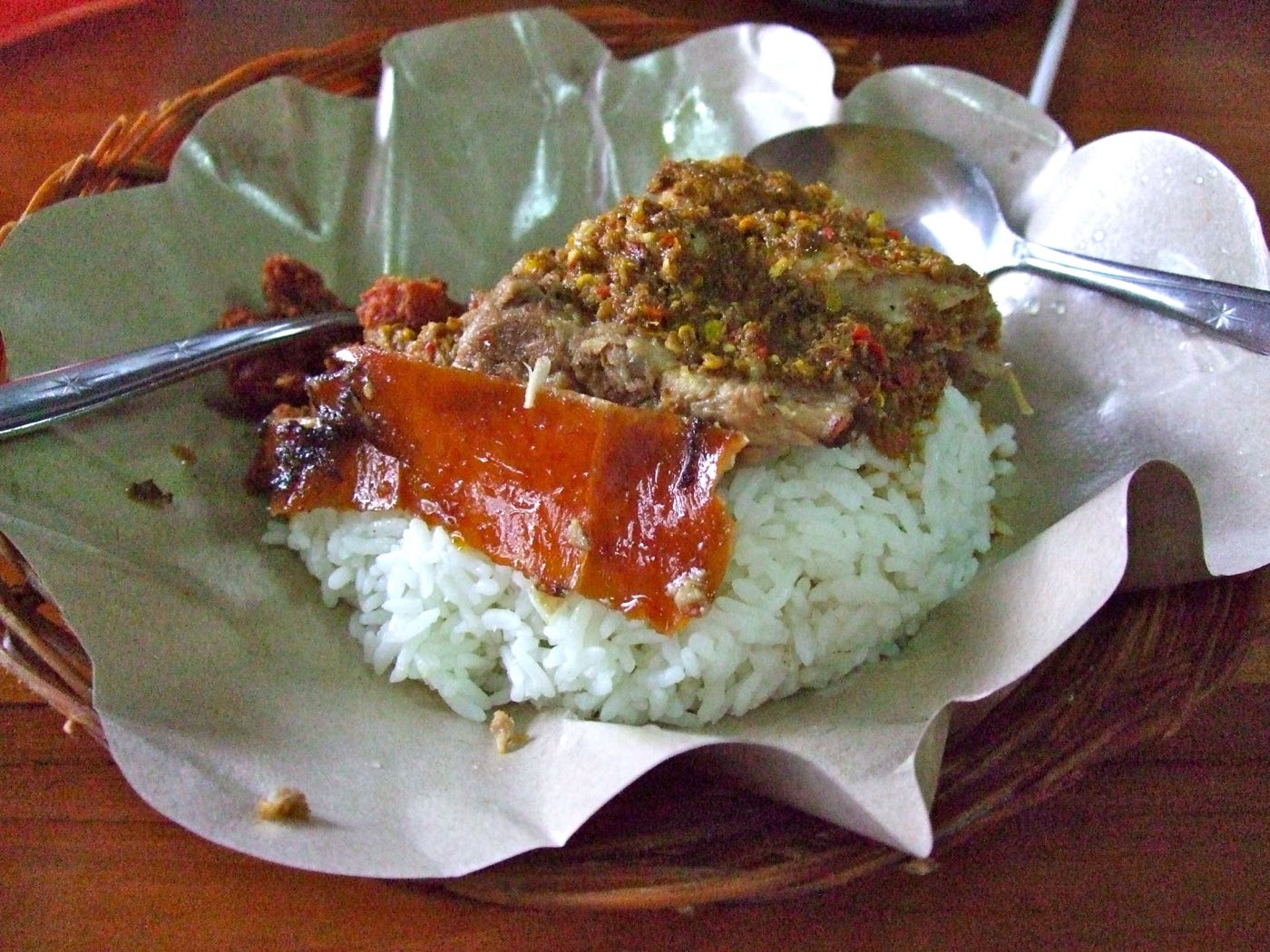 Nasi babi guling with crackling. Photo: Wei-chieh Chiu / Wikimedia Commons (CC BY-SA 2.0)

The north has its own drinks. Palm Living's list of north Bali's local drinks includes rujak yeh kuwud from Suwug, made from coconut water, which can use what is left over from making lawar. The drinks of north Bali covers arak, tuak and more, and jamu the herbal tradition and its Balinese name, loloh.
Language and Script
Balinese is an Austronesian language, and its higher registers borrow heavily from Javanese. Kawi, an old form of classical Javanese, is still used in Bali as a religious and ceremonial language, while most people speak the low register day to day, and most also speak Indonesian. Which words you use depends on who you are talking to, which is why a few phrases go a long way; Balinese words and phrases gives the useful ones.
The old texts were written on palm leaf, the lontar. Singaraja keeps a library of them, Gedong Kirtya.
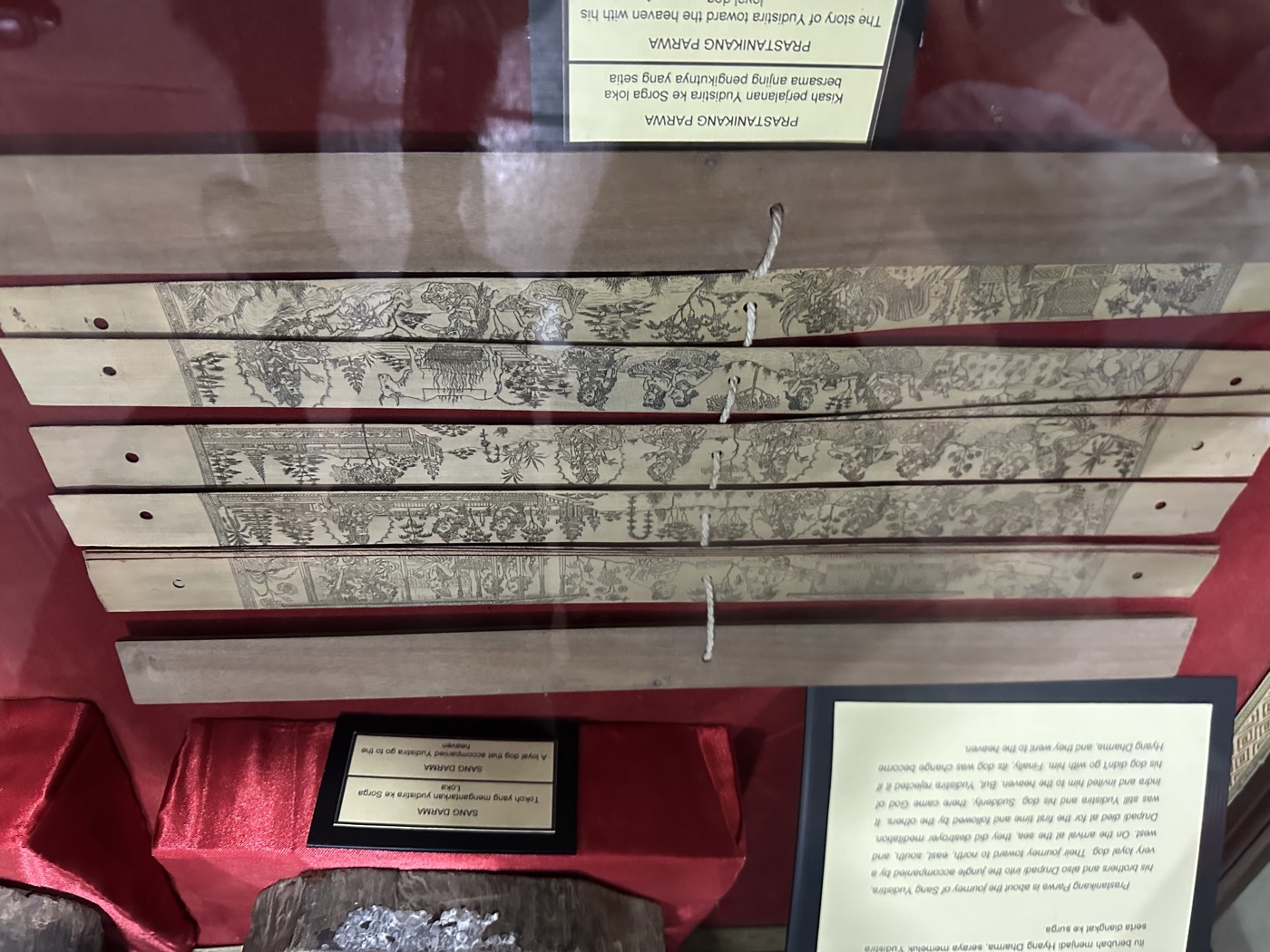 Illustrated lontar strips of the Prastanikang Parwa on display at Gedong Kirtya. Photo: Hanno Lans / Wikimedia Commons (CC BY 4.0)

Arts and Crafts
Wikipedia's account of Balinese art traces it to the artisans of the Majapahit kingdom, who came to Bali from the late fourteenth century, with the village of Kamasan in Klungkung the centre of classical Balinese art from the sixteenth century to the twentieth. The craft villages around Ubud each have their speciality: painting in Ubud and Batuan, woodcarving in Mas, gold and silver in Celuk, stone carving in Batubulan.
The north has its own line. I Ketut Gedé, a painter from Singaraja, drew many scenes of Balinese life, myth and ritual for the Dutch scholar H.N. van der Tuuk in the 1880s and 1890s; the barong above is one of them. Traditional crafts of north Bali covers the weaving, carving and metalwork made here today, and where to shop in north Bali where to buy them.
Etiquette: How to Be a Good Guest
Bali's government has written the rules down. The Governor's Circular No. 4 of 2023 for foreign visitors, as detikBali set out, asks you to:
- Honour temples and sacred symbols, and respect ceremonies and processions in progress
- Dress modestly at temples, attractions and in public
- Stay out of a temple's inner and middle courtyards unless you are there to pray, in Balinese dress, and not menstruating
- Never climb sacred trees or temple structures, or pose for photos in improper dress at holy sites
- Leave no litter and avoid single-use plastic
- Visit attractions with a licensed guide who knows the local customs
Temple etiquette goes through a visit step by step. The rest is simple: step around offerings, and if a ceremony blocks the road, wait. In the north, Palm Living's tours cover the main sights, from Lovina to the Munduk hills.
North Bali's Own Culture
Buleleng has a history of its own, told in north Bali history and the Jagaraga war; its great love story in Jayaprana and Layonsari; its bull races in Sapi Gerumbungan; and the reasons it feels different in why north Bali is different. Beyond Buleleng, Bali's own dog breed comes from the Kintamani highlands; see the Kintamani dog.
To spend time among it, stay in the villages rather than pass through. Palm Living's villas are mostly around Lovina, a short drive from Singaraja and the Bali Aga villages in the hills of Banjar district.
FAQ
What is Balinese culture known for? For a living Hindu religion practised in public: daily offerings, temple festivals and life-cycle ceremonies, run by the customary village and its banjar. It is also known for dance and gamelan music, which UNESCO inscribed as intangible heritage in 2015, and for the subak rice terraces, a World Heritage landscape.
What religion do Balinese people follow? Most follow Balinese Hinduism, which puts ritual practice, community duty and the honouring of ancestors at its centre, and aims at balance between the seen world, sekala, and the unseen, niskala. North Bali also has its churches and a Buddhist monastery.
What is a banjar in Bali? A banjar is the neighbourhood unit of a Balinese customary village. Bali's provincial law calls it the banjar adat or banjar suka duka, the banjar of joy and sorrow, and it organises the ceremonies, weddings and cremations of its members under its own written rules, the awig-awig.
What are the most important Balinese ceremonies? Galungan and Kuningan, when the ancestors are believed to return, and Nyepi, the Day of Silence, are the biggest island-wide holy days. For families, the key rites are the otonan birthday, metatah tooth filing, weddings and the ngaben cremation.
What should tourists know about Balinese culture? Dress modestly, especially at temples, and wear a sarong and sash to enter one. Do not go into a temple's inner courtyards unless you are there to pray, never climb shrines or sacred trees, never step on offerings, and give way to processions. Bali's Governor set these out in a 2023 circular for foreign visitors.
What language do Balinese people speak? Balinese, an Austronesian language with registers that change with the status of the person you are speaking to, and Indonesian, the national language. Kawi, an old form of Javanese, is still used in ritual.
Is north Bali culture different from the south? In places. Buleleng has more Bali Aga villages than any other regency, with their own burial customs and offerings, keeps Pagerwesi on the scale of Galungan, and has its own festivals, bull races and painting tradition.
Sources
- Wikipedia, Balinese Hinduism (orthopraxy, community duty, ancestors, sekala and niskala, kaja and kelod), read September 2026 (in English)
- Province of Bali, Regional Regulation No. 4 of 2019 on Customary Villages (desa adat, banjar adat or banjar suka duka, awig-awig), read September 2026 (in Indonesian)
- Buleleng Regency, Bali Aga, rich in tradition (the seven Bali Aga villages, burial, the village balian, Julah's offerings), read September 2026 (in Indonesian)
- Wikipedia, Pawukon calendar and Balinese saka calendar, read September 2026 (in English)
- UNESCO Intangible Cultural Heritage, Three genres of traditional dance in Bali (inscribed 2015; the related World Heritage listing of the subak cultural landscape), read September 2026 (in English)
- Wikipedia, Balinese language, Balinese art and I Ketut Gedé, read September 2026 (in English)
- Governor of Bali, Circular No. 4 of 2023 on foreign tourists in Bali, as published by Kecamatan Buleleng, and detikBali, 12 obligations and 8 prohibitions for foreign tourists, 31 May 2023, read September 2026 (in Indonesian)
- ANTARA, Governor of Bali issues new circular for foreign tourists, 31 May 2023, read September 2026 (in Indonesian)
- Palm Living, 6 local beverages in north Bali, read September 2026 (in English)
Start with Balinese Hinduism explained, the Balinese calendar and Balinese offerings explained.