
On this page
In Brief
The otonan ceremony is Bali's own birthday, held every 210 days. It falls when a person's birth-day combination returns in the pawukon calendar, so it can come twice in one calendar year.
It is a small religious rite of gratitude and purification. Offerings are made, prayers are said at the family shrine, and the person is blessed for the cycle ahead.
A baby's first otonan comes at 210 days old. Before it, at 105 days, comes the once-in-a-life three-month ceremony, when the baby's feet are set on the earth for the first time.
Otonan at a Glance
- What it is: The Balinese birthday, a rite of thanks and spiritual cleansing
- How often: Every 210 days, one full cycle of the pawukon calendar
- Before the first one: The three-month ceremony at 105 days, when a baby first touches the earth
- Where: At the family compound's shrine, led by the family or a priest
- The feel: Quiet, domestic, and devotional, not a party
- Part of: the Manusa Yadnya life-cycle rites within the Panca Yadnya
The Otonan Follows Bali's 210-Day Pawukon Calendar
Bali runs on more than one calendar at once.
Alongside the Gregorian year, daily religious life follows the pawukon, a 210-day cycle of interlocking weeks. It determines temple festivals, auspicious days and personal rites.
Your otonan is the day your particular combination of weeks returns. That happens every 210 days, which lands roughly every seven months.
This is the same clock that sets Galungan and the island's whole ceremonial rhythm. It is set out in the Balinese calendar explained.
An Otonan Gives Thanks and Cleanses for the Cycle Ahead
The point of the day is different too. A Western birthday celebrates getting older. An otonan cleanses and restarts.
Each part of the rite has its purpose:
- Offerings thank the ancestors and the divine for protection through the cycle just finished.
- Prayers ask that the person's character strengthens in the cycle ahead.
- Small purifications clear away whatever accumulated.
In the otonan a life is something to be kept in balance, cycle by cycle. The philosophy underneath is Tri Hita Karana.
Before the First Otonan, a Baby Touches the Earth at 105 Days
The first otonan comes when a baby is 210 days old, about seven months. The rite that comes before it carries even more weight.
At 105 days, three Balinese months of 35 days each, the family holds the three-month ceremony. It is called nyambutin or tigang sasih.
A study of the rite by I Nyoman Kartika Yasa describes a priest leading it at the family shrine. It begins with turun tanah, the baby's feet set on the earth for the first time, and continues with an otonan.
It is the one ceremony of childhood held only once in a life. The otonan will come round again every 210 days.
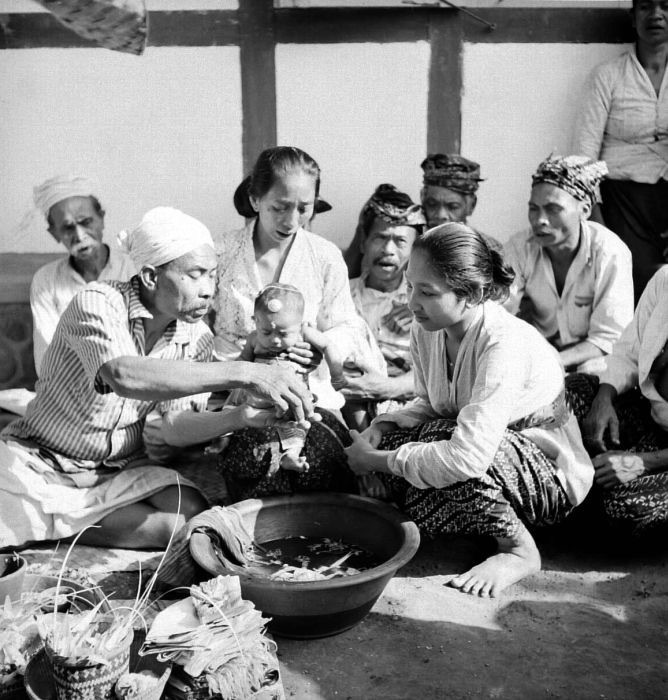 A priest bathing a baby at its three-month ceremony, photographed in 1949. Photo: Unknown author, Tropenmuseum / Wikimedia Commons (CC BY-SA 3.0)

It is one of the most beautiful ideas in Balinese life, and easy for a visitor to miss unless someone explains it.
An Adult's Otonan Is Modest and Fits Around a Working Day
For adults, the otonan is modest and often fitted around a working day. It has four parts:
- Offerings are prepared. These are the woven trays and banten of everyday devotion, with specific forms for the rite. The exact set varies from household to household and from village to village.
- Prayers are said at the family shrine. An elder leads them or, for bigger cycles, a pemangku (village priest).
- A blessing follows, with holy water and rice pressed to the forehead and temples.
- A shared meal closes the day if the family marks it fully. Otherwise life carries on, quietly renewed.
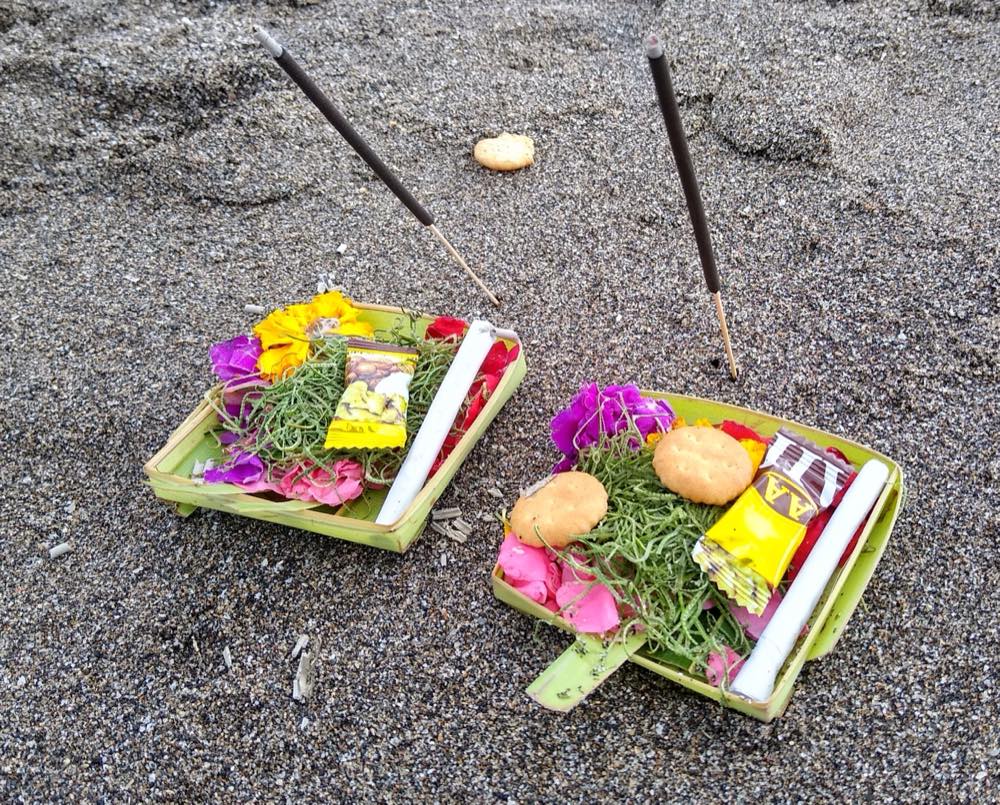 Canang sari, the woven offering trays of everyday devotion. Photo: Mx. Granger / Wikimedia Commons (CC0)

Many Balinese keep both birthdays
Many Balinese also celebrate the Gregorian birthday nowadays, especially younger people, so a person can honestly claim both. The otonan remains the one with spiritual weight.
Where a Visitor Notices an Otonan
The otonan explains two small things you may notice across the north:
- family gatherings on apparently random weekday mornings
- fresh towers of offerings outside a home when no island-wide festival is on
It is the island's rhythm working at the scale of a single life.
On a long stay around Lovina or the villages, you live alongside this cycle without seeing it advertised.
FAQ
What is an otonan in Bali?
The otonan is the Balinese birthday, held every 210 days when a person's birth-day returns in the pawukon calendar. It is a religious rite of gratitude and purification with offerings and prayers at the family shrine, rather than a party.
How often is a Balinese birthday celebrated?
Every 210 days, the length of one full pawukon cycle, which is roughly every seven months. This means an otonan usually falls twice, and occasionally only once, in a Gregorian year.
When does a Balinese baby first touch the ground?
At the three-month ceremony, held when the baby is 105 days old, three Balinese months of 35 days. A priest leads it at the family shrine, and it begins with turun tanah, the baby's feet set on the earth for the first time. The first otonan follows at 210 days.
Do Balinese also celebrate normal birthdays?
Many do, especially younger generations, with cake and well-wishes on the Gregorian date. The otonan remains the spiritually significant birthday, and the two coexist comfortably.
What is the pawukon calendar?
Bali's 210-day ceremonial calendar, made of interlocking weeks that determine temple anniversaries, auspicious days, festivals like Galungan, and personal rites like the otonan. It runs alongside the ordinary calendar and the lunar Saka calendar.
Sources
- I Nyoman Kartika Yasa, Tradisi upacara tiga bulan menurut agama Hindu di Bali, Jurnal Nirwasita 5(1), read September 2026 (in Indonesian)
- Wikipedia, Pawukon calendar, read September 2026
- Etnis.id, Otonan: the birthday ceremony in Balinese Hindu belief, read September 2026 (in Indonesian)
The full rhythm of the island's ceremonial year is in our north Bali events calendar, the deeper background in the Balinese calendar explained, and the wider shape of Balinese rites in the panca yadnya and Balinese ceremonies.