On this page
- In Brief
- Tirta Gangga and Taman Ujung at a Glance
- The Last Raja of Karangasem Built Both Gardens
- Tirta Gangga Is a Royal Garden Built Around a Holy Spring
- Taman Ujung Is a Palace of Pools Between Mountain and Sea
- Mount Agung's 1963 Eruption Ruined Both Gardens
- Tirta Gangga or Taman Ujung: How the Two Differ
- How to Fit Them In from Amed
- Practical Notes
- FAQ
- Sources
In Brief
Tirta Gangga and Taman Ujung are the two royal water gardens of Karangasem regency in east Bali. Both were built by Anak Agung Anglurah Ketut Karangasem, the last Raja of Karangasem, who lived from 1887 to 1966.
Tirta Gangga surrounds a holy spring among the rice fields of Ababi village and dates from the 1940s. Taman Ujung grew from a pool built in 1901 into a palace of great pools near the coast, finished in 1921.
Both were badly damaged when Mount Agung erupted in 1963, and both have been restored. The king's own palace in Amlapura sits between the two gardens, so all three fit into one outing.
Tirta Gangga and Taman Ujung at a Glance
- What they are: the royal water gardens of the former Kingdom of Karangasem
- Built by: I Gusti Bagus Jelantik, whose royal title was Anak Agung Anglurah Ketut Karangasem
- Tirta Gangga: Ababi village, Abang district, north of Amlapura, 1.2 hectares, built in 1948 (some sources say 1946)
- Taman Ujung: near the coast 5 kilometres south-east of Amlapura, 9.5 hectares by a 2023 survey, built from 1909 to 1921
- The disaster: Mount Agung's eruption of 1963 damaged both, and an earthquake later hit Taman Ujung
- Who runs them: Tirta Gangga belongs to the royal family and has its own management board, and Taman Ujung is run by a board of the regency and the palace
- Protected: Taman Ujung is a regency-level cultural heritage site
- Swimming: Tirta Gangga has visitor pools, with a ticket of their own
The Last Raja of Karangasem Built Both Gardens
Both gardens are the work of one man.
His name was I Gusti Bagus Jelantik, and Anak Agung Anglurah Ketut Karangasem was his royal title, as Karangasem's tourism office records. He succeeded his uncle in 1908 and ruled as stedehouder, a local ruler under the Dutch.
His grandson, the architect Widoere Djelantik, describes him on the family's Tirtagangga site as a born architect. He also wrote philosophy, hymns and poems in Balinese and Indonesian.
He designed his gardens himself. At Tirta Gangga, the family's history says, he dug beside his labourers, knee-deep in water and mud. Visitors were often surprised to spot the small figure of the Raja among the workers.
His palace in Amlapura, Puri Agung Karangasem, mixes Balinese, Chinese and European building. Its main hall is called Maskerdam, after Amsterdam, from the years the kingdom kept close ties with the Dutch, according to the regency's page on the palace.
Tirta Gangga Is a Royal Garden Built Around a Holy Spring
Tirta Gangga began with its spring.
Before the garden existed, a large spring rose here, and it gave the king the idea for a garden, Antara reported in 2018, quoting the regency. The family names it the springs of Rejasa, among the rice fields of Ababi.
The name joins tirta, holy water, with Gangga, the sacred river Ganges of India. The regency's Tirta Gangga page adds that the garden sits at the foot of Mount Agung, which keeps it cool.
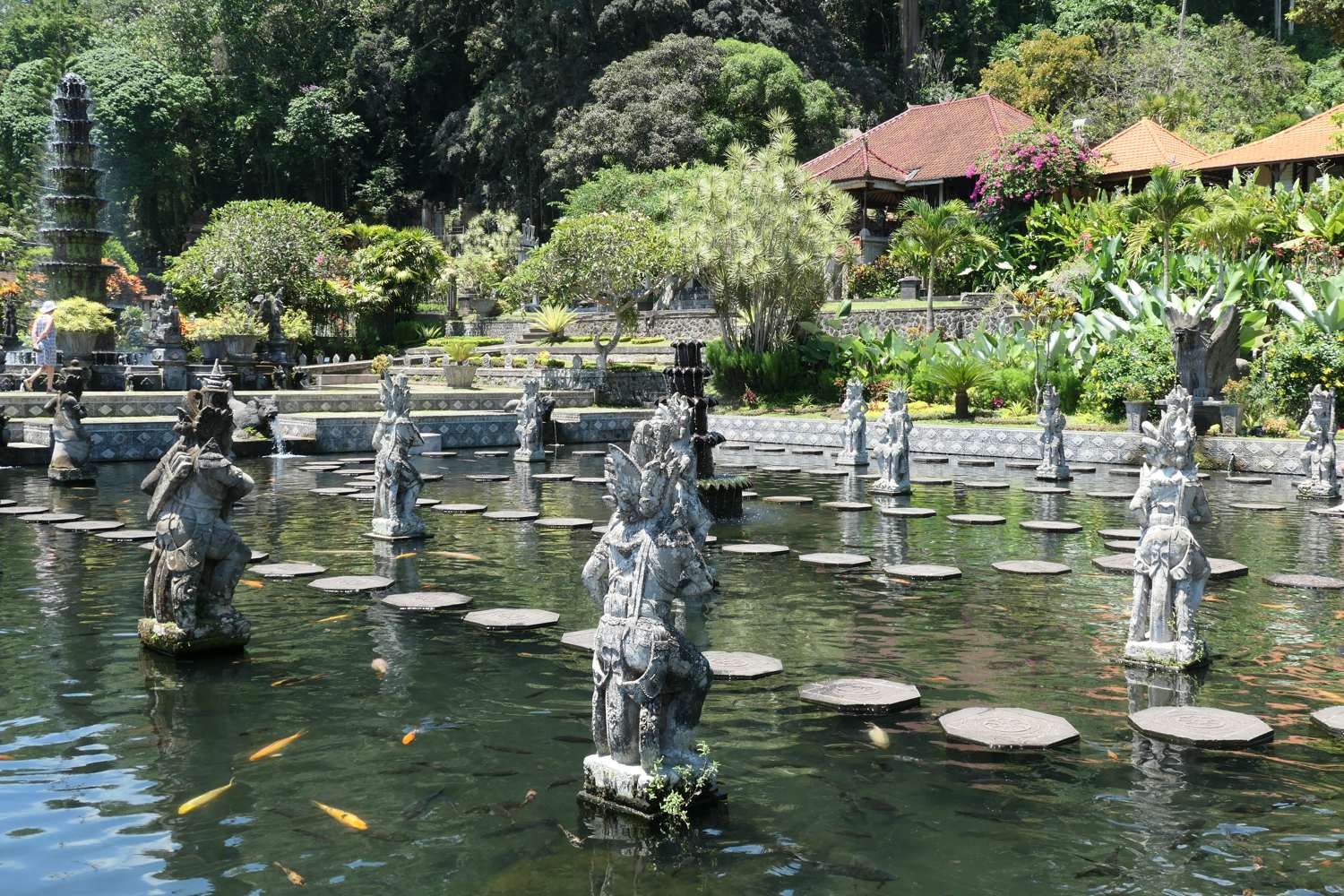 Stepping stones and statues in a pool at Tirta Gangga, with the tiered fountain behind. Photo: Anandajoti / Wikimedia Commons (CC BY-SA 4.0)
The Goddess Gangga Gave the Garden Its Name
The garden was first called Taman Rijasa. Anak Agung Made Kosalya, who chairs the garden's management board, told detikTravel how the name changed.
The king was meditating under a lychee tree when Dewi Gangga came to him. She asked him to rename the garden Tirta Gangga. In the board's understanding, the water rising from the spring here is a flow of the Ganges itself.
By the board's account, building ran from 2 January to 16 September 1948. Villagers from Ababi, Peladung and Temega helped. The family's history also gives 1948, while Wikipedia and one of the regency's pages give 1946.
Three Levels, an Eleven-Tiered Fountain and Stepping Stones
The garden covers 1.2 hectares on three levels, stretching from east to west. The family's description names the levels, from the top, Swah, Bwah and Bhur:
- Swah, the highest level: the spring under a banyan tree, the upper swimming pool and two ornamental ponds, one with four fountains the family likens to Versailles, the other with Victoria lotuses
- Bwah, the middle level: the eleven-tiered Nawa Sanga fountain, the first thing you see from the entrance
- Bhur, the lowest and largest level: the big south pond, with a long Demon island in the middle
At the first gate, statues stand in rows like soldiers, and a path of stepping stones crosses the pool among them. The regency describes the fountain tower as 10 metres high, in tiers like a temple roof.
For the board's chairman, the eleven tiers stand for the highest purity, toward which the king turned his mind, he told NusaBali.
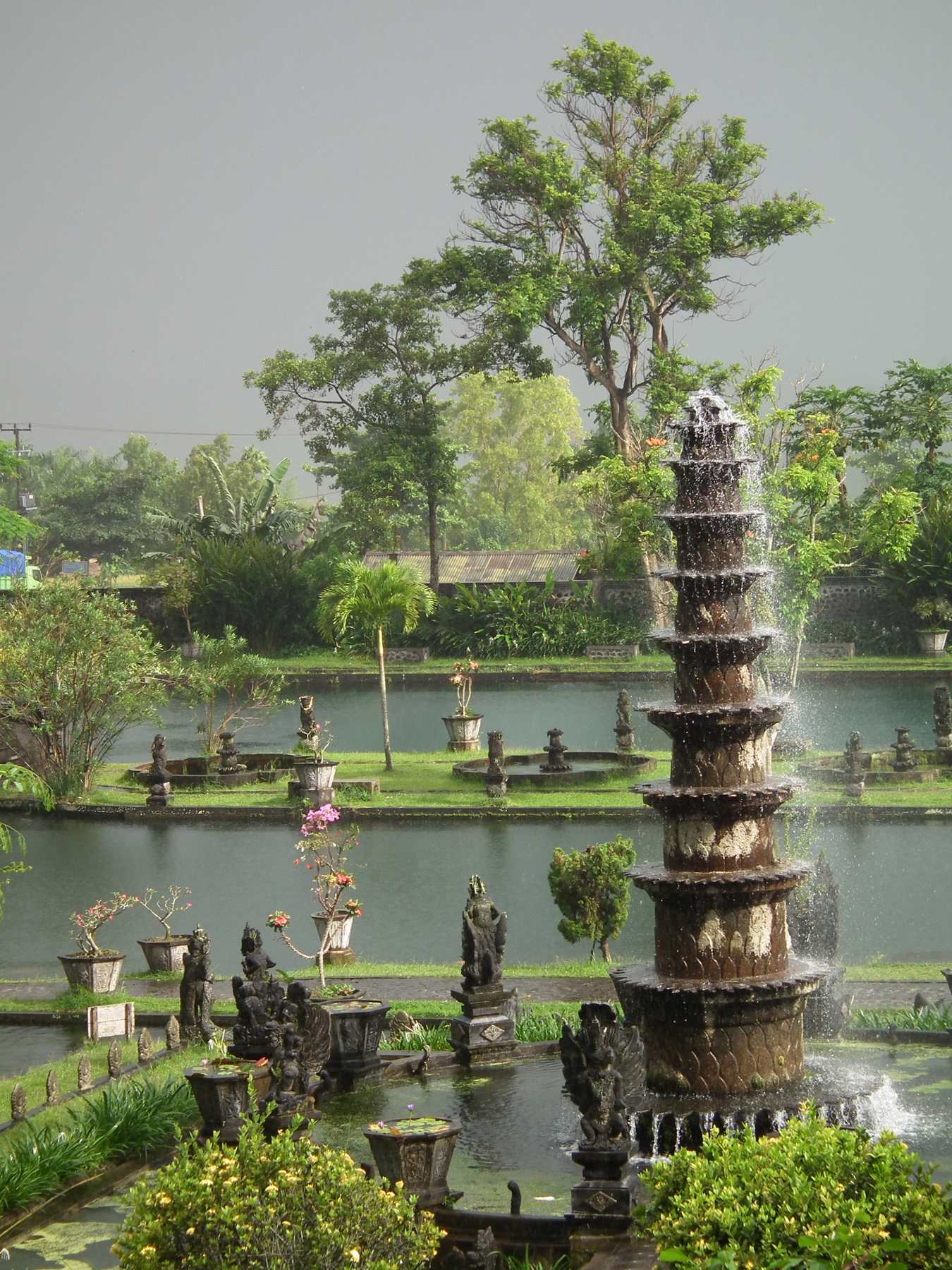 A tiered fountain among the pools at Tirta Gangga. Photo: Bair175 / Wikimedia Commons (CC BY-SA 3.0)
The Spring Serves Ceremony, a Town and Swimmers
Water from one of the springs is holy water, used in ceremonies at the temples around it. On certain feast days, the family writes, villages walk here in processions with offerings, umbrellas and flags. Their priests lead the ceremony at the spring to the music of the beleganjur.
The springs give a great deal of water. A third goes to Amlapura as drinking water. The rest runs through the swimming pools and the ponds, then out to the rice fields.
The swimming pools are for visitors, with separate pools for children and adults and a ticket of their own. The regency suggests bringing a towel and a change of clothes. For the Balinese rite of standing beneath holy spring water, see melukat, the Balinese water purification.
A Museum to the King Opened in December 2024
On 15 December 2024, Puri Agung Karangasem and the management board inaugurated the Museum Asta Gangga, NusaBali reported. A pavilion and a statue of the king were consecrated with it.
The museum is octagonal, and asta means eight. Its design follows the Bale Lunjuk at Taman Ujung, a link between the two gardens.
The statue faces north-east, toward Pura Bukit and Pura Lempuyang. In the board's account, that direction is the spiritual centre of the king's ancestors.
Taman Ujung Is a Palace of Pools Between Mountain and Sea
Taman Ujung is the older and larger of the two gardens.
It lies near the coast at Ujung, 5 kilometres south-east of Amlapura. Its full name is Taman Soekasada Ujung, and in the Dutch colonial years it was known as the Waterpaleis, the water palace, as Wikipedia records.
The garden spreads over 9.5 hectares by a 2023 survey, and The Jakarta Post gave 12 in 2009. Before land reform divided it, the garden's land ran to some 400 hectares.
It Began in 1901 as the Dirah Pool
The garden began in 1901 as a single pool, the Dirah. The regency's tourism office records its first use as a place of banishment for people who practised black magic.
In 1909 the king had the pool developed into a royal retreat. He commissioned a Dutch architect, van Den Hentz, and a Chinese architect, Loto Ang. They worked with the kingdom's own undagi, the Balinese master builders.
The work was finished in 1921, by Wikipedia's account. A 2023 study at Universitas Tarumanagara agrees, counting twenty years of building from 1901. The Jakarta Post dated the construction to 1926.
Balinese, Dutch and Chinese Builders Left Their Mark
The Tarumanagara architects read three building traditions here, with a Middle Eastern touch. The Balinese carving tells wayang stories. The pavilions follow the Dutch colonial Indies style, and the octagonal pool gate and the round Bale Bundar show Chinese influence.
The reliefs were cast in moulds instead of carved, a new technique at the time, the study notes. Pools cover almost 60 percent of the garden.
The Pavilions to Look For
Kompas and the Tarumanagara study name six pavilions:
- Bale Gili: the white pavilion in the middle of the main pool, reached by bridges, where the royal family rested
- Bale Kambang: the pavilion in the second pool, where the kingdom's guests were given banquets
- Bale Kapal: the ship pavilion, built to watch ships in the Lombok Strait, now a ruin with views of sea and mountains
- Bale Bundar: a round pavilion in mixed Balinese and European style, where the king meditated
- Bale Lunjuk: the pavilion whose shape the new museum at Tirta Gangga follows
- Bale Warak: on the hill 300 metres north of the Bale Lunjuk, with statues of a rhinoceros, a winged lion and a cow, where the royal family held the Nyegara Gunung ceremony
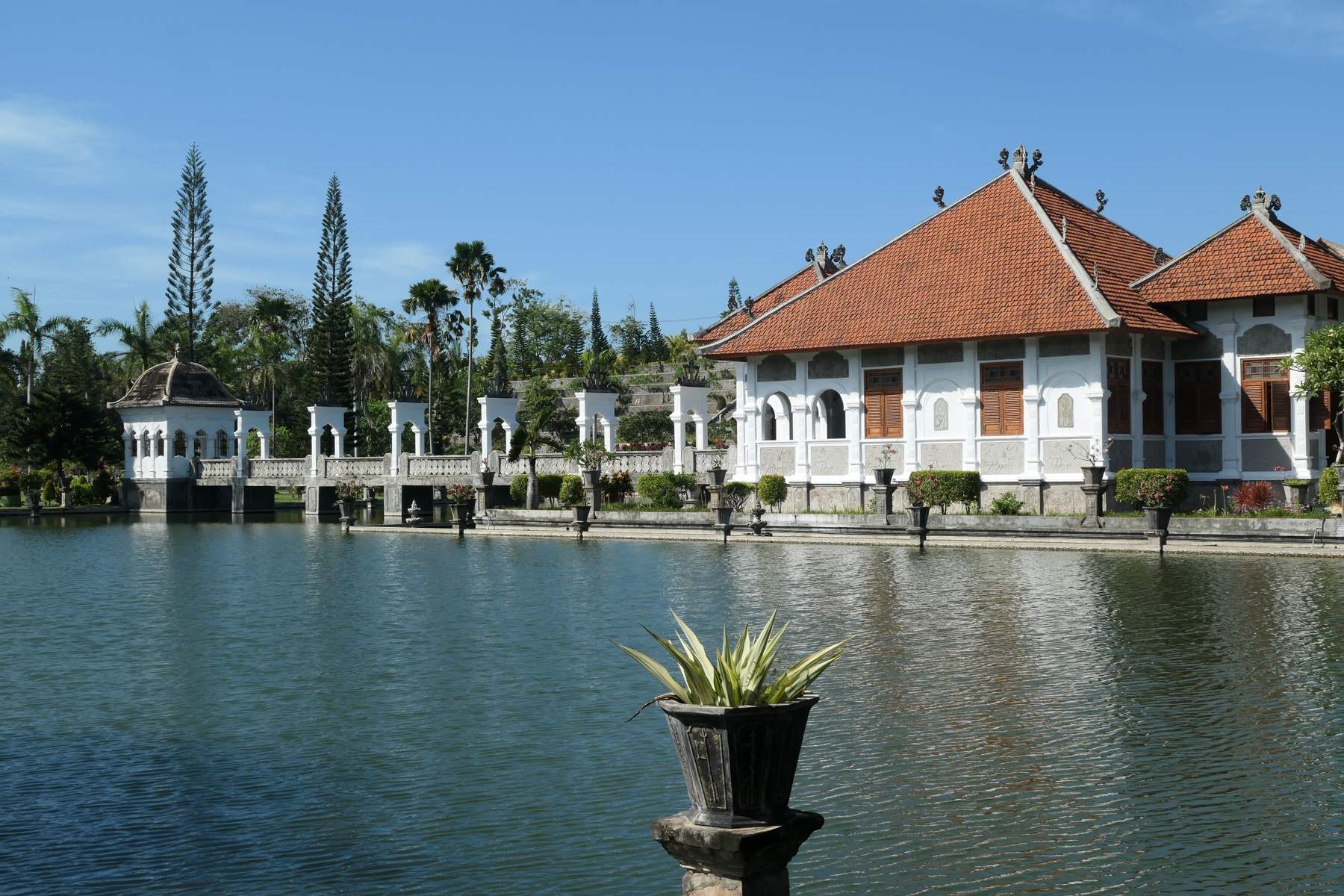 The Bale Gili in the main pool at Taman Ujung, with the bridge that leads to it. Photo: Anandajoti / Wikimedia Commons (CC BY-SA 4.0)
In the study's reading, the garden stands where mountain meets sea. Mount Lempuyang rises to the north-east, Agung to the west, and the Lombok Strait opens to the east. Its four pools stand for the churning of the ocean by Mount Mandaragiri, a story from Hindu scripture.
From the high ground, the regency's page points to the sea off Ujung beach in the south-east and the green hill of Bukit Bisbis.
The Royal House Still Looks After It
The garden belongs to the heirs of Puri Agung Karangasem and stays open to the public, the Tarumanagara study notes. A 2022 regent's regulation lists it as a regency-level cultural heritage site.
The same regulation sets up its management board. The board's supervisory council has three members from the regency government and two from the palace.
Couples come to the garden for pre-wedding photographs, Kompas notes.
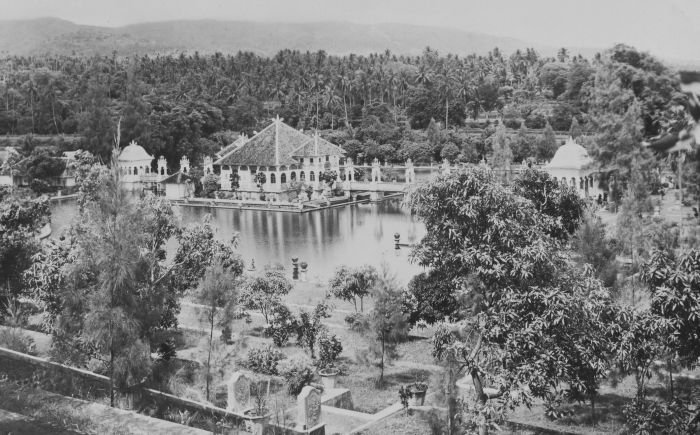 Taman Ujung around 1935, from the Tropenmuseum collection. Photo: Foto Studio Sagami / Wikimedia Commons (CC BY-SA 3.0)
Mount Agung's 1963 Eruption Ruined Both Gardens
The eruption of Mount Agung in 1963 wrecked both gardens, and each took decades to recover.
Tirta Gangga: Earthquakes, Looting and a Long Rebuild
At Tirta Gangga the lava flowed down the valleys to the east and west and spared the grounds. Earthquakes during the eruption destroyed most of what had been built, the family's history records.
The royal family took refuge elsewhere, and the empty garden was looted. Furniture, pipes, Chinese porcelain and statues disappeared.
Land reform had taken away the Raja's means for large works, so repair came slowly. His son, the physician Anak Agung Made Djelantik, supervised the work from 1979. In 1999 his grandson resolved to restore it. His foundation and masterplan brought the garden to its present form.
The garden was hit again in 2021. Heavy rain and a buried pipe that had leaked for years brought down a wall, the board's chairman told detikTravel. Much of the water and many of the large fish washed away, and the board rebuilt the wall within three months.
Taman Ujung: An Earthquake and a Restoration in the 2000s
Taman Ujung was destroyed by the eruption and lay neglected for years, the regency writes. An earthquake did more damage, in 1975 by The Jakarta Post's account and in 1979 by the Tarumanagara study's.
Restoration came around 2000, and sources credit different hands. The study names the regency government, working from 2001 to 2003 with a World Bank loan. The Jakarta Post credited members of the Karangasem court, from 2000 to 2004.
Visitors could enjoy the garden again from 2003, according to the regency and Kompas.
Tirta Gangga or Taman Ujung: How the Two Differ
The two gardens share a builder and the damage of 1963, but they differ in setting, size and age.
| Tirta Gangga | Taman Ujung | |
|---|---|---|
| Setting | Rice fields around a spring, north of Amlapura | Near the coast, south-east of Amlapura |
| Built | 1948 (or 1946) | 1909 to 1921, from a pool of 1901 |
| Size | 1.2 hectares | 9.5 hectares by the 2023 survey |
| Known for | The holy spring, statues, stepping stones and the tiered fountain | White pavilions on wide pools, and sea views from the high ground |
The visitor figures come from Karangasem's culture and tourism office, as detikBali reported in January 2026. Choose Tirta Gangga for the spring, the fountains and a swim. Choose Taman Ujung for space, pavilions and the sea.
How to Fit Them In from Amed
Both gardens are in Karangasem, the same regency as Amed's seven fishing villages.
Tirta Gangga is in Abang district, which also takes in Bunutan, one of Amed's villages, by Wikipedia's district list. Puri Agung Karangasem, the royal palace in Amlapura, is 6 kilometres from Tirta Gangga and 5 from Taman Ujung, by the regency's figures.
That puts all three royal sites into one outing, in this order:
-
Tirta Gangga, for the spring, the fountains and a swim.
-
Puri Agung Karangasem in Amlapura, the king's own palace.
-
Taman Ujung, near the sea, for the pavilions and the view from the high ground.
For a base on the coast, see where to stay in Amed. For the day itself, the options are in hiring a private driver.
Practical Notes
- Tickets: each garden sells its own entry at the gate, and Tirta Gangga's swimming pools charge separately. Prices and hours change, so confirm them on the day.
- Swimming: bring a towel and dry clothes for the pools at Tirta Gangga.
- The spring is holy: its water serves temple ceremonies. Near the spring and shrines, follow the customs in Bali temple etiquette.
- Feast days: processions may come to the spring for ceremonies, so give way and watch quietly.
- Maps: Tirta Gangga, Puri Agung Karangasem and Taman Ujung
FAQ
What is Tirta Gangga? Tirta Gangga is a royal water garden in Ababi village, Karangasem, in east Bali. The last Raja of Karangasem built it around a holy spring, and its name means holy water of the Ganges. It has pools, statues, stepping stones, an eleven-tiered fountain and swimming pools for visitors.
What is the history of Tirta Gangga? The king built it in 1948 on the springs of Rejasa, by his family's account, though some sources say 1946. The eruption of Mount Agung in 1963, and the looting that followed, left it in ruins. His son began rebuilding in 1979, and his grandson restored it to its present form from 1999.
Is Tirta Gangga a temple? It is a royal garden with a holy spring. Water from the spring is used in ceremonies at the temples around it, and villagers come in procession on feast days. Wikipedia notes a patirthan, a holy-water temple, in the complex.
What is Taman Soekasada Ujung? It is the full name of Taman Ujung, the water palace near the coast 5 kilometres south-east of Amlapura. The same king began it in 1909 from a pool built in 1901, and it was finished in 1921. Its white Bale Gili pavilion stands in the middle of the main pool.
Can you swim at Tirta Gangga? Yes, in the visitor swimming pools, which charge their own ticket. There are separate pools for children and for adults.
What are Tirta Gangga's opening hours? Hours and prices change, so Northbound does not list them. Confirm them on the day, at the gate or through your accommodation.
How far are Tirta Gangga and Taman Ujung from Amed? Both are in Karangasem regency with Amed, and Tirta Gangga shares Abang district with Amed's village of Bunutan. Use the map links above for a live route from where you stay.
Sources
- Karangasem Regency tourism office, Visiting the lovely Taman Ujung, for the king's name and title, the Dirah pool of 1901, the architects of 1909, the 1963 destruction, the reopening in 2003 and the view from the high ground, read October 2026 (in Indonesian)
- Karangasem Regency tourism office, Tirtagangga water garden and Tirta Gangga, for the name, the 1.2 hectares, the statues and stepping stones, the 10-metre fountain tower, the holy water and the visitor pools, read October 2026 (in Indonesian)
- Karangasem Regency tourism office, Puri Agung Karangasem, for the palace, Maskerdam and the distances to both gardens, read October 2026 (in Indonesian)
- Tirtagangga, the royal family's archive site, frozen in 2018: The garden, History and Who is who, for the king's life, the levels and fountains, the holy water and its uses, the 1963 damage and the rebuilding, read October 2026 (in English)
- detikTravel, The story of Tirta Gangga, October 2023, and Tirta Gangga was once torn by earthquake and subsidence, October 2023, for the board chairman's account of the name, the 1948 dates, the villages that helped and the 2021 collapse, read October 2026 (in Indonesian)
- NusaBali, Museum Asta Gangga inaugurated, December 2024, for the museum, the statue and the meaning of the eleven tiers, read October 2026 (in Indonesian)
- Antara, Regent opens the Pesona Tirtagangga Festival, August 2018, for the spring that inspired the garden, read October 2026 (in Indonesian)
- Tribun Bali, Tirta Gangga water garden, May 2022, for the separate swimming-pool ticket, read October 2026 (in Indonesian)
- Kompas, Taman Soekasada Ujung, December 2016, for the pavilions, the restoration and pre-wedding photography, read October 2026 (in Indonesian)
- Priyomarsono and Surya, Spatial patterns of Taman Soekasada Ujung, Jurnal Serina Sains, Teknik dan Kedokteran, Universitas Tarumanagara, 2023, for the size, the pools and pavilions, the building styles, the cosmology, the 1979 earthquake, the 2001 to 2003 restoration and the ownership, read October 2026 (in Indonesian)
- The Jakarta Post, Romance, serenity at the Water Palace, January 2009, for the 1926 date, the 12 hectares, the 1975 earthquake and the court's restoration, read October 2026 (in English)
- Karangasem Regency, Regent's Regulation No. 1 of 2022 on managing Taman Soekasada Ujung, for the heritage status and the management board, read October 2026 (in Indonesian)
- detikBali, 1.2 million tourists visit Karangasem, January 2026, for the 2025 visitor figures, read October 2026 (in Indonesian)
- Wikipedia, Tirta Gangga, Ujung Water Palace and Abang, Karangasem, for the 1946 date, the patirthan, the 1921 completion, the Waterpaleis name and the villages of Abang district, read October 2026 (in English and Indonesian)
Read next: Amed, Bali for the coast nearby, the best temples in Bali for Lempuyang and Besakih, and Bali temple etiquette before you visit the spring.