
On this page
- In Brief
- Temple Etiquette at a Glance
- A Temple Is a Working House of Worship, and the Rules Follow From That
- Wear a Sarong, a Sash and Covered Shoulders
- Menstruating Women Are Asked Not to Enter, for Ritual Purity
- Inside, Four Behaviours Matter Most
- Step Around the Offerings on the Ground
- Shoes Come Off at Certain Thresholds
- At a Ceremony, Be a Quiet Guest at the Back
- Bring Small Cash for the Fee or the Donation Box
- The Province Has Written Some of These Rules Down
- FAQ
- Sources
In Brief
Bali temple etiquette starts with what you wear. Cover your legs and shoulders, wrap a sarong around your waist and tie a sash (selendang) over it before you enter. Most temples loan both at the entrance, often for a small donation.
Inside, stay lower than anyone who is praying and keep your feet from pointing at shrines. Step around the small offerings on the ground, never over them, and ask before photographing people in prayer.
Menstruating women are asked not to enter. The rule is about ritual purity and carries no judgment.
Temple Etiquette at a Glance
- Sarong: Required for everyone, men and women, covering the legs past the knee
- Sash (selendang): Tied around the waist over the sarong, the marker that you have entered respectfully
- Shoulders: Covered. Tank tops, singlets and bare backs are not appropriate
- Knees: Covered. Shorts alone are not enough, even on men
- Menstruation: Women who are menstruating are asked not to enter the temple's inner courtyards, a rule the provincial government states in its circular on tourist conduct
- Footwear: Removed before entering certain inner sanctums and some shrines. Follow the signs and the locals
- Offerings (canang sari): On the ground everywhere. Step around them, never on them
- Photography: Generally allowed in outer areas. Ask before shooting people in prayer, and never use a priest or shrine as a backdrop while a ceremony is underway
- Standing height: Never position yourself higher than a person who is praying or a priest who is officiating
- Feet: Keep the soles from pointing at shrines, offerings or people
- Climbing: Do not climb on shrines, gates or temple structures for photos
- Donation: A small contribution at the entrance or donation box is customary and supports the temple
A Temple Is a Working House of Worship, and the Rules Follow From That
A Balinese temple is a pura, a working house of worship that the surrounding community uses constantly.
Balinese Hinduism rests on a principle called Tri Hita Karana, the three causes of wellbeing. They are harmony between people and God, harmony among people, and harmony with nature. A temple is where the first of those relationships is tended.
Everything inside is oriented toward keeping that harmony intact. This is why visitors are asked to lower their bodies, cover them and move carefully. You are a guest in a space that is doing spiritual work, whether or not a ceremony is visible.
Balinese philosophy also orders space vertically. The mountains, where the gods reside, are high and pure, and the sea is the realm of lower forces. Within a temple the same logic governs how people position themselves, which is the root of the rule about standing above someone in prayer.
Height carries meaning here, and so does cleanliness. With that in mind, the dress code and the behaviour read as basic courtesy in someone else's sacred home. For the religion that shapes all of this, see Balinese Hinduism explained.
Wear a Sarong, a Sash and Covered Shoulders
Temple dress applies to everyone, regardless of gender or how warm the day is.
- Sarong covering legs past the knee, for men and women
- Sash tied around the waist over the sarong
- Shoulders covered, no tank tops or bare backs
- Clothing clean and reasonably tidy
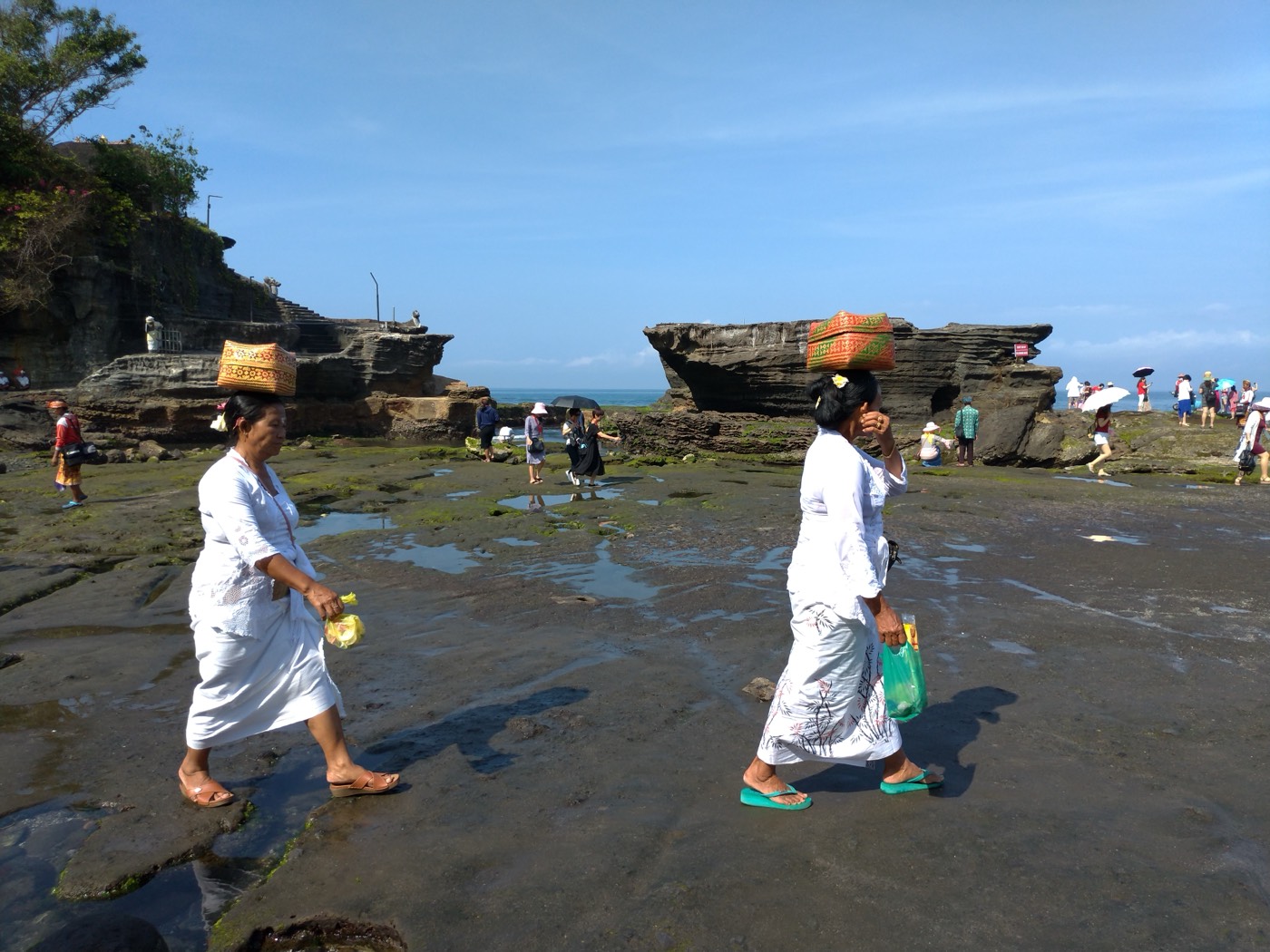
A sarong (kamen) is a length of cloth wrapped around the waist and falling past the knees. Over it goes the sash, a selendang, tied around the waist.
The sash is the part many visitors overlook, and in symbolic terms it matters more than the sarong. It marks the separation between the lower, impure half of the body and the upper. It also signals that you have entered the temple in the right spirit, so a sarong without a sash is incomplete.
Above the waist, shoulders must be covered. A t-shirt is fine, while tank tops, singlets, spaghetti straps and bare backs are not. Men in shorts still need a sarong over them, since uncovered knees do not meet the standard.
The aim is modest, covered and clean. It does not need to be formal.
Most temples that receive visitors keep sarongs and sashes at the entrance, included with the entry donation or loaned for a small fee. Larger sites such as Pura Ulun Danu Beratan have this well organised. Smaller village temples in the north may not, so carry your own sarong if you plan to visit several.
Menstruating Women Are Asked Not to Enter, for Ritual Purity
Women who are menstruating are asked not to enter Balinese temples. Many visitors find this custom surprising, so here is the reason.
The rule comes from the concept of sebel, a state of ritual impurity that temporarily separates a person from sacred space. Blood, including menstrual blood, places someone in this state. So does recent contact with death or childbirth.
Sebel is a temporary ritual condition. It makes no statement that menstruation is shameful or that women are unclean as people. Men fall under similar restrictions after a death in the family.
The temple is kept in a state of purity, and anyone in sebel steps back from it until the condition passes.
The same logic asks a grieving family to stay away for a period. It is applied consistently and singles no one out.
The Province States the Rule in Writing
The governor's circular on the conduct of foreign tourists was announced through the Bali provincial media centre. It prohibits foreign visitors from entering a temple's sacred inner areas, the utamaning mandala and madyaning mandala, except to pray. Those who pray must wear Balinese dress and must not be menstruating.
In Practice It Rests on Trust
No one checks, and the custom relies on personal honesty. Signs at temple entrances often state the rule plainly.
How strictly it applies varies between temples. Some restrict only the innermost courtyard, and others the whole compound. The respectful approach is to observe it and wait outside while your group goes in.
Inside, Four Behaviours Matter Most
Once you are dressed and inside, four behaviours carry the weight. Each traces back to the same teachings on purity and respect.
Never Stand Higher Than Someone Praying
If people are seated in prayer or a priest is officiating, lower yourself. Sit, crouch, or stand to the side and behind.
Towering over a worshipper, or climbing a wall to shoot down at a ceremony, inverts the spatial order the religion is built on. It is among the behaviours most likely to cause real offence.
Keep Your Feet From Pointing at Shrines or People
The feet are the lowest and least pure part of the body. When you sit, fold your legs or tuck your feet beneath you, and do not stretch them toward an altar, an offering or a person.
Pointing the soles at something sacred is read as an insult, as it is across much of Asia.
Do Not Climb on Shrines or Gates
The split gates (candi bentar) and the tiered meru towers are sacred structures. Sitting on a shrine base or scaling a gate for a photo is a serious breach, however good the shot looks.
Move Calmly and Keep Your Voice Down
A temple in use is a quiet place. Loud conversation, music and the energy of a group photo shoot sit poorly against the hush of people at prayer.
Step Around the Offerings on the Ground
The small trays on the ground are canang sari, daily offerings of gratitude.
Each is a small square tray woven from palm leaf. It holds flowers, a few grains of rice and an incense stick, and sometimes a sweet or a cigarette.
The Balinese place them as part of keeping harmony with the divine. You will find them on the ground and on shrine ledges all over the temple, and all over Bali.
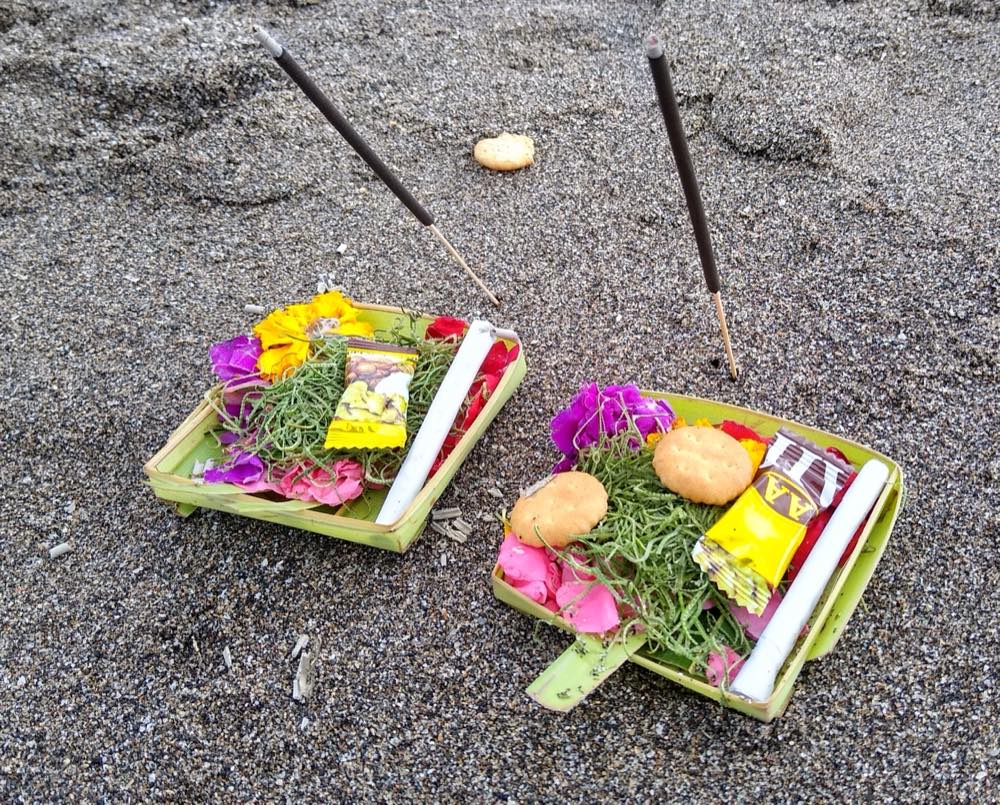 Canang sari offerings on black sand. Photo: Mx. Granger / Wikimedia Commons (CC0)

They are underfoot because the ground in front of a shrine or a doorway is where many of them belong. Step around them. Never step on one, and never kick it aside to clear a path.
If you crush one by accident, it is no catastrophe. The offering's purpose is fulfilled the moment it is made, and the physical object is already spent. The courtesy is to watch where you walk.
Do not take an offering, rearrange one for a photo or treat it as litter. A canang sari that looks discarded has usually done its work, and it is still not yours to touch.
Fresh offerings mark the spaces that matter most, so watching where they sit is a fast way to read a temple's rhythm. Balinese offerings explained covers what goes into a canang sari and the larger offerings behind it.
Shoes Come Off at Certain Thresholds
Footwear comes off at certain thresholds, though not at every temple gate.
The inner sanctum of some temples, raised prayer pavilions and a few specific shrines call for bare feet. The line between the shoe-on and shoe-off zones differs from site to site. The reliable guide is to watch what the Balinese do and read the signs.
The same purity logic applies. Shoes carry the dirt of the lower world, and the inner spaces are kept clean for the gods and for prayer. Leaving them at the threshold is a small act of respect for that boundary.
Rain is common in the north Bali highlands around Munduk and the lake temples. After it, expect wet stone underfoot in the shoe-off areas and step carefully.
At a Ceremony, Be a Quiet Guest at the Back
Bali runs on ceremony, so the odds of arriving during a ritual are high, especially in the temple-dense north.
Temple anniversaries (odalan) alone come round on a 210-day cycle at each of the island's thousands of temples. Weddings, tooth filings, cremations and full-moon observances add to them.
First Find Out Whether Visitors Are Welcome
Some ceremonies are open, and the community is happy for respectful onlookers. Others are private, and the entrance may simply be closed. Look for guidance from the people there, and never push past a closed or roped area.
If You Are Welcome, the Etiquette Tightens
- Dress fully, in sarong and sash.
- Stay at the back and to the side, and keep low.
- Give way. The procession and the worshippers have right of way at all times.
- Photograph with restraint. Shooting from a distance, without a flash and without inserting yourself into the scene, is usually fine. Stepping into the middle of a praying congregation to get a frame is not.
- Mind the priest. If a priest is leading prayer, never position yourself above him or in front of the shrine he faces.
A ceremony is a rewarding time to see a Balinese temple and an easy time to give offence. Follow the lead of those around you, and remember that the ritual is for them. For the broader rhythm of festivals and observances, see Balinese culture and traditions.
Bring Small Cash for the Fee or the Donation Box
Major temples that receive tourists charge a modest entrance fee. It often covers sarong and sash hire and goes toward maintaining the site.
Smaller village temples may have no fee at all, and a donation box (dana punia) near the entrance in its place. A contribution there is customary and appreciated, since these temples are maintained by the community on slim means. There is no fixed amount, so give what feels fair for a place that has opened its doors to you.
Carry small denominations of cash. Cards are not usually accepted at temple entrances, and change can be hard to come by at the more remote northern sites.
Think of the fee as your contribution to keeping a living temple alive.
The Province Has Written Some of These Rules Down
Most of the etiquette here is custom, held in place by the community and not by anyone at a gate. Some of it is also written down.
The provincial government publishes a short "do and don't" card for visitors through its Love Bali site. The governor's circular on the conduct of foreign tourists sets out what visitors may not do.
On temples, the circular prohibits two things:
- entering the sacred inner courtyards, unless you are there to worship in Balinese dress
- climbing sacred trees, holy buildings and monuments, or posing for disrespectful photographs at them
It also covers behaviour outside temple walls, including littering, rudeness to residents and officials, and working in Bali without the right permit.
The national tourism board carries a plain-English summary on Indonesia Travel. It describes the earlier version of the circular, which the current one updates.
Enforcement sits with the civil service police unit, Satpol PP, and the Bali police handle serious cases. A visitor who dresses properly and stays out of the inner courtyards is already inside every rule that touches a temple. The circular is worth reading because it shows which parts of the etiquette the island has put beyond argument.
For the temples themselves, the north's own are gathered in the best temples in north Bali. The island's famous ones are in the best temples in Bali.
FAQ
What should I wear to a temple in Bali? Wear a sarong covering your legs past the knee, a sash (selendang) tied around your waist over the sarong, and a top that covers your shoulders. This applies to men and women. Avoid tank tops, bare backs and uncovered knees. Most larger temples loan sarongs and sashes at the entrance.
Do men need to wear a sarong too? Yes. The sarong and sash apply to everyone regardless of gender. Shorts alone do not meet the standard, even for men, because the knees need to be covered.
Why can't women on their period enter a Balinese temple? The custom comes from the concept of sebel, a temporary state of ritual impurity associated with blood, death and childbirth. It is no judgment on women, and men face similar restrictions after a death in the family. The temple is kept ritually pure, and anyone in this state steps back from it until it passes. Enforcement relies on personal honesty, with no check at the gate.
Do I have to take my shoes off at Balinese temples? Not at every gate, but yes at certain inner sanctums, raised prayer pavilions and specific shrines. Watch what the Balinese do and follow the signs, since the shoe-off line differs by temple.
Can I take photos inside a temple? Generally yes in the outer areas. Ask before photographing people who are praying. Never use a priest or an active ceremony as a backdrop, and never climb a structure to shoot down on worshippers. During ceremonies, shoot discreetly from a distance or not at all.
What are the small offerings on the ground? They are canang sari, daily woven palm-leaf offerings of flowers and rice placed by the Balinese as acts of gratitude. Step around them, never on them, and do not move or take one for a photo.
What is the most disrespectful thing I can do in a Balinese temple? Standing higher than someone who is praying, especially climbing a wall or shrine to photograph a ceremony from above. Balinese spatial order treats height as purity, so positioning yourself above a worshipper inverts something central to the religion.
Do I have to pay to enter a temple in Bali? Major tourist temples charge a modest fee that often includes sarong and sash hire. Smaller village temples usually have a donation box, where a small cash contribution is customary. Carry small notes, as cards are not usually accepted.
Can I enter a temple during a ceremony? Sometimes. Some ceremonies welcome respectful onlookers, and others are private, with the temple closed to visitors. Look for guidance from the people there and never cross a roped or closed area. If you are welcome, stay at the back, dress fully, keep low and give worshippers right of way.
Where should I sit if there is a prayer happening? Sit lower than anyone praying, off to the side or behind. Fold your legs so your feet do not point at the shrine, the offerings or other people. The feet are the least pure part of the body.
Are the temple rules different in north Bali? The core etiquette is the same island-wide. In the north, smaller temples around Munduk, Bedugul and the inland villages see fewer tourists, so they are less likely to loan sarongs or post English signs. Bring your own sarong and sash and follow the lead of the locals.
Sources
- Bali Provincial Media Center, Tertibkan Turis Asing yang Berulah di Bali, Gubernur Koster Keluarkan SE Nomor 7 Tahun 2025 (the circular's obligations and prohibitions: sacred inner courtyards, Balinese dress, menstruation, climbing sacred trees and buildings, enforcement by Satpol PP and the Bali police), Indonesian, read September 2026
- Love Bali, Bali provincial government, the official "do and don't" card for foreign tourists (no disrespectful photographs at religious sites, no walking on offerings), English, read September 2026
- Love Bali, Bali provincial government, Bali cracks down on unruly tourists: Governor Koster issues new regulations (the circular's prohibitions in English, and who enforces them), English, read September 2026
- Indonesia Travel, Ministry of Tourism, New rules for foreign tourists in Bali (plain-English summary of the 2023 circular, No. 4 of 2023), English, read September 2026
- IrmaRosalina, Balinese Women, Wikimedia Commons (CC BY-SA 4.0), temple dress photograph
- Mx. Granger, Canang sari, Wikimedia Commons (CC0), offerings photograph
Read next: the best temples in north Bali, Balinese Hinduism explained, and understanding Balinese ceremonies.