
On this page
- In Brief
- Balinese Offerings at a Glance
- Canang Sari Is the Daily Offering Set Out Across Bali
- Offerings Are Made Each Day to Give Thanks and Keep Balance
- Each Part of a Canang Sari Has a Meaning
- A Canang Sari Is Made by Hand in Seven Steps
- The Saiban Is Offered After Cooking, Before the Family Eats
- Banten Is the Wider Word for Ceremonial Offerings
- Gebogan Are the Fruit Towers Carried to the Temple
- Where to See Gebogan in North Bali
- How to Respect the Offerings
- Practical Notes
- FAQ
- Sources
In Brief
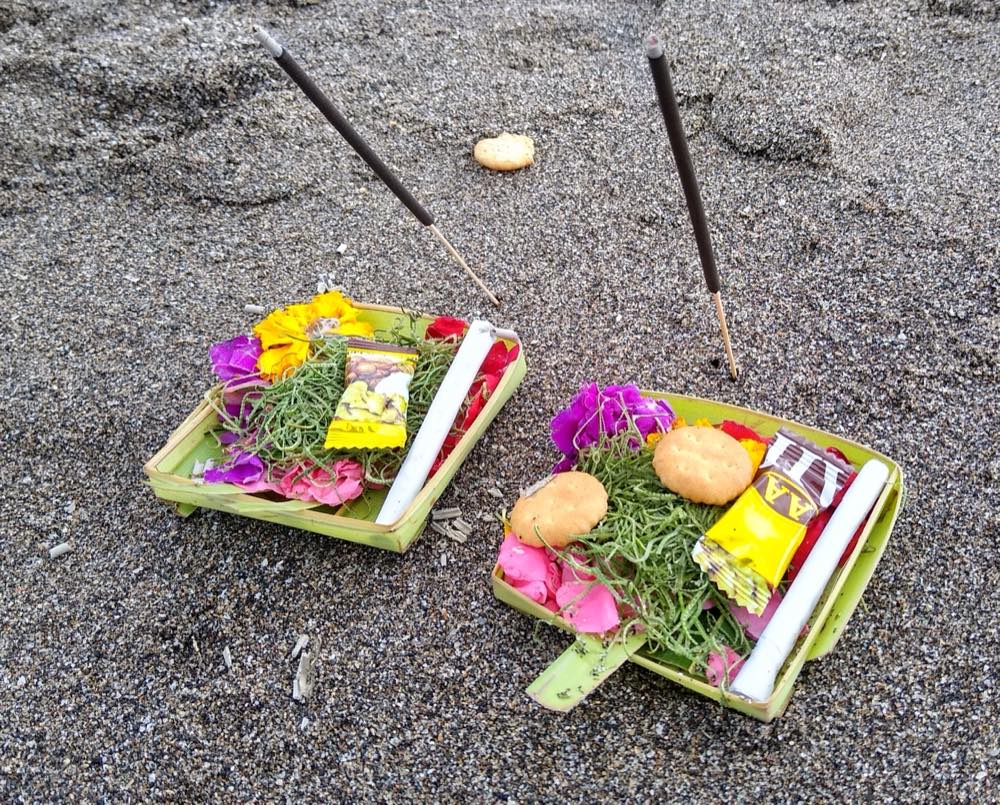
Balinese offerings are daily gifts of thanks, made by hand from leaves, flowers and food. The one you see everywhere is canang sari (pronounced cha-nang sah-ree), a square palm-leaf tray filled with flowers. It is placed fresh each day as an act of thanks and to keep the balance between the higher and lower forces.
Its flowers are set by colour to face the four cardinal directions and the god of each. White faces east for Iswara, red south for Brahma and yellow west for Mahadewa. Blue or purple faces north for Vishnu, standing in for black.
Two other offerings complete the picture. The saiban (yadnya sesa) is the smallest: a little of the day's cooked rice and food on a scrap of banana leaf. It is set down at five places around the home before the family eats.
The gebogan (also called pajegan) is the grandest a household makes. It is a tapering tower of fruit, cakes and flowers, built on a footed wooden tray and carried on a woman's head to the temple for its festival.
As a visitor you need one habit: walk around offerings on the ground and do not step on them.
Balinese Offerings at a Glance
- What it is: The daily Balinese Hindu offering of thanks
- Pronounced: cha-nang sah-ree
- Where you see it: On shrines, doorsteps, shop counters, car dashboards and the ground
- The tray (ceper): A small woven square of young palm leaf
- The flowers, by colour & direction: White/East/Iswara, Red/South/Brahma, Yellow/West/Mahadewa, Blue or purple/North/Vishnu
- Porosan: Betel leaf, lime and areca nut, standing for the Trimurti
- The finish: A stick of incense (dupa), lit as witness
- How often: Made fresh daily, by hand, usually by women
- Etiquette: Walk around them. Do not step on or kick one
- Saiban (yadnya sesa): A pinch of the day's cooked food, offered after cooking and before eating
- Gebogan (pajegan): A tower of fruit, cakes and flowers on a footed tray (dulang), carried to the temple
- Where to see gebogan: Temple anniversaries (odalan) and the Galungan to Kuningan days, anywhere in the north
Canang Sari Is the Daily Offering Set Out Across Bali
Canang sari is a square tray woven from palm leaf, filled with flowers and set out fresh every morning.
RRI, the public broadcaster, reads the name through Old Javanese: can for beauty, nang for purpose and sari for essence. So the offering is a way of asking God for beauty.
You will meet it within minutes of arriving in north Bali. It sits at the threshold of a warung, on a shrine, on a car dashboard or on the pavement at your feet.
Each one is made and placed by hand, usually by women, as part of the daily rhythm of the household. Its value lies in the act of giving: the flowers chosen and arranged, and the small blessing offered as it is set down.
Canang sari belongs to Agama Hindu Dharma, Bali's own form of Hinduism. The faith behind the offering is covered in Balinese Hinduism explained.
Offerings Are Made Each Day to Give Thanks and Keep Balance
The offering is a daily thank-you.
It is given in gratitude for what has been received, and as a way of keeping life in balance. In Balinese Hindu understanding, good forces and dark forces share the world.
This sits inside a larger philosophy called Tri Hita Karana, the three causes of wellbeing: harmony with God, with other people and with nature. The daily offering is one of the simplest and most constant expressions of harmony with the divine.
RRI adds that canang sari is offered every day. Particular care goes into it at the full and dark moons, on Kajeng Kliwon and on the holy days.
Where an offering goes holds a balance too. Some are raised on shrines and high places, given toward the gods and ancestors. Others are set on the ground at doorways, thresholds and crossroads, acknowledging the earth spirits so that life stays in order.
Neither is forgotten. The aim is balance, with neither side removed, the principle of Rwa Bhineda that runs through Balinese life. The offering itself is one of the five sacred duties known as the Panca Yadnya.
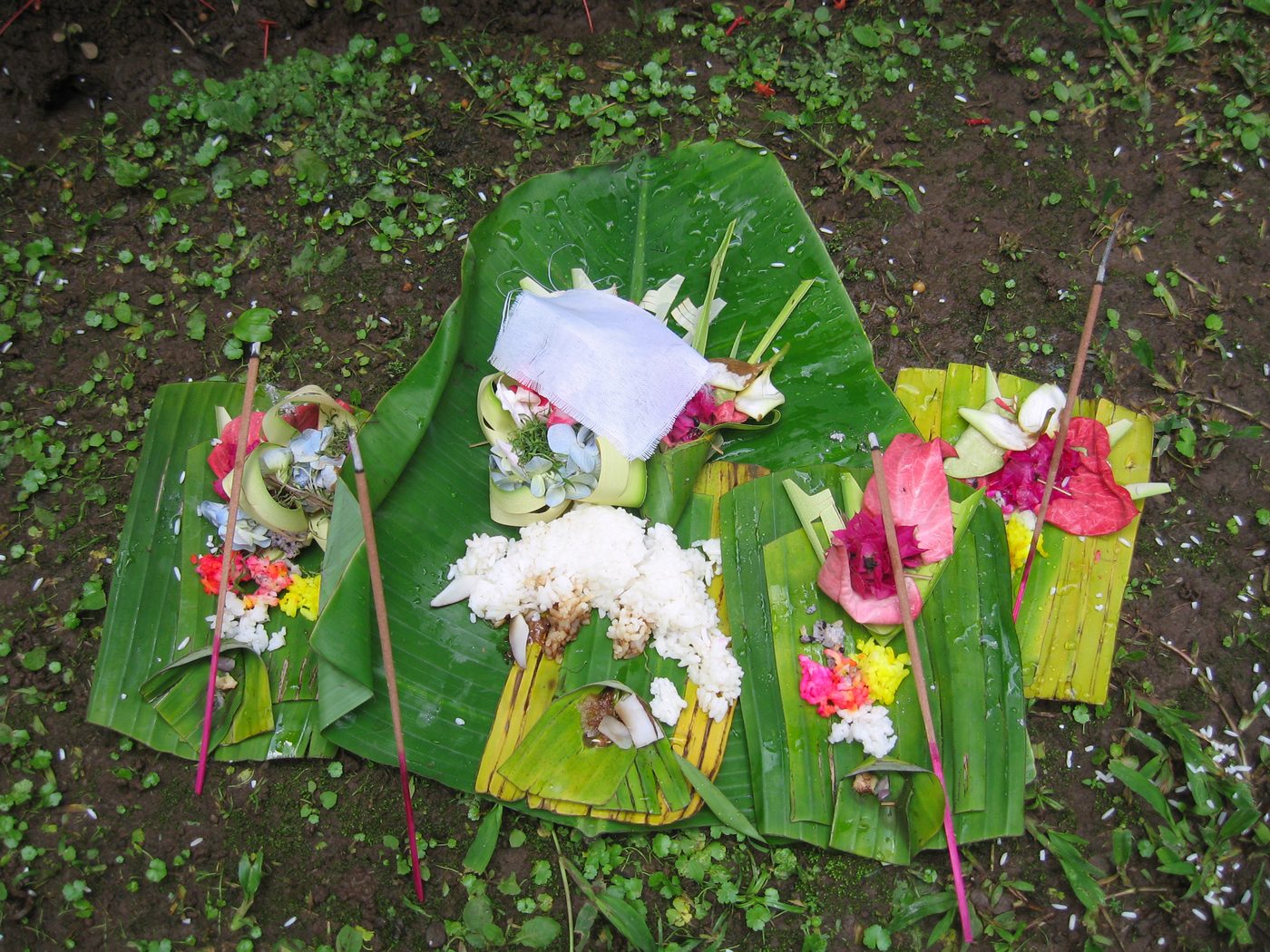 A segehan, one of the many ground offerings, laid out on banana leaf. Photo: Puri Lumbung Cottages / Wikimedia Commons (CC BY-SA 4.0)

For many of the women who make them, canang sari is also a quiet daily practice. It gives a few minutes of attention and gratitude before the day begins.
Each Part of a Canang Sari Has a Meaning
A canang has a few clear parts, and each one is made with care.
The tray, or ceper
The tray, the ceper, is folded from young coconut leaf (janur) into a square about the size of a palm. RRI notes that it stands for the crescent moon. It is the vessel that holds everything else.
The flowers, placed by colour and direction
The Hindu council PHDI sets out the arrangement in its own explanation of canang sari. Flowers of different colours face the cardinal directions. Each honours the god of that direction within Sang Hyang Widhi, the supreme oneness Balinese Hindus recognise.
- White, to the east, for Iswara
- Red, to the south, for Brahma
- Yellow, to the west, for Mahadewa
- Black, to the north, for Vishnu. Black flowers are rare, so blue or purple takes their place
The centre should hold all four colours, and shredded pandan leaf, bunga rampai, is used there instead.
The arrangement turns a handful of flowers into a small map of the cosmos. It is an everyday way of honouring the gods held within the one God.
The porosan, the food and the incense
Under the flowers sits the porosan, a small fold of betel leaf with lime and areca nut. RRI Singaraja explains it as the Trimurti: Brahma, Vishnu and Shiva. PHDI reads it as a reminder that every offering must rest on a sincere heart.
A full canang sari also holds a slice of sugarcane, a piece of banana and a little cake, which RRI reads as the nectar of life. A few grains of rice stand for the soul.
PHDI is clear that these food elements are what make it a canang sari. A tray of flowers alone, used only for prayer, is properly called uras sari.
The offering is set down with a stick of incense (dupa) burning beside it as witness.
What varies and what stays the same
You will find variations from village to village and from family to family. The colours, the directions and the daily devotion stay constant.
PHDI credits the form to Mpu Sangkulputih. In Balinese Hindu tradition he is the sage who created many of the island's offerings.
A Canang Sari Is Made by Hand in Seven Steps
Each canang is made by hand, often in minutes, from natural materials gathered fresh.
-
Fold the tray (ceper). Strips of young coconut leaf are folded and pinned into a small square tray.
-
Add the porosan. The fold of betel leaf, lime and areca nut goes in first.
-
Add the food. A slice of sugarcane, a piece of banana, a little cake and a few grains of rice follow.
-
Set the flower ring. A small round of woven leaf, the sampian, sits on top as the base for the flowers.
-
Arrange the flowers by colour and direction. White, red, yellow and blue or purple are set to their cardinal points, as listed above.
-
Finish the centre. Shredded pandan leaf goes in the middle.
-
Place it. The canang is set down with a prayer and a stick of incense, and replaced the next morning or afternoon.
The making is a skill passed down through generations of Balinese women.
Some resorts run canang-making sessions for guests. Kompas's travel desk learned the craft at one in Ubud, with the guide placing each colour by its compass point. Ask your host whether anyone nearby teaches it.
The Saiban Is Offered After Cooking, Before the Family Eats
Canang sari is the offering visitors notice. The one made first in a Balinese home is smaller and easier to miss.
After the morning's cooking, and before anyone in the family eats, a few tiny portions of the food are set aside and offered. This is yadnya sesa. In daily speech it is mebanten saiban, mesaiban or mejotan, as Palm Living explains from Lovina.
Palm Living describes it as the simplest offering of all, the smallest daily form of the Panca Yadnya. Its logic is plain. The family offers to God first what it is about to enjoy, then eats what remains, the blessed leftover called lungsuran or prasadam.
The Bhagavad Gita verse quoted for it is chapter 3, verse 13. Those who eat food first offered in sacrifice are released from sin, it says, while those who cook only for themselves "eat only sin."
What is in a saiban
A saiban holds very little, and that is deliberate. It is a few squares of banana leaf, each with a little cooked rice, a pinch of salt and a taste of the day's side dishes. There is no required dish.
The fuller form adds a sprinkle of clean water and a stick of burning incense as witness. The simplest form leaves both out.
Where the five portions go
The portions are set down at five places, each standing for one of the five elements, the Panca Maha Bhuta.
- Pertiwi (earth): at the gate or the house door, on the ground
- Apah (water): at the well or wherever the household's water is kept
- Teja (fire): in the kitchen, on the stove or hearth
- Bayu (air): on the rice store, or where the cooked rice is kept
- Akasa (ether): at the house shrine (pelangkiran or pelinggih)
The portion on the ground at the gate and the one raised at the shrine mirror the high and low placement of canang sari.
How a saiban differs from a segehan
The two are easy to confuse, since both can sit on the ground on a scrap of leaf. A segehan is a separate offering to the lower forces, with its own set contents. The saiban is the family's own food, whatever was cooked that morning.
When you will see a saiban
Look in the morning, after the cooking. In a homestay or a family-run warung in the north, you may find a leaf with a spoonful of rice on the kitchen step or beside the well. A small square may sit on the ground by the gate.
Treat it the way you would treat a canang. Walk around it, and leave it where it is.
Banten Is the Wider Word for Ceremonial Offerings
Canang sari is the everyday offering. Balinese ritual life builds far beyond it, and in north Bali you will see the larger forms on festival days.
Banten is the broader word for ceremonial offerings. They range from modest daily trays up to elaborate constructions for temple days, weddings and rites of passage. The bigger the occasion, the more involved the banten.
Gebogan are the tall towers of fruit, cakes and flowers that women carry to the temple balanced on their heads. They are the largest offering most households make, and the next section describes them.
Temple offerings appear in greater abundance during a temple's anniversary and the island-wide holy days. Shrines fill with flowers, fruit and woven art made for the occasion. If your visit lines up with a ceremony, you are seeing the same impulse as the daily canang, scaled up into something communal and grand.
Three guides go further. Understanding Balinese ceremonies covers the occasions, and Balinese ceremony elements explains the handmade parts. Nyepi, the day of silence has its own page.
Gebogan Are the Fruit Towers Carried to the Temple
A gebogan is the tower of fruit a woman carries to the temple on her head, often in a line of women in lace kebaya. The Balinese also call it pajegan, and Palm Living, writing from Lovina, uses both names for the same offering.
The saiban is the smallest offering in the house and the canang the most constant. The gebogan is the one a household puts the most into, and it appears on temple festival days.
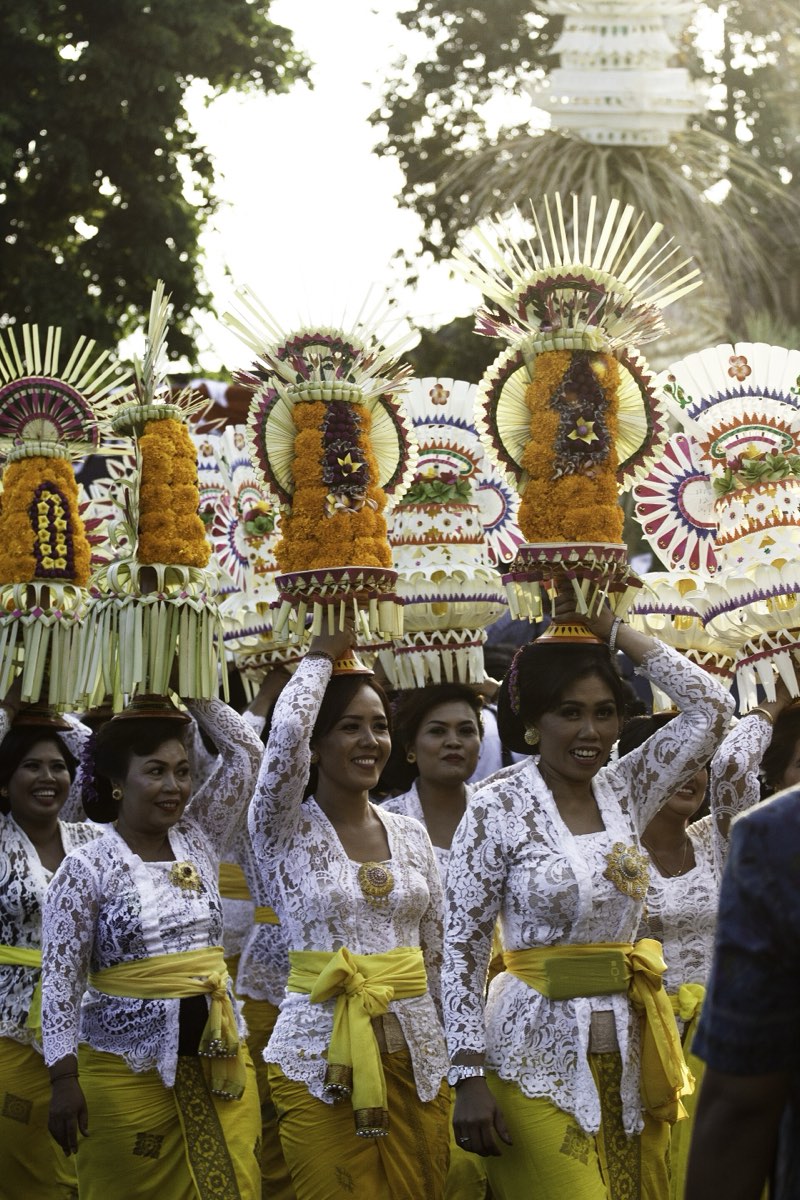 Gebogan carried high on a festival day. Photo: Tijden / Wikimedia Commons (CC BY-SA 4.0)

What is in a gebogan
Palm Living's account describes the base as a dulang, a wooden tray on a single foot. On it rises a tower that narrows as it climbs, built from four things:
- fruit
- jaja, Balinese cakes and sweets
- flowers
- woven palm-leaf ornaments called sampian
The pieces are pushed onto a core of small banana trunk so nothing falls on the walk to the temple. A canang sari crowns the arrangement.
Everything in it comes from the earth, and the offering says so: what the household enjoys, it gives to God first. The tapering shape is likened to a mountain. The word gebogan, Palm Living notes, means "sum" in Balinese, for the many colours and foods gathered in one offering.
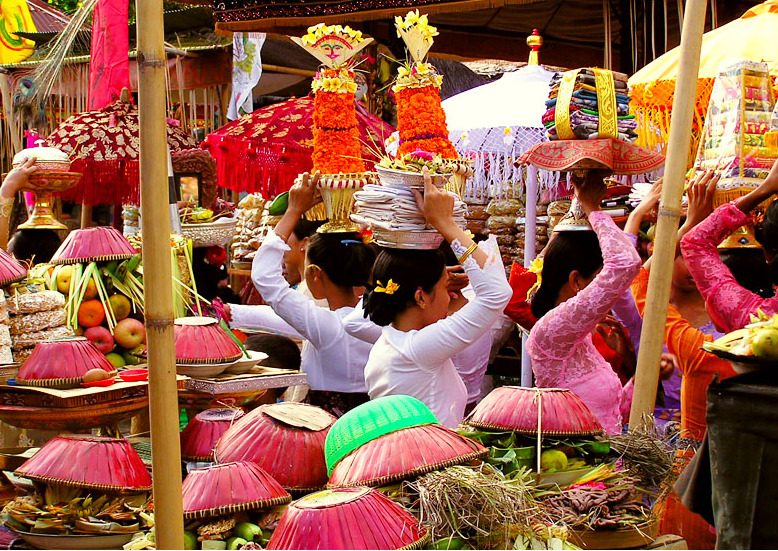 Women building offering towers inside a temple for its odalan, in Klungkung. Photo: Riza Nugraha / Wikimedia Commons (CC BY 2.0)

Mothers and daughters build it at home
Mothers and daughters make the gebogan, usually at home before a temple's festival. The skill is in the balance as much as the arrangement. A tower that looks effortless on a woman's head has been built to stay upright on a walk through a village.
Sincerity counts for more than height
Towers vary enormously in height. Balinese explanations of the gebogan agree on one point: its worth is measured by the sincerity of the giver. A modest gebogan made with a full heart counts for as much as a grand one.
The height and the artistry are a family's gift of skill and effort, and a pleasure to look at. No ranking is read into them.
Mepeed, the procession to the temple
On many festival days the gebogan arrive in procession. In a mepeed, the women of a village or a banjar walk side by side in a long line, each carrying her gebogan on her head. They walk to the temple, or around the temple grounds.
Palm Living describes it as a way of showing the greatness of God, who has given so many foods to live on. It is the whole community's offering made visible at once.
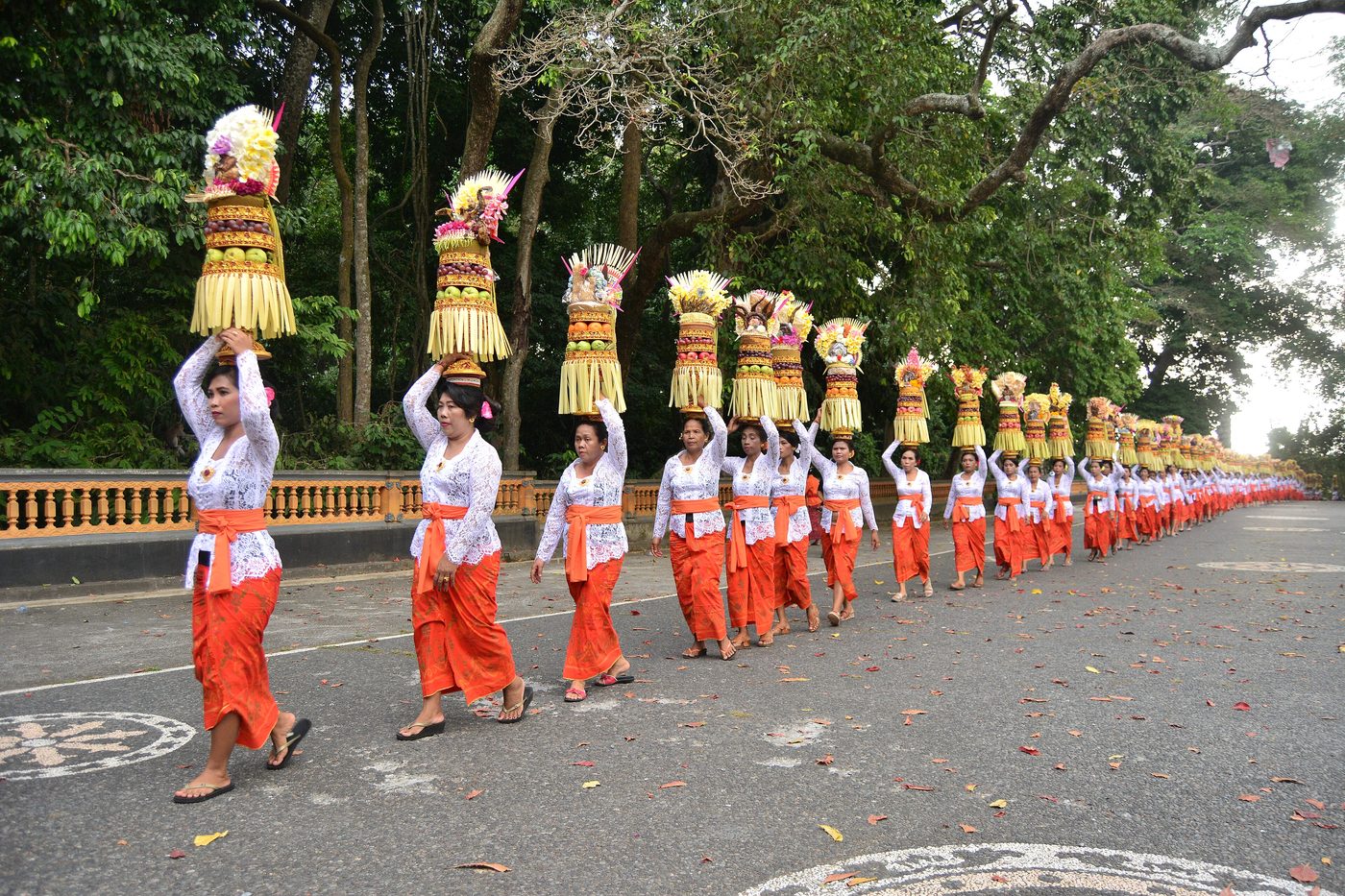 A mepeed procession of women carrying gebogan to the temple, held ten days after Kuningan in this village. Photo: Andika Panendra / Wikimedia Commons (CC BY-SA 4.0)

After the ceremony, the family eats the blessed food
At the temple the gebogan are placed before the shrines, prayed over and blessed with holy water. When the ceremony ends, families carry them home.
The gods have taken the essence of the offering. The fruit and cakes, now blessed, are shared and eaten by the family.
Where to See Gebogan in North Bali
You do not need to go looking for a festival. Gebogan appear wherever a temple is celebrating, and in the north that is almost always somewhere near you.
At a temple anniversary (odalan)
A temple has its anniversary, the odalan or piodalan. Many follow the 210-day Pawukon calendar, as RRI notes for Tanah Lot, and others the lunar year.
With so many temples, an odalan is under way somewhere on the island nearly every day. It is the likeliest place to watch women arriving with gebogan. The calendar behind the dates is explained in the Balinese calendar.
From Galungan to Kuningan
For the ten days between these two holidays, temples across Bali fill with offerings and penjor poles line the roads. Your chance of meeting a gebogan on its way to a temple is then at its highest.
The holidays come around every 210 days. See Galungan and Kuningan and Northbound's ceremony and festival calendar for the coming dates.
At a village procession
A mepeed can happen in any village on its temple's festival day. Some villages hold theirs on a fixed day in the ceremonial cycle. The procession pictured above is held ten days after Kuningan in its village.
How to find one
Ask the people who work in your villa or homestay. They will know which temple nearby is celebrating this week, what time the procession starts and whether visitors are welcome to watch.
Arrive a little early and stand to the side of the road or the temple gate. Wear a sarong and sash if you plan to go near the temple.
How to Respect the Offerings
One habit matters above the rest. Do not step on offerings placed on the ground, and do not kick them aside.
Walk around them where you can. They are set at doorways, on steps and along pavements, so a little attention to your feet goes a long way. It is noticed and appreciated.
If you brush one by accident, do not panic. Offerings on busy paths get walked over through the day, and the Balinese understand that accidental contact happens. It matters only that you were not careless or dismissive about it.
A few more small courtesies:
- Never kick an offering out of your way. Step over it or around it.
- Do not pick up or move an offering, even to "tidy" it.
- Ask before photographing someone making or placing one, and do not frame an offering in a mocking way.
- Do not interrupt a woman mid-offering or someone praying at a small shrine.
Bring the attention and respect you would bring to any living act of worship, without anxiety.
Practical Notes
Customs vary by village and family, and ceremony dates shift with the Balinese calendar. Confirm locally before planning around a specific festival.
- Offerings are made fresh daily, so you will see them each morning across north Bali.
- Watch your step near doorways, shrines and shopfronts where canang are placed on the ground.
- Accidental contact is understood. Deliberately stepping on or kicking an offering is not.
- During temple anniversaries and holy days, expect far larger offerings, processions and gebogan towers.
- Dress modestly near temples and ceremonies, and follow the lead of those around you.
- To attend a ceremony respectfully, ask your villa host or a local guide before you go, and do not turn up uninvited.
For where to stay and what to see across the region, start with the complete north Bali guide.
FAQ
What is canang sari?
Canang sari is the small daily Balinese offering, a square tray woven from palm leaf and filled with flowers. It is placed fresh each morning on shrines, doorsteps and the ground. It is given as thanks and to help keep the balance between good and dark forces, and it is replaced every day.
What is inside a Balinese offering?
A canang sari has a square tray of young coconut leaf and a porosan of betel leaf, lime and areca nut. It also holds a slice of sugarcane, banana and a little cake. Flowers are arranged by colour to face the cardinal directions, with shredded pandan in the centre. It is set down with a stick of incense.
Why do Balinese put offerings on the ground?
Offerings on the ground acknowledge the earth spirits at doorways, thresholds and crossroads. Raised offerings are given toward the gods and ancestors. Both together keep life in balance, which is central to Balinese Hindu practice.
Is it bad to step on a Balinese offering?
Deliberately stepping on or kicking an offering is disrespectful, so walk around them where you can. Accidental contact on a busy path is understood and nothing to worry about, since offerings on the ground get walked over through the day.
What is a gebogan?
A gebogan, also called pajegan, is a tall tapering tower of fruit, Balinese cakes and flowers built on a footed wooden tray (dulang). It is carried on a woman's head to the temple on festival days. It is blessed at the temple, then taken home, and the family shares the food.
What is yadnya sesa or saiban?
Yadnya sesa, called mebanten saiban or mejotan in daily speech, is the small offering a Balinese household makes after cooking and before eating. A little of the day's rice and food goes on squares of banana leaf. They are set down at the gate, the water source, the stove, the rice store and the house shrine.
Where can you see gebogan in north Bali?
At a temple anniversary (odalan), which happens somewhere on the island nearly every day, and above all in the ten days from Galungan to Kuningan. Ask the people at your villa or homestay which temple nearby is celebrating and when the offerings arrive.
Sources
- Parisada Hindu Dharma Indonesia (PHDI), Canang sari sebagai persembahan, by Ida Pandita Mpu Jaya Prema Ananda (what a canang sari must contain; the ceper, porosan, sugarcane, banana, cake and sampian; the flower colours, directions and gods; black and its blue substitute; pandan at the centre; uras sari and puspa warsa; Mpu Sangkulputih), in Indonesian, read September 2026
- RRI Singaraja, Canang sari: tradisi sederhana yang sarat makna (meaning of the name; the ceper as crescent moon; porosan of betel, lime and areca nut as the Trimurti; the colours and directions; rice, sugarcane and banana; daily and holy-day offering; where canang are placed; incense as witness), in Indonesian, read September 2026
- Kompas, Membuat canang sari di Bali, susun bunga sesuai arah mata angin (a canang-making session at a resort; palm-sized trays of janur; flower placement by direction; purple or blue for the north; replaced morning or afternoon; banten as the larger offerings), in Indonesian, read September 2026
- Palm Living, Yadnya sesa as the simplest offering (the names mebanten saiban and mejotan; contents; water and incense; lungsuran; the five placements by element), read September 2026
- Palm Living, Fruits offering in Bali: how Balinese call it (gebogan and pajegan; the dulang; contents and banana-trunk core; the canang on top; the meaning of the word; mepeed; sincerity over height), read September 2026
- Bhagavad Gita, chapter 3, verse 13 (food first offered in sacrifice), read September 2026
- RRI Singaraja, Ritual, daya tarik dan keunikan Tanah Lot (a temple's piodalan every 210 days on the Pawukon calendar), in Indonesian, read September 2026
- Images: Mx. Granger, Canang sari 1 (CC0); Puri Lumbung Cottages, Segehan (CC BY-SA 4.0); Tijden, Gebogan (CC BY-SA 4.0); Riza Nugraha, Odalan preparation inside a pura (CC BY 2.0); Andika Panendra, Tradisi Mepeed (CC BY-SA 4.0), Wikimedia Commons
Read next: understanding Balinese ceremonies, the five sacred duties behind every offering, and Bali temple etiquette before your first temple visit.