On this page
- In Brief
- North Bali Temples at a Glance
- The Northern Style: Dark Sandstone, Deep Reliefs and Carved Europeans
- West of Lovina: a Cliff Temple, a Forest Temple and an Island of Shrines
- East of Singaraja: Two Carved Temples and a Sacred Stone Boat
- In the Hills: a Buddhist Monastery and the Gateway Lake Temple
- How to Fit Them In: Two Clusters, West and East of Singaraja
- When to Go: Mornings, Late Afternoons and the Dry Season
- What to Wear and How to Behave at the Temples
- Photography: Go Close at the Carved Temples, Wide on the Coast
- Practical Notes
- FAQ
- Sources
In Brief
The best temples in north Bali are eight sacred sites along the Buleleng coast and the mountain road that leads to it. Six are Hindu temples on or near the coast. The other two are a Buddhist monastery in the hills and the lake temple you pass on the drive up from the south.
Start with the two carved temples east of Singaraja, Pura Beji Sangsit and Pura Meduwe Karang, which fit into one morning. West of Lovina, Pura Pulaki stands against a dark cliff with its monkeys, and Pura Melanting sits in the forest behind it. Further east, Pura Ponjok Batu keeps a sacred stone boat on the rocks below.
Each site asks for a sarong, a sash and covered shoulders, and takes a cash donation at the gate. The coastal temples are quiet, so you have time to look.
North Bali Temples at a Glance
- The monkey temple: Pura Pulaki, against a cliff on the northwest coast
- The forest temple: Pura Melanting, near Pulaki
- The island temple: on Menjangan, inside the national park
- The carved temples: Pura Beji Sangsit and Pura Meduwe Karang, near Singaraja
- The coastal shrine: Pura Ponjok Batu, with its sacred stone boat
- The Buddhist monastery: Brahma Vihara Arama, above Banjar
- The gateway lake temple: Ulun Danu Beratan, on the road from the south
- Dress: sarong and sash, covered shoulders, at each one
- Entry: a donation or entry contribution at the gate, in cash
- Crowds: low on the coast, busier at Ulun Danu Beratan
- How to see them: in two clusters, west and east of Singaraja, with a driver for the day
- Best time: mornings and late afternoons
The Northern Style: Dark Sandstone, Deep Reliefs and Carved Europeans
The temples of Buleleng, around Singaraja, are built and decorated in a northern style of their own.
Local carvers worked paras, a soft, dark volcanic sandstone, into deep reliefs. The carving is dense, playful and almost baroque.
The north was also Bali's front door in the colonial era. The Dutch arrived through the northern ports in the late nineteenth and early twentieth centuries, and that contact left its mark on the temple walls. Among the gods and demons you find carved Europeans, including a Dutchman on a bicycle and a foreigner in a car being robbed at gunpoint.
The customs are the same as anywhere in Bali, starting with a sarong, a sash and covered shoulders. Bali temple etiquette has the full set, and Balinese Hinduism explained sets out the wider faith behind the temples.
West of Lovina: a Cliff Temple, a Forest Temple and an Island of Shrines
Three of the eight sites lie in the northwest, toward Pemuteran and the national park.
Pura Pulaki: the Monkey Temple Against the Cliff
Pura Pulaki is built against a sheer dark cliff on the northwest coast, in Banyupoh near Gerokgak. It stands right on the Singaraja-Gilimanuk road about 53.5 km west of Singaraja. Its courtyards sit in a bay below a steep rocky headland and look out to the Bali Sea.
The Buleleng regency's heritage record lists it as a Pura Kahyangan Jagat, a temple revered by Hindus across Bali. The record traces its founding to the priest Dang Hyang Nirartha, who journeyed from Blambangan in east Java to the Gelgel court. That was in the reign of Dalem Cri Waturenggong.
Pulaki is also famous for its monkeys. Troops of grey long-tailed macaques live in and around the grounds, bold and quick to grab sunglasses, phones or food. They are not aggressive, but keep loose items packed away.
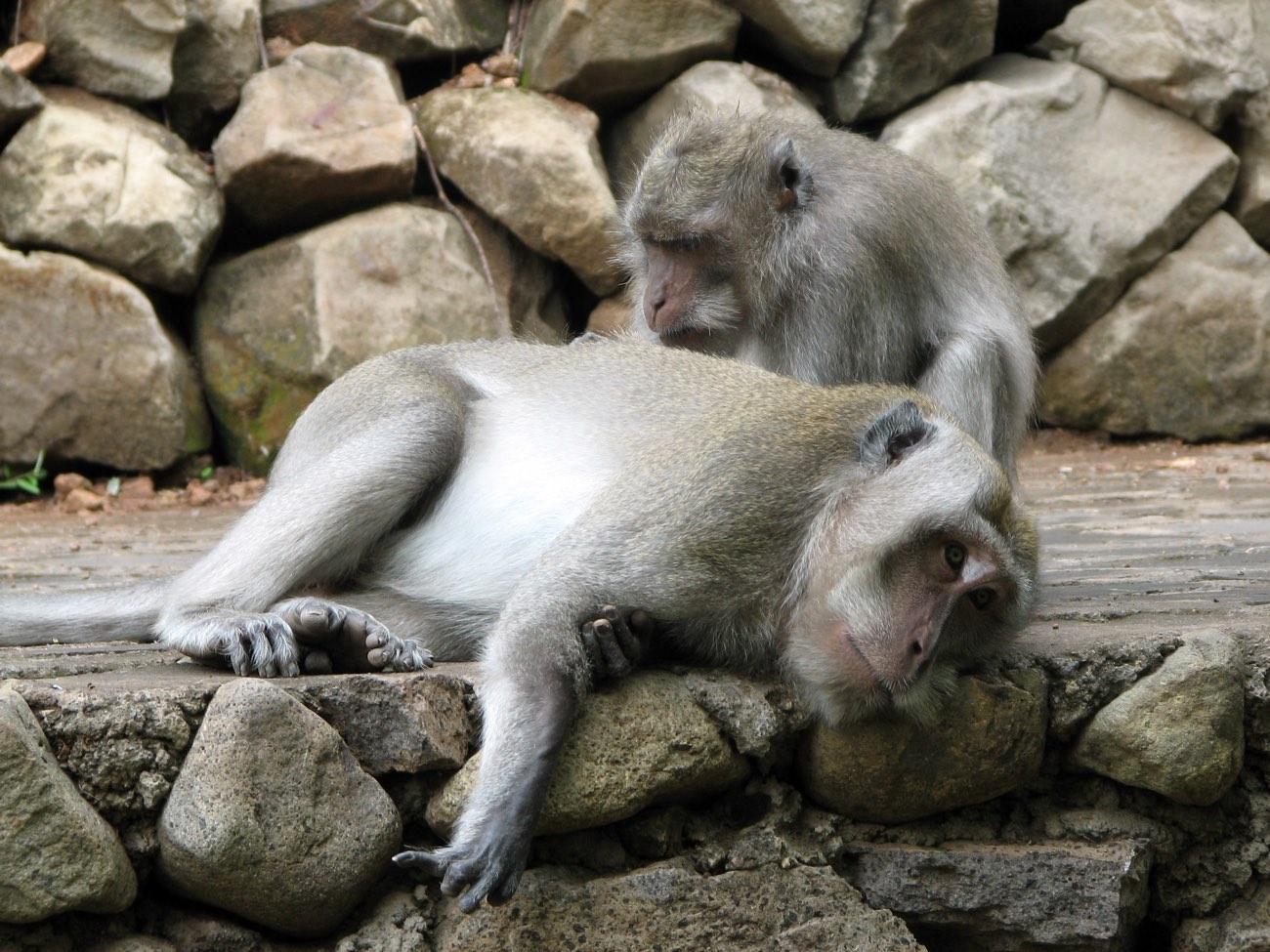 Macaques grooming on the Pura Pulaki wall. Photo: Eric Bajart / Wikimedia Commons (CC BY-SA 3.0)
In the rainy season the hills behind the temple turn brilliant green. The Pura Pulaki guide has the full visitor detail, the etiquette and the monkey precautions.
Where: Banyupoh, Gerokgak, on the northwest coast road between Lovina and Pemuteran.
Pura Melanting: the Traders' Temple in the Forest
Pura Melanting is Pulaki's quieter sister, and many visitors pass it by. It sits inland from Pulaki in the same village, Banyupoh in Gerokgak district, at the foot of the Pemuteran hills. You reach it through small forest and village lanes, and its tall buildings stand in the middle of the trees.
The two temples belong to the same sacred family. The Buleleng tourism office's Visit North Bali listing describes Melanting as a place of worship above all for traders.
The regency's heritage record gives the reason. Melanting is the shrine of Ida Ayu Swabhawa, Nirartha's daughter, who is held to rule the marketplace. She protects trade conducted according to dharma and troubles trade that is not.
Pulaki is sea and cliff, and Melanting is forest and stillness. They are a few minutes apart, so see them together.
Where: Banyupoh, Gerokgak, inland from Pura Pulaki and about 50 km west of Singaraja, under two kilometres from Pulaki.
Menjangan Island Temple (Pura Gili Kencana): Shrines on an Uninhabited Island
Menjangan is the uninhabited island inside the West Bali National Park, and it holds a cluster of shrines. The main one is often called Pura Gili Kencana.
A string of smaller pelinggih honours figures from Brahma Ireng to the prosperity goddess Kwan Im, who has a pagoda here. Together they reflect the island's layered Hindu and Chinese-Buddhist devotion, and pilgrims come for Tirta Yatra, the sacred journey.
The temple stands alone on an island with no inhabitants, with the reef and the deer for company and the sunrise over an empty sea. You can reach it only by boat, from Labuan Lalang or Banyuwedang, on the same trip most people make to snorkel. The Menjangan Island guide covers the island, the reef and the national park's access rules.
Where: Menjangan Island, West Bali National Park, 30 to 40 minutes by boat from the northwest coast.
East of Singaraja: Two Carved Temples and a Sacred Stone Boat
Pura Beji and Pura Meduwe Karang stand close together on the coast road, and Pura Ponjok Batu lies further east.
Pura Beji Sangsit: Pink Sandstone Carved on Almost Every Surface
Pura Beji is a subak temple in Sangsit, Sawan district, about eight kilometres east of Singaraja and a short drive from Lovina.
Beji means a bathing place or spring, the source of the fertility the temple honours. The regency's heritage record points to the figure of Dewi Sri, on the roof of the Gedong Simpen, as its emblem. The water it celebrates is shared out by the subak, the irrigation society. The subak dates to the ninth century, and its first written record to the eleventh (Wikipedia).
Beji is one of the clearest examples of the northern carving style. Its pink-tinged sandstone is worked into dense reliefs of flowers, vines and mythical beasts, covering almost every surface.
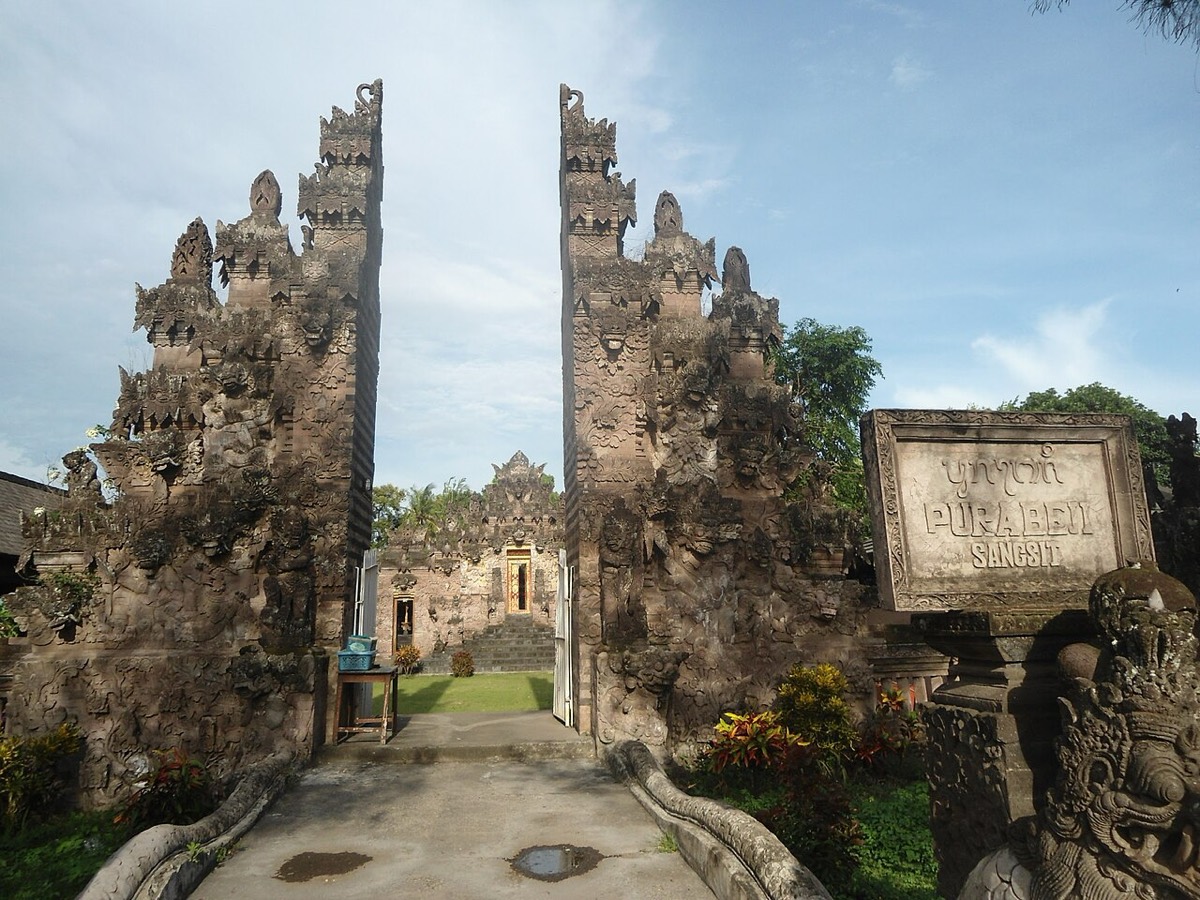 The carved gates of Pura Beji, Sangsit. Photo: DayakSibiriak / Wikimedia Commons (CC BY-SA 4.0)
The temple runs in three courtyards, from the outer Nista Mandala through the Madya Mandala to the sacred Utama Mandala, where worship happens. In the outer court stands the tall kulkul tower, with the slit-drum that once summoned the village.
Between the courts, an ornate split gate carries the heaviest carving, and shade trees keep the grounds cool. In farming Bali, a temple to the rice goddess carries real weight, and at Beji that devotion became art.
Where: Sangsit, Sawan district, about 8 km east of Singaraja on the coast road, and a short drive east of Lovina.
Pura Meduwe Karang: the Temple with the Bicycle Relief
Pura Meduwe Karang stands in Kubutambahan, about 12 km east of Singaraja. It is dedicated to Batara Meduwe Karang, the lord who protects unirrigated land, the dry-field farming that feeds the north.
The Kubutambahan village record dates the building to 1890, by families who had moved down from the old village of Bulian. The regency's heritage record says the work was finished and the temple named in 1895.
It is a large compound on three levels. The approach is lined with thirty-odd stone figures drawn from the Ramayana, with Kumbakarna battling Sugriwa's army of monkeys at the centre.
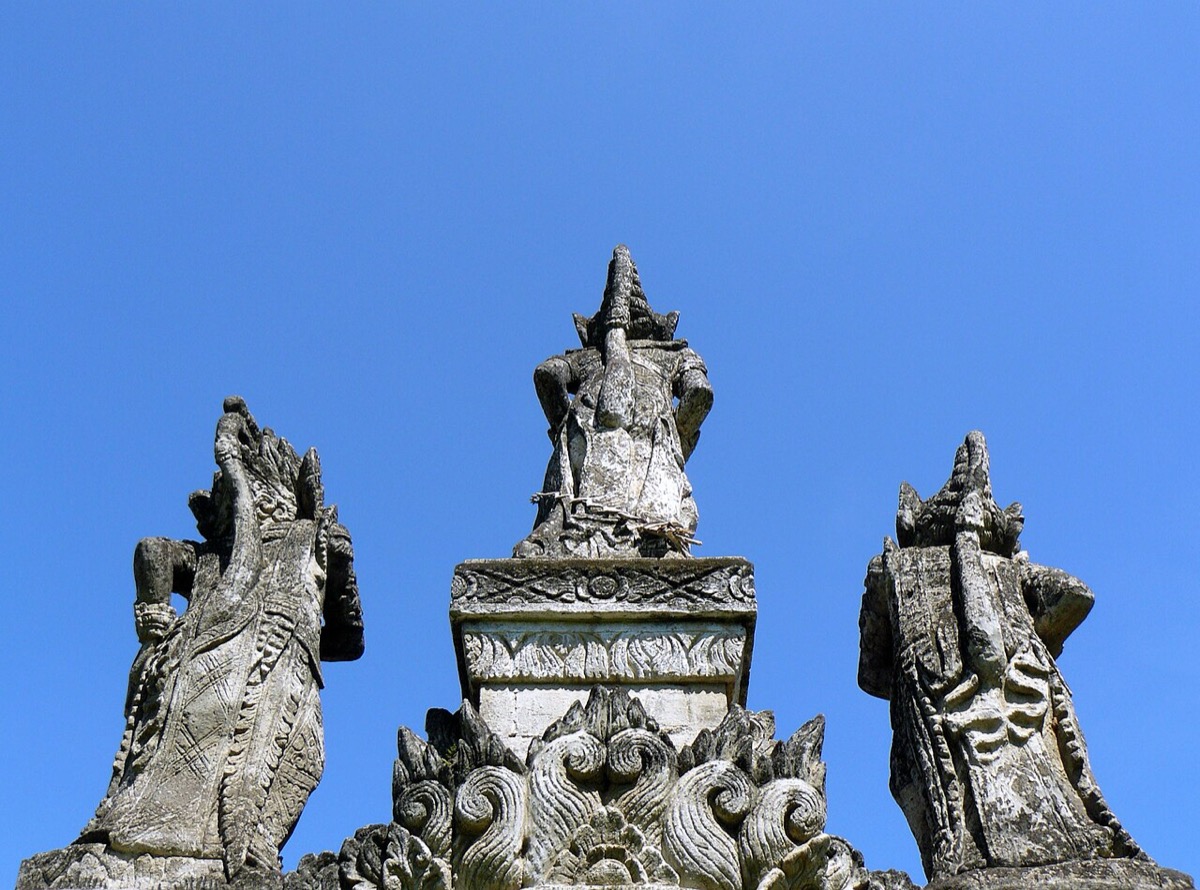 Gate figures at Pura Meduwe Karang. Photo: yeowatzup / Wikimedia Commons (CC BY 2.0)
The carving visitors come for is on the wall by the main shrine. It shows a European in shorts riding a bicycle, the rear wheel sprouting a lotus flower.
The Jakarta Post identifies him as W.O.J. Nieuwenkamp, the Dutch artist who arrived in Buleleng in 1904 and travelled the island by bicycle. The regency's heritage record places the relief in the rebuilding begun in 1922 and finished in 1935. It describes the figure as a Dutchman who contributed to the temple's construction.
The relief is one of the best-known carvings in north Bali. Nearby, the temple's Durga reliefs show the goddess in her fierce Rangda form, and they are among the most striking on the island.
Where: Kubutambahan, about 12 km east of Singaraja on the coast road.
Pura Ponjok Batu: the Coastal Temple with a Stone Boat Below
Pura Ponjok Batu stands on a stony promontory in Julah, Tejakula district, east of Singaraja. Black volcanic rock juts into the sea here, overgrown with frangipani, and the temple is built of dark stone designed to stand against the weather.
It is a Dang Kahyangan, a directional temple of island-wide importance. A special shrine at the front is for those about to make a journey.
The Tejakula district record ties its founding to Danghyang Nirartha's arrival in the fifteenth century, in the reign of Dalem Waturenggong. In local telling, the god weighed the north of the island and piled stones at the eastern end to bring the scales level. The promontory is named for that story.
The thing to see is below the temple. A stairway leads down to the rocky shore, where a sacred stone boat sits grounded in the rock. It is small and deeply revered, and it is tied to the legend of the priest Nirartha.
Beside it, a cave-like coral formation is used for melukat, the ritual purification of body and mind with holy water. The sea here is heavy, so take the steps with care.
Odalan and other ceremony days follow the Balinese 210-day calendar, with no fixed month. Check with your driver or the village before you plan a visit around one.
Where: Julah, Tejakula district, on the northeast coast east of Singaraja. It pairs with Tejakula and the quiet eastern coves.
In the Hills: a Buddhist Monastery and the Gateway Lake Temple
The last two sites are away from the coast, one above Lovina and one on the mountain road.
Brahma Vihara Arama: the Buddhist Monastery above Banjar
Brahma Vihara Arama is a Buddhist monastery in the hills above Banjar, near Lovina, and describes itself as the largest in Bali. A miniature replica of the Borobudur stupa stands in its terraced gardens.
It is the calm, contemplative counterpart to the Hindu temples, and it shows how deeply Buddhism is woven into Balinese spiritual life. The Brahma Vihara Arama guide covers the full visit.
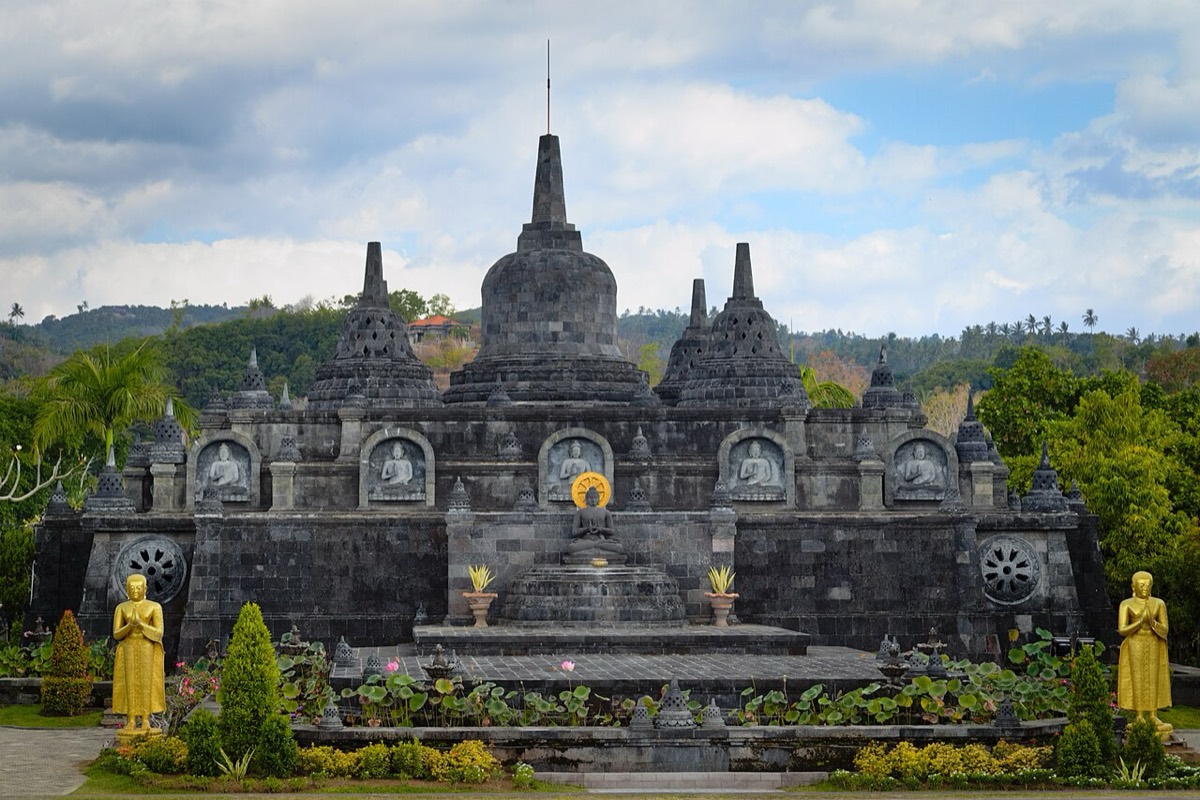 The Borobudur replica at Brahma Vihara Arama. Photo: Enrico Strocchi / Wikimedia Commons (CC BY-SA 2.0)
Where: the hills above Banjar, about 19 km west of Singaraja (regency heritage record) and 20 to 30 minutes from Lovina.
Pura Ulun Danu Beratan: the Lake Temple on the Way North
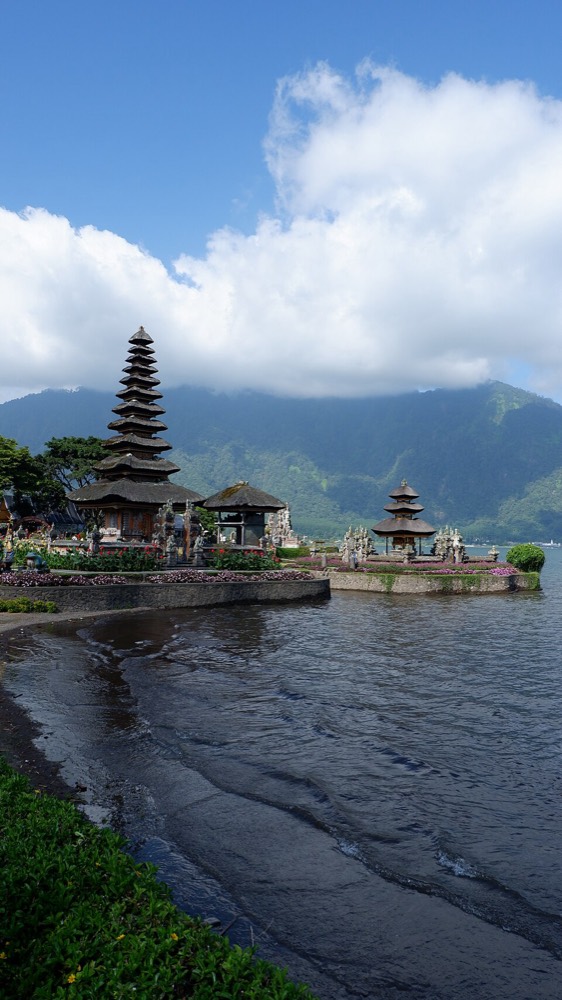
Pura Ulun Danu Beratan sits in the central highlands, strictly outside the north coast. It stands on the road most people take to reach the north, so it works as the gateway temple.
Its shrines, reflected in Lake Beratan, are among the most photographed images in Bali. A stop here makes a natural start to a north-bound temple day, and the Bedugul guide covers the lake area. It is busier than the coastal temples, so go early.
Where: Bedugul, Lake Beratan, on the mountain road between the south and the north coast.
How to Fit Them In: Two Clusters, West and East of Singaraja
You will not see all eight in a day, and you should not try. The temples fall into two clusters, west and east of Singaraja, with outliers in the highlands and on Menjangan.
- West cluster, from Lovina: Pura Pulaki and Pura Melanting sit together on the northwest coast toward Pemuteran. They make an easy half-day, with the cliff and the forest in one trip. Combine them with a Pemuteran or Menjangan day.
- East cluster, from Lovina: Pura Beji Sangsit and Pura Meduwe Karang, the two carved temples, are close together east of Singaraja and doable in a morning. Push further east and you reach Pura Ponjok Batu and Tejakula on the quiet coast.
- The monastery: Brahma Vihara Arama pairs with the Banjar Hot Springs above Lovina.
- Menjangan: the island temple comes free with a snorkel trip.
- Ulun Danu Beratan: a stop on the drive up from the south.
A driver for the day is the simplest way to chain them, since they are spread along the coast.
When to Go: Mornings, Late Afternoons and the Dry Season
Mornings and late afternoons are best, with cooler air, softer light and fewer people.
The dry season, April to October, makes the coast driving easiest. Pulaki is at its most beautiful in the wet season, with the green hills behind it.
Check for odalan, the temple anniversary, and for full-moon ceremony days. The temples are more alive then, dressed and busy with worshippers, though access to the inner courts may be limited to those praying.
Ceremony days run on the 210-day Balinese cycle, so ask locally and do not work from a Gregorian calendar. The Balinese calendar explained sets out how it works.
What to Wear and How to Behave at the Temples
The customs are the same at each temple:
- wear a sarong and sash
- cover your shoulders
- keep your voice low
- do not stand above a praying person or climb on shrines
- follow any direction from temple staff, especially during ceremonies
Menstruating women traditionally do not enter the inner courts. The full guide is Bali temple etiquette.
Photography: Go Close at the Carved Temples, Wide on the Coast
The carved temples, Beji and Meduwe Karang, reward close work, because the detail is the subject. Go in soft morning or late-afternoon light, when the low sun rakes across the reliefs.
The coastal temples, Pulaki and Ponjok Batu, are about the setting of cliff, sea and sky, so shoot wide. At Pulaki, watch the monkeys around your gear.
Practical Notes
Distances and ceremony days can change. Confirm locally before you go.
- Dress: sarong, sash and covered shoulders at each temple. Bring your own in case none is offered at the gate.
- Entry: a cash donation at the gate. Carry small notes.
- Best clusters: west (Pulaki and Melanting), east (Beji, Meduwe Karang and Ponjok Batu)
- Getting around: a driver for the day, since the temples are spread along the coast
- At Pulaki: guard sunglasses, phones and food from the monkeys
- At Ponjok Batu: take care on the wet rocks down to the stone boat
- Light: morning or late afternoon, especially for the carved temples
- Crowds: low at the coastal temples, busier at Ulun Danu Beratan
FAQ
What are the best temples in north Bali? Pura Pulaki, the monkey temple against the cliff, and Pura Melanting, its forest sister, lie west of Lovina. East of Singaraja are the carved temples, Pura Beji Sangsit and Pura Meduwe Karang, and Pura Ponjok Batu with its sacred stone boat. Add the Buddhist monastery Brahma Vihara Arama and the island temple on Menjangan for the full set.
What makes north Bali temples different from the south? The northern temples of Buleleng are built and carved in a style of their own, with dense, playful reliefs in dark sandstone. Several carry colonial-era carvings of Europeans, including the famous Dutchman on a bicycle at Pura Meduwe Karang. Crowds are low at the coastal temples.
What is the bicycle carving at Meduwe Karang? A relief on the wall by the main shrine showing a European on a bicycle with a lotus-flower wheel. The Jakarta Post identifies him as the Dutch artist W.O.J. Nieuwenkamp, who arrived in Buleleng in 1904 and travelled Bali by bicycle. It is one of the best-known carvings in north Bali.
What is special about Pura Ponjok Batu? A sacred stone boat sits on the rocks below the temple, tied to the legend of the priest Nirartha. Beside it is a coral formation used for melukat, ritual purification. The temple stands on a stony promontory jutting into the sea east of Singaraja.
Why is there a Buddhist monastery among the temples? Brahma Vihara Arama, above Banjar near Lovina, describes itself as Bali's largest Buddhist monastery. Buddhism and Hinduism have coexisted in Bali for centuries, and the monastery is the calm, contemplative counterpart to the Hindu temples. See the Brahma Vihara Arama guide.
Do you need a guide to visit north Bali's temples? No, you can visit independently with a sarong and respect for the customs. A private driver for the day is the practical way to chain temples that are spread along the coast. See getting to north Bali.
How should you dress to visit a temple in north Bali? A sarong and sash with covered shoulders, the same as anywhere in Bali. Many temples lend sarongs at the entrance. See the Bali temple etiquette guide for the full customs.
Can you visit the temple on Menjangan Island? Yes. Menjangan holds a cluster of shrines, reached by boat from the northwest coast, usually as part of a snorkelling trip into the West Bali National Park. See the Menjangan Island guide.
Sources
- Pemerintah Kabupaten Buleleng, Pusaka Budaya Bali Utara (Pura Pulaki: Banyupoh, 53.5 km from Singaraja, Kahyangan Jagat, Dang Hyang Nirartha from Blambangan to Gelgel under Dalem Cri Waturenggong; Pura Melanting as the shrine of Ida Ayu Swabhawa and the marketplace; Pura Beji: Sangsit in Sawan, about 8 km east of Singaraja, beji as bathing place and spring, the subak since the eleventh century, Dewi Sri on the Gedong Simpen; Pura Meduwe Karang: about 12 km east of Singaraja, built 1890 to 1895, rebuilt 1922 to 1935 with the relief of a Dutchman on a bicycle), Indonesian, read September 2026
- Buleleng tourism office, Visit North Bali: Melanting Temple (Banyupoh, Gerokgak, about 50 km west of Singaraja, a place of worship especially for traders, under two kilometres from Pulaki), English, read September 2026
- Kecamatan Tejakula, Pura Ponjok Batu (Julah village, Dang Kahyangan status, the fifteenth-century founding and the weighing-of-the-island story), Indonesian, read September 2026
- Kecamatan Kubutambahan, Sejarah Pura Madue Karang (building begun 1890 by families from Bulian), Indonesian, read September 2026
- The Jakarta Post, A Homage Nieuwenkamp (W.O.J. Nieuwenkamp's arrival in Buleleng in 1904, his bicycle, and the Meduwe Karang relief that portrays him), English, read September 2026
- Pura Ulun Danu Beratan, official site (the lake temple and its grounds), read September 2026
- Wikipedia, Subak (irrigation) (developed in the ninth century, first written record from around the eleventh), English, read October 2026
- Photographs: Eric Bajart, DayakSibiriak, yeowatzup, Enrico Strocchi and Alharomain354, Wikimedia Commons
Read next: Pura Pulaki in full, Brahma Vihara Arama, and Bali temple etiquette.



.jpg)
.jpg)
.jpg)