
On this page
- In Brief
- The Balinese Wedding at a Glance
- The Short Answer: A Wedding Is a Purification
- The Forms of Marriage
- Choosing the Day: Dewasa Ayu
- Memadik: The Asking
- Mekala-kalaan: The Ceremony, Step by Step
- The Dress, the Offerings, the Priest
- Ngerorod: The Elopement Form
- Being a Guest: What to Wear, What to Bring
- Foreigners Marrying Balinese: The Honest Outline
- Practical Notes
- FAQ
In Brief
A Balinese wedding, pawiwahan, is a Hindu religious rite as much as a celebration. The couple are cleansed and protected from negative forces, the bride is formally released by her own family's ancestors and received into her husband's, and a priest seals the marriage before the gods. Most weddings follow one of two paths: memadik, the formal asking by the groom's family, or ngerorod, marriage by elopement. The heart of the ceremony is mekala-kalaan, a ritual of purification with symbolic acts such as buying and selling, piercing a woven mat with a kris, and cutting a thread. The date is set by the Balinese calendar. If you are invited, wear kebaya and sarong or a collared shirt with sarong or trousers, arrive when told, and follow the family's lead.
The Balinese Wedding at a Glance
- The word: Pawiwahan, the Hindu marriage rite
- The two main paths: Memadik (the asking) and ngerorod (elopement)
- Other forms: Nyentana (the groom joins the bride's family) and pada gelahang (both keep their own homes' status)
- Choosing the day: Dewasa ayu, an auspicious date read from the Balinese calendar
- The core rite: Mekala-kalaan, the purification with the kris, the mat and the thread
- Who presides: A priest, often a high priest (sulinggih or pedanda) for the final blessing
- Where: Usually the groom's family compound
- Guests wear: Kebaya and sarong with a sash, or a collared shirt with sarong or trousers
- In north Bali: Village variants, including the Melaib elopement custom of Pedawa
The Short Answer: A Wedding Is a Purification
A Balinese wedding follows Hindu scripture and the customary law each village has handed down. Done properly, the couple are said to earn happiness in this world (jagaditha) and in liberation (moksa) beyond it, as Tirto's guide to the ceremony puts it.
That explains the shape of the day. Most of what you watch is protection and cleansing. Offerings are made to the gods and to the lower forces, the couple are purified in stages, and the bride is ritually separated from her girlhood and her birth family before she is welcomed into her husband's. In the usual Balinese pattern, a married woman follows her husband's line, so the ceremony takes place at the groom's family compound and ends with a visit to the bride's family to take leave of her ancestors.
Details change from village to village, and between families of different castes. What follows is the common outline. The family you are with will always know their own version best, and the wider ritual life is explained in understanding Balinese ceremonies.
The Forms of Marriage
Balinese customary law recognises several ways to marry, and the path a couple takes shapes everything after it.
Memadik, or ngidih: the asking. The groom's family formally asks for the bride. It is regarded as the most honourable form, used when both families agree to the match.
Ngerorod, or merangkat: the elopement. The couple marry on their own choice, usually because one family objects, and the families are brought round afterwards. It has its own full procedure, covered below.
Nyentana. The reverse of the usual pattern: the groom leaves his family and enters the bride's, typically when her family has no son to carry the line.
Pada gelahang. Literally "owned together". Husband and wife each keep the status of heir in their own family home, and carry duties in both villages, an option for couples who are both only children.
Choosing the Day: Dewasa Ayu
Nothing starts until the date is right. After the families agree, the groom's side sets the wedding day, madewasa ayu, on the advice of a priest or elders who know how to read auspicious dates. Balinese families choose good days for each stage, from the formal asking to the fetching of the bride and the ceremony itself, in the belief that a well-chosen day gives the marriage a good start.
The dates come from the Balinese calendars, the 210-day pawukon cycle and the lunar saka year working together. How those calendars fit together is explained in the Balinese calendar explained.
Memadik: The Asking
The visit (mesedek). The groom's family goes to the bride's parents' home to introduce themselves and state their serious intent. The bride's family then decides whether to accept.
Gifts to the mother (natab pawetonan). In a memadik marriage, the groom's side presents gifts such as jewellery and clothing to the bride's mother, in a ritual held on the bed. Tirto describes it as a symbolic repayment of a mother's milk, marking that her task is complete and passes to the husband.
The daughter's provisions (bekal or tadtadan). The mother gives her daughter jewellery or clothes for worship to take into her new life.
Mekala-kalaan: The Ceremony, Step by Step
The order below is the common one. Villages and families shorten, merge or rearrange steps, so treat it as a map and not a script.
1. Ngekeb, the preparation. The day before, the bride is bathed and her whole body scrubbed with a paste of daun merak leaves, turmeric, kenanga flowers and ground rice, with flower water for bathing and rice-stalk water for her hair. She stays in her room praying until the groom's family comes for her, covered head to foot in a thin yellow cloth that stands for burying her past.
2. Fetching the bride (ngungkab lawang). "Opening the door." The groom's party comes to the bride, a messenger knocks, verses are exchanged between the two sides, and she is brought out. Small offerings are made to clear the way, and the bride throws betel leaves to ward off anything harmful.
3. The welcome (mesegeh agung). At the groom's compound, the groom's mother lifts away the yellow cloth, exchanging it for kepeng coins, a welcome into the family.
4. Mekala-kalaan, the purification. Led by a priest, often with bells ringing, this is the heart of the day, and its acts are the ones guests remember:
- Touching the feet to the offering called kala sepetan, to cleanse the couple.
- Buying and selling. The bride carries a basket, the groom haggles and buys its contents, a picture of a marriage in which each supplies what the other needs.
- Piercing the mat. The bride holds a mat woven from young pandan leaves, tikeh dadakan, and the groom pierces it with his kris, the female and male principles joined.
- Planting. The couple plant turmeric, taro and andong behind the family shrine, for descendants.
- Cutting the thread. A thread stretched between dadap branches is cut, the couple leaving youth for married life.
- Circling. The groom shoulders a load (metegen-tegenan) and the bride carries one on her head (mesuun-suunan), and they walk clockwise around the sacred fire, the first seven steps together taken as vows.
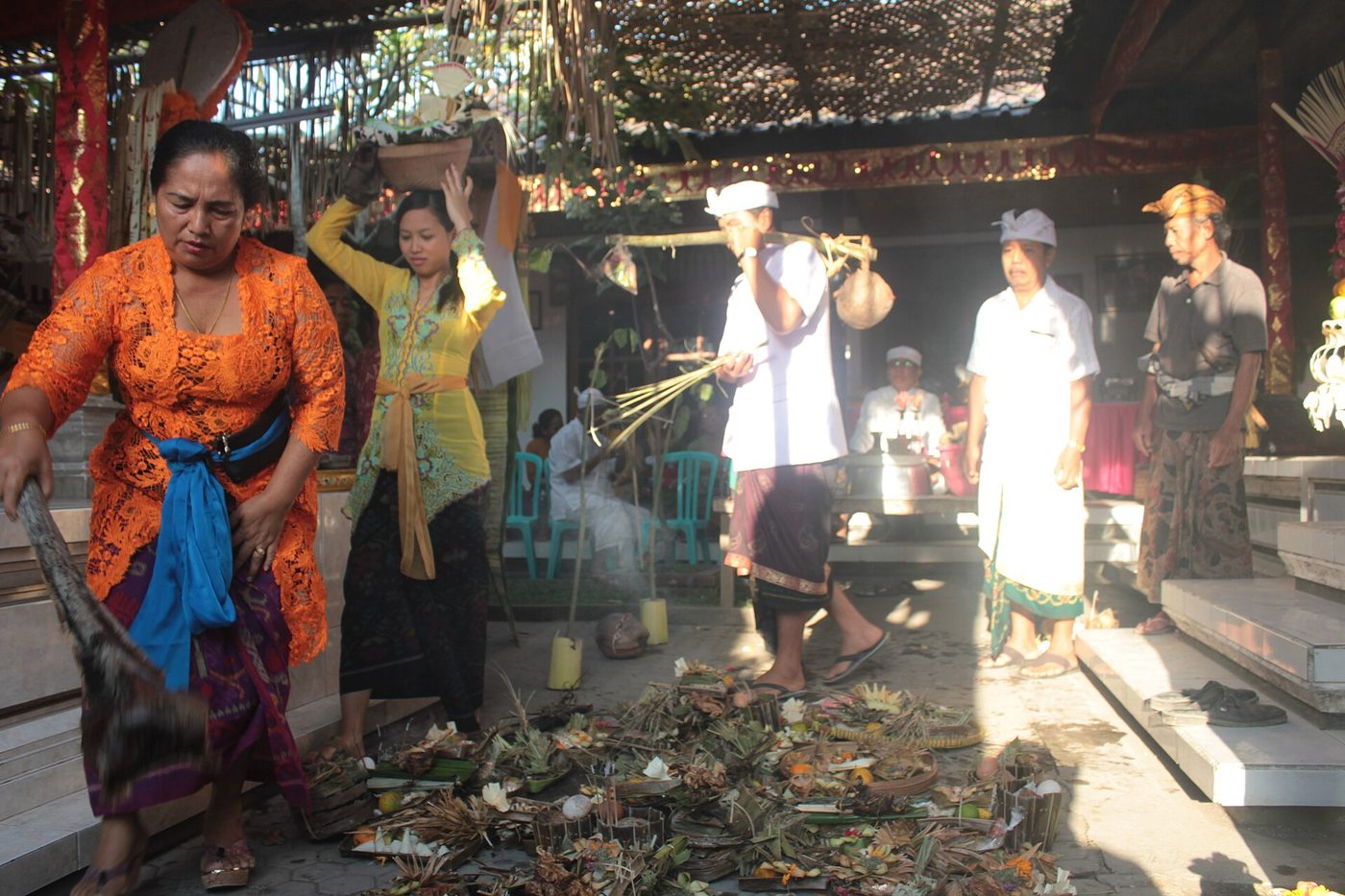 The metegen-tegenan and mesuun-suunan walk: the groom shoulders his load, the bride carries hers on her head. Photo: Septiari30 / Wikimedia Commons (CC BY-SA 4.0)

5. Widhi widana and mejaya-jaya, the blessing. In their full wedding dress, the couple pray before the family shrine in a rite led by a high priest, the sulinggih or pedanda, asking the blessing of Sang Hyang Widhi. It is the climax and the close of the rites. Tirto notes that the couple then traditionally stay home together for three days.
6. Majauman, the farewell visit. A few days later the groom's family accompanies the bride back to her parents' home with traditional cakes, fruit and other gifts, so she can take formal leave of her own ancestors. The word comes from jaum, needle: the visit stitches the two families together.
North Bali villages add their own steps. In Busungbiu, inland in western Buleleng, couples go to Pura Pabijian as part of their wedding rites to wash their feet in the river beside the temple and pray for inner cleansing, a custom handed down in the village, according to the photographer's record below.
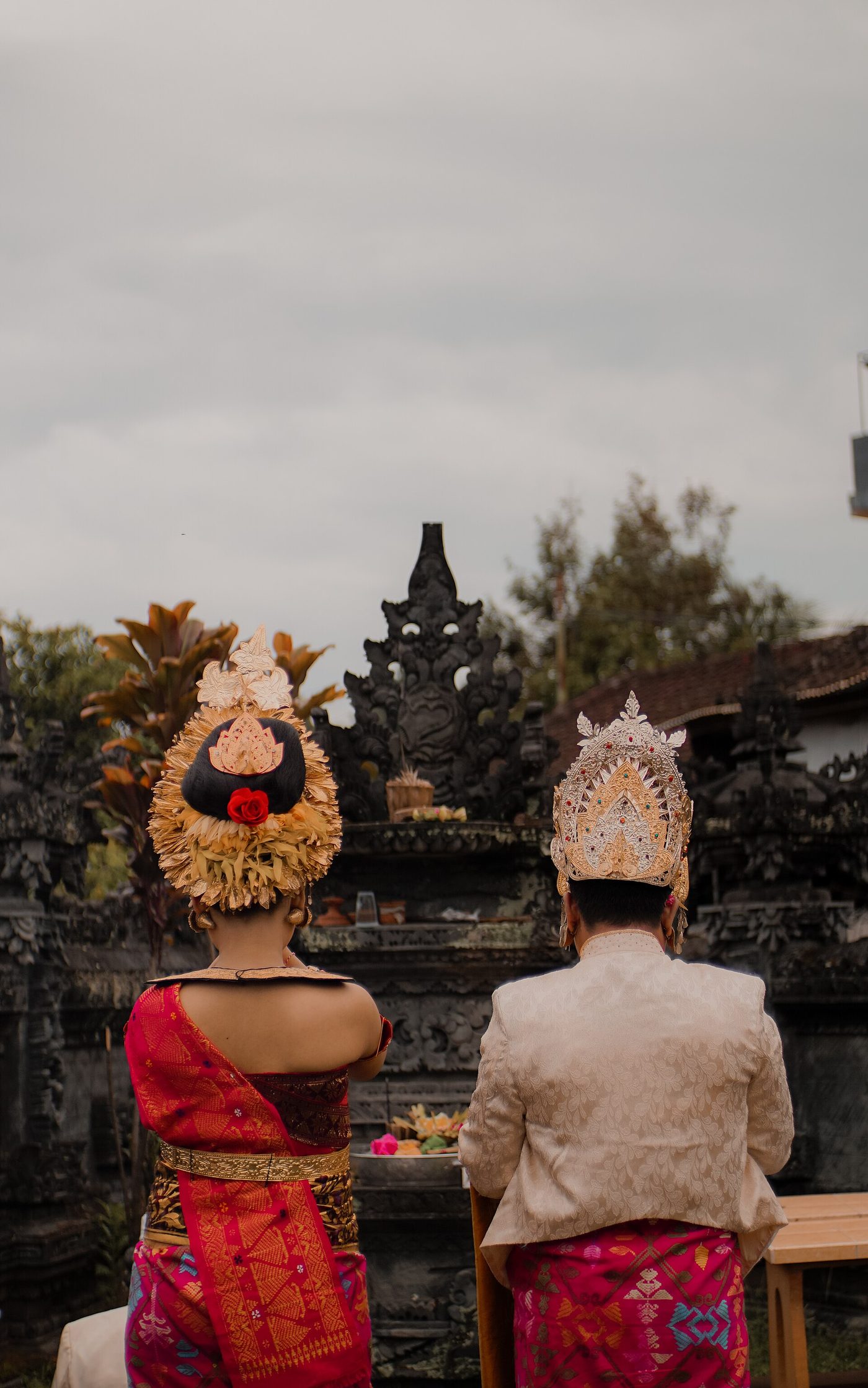 A bride and groom in Busungbiu, north Bali, at Pura Pabijian for their wedding cleansing. Photo: Anggabuana / Wikimedia Commons (CC BY-SA 4.0)

The Dress, the Offerings, the Priest
The dress. For the ceremony the couple wear full ceremonial dress. Its grandest form, payas agung, is also worn for tooth filing and coming-of-age rites. The headdress is the most sacred part, dressed with kenanga and cempaka flowers. The bride wears a bodice and a kamen to the ankles, the groom a cloth from chest to calves, and only the groom carries a kris.
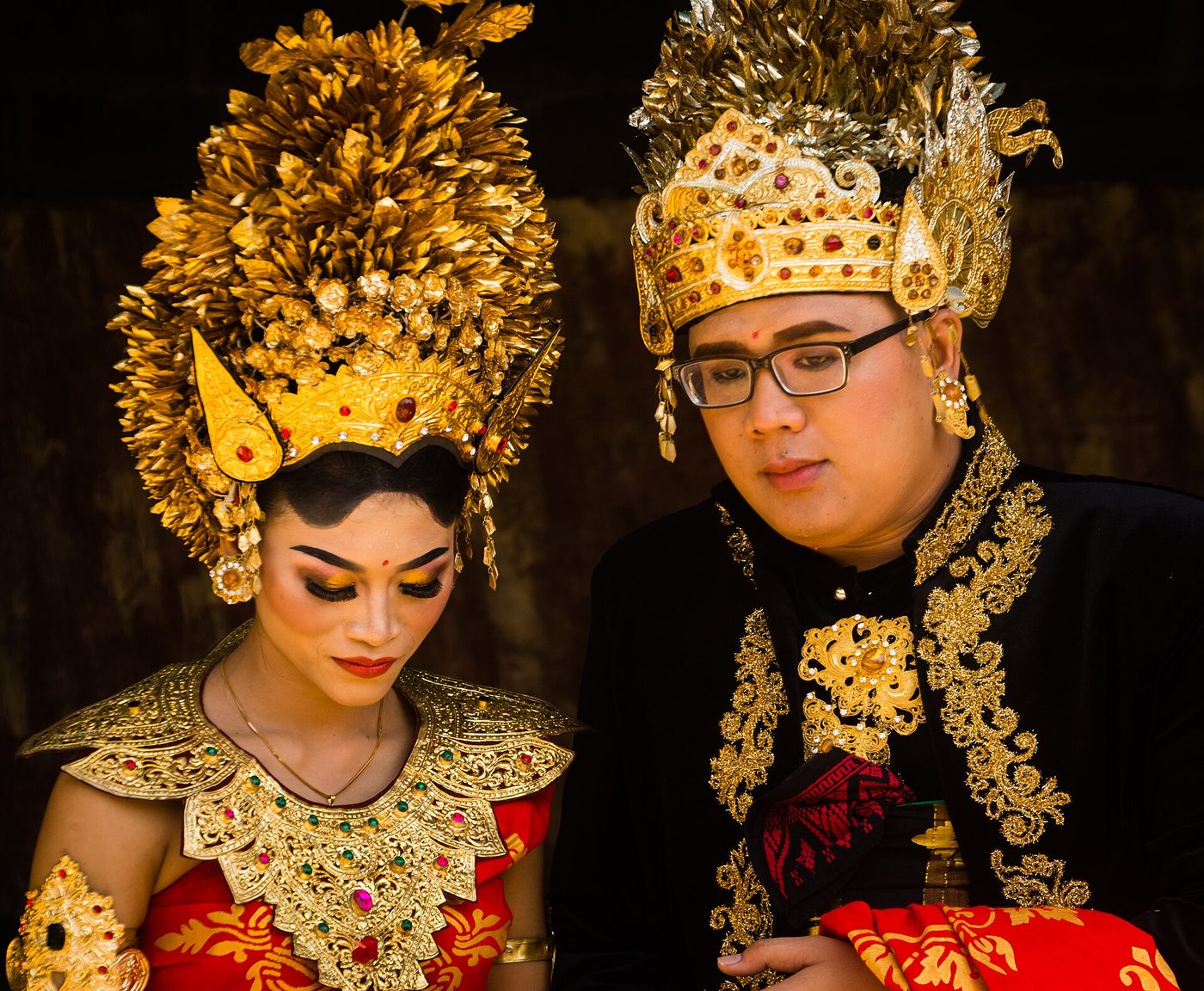 A bride and groom in gold ceremonial headdresses on their wedding day. Photo: KitHamilton / Wikimedia Commons (CC BY-SA 4.0)
The offerings. Every step has its own offerings, banten, the larger relatives of the daily offerings you see on every doorstep. At the fetching of the bride alone, Tirto lists nine sets, among them pejati, prayascita, a caru of a brindled chicken, and several kinds of segehan, the ground offerings for the lower forces.
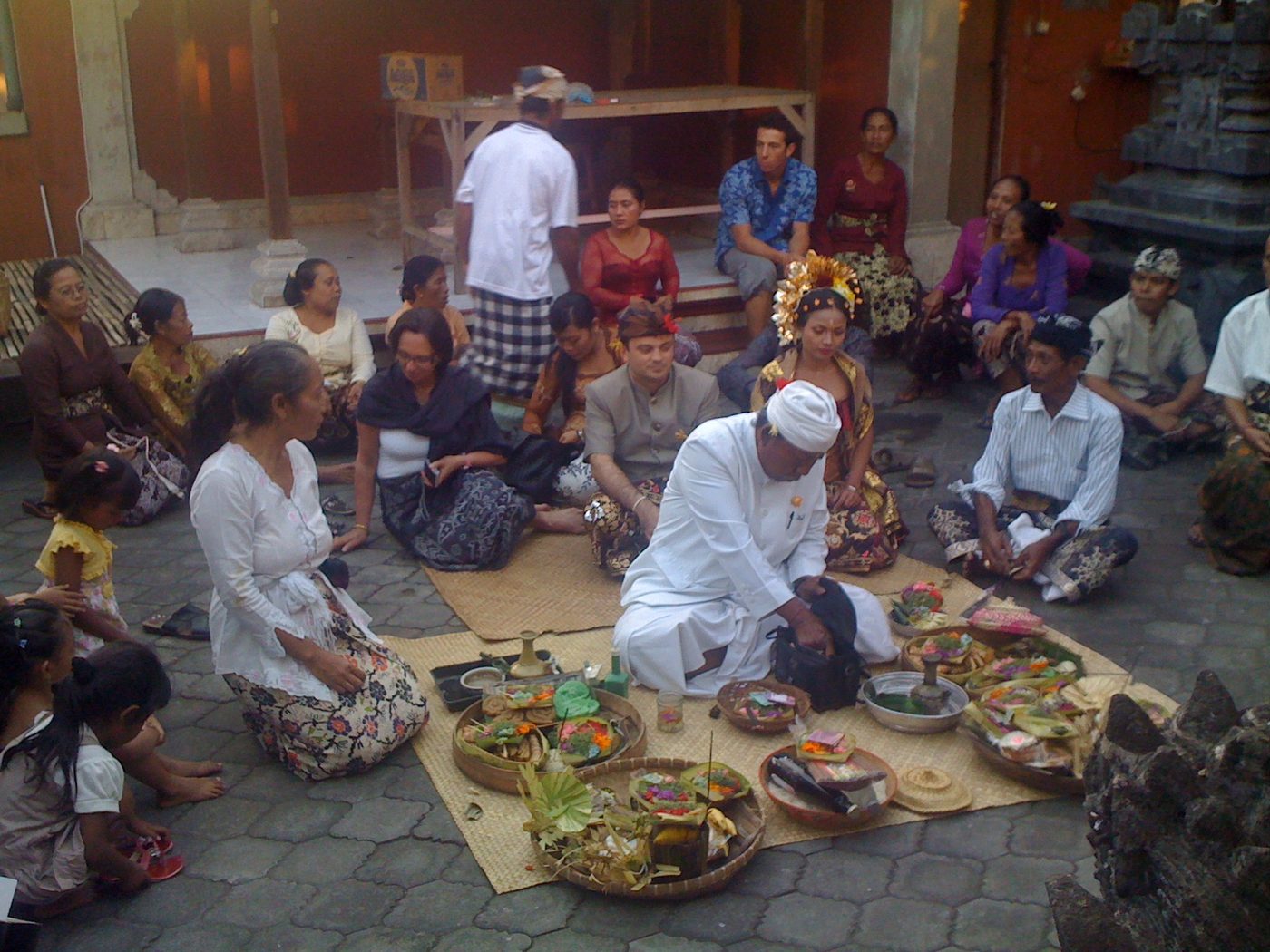 The bride and groom sit behind the priest as he leads the rites before the offerings. Photo: alq666 / Wikimedia Commons (CC BY-SA 2.0)

The priest. A priest guides the mekala-kalaan from the first ring of the bell, and a high priest, sulinggih or pedanda, leads the final widhi widana blessing, with holy water for the couple.
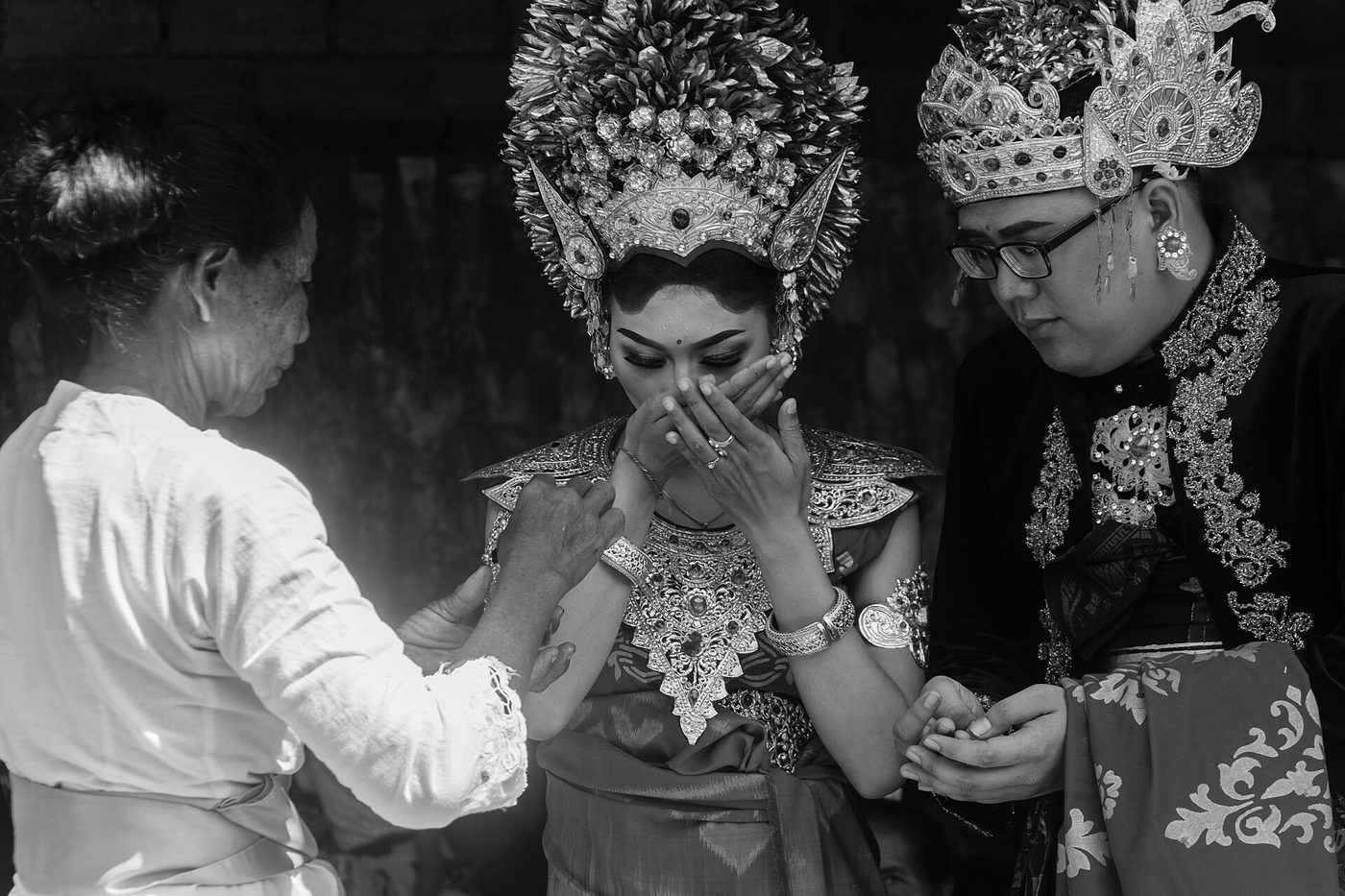 An officiating priestess gives holy water to the bride and groom. Photo: KitHamilton / Wikimedia Commons (CC BY-SA 4.0)

Ngerorod: The Elopement Form
Ngerorod, "running away", is fully recognised in Balinese custom, and it has its own careful procedure. It usually happens when a family refuses the match, often over a difference in caste. Detik's account sets out the steps:
- The couple agree to leave together, usually at night.
- They stay hidden with a host, the pengkeban, who reports the elopement to the local authorities.
- Within a day, the groom's family sends messengers to tell the bride's family.
- After three days, the groom's family brings the couple home and announces the wedding.
- If the bride's family consents, they visit to give their approval, and the village announces the marriage.
- The mejauman visit to the bride's family seals it.
The north keeps an older form. In Pedawa, one of the Bali Aga villages in the hills above Banjar, the elopement custom called Melaib gives couples a sanctioned way to choose each other, with the village witnessing. It is described in the Bali Aga villages of north Bali.
Being a Guest: What to Wear, What to Bring
An invitation to a Balinese wedding is an honour, and the family will expect you to take part quietly in a religious day.
What to wear. Women usually wear a lace kebaya covering the shoulders and upper arms, a coordinated sarong, and a sash at the waist. Men wear a collared shirt, batik being ideal, with trousers or a plain sarong, and an udeng headcloth if you have one. Avoid sleeveless tops and anything above the shin. The same rules as a temple apply, because much of the day happens beside the family shrine (see Bali temple etiquette).
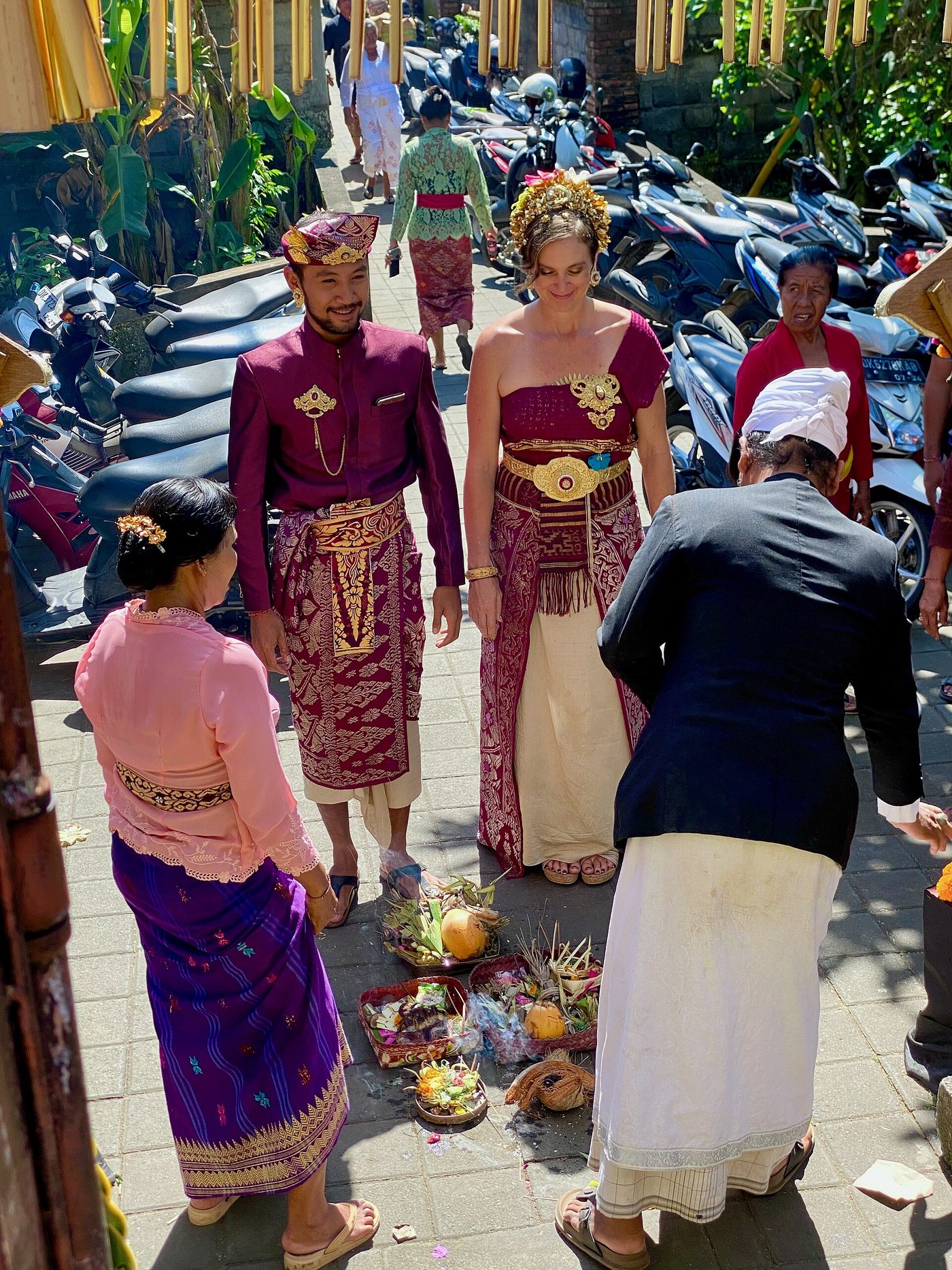 Family and guests in ceremonial dress leave the compound for a blessing after the wedding. Photo: ByKariBell / Wikimedia Commons (CC BY-SA 4.0)

What to bring. Cash in an envelope is the usual gift, given discreetly or left where the family collects gifts, and the amount depends on how close you are to the couple. Ask the person who invited you what is customary in that family.
How to behave. Arrive at the time you are told, sit where you are shown, stay back from the priest and the offerings, and keep photos discreet during the rites.
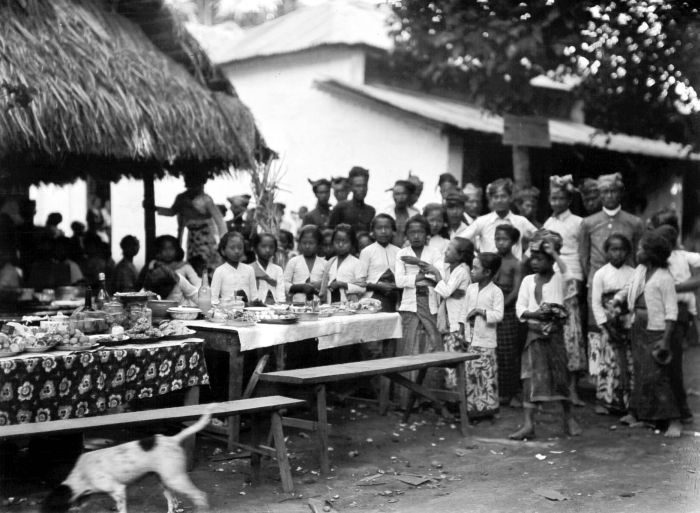 A wedding feast in Tejakula, north Bali, from the Tropenmuseum archive. Photo: Unknown author, Tropenmuseum / Wikimedia Commons (CC BY-SA 3.0)

Foreigners Marrying Balinese: The Honest Outline
This is a legal matter as much as a cultural one, and the details change, so treat what follows as orientation and take it to a notary.
Religion comes first. Under Indonesia's Marriage Law, Law 1 of 1974, a marriage is valid when it is performed according to the religion of the couple, and it must then be registered. In July 2023 the Supreme Court issued Circular 2 of 2023 instructing courts not to grant applications to register marriages between people of different religions, as The Diplomat reported. In practice, a couple marrying in a Balinese Hindu ceremony share one faith.
Sudhi wadani. A non-Hindu partner who embraces Hinduism does so through sudhi wadani, a purification in which the person declares the faith before witnesses. It is arranged through the local Parisada Hindu Dharma Indonesia office with a written statement that the choice is freely made, and it is usually held at a village temple, according to Detik.
Registration and paperwork. After the religious ceremony, the marriage is registered with the civil authorities, and a foreign partner needs documents from their own country. The list of papers, translations and approvals changes, so work through a notary and the civil registry office in Buleleng before you set a date.
For foreign couples marrying each other in north Bali, the practical side is in wedding venues in north Bali.
Practical Notes
Ceremonies differ between villages, castes and families, and wedding dates follow the Balinese calendar. Confirm the details with the family who invites you.
- The calendar sets the date. Weddings fall on auspicious days read from the Balinese calendars, so ask the family for the exact day and time.
- Expect several days. The preparation starts the day before, and the farewell visit to the bride's family comes a few days after.
- Ask before you photograph the priest, the offerings or the couple during the rites.
- Legal questions go to a notary, never to hearsay; the rules for mixed marriages have changed recently.
For more of north Bali's ritual life, see understanding Balinese ceremonies, and for everything else about the region, the complete north Bali guide.
FAQ
What happens at a Balinese wedding?
A Balinese Hindu wedding moves through a series of rites: choosing an auspicious day, the formal asking or an elopement, the bride's preparation and fetching, the mekala-kalaan purification, a priest's blessing, and a final visit to the bride's family so she can take leave of her ancestors. Most of it takes place at the groom's family compound.
What is mekala-kalaan?
Mekala-kalaan is the purification at the heart of a Balinese wedding, led by a priest. The couple touch their feet to an offering, act out buying and selling, the groom pierces a woven pandan mat held by the bride with his kris, they plant turmeric and taro, cut a thread, and walk around the sacred fire.
What is memadik in a Balinese wedding?
Memadik, also called ngidih, is the formal asking: the groom's family visits the bride's parents to request the marriage. It is regarded as the most honourable form of Balinese marriage and leads into gifts to the bride's mother and the full ceremony.
What is ngerorod?
Ngerorod is marriage by elopement, a recognised form in Balinese custom. The couple leave together and stay with a host, the groom's family informs the bride's family within a day, and after three days the wedding is announced and the families reconcile through the rites.
What should I wear to a Balinese wedding?
Women usually wear a lace kebaya covering the shoulders and upper arms with a sarong and a sash. Men wear a collared shirt, ideally batik, with trousers or a plain sarong, and an udeng headcloth if they have one. Avoid sleeveless tops and short hemlines.
What gift do you give at a Balinese wedding?
Cash in an envelope is the usual gift, handed over discreetly or left where the family collects gifts, with the amount reflecting how close you are to the couple. Ask the person who invited you what is customary.
Can a foreigner marry a Balinese Hindu?
Yes, but Indonesian law requires the marriage to follow the couple's religion, and courts have been told not to register interfaith marriages. A non-Hindu partner usually embraces Hinduism through the sudhi wadani ceremony before the wedding, and the marriage is then registered. Take the paperwork to a notary, because the requirements change.
How long does a Balinese wedding take?
The full sequence spreads over several days, from the preparation of the bride the day before the ceremony to the mejauman visit to her family a few days after. Traditionally the couple then stay home together for three days.