
On this page
In Brief
A tridatu is a bracelet of three twisted threads, red, white and black, worn by Balinese Hindus on the right wrist. The name joins tri, three, with datu, most often explained as element or colour. The colours stand for the Hindu trinity: red for Brahma the creator, black for Vishnu the preserver, and white for Shiva, who returns things to their source. It is blessed, given after prayers at a temple, and left on until it falls away by itself. Visitors can wear one too.
Tridatu at a Glance
- What it is: A blessed bracelet of red, white and black thread
- The name: Tri (three) and datu (element or colour)
- Red: Brahma, the creator
- Black: Vishnu, the preserver
- White: Shiva, the dissolver
- Where it comes from: Given after prayers at some temples, blessed beforehand
- Which wrist: The right
- How long: Traditionally until it falls off by itself
- Visitors: Welcome to wear one; never on the ankle
What Tridatu Means
The three threads are a small portable picture of the Trimurti, the three faces of Ida Sang Hyang Widhi Wasa, the one God of Balinese Hinduism. Red is Brahma, who creates. Black is Vishnu, who sustains. White is Shiva, the pelebur, who dissolves what has run its course so the cycle can begin again.
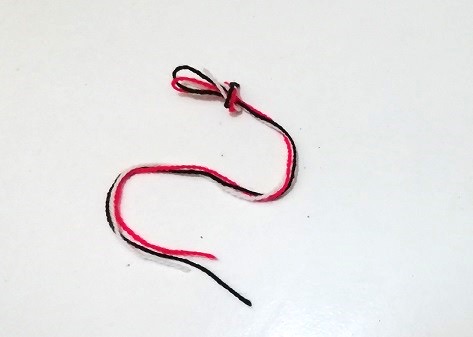 The three-colour tridatu thread before it is tied. Photo: M. Adiputra / Wikimedia Commons (CC BY-SA 4.0)

Balinese writers attach a second layer of meaning. The threads also stand for the tri kona, the three passages every person goes through: utpeti (birth), stiti (life) and pralina (death). Some teachers link the bracelet to the tri kaya parisudha as well, the discipline of pure thought, pure word and pure deed. Some Balinese explanations give datu as king instead, so you will also see "three kings" in translations.
The bracelet is also understood as protection. The thread goes through a ritual before anyone wears it, and many Balinese believe it carries the power of the divine to keep harm and dark influences away. It is also a quiet mark of Balinese identity.
Where the Custom Comes From
The origin story told in Bali is a legend. It is set in the Gelgel era, when the king sent his commander Ki Patih Jelantik against Ki Dalem Bungkut of Nusa Penida. After Bungkut's defeat, the powerful figure Ratu Gede Mecaling resolved to protect the Hindus who stayed devoted to their ancestors and to punish those who had strayed. The tridatu marked the faithful so they would be spared. Some tellings add that the thread was first given at Pura Dalem Ped on Nusa Penida.
When You Receive It
A tridatu is usually received at the end of prayers at a temple, alongside the holy water and the grains of rice, called bija, that close a Balinese blessing. Not every temple gives one, and not every ceremony includes it. When it is given, it goes on the right wrist.
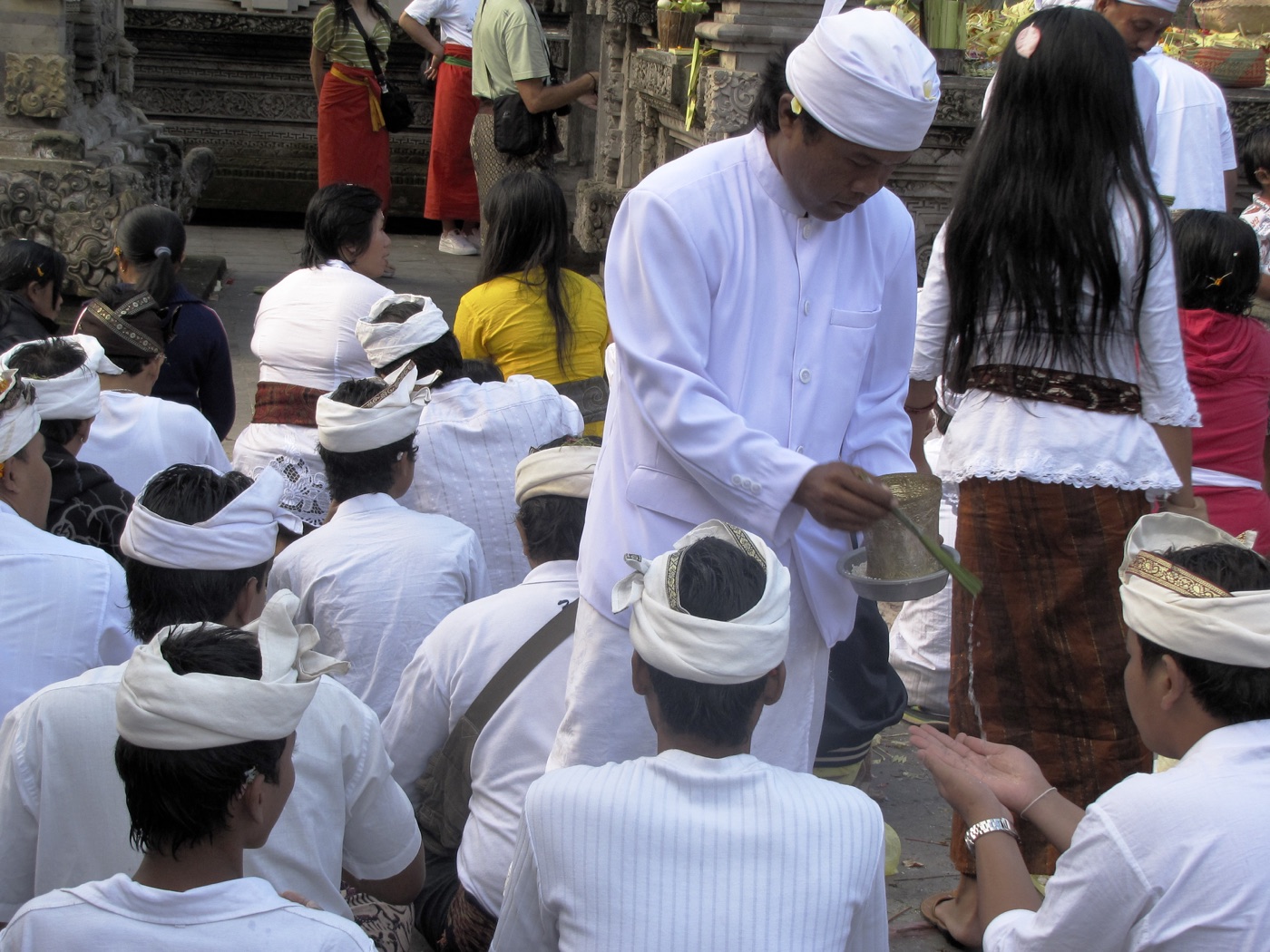 A priest brings holy water from the spring to worshippers at Pura Tirta Empul. Photo: Spencer Weart / Wikimedia Commons (CC BY-SA 3.0)

For a visitor, the natural way into a blessing is to join one on purpose. In the north, that usually means a melukat water purification, where a priest guides you through the springs and the prayers. Ask beforehand whether a tridatu is part of the blessing at the site you choose. The wider sequence of offerings, holy water and rice is explained in understanding Balinese ceremonies.
How Long You Wear It, and When It Falls Off
You do not take a tridatu off on purpose. You wear it day and night and let it wear thin, break, or slip off on its own.
What to do with the thread once it falls varies between families, so ask the family you are staying with or the priest who gave it.
Can Visitors Wear a Tridatu?
Yes. There is no prohibition on non-Hindus or people from outside Bali wearing one, and many visitors leave the island with a tridatu from a blessing. Balinese sources ask for a few things in return:
- Right wrist only. The tridatu is not worn on the left wrist like an ordinary accessory.
- Never on the ankle. Wearing it on the foot is taken as disrespect to the faith.
- Know what it is. A blessed thread from a temple carries more weight than a copy bought as a souvenir, and it is worth treating that way.
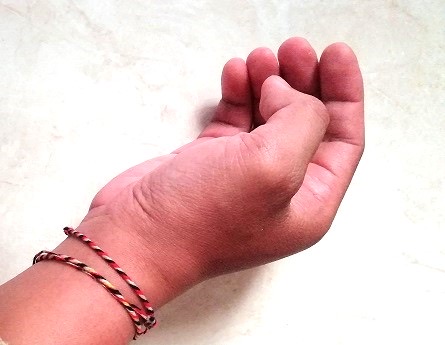 A tridatu worn as a bracelet. Photo: M. Adiputra / Wikimedia Commons (CC BY-SA 4.0)
Three-colour bracelets are also sold in souvenir shops, and some people wear them as fashion. What changes the meaning is where it came from: a thread given at a temple after prayer is a blessing. The general temple customs that go with receiving one are in our Bali temple etiquette guide.
Tridatu vs the Indian Red String
Anyone who knows India will recognise the idea. There, a protective thread called kautuka, and locally kalava, mauli or rakshasutra, is tied on the wrist by a priest or the eldest family member during a ritual. It is usually red, sometimes with yellow, and Indologists trace such threads back to the Vedic texts.
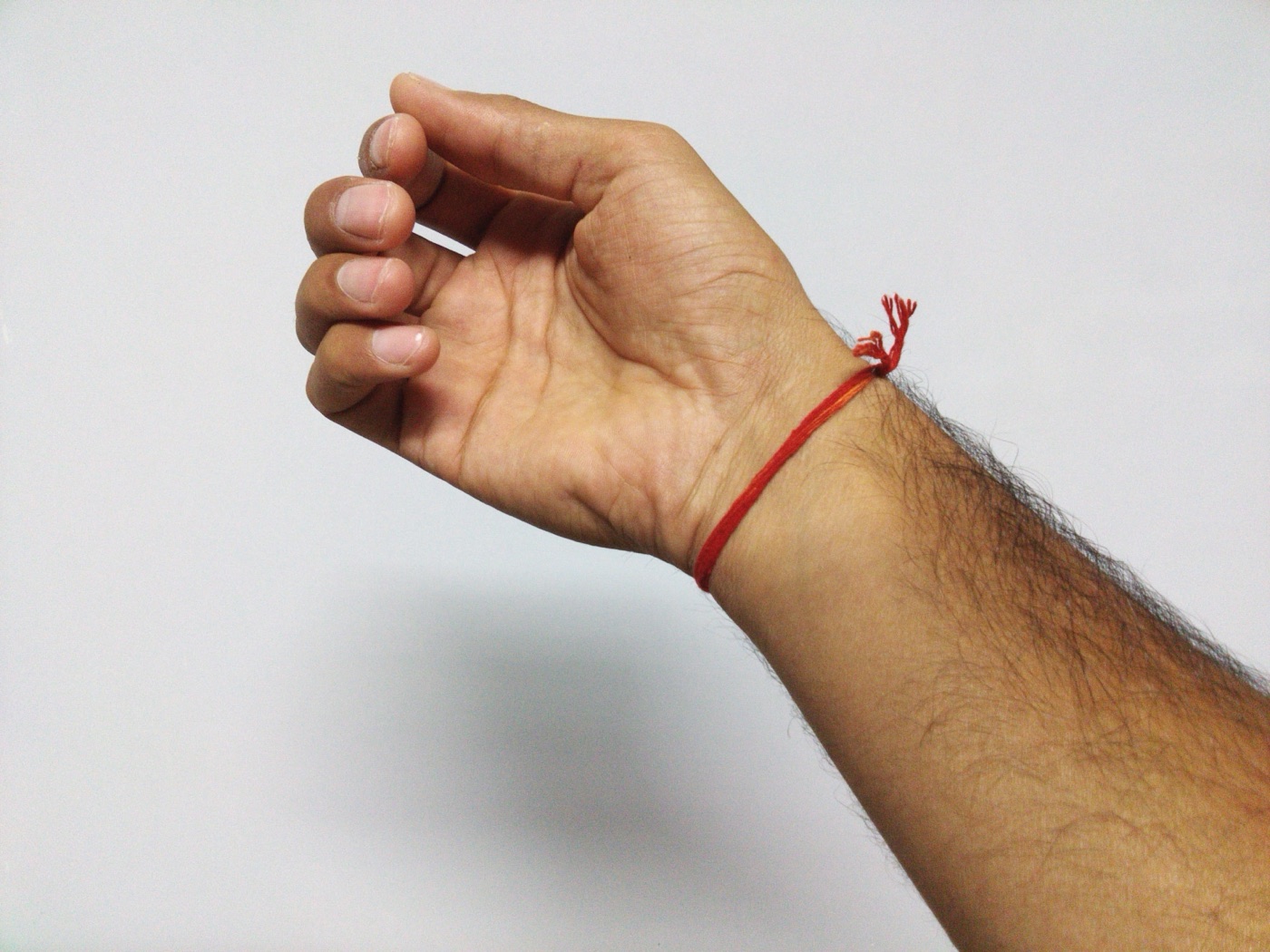 A red kalava, or mauli, tied on the right wrist in Indian Hindu practice. Photo: Aditya.Asopa / Wikimedia Commons (CC BY-SA 4.0)

The tridatu always carries three colours, one for each god of the Trimurti, where the kalava is mostly red and yellow. The Indian thread is traditionally worn on the right wrist by men and the left by women, while Balinese custom asks everyone to wear the tridatu on the right. For how Balinese Hinduism grew apart from Indian Hinduism over a thousand years, see Balinese Hinduism explained.
FAQ
What does a tridatu bracelet mean?
A tridatu is a blessed Balinese Hindu bracelet of red, white and black thread. The colours stand for the Trimurti: red for Brahma the creator, black for Vishnu the preserver and white for Shiva the dissolver. It is worn as a reminder of God and as protection.
Which wrist do you wear a tridatu on?
The right wrist. Balinese custom asks that the tridatu is never worn on the left wrist like an ordinary accessory, and never on the ankle.
Can you take off a tridatu bracelet?
The common custom is to leave it on and let it break or fall off by itself, rather than removing it on purpose.
Can tourists wear a tridatu?
Yes. There is no rule against non-Hindus wearing one. Wear it on the right wrist, never on the ankle, and treat a thread given at a temple as the blessing it is.
Where can I get a tridatu in north Bali?
The meaningful way is to receive one after prayers at a temple that gives them, or at a blessing your villa host or a local guide arranges for you. Three-colour bracelets are also sold as souvenirs, but those have not been blessed.
Is a tridatu the same as the Indian red string?
They are related ideas but different threads. The Indian kalava or mauli is mostly red and yellow and traditionally worn on the right wrist by men and the left by women. The Balinese tridatu has three colours for the three gods of the Trimurti and is worn on the right wrist by everyone.