
On this page
- In Brief
- Bali's Churches at a Glance
- Balinese Christians Founded Two Villages in the West
- Palasari: A Catholic Church With a Temple Gateway and Tiered Roofs
- Blimbingsari: A Protestant Church on a Temple's Three Courtyards
- The Forms of a Hindu Temple Serve a Christian Congregation
- How to Fit Them Into a West Bali Trip
- Practical Notes
- FAQ
- Sources
In Brief
Churches in Bali stand across the island, and two in the far west borrow the forms of a Balinese temple. One is in Blimbingsari, a Protestant village, and the other in Palasari, a Catholic one. Bali's Christian minority founded both villages, in Melaya district of Jembrana regency.
The roofed gateway, the tiered roof and the drum tower all appear here, so the churches read as temples to a different faith. They show how Balinese culture carries into a religion that came from elsewhere.
The villages sit beyond the northwest coast. They make an easy detour from a Pemuteran or West Bali trip.
Bali's Churches at a Glance
- The faith: Protestants and Catholics together are under 3% of Bali's people, against about 86% Hindu, by the Ministry of Religious Affairs' count
- The villages: Blimbingsari (Protestant) and Palasari (Catholic), in Melaya district, Jembrana, west Bali
- The churches: GKPB Pniel Blimbingsari and the Catholic Church of the Sacred Heart of Jesus (Hati Kudus Yesus), Palasari
- The draw: Temple forms in church architecture: a kori agung gateway, tiered meru-style roofs, a bale kulkul drum tower
- Combine with: Pemuteran, Menjangan, West Bali National Park
- Etiquette: Dress modestly, as these are active places of worship
- Best for: Travellers drawn to culture, architecture and Bali's religious history
Balinese Christians Founded Two Villages in the West
Bali's Christian community is small but old.
The island's identity is closely tied to its Hinduism, so Balinese Christians surprise many visitors. The main Protestant church is the Gereja Kristen Protestan di Bali, the GKPB. It dates its birth to 11 November 1931, as the Communion of Churches in Indonesia records.
On that day the Christian and Missionary Alliance baptised twelve Balinese at a small stream near Dalung, in Badung. The Alliance had sent an evangelist, Tsang To Hang, to Bali the year before. By the end of the decade there were Catholic families too, in southern villages such as Tuka.
The converts were few, and at the end of the 1930s both groups went west.
In 1939 a group of Balinese Protestants left their home villages and settled in dense forest in west Bali. Their settlement became Blimbingsari.
In 1940 Father Simon Buis SVD, a priest of Dutch descent, led Catholic families from Tuka, Beringkit and Gumbrih to forest land in Jembrana. By detikBali's account, the Raja of Jembrana gave the land. The families cleared it and named the place Palasari.
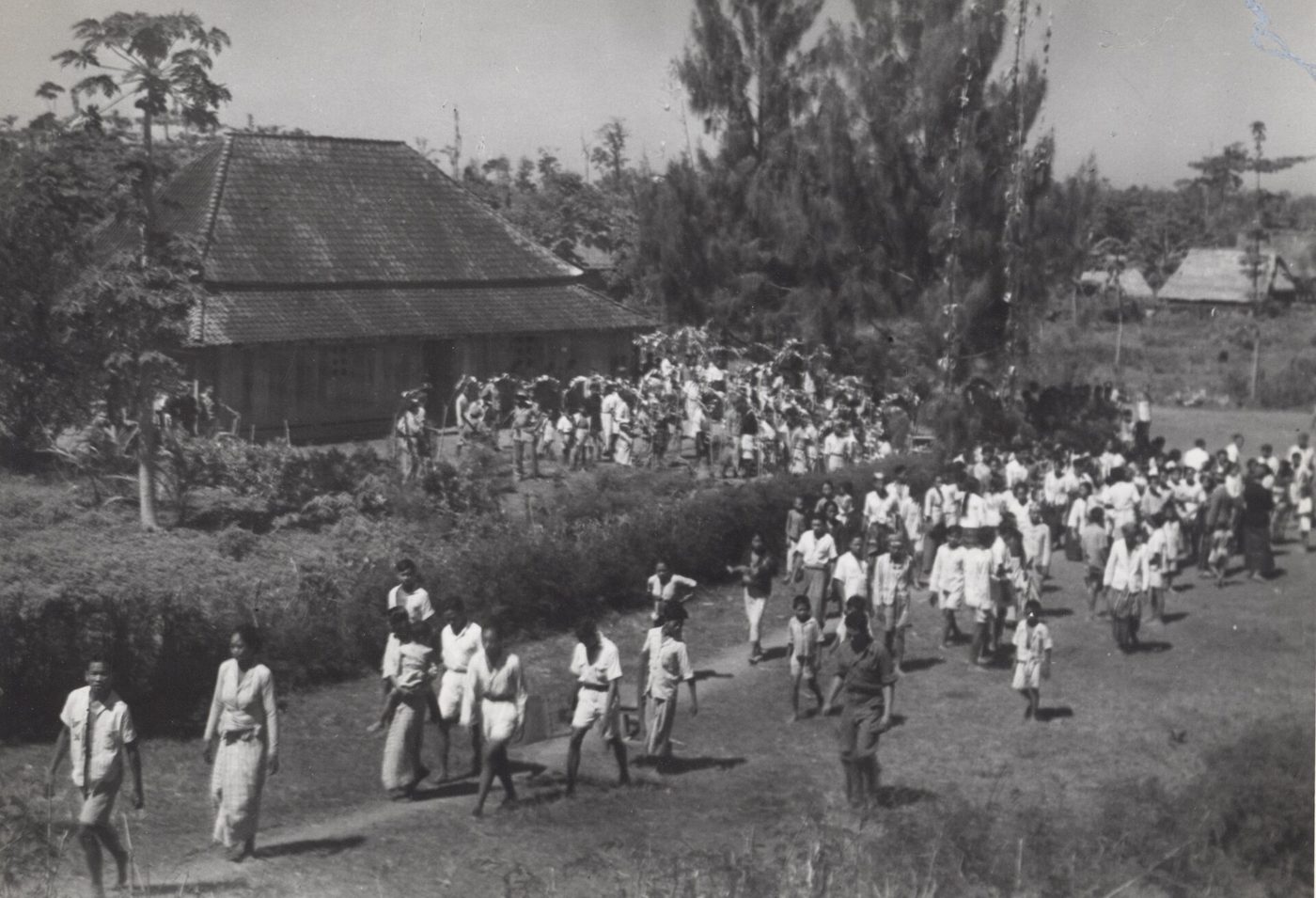 The first Protestant church at Blimbingsari, in an undated photograph from the Dutch colonial information service; the church standing today was built after an earthquake in 1971. Photo: Netherlands Indies Government Information Service / KITLV / Wikimedia Commons (CC BY 4.0)
Blimbingsari became the centre of the new Protestant church. Its first synod was held there in January 1948, and the name GKPB was adopted the following year.
The village is still mostly Christian. Palasari is now a hamlet of Ekasari, a village with a Hindu majority, and the two faiths live side by side.
Palasari: A Catholic Church With a Temple Gateway and Tiered Roofs
The Church of the Sacred Heart of Jesus stands on about three hectares in Ekasari village, roughly 20 kilometres northwest of Negara.
The first church was moved to its present site in 1947. The permanent building was started in 1955 to a design by a Dutch brother of the SVD order, Br. Ign. A.M.D. Vrieze, and consecrated on 13 December 1958.
It was fully rebuilt between 1992 and 1994 into the church you see now. The Bali heritage office has recorded it in its inventory.
The building is a meeting of two traditions. Olih Solihat Karso, a lecturer at the Indonesian Institute of the Arts in Denpasar, has studied it. The study describes the front as the silhouette of a kori agung, the roofed gateway of a Balinese temple or palace.
On top sits a bale kulkul, the tower that normally holds a village's wooden slit drum. Here it holds the church bell.
The roofs are tiered like the meru shrines of a temple. Three towers of three and two tiers stand for the Trinity and rise about 33 metres.
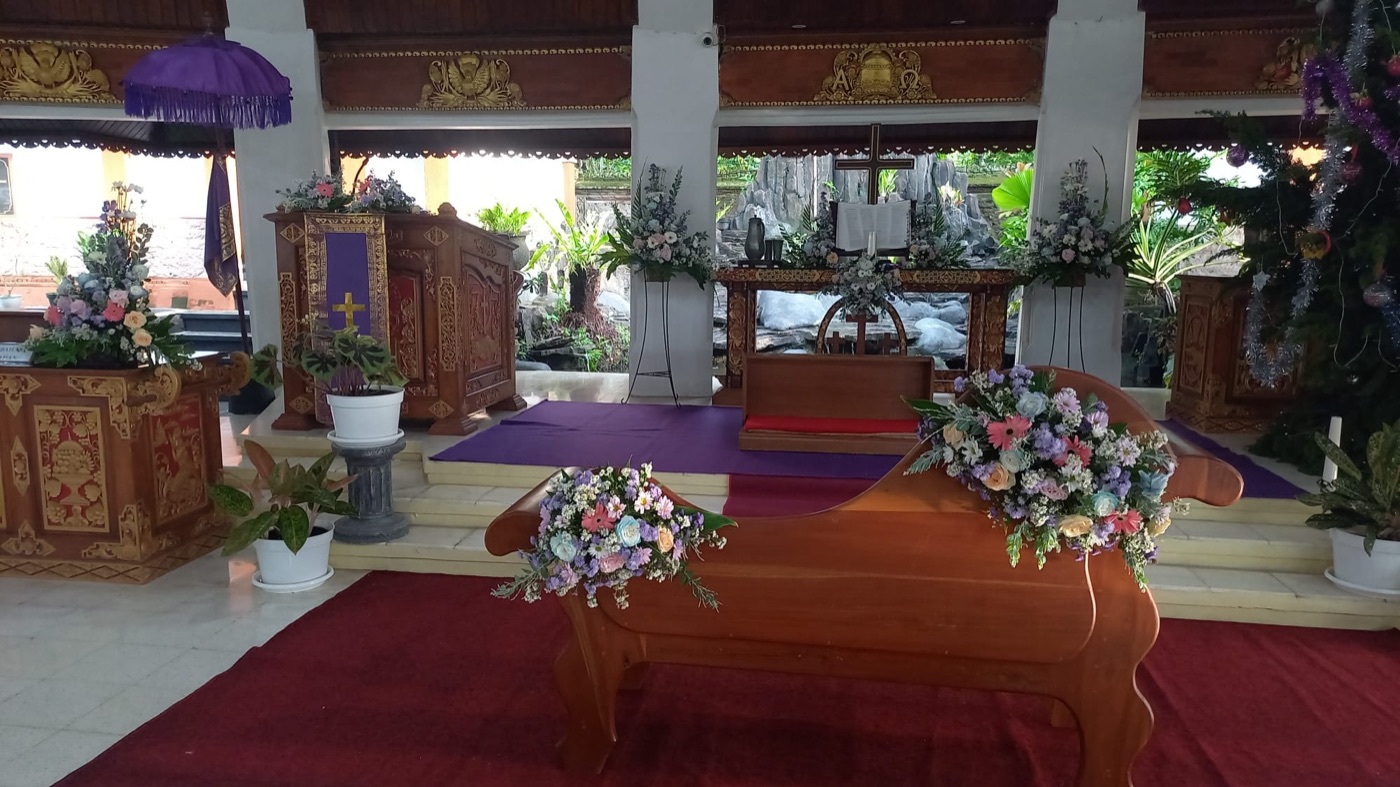
Inside, Gothic and Balinese forms share the same room:
- The arches are Gothic.
- The fourteen Stations of the Cross are carved with Balinese floral patterns.
- The statues of Mary and Jesus stand on seats shaped like the padmasana shrine.
- Ceremonial parasols flank the tabernacle.
The parish keeps its Balinese names and language. At the big festivals the congregation wears Balinese dress and puts up penjor, the tall bamboo poles of Galungan.
Where: Jalan Gereja, Palasari, Ekasari village, Melaya, Jembrana. Map
Blimbingsari: A Protestant Church on a Temple's Three Courtyards
GKPB Pniel stands on raised ground at a corner of Blimbingsari's main crossroads, facing south across to the village office.
An earthquake brought down the first church in 1971. The congregation rebuilt it on the plan of a Balinese temple, which is why people call it the pura gereja, the temple church.
The grounds follow the tri mandala, the three courtyards of a temple. The outer yard holds the pastor's house and the church office. A candi bentar, the split gate, leads into the middle yard, and the church itself stands in the inner yard.
The main door is a candi kurung, a roofed gateway. The building is of padas stone and red brick, carved with Balinese reliefs, and it has a bale kulkul too.
At services the congregation wears the dress people wear to a temple, and gamelan accompanies the liturgy, as detikBali reports.
The village around the church is quiet and ordered. In 2017 it won a national award for community-based tourism.
Where: Blimbingsari village, Melaya, Jembrana. Map
The Forms of a Hindu Temple Serve a Christian Congregation
New things are often taken in on this island and given a Balinese form.
The carving, the gateways, the courtyards and the drum tower here are the ones that shape a Hindu temple. In these two villages they serve a Christian congregation, and the people inside still dress, speak and celebrate as Balinese.
For a visitor, the two churches are a reminder that Bali's spiritual life is broader than the postcard. The Buddhist monastery at Brahma Vihara Arama near Lovina and the temples on Menjangan show the same breadth.
The Hindu background is in Balinese Hinduism explained. The temple forms these churches borrow are explained in traditional Balinese architecture.
How to Fit Them Into a West Bali Trip
Both villages are in Jembrana, in the west, beyond the northwest coast.
They pair naturally with a trip to Pemuteran, Menjangan or the West Bali National Park. They are off the standard tourist circuit, which is part of their calm.
A private driver is the practical way to reach them.
Practical Notes
- When to go: Daytime. Come outside service times to look around quietly, or at a service to see the community at worship.
- Busiest day: Sunday, with worshippers.
- Festivals: Christmas and Easter bring the churches' own festivals, with the congregations in Balinese dress.
- Season: The dry season, roughly April to October, makes the western drive easiest.
- Dress: Modestly, with shoulders and knees covered, as at any place of worship.
- Inside: Keep your voice low and be discreet with photography, especially during services.
- As a guest: These are living community churches, and visitors are their guests.
FAQ
Are there churches in Bali? Yes. Bali is about 86% Hindu, but Protestants and Catholics together make up under 3% of its people, and there are churches across the island. Two of the most distinctive are in the Christian villages of Blimbingsari (Protestant) and Palasari (Catholic) in Jembrana, west Bali.
Why are Bali's churches built like temples? Balinese Christians kept their own architecture. Palasari's church has the roofed gateway, bell tower and tiered roofs of a Balinese temple over a Gothic interior. Blimbingsari's church was rebuilt after a 1971 earthquake on a temple's three-courtyard plan, with a split gate and a drum tower.
Where are the Christian villages in Bali? Blimbingsari and Palasari, both in Melaya district, Jembrana regency, in west Bali. Blimbingsari was settled by Balinese Protestants in 1939, and Palasari by Catholic families led by Father Simon Buis in 1940.
Can tourists visit Bali's churches? Yes, respectfully. Dress modestly, keep quiet, and be discreet with photography, especially during services. They are active community churches.
Where can I go to Mass or a church service in Bali? Catholic parishes across the island belong to the Diocese of Denpasar, whose website carries parish news. Most Balinese Protestant congregations belong to the GKPB synod, listed by the Communion of Churches in Indonesia. Ask the parish or congregation directly for current service times.
How do you get to Palasari and Blimbingsari? They are in the west, an add-on to a Pemuteran, Menjangan or West Bali National Park trip. A private driver is the practical way, since they are off the main routes.
Sources
- detikBali, Sejarah-keunikan Gereja Palasari Jembrana yang kental adat Bali, 24 December 2022 (the land grant and the families, Ekasari's Hindu majority, the move in 1947, construction from 1955, the architect, the 1958 consecration, heritage listing, Balinese customs), in Indonesian, read September 2026
- Olih Solihat Karso, Indonesian Institute of the Arts Denpasar, Inkulturasi Gereja Katolik Hati Kudus Yesus Palasari (founding, location, the 1992 to 1994 rebuilding, the facade, roofs, interior and liturgy), in Indonesian, read September 2026
- detikBali, Gereja berarsitektur Bali dan jejak komunitas Kristen di Blimbingsari, 25 December 2025 (settlement in 1939, the 1971 earthquake, the tri mandala plan, materials, worship, the tourism award), in Indonesian, read September 2026
- Communion of Churches in Indonesia (PGI), Gereja Kristen Protestan di Bali (GKPB) (the 1931 baptism, the 1948 synod at Blimbingsari, the church's name), in Indonesian, read September 2026
- Katadata Databoks, 86.5% of Bali's population is Hindu (Ministry of Religious Affairs figures by religion), read September 2026
- Diocese of Denpasar, website, read September 2026
Read next: Brahma Vihara Arama, Pemuteran and West Bali National Park.