_on_the_road_along_Kuta_Beach.jpg)
On this page
In Brief
A dokar is Bali's traditional horse-drawn cart: one small horse, usually from Sumba, pulling a light two-wheeled carriage with bench seats for three or four passengers and bells on the harness. It was the island's everyday transport through the colonial era and into the 1970s, when Denpasar alone had hundreds. Motorbikes, cars and the cost of feeding a horse have cut the trade to a few dozen carts, found in four places: by Pasar Anyar market in Singaraja in north Bali, around Pasar Badung and Terminal Tegal in Denpasar (where the city runs a free heritage tour by dokar), on the Kuta beach road, and outside the art market in Semarapura, Klungkung. The drivers are mostly older men who took over from their fathers, and the horses' welfare is a fair question to ask.
The Dokar at a Glance
- What it is: A two-wheeled cart pulled by one horse, with facing bench seats, entered from the back
- Also called: Delman or andong elsewhere in Indonesia; cidomo on Lombok
- The horses: Small horses, typically brought from Sumba, since Bali breeds few
- Where to find one: Pasar Anyar, Singaraja; Pasar Badung, Terminal Tegal and Jalan Kaliasem, Denpasar; the Kuta beach road; Pasar Seni, Semarapura
- When: Market carts work the early morning; Kuta's tourist carts work mostly from late afternoon
- How to pay: Cash, agreed with the driver before you set off, by distance and load
- In north Bali: Singaraja's carts have carried visitors at the Buleleng Festival in August
What a Dokar Is
Horse carts go by different names across Indonesia, and dokar is the one used mostly on Bali. The carriage is pulled by a single horse and painted in bright colours, with tassels and bells on the harness. Most seat up to four people on two benches along the sides, facing each other, and you climb in from the back. The wheels are wooden and spoked, and the driver, the kusir, sits up front on the shaft.
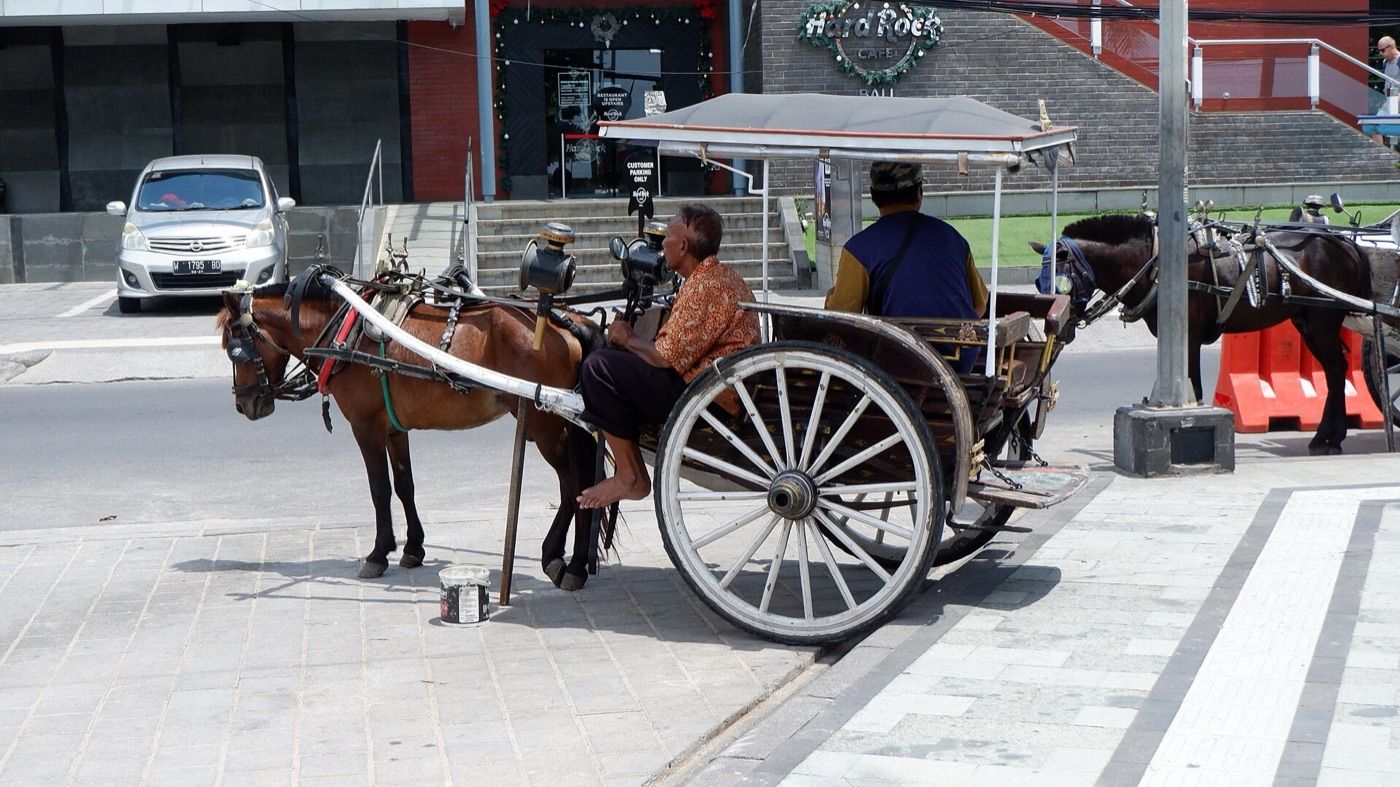 A dokar and its driver waiting for passengers on the road along Kuta Beach. Photo: Alharomain354 / Wikimedia Commons (CC BY-SA 4.0)
A dokar carries whatever the market needs carried. Singaraja's drivers load sacks of vegetables beside their passengers, take families on a short ride for the children's sake, and hire out for weddings as a seasonal job, with the fare agreed by distance and by what the horse can pull. In the words of one Singaraja kusir, it is a horse and not an engine, so the fare depends on the distance.
A Short History
The dokar was Bali's public transport long before it was a curiosity. Denpasar's tourism office cites Dutch records of as many as 261 dokar working the city in the colonial period, each driver in traditional dress with a whip, the carts jingling with bells on both sides. The 1960s were the golden age: Denpasar's drivers had their own union, Perdoden. Then, as motorbikes and cars spread under the New Order government, the carts thinned out.
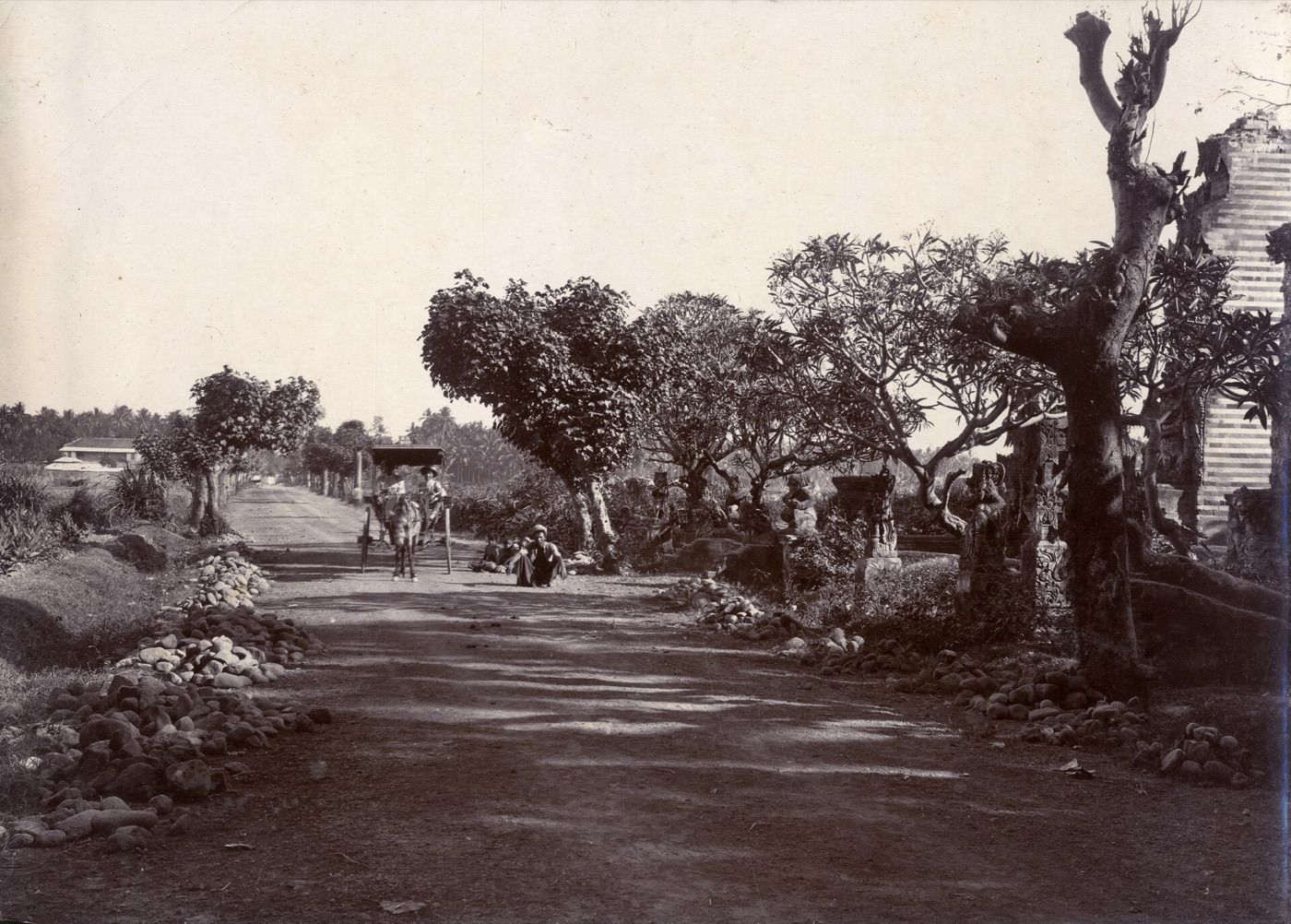 A horse carriage on a Bali road, photographed around 1918. Photo: Unknown author, KITLV / Wikimedia Commons (CC BY 4.0)
In the north, Koran Buleleng, Singaraja's local paper, writes that dokar were working the city in its days as a thriving trading port, long before Singaraja became the seat of government of Sunda Kecil. The history of the port and the old town is in Singaraja old town and the history of north Bali.
The numbers tell the rest. In 2013 an old Denpasar driver, Nengah Purno, told The Jakarta Post there had been hundreds of carts in Sukarno's time and only fifteen horsemen left. In Semarapura, the driver I Wayan Dunung, who started in 1973, remembered hundreds of carts in the 1970s and about forty in 1993; by the time NusaBali met him outside the art market, he and one other driver were what remained.
The cart even has its own song: Kusir Dokar, about the driver's working life, by Anak Agung Made Cakra, the first star of Balinese-language pop (see Balinese songs).
Where Dokar Still Run
Singaraja, north Bali
Singaraja's dokar stand is on Jalan Diponegoro by the north gate of Pasar Anyar, the city's main market. Koran Buleleng counted three carts waiting there one morning in January 2021. One driver, Ketut Siara, said there had been many more twenty-five years earlier, that many drivers had died without anyone taking their place, and that he waited from about five until nine in the morning for a passenger or two.
Komang Yasa, from the village of Jinengdalem in Buleleng, has driven a dokar since 1985. His father drove one in the colonial years. When the Singaraja news site Tatkala spent a morning with him in March 2025, he had parked from five in the morning outside the shops on Jalan Diponegoro, watered his horse with a bucket from behind the market, fed it grass from a sack under the seat, and by the time they spoke he had carried two fares. He told the reporter he never works a sick horse and retires them at about ten years old.
The regency has started to put the carts back in front of people. For the Buleleng Festival in August 2025, the transport office ran free minibuses and two dokar to the festival grounds, and paid the drivers the same daily incentive as the minibus drivers. In August 2026 the festival took "Buleleng of the old days" as its theme and replaced the free minibuses with two dokar circling the festival area, which the head of the transport office described as a way to introduce the next generation to the carts. Komang Yasa was one of the drivers, and told Singaraja FM he hoped the dokar would keep a place in the regency's cultural events. The festival itself is in the Buleleng Festival guide.
Denpasar
In Denpasar the carts wait around the Titik Nol area of Jalan Kaliasem, Pasar Badung and Terminal Tegal. NusaBali found six to eight still working in December 2025. One of them, Wayan Pinet from Karangasem, has driven since 1985 and said there were once about four hundred. His passengers now mostly want a slow tour of the city; few use the cart to carry goods home.
The city government uses exactly that. Its Madokaran programme, part of the Denpasar Heritage City Tour run by the city's tourism office, takes visitors by dokar on two loops from Terminal Tegal and Pasar Badung past the palaces, temples and old trading streets of the Gajah Mada heritage district. Days, hours and routes are on the Madokaran page of Denpasar Tourism.
Kuta
Kuta's carts turned to tourism early. In 2013 The Jakarta Post found 42 carts working the beachfront under a drivers' association that capped the number, made each horse take fares in turn, collected all dung from the street and suspended any driver who broke the rules for two days. Carts still wait along Jalan Pantai Kuta, and NusaBali found them waiting outside the Hard Rock Cafe in the quiet, rainy months after November 2025, working mostly from late afternoon into the evening, with fewer passengers than in the busy season.
Klungkung
In Semarapura, the old royal town of Klungkung, the last carts wait outside the Pasar Seni on Jalan Puputan. The regulars are local women who ride home from the market, one of whom told NusaBali she had ridden home in a dokar with her mother as a child.
The Horses and Their Welfare
The horses are small Sumba horses. Bali has few horse farms, so they are brought from outside the island, which Koran Buleleng names as one reason the trade is shrinking. Feeding them is the other. Nengah Purno in Denpasar used to cut free grass along the rice fields on his way to the market; by 2013 the fields were under houses. The Kuta drivers told The Jakarta Post they buy cut grass mixed with rice husks, and that a horse works about four hours a day. Denpasar's Wayan Pinet adds bran and eggs to the grass and counts the cost of feed as one reason young men do not take up the work.
Not every cart horse is well kept, and welfare groups have said so. The Jakarta Animal Aid Network toured Java, Bali and Lombok in 2010 and 2011 and treated horses in Kuta among other places; it describes horses pushed past their limits by owners with little training in their care. Indonesia's agriculture ministry has published a guide to the welfare of working horses, covering handling, feed and water, stabling, health, transport and the end of a horse's working life, and its library notes that the new national Criminal Code, Law No. 1 of 2023, carries articles on cruelty to animals.
Some of that you can see from the kerb. A horse that is thin, lame, sweating hard in the midday sun or carrying sores under the harness is a reason to walk on. A short ride in the cool of the morning, with a light load, suits the horse best.
How to Fit It In
In the north, a dokar belongs to an early morning in Singaraja's old town: walk from the old harbour through Pasar Anyar while it is busiest, and the carts stand on Jalan Diponegoro by the market's north gate. A route for the rest of the morning is in Singaraja old town, and more for the day in things to do in north Bali. For the wider culture, start with Balinese culture and Buleleng regency explained.
Singaraja is a short drive east of Lovina, where most of Palm Living's villas are, so the market fits before breakfast. For a driver for the day, see private drivers in north Bali.
Practical Notes
- Go early. Market dokar work from dawn and are usually gone by mid-morning.
- Agree the fare first, in cash, for the route and the number of people. Drivers set it by distance and load.
- Keep the load light and look at the horse before you get in.
- Ask before photographing the driver. Most are happy to talk about the horse.
- In Denpasar, check the city's Madokaran page for the free heritage route.
FAQ
What is a dokar in Bali? A dokar is Bali's traditional horse cart: one small horse pulling a two-wheeled carriage with facing bench seats for three or four passengers. It was the island's main public transport through the colonial period and into the 1970s, and today survives around a few markets and on the Kuta beach road.
Where can I ride a dokar in Bali? Outside Pasar Anyar in Singaraja in the early morning; around Pasar Badung, Terminal Tegal and Jalan Kaliasem in Denpasar, where the city runs the Madokaran heritage tour; along the beach road in Kuta; and outside the Pasar Seni in Semarapura, Klungkung. The number of carts is small everywhere, so none is guaranteed on a given day.
Is there a dokar in north Bali? Yes. A few drivers still work from the stand on Jalan Diponegoro by Pasar Anyar in Singaraja, mostly in the early morning, and the Buleleng government has brought dokar to the Buleleng Festival in August to carry visitors.
What is the difference between a dokar and a delman or cidomo? They are regional names for the same kind of horse cart. Dokar is the name mostly used on Bali, delman and andong are other regional names, and cidomo is Lombok's version, which runs on pneumatic tyres where most others use wooden wheels.
Is it cruel to ride a dokar? It depends on the horse and how it is kept. Welfare groups have raised concerns about overworked and underfed carriage horses in Indonesia, and one has treated horses in Kuta, while the drivers quoted here describe watering, resting and retiring their horses. Look at the horse before you ride, keep the ride short and the load light, and walk on if the animal looks thin, lame or sore.
Why are dokar disappearing? Motorbikes and cars are faster, horses have to be brought from outside Bali, grass is harder to find as rice fields become housing, and few young men want to take over from their fathers. Singaraja's drivers name all four.
Sources
- Tatkala, Komang Yasa, loyal to the dokar in Singaraja, March 2025, for the Pasar Anyar stand, his years as a driver, his father, the horse's care and retirement, read September 2026 (in Indonesian)
- Koran Buleleng, Cerita dokar hari ini, January 2021, for the dokar in Singaraja's trading-port era, the Jalan Diponegoro stand, Ketut Siara and the reasons for the decline, read September 2026 (in Indonesian)
- Bali Post, Dokar and free minibuses at Bulfest, August 2025, and Bulfest brings back the old days with dokar, August 2026, for the transport office's use of dokar at the festival, read September 2026 (in Indonesian)
- Buleleng Regency, Bulfest revives the taste of old Buleleng, August 2026, for the festival's heritage theme, read September 2026 (in Indonesian)
- Singaraja FM, Dokar at the Buleleng Festival, August 2026, for Komang Yasa of Jinengdalem, read September 2026 (in Indonesian)
- Denpasar Tourism, Madokaran in Denpasar, for the colonial records, the 1960s and Perdoden, and the heritage tour, read September 2026 (in English and Indonesian)
- NusaBali, Only eight dokar left in Denpasar, December 2025; Kuta's dokar hold on; and Dokar in Klungkung refuse to die out, read September 2026 (in Indonesian)
- The Jakarta Post, The last horsemen of Denpasar, December 2013, for Nengah Purno, the Kuta drivers' rules, Sumba horses and feed, read September 2026 (in English)
- Wikipedia, Cidomo, for the regional names and the design of the cart, read September 2026 (in English)
- Jakarta Animal Aid Network, Aid for carriage horses, for the welfare tours of 2010 and 2011, read September 2026 (in English)
- Ministry of Agriculture library, Animal welfare in working horses, for the working-horse welfare guide and the Criminal Code articles, read September 2026 (in Indonesian)
Read next: Singaraja old town, the Buleleng Festival and Balinese songs.