
On this page
In Brief
Traditional Balinese songs are called tembang, and Balinese literature sorts them into four kinds. Sekar rare are the simple children's and folk songs. Sekar alit are the verse forms called pupuh or macapat, bound by rules of line length and final vowel. Sekar madya are the kidung sung at ceremonies, and sekar agung are the kakawin, Old Javanese poems sung to classical metres. The songs most people know are children's songs such as Meong-Meong and Putri Cening Ayu, the call-and-response songs of the janger dance, and pop Bali songs such as Bungan Sandat. Sacred singing belongs to every ceremony, and in north Bali village clubs called sekaa santi sing and interpret the old texts at rites across the regency. Singing has a long record here: an inscription of 896 found at Bebetin in Buleleng already lists singers among the village's people.
Balinese Songs at a Glance
- What they are called: tembang for sung poetry in general; gending or gegendingan for folk and children's songs
- The four kinds: sekar rare, sekar alit, sekar madya, sekar agung
- Languages: everyday Balinese for children's songs; mostly Middle Javanese and refined Balinese for kidung; Old Javanese for kakawin
- Songs to know: Meong-Meong, Putri Cening Ayu, Ratu Anom, Galang Bulan, Bungan Sandat
- Where they live: temple ceremonies, the banjar hall, schools and competitions, and the stage
- In the north: sekaa santi sing at rites in villages such as Tajun, Penarukan, Sawan, Kubutambahan and Busungbiu
The Four Kinds of Tembang
The building of a Balinese song, its wangun tembang, falls into four kinds (detikBali). Singaraja's Banyuasri ward office has published a fuller account in Balinese, with examples of each (Kelurahan Banyuasri).
Sekar rare: children's and folk songs
The oldest layer, sung by children at play or by adults to lull a baby to sleep. The words are everyday Balinese, the lessons are simple, and many of the songs have no title. They are built like a Malay pantun: the first lines set up a sound, the last lines carry the meaning. The Banyuasri account lists Meong-Meong, Juru Pencar, Ratu Anom, Made Cenik and Guak Maling Taluh among them.
Two relatives belong to the same old family. The gending janger are cheerful songs for the janger dance, among them Don Dapdape, Bungan Seruni and Galang Bulan. The gending sanghyang, such as Kukus Arum and Sekar Gadung, are sung to bring down the spirits of the sanghyang trance dances and are among the most sacred songs in Bali.
Sekar alit: pupuh and macapat
Here the rules begin. Each pupuh fixes three things: the number of lines in a verse, the number of syllables in a line, and the vowel each line ends on. A song sung with the wrong syllable count is called ngelung; with the wrong final vowel, ngandang. The palm-leaf treatise Gitasancaya lists forty-two pupuh, and ten are in common use: Sinom, Semarandana, Mijil, Maskumambang, Pangkur, Pucung, Ginada, Ginanti, Dangdang Gula and Durma.
A long story told in pupuh is a geguritan, a form that grew at the Klungkung court from around the seventeenth century. The north's own tragedy, the story of Jayaprana and Layonsari, is sung as the Geguritan Jayaprana, in pupuh Ginada. Learners start with the plain melody, paca paliring, and only later add the ornaments and turns called nyengkok wilet.
Sekar madya: kidung
Kidung are songs of praise, mostly in Middle Javanese and refined Balinese, sung during ceremonies. Each kind of rite has its own: there are kidung for the gods, for sages and priests, for the passages of human life, for the dead and for the spirits below, matching the five kinds of yadnya. Kidung Wargasari is often sung as a prayer procession begins (detikBali). Kidung singers do not pause at the end of a line, so the verse flows on.
Sekar agung: kakawin
The grandest form: Old Javanese poetry sung to metres drawn from Sanskrit poetry, called wirama in Bali, with names such as Sronca and Basantilaka. A verse usually has four lines, each with its own name, and the pattern of long and short syllables, guru and laghu, is fixed. The Banyuasri account names the classics: the Bharatayuddha of Mpu Sedah and Mpu Panuluh, the Siwaratrikalpa of Mpu Tanakung and the Negarakertagama of Prapanca.
 Leaves of a lontar of the Kakawin Bharata Yuda, kept in Sukawati. Photo: Eka343 / Wikimedia Commons (CC BY-SA 4.0)

Well-Known Balinese Songs
Meong-Meong
Meong is the cat. The song goes with a children's game: the players form a circle, one child plays the cat and another the mouse, and everyone sings. Palm Living's Bali Information describes the game and notes that it teaches teamwork, among other values.
Putri Cening Ayu
A mother and her little daughter talk before the mother goes to market: she asks the child to stay home and wait patiently until she comes back (detikBali). The song is about the love running both ways between them, and it is one of the old songs Bali Information lists as often heard in instrumental versions.
Ratu Anom
A children's song with advice for the young: face life with confidence and do not give in to laziness, in Bali Information's reading. Banyuasri's account lists it among the classic children's songs.
The janger songs
Janger is a social dance for young people in which rows of girls, the janger, sit facing rows of boys, the kecak, and sing to each other. A singer with a trusted voice starts each song, the rows answer, and then, on the same melody, they swap the words for syllables, jangi janger against the boys' tecak. The songs belong to the children's song family and grew out of the songs of the sanghyang rituals (Desak Made Suarti Laksmi, ISI Denpasar).
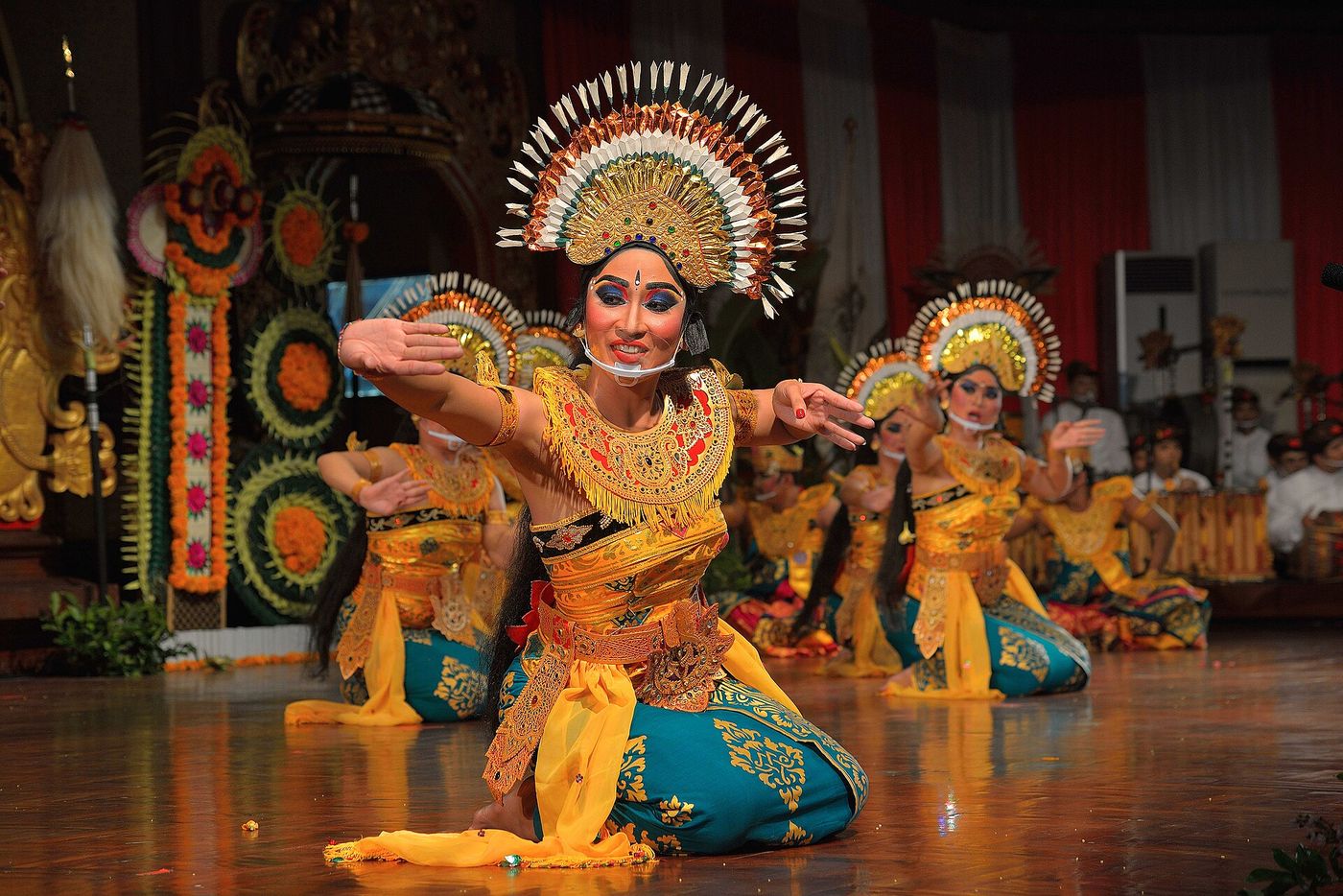 Janger dancers on stage. Photo: Hendri Suhandi / Wikimedia Commons (CC BY-SA 4.0)
Janger dates to the late 1920s and was at its height in the 1940s and 1950s. Its lyrics praise beauty and unity, and they bend easily to a message: in the mid-1960s rival political parties used janger to rally supporters, and it later carried messages on family planning and legal awareness. Where it began is disputed. Laksmi's paper records claims for the north, the south and Nusa Penida, and one account, attributed to I Made Kredek, places its start in Menyali in north Bali, with songs taken from the local horse drivers.
Bungan Sandat and pop Bali
Bali has its own pop music, sung in Balinese, and its first recorded star was Anak Agung Made Cakra (1929 to 1999), who cut the first pop Bali recording in 1976 for the Bali Record label (NusaBali). His songs took ordinary lives as their subjects, the horse-cart driver of Kusir Dokar and the minibus driver of Sopir Bemo, and he wrote them in the Balinese pelog and slendro scales, slow at the start, quick in the refrain, then slow again. His Bungan Sandat compares a life to the sandat flower, which keeps its scent even after it wilts; in Bali Information's reading, goodness is what lasts after beauty fades.
Songs for the Gods
A Balinese ceremony is made of five sounds, the panca gita: the priest's bell, the wooden slit drum called kulkul, the gamelan, the mantra and the kidung. The voice is one of the five (I Wayan Mudana, Undiksha).
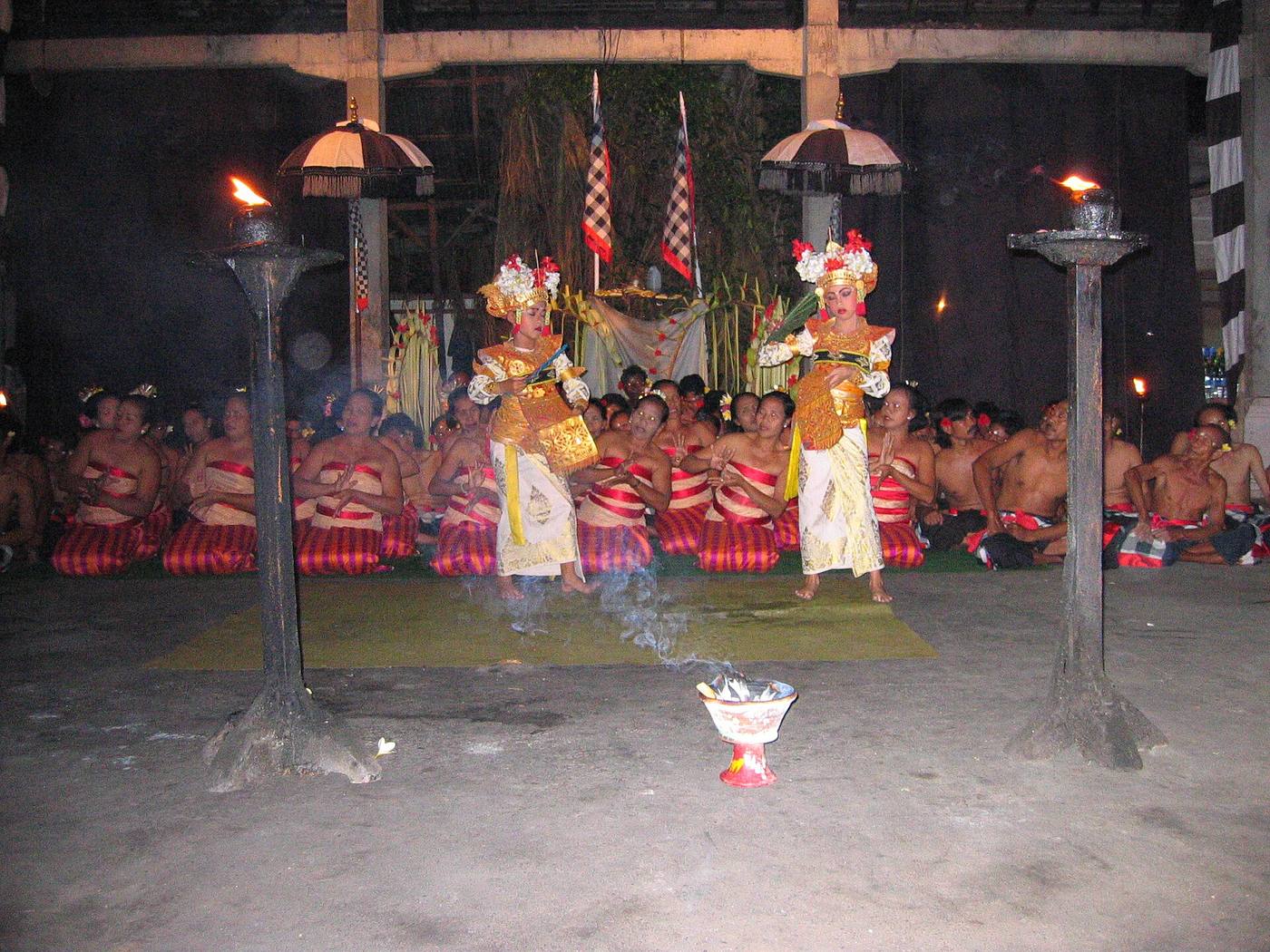 Sanghyang dedari dancers between the women's and men's choirs. Photo: casey yancey / Wikimedia Commons (CC BY 2.0)

In the sanghyang dances, the choirs sing the sanghyang songs that call the spirits down. On the stage, the sung drama called arja is accompanied by a soft gamelan, the geguntangan, kept quiet so that every word of the singing can be heard (ISI Denpasar notes). The gamelan side of Balinese music is covered in Balinese gamelan.
How Songs Live in the Banjar
In north Bali, rituals are generally accompanied by song, and the singers are usually a sekaa santi, a club of people who love the old literature and meet to sing it. Santi means calm and peace. The practice was once called mabebasan or mapepaosan, and since the 1980s it has been known as pesantian: members sing a passage of an old text and then give its meaning, working through the Ramayana, the Mahabharata, the Arjuna Wiwaha, the Sutasoma and the Bhagavad Gita (Mudana, Undiksha).
Sekaa santi sing at rites in Tajun, Penarukan, Baktiseraga, Busungbiu, Kubutambahan, Sawan and Bontihing, for the customary village, for the subak and for the wider community, and they do it as ngayah, service given freely. Buleleng's culture office holds a pesantian contest for young people each year as part of Singaraja's anniversary, and children learn the songs at the pasraman, the religious schools each customary village runs in the school holidays. Beyond the regency, the Ministry of Religious Affairs holds the Utsawa Dharma Gita, a festival and contest of sacred song that began as Bali's own kakawin and kidung competitions.
The north has been singing a long time. The inscription of 896 from Bebetin, in the Sawan district, lists pagending, singers, beside the village's gamelan players and puppeteers (Sawan district). Palm-leaf manuscripts of Balinese literature are kept and recopied at Gedong Kirtya, the lontar library in Singaraja.
Where to Hear Balinese Songs
- At a temple ceremony. Kidung are sung during the prayers; stay at the back in temple dress and follow Bali temple etiquette.
- At a cremation or a life rite. Kidung and kakawin go with the rites of the dead and the living; see Balinese ceremonies.
- In the village. Sekaa santi belong to the banjar and the customary village, and your host will know when one is singing; the banjar guide explains how a village is organised.
- On stage. Janger and arja are performed by village troupes; ask your host whether one is playing nearby.
- In shops and restaurants. Old songs such as Putri Cening Ayu play as bamboo-flute instrumentals, as Bali Information notes.
FAQ
What are traditional Balinese songs called? Tembang. They fall into four kinds: sekar rare (children's and folk songs), sekar alit (pupuh or macapat), sekar madya (kidung) and sekar agung (kakawin). Folk and children's songs are also called gending or gegendingan.
What are the most famous Balinese songs? Among children's and folk songs, Meong-Meong, Putri Cening Ayu, Ratu Anom and the janger songs such as Galang Bulan. In pop Bali, Anak Agung Made Cakra's Bungan Sandat and Kusir Dokar. At ceremonies, Kidung Wargasari often opens the prayers.
What is the song Putri Cening Ayu about? A mother tells her young daughter to stay home and wait patiently while she goes to the market. It is a song about the love between mother and child, often heard in instrumental versions.
What is the difference between kidung and kakawin? Kidung are songs of praise, mostly in Middle Javanese and refined Balinese, matched to each kind of ceremony. Kakawin are poems in Old Javanese, sung to strict classical metres of long and short syllables, such as the Bharatayuddha and the Ramayana.
What is pupuh? A Balinese verse form, also called macapat or sekar alit, with fixed rules for the number of lines in a verse, the syllables in a line and the vowel each line ends on. Ten pupuh are in common use, among them Sinom, Ginada and Durma.
Who sings at Balinese ceremonies? Members of the community, often organised as a sekaa santi, a club that sings kidung and kakawin and explains their meaning. Singing is one of the five sounds that complete a ceremony, with the priest's bell, the kulkul, the gamelan and the mantra.
Sources
- detikBali, Mengenal sekar rare, sekar alit, sekar madia, dan sekar agung, for the four kinds and Kidung Wargasari, read September 2026 (in Indonesian)
- Kelurahan Banyuasri, Buleleng Regency, Ajah-ajahan budi pekerti ring sajeroning gending rare, for the children's, janger and sanghyang songs, the pupuh rules, geguritan and the kakawin classics, read September 2026 (in Balinese)
- I Wayan Mudana, Universitas Pendidikan Ganesha, Peranan sekaa santi dalam pengembangan budaya literasi masyarakat Bali Utara, 2025, for sekaa santi in north Bali, the panca gita and pesantian, read September 2026 (in Indonesian)
- Desak Made Suarti Laksmi, Janger Bali: sejarah dan popularitasnya, Journal of Music Science, Technology, and Industry, ISI Denpasar, 2022, read September 2026 (in Indonesian)
- Wikipedia, Janger dance, for I Made Kredek's account of Menyali, and Kakawin, for the Sanskrit metres, read September 2026 (in English)
- detikBali, Lirik lagu Putri Cening Ayu, for the song's story, read September 2026 (in Indonesian)
- NusaBali, Melegenda, AA Made Cakra rekam persoalan masyarakat dalam lagunya, read September 2026 (in Indonesian)
- Ministry of Religious Affairs, Directorate General of Hindu Community Guidance, Sejarah pelaksanaan Utsawa Dharma Gita, read September 2026 (in Indonesian)
- ISI Denpasar student blog, Nada dan laras karawitan Bali, for arja and its geguntangan, read September 2026 (in Indonesian)
- Sawan District, Buleleng Regency, Sejarah Desa Bebetin, for the inscription of 896, read September 2026 (in Indonesian)
- Bali Information (Palm Living), Top 5 traditional Balinese songs, for Meong-Meong, Ratu Anom, Bungan Sandat and the instrumental versions, read September 2026 (in English)
Read next: Balinese gamelan, Jayaprana and Layonsari and Balinese dance and gong kebyar.