
On this page
In Brief
The Kintamani dog, officially the Kintamani-Bali Dog, is a medium-sized spitz-type breed native to the village of Sukawana in Kintamani district, Bangli regency, in Bali's central highlands. Indonesia's kennel association, PERKIN, named it the country's first breed in 2006, and the Fédération Cynologique Internationale (FCI) accepted it on a provisional basis on 20 February 2019, in Group 5, spitz and primitive types. Its standard describes a watchful, intelligent, alert, gentle and loyal companion dog with a double coat in white, black, fawn or brindle. A genetic study led from Udayana University found it almost identical to the Bali street dog and closest to the Australian dingo, which does not support the old story of a Chinese Chow Chow ancestor. Rabies has circulated in Bali since 2008, so every dog on the island needs vaccinating, and visitors should never pet dogs they do not know. To adopt, go through Bali's registered animal welfare groups; for a pedigree dog, through the breed club and PERKIN.
The Kintamani Dog at a Glance
- Official name: Anjing Kintamani-Bali (Kintamani-Bali Dog), FCI standard no. 362
- Origin: Sukawana village, Kintamani district, Bangli regency, Bali
- Old name: Anjing gembrong or kuluk gembrong, for its long thick coat
- Recognition: PERKIN, 2006; Asia Kennel Union, 2012; FCI, provisional, 20 February 2019
- Size: Males 49 to 57 cm at the shoulder and 15 to 18 kg; females 44 to 52 cm and 13 to 16 kg
- Coat: Double coat, harsh outer coat, a ruff at the neck; white, black, fawn or brindle
- Temperament, per the standard: Watchful, intelligent, alert, gentle, loyal and easy to train
- Use: Companion dog
- Health rule in Bali: Rabies vaccination for every dog; any bite or scratch to a person means a same-day vaccine
Where the Kintamani Dog Comes From
The FCI breed standard gives the origin precisely: the village of Sukawana, in the district of Kintamani, a region of mountains, volcanoes and forests. Its beginning, the standard admits, is unknown. Old Balinese lontar manuscripts mention a kuluk gembrong, a long-coated dog believed to be its ancestor, and people in Bali still call it anjing gembrong for that coat, Kompas reported when the breed was recognised.
 The stair to the temple on Puncak Penulisan, the high ground beside Sukawana. Photo: ronnie.muhadi / Wikimedia Commons (CC BY-SA 3.0)

Sukawana sits about 70 kilometres from Denpasar, between the hill of Penulisan and the Batur valley. Kompas's account of the breed's origins sets out the theory that this ground kept the village's dogs apart from others for generations, which is why they look so alike. The breed club, Himpunan Trah Anjing Kintamani Bali, suggests the cold of the highlands may explain the thick coat, and notes that the dog is the fauna mascot of Bangli regency.
The Chow Chow story, and what the genes say
The story passed down, as Kompas retells it, is that a Chinese trader settled in Kintamani around 1400 with his Chow Chow, and that his dog and the local dogs produced the gembrong. The breed club records it as oral tradition with no firm evidence behind it.
Science tested it. In 2005 I Ketut Puja of Udayana University's veterinary school and colleagues published a genetic profile of the breed in the Journal of Heredity. They compared 31 genetic markers across Kintamani dogs, Bali street dogs, Australian dingoes and nine recognised breeds. The Kintamani dog was identical to the Bali street dog at all but three markers. Both were closest to the dingo, only distantly related to the recognised Asian breeds, and unrelated to the European ones. The authors concluded that the Kintamani dog evolved from Bali's own free-living dogs "with little loss of genetic diversity."
How Bali's Dog Became a Recognised Breed
The breed standard records a first dog show in 1985, held by the Kintamani-Bali Dog Club of Bali with Udayana University's veterinary programme. After that:
- 2006: Perkumpulan Kinologi Indonesia (PERKIN) named the Kintamani the first Indonesian breed.
- 2012: The Asia Kennel Union listed it as an Asian breed.
- 2014: Indonesia's Ministry of Agriculture recognised it as a national animal breed (rumpun ternak).
- July 2017: The breed club applied to the FCI.
- 20 February 2019: The FCI accepted the Kintamani-Bali Dog on a provisional basis.
The application needed evidence. Indonesia's kennel club collected blood samples from 2,000 Kintamani dogs over two years to show the breed was consistent and free of inherited disease, its chairman told Kompas. The FCI's letter was handed to the Governor of Bali in Denpasar in April 2019.
"Provisional" matters. The FCI's own listing shows the breed in Group 5, section 5, Asian spitz and related breeds, recognised on a provisional basis, and Kompas reported that the FCI would keep watching the breed's development before any change of status. At home, PERKIN, the FCI's full member for Indonesia, is the only registry that issues pedigree papers for pure-bred dogs in the country and keeps the standard for the Kintamani.
What the Breed Standard Says
The standard describes a well-balanced dog with a rectangular body, a wedge-shaped head, pricked ears and a sickle tail. The ears are triangular with rounded tips; the eyes almond-shaped and dark. The tail is set low, fully feathered and carried moderately upward, never dropping below the line of the back.
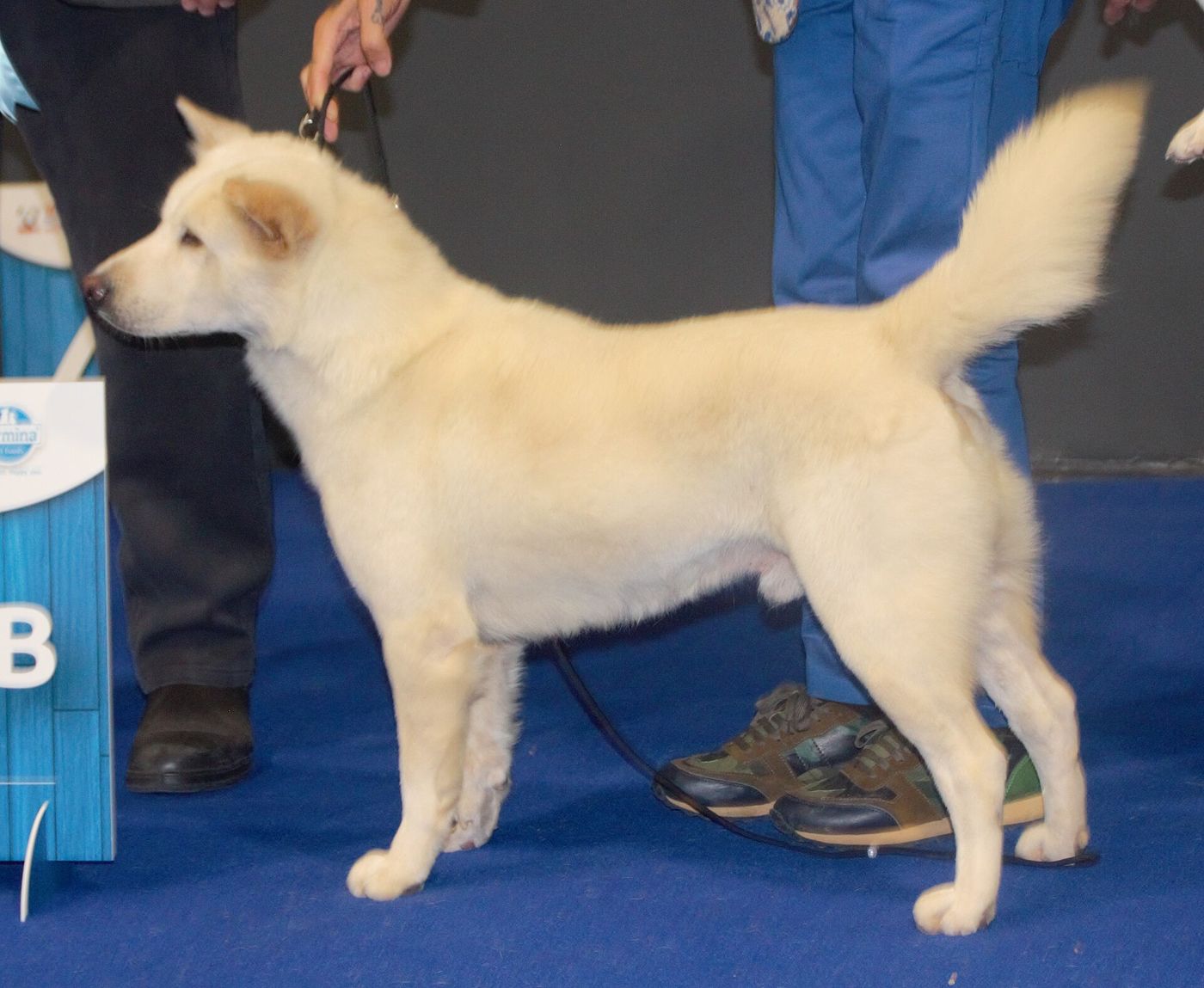 A white Kintamani-Bali Dog at a dog show; the biscuit ear edges are what the standard prefers. Photo: Canarian / Wikimedia Commons (CC BY 4.0)

The coat is double: a short, soft undercoat and a harsh outer coat of medium length. Longer hair forms a ruff around the neck, the badong, and extends over the withers as the bulu gumba, both more visible on males. Four colours are accepted:
- White, ideally with biscuit-coloured edges to the ears
- Black, with a little white on chest, toes or tail tip allowed
- Fawn, from light fawn to deep red, a black mask preferred
- Brindle, a fawn base with dark stripes
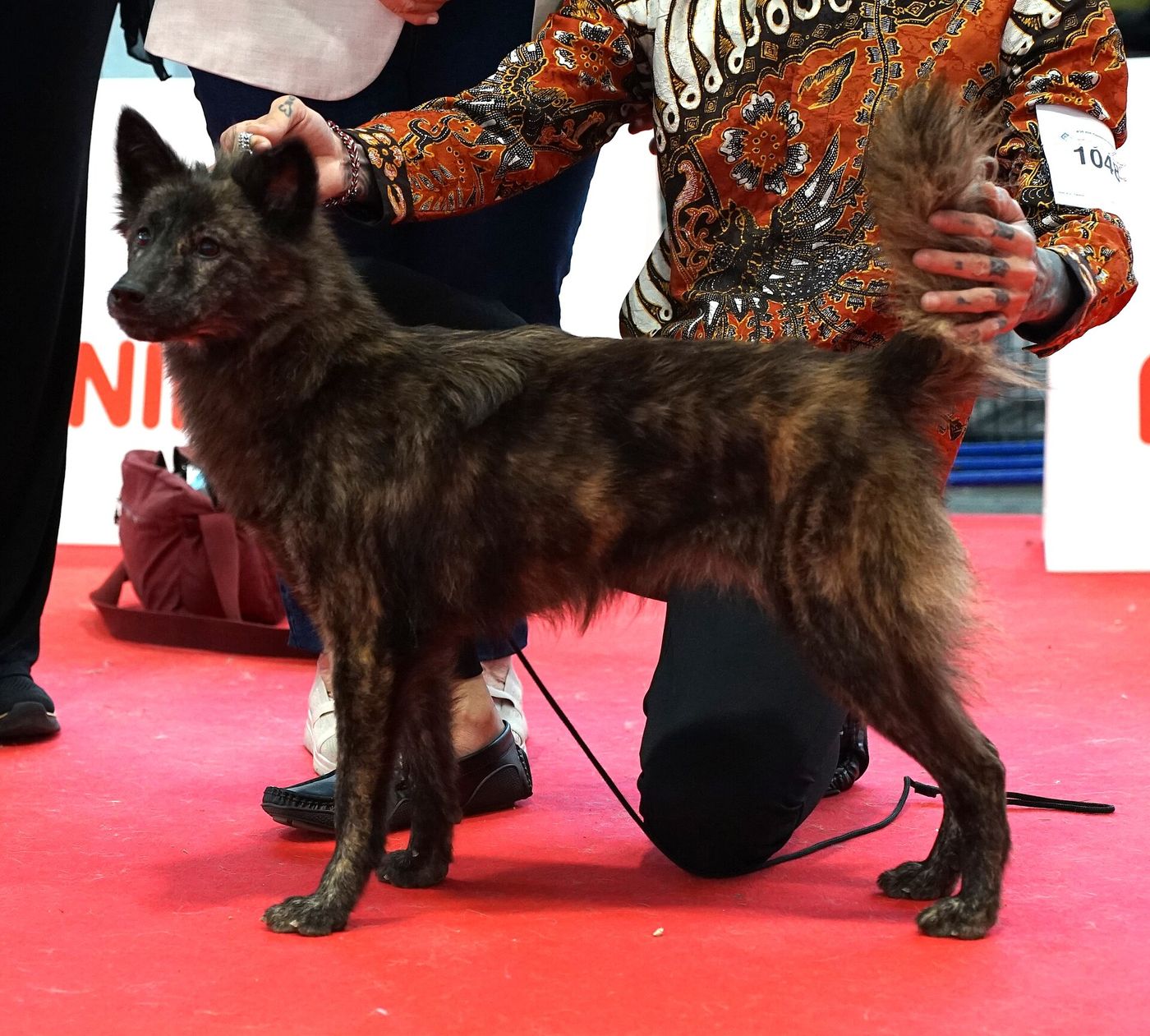 A brindle Kintamani-Bali Dog, one of the four accepted colours. Photo: Canarian / Wikimedia Commons (CC BY 4.0)

Temperament and Living With One
The standard's own words for temperament are "watchful, intelligent, alert, gentle, loyal and easy to train." It lists aggressive or overly shy dogs as a disqualifying fault.
The descriptions from Bali add the guarding side. Kompas describes the breed as brave, agile, alert and wary of strangers, a reliable guard devoted to the person who cares for it, and one that may attack dogs or other animals entering its territory. It digs, and a bitch will make a den in the ground to give birth. Palm Living's sister site, Bali Information, notes the same territorial streak, the deep bond with owners, and the need for regular play and exercise.
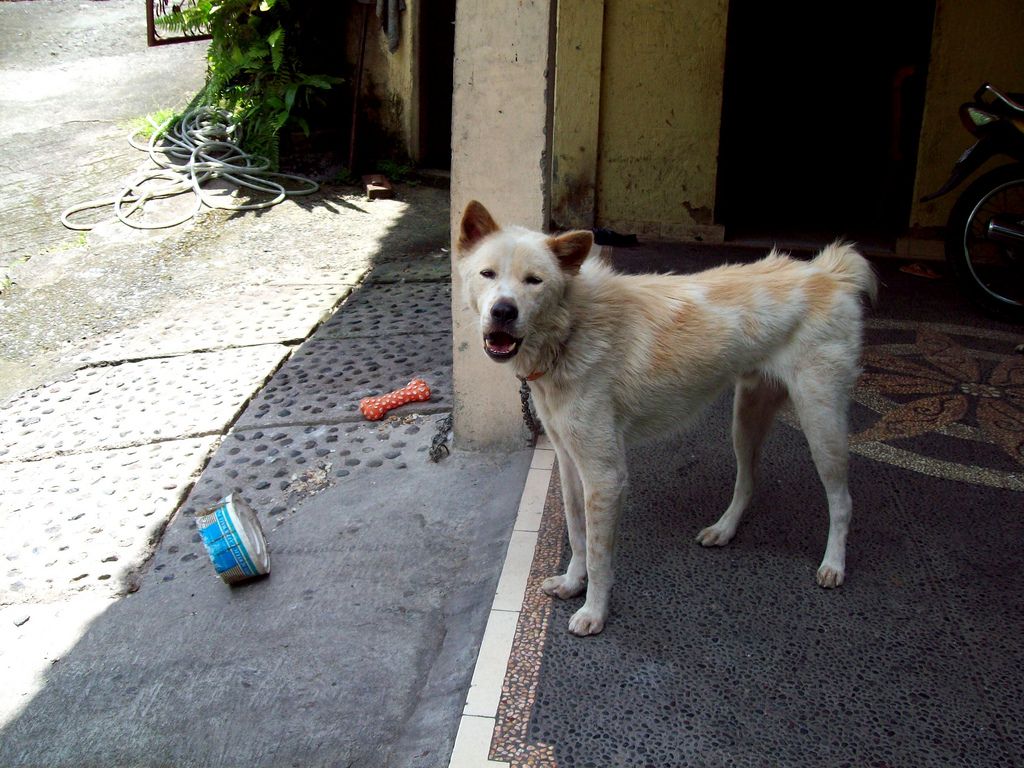 A Kintamani dog at home in Ubud. Photo: Blek from Dompu / Wikimedia Commons (CC BY 2.0)

Kintamani Dogs and Rabies
Every dog in Bali lives with rabies in the background. The Bali provincial government dates the first outbreak to 2008 and runs mass vaccination to reach at least 70 percent of dogs, the level needed to stop transmission. For an owner, that means keeping a dog's rabies vaccinations current.
For a visitor, it means one rule. However friendly a Kintamani dog looks, do not pet dogs you do not know. If one bites or scratches you, wash the wound with soap and running water for at least 15 minutes and get the rabies vaccine the same day. The full steps, and where to find the vaccine in the north, are in dangerous animals in Bali and healthcare in north Bali.
Taking a dog off the island is harder. Bali was declared a rabies quarantine area in 2008, and in 2019 the quarantine post at Gilimanuk told Tribun Bali that dogs were still barred from entering or leaving the island under that decree. The quarantine agency's general procedure for dogs moving between islands asks for a vaccination book, a rabies antibody titre test and a veterinary certificate. Rules change, so ask Badan Karantina Indonesia, and your own country, before you commit to a dog you mean to take home.
Adopting or Buying a Kintamani Dog in Bali
A pedigree dog. Pedigree papers come only through PERKIN. Its site lists the breed club, Himpunan Trah Anjing Kintamani Bali, in Denpasar; start with the club's own website and ask for PERKIN papers.
A rescued dog. Bali's welfare groups rehome island dogs, and the genetic study shows how close the Kintamani is to them. Two that set out adoption on their own sites:
Bali Animal Welfare Association (BAWA), Lodtunduh, Ubud
In their words: Adoption at BAWA is about "matching the animal to the right family," with pre-adoption interviews and house checks. It also places rescued animals in foster homes while they recover.
Contact: bawabali.com · Map
Lovina Animal Welfare, Lovina
In their words: A registered charity, also called North Bali Animal Aid, that rescues animals, "mainly dogs," and provides food, medication, shelter, rehabilitation, fostering and adoption. It also sponsors dogs so they can stay with families who are struggling, and runs a neutering programme.
Contact: lovinaanimalwelfare.org (no public address on its site; contact it there)
Lovina Animal Welfare on Instagram
How to Fit It In
The breed's home ground is the highlands around Batur, on the road that crosses from Ubud over the caldera and down to the north coast near Kubutambahan; getting to north Bali describes it. The same slopes grow Kintamani arabica, covered in the best coffee in Bali. Palm Living's villas are mostly around Lovina on the north coast, a long drive down from Kintamani, and its tours include a Batur day trip.
Practical Notes
- Do not pet dogs you do not know, Kintamani or not.
- Any bite or scratch: Wash for 15 minutes and get the rabies vaccine the same day.
- Adopting: Go through an organisation with a website, a process and a way to reach it.
- Buying: Ask for PERKIN papers, which are the only proof of a pedigree Kintamani.
- Taking a dog home: Check Bali's quarantine rules and your own country's import rules first.
FAQ
Is the Kintamani dog a recognised breed? Yes. PERKIN, Indonesia's kennel association, named it the country's first breed in 2006, and the FCI accepted the Kintamani-Bali Dog on a provisional basis on 20 February 2019 as breed no. 362, in Group 5, spitz and primitive types.
Where does the Kintamani dog come from? From the village of Sukawana in Kintamani district, Bangli regency, in Bali's central highlands. The FCI standard names Sukawana as the breed's origin, and old Balinese manuscripts mention a long-coated kuluk gembrong believed to be its ancestor.
Is the Kintamani dog part Chow Chow? Local legend says so. A 2005 genetic study found the Kintamani dog identical to the Bali street dog at all but three of 31 markers, closest to the Australian dingo, and only distantly related to the recognised Asian breeds it was compared with.
How big does a Kintamani dog get? The FCI standard gives 49 to 57 cm at the shoulder and 15 to 18 kg for males, and 44 to 52 cm and 13 to 16 kg for females.
Is a Kintamani dog a good family pet? The breed standard calls it watchful, intelligent, alert, gentle, loyal and easy to train, and bred as a companion. Bali sources also describe a strong guarding instinct and a territorial streak with unfamiliar dogs, so it needs socialising and plenty of exercise.
Can I adopt a Kintamani dog in Bali? Yes, through registered welfare groups such as BAWA near Ubud and Lovina Animal Welfare in the north, which rehome rescued dogs. For a pedigree dog, go to the breed club and ask for PERKIN papers.
Can I take a Kintamani dog out of Bali? Not easily. Bali has been a declared rabies quarantine area since 2008, and in 2019 the quarantine service said dogs were still barred from leaving or entering the island. Ask Indonesia's quarantine agency, Badan Karantina Indonesia, for the current rule before you commit.
Sources
- Fédération Cynologique Internationale, FCI-Standard N° 362, Anjing Kintamani-Bali, 26 March 2019 (origin, history, temperament, coat, colours, size), and breed listing (provisional acceptance 20 February 2019, group and section), read September 2026 (in English)
- Fédération Cynologique Internationale, member for Indonesia (PERKIN), read September 2026 (in English)
- Perkumpulan Kinologi Indonesia, PERKIN (sole pedigree registry, the Kintamani standard, the breed club listing), read September 2026 (in Indonesian)
- Puja I.K., Irion D.N., Schaffer A.L., Pedersen N.C., The Kintamani dog: genetic profile of an emerging breed from Bali, Indonesia, Journal of Heredity 96(7), 2005, abstract read September 2026 (in English)
- Himpunan Trah Anjing Kintamani Bali, History of the Kintamani dog, read September 2026 (in Indonesian)
- Kompas, Kintamani dog recognised as Indonesia's own breed, April 2019 (PERKIN 2006, Asia Kennel Union 2012, Ministry of Agriculture 2014, the 2017 application, the handover), read September 2026 (in Indonesian)
- Kompas, Kintamani dog recognised as a native breed, 16 April 2019 (the 2,000 blood samples), read September 2026 (in Indonesian)
- Kompas, The origins of the Kintamani dog, 19 March 2021 (Sukawana, the isolation theory, the Chow Chow legend, temperament), read September 2026 (in Indonesian)
- Bali Information (Palm Living), Kintamani dogs: what makes them special, read September 2026 (in English)
- Bali Provincial Government, Rabies in Bali, read September 2026 (in English)
- Badan Karantina Indonesia, Quarantine procedure for travelling with pets, read September 2026 (in Indonesian)
- Tribun Bali, Dogs and cats barred from entering or leaving Bali, 31 March 2019, read September 2026 (in Indonesian)
- Bali Animal Welfare Association, Adopt and foster, and Lovina Animal Welfare, home page, read September 2026 (in English)
More for the road north: dangerous animals in Bali, things to do in north Bali and getting to north Bali.