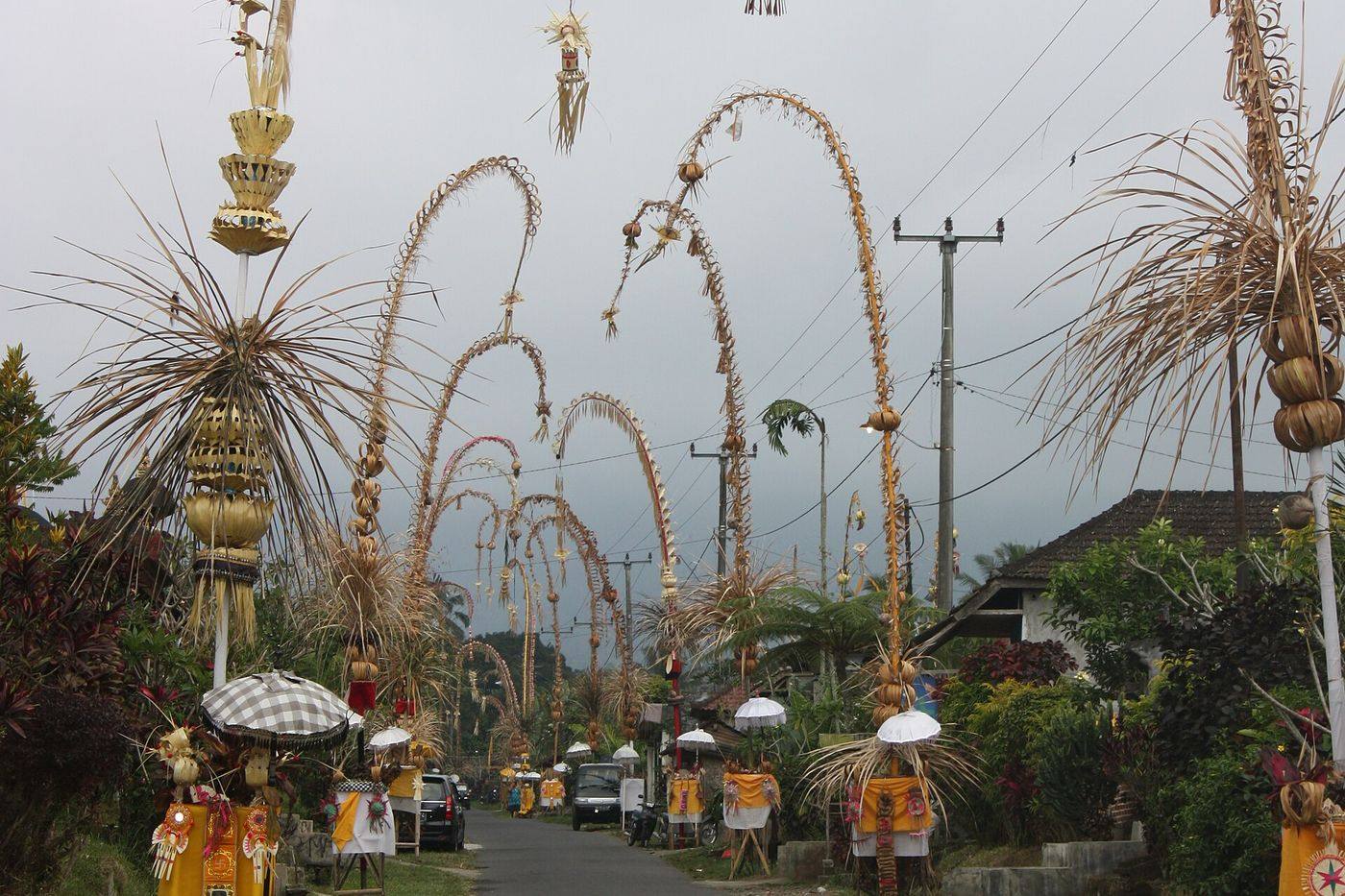
.jpg)
On this page
In Brief
A penjor is a long bamboo pole with a curving tip, dressed in young palm leaf, hung with the produce of the land and fitted with a small bamboo shrine at head height. Balinese Hindus set one up at the gate of the house yard for Galungan, on Penampahan, the day before, and for temple anniversaries and the great ceremonies of a village. The pole is read as Gunung Agung, the holy mountain, and as the naga Basuki, and it says thank you for the harvest. It stays up until Buda Kliwon Pahang, 35 days after Galungan, when it is taken down, its decorations are burned and the ash is planted in the yard inside a young coconut. A plainer decorative penjor, without the shrine, is put up for festivals and has no ritual role.
Penjor at a Glance
- What it is: A tall, curved bamboo pole dressed with young palm leaf and hung with produce, with a small shrine, the sanggah, near the base
- What it means: Thanks for the earth's harvest; the mountain Gunung Agung; the naga Basuki
- Where it stands: Usually to the right of the gate into the house yard, and at temple entrances
- When it goes up for Galungan: On Penampahan, the Tuesday before Galungan, after the day's offerings
- When it comes down: On Buda Kliwon Pahang, also called Pegatwakan, 35 days after Galungan
- How it ends: Its decorations burned, the ash sealed in a young ivory coconut and planted in the yard
- Two kinds: The sacred penjor of Galungan and temple ceremonies, and the decorative penjor of festivals
- Height: A column on the religious affairs ministry's Bali site puts a typical one at about ten metres
What a Penjor Means
A penjor is a gift to the mountain. A column on the religious affairs ministry's Bali site quotes the Balinese chronicle Usana Bali: the penjor is offered to the god of Gunung Agung, where the gods and the ancestors dwell. The lontar Jayakasunu makes the pole itself the mountain, and the hymn Basuki Stawa says the mountain is a naga king, Naga Basuki, whose tail rests on the summit and whose head lies in the sea. The same column draws the meaning out: the mountain stores the water that becomes rivers and runs down to the ocean. It adds that the name of Besakih, the mother temple on Agung's slopes, comes from Basuki.
Read as a naga, the penjor has a body. In that reading the little shrine with its coconut frond is the neck and head of Naga Taksaka, the ring of woven palm leaf near the coconut is the naga's hair, the ornament hanging from the curved tip is Basuki's tail, and everything strung along the pole, rice, cassava, corn and cloth, is the coat of Naga Ananta Bhoga, the naga from whom food and clothing grow.
It is also plain thanks. The district office of Banjar, the district that includes Lovina, explains that the curved bamboo stands for the highest mountain, a holy place, and the coconut, banana, sugarcane, cakes and cloth stand for all the plants and goods that God provides. The same page traces the word to penyor, the means of making an act of worship.
For Galungan there is a third meaning. Buleleng's culture and tourism office says the penjor goes up on Penampahan, the day when people fight their own dirty thoughts, ego and bad habits, and stands afterwards as the sign of that victory, the triumph of dharma that Galungan celebrates.
What a Penjor Carries
The Banjar district office lists the parts of a ceremonial penjor, and detikBali's guide to making one adds the rest:
- The bamboo, long and supple, with its tip bending over
- Young palm leaf, janur or young sugar-palm leaf, cut and woven into ornaments, with other leaves, plawa
- Pala bungkah, tubers such as sweet potato and cassava
- Pala gantung, hanging fruit such as coconut, cucumber, banana and pineapple
- Pala wija, grains such as rice and corn
- Jaja and kepeng, Balinese cakes and kepeng coins
- The sampian penjor, the woven ornament at the very tip, with its porosan of betel and flowers
- The sanggah ardha candra, a little bamboo shrine with a roof curved like a crescent moon, which holds the offerings
- The lamak, a long woven panel hanging from the shrine, with white and yellow cloth
- A kober, a small flag bearing the sacred syllable Ongkara, near the top
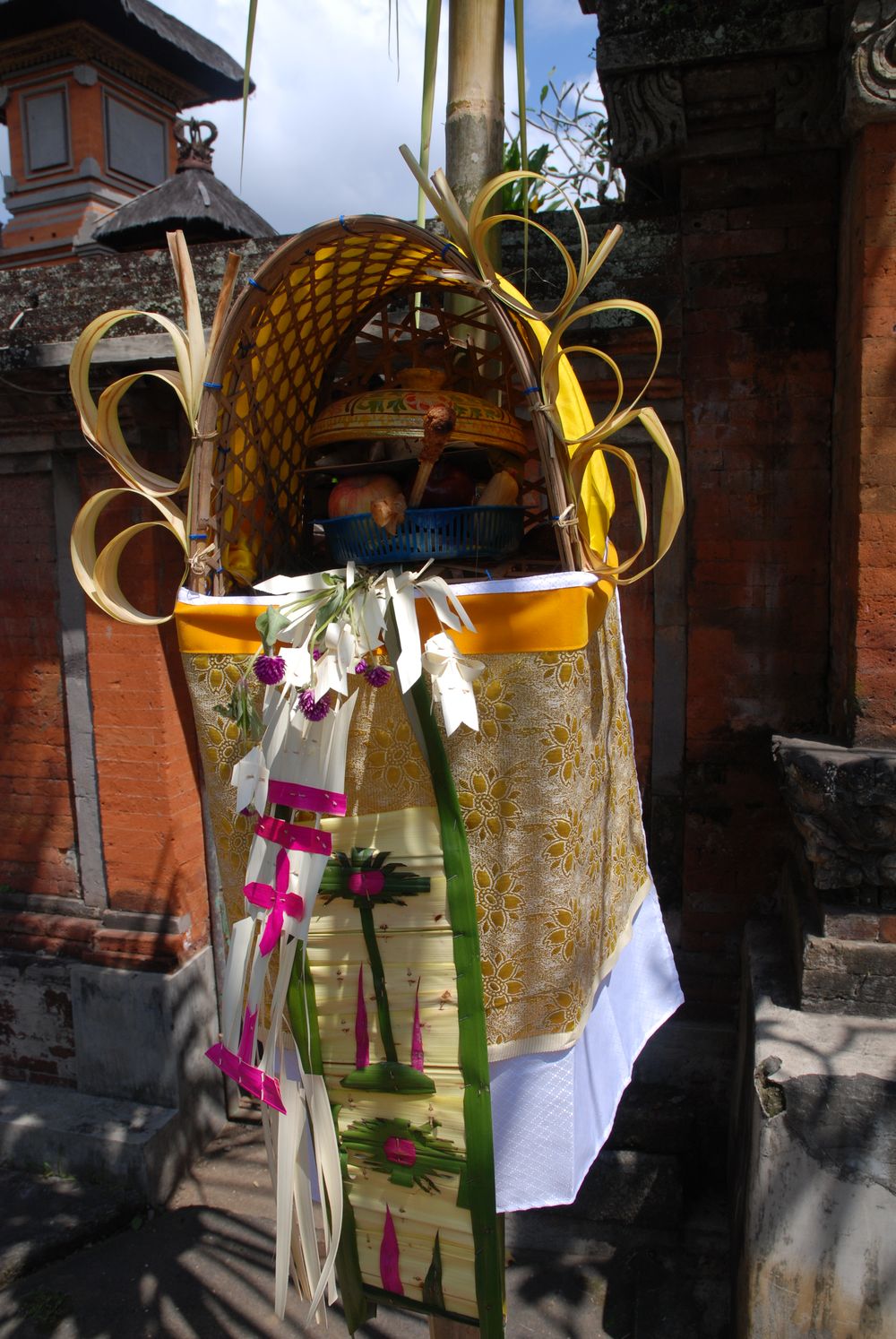 The sanggah, the penjor's small shrine, with its lamak hanging below. Photo: Tigerente / Wikimedia Commons (CC BY-SA 4.0)

Each part stands for a god. The Banjar district office quotes the lontar Tutur Dewi Tapini: the bamboo and the cakes for Brahma, the coconut for Rudra, the yellow cloth and palm leaf for Mahadewa, the leaves for Sangkara, the tubers and hanging fruit for Wisnu, the white cloth for Iswara, the shrine for Siwa and the offerings for Sadha Siwa and Parama Siwa. Buleleng's culture office gives a slightly different list from the same text, adding the sugarcane for Sambu and the rice for Dewi Sri, the rice goddess.
The rule behind the list is that a sacred penjor must carry the harvest. The regency's welfare section says as much: many penjor now go up as attractions, and a penjor without the earth's produce has lost its meaning.
How a Penjor Is Made
detikBali sets out the method. Choose a long bamboo that bends at the tip and clean it. Weave young palm leaf into shapes, birds, flowers and small ornaments, and dress the upper part with them, with the Ongkara flag at the top. Bind the produce along the pole with bamboo cord. At the front, at a person's height, hang the lamak, the little shrine and an old coconut. Then raise the pole in front of the house.
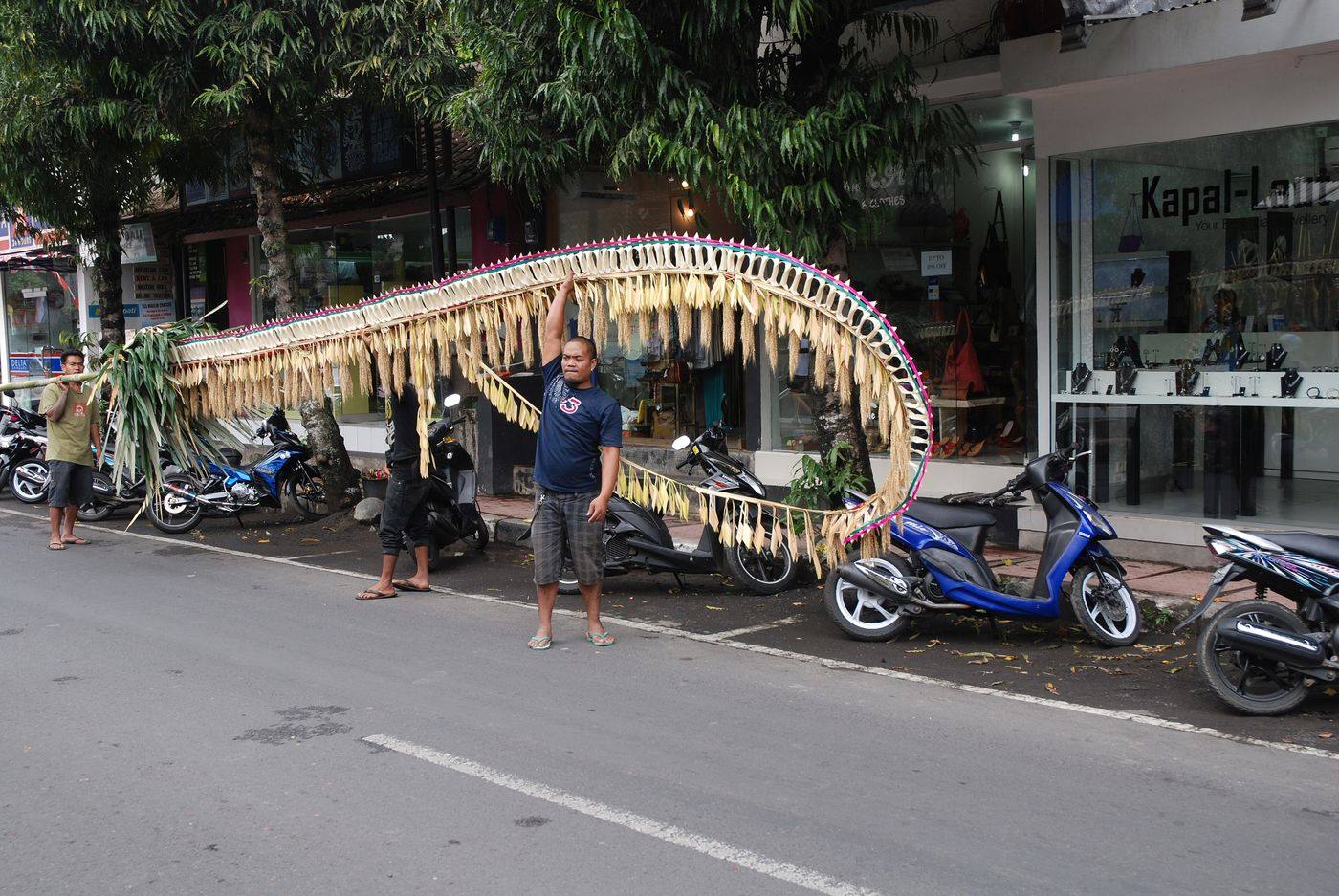 A finished penjor carried along the street in Ubud in the days before Galungan. Photo: Tigerente / Wikimedia Commons (CC BY-SA 4.0)

Freshness matters. The welfare section says a Galungan penjor belongs to Dewa Yadnya, the offerings to the gods, so what is offered should be fresh, and yellow and white from the young palm leaf are the colours to aim for. detikBali asks for natural materials and says a beautiful penjor is a good thing as long as it does not turn into a contest of excess that crowds out the meaning.
When a Penjor Goes Up
Galungan. Galungan falls every 210 days on the Balinese calendar, on Buda Kliwon Dungulan. The penjor belongs to the day before, Penampahan, Anggara Wage Dungulan, and goes up after the Penampahan offerings; Buleleng's culture office specifies after midday. The welfare section notes that many families now raise theirs earlier, most often on the Sunday, because Penampahan itself is busy or hands are short. Bali Post adds where it goes: usually on the right of the gate into the house yard. How the 210-day cycle works is in the Balinese calendar explained.
Temple anniversaries and great ceremonies. Both Buleleng offices name temple anniversaries, piodalan, alongside Galungan as occasions for a sacred penjor. For a great ceremony such as a temple's ngenteg linggih, Bali Post explains, the requirements are set by the local assembly holding it: the shrine gets a small ceremonial umbrella in agreed colours and a fuller offering, the pejati.
Festivals. The decorative penjor, penjor pepenjoran, can go up at any time: for village competitions, arts festivals and big public events. I Gusti Ngurah Sudiana, who chairs the advisory board of the Hindu council in Bali, is quoted on the ministry's site explaining that these usually have no shrine and no sampian, and serve only to make an occasion beautiful. Some towns now hold whole penjor festivals.
How a Penjor Comes Down
Galungan's season closes 35 days after Galungan, on Buda Kliwon Pahang, the day called Pegatwakan. The religious affairs ministry's Bangli office explains the name, pegat for cut off and uwakan for return, and describes what happens:
- The penjor is taken down.
- Its decorations are burned.
- The ash goes into a young ivory coconut, nyuh gading, opened for the purpose.
- The coconut is planted where the penjor stood, or behind the family's Rong Telu shrine.
The prayer that goes with it asks for fertility until the next Galungan. Buleleng's welfare section adds a kawangen offering and eleven kepeng coins to the coconut, says it may also be set adrift in water, and allows that a penjor may come down as early as the day after Kuningan. A penjor still standing after Pegatwakan, it says, is a lapse on the owner's part, the more so the longer it stays.
Seeing Penjor in North Bali
Any village road in the north will do. In Galungan week a penjor stands outside almost every house, and the lanes around Lovina look like the photograph at the top of this page, taken around Lovina; a slow drive or walk through them in the morning light is one of the pleasures of that week. The ten days from Galungan to Kuningan are a family and temple time, so expect some businesses to close and the roads to be busy. Galungan and Kuningan explains the festival, and Balinese offerings explained covers the fruit towers you will see carried past them.
If you want to be here for it, Palm Living's villas for rent are mostly in and around Lovina, among the villages where the penjor go up.
FAQ
What is a penjor in Bali? A tall bamboo pole with a curved tip, dressed in young palm leaf and hung with rice, fruit, tubers, cakes and cloth, with a small shrine near the base. Balinese Hindus set it up at the gate of the house yard for Galungan and at temples for their anniversaries.
What does a penjor symbolise? Thanks for the harvest the earth gives. The pole is read as Gunung Agung, the holy mountain, and as the naga Basuki, with the produce along it standing for Ananta Bhoga, the naga of food and clothing. For Galungan it is also a sign of the victory of dharma.
When are penjor put up? For Galungan, on Penampahan, the day before, after the day's offerings. Galungan comes every 210 days on the Balinese calendar. Penjor also go up for temple anniversaries and large village ceremonies.
When are penjor taken down? On Buda Kliwon Pahang, called Pegatwakan, 35 days after Galungan. The decorations are burned and the ash is planted in the yard inside a young ivory coconut. Some families take theirs down earlier, the day after Kuningan.
What is hung on a penjor? Tubers, hanging fruit such as coconut and banana, grains such as rice and corn, cakes and coins, a woven ornament at the tip, a small bamboo shrine with its offerings, a long woven lamak, white and yellow cloth and a small flag with the syllable Ongkara.
Why do some penjor have no shrine? Those are decorative penjor, put up for festivals, competitions and public events. The Hindu council's advisory chair explains that they usually carry no shrine and no sampian because they serve as decoration, not as an offering.
Sources
- Kecamatan Banjar, Kabupaten Buleleng, Makna penjor upacara (the word, the materials, the sanggah ardha candra, the meaning of the curve and the produce, the lontar Tutur Dewi Tapini), Indonesian, read September 2026
- Dinas Kebudayaan dan Pariwisata Kabupaten Buleleng, Makna penjor bagi umat Hindu (naga Basuki and the mountain, raising after midday on Penampahan, the Tutur Dewi Tapini list, sacred and decorative penjor), Indonesian, read September 2026
- Bagian Kesejahteraan Rakyat, Setda Kabupaten Buleleng, Makna penjor Galungan yang dipasang saat penampahan (the day and the offerings, raising early, freshness and colours, taking down, the ivory coconut, kawangen and kepeng) and Buda Kliwon Pegat Uwakan (the end of the Galungan cycle, burning and planting, a penjor left standing), Indonesian, read September 2026
- Kantor Wilayah Kementerian Agama Provinsi Bali, Penjor, simbol manifestasi istana Tuhan (Usana Bali, Jayakasunu and Basuki Stawa, Besakih and Basuki, the naga reading of the parts, typical height, decorative penjor), Indonesian, read September 2026
- Kantor Kementerian Agama Kabupaten Bangli, Hari Budha Kliwon Pegatwakan (35 days after Galungan, the meaning of the name, burning, the nyuh gading, planting and the prayer), Indonesian, read September 2026
- detikBali, Penjor Galungan: makna hingga cara membuatnya (materials and method, kepeng and the Ongkara flag), Indonesian, read September 2026
- Bali Post, Penjor Galungan dan upacara yadnya, yuk simak bedanya (placement at the gate, penjor for great ceremonies, decorative penjor), Indonesian, read September 2026
- Wikipedia, Penjor festival, English, read September 2026
Read next: Galungan and Kuningan for the festival the penjor announces, the anatomy of a Balinese ceremony for the other things a village makes by hand, and Balinese mythology for the nagas and the mountain.