
On this page
- In Brief
- The Elements at a Glance
- The Village Makes It by Hand, Over Days
- Banten: Offerings Woven From Young Palm Leaf
- Penjor: A Bamboo Pole Read as Mountain and Naga
- Tirta: Holy Water Consecrates Everything
- Gebogan and Sarad: The Tall Offerings
- Gamelan: Music That Is Part of the Rite
- Ceremonial Dress: Sarong, Sash and White
- The Pemangku Leads the Ceremony
- How the Elements Fit Together
- How to Witness a Ceremony Respectfully
- FAQ
- Sources
In Brief
A Balinese ceremony is made by its own community, by hand and often over days, as an act of devotion. Women weave the offerings and men raise the penjor. The community's own musicians play the gamelan, and a priest consecrates everything with holy water.
Each part has a name, a maker and a meaning. Once you know the parts, you see far more in what you witness.
The Elements at a Glance
- Banten: Handwoven palm-leaf offerings, from the daily canang to grand towers
- Penjor: The tall, curved, decorated bamboo poles raised for Galungan and big rituals
- Tirta: Holy water, which consecrates everything else
- Gamelan: The bronze orchestra that accompanies ritual
- Sarad and gebogan: Tall offerings and towers of fruit, cakes and flowers
- Dress: Sarong and sash (selendang), often white or yellow for the sacred
- Pemangku: The temple or village priest who leads the ceremony
- Made by: The community, by hand, often over days, as devotion
The Village Makes It by Hand, Over Days
A Balinese ceremony is made by the people who hold it.
For a temple festival or a big rite, the village, the banjar, gathers for days beforehand. Women weave the offerings, men cut and raise the penjor and build the structures, and everyone contributes. The craft is itself the devotion, the yadnya, the sincere giving of effort and skill.
What you witness on the day is the visible tip of days of communal making.
Banten: Offerings Woven From Young Palm Leaf
Banten is the broad word for the offerings, from the tiny daily canang sari to elaborate ceremonial constructions.
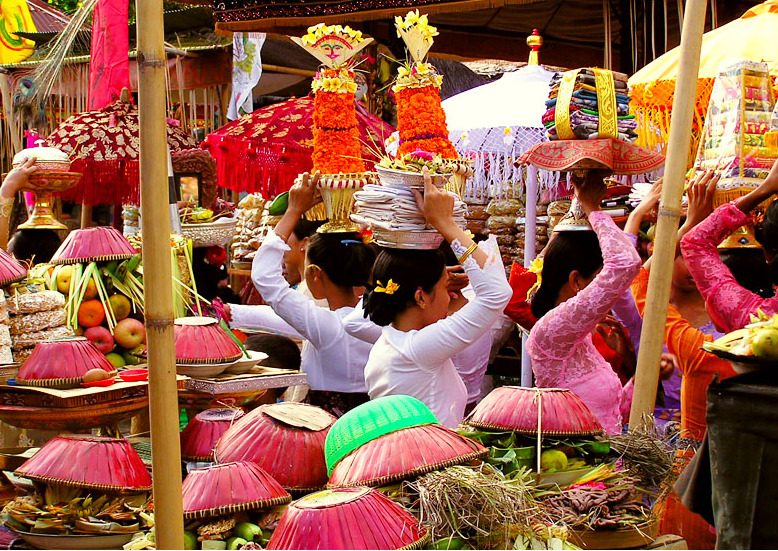
They are made by hand from natural materials. Young palm leaf, janur, is cut and pinned into intricate woven trays and shapes, which are then filled with:
- flowers
- rice and fruit
- cakes (jaja)
- betel, and more
Larger banten are built up on a base, sometimes with a banana-stem core to hold the structure, and layered into towers.
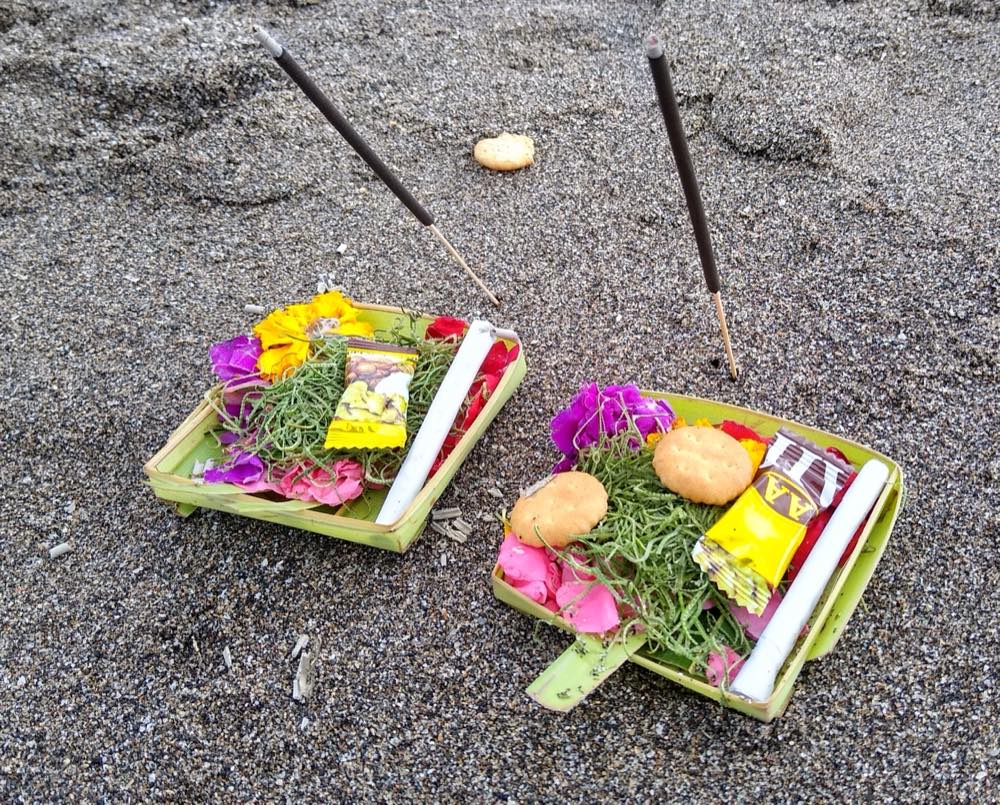 Canang sari, the smallest banten, woven and laid fresh daily. Photo: Mx. Granger / Wikimedia Commons (CC0)

Nothing is permanent. The essence is offered, and the rest returns to the earth or is shared. The weaving of banten is a craft passed down through generations of women.
Penjor: A Bamboo Pole Read as Mountain and Naga
The penjor is the tall bamboo pole, often five metres or more, that arches over the road for Galungan and other major ceremonies.
A single long bamboo is cut, then dressed with:
- young coconut leaves
- fruit and grain
- flowers and cakes
- a small woven shrine, the sanggah, at its base
The pole stands for the sacred mountain and for the abundance of the earth, given in thanks. Buleleng's welfare office and Banjar district both explain it this way.
A column on the religious affairs ministry's Bali site also reads the pole as a naga. The curved tip is the tail of the naga Basuki. The harvest hung along its length is the naga Anantaboga.
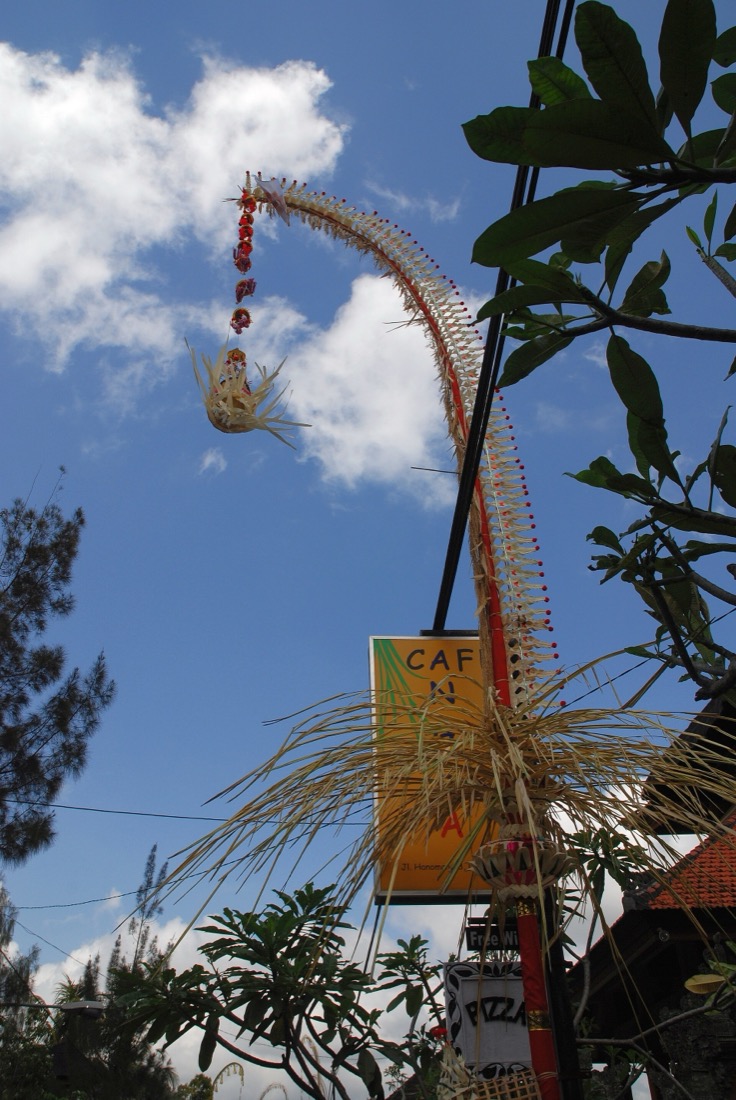 Penjor arched over the road for Galungan, each one a village's handiwork. Photo: Tigerente / Wikimedia Commons (CC BY-SA 4.0)

Raising the penjor is men's work, and a village street lined with them is one of Bali's great sights.
Tirta: Holy Water Consecrates Everything
Tirta is holy water, and without it the ritual is incomplete. Balinese Hinduism is sometimes called Agama Tirta, "the religion of holy water."
The water is blessed by a priest or drawn from sacred springs, as in melukat. It then consecrates the offerings, the participants and the shrines, sprinkled, given to drink and touched to the head.
The making of high holy water is the work of the high priest, the pedanda.
Gebogan and Sarad: The Tall Offerings
Gebogan are towers of fruit, cakes and flowers, sometimes over a metre high. Women build them and carry them to the temple balanced on their heads.
Sarad are elaborate decorative offerings, sometimes large rice-dough reliefs, made for the grandest ceremonies.
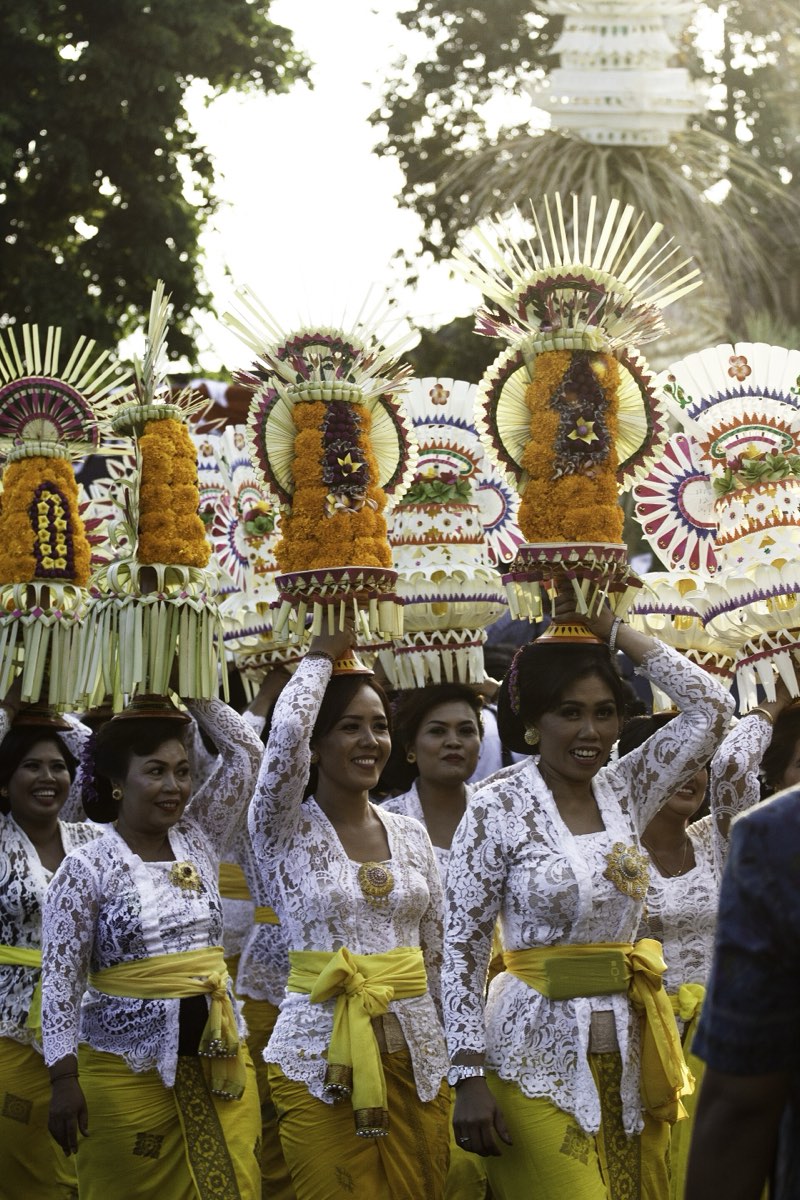 Gebogan towers carried to the temple, balanced and blessed. Photo: Tijden / Wikimedia Commons (CC BY-SA 4.0)

Both are feats of devotional craft. They are presented, blessed, and then carried home and shared.
Gamelan: Music That Is Part of the Rite
The bronze gamelan is part of the rite itself.
Its sound consecrates the space and accompanies the dances and prayers. The community's own musicians play it, after rehearsing for the occasion in the banjar hall.
Ceremonial Dress: Sarong, Sash and White
Ceremonial dress is itself an act of respect. To take part you wear:
- a sarong, the kamen
- a sash, the selendang, tied at the waist
- often a white or light top
- for men, sometimes the udeng headcloth
White is the colour of the sacred, and yellow is worn at Kuningan. Visitors near a ceremony should follow the same temple etiquette.
The Pemangku Leads the Ceremony
The pemangku is the temple or village priest who conducts the ceremony.
The pemangku leads the prayers, blesses with tirta and guides the sequence. For the highest rites a pedanda, a high priest, officiates. Priests are honoured in turn through Rsi Yadnya, the offerings to priests and sages.
How the Elements Fit Together
A ceremony moves through a sequence.
-
The space and the offerings are prepared and consecrated with tirta.
-
The gamelan plays through the rite.
-
Prayers and offerings are made to the gods. Offerings also go to the lower spirits, kept in balance, which is the principle of Rwa Bhineda.
-
Dances may be performed as offerings.
-
Holy water is shared to close.
Each element has its place, and almost all of it was made by hand for that moment.
The categories of ceremony these elements serve are set out in Panca Yadnya. The calendar that schedules them is in the Balinese calendar.
How to Witness a Ceremony Respectfully
If you are welcomed near a ceremony, you are a guest at an act of devotion.
- Dress properly, in sarong and sash.
- Stay at the edge and keep quiet.
- Give way to the people taking part.
- Photograph only with permission.
The full guidance is in Bali temple etiquette.
FAQ
What are the main elements of a Balinese ceremony? The main elements are the handmade offerings (banten), the tall bamboo penjor poles, holy water (tirta) and the gamelan music. With them come the fruit-and-flower towers (gebogan), ceremonial dress and the priest (pemangku) who leads it. Almost all of it is made by the community by hand.
How are Balinese offerings made? They are made by hand from natural materials. Young palm leaf is cut and pinned into woven trays and shapes, then filled with flowers, rice, fruit, cakes and betel. Larger offerings are built on a base, sometimes with a banana-stem core, into elaborate towers.
What is a penjor and how is it made? A penjor is the tall, curved bamboo pole raised for Galungan and big ceremonies. A long bamboo is dressed with young coconut leaves, fruit, grain, flowers and a small shrine at its base. It is an offering of thanks for the earth's abundance.
What is tirta? Tirta is holy water. It is so central to Balinese ritual that the religion is sometimes called Agama Tirta. Blessed by a priest, it consecrates the offerings, the people and the shrines.
Who makes everything for a ceremony? The community itself does. The village banjar gathers for days beforehand: women weave the offerings, and men cut and raise the penjor and build structures. The handmade craft is itself the act of devotion.
What should you wear to a Balinese ceremony? Wear ceremonial dress: a sarong and a sash tied at the waist, often with a white or light top. White is the sacred colour. Visitors near a ceremony should follow temple etiquette and dress respectfully.
Sources
- Bagian Kesejahteraan Rakyat, Setda Kabupaten Buleleng, Makna penjor Galungan yang dipasang saat penampahan, and Kecamatan Banjar, Makna penjor upacara (why the penjor goes up on Penampahan Galungan, the curved bamboo dressed with young palm leaf, tubers, fruit and grain, and the penjor as a symbol of the mountain and of thanks for the earth's abundance), Indonesian, read September 2026
- Kantor Wilayah Kementerian Agama Provinsi Bali, Penjor, simbol manifestasi istana Tuhan (an opinion column on the ministry's Bali site reading the penjor as Gunung Agung and as the naga: Taksaka at the head, Basuki in the curved tail, Ananta Bhoga in the harvest along the pole), Indonesian, read September 2026
- Kecamatan Buleleng, Kabupaten Buleleng, Hari Raya Galungan dan Kuningan (Galungan, when the penjor go up, falling every 210 days on the Balinese calendar), Indonesian, read September 2026
- Photographs credited in full at each caption: penjor at Galungan, Ubud, gebogan and canang sari, Wikimedia Commons
Read next: Balinese offerings explained, understanding Balinese ceremonies, and the Balinese calendar explained.