
On this page
In Brief
Balinese mythology is the body of stories behind Balinese Hinduism. It draws on the Ramayana and the Mahabharata, which reached Bali through Java, on Javanese tales such as Calon Arang, and on Bali's own palm-leaf manuscripts, the lontar. Its core figures include Bedawang Nala, the giant turtle beneath the island, bound by the nagas Basuki and Anantaboga; the Barong and Rangda, whose battle never ends; the bhuta kala, the forces of nature; Dewi Sri of the rice and Dewi Danu of the lakes; and the tyrant Mayadenawa, whose defeat is remembered at Galungan. North Bali adds its own legends, above all Jayaprana and Layonsari and the invisible villagers of Pulaki. The stories live in shadow plays, temple dance, carving and painting more than in books.
Balinese Mythology at a Glance
- Where the stories come from: Indian epics by way of Java, Javanese tales, Balinese lontar manuscripts and local legend
- How they are told: Wayang shadow puppetry, dance-drama, temple carving, painting and the offerings themselves
- The foundation of the world: Bedawang Nala, the turtle, held still by the nagas Basuki and Anantaboga
- The eternal fight: The Barong, king of the spirits, against Rangda, queen of the witches
- Goddesses of plenty: Dewi Sri of the rice, Dewi Danu of the lakes
- North Bali's own: Jayaprana and Layonsari; Ida Ayu Swabhawa and the invisible people of Pulaki
- A northern artist: I Ketut Gedé of Singaraja, who drew the myths in the late nineteenth century
- A northern library: Gedong Kirtya in Singaraja, which keeps the lontar
Where Balinese Myths Come From
Most of the big stories arrived from India, and most of them came by way of Java. UNESCO, listing Indonesia's wayang puppet theatre as world heritage, notes that wayang flourished for ten centuries at the royal courts of Java and Bali, and that its stories borrow from indigenous myths, the Indian epics and Persian tales. The Ramayana gave Bali Rama, Sita and the demon king Rawana, and the Mahabharata gave it the five Pandawa brothers.
Bali's own sources are its lontar, texts incised on dried palm leaves. Several are quoted below: the Purwa Bhumi Kemulan on the creation of the world, the Basuki Stawa on the naga Basuki, and the Usana Bali on the holy mountain. Singaraja's Gedong Kirtya still keeps and copies lontar.
The Turtle and the Nagas
Beneath Bali lies a turtle. Balinese folklore, as detikBali retells it from academic studies of the ornament, says a giant turtle called Bedawang Nala carries the island on its back, and when it stirs, the earth shakes. To keep it still, two nagas, Basuki and Anantaboga, were set to coil around it and watch it, and in carvings the turtle and the serpents glare at each other face to face. Basuki stands for the water on the earth's surface; Anantaboga, whose name means "food without end", for the soil. The turtle itself, with its tongue of fire, is read as the magma under the island.
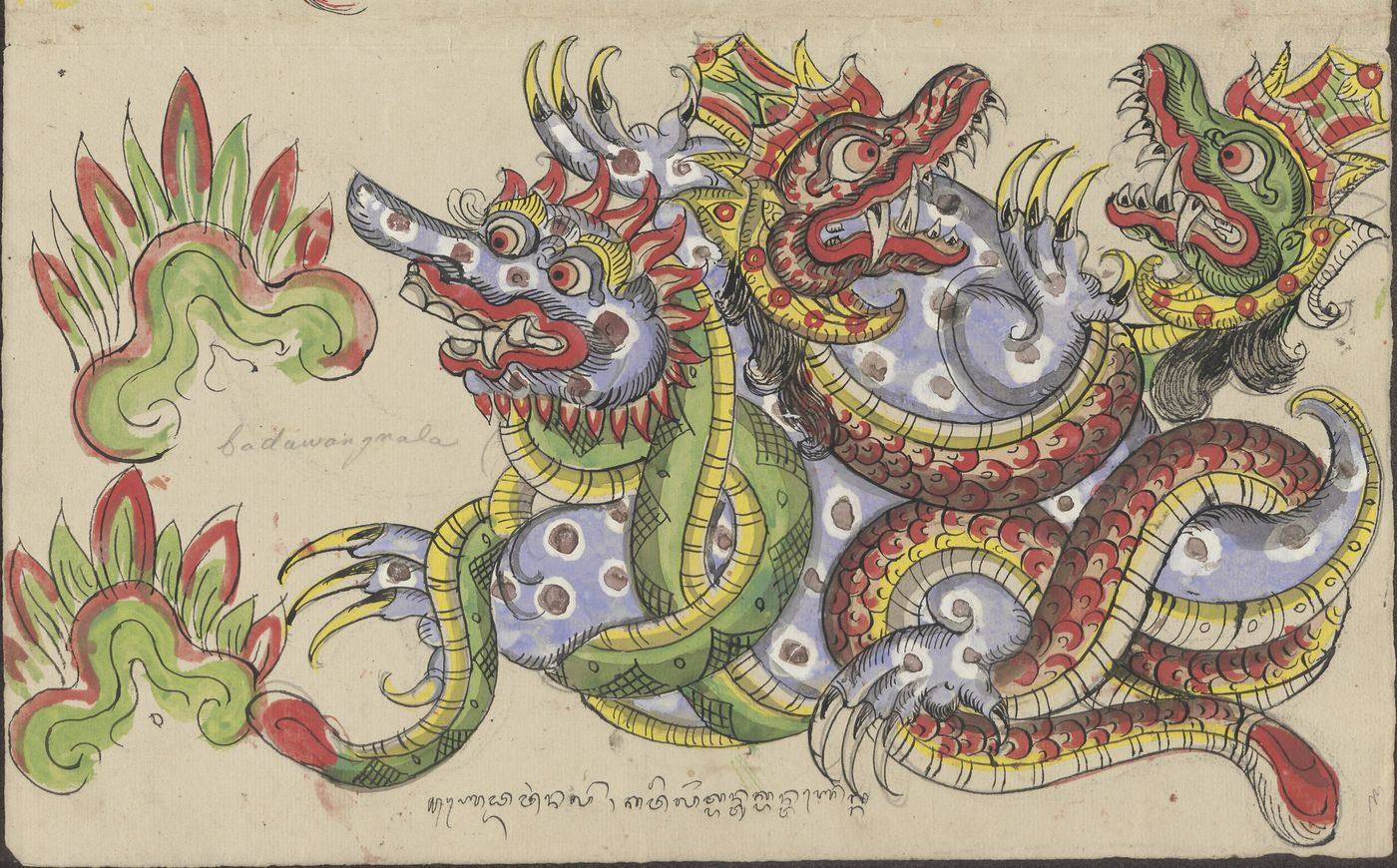 Bedawang Nala entwined by two serpents, drawn around 1890 by I Ketut Gedé of Singaraja and now in Leiden University Library. Photo: Leiden University Library / Wikimedia Commons (public domain)
.jpg)
You can see them in stone. I Nyoman Widya Paramadhyaksa, in a study of the ornament in Gadjah Mada University's Jurnal Filsafat, describes Bedawang Nala at the base of the tiered meru shrines, a fire-tongued turtle coiled by one or two serpents, and links it to Vadavamukha, the hell at the foot of Mount Meru, the mountain that holds up the universe, as well as to the earthquake story. Look at the foot of a padmasana or a meru in a large temple and the turtle is often there.
Basuki has a mountain of his own. A column on the religious affairs ministry's Bali site quotes the Basuki Stawa: the mountain is a naga king, Basuki, with his tail at the summit of Gunung Agung and his head in the sea, and the name of Besakih, the mother temple, comes from Basuki. The same reading turns every Galungan penjor into a naga.
The painter of the drawing above, I Ketut Gedé, came from Singaraja. According to Wikipedia's entry, he is best known for his illustrations of Hindu myths such as the Ramayana, many made for the Dutch scholar H.N. van der Tuuk in the 1880s and 1890s, and the Dutch artist W.O.J. Nieuwenkamp thought him the finest classical painter of his day.
The Barong and Rangda
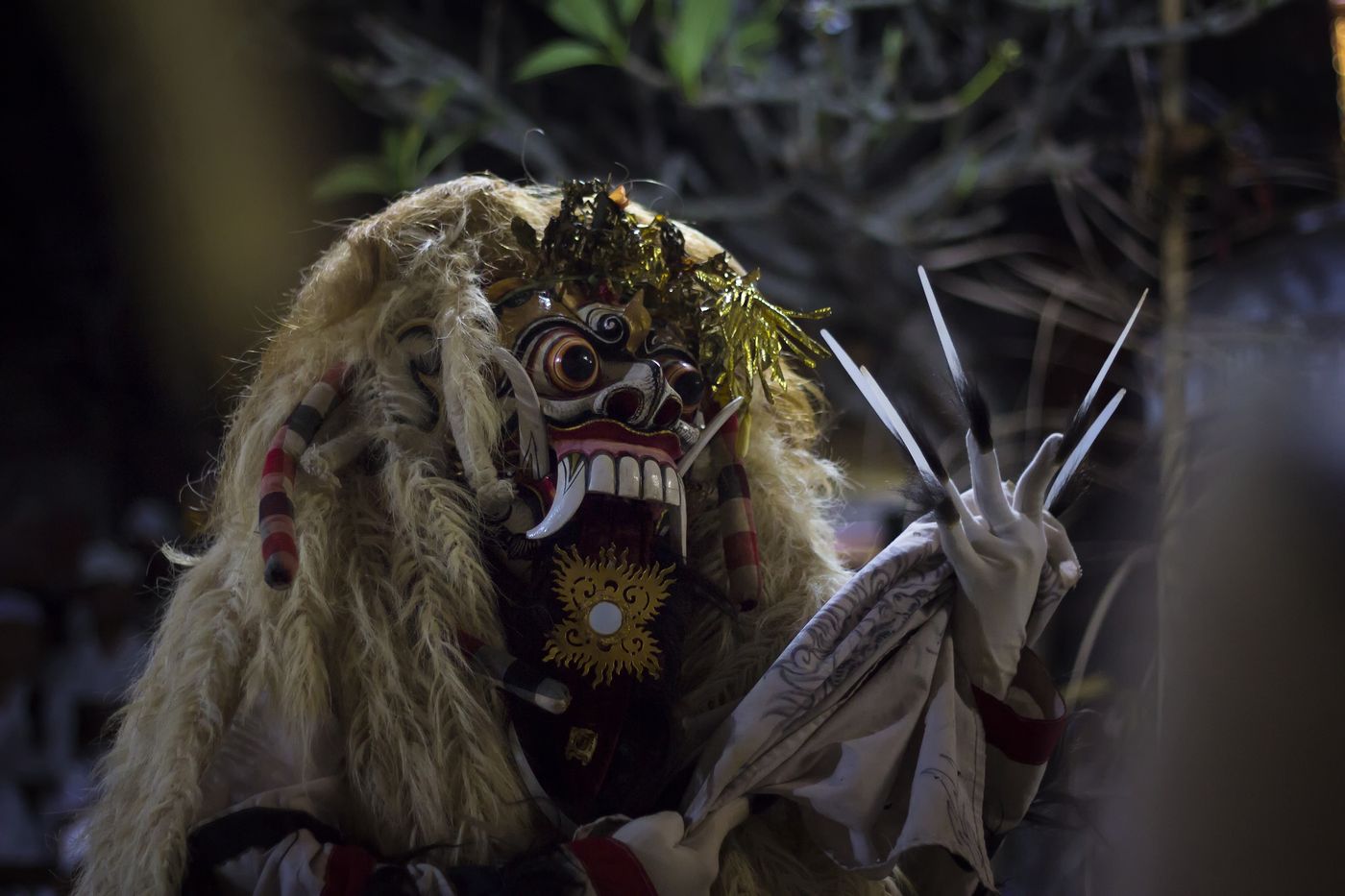
The Barong is the king of the spirits and stands for virtue, a lion-like guardian with thick white fur, gold jewellery and pieces of mirror. Rangda, whose name means "widow" in Javanese, is the queen of the demons and leads an army of witches. Indonesia's Ministry of Tourism calls their dance a mirror of life in which the two are locked in a battle that never ends. The ministry adds that each region models its Barong on a different animal; the lion, Barong Ket, is the one found almost everywhere.
Rangda's story is Calon Arang's. In the tale, which Wikipedia summarises from the Javanese and Balinese tradition, Calon Arang was a widow of Girah in the kingdom of King Airlangga whose daughter, Ratna Manggali, found no suitors because people feared her mother. In revenge the widow called on the goddess Durga and brought flood and plague on the land. The king's sage, Mpu Bharadah, sent his pupil Bahula to marry the daughter; Bahula stole the widow's book of magic, and without it she was defeated. In the Calon Arang dance-drama, the Barong answers Rangda's magic, the kris dancers turn their blades on themselves in trance, and balance is restored. The idea underneath, that the two forces are kept in balance and neither is abolished, is Rwa Bhineda.
The Bhuta Kala
Below gods and people are the bhuta kala. The Hindu council PHDI cites the lontar Purwa Bhumi Kemulan: after Bhatara Siwa and Bhatari Uma had made the world, Siwa took the form of Bhatara Kala, and he and Uma, as Durga, created the bhuta kala together. PHDI reads them as the energy of the five elements, earth, water, fire, air and ether, pictured with fangs and round burning eyes because the storms and earthquakes they stand for were beyond human control. They receive the ground offerings and the caru, and once a year they are built in paper and bamboo as ogoh-ogoh.
Dewi Sri and Dewi Danu
Dewi Sri is the rice goddess. Buleleng's welfare section, writing about Pura Banua at Besakih, calls her the sakti, the power, of Wisnu as the god of prosperity. At harvest, it says, farmers set aside a small bundle of rice and honour it with offerings as Dewa Nini, the name Dewi Sri takes in the granary. In the north she stands on the roof of the subak temple Pura Beji at Sangsit and faces east from the centre of Seririt, opposite Wisnu.
Dewi Danu is the goddess of the lakes. The Ministry of Tourism describes Pura Ulun Danu Beratan, built by the king of Mengwi in 1634, as a guardian of water sources and a centre of her worship for the fertility of Bali's land. Rice and water belong together: the lakes feed the terraces through the subak. The lake temple is an hour up the mountain from Lovina; see Ulun Danu Beratan.
Mayadenawa and the First Galungan
One version of the origin of Galungan, as detikBali tells it, is the fall of Mayadenawa. A proud king of giant descent from Bedahulu, he won great powers from Siwa, then forbade his people to worship the gods and pulled down their temples. The priest Mpu Sangkul Putih prayed at Besakih for help, and the god Indra led the gods down to fight him. Fleeing, Mayadenawa left slanting footprints to throw off his pursuers, which gave the village of Tampaksiring its name, "tilted footprint", and he poisoned a spring. Indra created a new spring to heal his army, Tirta Empul, then caught Mayadenawa and killed him. The victory of dharma is what Galungan celebrates.
The Epics in Balinese Form
The shadow play is one of the oldest homes of the epics. UNESCO describes the wayang master, the dalang, working flat leather shadow puppets behind a lit screen to the sound of the gamelan, and notes that the comic characters speak for ordinary people and can mock the powerful. In Bali one of them is Twalen, a clownish servant who, in Balinese belief as Wikipedia records it, is older and more powerful than the gods, the elder brother of Siwa.
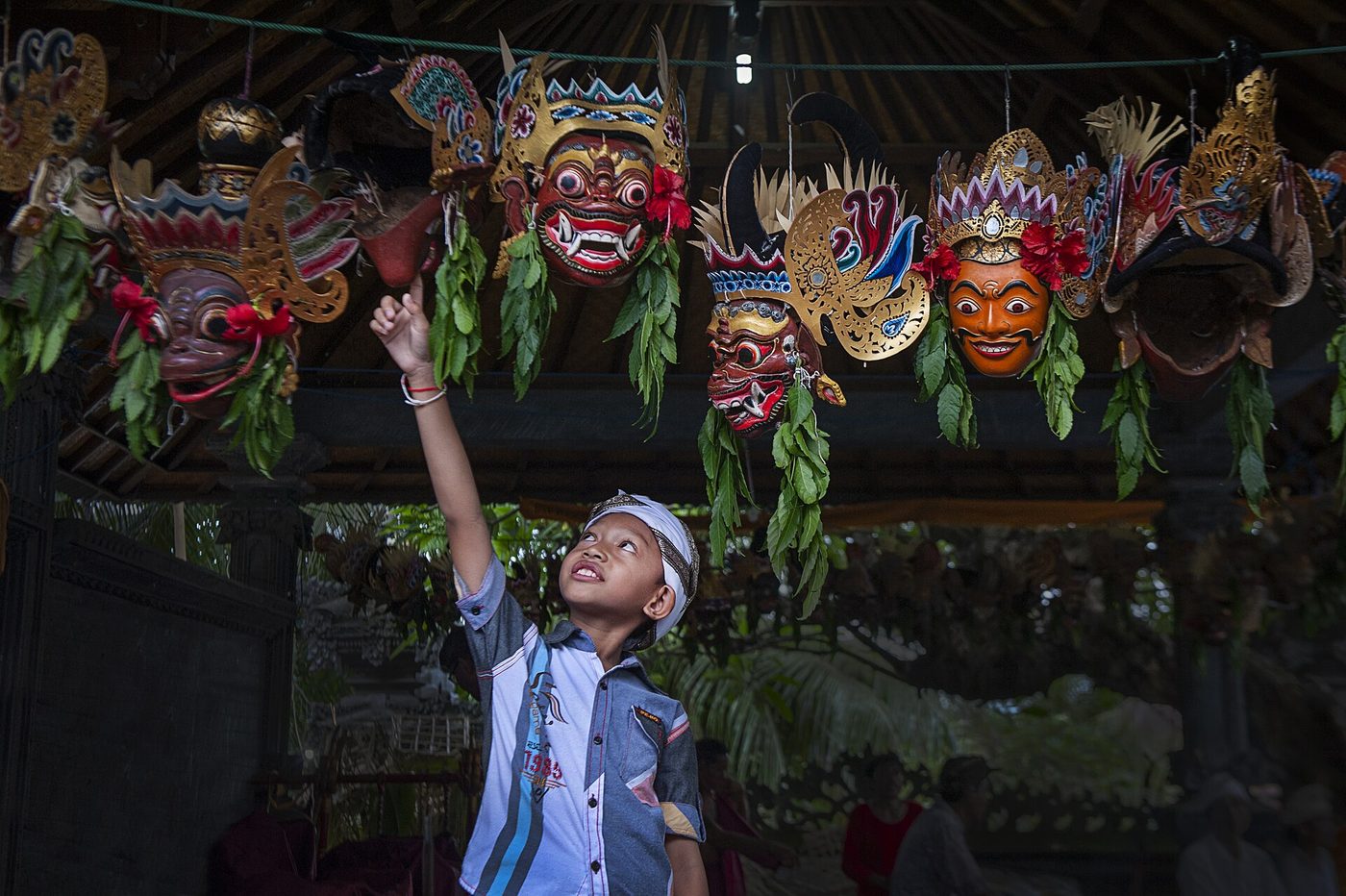 Wayang Wong masks hung ready for a performance in Tejakula. Photo: Imadedana / Wikimedia Commons (CC BY-SA 4.0)

The north has its own form. In Tejakula, on the northeast coast, the Ramayana is danced in masks as Wayang Wong, a sacred performance held within the village's temple ceremonies; north Bali's dance and music places it among the island's dances. Elsewhere on the island the same epic is acted out to the chant of the Kecak.
Legends of the North
Jayaprana and Layonsari. North Bali's great love story: an orphan raised at the court of Kalianget marries the beautiful Layonsari, the king desires her and has Jayaprana killed in the forest at Teluk Terima, and Layonsari takes her own life rather than marry him. Buleleng's culture office writes that in local belief Jayaprana was no myth but a real man, and his grave above Teluk Terima is a temple where people still pray for blessings. The full story is in Jayaprana and Layonsari.
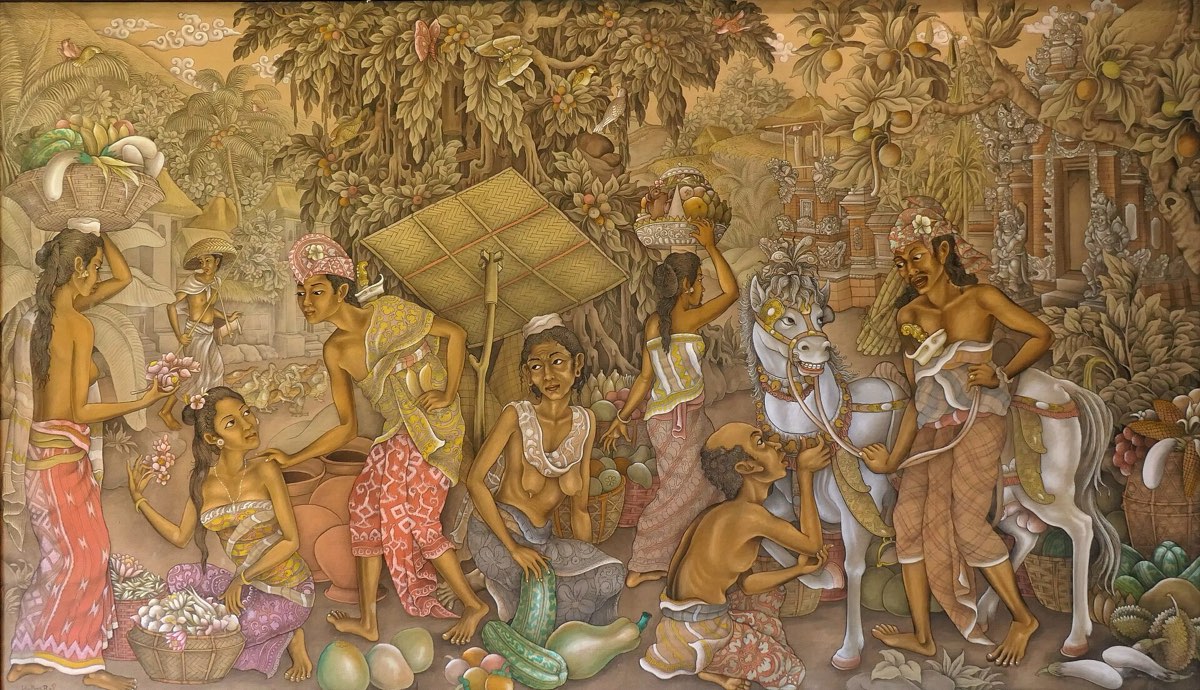 The legend in paint: Jayaprana and Layonsari by Ida Bagus Rai, Neka Art Museum. Photo: Anandajoti Bhikkhu / Wikimedia Commons (CC BY-SA 4.0)

The invisible people of Pulaki. Buleleng's heritage record, Pusaka Budaya Bali Utara, retells the story, drawing on I Gusti Bagus Sugriwa's Dwijendra Tatwa. When the priest Dang Hyang Nirartha left his children at the village of Gading Wani to travel on to Klungkung, and stayed away far longer than he had promised, his daughter, Ida Ayu Swabhawa, grew so angry that she turned the villagers around her into wong samar, people who cannot be seen, and became invisible herself. She lives with them beneath great trees with hanging roots, ngelanting in Balinese, and her shrine is Pura Melanting. As Dewi Melanting she rules the market: she troubles those who trade against dharma and protects those who trade honestly. Pura Melanting is one of the group of temples around Pura Pulaki, on the coast road west of Lovina.
The lion of Singaraja. The city's founder, Ki Gusti Ngurah Panji Sakti, is remembered in the winged lion that rears over its central crossroads; Singaraja's old town explains what its feathers encode.
Where to Meet the Myths in North Bali
The myths are easiest to meet at temple festivals, where the dances are offerings, and on the night before Nyepi, when the bhuta kala walk the streets as ogoh-ogoh. The turtle and its nagas wait at the base of the meru and padmasana shrines, the lontar sit in Gedong Kirtya in Singaraja, and a Barong and Rangda danced on the sand at the opening of the Lovina Sunday Market. Palm Living's villas for rent are mostly around Lovina, within reach of all of it.
FAQ
What is Balinese mythology? The stories behind Balinese Hinduism: the Indian epics as they came through Java, Javanese tales such as Calon Arang, and Bali's own lontar texts and legends, told mostly through wayang, dance, carving and painting.
Who are the main figures in Balinese mythology? Bedawang Nala and the nagas Basuki and Anantaboga; the Barong and Rangda; the bhuta kala; Dewi Sri and Dewi Danu; Mayadenawa and the god Indra; and the heroes of the Ramayana and Mahabharata, joined in Bali by characters such as Twalen.
What is the turtle in Balinese mythology? Bedawang Nala, a giant fire-tongued turtle that carries the island. When it moves the earth shakes, so the nagas Basuki and Anantaboga coil around it to keep it still. It is carved at the base of meru and padmasana shrines.
Who is Rangda? The queen of the demons and leader of the witches; her name means "widow" in Javanese. She is identified with the widow Calon Arang and fights the Barong in a battle that restores balance without ever ending.
Who is Dewi Sri? The Balinese rice goddess, understood as the power of Wisnu as the god of prosperity. At harvest, farmers set aside a small bundle of rice and honour it as Dewa Nini, the name she takes in the granary.
What legends come from north Bali? Above all the love story of Jayaprana and Layonsari, whose grave-temple stands above Teluk Terima, and the tale of Ida Ayu Swabhawa, who made the people of Pulaki invisible and became the market goddess of Pura Melanting.
Sources
- UNESCO, Wayang puppet theatre (wayang at the courts of Java and Bali, its sources, the dalang, the comic characters), English, read September 2026
- detikBali, Mengenal Bedawang Nala dalam mitologi Hindu Bali (the turtle, the earthquakes, the two nagas and their meanings, the ornament on meru and padmasana) and Kisah Mayadenawa di balik perayaan Galungan dan Kuningan, Indonesian, read September 2026
- I Nyoman Widya Paramadhyaksa, Makna filosofis keberadaan ornamen Bedawang Nala di dasar bangunan meru, Jurnal Filsafat, Universitas Gadjah Mada (abstract), English and Indonesian, read September 2026
- Kantor Wilayah Kementerian Agama Provinsi Bali, Penjor, simbol manifestasi istana Tuhan (the Basuki Stawa, Basuki and Besakih), Indonesian, read September 2026
- Wikipedia, I Ketut Gedé, Calon Arang and Twalen, English, read September 2026
- Indonesia Ministry of Tourism, The Barong and the Kris dance (English) and Pura Ulun Danu Beratan Bedugul (Indonesian), read September 2026
- Parisada Hindu Dharma Indonesia, Bhuta Yadnya (the Purwa Bhumi Kemulan and the birth of the bhuta kala), Indonesian, read September 2026
- Dinas Kebudayaan dan Pariwisata Kabupaten Buleleng, Jayaprana & Layonsari (the grave-temple at Teluk Terima, local belief that Jayaprana was real), Indonesian, read September 2026
- Bagian Kesejahteraan Rakyat, Setda Kabupaten Buleleng, Pura Banua Kawan sebagai tempat pemujaan dewi kesuburan (Dewi Sri as Wisnu's power, Dewa Nini), Indonesian, read September 2026
- Pemerintah Kabupaten Buleleng, Pusaka Budaya Bali Utara (Pura Pulaki and its group of temples, Ida Ayu Swabhawa, the wong samar, Pura Melanting and the market, after Sugriwa's Dwijendra Tatwa), Indonesian, read September 2026
- BPI / Palm Living, Balinese mythology (the Ramayana's Rama, Sita and Rawana), English, read September 2026
Read next: Rwa Bhineda for the balance behind the stories, Jayaprana and Layonsari for the north's own legend in full, and Balinese Hinduism explained for the faith they belong to.