On this page
- In Brief
- Bali Street Food at a Glance
- Bali Street Food Is Sold in Three Kinds of Place
- What to Order: From Nasi Campur to Jaja Bali
- North Bali Has Two Street Dishes of Its Own
- Where to Find It: Warungs All Day, Markets and Carts in the Evening
- How to Eat Street Food Safely: Busy Stalls, Hot Food, Sealed Water
- Practical Notes
- FAQ
- Sources
In Brief
Bali street food is sold in three kinds of place: warungs (small family kitchens), kaki lima (roadside carts) and pasar senggol (evening food markets). It is some of the cheapest good food on the island.
Order nasi campur, sate lilit or babi guling to start, and look for Balinese sweets such as laklak and pisang rai. In the evening, bakso and martabak carts roam the neighbourhoods.
Kompas recommends the evening markets in Gianyar town and Tabanan town, plus Kreneng in Denpasar and Sindhu in Sanur. In the north, Singaraja has its own market at the old harbour and a food court in the town park.
Eat where it is busy and the food is cooked hot in front of you. Carry small notes, and drink sealed bottled water.
Bali Street Food at a Glance
- Where: Warungs, roadside carts (kaki lima) and evening markets (pasar senggol)
- Order: Nasi campur, sate lilit, babi guling, bakso, nasi and mie goreng, martabak
- Sweets: Laklak, pisang rai and other jaja Bali, the island's traditional cakes
- North Bali specialities: Siobak and tipat blayag, both from Buleleng
- Well-known markets: Gianyar, Kreneng (Denpasar), Sindhu (Sanur), Tabanan and the old harbour in Singaraja
- Cost: Some of the cheapest meals on the island. Prices are posted at most stalls
- Payment: Cash, in small notes
- Safety: Busy stalls, food cooked hot to order, sealed bottled water
Bali Street Food Is Sold in Three Kinds of Place
Some of the cheapest and most local food in Bali comes from warungs, carts and evening markets.
Warungs are small family kitchens with a counter, a few tables and a glass case of the day's dishes. They are on most streets and open all day, and many specialise in a single dish.
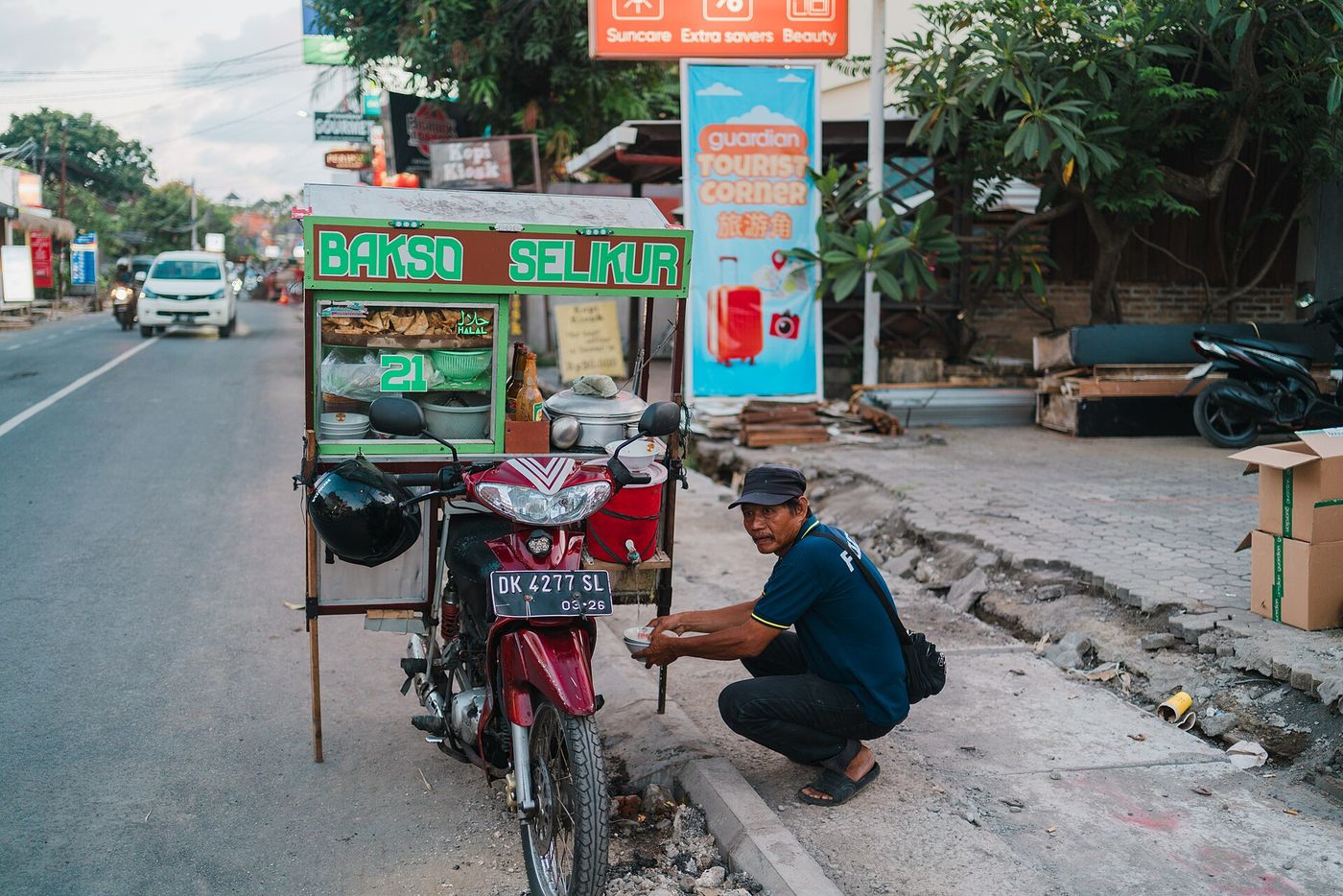
Kaki lima are mobile carts, pushed or built onto a motorbike. The name is Indonesian for "five legs". Bakso and martabak carts are the ones you will see most, especially in the evening.
Pasar senggol are the evening markets. Kompas describes them as night markets found in most regency towns and districts. Stalls sell Balinese food, cold drinks and snacks, and some sell clothes and toys as well.
Several are day markets that turn into food markets as the light goes. A place selling vegetables and offering supplies in the morning is full of food stalls by evening.
The food is Indonesian and Balinese home cooking:
- rice plates
- soups
- satay
- fried noodles
- sweet snacks
Busy stalls turn their food over fast. The two things to learn are what to order and how to choose a busy stall.
What to Order: From Nasi Campur to Jaja Bali
Nasi campur. The everyday rice plate comes with a spread of sides, and it differs from one warung to the next. It is a good first order. See what to eat in Bali for the full menu.
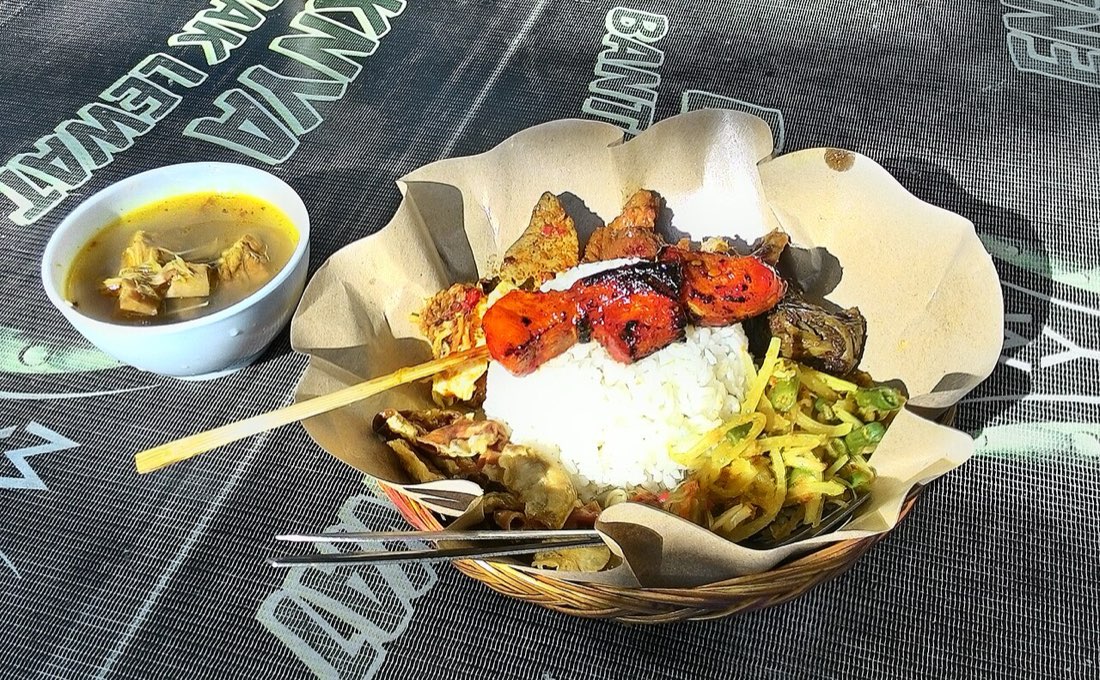 A warung nasi campur with soup. Photo: Gunawan Kartapranata / Wikimedia Commons (CC BY-SA 4.0)
Sate lilit. This is Bali's own satay. Indonesia's tourism site explains that lilit means "to wrap" in Balinese. Minced pork, chicken or fish mixed with Balinese spice paste and coconut is pressed around a bamboo stick or a lemongrass stalk, then grilled over coals.
Babi guling and lawar. Spit-roast pork is served with its crackling, usually with lawar, a chopped mix of vegetables, coconut and spices. Kompas lists it among the Balinese dishes at the Gianyar evening market. The same list has tipat cantok, which is rice cake and vegetables in peanut sauce.
Bakso. Meatball soup is an Indonesian comfort-food staple, sold from carts across Bali. It is hot, filling and quick.
Nasi goreng and mie goreng. Fried rice and fried noodles are cooked fresh in a wok in minutes. They are the safe default at any hour.
Martabak. Two dishes share one name. Martabak manis is a thick sweet pancake folded over chocolate, cheese or peanuts. Martabak telur is a crisp, savoury pastry filled with egg and spring onion, and both are evening-market staples.
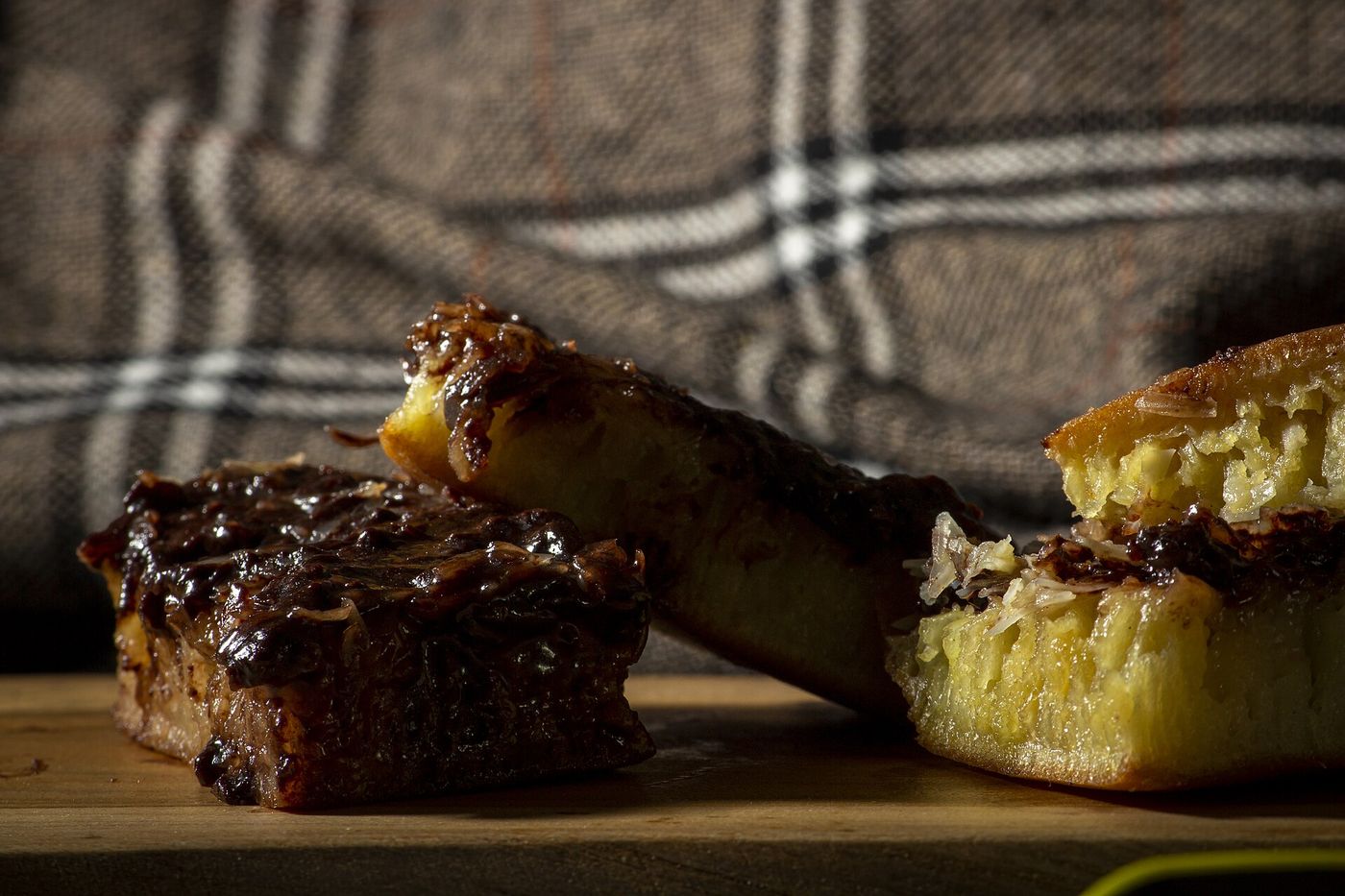 Martabak manis with chocolate and cheese. Photo: Malikpb / Wikimedia Commons (CC BY-SA 4.0)
Jaja Bali. The island's traditional cakes are sold at markets in the morning and at the evening stalls. Palm Living describes laklak as small round rice-flour cakes, white or pale green, cooked in clay moulds. They are topped with grated coconut and a thick brown-sugar syrup.
At Sindhu in Sanur, Kompas found these on the same row of stalls:
- pisang rai
- giling-giling
- laklak
- black and white sticky rice
North Bali Has Two Street Dishes of Its Own
Buleleng, the northern regency, has two street dishes of its own.
Siobak. Singaraja's signature is pork and pork offal, slow-simmered with cloves, cinnamon, palm sugar and fermented bean paste. It comes in a thick brown sauce with pickles and pork crackling, and it is sold at eating houses around the town.
Buleleng's culture and tourism office calls siobak one of the regency's best-known original dishes, born in a town with many pig farms. The office says a visit to Singaraja is not complete without it.
Tipat blayag. Rice cake (tipat) is cut into pieces and served in a chicken broth with vegetables, chicken and fish sate lilit. Kompas visited a roadside warung in Bondalem, Tejakula and heard it described as Buleleng's own dish, also found in Karangasem and Denpasar. The rice cake and the chicken broth are fixed, and the rest is up to the cook.
An Evening of Grazing in Singaraja
Singaraja has a pasar senggol at the old Buleleng harbour. The regency tourism office lists the Taman Kota culinary market, in the town park on Jalan Ngurah Rai, as a favourite with people around the town.
Singaraja's old town covers the harbour quarter, and the best warungs in north Bali covers the kitchens along the Lovina coast. When it runs, the Lovina Sunday Market adds laklak and village sausage cooked on the beach.
Where to Find It: Warungs All Day, Markets and Carts in the Evening
Warungs. They are open all day on most streets, and they are the reliable everyday option.
Evening markets. You graze from stall to stall at a pasar senggol. Kompas recommends the first four below, and the fifth is the north's own.
- Gianyar (Map): on Jalan Ngurah Rai in the heart of Gianyar town, about 10 kilometres south-east of central Ubud. Babi guling, tipat cantok and lawar, plus clothes and accessories.
- Kreneng, Denpasar (Map): a daytime market for vegetables, meat and ceremony supplies that becomes a pasar senggol towards evening, with Balinese cakes such as pisang rai and giling-giling.
- Sindhu, Sanur (Map): about two kilometres from Sanur beach, a produce market by day and a food market at night, with nasi campur, sate lilit and a long row of cakes.
- Tabanan (Map): along Jalan Gajah Mada in the town centre, with Balinese nasi campur, ayam betutu and bubur Bali.
- Singaraja (Map): the evening market at the old harbour, and the Taman Kota food court.
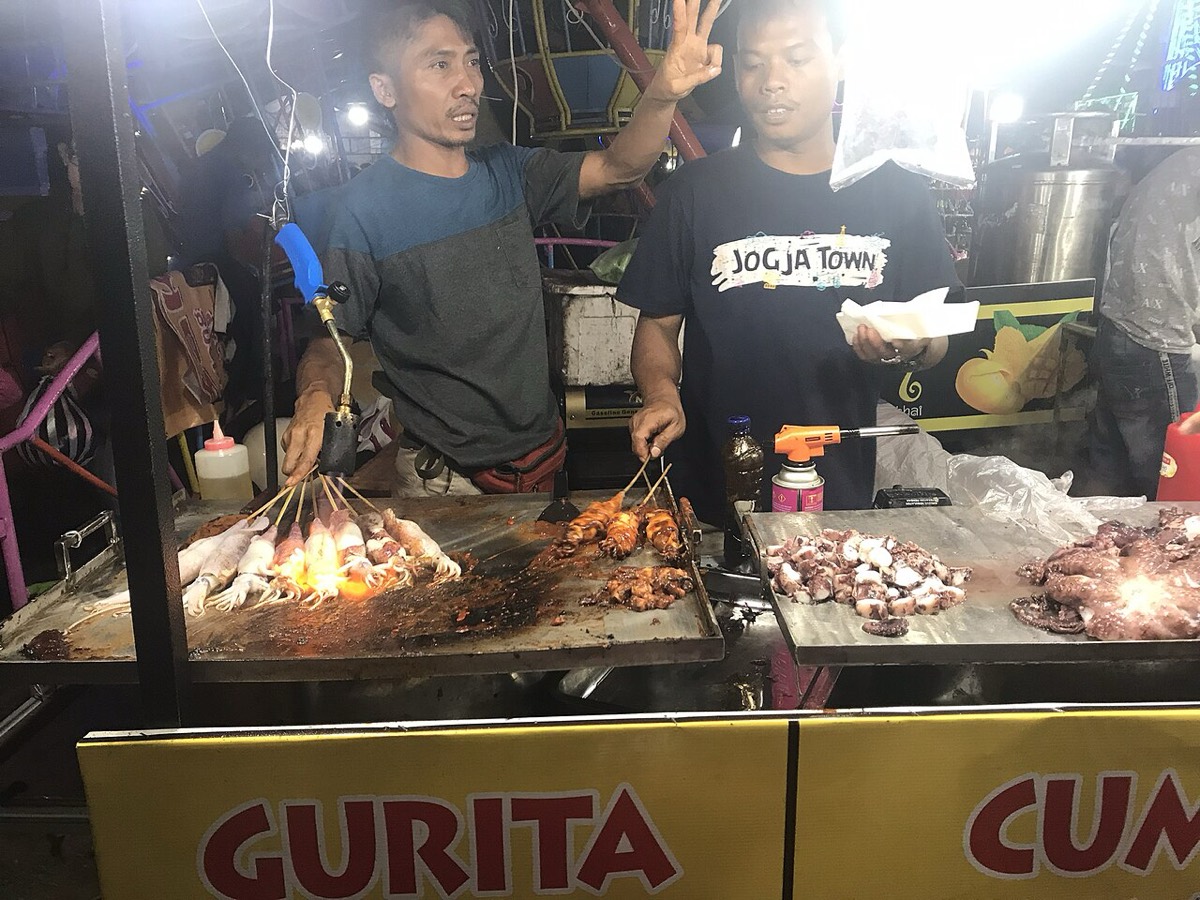 Skewers over the grill at a night market. Photo: Julia Kado / Wikimedia Commons (CC BY-SA 4.0)
Markets move and change their days, so check locally before you build an evening around one.
Roadside carts. Listen for the calls and bells in the evening, when bakso and martabak carts roam the neighbourhoods.
How to Eat Street Food Safely: Busy Stalls, Hot Food, Sealed Water
Street food is part of everyday life in Bali, and a few easy habits keep it a pleasure:
- Choose food cooked to order and served steaming hot. Hot food should be hot and cold food cold.
- Eat where it is busy, so nothing has been sitting out.
- Go easy on raw vegetables and raw sauces made from uncooked fruit or vegetables.
- Drink sealed bottled water or other drinks from factory-sealed bottles and cans, never tap water. Skip ice where you cannot tell what water it was made from.
- Wash your hands, or use sanitiser, before you eat.
Build up to the sambal a little at a time. If your stomach does object, Bali belly covers what to do. The Bali currency guide covers carrying the small cash you will need.
Practical Notes
- Cash: carry small notes. Most stalls cannot change a large one.
- Pork: much Balinese street food is pork (babi). Ask before ordering if you do not eat it. Chicken (ayam) and fish (ikan) versions of sate lilit are common.
- Vegetarian: harder at stalls than in warungs. See vegan and vegetarian Bali.
- Spice: sambal comes on the side or on the plate. Ask for tidak pedas (not spicy) if you want it mild.
- Timing: traditional cakes are a morning-market food. The evening markets fill up from late afternoon.
- Learn it: a cooking class is the fastest way to know what you are looking at.
FAQ
Is street food safe in Bali? Generally, yes, if you eat at busy stalls serving food cooked hot to order, go easy on raw vegetables and uncooked sauces, and drink sealed bottled water. High turnover is a good safety signal.
What street food should I try in Bali? Nasi campur, sate lilit, babi guling, bakso, nasi and mie goreng, and martabak for dessert, plus Balinese cakes such as laklak and pisang rai. In the north, try Singaraja's siobak and Buleleng's tipat blayag.
Where are the best night markets in Bali? Kompas recommends the pasar senggol in Gianyar town, at Kreneng in Denpasar, at Sindhu in Sanur and in Tabanan town. In the north, Singaraja has an evening market at the old harbour and a food court at the Taman Kota park.
How much does street food cost in Bali? It is some of the cheapest good food on the island, far below restaurant prices. Most stalls post their prices. Carry small notes, because change for a large one is scarce.
Can you drink the water in Bali? No, not from the tap. Drink sealed bottled water or drinks from factory-sealed bottles and cans, and skip ice when you cannot tell how it was made.
Is warung food the same as street food? Closely related. Warungs are small fixed family kitchens, while street food also includes mobile carts and market stalls. Both serve cheap, local food, and many warungs sit right on the street.
What is Balinese street food like in north Bali? You find the same warungs, carts and evening markets as on the rest of the island, with two local dishes on top. Siobak is Singaraja's slow-cooked pork in a thick spiced sauce. Tipat blayag is rice cake in chicken broth with vegetables and sate lilit.
Sources
- Kompas, 6 pasar senggol di Bali (what a pasar senggol is; the Gianyar, Kreneng, Tabanan and Sindhu markets, their locations and the food at each), in Indonesian, read September 2026
- Kompas, Tipat blayag Buleleng (the dish, its fixed and variable parts, and where else in Bali it is found), in Indonesian, read September 2026
- Buleleng Regency Culture and Tourism Office, Siobak makanan khas Buleleng (what siobak is, its spices and preparation, its origin in Singaraja), in Indonesian, read September 2026
- Buleleng Regency tourism office, Visit North Bali, Pasar Kuliner Taman Kota (the culinary market in Singaraja's town park), read September 2026
- Tatkala, Lalapooh: crepes at the Pasar Senggol of the old Buleleng harbour (the evening market at the old harbour, Singaraja), in Indonesian, read September 2026
- Indonesia's official tourism site, Sate Lilit (meaning of lilit, the meats, spice paste, coconut and lemongrass skewers), read September 2026
- Palm Living, Balinese traditional cake: laklak (what laklak is and how it is served), read September 2026
Read next: what to eat in Bali for the full menu, the best warungs in north Bali for where to sit down, and the best seafood in Bali for the grills on the coast.