On this page
In Brief
The Lovina Sunday Market is a small makers' market for Buleleng's local businesses, held on the beach at Spice Beach Club in Kaliasem, just west of central Lovina. The Buleleng government opened it on Sunday 6 July 2025 with a Barong dance, a release of forty turtle hatchlings and a speech from the Regent, and announced it as a weekly event. Everything on the tables is made in the regency: woven cloth, carved metalwork, paintings, coconut oil, laklak cooked to order, village sausage and wine from north Bali grapes. Confirm it is on before you plan a Sunday around it; see the practical notes below.
The Market at a Glance
- What it is: A beach market for Buleleng's small local producers (in Indonesian, UMKM: micro, small and medium businesses)
- Where: Spice Beach Club, Kaliasem Beach, on the main Singaraja to Seririt road west of central Lovina
- When: Announced as every Sunday from 6 July 2025
- Cost: No entrance fee was mentioned in any report of the opening
- What to buy: Woven and songket cloth, handmade bags, carved aluminium homeware, paintings, virgin coconut oil, local honey, robusta coffee, Buleleng wine
- What to eat: Laklak hot off the clay stove, smoked urutan sausage from Tajun village, chips, pie and dodol sweets
- Started by: The owner of Spice Dive and Spice Beach Club, Nyoman Arya Astawa, with the Buleleng government
Why Lovina Started a Sunday Market
The reason is in the Regent's opening speech, and it is an honest one. Visitors arrive in Lovina constantly, he said, but after watching the dolphins they go straight home, and they buy nothing to take with them. The dolphin trips are over by eight in the morning, so a visitor who came only for them can be gone before the town has opened, and the people who make things in this regency never meet them.
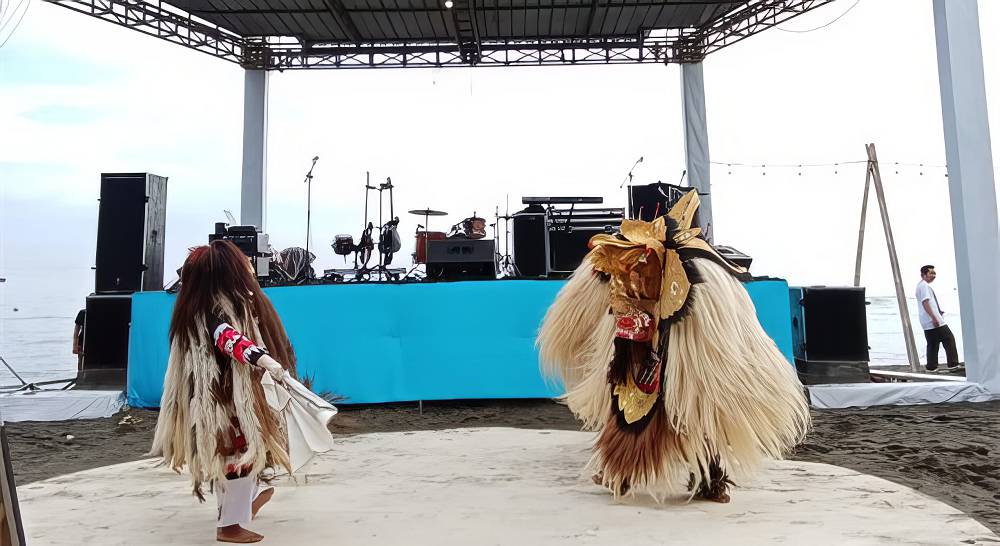 The Barong meets Rangda on the sand at the market's opening, 6 July 2025. Photo: Palm Living.
The idea of a weekly market came from Nyoman Arya Astawa, who owns the dive centre and beach club at Kaliasem and is known locally as Mang Dauh. He offered the beachfront as a place for small producers to show and sell their work. On the first Sunday, he told reporters, the buyers were a mix of local families and tourists staying around Lovina, which was the point.
The Regent of Buleleng, dr. I Nyoman Sutjidra, opened it in person, with the Vice Regent, the regional secretary, the head of the tourism office and the local hotel and restaurant association in attendance. He asked the producers to treat it as a standing weekly event, with something different each Sunday, and said he hoped it would not stop at the opening day.
What Is on the Tables
Everything sold is made in Buleleng. That is the rule of the market, and the reason to buy here.
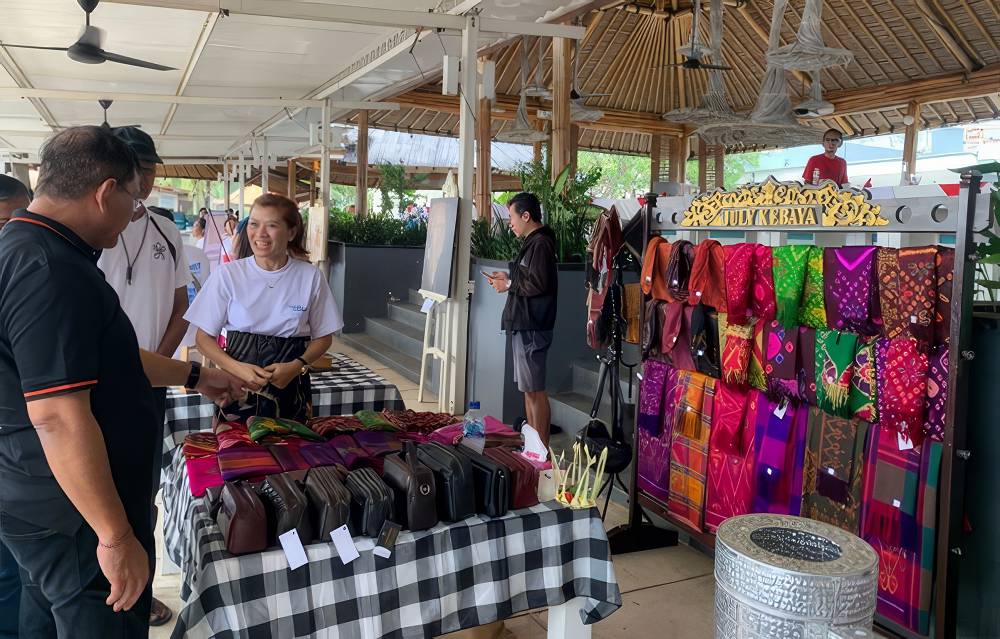 Woven cloth and handmade bags at one of the craft stalls. Photo: Palm Living.
Cloth and craft. Woven and songket cloth in bright pinks, greens and purples, sold as lengths and made up into bags and purses. One stall at the opening sold household pieces in carved aluminium. There were also paintings on easels by local artists, accessories, virgin coconut oil, local honey and robusta coffee from the Buleleng hills. If craft is what you came north for, where to shop in north Bali covers the weaving villages and the markets in Singaraja.
Laklak. Small rice-flour pancakes, green from pandan or moringa leaf, cooked in a clay mould over a fire and eaten hot with grated coconut and palm sugar syrup. The government's own notice singles out laklak kelor, the moringa version, as a Buleleng speciality. Watching them made is half of it. There is more on laklak and the rest of the island's cakes in what to eat in Bali.
Urutan from Tajun. Urutan is the Balinese pork sausage, spiced with the same base of chilli, galangal and turmeric as most of the island's cooking. The version on sale is urutan asap, smoked sausage, from Tajun, a village in the hills east of Singaraja. Next to it at the opening were pork crackling, pie (the small custard tarts sold all over Bali) and dodol, a dense sticky sweet wrapped in dried corn husk.
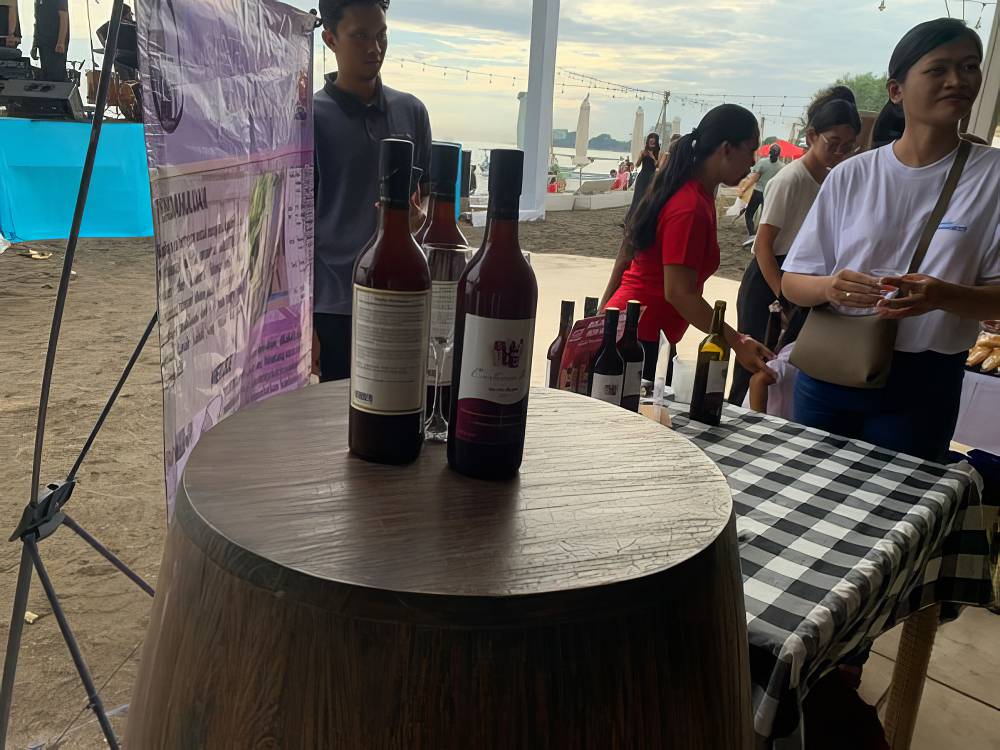 Wine made from Buleleng grapes, on sale at the market. Photo: Palm Living.
Buleleng wine. North Bali's dry coast, west of Lovina towards Seririt and Gerokgak, is where the island's grapes grow, and a local producer sells bottled wine at the market. It is a chance to taste something made in the regency from its own fruit. For the older drinks of the north, arak, tuak and the herbal loloh, see the drinks of north Bali.
Prices, by Palm Living's account of the opening, are what locals pay. Bring small notes; assume cash only.
The Opening: Barong, Turtles and Ayam Betutu
The first market was as much a ceremony as a sale. It opened with a Barong dance performed by a local community group, Komunitas Rumah Sampah Kaliber. The Barong is the shaggy, lion-like guardian you see in the photograph above; opposite him is Rangda, the widow-witch. Their dance has no winner, because in Balinese thinking the two forces are never finished with each other, only kept in balance. If that idea is new to you, Rwa Bhineda explains it.
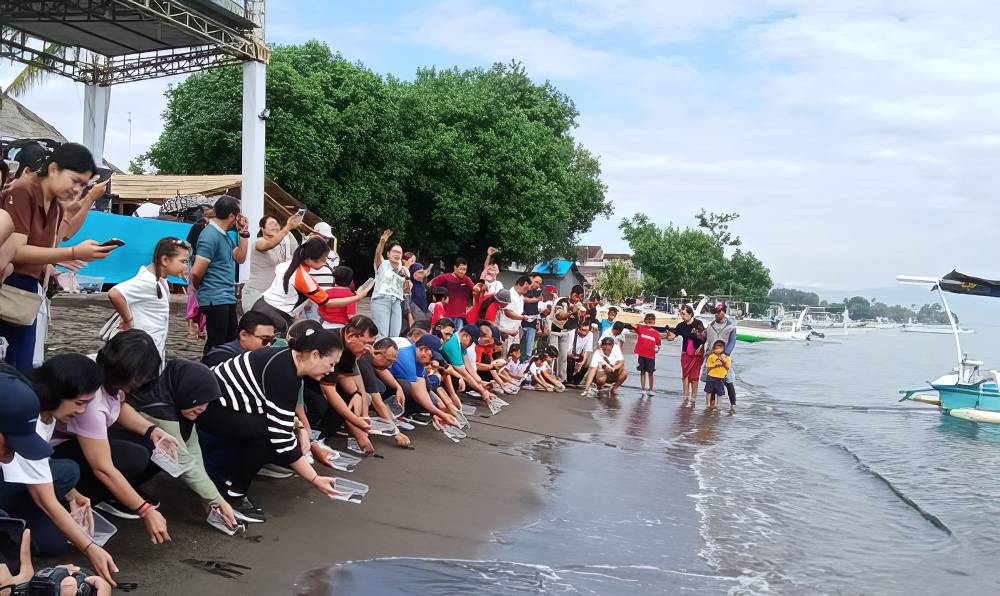 Releasing turtle hatchlings on Kaliasem's black sand at the opening. Photo: Palm Living.
After the dance, forty turtle hatchlings were released from the black sand in front of the club. Each one was given a name before it went into the water. The Regent called his "Paten" and the Vice Regent, Gede Supriatna, called his "Joss", which tells you the mood of the morning. The singer Bagus Wirata and a live band played from the stage by the sea, and the officials finished with ayam betutu, the slow-cooked spiced chicken, at Warung Nyoman next door.
Whether a given Sunday has a performance is something to ask about rather than expect. The opening was a one-off; the Regent's request was for the weekly market to keep changing.
How to Fit It into a Lovina Sunday
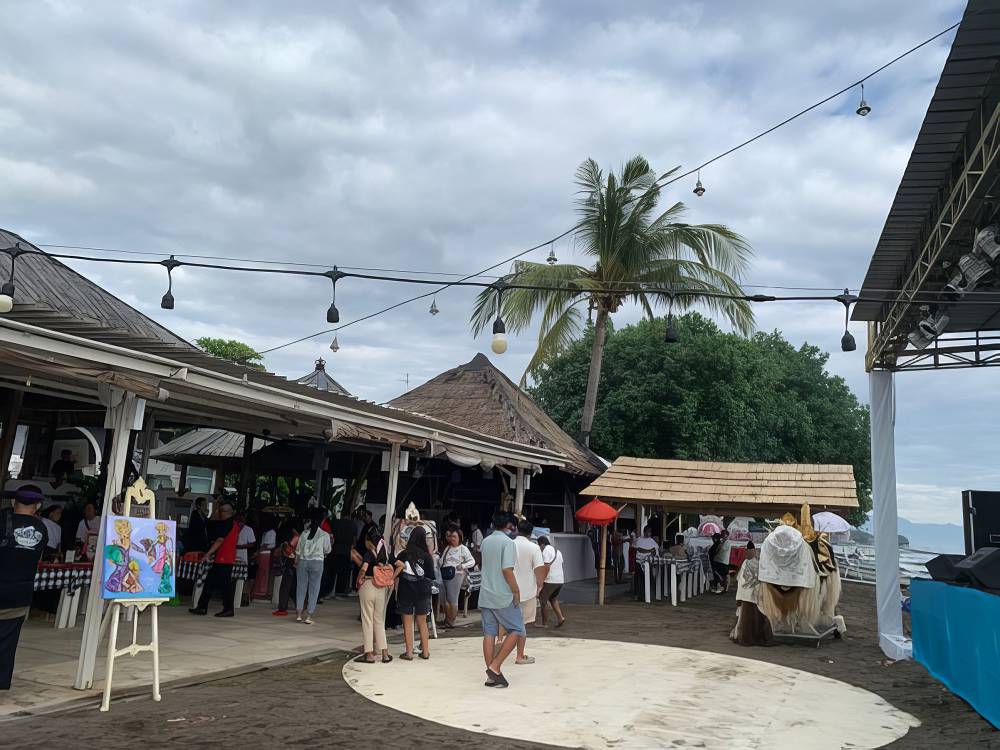 Market day at Spice Beach Club, Kaliasem. Photo: Palm Living.
The natural order is the one the market was designed around. Take the dolphin boat at dawn, which is over by eight, then go to Kaliasem for breakfast from the stalls instead of from the hotel. It is a few minutes by car or scooter west of the dolphin statue at Kalibukbuk, on the sea side of the main road.
From there the day is open. Banjar hot springs and the Buddhist monastery are a short drive further west, and the club itself has a pool and a restaurant if you would rather not move. In August, a Sunday at Kaliasem can also mean Sapi Gerumbungan, the decorated bull races held in the fields nearby. Other ideas are in things to do in Lovina.
If you are choosing where to stay with this in mind, Kaliasem and the villages west of it are the quiet end of Lovina; the best villas in Lovina lists what is on that stretch of coast.
Practical Notes
- Check before you go. The market was announced as weekly in July 2025. We have not confirmed the current schedule ourselves. Message Spice Beach Club or ask your villa to call, and ask what time the stalls open.
- Go early. It is a morning market on an open beach, and the cooked food goes first.
- Bring cash in small notes. Nearest ATMs are in central Lovina.
- Dress as you would for the beach club, and cover up if there is a ceremony or blessing as part of the morning.
- Ask before photographing people at their stalls. Most will say yes and then sell you something, which is fair.
FAQ
Where is the Lovina Sunday Market? On the beach at Spice Beach Club in Kaliasem, a few minutes' drive west of central Lovina on the main Singaraja to Seririt road. The Buleleng tourism office describes the location as the Spice Beach Club area of Kaliasem Beach.
Is the Lovina Sunday Market on every week? It was launched on 6 July 2025 as a weekly Sunday event, and the Regent of Buleleng asked for it to continue every Sunday. Check with Spice Beach Club before you go, since we have not confirmed the current schedule.
What can you buy at the Lovina Sunday Market? Only things made in Buleleng: woven and songket cloth, bags, carved aluminium homeware, paintings, coconut oil and local wine, plus food cooked on the spot such as laklak pancakes and urutan sausage from Tajun village.
Who started it? Nyoman Arya Astawa, the owner of Spice Dive and Spice Beach Club at Kaliasem, offered the space to local producers. The Buleleng government opened it officially, with the Regent, dr. I Nyoman Sutjidra, attending.
Why was it started? Because most visitors to Lovina came for the dawn dolphin trip and left straight afterwards without buying anything local. The market gives them a reason to stay on the beach for the morning and meet the people who make things here.
Sources
- Buleleng Culture and Tourism Office, Sunday Market officially opened in Lovina, 6 July 2025 (in Indonesian)
- Bali Travel News, Sunday Market, a promotion space for small businesses at Lovina Beach, 7 July 2025 (in Indonesian)
- Lentera Esai, Sunday Market Lovina officially opened, 6 July 2025 (in Indonesian)
- Palm Living's own visit to the opening, first written up on Bali Information
More of the north's calendar: the Lovina Festival on the beach each July and the Buleleng Festival in Singaraja each August.