
On this page
Last updated: September 2026
In Brief
Suksma (said roughly sook-smuh) is Balinese for thank you. Matur suksma is the more humble, respectful version, right for elders, priests and anyone you want to honour. The usual replies are suksma mewali, thanks returned, or nggih, sareng-sareng, yes, and to you too. Conversations open with Om Swastyastu, a Hindu greeting and blessing, and formal ones close with Om Santih Santih Santih Om, peace three times. Balinese is its own language, separate from Indonesian, with polite and everyday levels of speech. Almost every Balinese person also speaks Indonesian, but Palm Living's original guide to the language, written from Lovina, notes that even a little Balinese earns visitors extra warmth.
Balinese Words at a Glance
- Thank you: Suksma
- Thank you (humble, respectful): Matur suksma
- You're welcome: Suksma mewali, or nggih, sareng-sareng
- Hello (any time of day): Om Swastyastu
- Good morning / good evening: Rahajeng semeng / rahajeng wengi
- How are you? Punapi gatra? (polite) or kenken kabare? (casual)
- Fine: Becik
- Yes / no: Nggih / nenten
- Sorry, excuse me: Ampura
- Delicious: Jaen
- How much? Aji kuda?
- Indonesian equivalents: Terima kasih, sama-sama, selamat pagi, apa kabar, berapa
What Does Suksma Mean?
Suksma means thank you. The BASAbali dictionary, a community Balinese dictionary whose entries are verified by the government language office Balai Bahasa, lists thank you as its first sense and marks it as mider, the neutral level of speech that fits any situation (BASAbali Wiki). You can say it to a waiter, a driver, a villa host or a grandmother, and it will never be wrong.
The word came into Balinese from Sanskrit through Kawi, the old literary Javanese of the Hindu-Buddhist courts, and it carries more than thanks. The same dictionary entry gives spirit and soul as further meanings, and its derived form suksman means purpose or meaning.
Say it with the stress light and the final a soft, close to the a in sofa: sook-smuh. That softened final a is a regular feature of standard Balinese, which pronounces a written final a as a schwa (Wikipedia: Balinese language).
Matur Suksma vs Suksma: When to Use Which
Suksma on its own is everyday thanks.
Matur suksma adds matur, the humble word for to say or to speak. BASAbali places matur at the alus sor level, the refined register you use to lower yourself politely toward the person you are speaking to, and glosses matur suksma as expressing thanks humbly and from the heart (BASAbali Wiki). The Indonesian news agency Tempo notes that everyday speech often shortens it to plain suksma (Tempo).
Use matur suksma when:
- you thank an older person, a priest (pemangku) or a village elder,
- someone has done you a real kindness, such as inviting you into a ceremony or their home,
- you close a speech, a message or a formal moment. BASAbali's collected examples show matur suksma at the end of speeches, often right before Om Santih Santih Santih Om.
Use suksma for everything else. Between friends you will also hear a quick suksma, nggih, which softens it further.
How to Reply: Suksma Mewali
If someone thanks you, answer with suksma mewali (sook-smuh muh-wah-lee), which Palm Living's original guide gives as the Balinese you're welcome. Mewali comes from wali, to return, and the refined form mawali means to go back (BASAbali Wiki), so the phrase is close to thanks returned to you. BASAbali's entry for mewali is tagged to Pangkung Paruk, a village in Seririt district on the Buleleng coast, with a dialogue that ends suksma nggih, nggih mewali: thank you, yes, you're welcome (BASAbali Wiki).
The other common reply is nggih, sareng-sareng (ngee, sah-rung sah-rung). Sareng-sareng means together, the same idea as Indonesian sama-sama, and BASAbali's example is exactly this exchange: Suksma, Beli, thank you, brother; Nggih, sareng-sareng, sure, you are welcome (BASAbali Wiki). The everyday form is bareng-bareng.
Om Swastyastu and the Greetings
Om Swastyastu (ohm swah-stee-AHS-too) is the greeting Balinese Hindus give when they meet, and Tempo compares it to Assalamu'alaikum in Islam (Tempo). Om is the sacred syllable for God, and swasti means safe, prosperous and blessed (BASAbali Wiki). Palm Living's original guide to Balinese words renders the whole phrase as a wish that the other person receives many blessings from God, is happy and is well, and notes that it can be said at any time of day, by anyone, to anyone.
The gesture goes with it: palms together in front of the chest, fingertips pointing up. The other person answers with the same words and the same gesture.
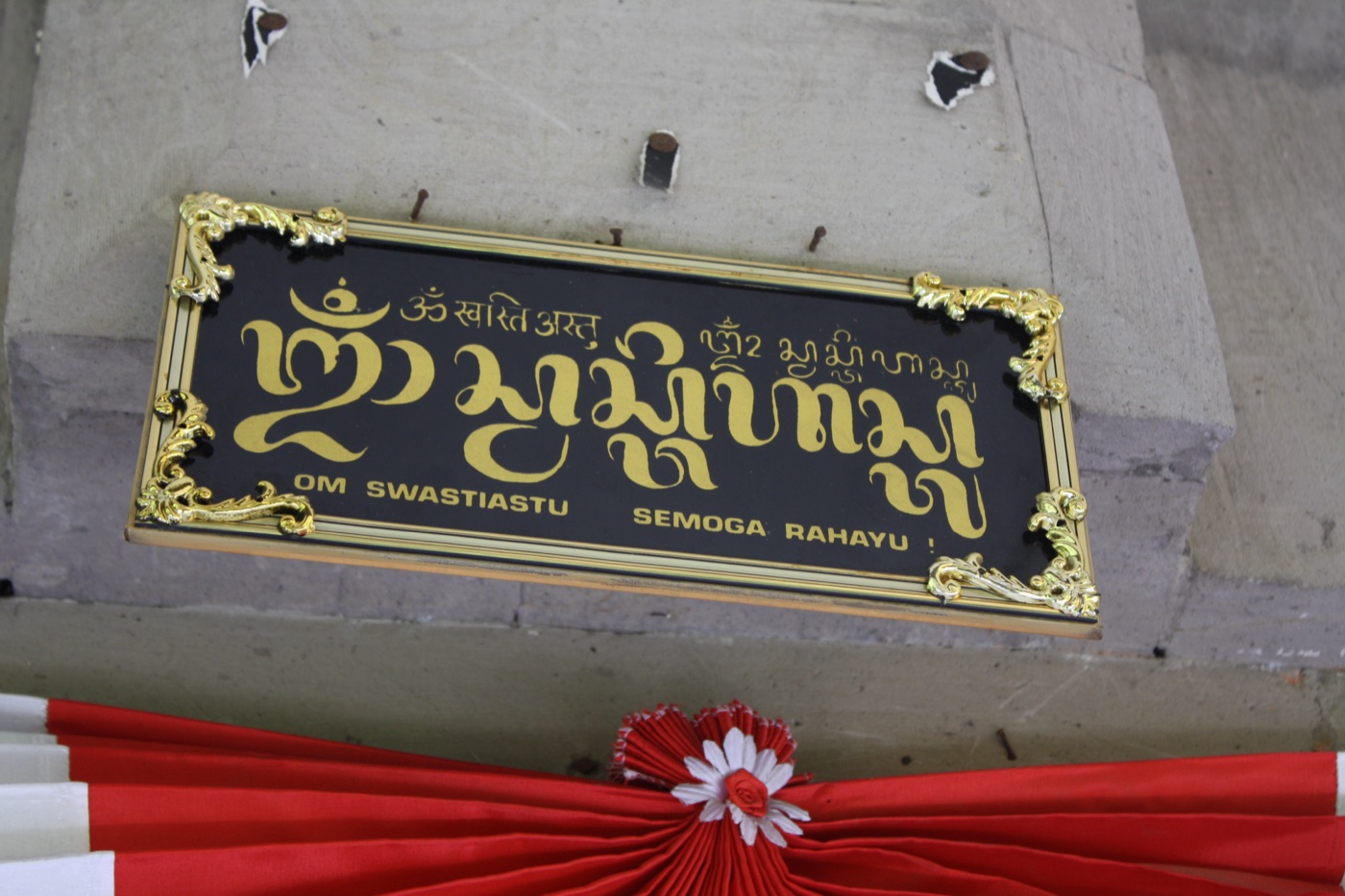 Om Swastiastu in Balinese script over a school doorway in Denpasar. Photo: Alteaven / Wikimedia Commons (CC BY-SA 3.0)
The spelling varies. Om Swastyastu and Om Swastiastu are both in everyday use, and you will see both on signs.
Om Santih Santih Santih Om is the closing partner, santih meaning peace, repeated three times (BASAbali Wiki). You will hear it at the end of speeches, prayers and formal messages more than at the end of a chat.
For times of day, add rahajeng, which means safe, peaceful or prosperous (BASAbali Wiki):
- Rahajeng semeng (rah-hah-jung suh-mung): good morning
- Rahajeng tengai (rah-hah-jung tung-ai): around midday, when the sun is high
- Rahajeng wengi (rah-hah-jung wung-ee): good evening, good night
- Rahajeng rauh (rah-hah-jung rah-ooh): welcome, as heard at hotel doors
To leave, say tiang mapamit (tee-ahng muh-pah-mit), I'll take my leave. BASAbali calls it the usual way of excusing yourself before leaving (BASAbali Wiki).
Balinese vs Indonesian: Which One to Learn
They are two different languages. Balinese belongs to the Bali-Sasak-Sumbawa group of Austronesian languages, alongside the languages of Lombok and Sumbawa, while Indonesian is the national language. The 2000 census counted about 3.3 million Balinese speakers, but the Bali Cultural Agency estimated in 2011 that fewer than a million people still used Balinese in daily life. Most Balinese also speak Indonesian, which dominates schools, government, media and most business, and switching between the two in one conversation is normal (Wikipedia: Balinese language).
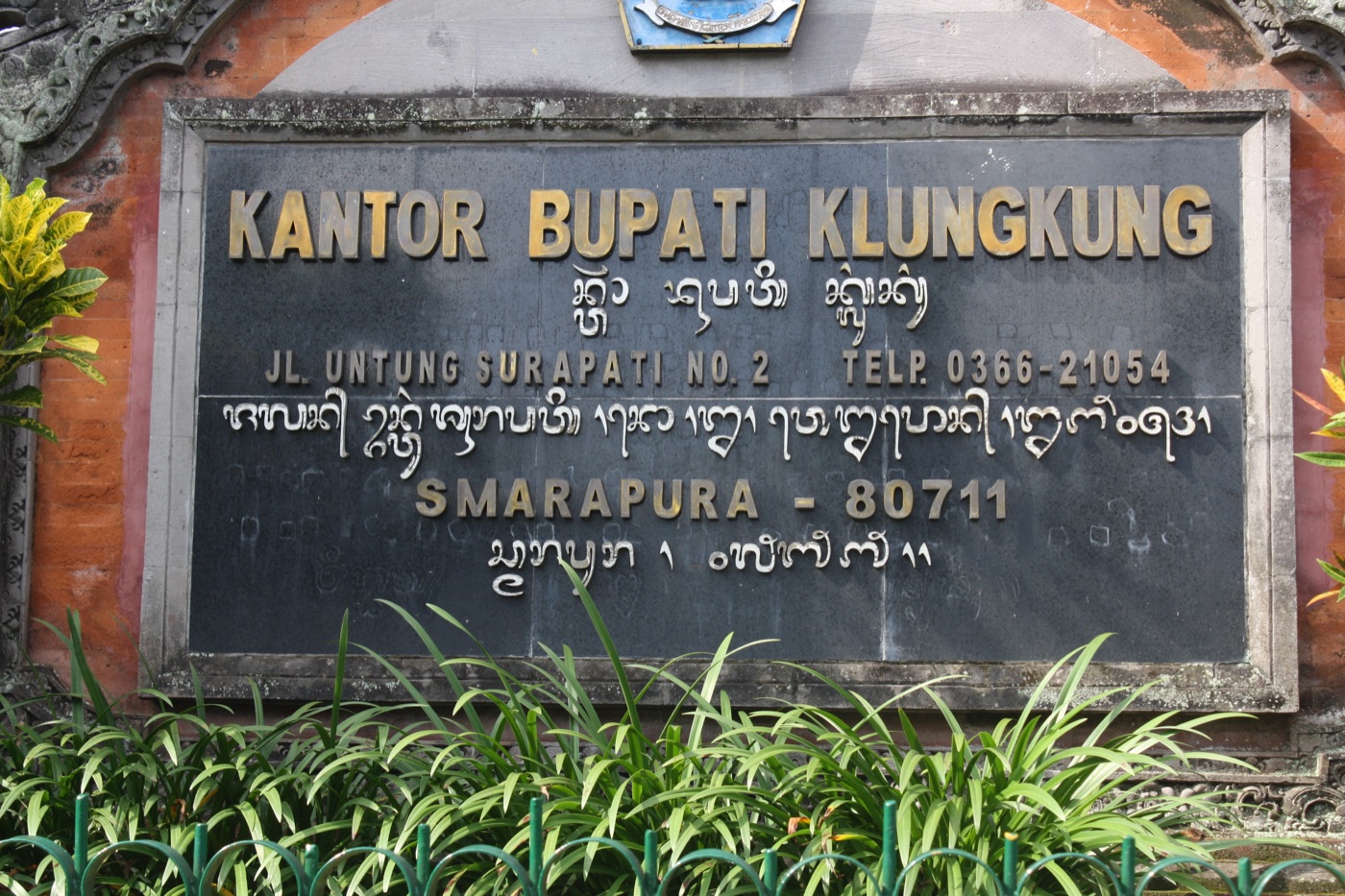 The Klungkung regent's office sign, in Latin letters and Balinese script. Photo: Alteaven / Wikimedia Commons (CC BY-SA 3.0)

The script matters too. Balinese has its own writing system, aksara Bali, and the province's 2018 regulation on Balinese language, script and literature requires their use in public spaces, and Balinese script on public signs has been recovering since (Wikipedia: Balinese language).
For a visitor, the practical answer is both, in small doses:
- Indonesian gets things done anywhere in Bali and across the country: terima kasih (thank you), berapa? (how much?), di mana? (where?).
- Balinese is the courtesy. A suksma or an Om Swastyastu shows you took the trouble to learn the local language, at a time when younger Balinese increasingly use Indonesian for things their elders said in Balinese.
The levels of speech
Balinese marks respect through word choice. Speakers pick a lower, middle or higher word for the same idea depending on who they are talking to and about. Most everyday talk uses the common register, basa kapara, and the high register, basa singgih, is reserved for formal, ceremonial and respectful speech, including speech to high priests (Wikipedia: Balinese language). Tempo lists the familiar levels as kasar (coarse), andap (between peers), mider (neutral) and alus (refined), with alus used toward elders, parents, religious leaders and officials (Tempo).
The level system is tied up with Bali's old caste titles, which is part of why names matter so much here; the background is in how Balinese names work.
For a guest, the polite forms are the safe choice, and the list below marks them.
The 30 Words, Grouped
Pronunciation is approximate, written for English speakers. Final a is soft (uh), e is often soft too, and c sounds like the ch in church. Registers follow the BASAbali dictionary: polite marks the alus forms, everyday the andap forms, neutral the mider forms that fit anywhere.
Greetings and goodbyes
- Om Swastyastu (ohm swah-stee-AHS-too). Hello, a blessing. Said any time of day.
- Om Santih Santih Santih Om (ohm shahn-tee ×3 ohm). Peace, peace, peace; the formal close.
- Rahajeng semeng (rah-hah-jung suh-mung). Good morning. Neutral.
- Rahajeng wengi (rah-hah-jung wung-ee). Good evening, good night. Polite; the everyday word for night is peteng.
- Punapi gatra? (poo-nah-pee gah-truh). How are you? Polite. The casual version is kenken kabare? (kayn-kayn kah-bah-ray).
- Becik (buh-cheek). Good, fine. The reply to how are you, often doubled: becik-becik.
- Mapamit (muh-pah-mit). I'll take my leave. Polite.
Thanks and courtesy
- Suksma (sook-smuh). Thank you. Neutral.
- Matur suksma (mah-toor sook-smuh). Thank you, humbly. Polite.
- Suksma mewali (sook-smuh muh-wah-lee). You're welcome.
- Sareng-sareng (sah-rung sah-rung). You're welcome, likewise. Polite; everyday bareng-bareng.
- Nggih (ngee). Yes. Polite; BASAbali notes it is the informal way to say yes to someone senior.
- Nenten (nun-tun), shortened ten. No. Polite; the everyday word is tusing or sing.
- Ampura (ahm-poo-ruh). Sorry, pardon. Neutral. Titiang nunas ampura is a formal apology; tiang ngidih pelih is the casual one.
- Durusang (doo-roo-sahng). Please, go ahead. Polite, used when offering something.
People
- Tiang (tee-ahng). I, me. Polite; titiang is humbler still. BASAbali lists ake as the coarse form used in Buleleng.
- Ragane (rah-gah-nay). You. Polite.
- Beli or Bli (buh-lee, blee) and Mbok (m-bok). Brother and older sister, the everyday respectful way to address a man or a woman: Bli Wayan, Mbok Nengah (Tempo).
- Wastan titiang... (wahs-tahn tee-tee-ahng). My name is... Polite.
Food and the warung
- Ngiring ngajeng (ngee-ring ngah-jung). Let's eat. Polite. Sampun ngajeng? means have you eaten?, a common friendly question.
- Jaen (jah-un). Delicious. Everyday. Jaen pisan: very delicious.
- Lalah (lah-lah). Spicy. Everyday; the polite word is pedes.
- Yeh (yay) or toya (toy-uh). Water. Yeh is everyday; toya is polite.
- Pisan (pee-sahn). Very. Polite; the everyday equivalent is sajan.
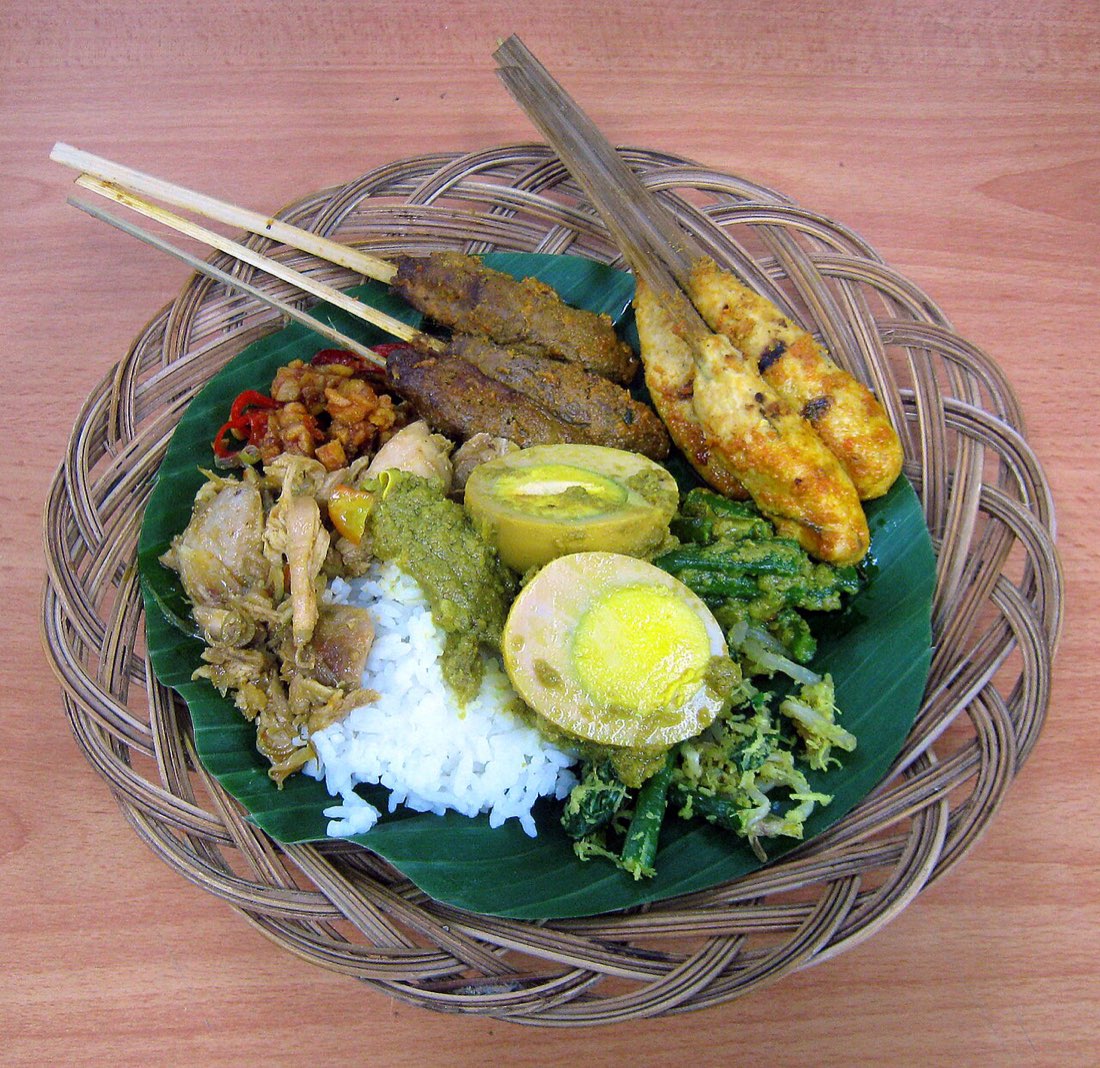 Nasi campur with sate lilit on a banana leaf: jaen pisan. Photo: Gunawan Kartapranata / Wikimedia Commons (CC BY-SA 3.0)

What to order once you have the words is in what to eat in Bali.
Shopping and directions
- Aji kuda? (ah-jee koo-duh). How much? Aji kuda niki? is how much is this?
- Mael (mah-ul). Expensive. Everyday. Niki ten mael: this isn't expensive. The opposite is mudah, cheap.
- Dija? (dee-juh). Where? Ring dija? Where is it? Uli dija? Where are you from? For where to?, the word is kija.
At the temple
- Pura (poo-ruh). Temple. Every village has three, BASAbali notes: the pura puseh, pura desa and pura dalem.
- Tirta (teer-tuh). Holy water, received after prayer.
- Bija (bee-juh). The grains of rice pressed to the forehead after the holy water; the full story is in bija, the rice on the forehead.
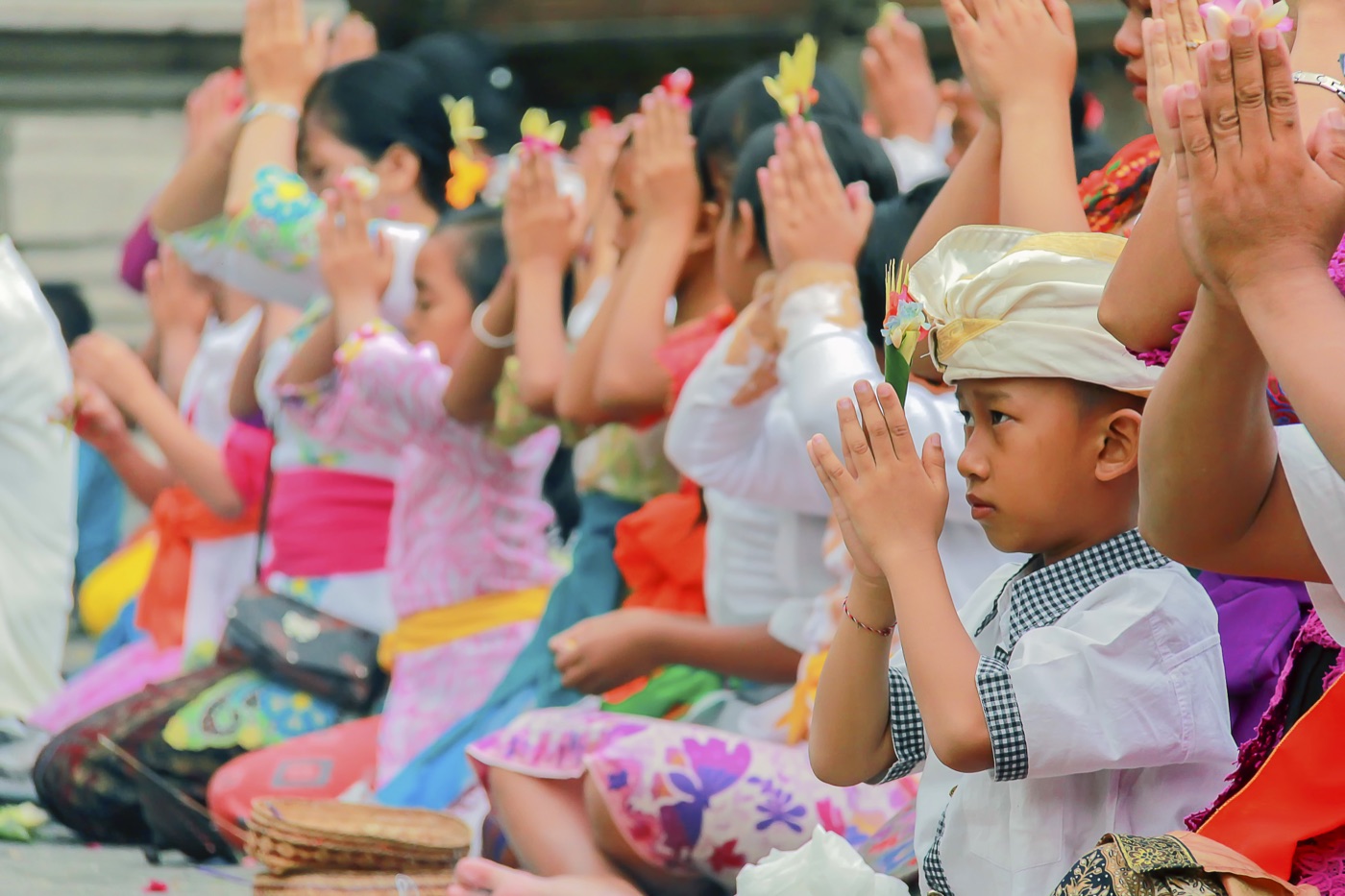 Hands raised in prayer at a temple ceremony in Tampaksiring. Photo: Wiaskara / Wikimedia Commons (CC BY-SA 4.0)

Temple words come with temple manners, covered in the Bali temple etiquette guide, and the faith behind them in Balinese Hinduism explained.
All definitions above are from the BASAbali dictionary unless another source is linked (BASAbali Wiki).
Words You Will Hear in the North
Buleleng, the regency that covers the whole north coast, has its own way of speaking Balinese, and people in the rest of Bali notice it straight away.
It was once the model. Balinese is split into a lowland dialect, spoken across the plains and coasts, and a highland dialect of the old Bali Aga villages. At the 1974 congress on standardising Balinese, the varieties of Buleleng and Klungkung were recommended as the model, partly because Singaraja had long been a colonial-era centre of administration, education and literature. Northern and eastern Balinese also keep grammatical endings that the Denpasar variety tends to drop (Wikipedia: Balinese language, citing Clynes 1995).
It sounds direct. Locals call it basa Bulelengan. A 2023 study in the journal Kalangwan by Komang Puteri Yadnya Diari and I Ketut Suara Antara describes how southern Balinese often find the Buleleng accent strange and some consider it kasar, coarse, and even treat it as a source of jokes. The authors argue the opposite reading: Buleleng speech reflects an egalitarian attitude that does not dwell on status. They trace its character to Singaraja's port-town mix of urban, Chinese and Arab influence and to Bali Aga speech, which does not use the strict levels of politeness. They also note its clear vowels, as in es toke (ice cubes), where southern speech would soften the final vowel (Kalangwan, 2023).
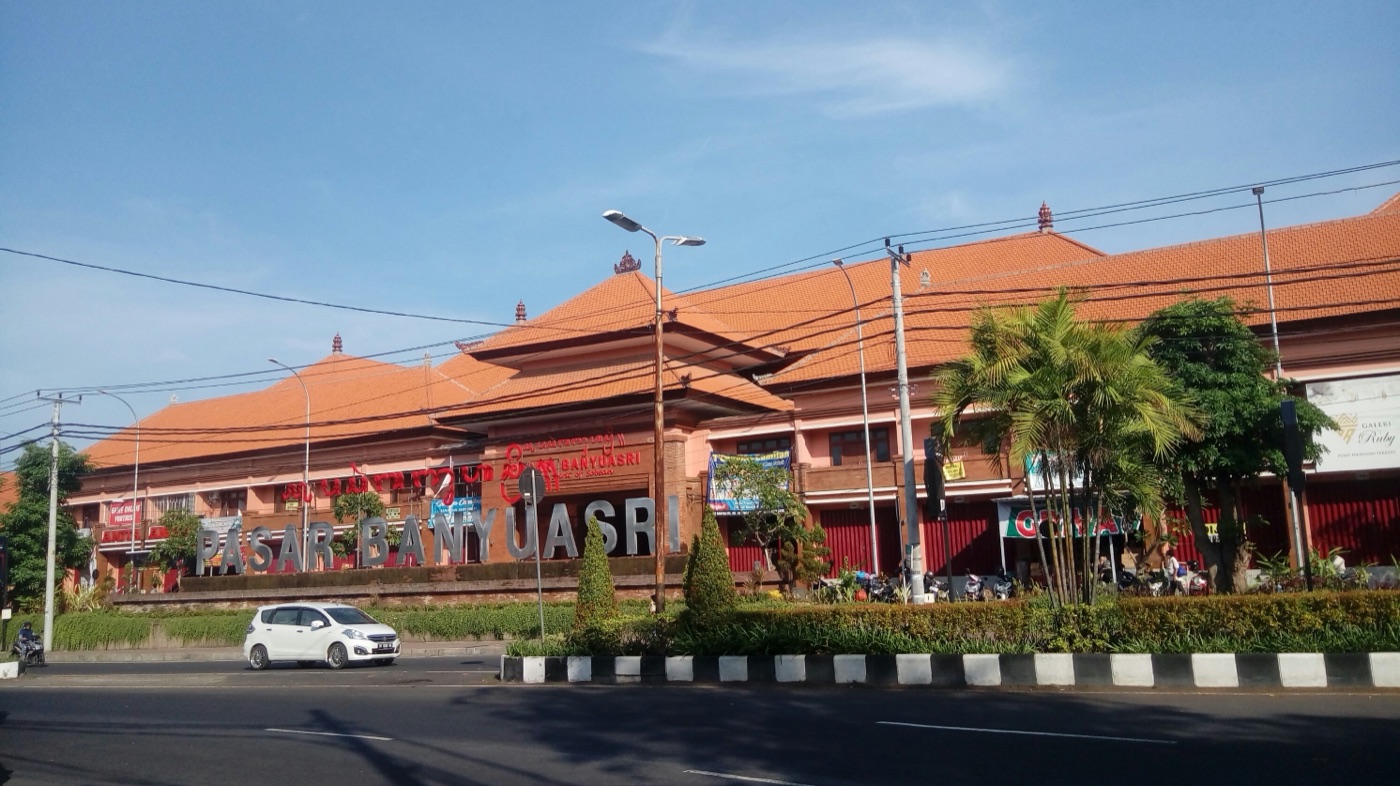 Pasar Banyuasri in Singaraja, where the city does its shopping. Photo: DayakSibiriak / Wikimedia Commons (CC BY-SA 4.0)

A few northern forms in the dictionary. BASAbali records keja as the Buleleng form of kija (where to) and ake as the Buleleng coarse form of I (BASAbali Wiki; BASAbali Wiki). Ake belongs among friends, so as a visitor stick with tiang.
The hill villages speak older Balinese. The Bali Aga villages behind the coast, among them Sidatapa, Pedawa and Sembiran, keep sub-dialects of their own; Sembiran's is counted separately by linguists (Wikipedia: Balinese language). The villages are covered in the Bali Aga villages of north Bali guide.
What that means in practice: in Singaraja or a Lovina warung, expect plainer Balinese with fewer polite forms, and do not read it as rudeness. Your own suksma and matur suksma land the same in the north as anywhere.
Practical Notes
Language is durable, but usage shifts between villages and generations. When a local corrects you, take the correction; it is a gift.
- Start with four. Om Swastyastu, suksma, nggih and aji kuda? cover most of a day.
- Speak Indonesian for anything complicated. Directions, prices, medical questions and bookings go faster in Indonesian or English.
- Look words up in BASAbali. The BASAbali Wiki is a free Balinese-English-Indonesian dictionary with example sentences and speech levels, and it also has Android and iOS apps.
- Hear real voices. Native-speaker recordings of individual Balinese words are on Wikimedia Commons through the Lingua Libre project.
- Mind the gesture. Palms together at the chest with Om Swastyastu is always appropriate; keep it for greetings and do not use it as a joke.
- Names first. Balinese first names follow birth order, so Bli or Mbok plus the name, as in Bli Made, is warm and correct; see how Balinese names work.
- Village life. For the community structure most of these words are spoken in, see the Balinese village banjar guide.
For everything else in the north, start with the complete north Bali guide.
FAQ
What does suksma mean?
Suksma means thank you in Balinese. It is a neutral word you can use with anyone. The same word also means spirit or soul, and it came into Balinese from Sanskrit through old Javanese.
How do you say thank you in Balinese?
Say suksma for everyday thanks, or matur suksma for a more humble and respectful thank you to elders, priests or anyone you want to honour. In Indonesian, which most Balinese also speak, thank you is terima kasih.
What is the reply to suksma?
Suksma mewali, meaning thanks returned, or nggih, sareng-sareng, meaning yes, and to you too. Both work as you're welcome.
What does mewali mean?
Mewali comes from wali, to return. In suksma mewali it turns the thanks back to the other person, which is why the phrase works as you're welcome.
How do you say hello in Balinese?
Om Swastyastu, with palms together at the chest. It works at any time of day. For specific times, use rahajeng semeng for good morning and rahajeng wengi for good evening.
How do you reply to Om Swastyastu?
Reply with the same words, Om Swastyastu, and the same gesture of palms pressed together in front of the chest.
Is Balinese the same as Indonesian?
No. Balinese is a separate language, related to the languages of Lombok and Sumbawa, with its own script and its own levels of polite speech. Indonesian is the national language, and almost all Balinese speak both.
What does matur suksma mean?
Matur suksma is a humble, respectful thank you. Matur is the refined word for speaking, so the phrase expresses thanks with deference. It is often shortened to suksma in everyday speech.