
On this page
In Brief
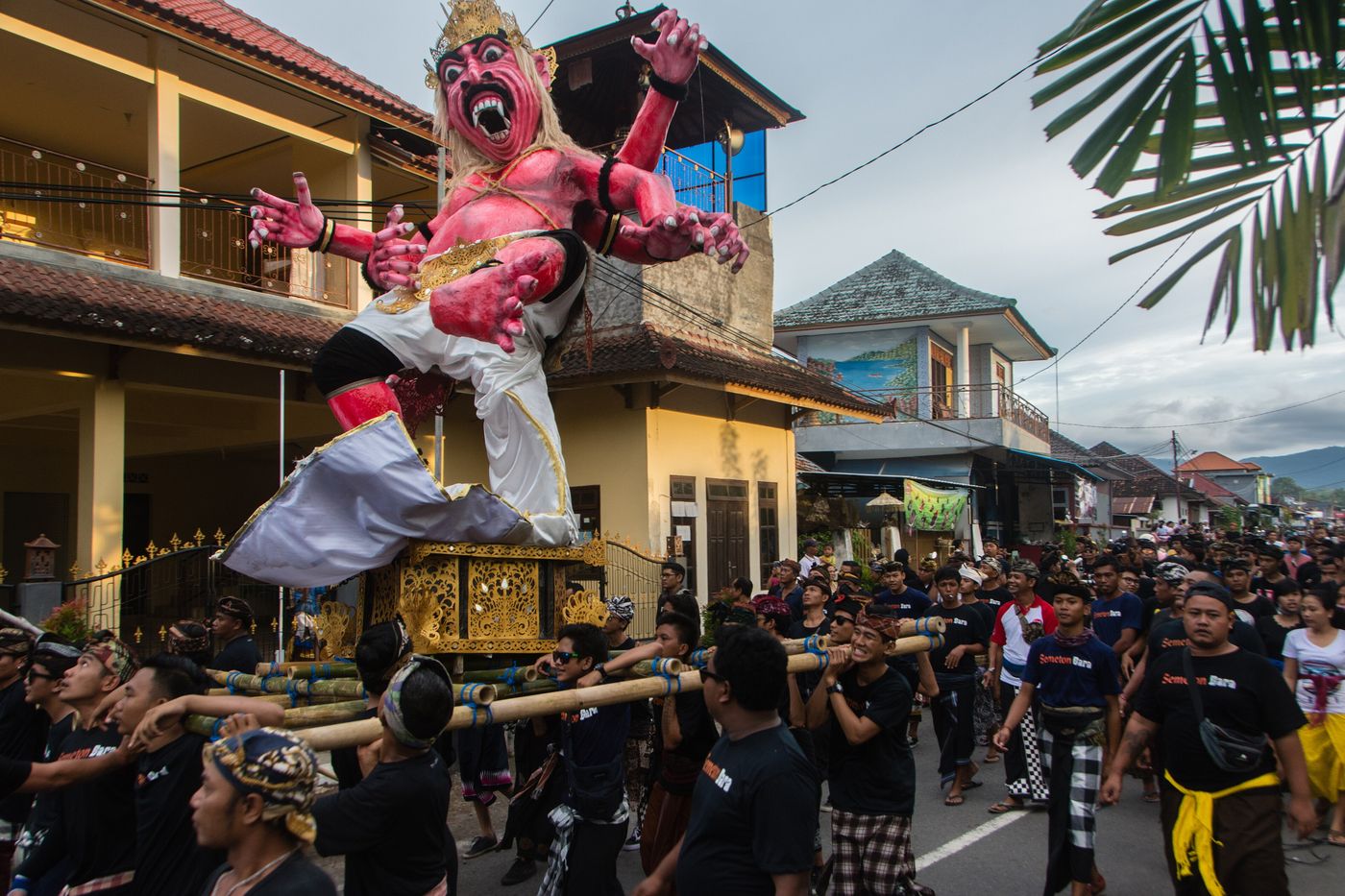
An ogoh-ogoh is a large effigy, usually of a demon or giant, that a Balinese banjar (neighbourhood association) builds for Pangrupukan, the evening before Nyepi. It stands for the bhuta kala, the unruly forces of nature and time, and for the anger and greed inside people. After the day's tawur kesanga offerings, the youth of each banjar carry their figure through the streets on a bamboo platform, rocking and shaking it to the sound of the baleganjur, then burn it in the village cemetery. The parade dates from the 1980s, and Bali's Hindu council counts it as no required part of Nyepi. In the north, Singaraja gathers its banjar into one parade through the city centre, and the villages around Lovina parade their own.
Ogoh-Ogoh at a Glance
- What they are: Large figures of bamboo, paper and cloth, most often in the form of a bhuta kala giant
- The name: From the Balinese ogah-ogah, "something that is shaken"
- When: Dusk on Pangrupukan, the day before Nyepi, after the tawur kesanga offerings
- Who makes them: The banjar's youth group, the seka teruna, paid for by residents' contributions
- The music: Baleganjur, the marching gamelan of drums, gongs and cymbals
- How it ends: Burned in the village cemetery, the setra; some figures are kept
- How old: A tradition of the 1980s, grown from older noise-and-torch rites of the same night
- In north Bali: A combined parade in central Singaraja; village parades along the Lovina coast
What an Ogoh-Ogoh Stands For
The figure is a portrait of the bhuta kala. Buleleng's culture and tourism office explains the words this way: bhu is the power of the universe and kala is time, both beyond measure and beyond argument. The Hindu council, Parisada Hindu Dharma Indonesia (PHDI), reads them the same way: bhuta are the five elements of the natural world, kala is time, and the fanged, bulging-eyed giant of popular imagination is simply how people picture those forces when they are out of balance.
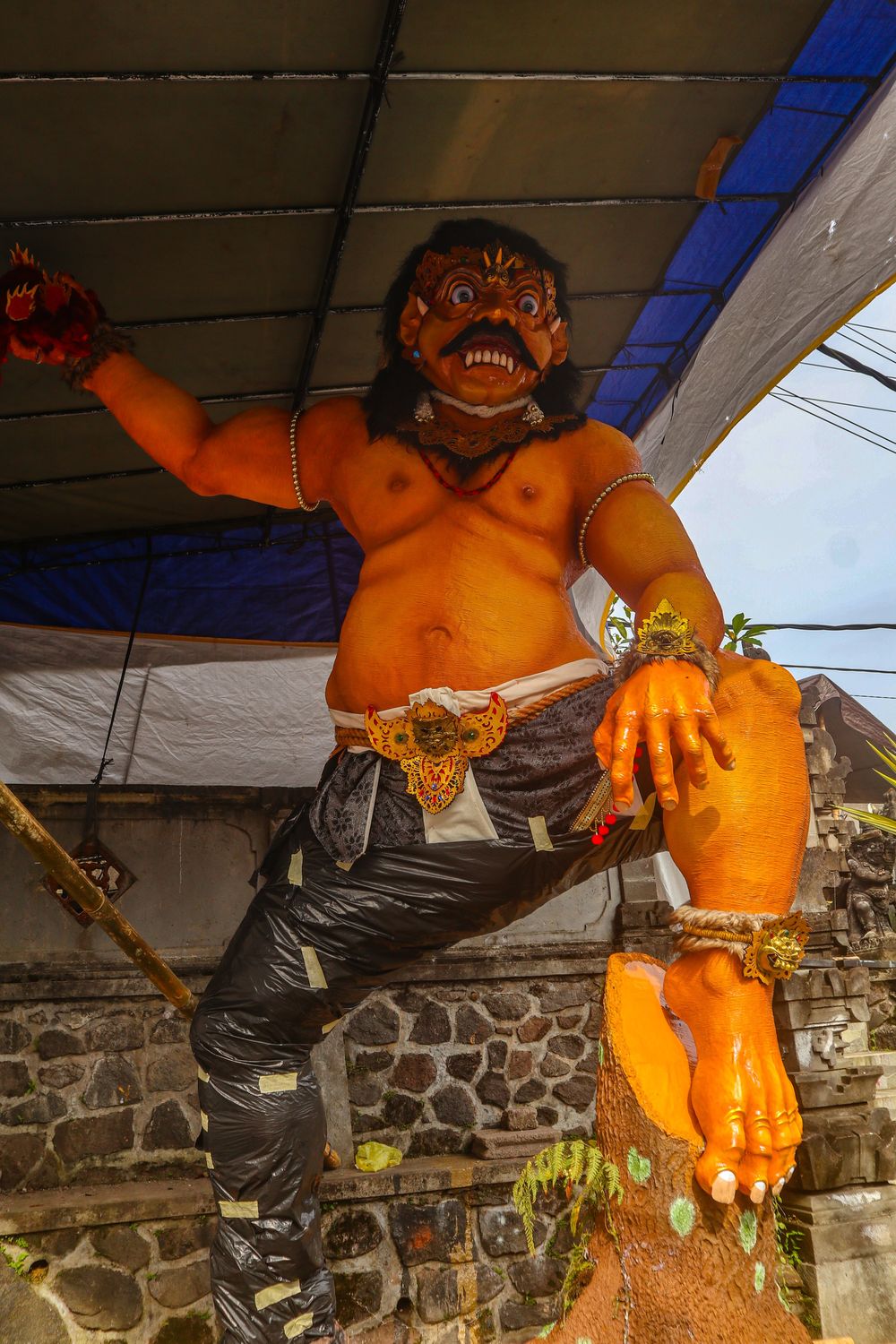 An ogoh-ogoh still standing under its shelter in Pancasari, in the Buleleng highlands, a few days after Nyepi. Photo: Sulthan Naufal / Wikimedia Commons (CC BY-SA 4.0)

The same forces live inside people. Buleleng's protocol office puts it in the terms Balinese scholars use: the power of the bhuana agung, the great world, and of the bhuana alit, the small world of the self, can lead to happiness or to ruin, depending on human intention. The news agency Antara lists the traits a figure usually carries: anger, greed, ignorance.
So the classic ogoh-ogoh is a raksasa, a giant. Others take the form of creatures from heaven, earth and hell, nagas, elephants and celestial nymphs, and a few have been made to look like politicians or celebrities. Some Hindu teachers want the old form kept. A paper by I Dewa Gede Ngurah Diatmika of STKIP Agama Hindu Singaraja argues that because the night is about nyomia, calming the bhuta kala into bhuta hita, the figure ought to be a bhuta kala. The idea of keeping the dark in balance rather than pretending it away is Rwa Bhineda, and the offerings of the same day are Bhuta Yadnya.
A Young Tradition
For all their air of antiquity, the effigies are young. The Buleleng culture office dates them to 1983, the year the president made Nyepi a national holiday: people in parts of Denpasar began building figures of the bhuta kala, first called onggokan, and the practice spread across the island once ogoh-ogoh were entered in the twelfth Bali Arts Festival. The north was not far behind. Diatmika records that the youth of Banjarasem, a village in Seririt district west of Lovina, first paraded ogoh-ogoh in 1983 and have done so every year since.
Before that, the evening before Nyepi was already loud. Families lit torches and bundles of dry coconut leaf, banged bamboo slit drums and scattered aromatic spices around the house compound to drive out anything unwelcome, and Wikipedia's history of the tradition describes the parade as a later addition to the end of those rites.
The Buleleng office is plain that the figures have no direct connection to Nyepi itself and are made to enliven the night. PHDI Bali said the same when the pandemic cancelled the parades: its chairman wrote that parading ogoh-ogoh is not a required part of Nyepi, and that year the purification, the offerings and Pangrupukan went ahead without them.
How a Banjar Builds One
An ogoh-ogoh belongs to a banjar, and in most banjar it belongs to the young. The seka teruna, the youth group of the banjar, designs it, raises the money from residents' contributions and builds it over the weeks before Nyepi; in Banjarasem, Diatmika notes, the work starts about a month ahead.
The method is old-fashioned. A frame of woven bamboo or rattan, with an iron skeleton inside the big ones, is covered in layers of paper, painted, and finished with hair, fibre, cloth and ornaments. Styrofoam had a spell of popularity and is now out: the province's customary village council told banjar to build with eco-friendly materials and no styrofoam or plastic, citing the governor's regulation on limiting waste.
When Bali's provincial culture office ran an island-wide ogoh-ogoh competition, its rules set out what the province wants to see:
- natural, environmentally friendly materials, with no styrofoam, sponge or single-use plastic
- a Balinese Hindu character, with no politics, no ethnic or religious provocation and no pornography
- a figure in either santa rupa, a god's gentle form, or rudra rupa, a giant's
- a written story for each figure, which the judges scored on beauty, on costume and ornament, and on grounding in Hindu literature
Cities and regencies add their own rules. Denpasar has written a regional regulation on preserving ogoh-ogoh that bans sound systems from its parades and requires gamelan or other traditional instruments. The city's legal office also named a worry that reaches beyond music: figures made outside any banjar that skip the pamlaspasan, the blessing that the melaspas ceremony gives a new building, and the final burning.
Pangrupukan: The Parade on the Eve of Nyepi
The night belongs to a sequence. Days before, villages take their temple treasures to the sea for Melasti. On the dark moon of the ninth month, tilem kesanga, every household, banjar and village makes the tawur kesanga, the great caru offering to the bhuta kala, which the Singaraja paper describes running in scale from the family yard to the province. Then, as the light goes, comes Pangrupukan.
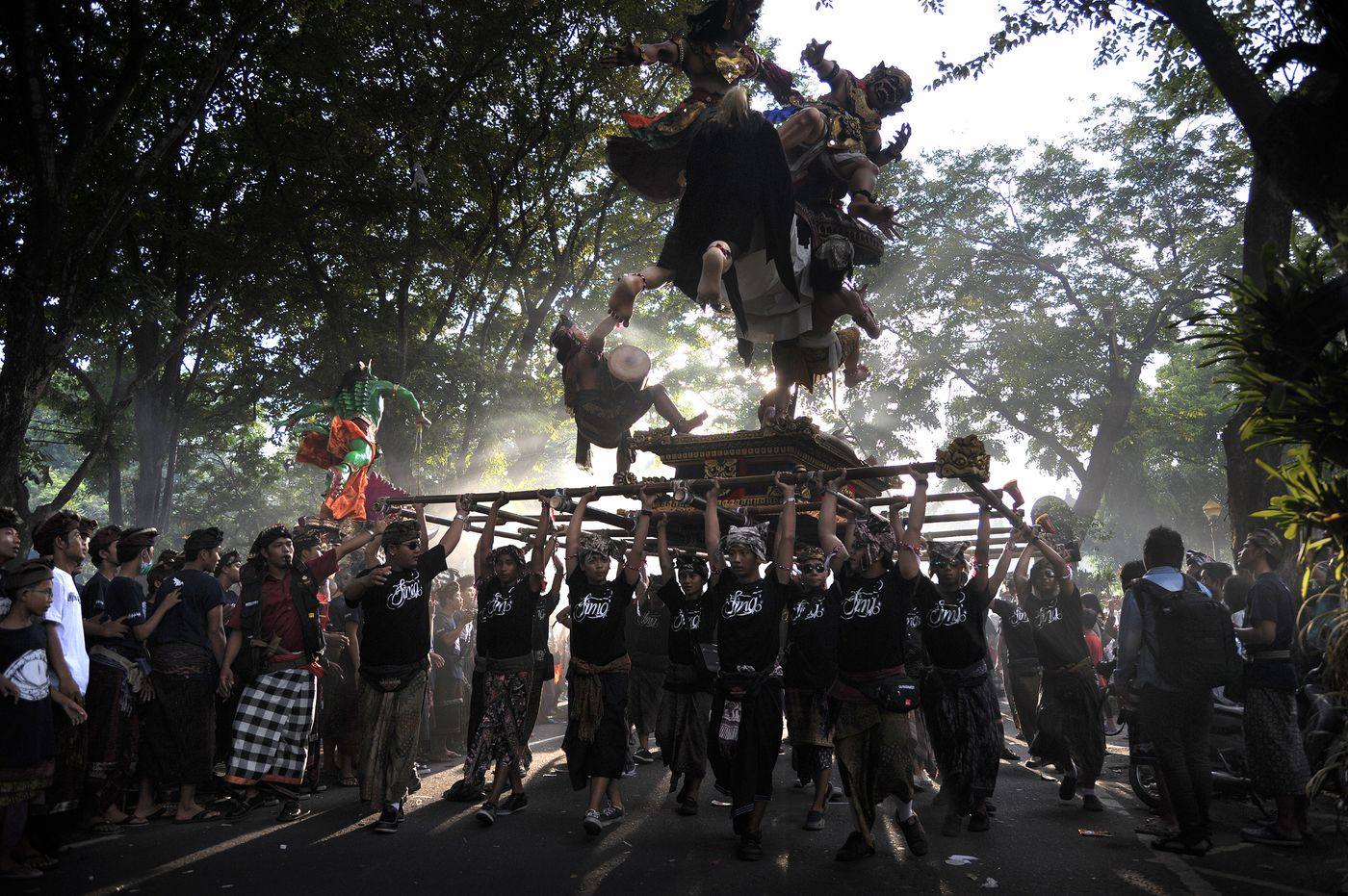 The carriers take the weight of the platform together on Pangrupukan. Photo: Dedy Siswandi / Wikimedia Commons (CC BY-SA 4.0)

The ogoh-ogoh rides on a platform of bamboo poles, hoisted onto the shoulders of the carriers. They shake and rock it as they go, which is where the name comes from, and the baleganjur drives the pace from behind. Figures are carried toward the catus pata, the village crossroads, and around the village before heading to the cemetery.
The Burning
At the setra, the village cemetery, the figure is set alight. Diatmika gives two reasons. The first is that an ogoh-ogoh left standing after the parade could be occupied by the very forces it depicts, so it is dissolved, prelina, by fire in the cemetery that belongs to the village. The second is a lesson in the three powers of God: building it is creation, carrying it whole through the village is preservation, and burning it is dissolution.
Not every figure is burned. Some are kept, like the giant in Pancasari pictured above, still standing under its shelter days after Nyepi, and Wikipedia notes a privately run ogoh-ogoh museum at Mengwi.
The next morning at dawn, Nyepi begins, and nobody goes out for a full day.
Ogoh-Ogoh in Singaraja and Lovina
Singaraja. The customary village of Buleleng, which covers the old centre of the city, gathers the figures of all its banjar into one parade, the Pengerupukan Festival. Bali Post's account describes the route along Jalan Veteran to the catuspata, the crossroads of Desa Adat Buleleng, and on to the village cemetery. At the crossroads each banjar performs its ogoh-ogoh for ten to twenty minutes before thousands of people from across the regency, the Regent opens the evening with ngoncang, which the paper calls a tradition particular to Buleleng, and the village's pecalang guards work alongside the police on the crowds and traffic. The customary village and the regency set the route and the programme each year, so check announcements from Buleleng's culture and tourism office and the local news before you go.
Lovina and the coast. The villages of the Lovina coast make and parade their own figures, around their own streets. Palm Living filmed the parade in Lovina:
For a sense of how a north coast village does it, Banjarasem, a short drive west, is the documented case. Diatmika follows the day there: Melasti on the beach at neighbouring Kalisada in the afternoon, the tawur kesanga at dusk, then the youth carrying their figures to the village's western edge at Tegalarangan, back east to the hamlet of Yehanakan, west again to Kalanganyar and south to the Banjarasem cemetery, where every figure is burned.
If you are staying near Lovina, the parade most likely to pass is your own village's. Palm Living's villas for rent are mostly in and around Lovina, so a stay there puts you close to the village parades and, the next day, somewhere comfortable to sit out the silence.
Practical Notes
- When: Dusk on the day before Nyepi, which falls on the day after the dark moon of the ninth Balinese month, usually in March. The date moves every year; see the Balinese calendar explained.
- Where: In your own village, or in central Singaraja for the largest parade in the north. Ask the people at your villa which banjar is parading and where it will pass.
- Keep back from the platforms. The carriers swing and shake the figures, and the crowd moves with them.
- Leave the figures alone. Photograph freely from the roadside, and ask before close portraits of the carriers.
- Plan for the next day now. Nyepi starts the following morning, with no travel, no lights and no shops for a full day. Buy food and water in advance and read Nyepi, the day of silence.
FAQ
What is an ogoh-ogoh? A large effigy, usually a demon or giant, built from bamboo, paper and cloth by a Balinese banjar for the evening before Nyepi. It represents the bhuta kala, the forces of nature and time, and the negative traits in people. It is paraded through the village and then burned.
What does ogoh-ogoh mean? The word comes from the Balinese ogah-ogah, "something that is shaken", after the way the carriers rock the figure as they parade it. The figure itself symbolises the bhuta kala and human vices such as anger and greed.
When is the ogoh-ogoh parade in Bali? At dusk on Pangrupukan, the day before Nyepi, after the tawur kesanga offerings. Nyepi usually falls in March, on the day after the dark moon of the ninth Balinese month, so the parade moves every year.
Why are ogoh-ogoh burned? Burning dissolves the figure so that the forces it represents cannot take up residence in it, and it marks the negative traits destroyed before the new year. It usually happens in the village cemetery, the setra. Some elaborate figures are kept.
Where can I see ogoh-ogoh in north Bali? The largest parade in the north goes through central Singaraja, run by the customary village of Buleleng. Villages along the coast, around Lovina and west toward Seririt, parade their own figures through their own streets.
What are ogoh-ogoh made of? A frame of woven bamboo or rattan, with iron inside the largest, covered in layers of paper, painted, and finished with hair, cloth and ornaments. Bali's customary village council and the provincial culture office have told banjar not to use styrofoam or plastic.
Sources
- Dinas Kebudayaan dan Pariwisata Kabupaten Buleleng, Ogoh-ogoh (the meaning of ogah-ogah, bhu and kala, the 1983 start in Denpasar, onggokan, the twelfth Bali Arts Festival, the forms, no direct link to Nyepi), Indonesian, read September 2026
- Bagian Protokol dan Komunikasi Pimpinan, Setda Kabupaten Buleleng, Pengertian ogoh-ogoh dan fungsinya (bhuana agung and bhuana alit, the baleganjur, burning at the cemetery), Indonesian, read September 2026
- Parisada Hindu Dharma Indonesia, Caru adalah memaknai ruang dan waktu (bhuta kala as the elements and time, their fearsome image and the ogoh-ogoh), Indonesian, read September 2026
- I Dewa Gede Ngurah Diatmika, STKIP Agama Hindu Singaraja, Ogoh-ogoh dan Hari Raya Nyepi, Jurnal Widya Sastra Pendidikan Agama Hindu (the Banjarasem parade since 1983, its route and timing, the tawur kesanga, nyomia, burning at the setra, creation, preservation and dissolution), Indonesian, read September 2026
- Antara, PHDI Bali dan MDA keluarkan edaran tiadakan pengarakan ogoh-ogoh (the parade is not a required part of Nyepi), and Mengenal seni ogoh-ogoh (the vices a figure represents), Indonesian, read September 2026
- Dinas Kebudayaan Provinsi Bali, Pelaksanaan lomba ogoh-ogoh se-Bali (materials, content and judging rules for the island-wide competition), Indonesian, read September 2026
- Bali Post, MDA atur pawai ogoh-ogoh (the customary village council's circular on building and parading, with its eco-friendly materials rule), and Parade ogoh-ogoh di Buleleng (the Singaraja parade, route, crossroads performances, ngoncang and pecalang), Indonesian, read September 2026
- Bali Post, Pawai ogoh-ogoh gunakan sound system dilarang permanen di Denpasar (Denpasar's regional regulation on preserving ogoh-ogoh, gamelan required, and the concern over figures without pamlaspasan and pralina), Indonesian, read September 2026
- Wikipedia, Ogoh-ogoh (the Pangrupukan rites before the parade, materials, the carrying), English, read September 2026
- Palm Living, Ogoh Ogoh Lovina on YouTube, and Good to know about Nyepi day in Bali, English, read September 2026
Read next: Nyepi, the day of silence for the day after, mecaru and the caru offerings for the rite that comes before the parade, and Rwa Bhineda for the idea behind it.