
On this page
- In Brief
- Rwa Bhineda at a Glance
- Rwa Bhineda Means the World Is Built From Pairs
- The Poleng Cloth Shows the Balance in Black and White
- Barong and Rangda Fight a Battle That Does Not End
- Offerings Go to the Shrines and to the Ground
- Villages and Houses Are Laid Out Between Mountain and Sea
- The Fierce Figures Keep the Dark in Balance
- Where the Teaching Sits, and Where to See It in the North
- FAQ
- Sources
In Brief
Rwa Bhineda means "two different things". In Balinese philosophy the world is made of pairs of opposing forces, such as good and bad, light and dark, high and low. Harmony comes from keeping the two in balance.
You see it in four places:
- the black-and-white checked poleng cloth wrapped around shrines and sacred trees
- the Barong and Rangda dance
- offerings placed both on raised shrines and on the ground
- the way villages and houses are laid out between the mountain and the sea
It is one of the keys to reading Bali, because much of what you see on the island fits together through it.
Rwa Bhineda at a Glance
- Meaning: "Two different things" (rwa, two, and bhineda, different)
- The teaching: The world is made of opposites, and harmony is keeping them in balance
- The cloth: Black-and-white checked poleng, with equal numbers of each square
- The dance: Barong and Rangda, which the Ministry of Tourism calls a never-ending battle
- The offerings: Some raised to the gods, some on the ground for the bhuta kala, the lower forces
- The layout: Space ordered between kaja (toward the mountain) and kelod (toward the sea)
Rwa Bhineda Means the World Is Built From Pairs
Rwa Bhineda holds that existence is built from pairs:
- day and night
- good and bad
- high and low
- gods and demons
- life and death
A Hindu religious counsellor with the Ministry of Religious Affairs in Denpasar put it simply on RRI, the public radio. It is natural, he said, that the world holds two different things. When they run in harmony, they make the balance of nature.
In this teaching, light needs dark to mean anything, and order needs disorder. The aim of Balinese ritual, then, is to keep the two forces in equilibrium. That is why so much of it is about maintenance. The dark and disorderly forces are acknowledged, fed and held in their place, so that they do not disturb the rest.
The Poleng Cloth Shows the Balance in Black and White
The black-and-white checked cloth wrapped around temple statues, shrines and big sacred trees is Rwa Bhineda made visible.
Buleleng's culture and tourism office describes it as a symbol of the balance of nature, between right and left, above and below, good and bad. It notes that the black and white squares are equal in number.
The same office explains why the big trees wear it. A banyan wrapped in poleng and given offerings marks the relationship between people and nature.
Three Kinds of Poleng Are Used in Ritual
There is more than one poleng, and the religious counsellor on RRI names three used in ritual.
The black-and-white rwa bhineda is used on statues, village drum towers and sacred trees. The sudamala adds grey, as the colour that reconciles the two. The tridatu is black, white and red, standing for the three qualities of human nature.
The tridatu version, he says, is used for the uniforms of the pecalang, the village guards. The same three colours turn up in the tridatu bracelet many Balinese wear on the wrist.
Barong and Rangda Fight a Battle That Does Not End
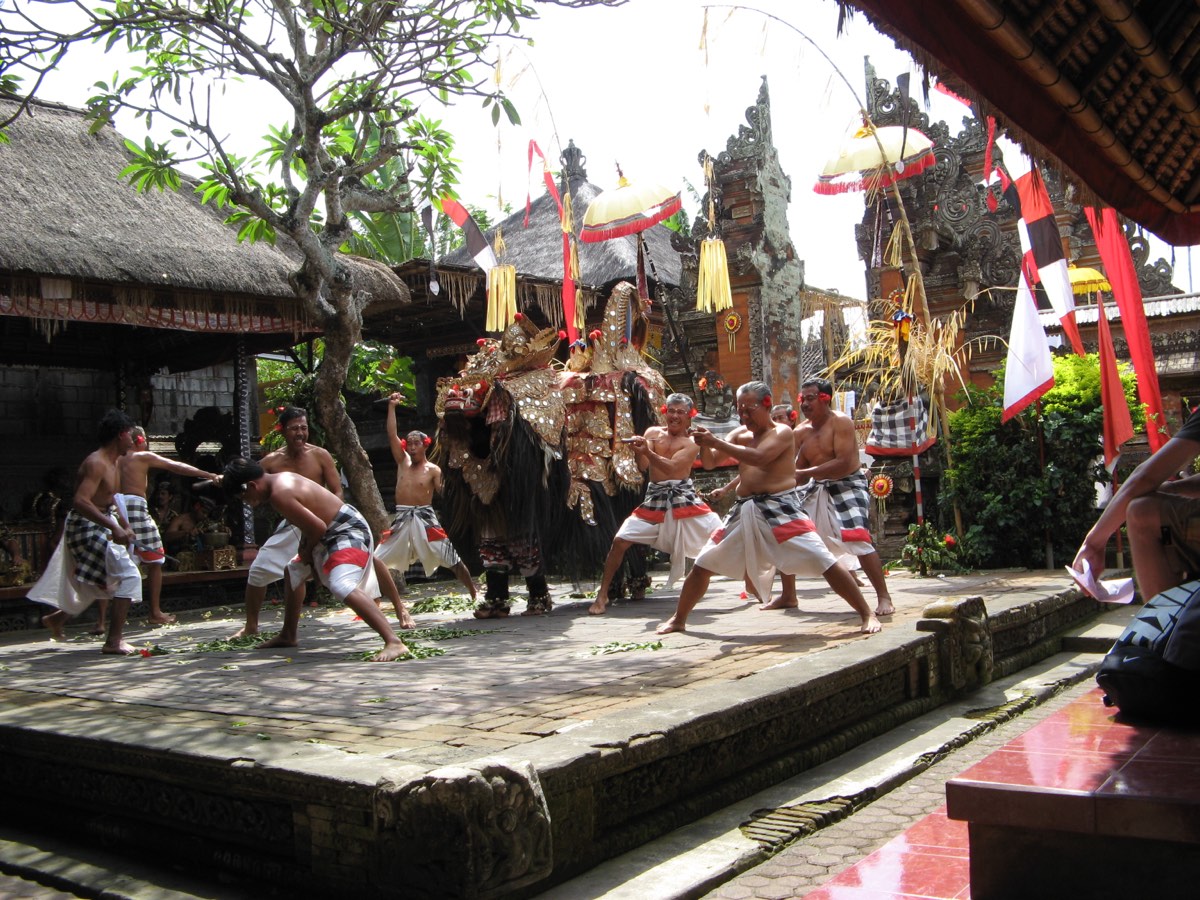
In the Barong dance, the Barong, a lion-like guardian that stands for virtue, faces Rangda, the widow-witch who leads the forces of evil.
Indonesia's Ministry of Tourism describes the dance as "a mirror of life" in which the two are "involved in a never-ending battle."
In the Calon Arang drama the Barong overcomes Rangda's magic. Even there, the ministry describes the outcome as balance restored in nature, and neither force is abolished.
More on the performing arts of the north is in north Bali's dance and music.
Offerings Go to the Shrines and to the Ground
Daily offerings go both to raised shrines, for the gods, and to the ground.
The low ones are segehan, the smallest offering of bhuta yadnya, the rites for the lower forces. The Buleleng regency's own explanation is that segehan are given to the bhuta kala so that they do not disturb, keeping nature in harmony and balance.
Segehan are offered daily and placed low, in the corners of temple and house courtyards, at the gate and at crossroads.
That is Rwa Bhineda in the simplest daily act. It connects to Panca Yadnya, the five kinds of offering.
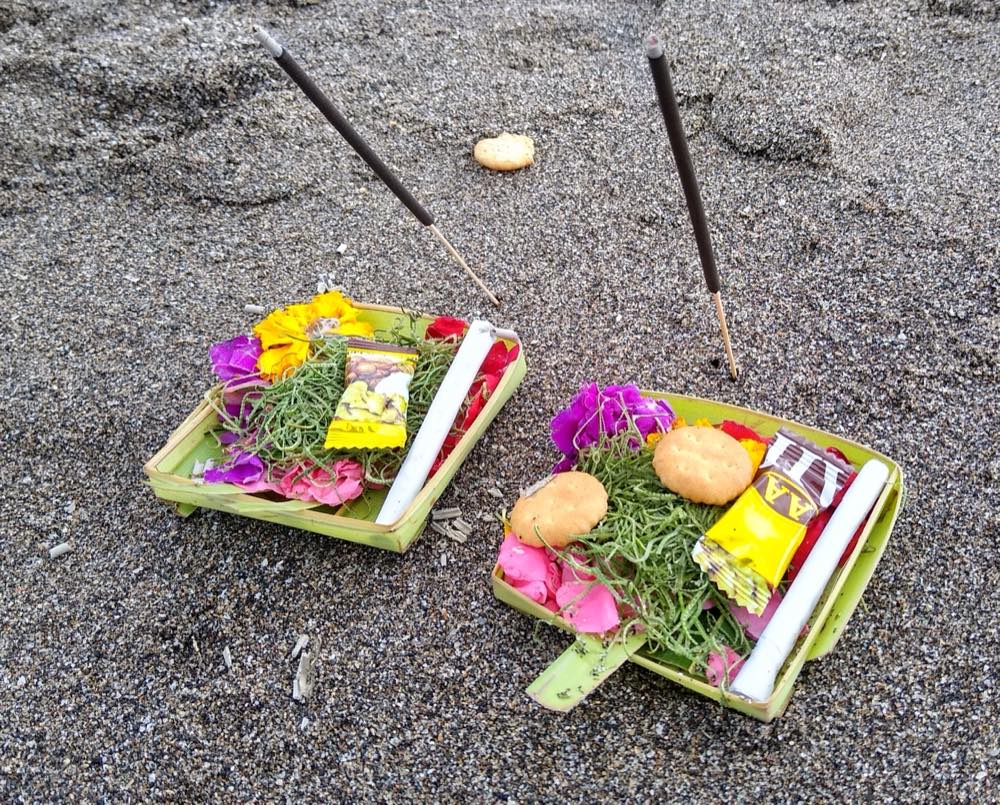 Canang sari set on the ground, the low half of the daily balance. Photo: Mx. Granger / Wikimedia Commons (CC0)

Villages and Houses Are Laid Out Between Mountain and Sea
Bali's provincial spatial-planning service lists Rwa Bhineda among the concepts behind traditional Balinese space.
The teaching gives the orientation between luan and teben, the high and the low end. It gives the orientation between kaja and kelod, toward the mountain and toward the sea, along with the sense of sacred and profane.
Temples, house compounds and villages are laid out along that axis. Traditional Balinese architecture shows how.
The Fierce Figures Keep the Dark in Balance
Rwa Bhineda explains many of the striking things a visitor sees in Bali, and corrects a common misreading of them.
The fierce Rangda mask is one. The ogoh-ogoh figures paraded on the eve of Nyepi are another, and the news agency Antara describes them as often standing for negative human traits. The offerings put down for the lower spirits are a third.
Each acknowledges that the dark is real and has to be kept in balance. They are ways of dealing with the dark, and nobody is worshipping it.
Where the Teaching Sits, and Where to See It in the North
For a visitor, knowing the teaching turns spectacle into sense.
It sits alongside Tri Hita Karana, the three harmonies, and Panca Yadnya, the five offerings. Together they are among the core teachings that hold the Balinese world together. The wider faith is in Balinese Hinduism explained.
In the north, the balance was played out on a beach at the opening of the Lovina Sunday Market, which began with a Barong and Rangda dance.
FAQ
What does Rwa Bhineda mean? It means "two different things". Rwa is two and bhineda is different. It is the Balinese teaching that the world is made of opposing forces, good and bad, light and dark, high and low, and that harmony comes from keeping them in balance.
What is the poleng cloth? Poleng is the black-and-white checked cloth wrapped around temple statues, shrines and sacred trees. It is the visible symbol of Rwa Bhineda, the two opposites woven together in equal squares. Other versions add grey (sudamala) or red (tridatu).
Why are trees in Bali wrapped in black-and-white cloth? Big trees such as banyans are treated as sacred. Wrapping one in poleng and giving it offerings marks the relationship between people and nature, and the checked cloth is the symbol of Rwa Bhineda.
What do Barong and Rangda represent? The Barong stands for virtue and protection, and Rangda leads the forces of evil. The Ministry of Tourism calls their dance a never-ending battle. Even when the Barong prevails, as in the Calon Arang drama, the result is balance restored, with neither force gone for good.
Do Balinese worship evil? No. Offerings to the lower forces and figures like Rangda or the ogoh-ogoh acknowledge that dark forces are real and must be kept in balance. Segehan, the ground offerings, are given so that those forces do not disturb.
How does Rwa Bhineda relate to Tri Hita Karana? Both are Balinese teachings about harmony. Tri Hita Karana is harmony across three relationships: with the divine, with people and with nature. Rwa Bhineda is the balance held between opposing forces within all of them.
Sources
- RRI Denpasar, Kenali jenis dan makna kain poleng di Bali, 26 September 2024 (the meaning of Rwa Bhineda; the three kinds of poleng; pecalang uniforms), in Indonesian, read September 2026
- Buleleng Culture and Tourism Office, Pohon di Bali berisi kain poleng, berikut penjelasannya (poleng as the symbol of Rwa Bhineda; equal squares; sacred trees), in Indonesian, read September 2026
- Indonesia Ministry of Tourism, The Barong and the Kris Dance: the eternal battle between good and evil, read September 2026
- Buleleng Regency, Welfare Section, Makna dan arti segehan serta fungsinya (ground offerings to the bhuta kala; where they are placed), in Indonesian, read September 2026
- Province of Bali spatial-planning information service, Konsep ruang (Rwa Bhineda as the orientation of luan-teben and kaja-kelod), in Indonesian, read September 2026
- Antara, Mengenal seni ogoh-ogoh, tradisi sakral jelang Hari Nyepi, 27 March 2025, in Indonesian, read September 2026
Read next: Tri Hita Karana, the Balinese offerings explained and Balinese Hinduism explained.