
On this page
In Brief
Pecalang are the traditional security guards of Bali's desa adat, the customary Hindu villages. Each village forms, appoints and dismisses its own pecalang, and they keep order within its boundaries: guiding traffic and crowds at temple ceremonies and processions, patrolling the streets during Nyepi, the Day of Silence, and watching over village life the rest of the year. The name comes from celang, "alert". Bali's Regional Regulation No. 4 of 2019 on Customary Villages gives them a legal footing: pecalang are one of a customary village's institutions, appointed by its leaders, trained by competent bodies and bound by a code of conduct set by the island's council of customary villages, and they may help the state's police only after coordinating with their own village. Since 2020 a provincial system called Sipandu Beradat has linked them with village police officers and civil defence volunteers.
Pecalang at a Glance
- What they are: the security unit of a Balinese customary village (desa adat)
- Other names: pacalang, jaga bhaya desa adat, the village's guard
- Who they answer to: the customary village and its leaders, the prajuru
- What they do: keep order at ceremonies and processions, patrol on Nyepi, watch the village
- Uniform: checked poleng cloth, often the black, white and red tridatu pattern, with a headcloth
- Legal basis: Bali Regional Regulation No. 4 of 2019, Articles 43 and 47, following Regulation No. 3 of 2001
- Code of conduct: the Tuntunan Sasana Pacalang, set by the Majelis Desa Adat of Bali
- Integrated security: Governor's Regulation No. 26 of 2020, Sipandu Beradat
Who the Pecalang Are
Every Balinese Hindu belongs to a customary village, the desa adat, with its own temples, its own territory and its own written law, the awig-awig. How that village and its banjar wards work is in the Balinese village and the banjar. The pecalang are that village's guards. They are members of the village themselves, drawn from each of its banjar.
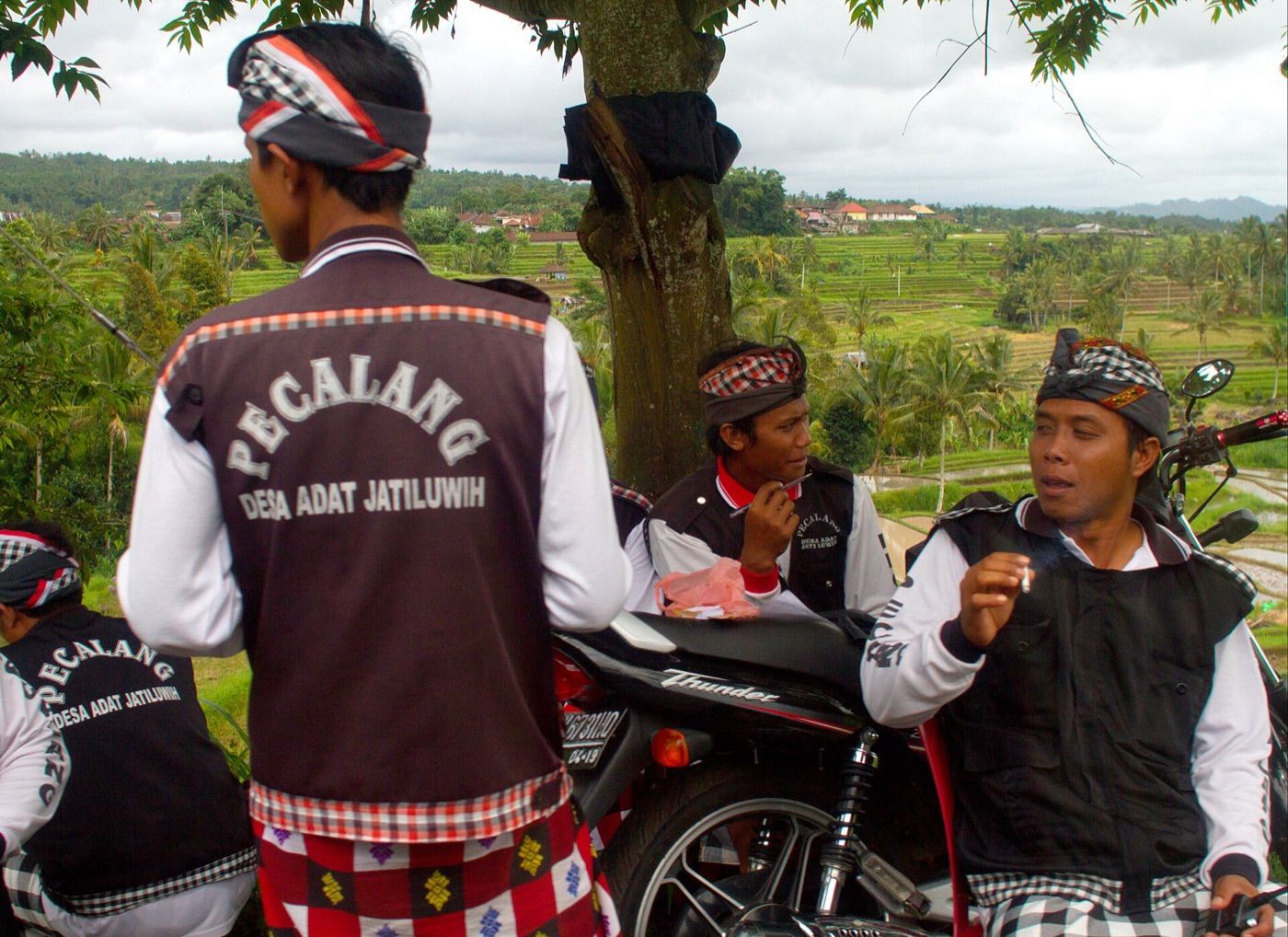 Pecalang of the customary village of Jatiluwih, Tabanan, in their village vests and poleng cloth. Photo: Jon Gudorf Photography / Wikimedia Commons (CC BY-SA 2.0)
The Karangasem branch of the Hindu council PHDI, in an article on the pecalang's role at ceremonies, sets out what tradition asks of them, drawing on the lontar Purwadigama. A pecalang must know every corner of his village; be brave in defence of what is right; be quick and alert without haste; guide others like a teacher; and be devoted to God. Only married members of the village may serve, the council explains, because they are thought steadier and less likely to act in anger. In return a pecalang is excused from the village's communal labour, and wears the uniform and attributes that mark his office. The council also distinguishes the village pecalang from the pecalang subak, who keep order among the farmers of an irrigation society (see subak).
The name carries the job. Pecalang comes from calang or celang, which the Karangasem council and two researchers writing in The Conversation both translate as "alert" or "watchful".
The checked cloth
The black-and-white checked cloth called poleng wraps shrines, statues and sacred trees across Bali, and pecalang wear it too. A religious counsellor speaking on RRI, the state radio, explained that the three-colour version, poleng tridatu in black, white and red, is the pecalang's uniform, standing for the three qualities of human nature: a guard should have the maturity to control a situation and the firmness to tell good from bad. The idea of balance behind poleng is explained in Rwa Bhineda.
What Pecalang Do
At temple ceremonies and processions
Keeping ceremonies safe and smooth is the pecalang's first duty. When a village carries its temple treasures to the sea for melasti, holds a temple anniversary, or walks a procession to a cremation, it is the pecalang who close or slow the road, direct the traffic around the procession and keep the crowd in order. The ceremonies themselves are explained in Balinese ceremonies, and how to behave as a guest in Bali temple etiquette.
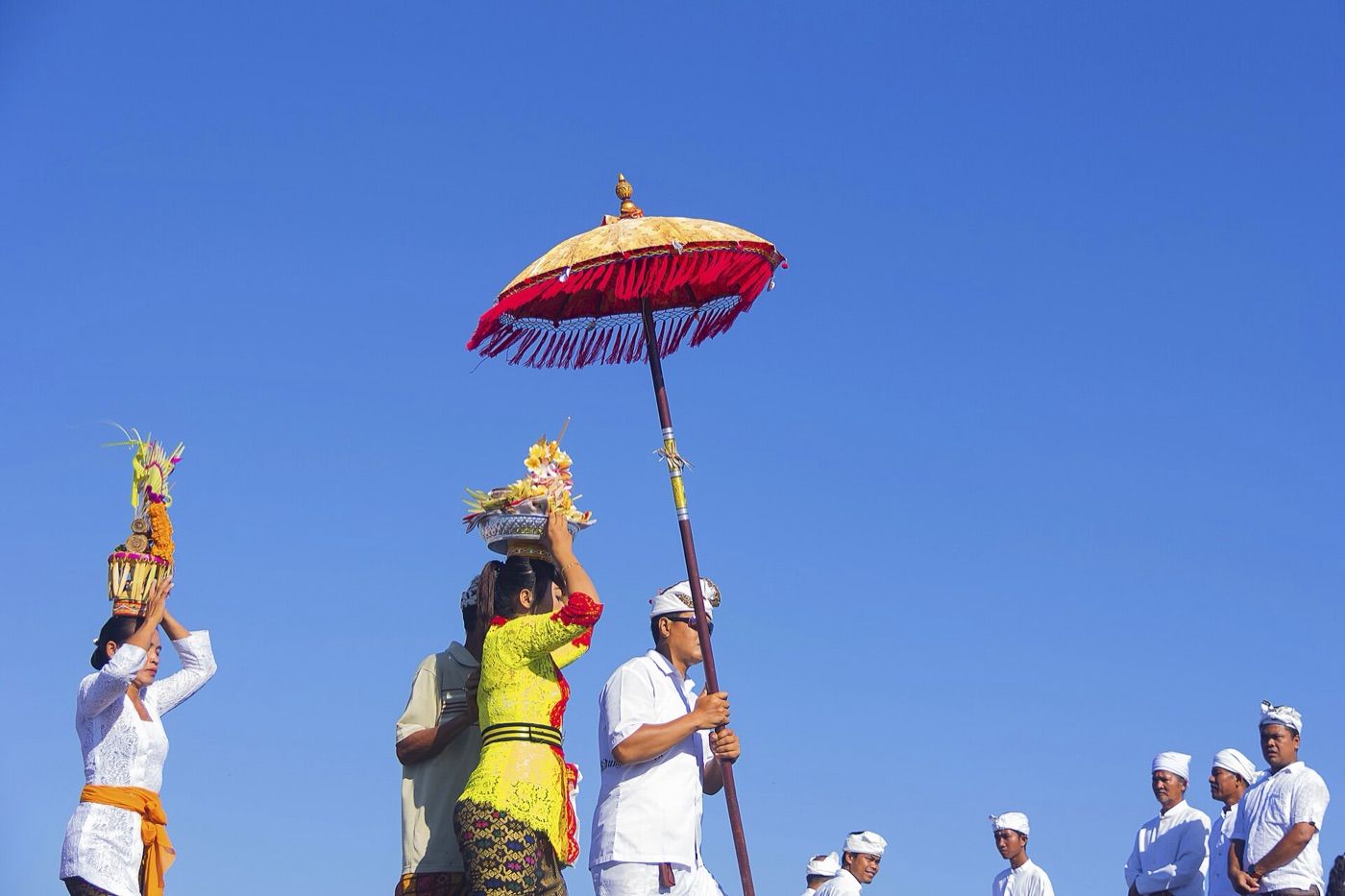 A melasti procession on its way to the beach. Processions like this are what the pecalang keep the road open for. Photo: Wiaskara / Wikimedia Commons (CC BY-SA 4.0)

On Nyepi
Nyepi, the Day of Silence, is when most visitors meet them. For twenty-four hours from six in the morning nobody travels, works or lights a fire, and the only people on the streets are the pecalang, who patrol to keep the silence and turn back anyone who goes out. Bali's religious leaders set out the rules for each Nyepi in a joint appeal published by the provincial government. When Nyepi in March 2026 fell on the evening of Takbiran, the eve of Idul Fitri, the appeal made the customary village leaders, mosque committees, pecalang, civil defence volunteers and village officials jointly responsible for order in each area, coordinating with the police, and allowed Muslims to walk quietly to the nearest mosque for Takbiran without loudspeakers. The whole day is described in Nyepi, the day of silence, and the night before in ogoh-ogoh.
In village life
Beyond ceremonies, pecalang patrol the village, keep watch over its events, and in many places watch over concerts and gatherings. The Karangasem council notes that as village life has grown more complex, their work has spread from religious and customary events to village activities of every kind.
Where Pecalang Came From
Nobody knows exactly when pecalang began. The Karangasem council traces the village guard, the jaga baya desa, to the founding of Bali's first villages in the legends of the sage Rsi Markandeya. The researchers I Made Chandra Mandira and I Ngurah Suryawan, writing in The Conversation, note that some trace them to the security men of the Balinese kingdoms, known by names such as sikep, dolop and sambangan, and others to the parking and traffic duty of the Bali Arts Festival from the 1970s.
What brought them to national attention was politics. When the PDI-P, the party of Megawati Soekarnoputri, held its fifth congress at Sanur from 8 to 10 October 1998, pecalang were called up across the island's villages to keep order among the crowds of supporters. After that, the researchers write, pecalang came to be trusted as Bali's guarantee of security; villages gave them posts, equipment and even patrol cars. After the bombings of 2002 and 2005 they took part in checks and raids on migrants from other islands, work the researchers present as a sign of how easily the role can be put to other people's purposes, whether political power or the tourism trade.
What the Law Says
Pecalang appear in Bali's earlier Regional Regulation No. 3 of 2001 on the desa pakraman, which, as the Karangasem council quotes it, gave the pecalang responsibility for security and order within the customary village, limited to its customary and religious affairs, and had them appointed by the village assembly.
The current law is Bali's Regional Regulation No. 4 of 2019 on Customary Villages. Article 1 defines the pacalang, or jaga bhaya desa adat, as a traditional Balinese security unit formed by the customary village to keep security and order within its territory. Article 43 lists them among the village's own institutions, beside the priests' and youth organisations. Article 47 sets out the rest:
- Pecalang keep security, peace and public order within the customary village's territory.
- They are appointed and dismissed by the village, by decision of its leaders.
- They may take part in helping the state's security forces, after coordinating with the village leaders.
- They receive education and training from competent institutions.
- They receive a reward, olih-olihan, according to the village's awig-awig.
- Their duties follow the Tuntunan Sasana Pacalang, a code of conduct set by the Majelis Desa Adat, Bali's council of customary villages.
In July 2020 Governor Wayan Koster launched Governor's Regulation No. 26 of 2020 on Sipandu Beradat, an integrated security system based on the customary village. It brings together the pecalang, the civil defence volunteers (Linmas), the police's village community officers (Bhabinkamtibmas) and private and village security at village, district, regency and provincial level. The head of the Majelis Desa Adat said at the launch that pecalang would be trained and certified through licensed security firms.
In May 2025 the island's pecalang association, the Pesikian Pecalang Bali, held a mass gathering in Denpasar, representing 1,500 customary villages. It rejected mass organisations that pose as security groups while practising thuggery, pledged support to the police and army, and backed Sipandu Beradat.
Pecalang and Visitors
Pecalang are village guards rather than police, but on the days they are working, their word is the one to follow. A few things help.
- At a procession, stop or slow when a pecalang signals, and wait. The delay is usually short, and the procession is worth watching from the roadside.
- On Nyepi, stay inside your villa or hotel grounds for the full day. If a pecalang tells you to go in, go in.
- At a ceremony, ask a pecalang where you may stand or park; they know where visitors are welcome.
- If someone falls ill on Nyepi, tell your accommodation, which will work through the village. Ahead of Nyepi in March 2026, Kubutambahan district in Buleleng asked each customary village to prepare letters, signed by its head, for residents who had to be taken out of the area for treatment.
In the north, the villas of Palm Living are mostly around Lovina, and each sits within a customary village with its own pecalang. For what to expect across a stay in the region, see Balinese culture.
FAQ
What is a pecalang in Bali? A pecalang is a guard of a Balinese customary village (desa adat). Pecalang are villagers appointed by their village to keep order within its territory, especially at temple ceremonies and processions and during Nyepi.
What does the word pecalang mean? It comes from calang or celang, meaning alert or watchful, so a pecalang is the village's watchman.
Are pecalang police? No. Pecalang belong to the customary village, which appoints and dismisses them. Under Bali's 2019 law on customary villages they may help the police, but only after coordinating with their own village leaders, and they work alongside the police in the Sipandu Beradat system.
What do pecalang do on Nyepi? They patrol the streets during the twenty-four hours of silence and turn back anyone who goes out, since no one may travel or leave home.
Why do pecalang wear black and white checked cloth? The checked cloth is poleng, which in Bali stands for the balance of opposites. Pecalang often wear the tridatu version in black, white and red, which a religious counsellor on RRI explained stands for the three qualities of human nature and a guard's duty to tell good from bad.
Who can become a pecalang? A member of the customary village, chosen by it. Tradition, as the Karangasem branch of the Hindu council describes it, limits the role to married villagers, who are thought to be steadier.
Sources
- Province of Bali, Regional Regulation No. 4 of 2019 on Customary Villages in Bali, Articles 1, 43 and 47 and the elucidation, read September 2026 (in Indonesian)
- PHDI Karangasem, The role of pecalang in religious ceremonies, November 2015, for the meaning of the name, Regulation No. 3 of 2001, the lontar Purwadigama, the qualities, rights and kinds of pecalang, read September 2026 (in Indonesian)
- I Made Chandra Mandira and I Ngurah Suryawan, The Conversation, The changing role of pecalang: from ritual guards to tourism watchmen, for the origins, the 1998 congress, the years after the bombings and the gathering of May 2025, read September 2026 (in Indonesian)
- NusaBali, Customary villages now have an integrated security system, July 2020, for the launch of Sipandu Beradat, read September 2026 (in Indonesian)
- Bali Kesbangpol, Joint appeal on Nyepi, Caka 1948, March 2026, for the pecalang's shared responsibility on Nyepi, read September 2026 (in Indonesian)
- Kubutambahan village website, Kubutambahan district prepares for Nyepi Caka 1948 and Idul Fitri, March 2026, read September 2026 (in Indonesian)
- RRI Denpasar, Kinds and meanings of poleng cloth, September 2024, for the tridatu uniform, read September 2026 (in Indonesian)
Read next: Nyepi, the day of silence, the Balinese village and the banjar and ogoh-ogoh.