
On this page
- In Brief
- Rejang at a Glance
- Rejang Belongs to Wali, the Sacred Circle of Balinese Dance
- The Movements Are Simple So the Village's Women Can All Dance
- A Rejang Looks Different in Each Village
- North Bali's Villages Keep Their Own Rejang
- Rejang Is Danced for the Gods, Stage Dances for an Audience
- How to Watch Rejang Respectfully in North Bali
- FAQ
- Sources
In Brief
The rejang dance of Bali is an offering dance, one of the island's most sacred dances (wali). Women and girls perform it inside temple courtyards during ceremonies, especially temple anniversaries (odalan).
It is an offering in motion, with no audience in mind. The dancers repeat slow, simple gestures in procession toward the shrines, to welcome and honour the visiting deities.
Its village forms need no training to join, because the point is devotion.
UNESCO has inscribed Bali's three genres of traditional dance as intangible cultural heritage. The three are sacred, semi-sacred and entertainment, and rejang belongs to the sacred genre.
Rejang at a Glance
- What it is: A sacred processional offering dance, danced by women and girls
- Type: Wali (sacred), the innermost category of Balinese dance
- When: Temple anniversaries (odalan) and major ceremonies, inside the temple
- The movement: Slow, graceful, deliberately simple, in lines and processions
- The dress: Full temple dress, with tall golden headdresses in some styles
- Famous forms: Rejang Dewa, Rejang Sari, and village-specific styles, including distinct Bali Aga versions
- Can you watch? Yes, respectfully, if you are at the ceremony in temple dress
Rejang Belongs to Wali, the Sacred Circle of Balinese Dance
Balinese dance divides into three circles.
Wali dances are sacred rites performed in the temple's inner courtyard, for the gods. Bebali dances are ceremonial accompaniments in the middle courtyard. Balih-balihan are the entertainment forms, the Legong and Kecak of the stages.
Rejang sits at the centre of the first circle. When the deities are invited down into a temple during its odalan, the rejang welcomes and entertains the honoured guests.
The Movements Are Simple So the Village's Women Can All Dance
Its place in the ceremony explains what is unusual about rejang.
The movements are simple so that the women of the village, from small girls to grandmothers, can dance it. Rejang belongs to the community and needs no trained performers.
It moves in lines and slow circles because it is a procession toward the shrines.
It cannot be lifted onto a hotel stage, because outside the temple and the ceremony it has no meaning.
A Rejang Looks Different in Each Village
What you see depends on the village and the occasion:
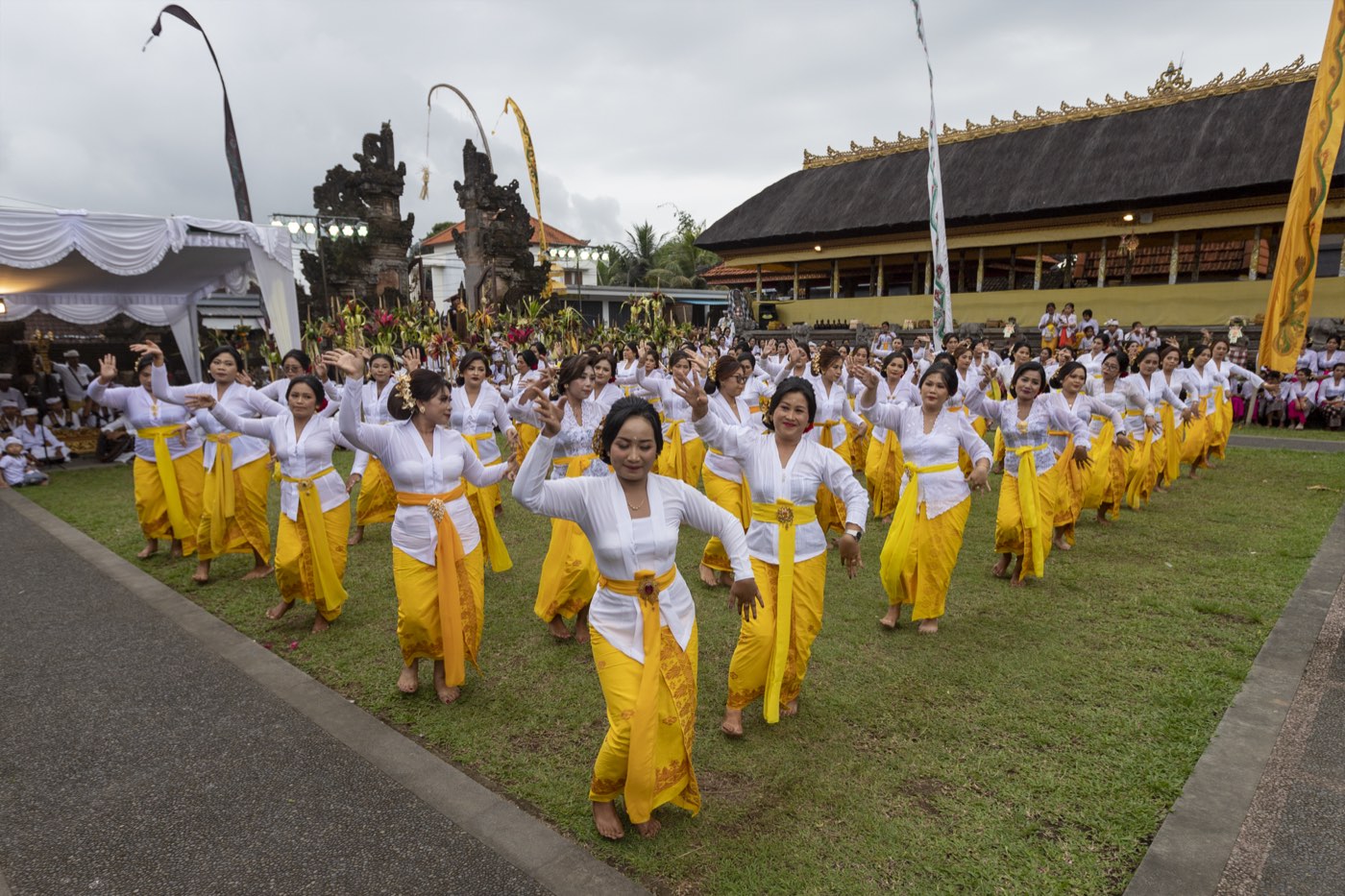
- long lines of dancers in white and gold, or in village cloth, moving with unhurried grace
- fans or sashes held delicately
- the gamelan playing the patient, circling melodies reserved for ritual
- sometimes hundreds of women dancing together at a large odalan
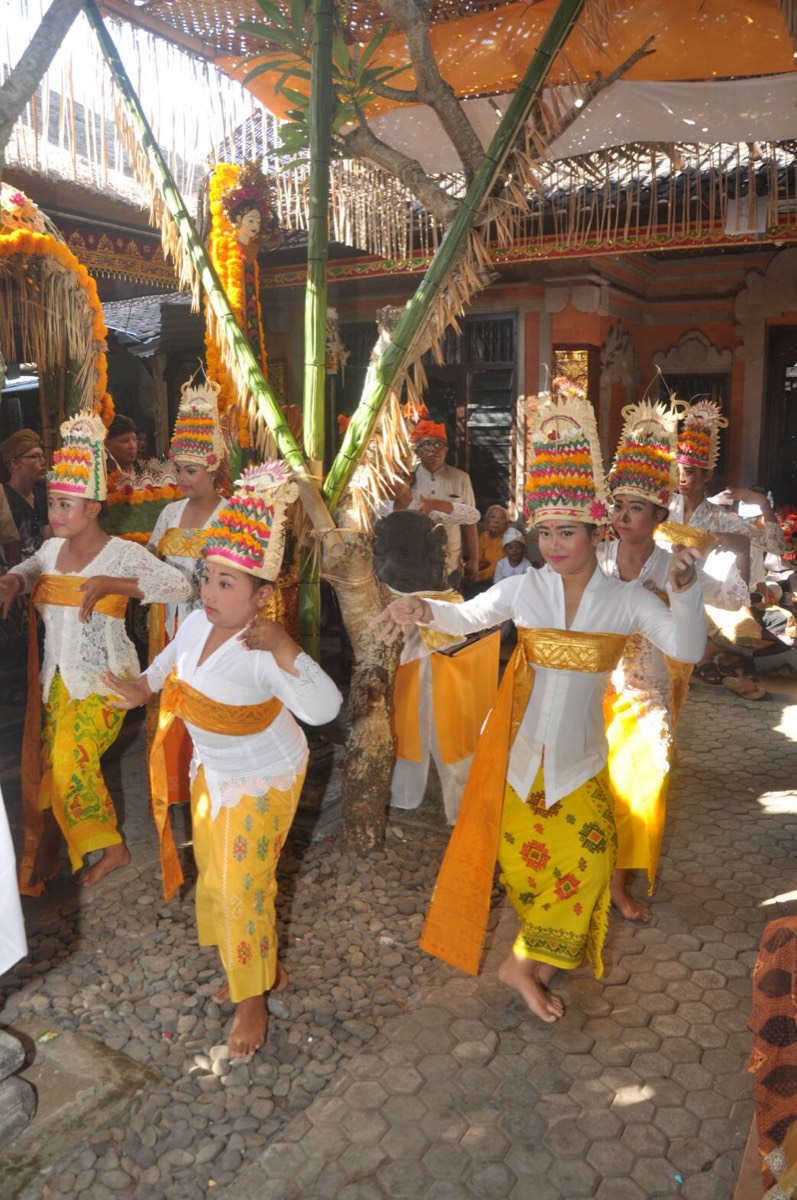 Rejang Dewa, the form danced by young girls in tall crowns. Photo: rifqirizqullah / Wikimedia Commons (CC BY-SA 4.0)

In Rejang Dewa, one of the best-known forms, young girls in golden crowns dance as a pure offering.
Some villages hold that their rejang must be danced by girls before adolescence. Others open it to all women. The variety is the point, since each village's rejang is its own inheritance.
North Bali's Villages Keep Their Own Rejang
The north has its own textures.
Buleleng's temple ceremonies pair rejang with the region's famously fiery gamelan, described in the north's dance and music tradition.
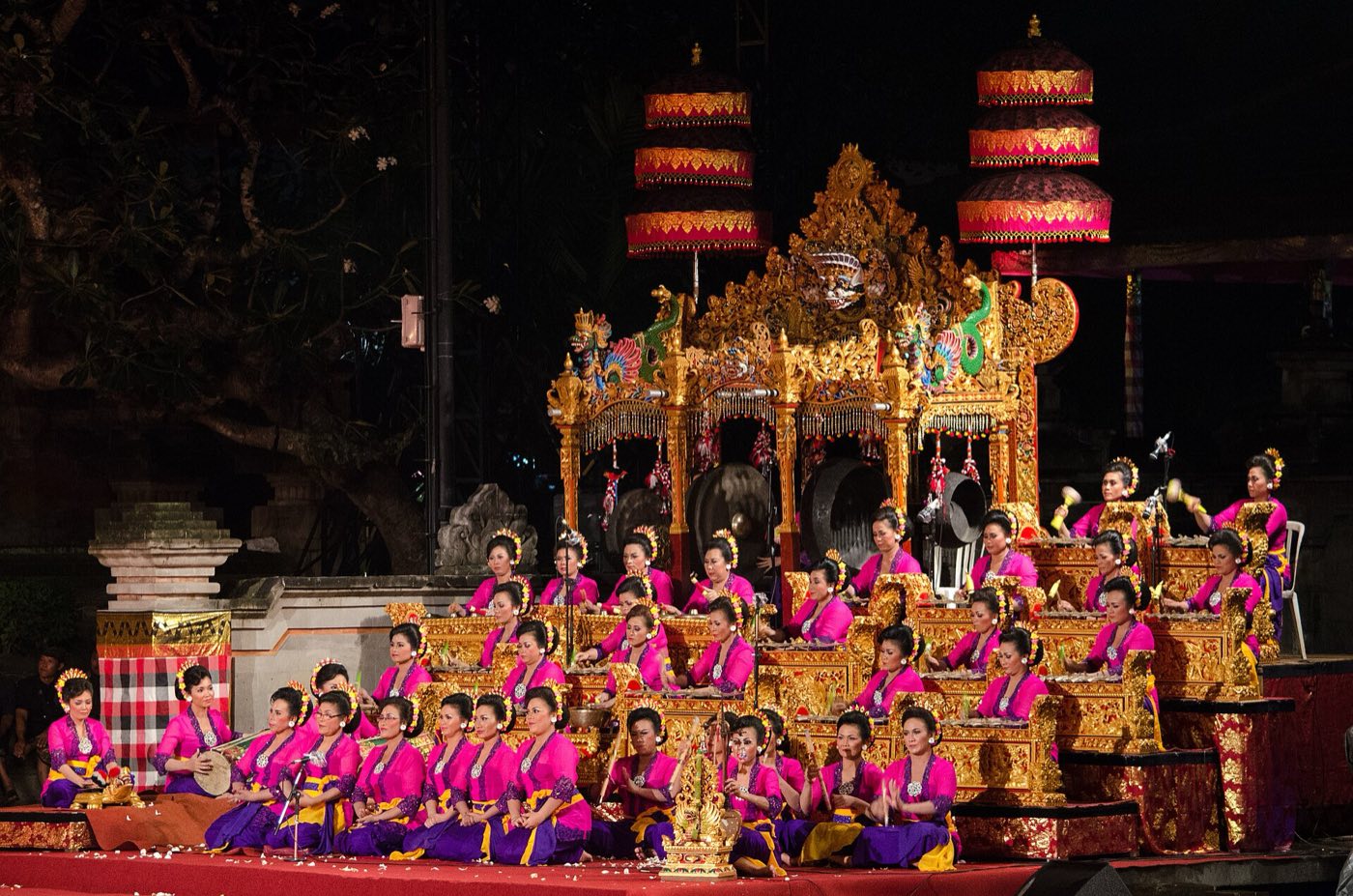 Gong kebyar, the gamelan style most associated with Buleleng, played here by a women's ensemble on an exhibition stage. Photo: Benjamin Hollis / Wikimedia Commons (CC BY 2.0)

The Bali Aga villages keep sacred rejang of their own. In Cempaga, the regency's research agency records, the rejang is danced at the Pura Puseh Agung from night until morning as the ceremony draws to a close.
Village forms differ so much that the reliable account of any one of them is the village's own.
Rejang Is Danced for the Gods, Stage Dances for an Audience
| Rejang (wali) | Stage dances (balih-balihan) | |
|---|---|---|
| For | The gods | An audience |
| Where | Temple inner courtyard, during ceremony | Stages, hotels, festivals |
| Dancers | The village's women and girls | Trained performers |
| Movement | Simple, slow, processional | Virtuosic, dramatic |
| Can it be booked? | No, it belongs to the ceremony | Any night of the week |
Both are real Balinese culture, and they live in different circles. A Legong at a festival and a rejang at an odalan come from the same civilisation, one as art and one as prayer.
How to Watch Rejang Respectfully in North Bali
Rejang happens wherever there is an odalan, which somewhere in Buleleng is most weeks. The island-wide rhythm is in the events calendar.
If you are invited to a temple ceremony, or attend one:
- Wear full temple dress: sarong, sash and covered shoulders.
- Stay in the outer courtyards unless you are invited deeper.
- Keep clear of the dancers. Do not walk in front of them or between them and the shrines.
- Keep cameras discreet, without flash, and ask first.
The full set of rules is in Bali temple etiquette. The Balinese calendar explains why an odalan lands when it does.
A quiet presence at the back is welcome at most village ceremonies. Treat the invitation as the gift it is.
FAQ
What is the rejang dance in Bali?
Rejang is a sacred Balinese offering dance performed by women and girls inside temple courtyards during ceremonies, especially temple anniversaries. It is danced as an offering to welcome visiting deities, with no audience in mind.
Who dances the rejang?
The women and girls of the village community dance it, from children to elders, depending on the village's tradition. Some forms, like Rejang Dewa, are danced by young girls. The movements are deliberately simple so the whole community can take part.
Can tourists watch a rejang dance?
Yes, if you attend the temple ceremony respectfully. Wear full temple dress, take a quiet place in the outer courtyard, use no flash, and do not stand between the dancers and the shrines. Rejang belongs to the ceremony and is not staged commercially, so a temple ceremony is the place to see it.
What is the difference between wali, bebali, and balih-balihan dances?
Wali dances are sacred rites for the gods in the temple's inner courtyard (rejang, baris gede, sanghyang). Bebali are ceremonial dances of the middle courtyard. Balih-balihan are entertainment dances for audiences, like Legong and Kecak. UNESCO inscribed the three genres together as intangible cultural heritage in 2015.
Where can I see rejang in north Bali?
You can see it at a Buleleng temple during its odalan, and at major island ceremonies. Temple anniversaries follow the Balinese calendars, so check the north Bali events calendar and ask locally. Bali Aga villages such as Cempaga keep their own sacred forms.
Sources
- UNESCO Intangible Cultural Heritage, Three genres of traditional dance in Bali (inscribed 2015), read September 2026
- Buleleng Research and Innovation Agency, Unique and sacred dances of the Bali Aga villages of Buleleng (the rejang of Cempaga), read September 2026 (in Indonesian)
- Wikimedia Commons, Women's Gamelan Gong Kebyar Exhibition, Benjamin Hollis, CC BY 2.0
Read next: dance and music in north Bali and the Bali Aga villages for the living traditions of the north.
See also Balinese ceremonies explained for where the rejang sits in a temple festival.