
On this page
In Brief
Legong is Bali's classical dance for girls: a condong, or attendant, dances a prelude, and two identically dressed legong dancers perform a stylised story to a gamelan of twenty-five players or more. It began as palace entertainment in Gianyar in the nineteenth century, and its best-known piece, Legong Keraton Lasem, tells of the king of Lasem who abducts a princess and rides to his death. Balinese tradition traces it to a king of Sukawati who saw heavenly dancers in a trance; historians date its present form to the late nineteenth and early twentieth centuries. Legong Keraton is one of the nine dances chosen to represent Balinese dance when UNESCO inscribed it in 2015. It survives in village troupes, arts schools and temple festivals, and in the north as Legong Tombol, revived in Banyuatis.
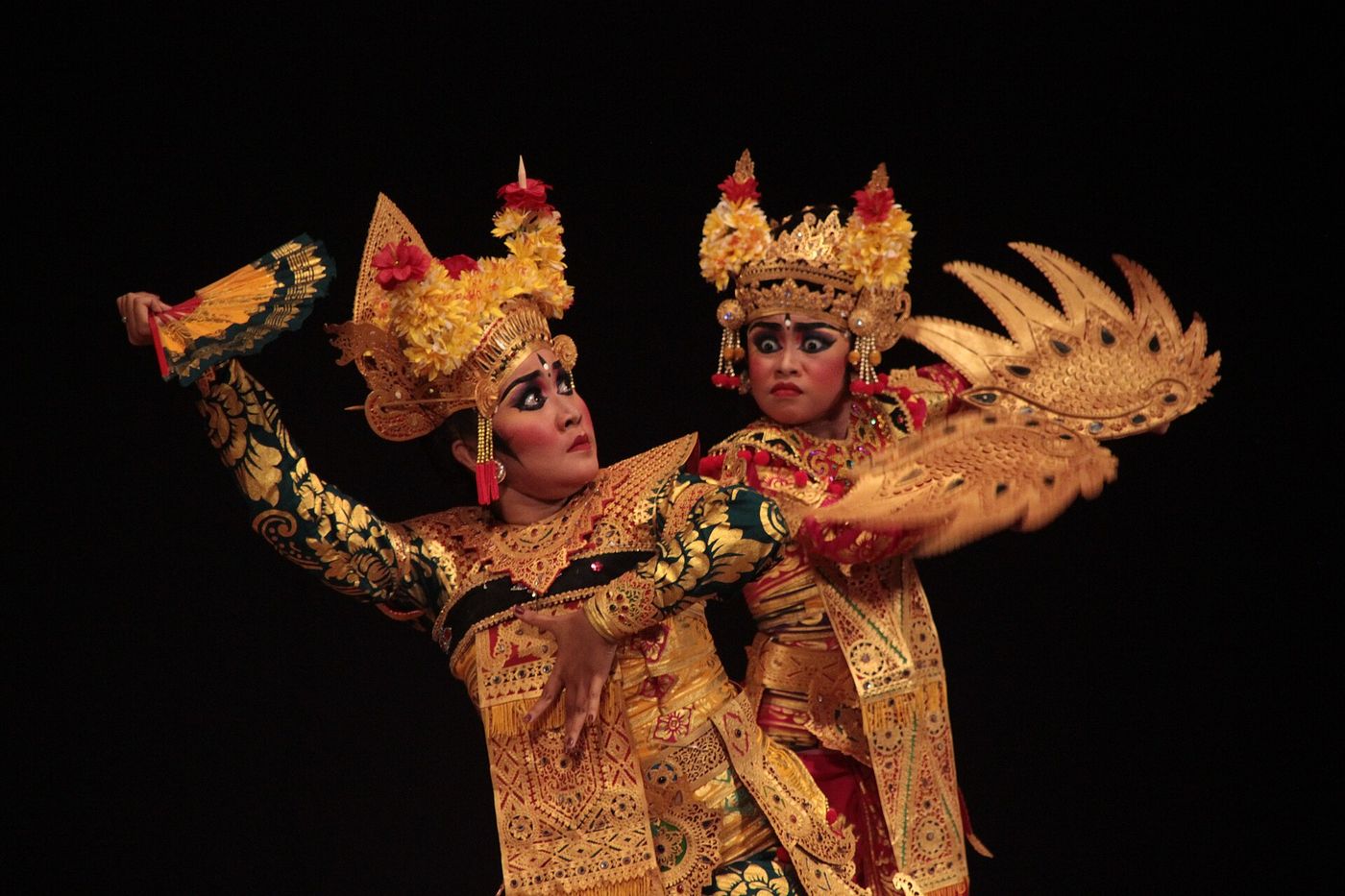 Two dancers of Legong Keraton Lasem hold an agem, a set position, in a performance at ISI Denpasar. Photo: Kresnanta / Wikimedia Commons (CC BY-SA 4.0)
Legong at a Glance
- What it is: A refined dance for girls, performed by a condong and two legong to gamelan
- The best-known piece: Legong Keraton Lasem, the story of the king of Lasem and Princess Rangkesari
- Origin: The palaces of Gianyar in the nineteenth century; the condong's role was added between 1910 and the early 1930s
- Music: Gamelan pelegongan or semar pegulingan, today often gong kebyar
- Category: Balih-balihan, entertainment; at temple festivals it is danced outside the inner courtyards
- UNESCO: Legong Kraton is one of the nine dances in Three genres of traditional dance in Bali, inscribed 2015
- In the north: Legong Tombol of Banyuatis, and a kebyar style of legong that grew out of Jagaraga
What Legong Is
The philosopher Stephen Davies, who has studied the history of the genre in detail, describes the traditional line-up as three young girls: the condong, who dances a prelude, and the two legong. All three wear gilded cloth, ornate accessories and headdresses crowned with frangipani (Davies, BKI 2008). The repertoire has about fifteen dances, some now lost, running thirty minutes to an hour in full. Some tell stories; others are pictures of birds, insects and plants.
Davies calls legong the treasury of movement for Balinese women's dance: no dancer's training is complete without it. UNESCO's inscription file names the elements of that vocabulary: agem, the basic posture with knees turned out; tandang, the travelling steps; tangkis, the transitions; and tangkep, the facial expression, eyes included (nomination file).
Legong is an entertainment dance, and like every Balinese dance it is also an offering. At a temple festival it is danced just outside the temple, since it is not one of the dances allowed in the inner courtyards. The circles of sacred and stage dance are explained in Balinese dance and music.
From the Palace: Where Legong Came From
The story most often told comes from the chronicle of Sukawati. Its king, I Dewa Agung Made Karna, who lived from 1775 to 1825, meditated for forty days at a temple site in Ketewel and saw in a trance two celestial dancers dressed in gold. He built a temple there, Pura Yogan Agung, and taught his court what he had seen. The masked dances that came from that vision, called topeng sanghyang or sanghyang legong, are still danced in the Ketewel temple on the Balinese 210-day calendar (Davies, BKI 2008). Other accounts trace legong to Sanghyang Dedari, the trance dance of two young girls, and UNESCO's file names both Sanghyang Dedari and the older court drama Gambuh as its sources.
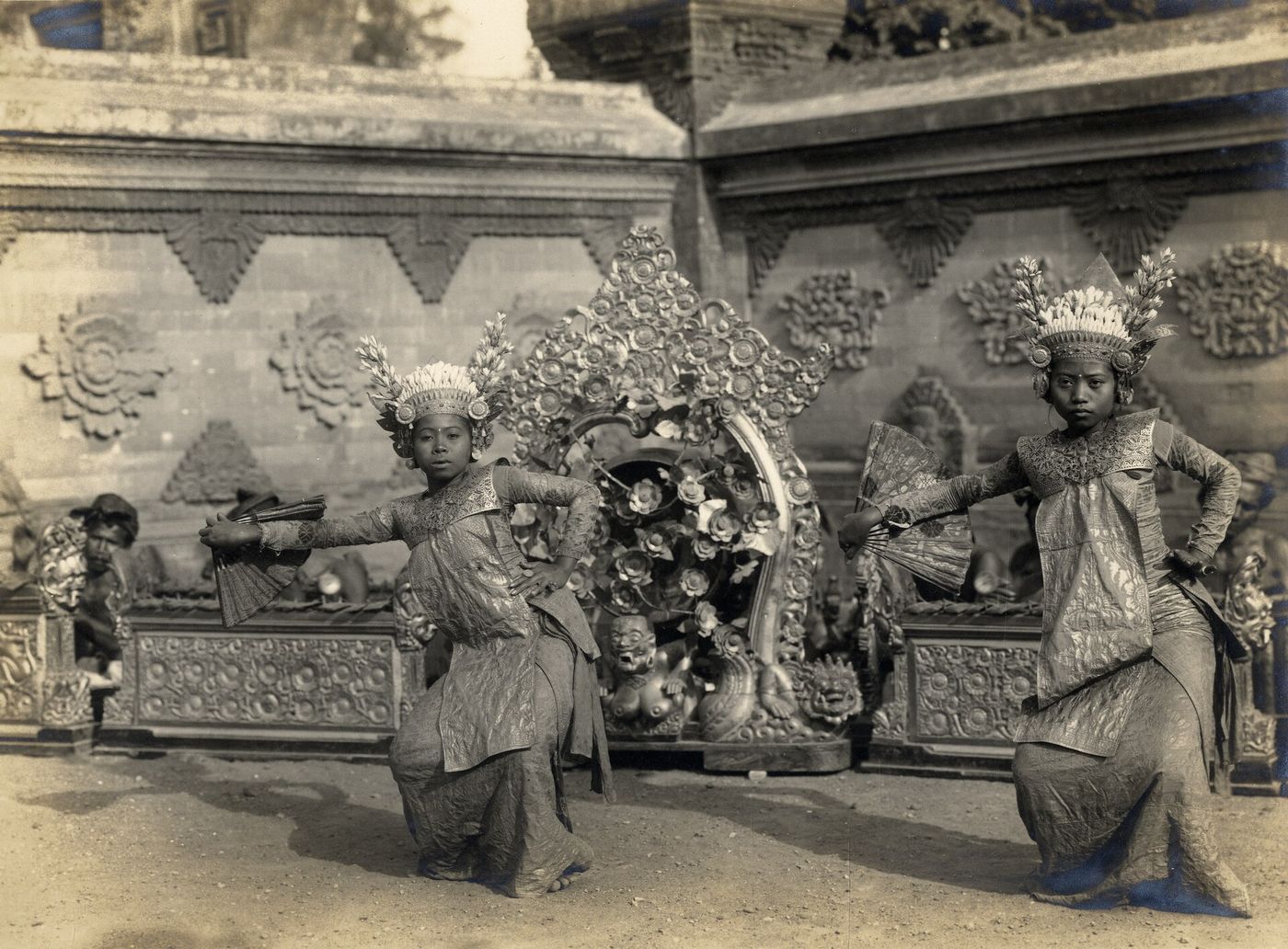 Legong dancers at Gianyar, in an album of a journey through Bali dated 1927. Photo: Unknown author, KITLV / Wikimedia Commons (CC BY 4.0)
Davies, working through the lives of the teachers, argues for a later date. In his reading, legong was made from andir, a dance for boys created in Blahbatuh in the mid-nineteenth century, when the king of Gianyar asked for a version for girls. The dancer Anak Agung Rai Perit and the musician I Dewa Ketut Belacing made it, around 1889. The condong's part was added village by village: in Sukawati in 1910, in Peliatan by 1916, in Saba in 1930 and in Badung in 1932. The historian Adrian Vickers replied that Balinese and Dutch written sources, closer to the time, modify that picture (Vickers, BKI 2009).
Even the name is younger than the dance. "Keraton" is the Javanese word for palace, and legong acquired it in the 1930s, when it was first performed in Java. Bali's culture office dates Legong Keraton Lasem in Sukawati to the nineteenth century and another piece, Legong Raja Cina, to the early twentieth century at Puri Taman in Saba (Bali Culture Office).
The Story of Legong Keraton Lasem
The tale comes from the Malat, a cycle of East Javanese romances. The king of Lasem wants to marry Princess Rangkesari, who detests him, and when she runs away and is lost in the forest he captures her. He rides out for a final assault on her family, and on the way a monstrous raven attacks him, a sign that he will die (Wikipedia).
The condong sets the scene, hands the two legong their fans, and returns at the end as the raven. The two legong, dressed identically, share the story's roles between them. Davies notes that in legong the drama always comes second to the beauty of the dance.
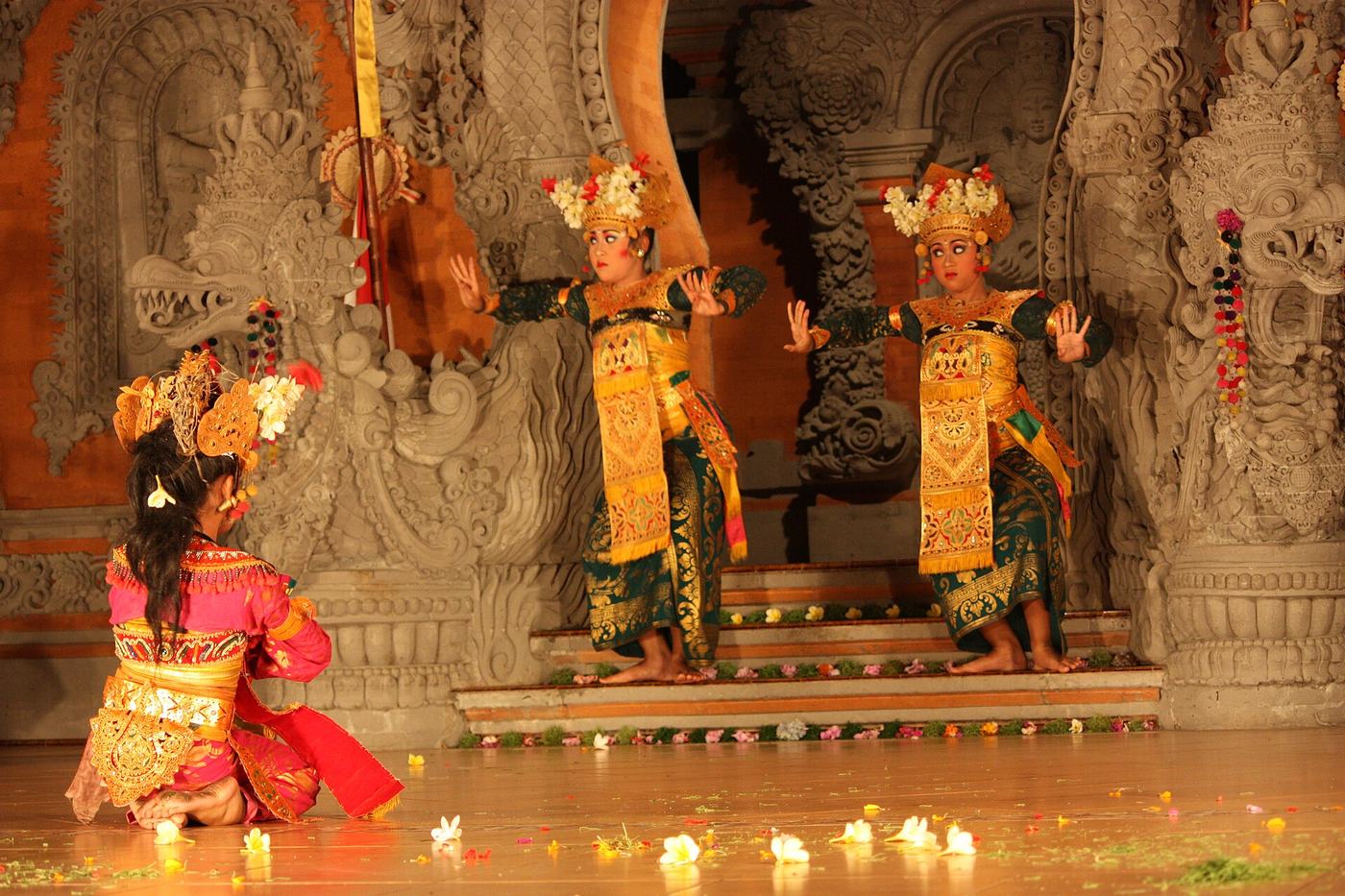 The two legong and the condong on a stage in Ubud. Photo: Arian Zwegers / Wikimedia Commons (CC BY 2.0)

How a Legong Dancer Is Trained
UNESCO's inscription file describes the lessons. A teacher dances at the front and the pupils, some as young as four or five, follow from behind in time with the music. Girls usually start with Pendet. The teacher corrects them as they go, and the sequence is repeated until it is memorised; the test is a performance with live gamelan. Children learn in village arts clubs at the banjar hall and in private studios, sanggar, as well as at school and at ISI Denpasar, the Indonesian Institute of the Arts (nomination file). The village side of that system is in the banjar.
Legong has always favoured young dancers. Writers of the 1930s and 1940s put the age of retirement at around twelve to fourteen. Davies explains the reason as the need to shape a body to legong's positions while it is still flexible, and quotes Balinese experts who still consider a dancer of about ten ideal. Dancers now often perform into their twenties and beyond, and teachers much longer.
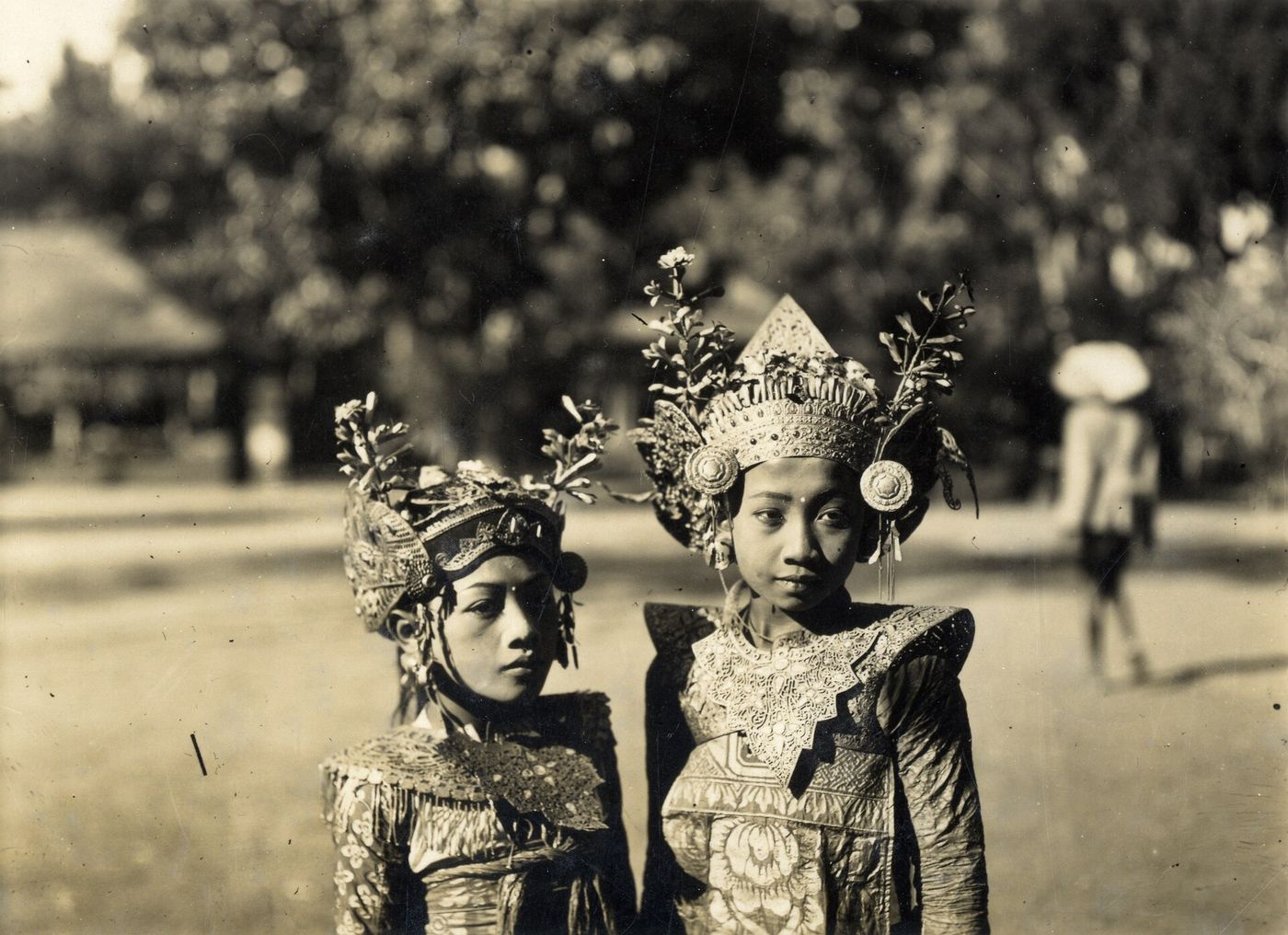 Two young legong dancers, photographed around 1932. Photo: Unknown author, KITLV / Wikimedia Commons (CC BY 4.0)
Legong and UNESCO
In 2015 UNESCO inscribed Three genres of traditional dance in Bali on its Representative List. The committee's decision notes that nine dances from the three genres were entered in Bali's heritage inventory from 2010. The nomination file names them, each with an example from one regency:
- Sacred (wali): Rejang (Klungkung), Sanghyang Dedari (Karangasem), Baris Upacara (Bangli)
- Semi-sacred (bebali): Topeng Sidhakarya (Tabanan), Gambuh (Gianyar), Wayang Wong (Buleleng)
- Entertainment (balih-balihan): Legong Kraton (Denpasar), Joged Bumbung (Jembrana), Barong Ket "Kuntisraya" (Badung)
The file's Legong Kraton is "exquisitely beautiful", danced by two or three girls, with a studio in Peguyangan, Denpasar, as its example. The committee also encouraged Indonesia to keep addressing the threats that come from promoting Balinese dance to tourists, especially for the religious dances. For legong, Davies records what Balinese experts deplore in tourist shows: whole sections cut, a focus on Lasem alone, and lower standards.
Legong in the North: Kebyar and Legong Tombol
North Bali changed legong from a distance. Gong kebyar, the explosive gamelan style that grew up in Buleleng, brought a new dance with it: in 1915 I Wayan Paraupan, known as Pan Wandres, of Jagaraga created Kebyar Legong, a duet mixing Baris, Jauk and Legong (Buleleng Culture and Tourism Office). Kebyar then worked back on legong itself. In 1932 the teacher Ida Bagus Boda of Badung re-choreographed legong's opening in the kebyar style, and the change spread quickly. By the mid-1930s many of the soft-toned pelegongan and semar pegulingan orchestras had been melted down and recast as gong kebyar, and legong is now often played on kebyar instruments, which Balinese experts regard as far from ideal (Davies, BKI 2008). The whole story of kebyar is in north Bali's dance and music and the Jagaraga war.
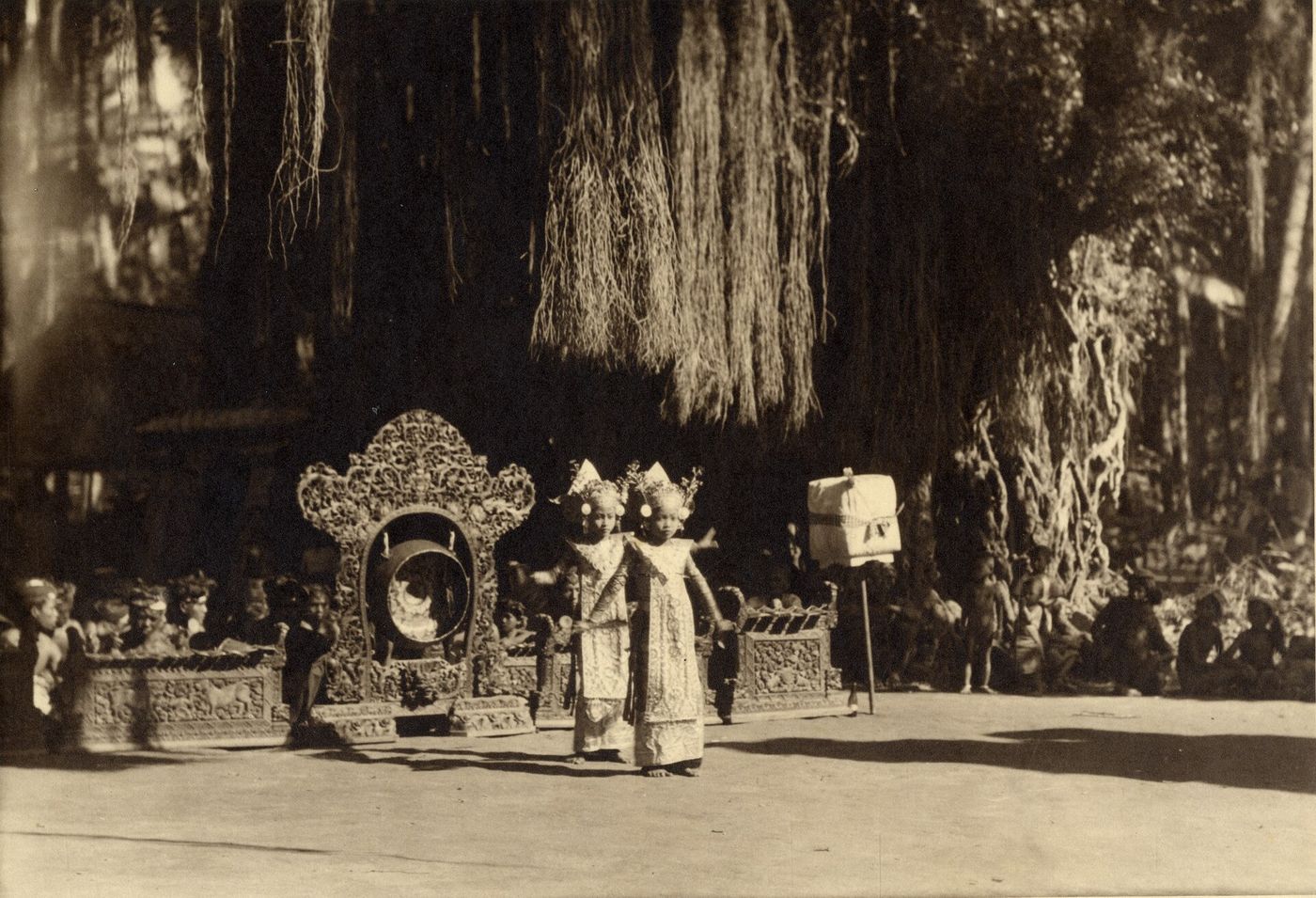 Legong danced before the gamelan under a banyan tree, around 1932. Photo: Unknown author, KITLV / Wikimedia Commons (CC BY 4.0)
Legong Tombol. Buleleng's own legong was born outside it: the legong master I Wayan Rindi created it at the Karangasem palace in the 1950s. Around 1959 Rindi brought it to Banyuatis, a hill village in Buleleng's Banjar district, where it was reworked in the Buleleng style with the family of Pan Manikan and their gamelan. Around 1960 dancers from Banyuatis performed it at Tampaksiring Palace for President Sukarno. Then politics and a missing generation of dancers let it die out for some forty years (tatkala.co).
A surviving dancer and an old musician in Banyuatis still remembered it. With the villager Yudi Gautama, the ISI Denpasar lecturer Ida Ayu Wimba Ruspawati reconstructed it in 2015 for her doctorate (Buleleng Culture and Tourism Office). The regency office describes it as southern movement and costume joined to Buleleng's kebyar character. Dozens of dancers opened the fourth Buleleng Festival with it in August 2016, in front of the Singa Ambara Raja monument in Singaraja, and in August 2019 the festival held a workshop on it alongside Legong Pangeleb, reconstructed by the Jagaraga artist Made Keranca (Buleleng Regency). The culture office has filmed Legong Tombol danced by Sanggar Tari Eka Gayatri of Kubutambahan.
Where Legong Lives On
- In the old legong villages of Gianyar. Davies's sources name Sukawati, Peliatan, Saba, Bedulu and Pejeng. For Peliatan's overseas tour of 1952 and 1953, a legong dancer who had retired after 1916 came back to train the girls.
- At the Bali Arts Festival, the province's arts festival at the Taman Budaya (Art Centre) in Denpasar. In June 2022 a Sukawati studio danced Legong Keraton Lasem and Legong Raja Cina there.
- At temple festivals, outside the inner courtyard, where a village's own troupe may dance.
- In the north, at the Buleleng Festival and at regency events, where Buleleng's studios perform. Palm Living's page on legong suggests asking the staff whether a performance is on nearby, and its villas are mostly around Lovina.
Watching Legong
- Sit close if you can. The eyes, fingers and the flick of the fan carry most of the dance.
- Watch the condong. Her prelude sets the mood, and in Lasem she comes back as the raven.
- Temple dress at a ceremony. A sarong and sash; see Bali temple etiquette.
- Turn off the flash, at a temple or in a theatre.
FAQ
What is the legong dance? Legong is a classical Balinese dance for girls, usually two legong dancers and an attendant called the condong, performed to gamelan. It is known for intricate finger movements, complicated footwork, expressive eyes and gilded costumes, and it began as entertainment in the palaces of Gianyar.
What is the story of the legong dance? The best-known piece, Legong Keraton Lasem, tells how the king of Lasem captures Princess Rangkesari and rides to war against her family; a raven attacks him on the way, foretelling his death. Other legong pieces tell different stories, and some depict birds or animals.
Who performs legong? Traditionally young girls, trained from early childhood; the dancers used to retire in their early teens. Today dancers often perform into their twenties and beyond, and men have also danced it.
Where did legong come from? Balinese tradition credits a king of Sukawati, I Dewa Agung Made Karna, who dreamed of two heavenly dancers. Historians date the dance as it is performed now to the late nineteenth century in the palaces of Gianyar, with the condong's role added between 1910 and the early 1930s.
Is legong on the UNESCO list? Yes. Legong Kraton is one of the nine dances named in Three genres of traditional dance in Bali, inscribed by UNESCO in 2015, representing the entertainment genre.
What is Legong Tombol? A north Bali legong created by I Wayan Rindi in the 1950s and brought to Banyuatis in Buleleng around 1959. It died out, was reconstructed in 2015 by the ISI Denpasar lecturer Ida Ayu Wimba Ruspawati, and now appears at the Buleleng Festival.
Where can I see legong in Bali? In the Gianyar villages with long legong traditions, such as Peliatan and Sukawati, at the Bali Arts Festival in Denpasar, and at temple festivals. In the north, Legong Tombol appears at the Buleleng Festival and regency events.
Sources
- Stephen Davies, The origins of Balinese legong, Bijdragen tot de Taal-, Land- en Volkenkunde 164 (2008), for the line-up, repertoire, the Sukawati story, andir, the condong's dates, training and the kebyar influence, read September 2026 (in English)
- Adrian Vickers, When did legong start? A reply to Stephen Davies, BKI 165 (2009), abstract, read September 2026 (in English)
- UNESCO Intangible Cultural Heritage, Three genres of traditional dance in Bali, the committee decision and the nomination file, for the nine dances, their regencies and how dance is taught, read September 2026 (in English)
- Bali Provincial Culture Office, Legong Keraton and kebyar at the Bali Arts Festival, June 2022, read September 2026 (in Indonesian)
- Buleleng Culture and Tourism Office, Legong Tombol and Tari Truna Jaya, for Pan Wandres and Kebyar Legong, read September 2026 (in Indonesian)
- Buleleng Regency, Workshop on Legong Pangeleb and Legong Tombol, August 2019, read September 2026 (in Indonesian)
- tatkala.co, The soul of the Buleleng Festival is called Legong Tombol, August 2016, read September 2026 (in Indonesian)
- Wikipedia, Legong, for the Lasem story and the condong's roles, read September 2026 (in English)
- Palm Living, Bali Legong Dance on Bali Information, read September 2026 (in English)
Read next: Kecak, Bali's circle of voices, the Barong and Rejang, Bali's sacred offering dance.