
On this page
In Brief
Balinese gamelan is a family of ensembles built around tuned gongs, metallophones, drums and cymbals, with some sets made wholly of bamboo. There are more than twenty kinds, from the forty-player gong gede of the old courts to the gender wayang, two to four players who accompany the shadow puppets. Most instruments come in pairs tuned a little apart, and the beating between them, called ombak, is the shimmer you hear. A gamelan is usually played by a sekaa, the music club of a banjar, which rehearses in the neighbourhood hall and plays for temple ceremonies. The north matters here: an inscription of 896 found in Buleleng already lists gamelan players, gong kebyar was born in Buleleng's villages in the 1910s, and the regency keeps its own northern kind of kebyar set. In north Bali you hear gamelan at temple ceremonies, banjar rehearsals and the regency's festivals.
Balinese Gamelan at a Glance
- What it is: Ensembles of tuned bronze gongs, gong-chimes and metallophones, led by a pair of drums, with cymbals and bamboo flutes; some are all bamboo, and one sacred kind is iron
- How many kinds: More than twenty, by the count of the world-music magazine Songlines, sorted by Balinese scholars into old, middle and new
- The sound: Two tuning systems, pelog and slendro, with instruments paired and tuned apart so that they beat against each other
- Who plays: A sekaa, the club of a banjar or village, which usually owns the instruments with its community
- Recognition: Indonesia's gamelan was inscribed by UNESCO on the Representative List of the Intangible Cultural Heritage of Humanity in 2021
- The north's part: Gong kebyar was born in Buleleng, and the northern kind of kebyar set survives only there
- Where to hear it in the north: Temple ceremonies, banjar rehearsals, the Buleleng Festival and the Lovina Festival
What a Gamelan Is
The word comes from gamel, the action of a hammer, and a gamelan is first of all a set of struck instruments. Large hanging gongs mark the structure of each piece. Rows of bronze keys over bamboo resonators carry the melody. Gong-chimes shaped like upturned bronze pots add rhythm, and a pair of double-headed drums, one called male and one female, leads the ensemble through its changes of speed and volume.
Balinese musicians describe a piece as a tree, Songlines explains. The deep metallophones play the trunk, the core melody called pokok. Higher instruments spread it into branches, and the smallest and brightest add the flowers, usually as kotekan, two interlocking parts that combine into one line faster than any single player could manage. Our guide to Balinese dance and gong kebyar explains kotekan in more detail.
A gamelan is made and tuned as one set, so an instrument cannot simply move to another set, and many sets are sacred. Bali's culture office records how Banjar Anyar in Tabanan voted at a banjar meeting in 1942 to buy its gamelan, had it recast as a gong kebyar, and still honours the set as Ratu Gede, as holy as its Barong.
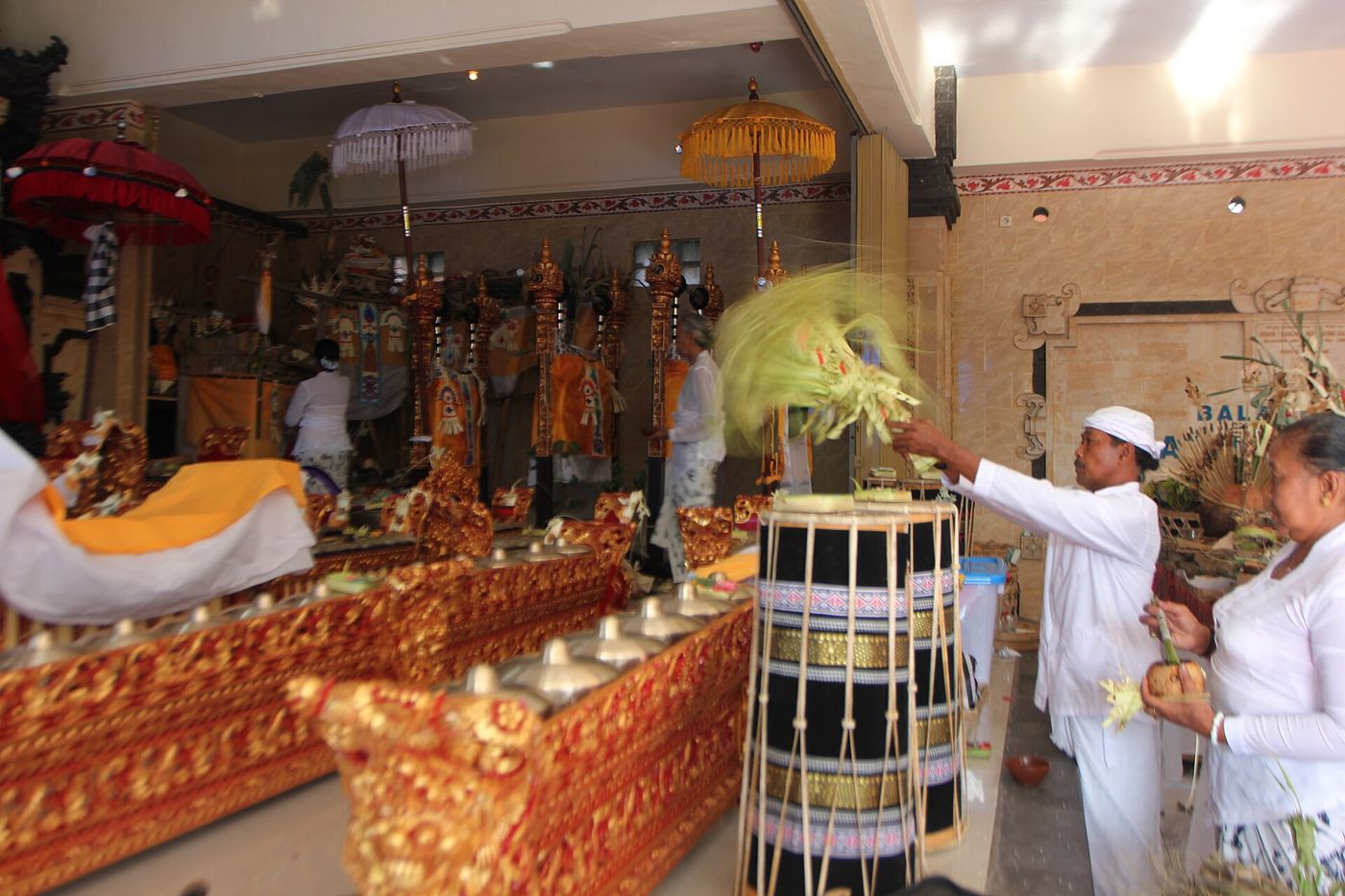 A gamelan blessed during its pamelaspas ceremony. Photo: Eka Purna Sumeika / Wikimedia Commons (CC BY-SA 4.0)

Balinese scholars sort the ensembles by age. Notes from I Wayan Dibia's introduction to Balinese music, posted on an ISI Denpasar blog, put gambang, selonding, gender wayang and angklung in the old group, where drums are rare or absent. In the middle group, drums take the lead: gambuh, semar pagulingan, pelegongan, gong gede. The new group, of the twentieth century by Kompas's dating, includes gong kebyar, joged bumbung and janger.
The Main Kinds of Balinese Gamelan
Gong gede
The great ceremonial gamelan, named for its large gongs. It needs more than forty players, and in the old courts it played in the outer courtyard every morning; when the palaces lost power under the Dutch, most court gamelan passed to the villages. The gong gede of Batur temple is said to date from the fifteenth century (Songlines). Its stately music plays for rites to the gods.
Semar pagulingan and pelegongan
Semar pagulingan is the sweet-toned court gamelan named after Semar, the god of love, which played in the palace's inner courtyard in the afternoon and evening. In its classic form it has a seven-tone pelog scale and borrows the repertoire of the ancient gambuh theatre, with the flute melody moved to the trompong, a row of ten gong-chimes. Pelegongan is its five-tone relative, which accompanies the Legong dance.
Gong kebyar
The sound of modern Bali, and by far the most common gamelan today. It grew in Buleleng in the 1910s out of gong gede and pelegongan, and as it spread, many clubs melted down older sets to recast them as the lighter, faster kebyar instruments. It plays a five-tone pelog scale over two octaves (Buleleng culture and tourism office). The story of its birth in Jagaraga is in our dance and gong kebyar guide.
Angklung
One of the oldest kinds, named after shaken bamboo rattles it rarely uses today. It is a small bronze set, light enough to carry, and in most of Bali it plays a four-note slendro scale for cremations and purification rites. To Balinese ears it is bittersweet. Sets with a fuller scale are common in the north, where the angklung also accompanies temple dances such as Baris and Rejang (Songlines; ISI Denpasar notes).
Gender wayang
The smallest ensemble: two players, complete at four. Each instrument has ten bronze keys over tuned bamboo tubes in the five-tone slendro scale, and each of the player's hands plays its own part. It accompanies the shadow puppet theatre and is required for most sacred rites, including tooth filing and cremation.
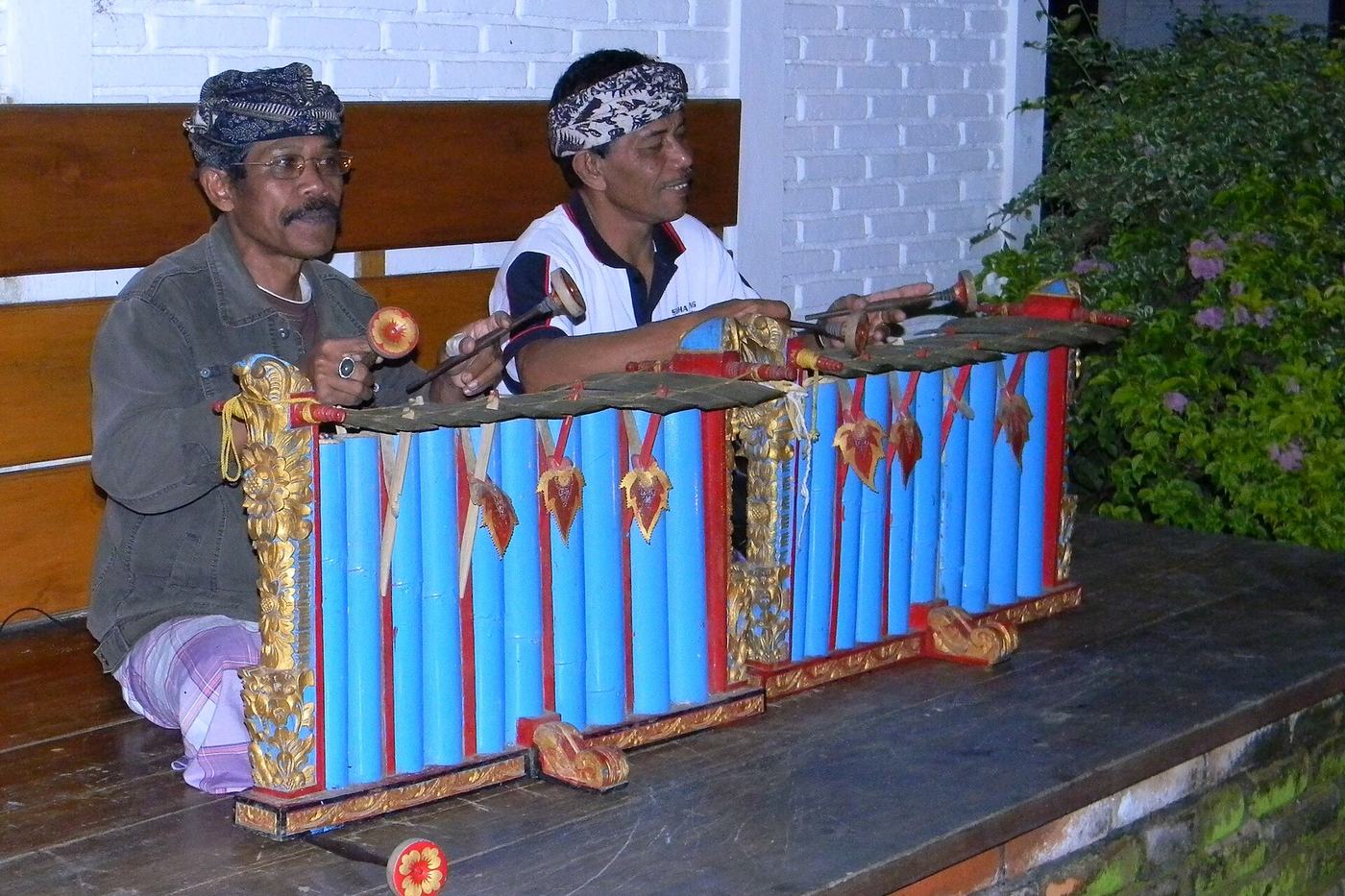 Made Terip and Ketut Mostal play gender wayang at Puri Lumbung. Photo: Andrea Tashik / Wikimedia Commons (CC BY-SA 2.0 UK)

Beleganjur
The marching gamelan: gongs, hand-held gong-chimes, drums and several pairs of cymbals, played on the move. Its name is often glossed as "walking army", and it still carries its martial origins. You hear it leading religious processions and cremations, and pushing the ogoh-ogoh through the streets on the eve of Nyepi (Beleganjur on Wikipedia).
Jegog
The giant bamboo gamelan of Jembrana in the west. A set has fourteen instruments, and the longest tubes reach three metres, so the two players of the deepest one crouch on top of its frame. Local tradition credits its creation in 1912 to Kiyang Geliduh, who dreamed of bamboo stems knocking together in the wind (detikBali). Rival groups play at once in contests called mabarung.
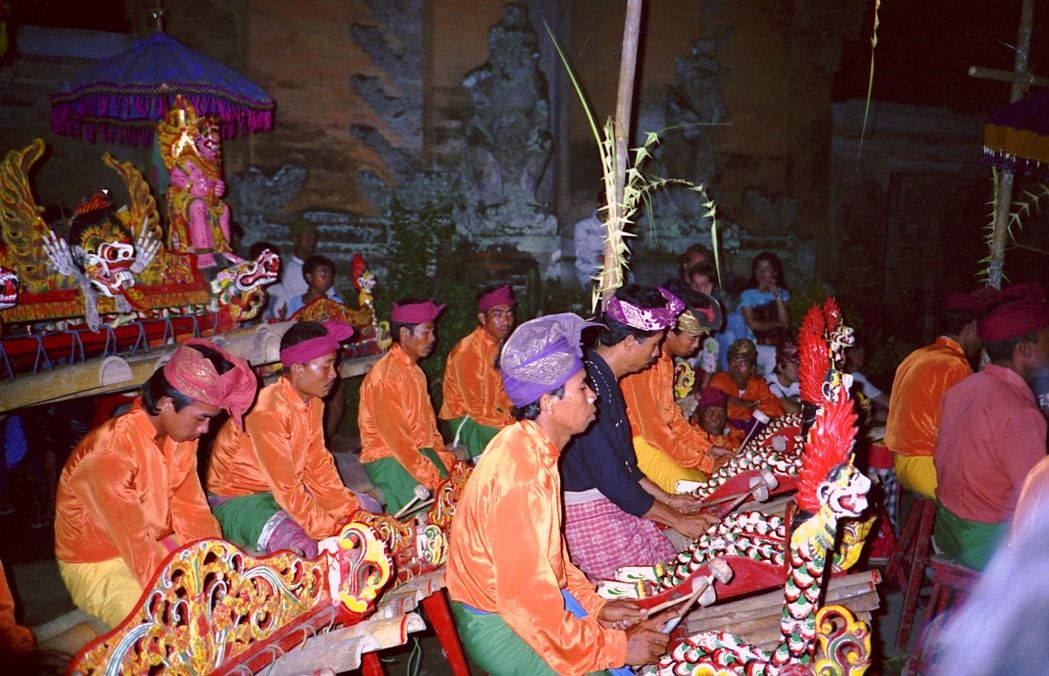 A jegog performance at Peliatan, around 1989. Photo: Samuel Wantman / Wikimedia Commons (public domain)

Rindik and the bamboo sets
The rindik is a bamboo xylophone tuned to slendro; a set of them accompanies the older joged pingitan dance. A young maker from Alasangker, near Singaraja, told the Buleleng government that he uses tabah bamboo from the north's hills and checks each key with a tuning app before his rindik ship abroad; Bali Information tells his story in English.
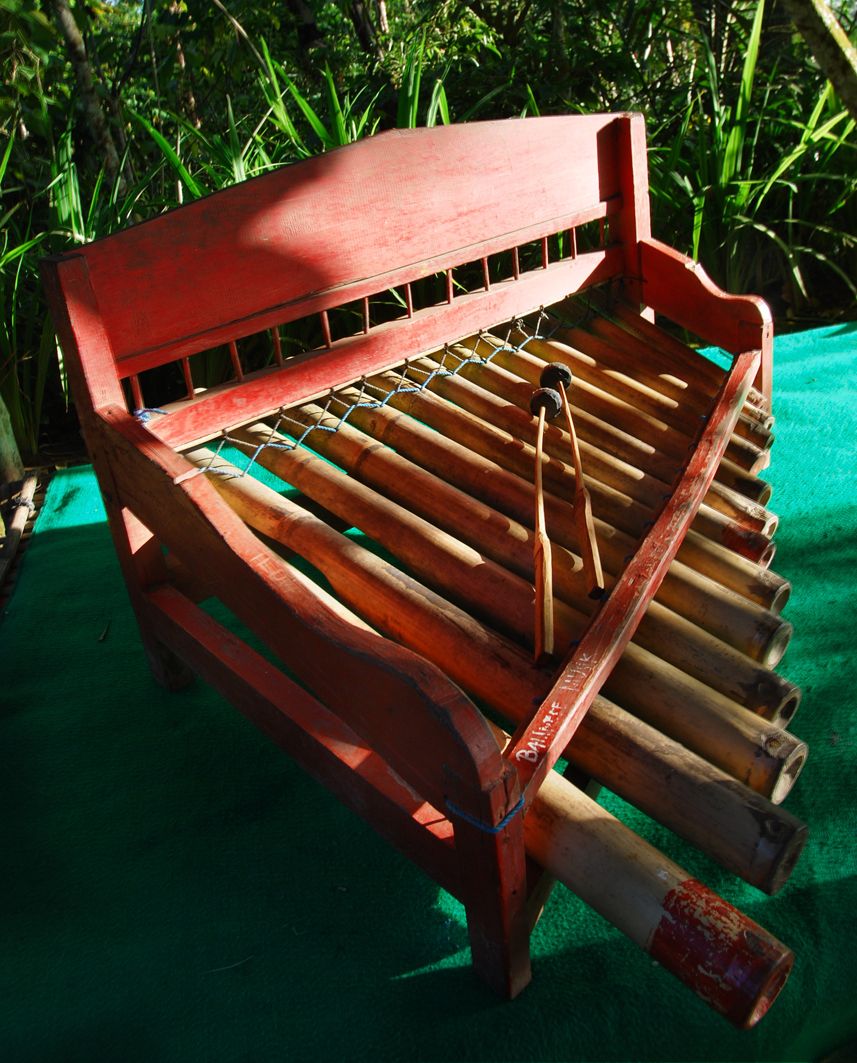 A rindik, the bamboo xylophone. Photo: William Cho / Wikimedia Commons (CC BY-SA 2.0)

Selonding and gambang
The oldest and rarest. Selonding has iron keys, no gongs and no drums, and is kept as a sacred set in Karangasem villages such as Tenganan, home of the Bali Aga, and Bongaya. Gambang pairs four xylophones with two bronze metallophones, plays almost only for cremations, and draws its pieces from the sung poetry of kidung.
The Paired Tuning: Ombak
Every Balinese gamelan uses one of two scales. Pelog has seven notes at unequal intervals, played in five-note modes; slendro has five, spaced roughly evenly. Beyond that nothing is standard: there is no fixed pitch, and each tone varies with local taste (ISI Denpasar notes), so every set has its own voice.
The shimmer comes from the pairs. Nearly every instrument has a partner tuned slightly apart. The lower is the pengumbang and the higher the pengisep, and when both sound the same note together, the two frequencies beat against each other. That pulse is ombak, the wave. Most gamelan beat at five to eight pulses a second; older sets are slower and newer ones faster (Songlines).
Tuners even stretch the octaves slightly wide (gender wayang on Wikipedia), and in jegog the deepest bamboo pairs can sit seven hertz apart, close to a whole tone at that pitch.
How a Banjar Sekaa Works
A sekaa is a club formed around a shared purpose inside the customary village, and the banjar, the neighbourhood, may keep several music clubs at once. Instruments usually belong to the banjar or the sekaa, and before a temple festival the players rehearse in the banjar hall almost daily. Membership was traditionally male (Songlines); women's and children's gong kebyar groups now represent Buleleng alongside the men's.
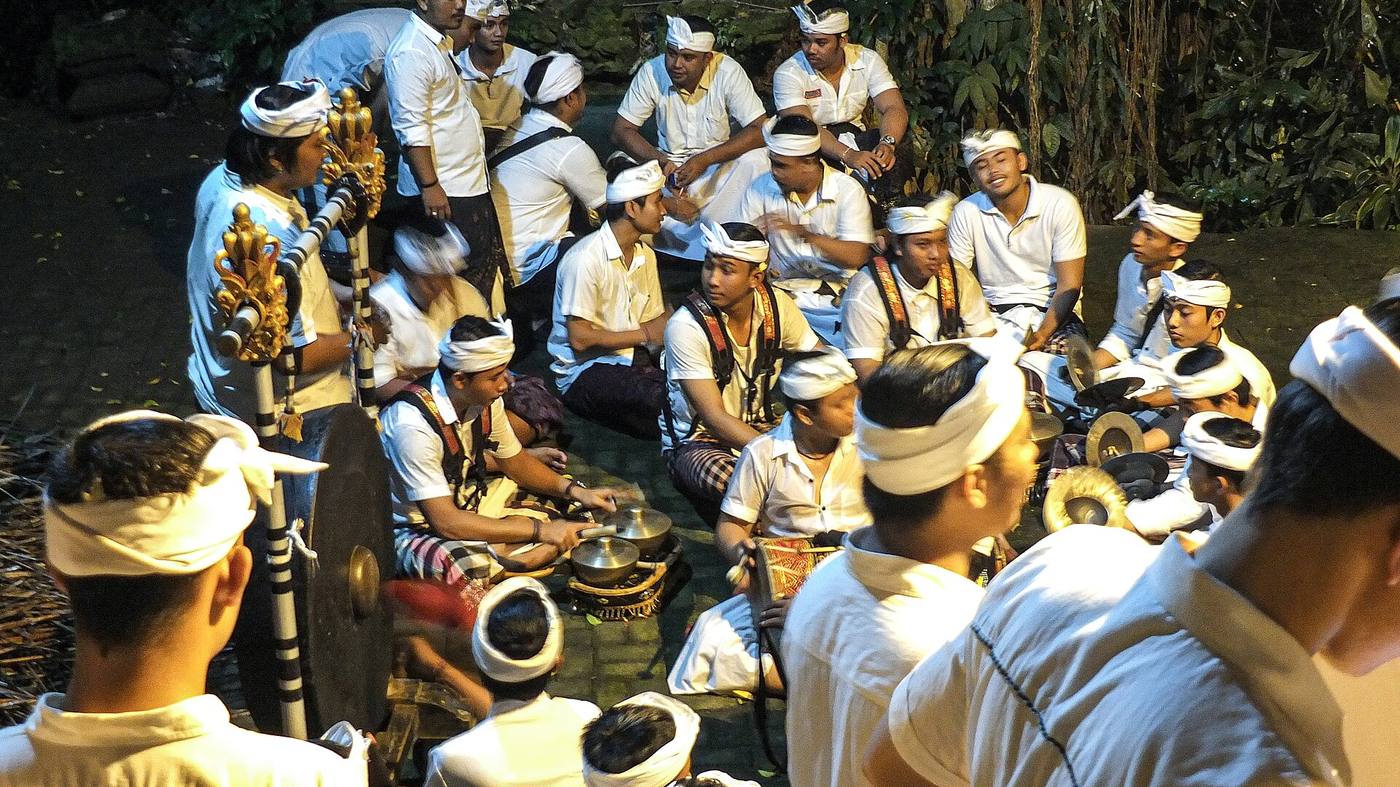 A gamelan club rests between pieces at a ceremony at Campuhan temple, Ubud. Photo: Jacques Alois Morard / Wikimedia Commons (CC BY-SA 4.0)
Singaraja's Sekaa Gong Eka Wakya shows how it works. It belongs to Banjar Paketan in the customary village of Buleleng, and when it was chosen for the Bali Arts Festival, every player and dancer came from the banjar, married members included. It has its own head, the kelian, and a coach. Its instruments stand on plain, uncarved frames and still carry their old keys, which its coach calls the community's gong duwe, not to be melted down on a whim (Buleleng regency).
Kebyar clubs grew up competing. Mebarung means two or more sekaa sharing one stage, and Buleleng's musicians told tatkala.co that the duel is the essence of gong kebyar.
North Bali's Part in the Story
Gamelan has a long written history in the north. An inscription dated 896, found at Bebetin in the Sawan district, lists among the village's people gamelan players, singers, angklung players, drummers, players of the great flute, mask-dance troupes and shadow puppeteers, according to the Sawan district.
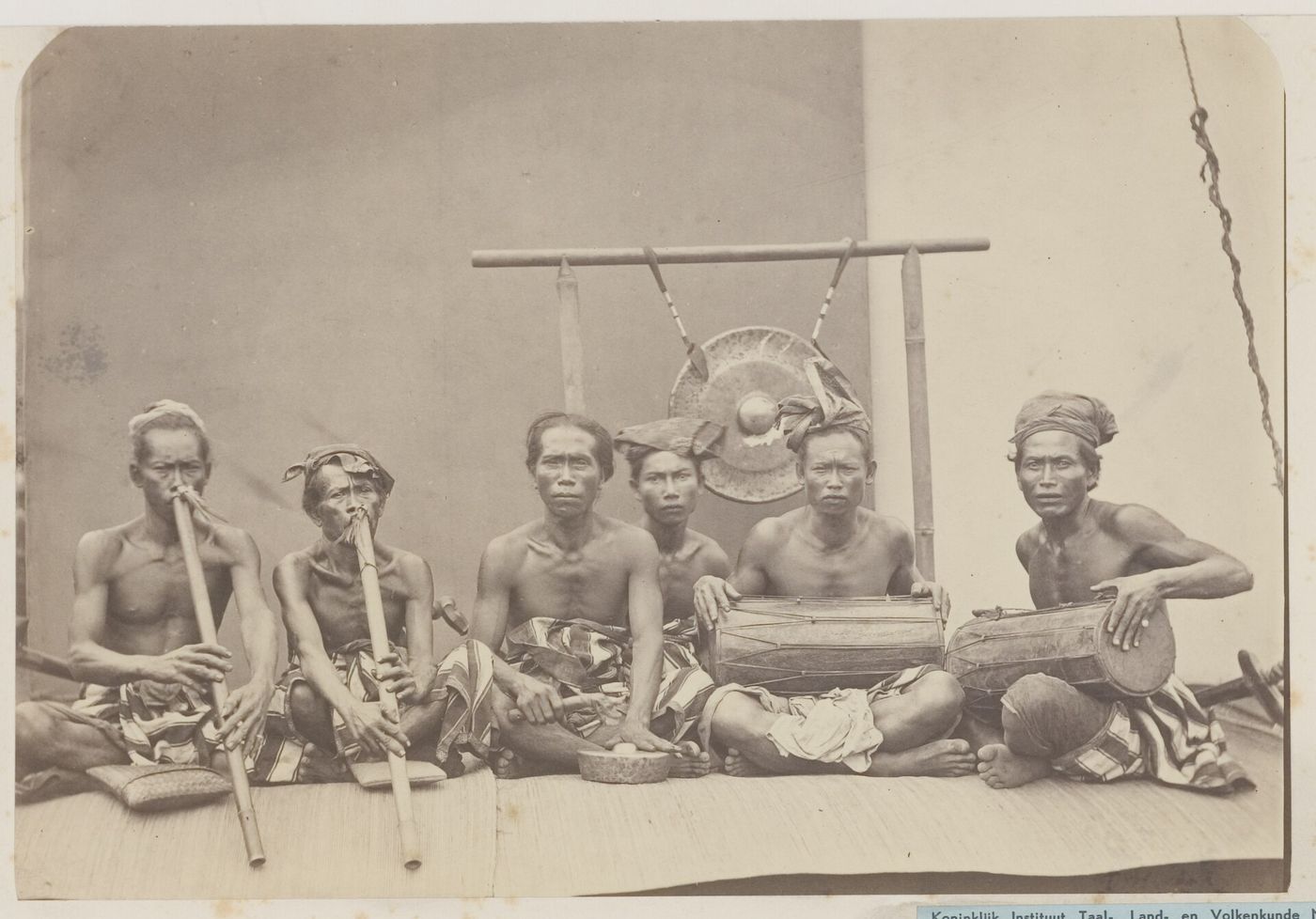 A gamelan orchestra of Buleleng, photographed in 1865. Photo: Isidore van Kinsbergen / Wikimedia Commons (public domain)
Gong kebyar came out of the north around 1914 to 1915. The regency's culture office names Jagaraga as its birthplace and notes that other accounts give Bungkulan (Buleleng culture and tourism office); Jagaraga's story, and the dances that came with it, are in our dance guide. From there it travelled south. Peliatan's famous Gunung Sari club traces its start to early members who toured as far as Singaraja, then the Dutch capital, heard north Bali's gong kebyar there and went home to form a serious sekaa (Bali culture office).
The north still builds its kebyar differently. In the northern set the metallophone keys are cut in the penyalin shape and pegged to the frame; the southern set hangs keys of the kalorusuk shape. The northern set sounds bigger, the regency's culture office says, and only in Buleleng do some clubs still keep it.
Buleleng's clubs also revive old northern pieces, such as Kebyar Dauh Enjung, a dance piece of the late 1940s from Umejero, reconstructed after decades unperformed and staged again by Umejero's women's gamelan at the Bali Arts Festival in 2022 (tatkala.co). Smiths in Sawan still forge the gongs, as our guide to north Bali's crafts describes.
Where to Hear Gamelan in North Bali
- Temple ceremonies. Every temple anniversary (odalan) needs gamelan. Ask your host what is on, and read Bali temple etiquette first.
- Banjar rehearsals. Before a ceremony the halls ring with practice, often in the evening. Listen from the roadside.
- Cremations. Angklung and beleganjur walk with the procession; see Ngaben, the Balinese cremation.
- The Buleleng Festival. Gong kebyar plays nightly on the Singaraja stages; see the Buleleng Festival.
- On Lovina beach. Buleleng's troupes play at the Lovina Festival and the Buleleng Rhythm Festival.
- In Denpasar. Buleleng's men's, women's and children's kebyar clubs play at the Bali Arts Festival, sometimes in mebarung against another regency.
Most of Palm Living's villas are around Lovina, a short drive west of Singaraja's banjar halls and festival stages, with a few at Pemuteran and Brongbong.
Practical Notes
- Dress for the temple at any ceremony: sarong and sash, shoulders covered.
- Sit low and at the back, stay out of the space in front of the musicians, and keep the flash off.
- Ask before photographing players during a rite.
- Dates move with the Balinese calendars; the north Bali events calendar and your host will know what is coming.
FAQ
What is Balinese gamelan? It is the traditional orchestra of Bali: tuned bronze gongs, gong-chimes and metallophones, led by a pair of drums, with cymbals and flutes, and in some kinds only bamboo. It is played by village music clubs, above all for temple ceremonies, and is known for its fast interlocking parts and its shimmering paired tuning.
What are the main types of Balinese gamelan? The best known are gong gede, semar pagulingan, pelegongan, gong kebyar, angklung, gender wayang, beleganjur, jegog, rindik, selonding and gambang. Gong kebyar is the most common today; gender wayang is the smallest; selonding, with iron keys, is among the oldest and most sacred.
How is Balinese gamelan different from Javanese gamelan? Both come from a shared ancestry and use the pelog and slendro scales. Javanese gamelan is soft and calm; Balinese gamelan is bright, fast and sudden, driven by small cymbals called ceng-ceng and by pairs of instruments tuned apart so the sound pulses.
Why does Balinese gamelan sound like it shimmers? Nearly every instrument has a partner tuned slightly higher or lower. When both play the same note, the two frequencies beat against each other, a pulse the Balinese call ombak, usually five to eight beats a second.
Where did gong kebyar come from? From Buleleng in north Bali, around 1914 to 1915. The regency names the village of Jagaraga as its birthplace, with Bungkulan as the other claimant, and the style spread south through the island's gamelan competitions.
Where can I hear gamelan in north Bali? At temple ceremonies, at evening rehearsals in the banjar halls, during cremation processions, and on the stages of the Buleleng Festival in Singaraja and the Lovina Festival on the beach at Kalibukbuk.
Sources
- UNESCO Intangible Cultural Heritage, Gamelan, inscribed 2021, read September 2026 (in English)
- Songlines, Andy Channing, Balinese gamelan: a complete guide to a unique world of sound, first published 1999, for the ensembles, the tree structure, the beating rate, the clubs and the Java comparison, read September 2026 (in English)
- ISI Denpasar student blog, Nada dan laras karawitan Bali, from I Wayan Dibia's Pengantar Karawitan Bali, for the old, middle and new groups, the absence of a standard pitch and the northern angklung, read September 2026 (in Indonesian)
- Kompas, Sejarah gamelan Bali, for the dating of the three groups and the ceng-ceng, read September 2026 (in Indonesian)
- Buleleng Culture and Tourism Office, Kesenian Gong Kebyar, for kebyar's northern birth and the northern and southern sets, read September 2026 (in Indonesian)
- Bali Provincial Culture Office, Giliran Tabanan dan Gianyar tampilkan gong kebyar legendaris, for Banjar Anyar's gamelan and Peliatan's debt to Singaraja, read September 2026 (in Indonesian)
- Sawan District, Buleleng Regency, Sejarah Desa Bebetin, for the inscription of 896, read September 2026 (in Indonesian)
- Buleleng Regency, Sekaa Gong Kebyar Legendaris Eka Wakya and the rindik maker of Alasangker, read September 2026 (in Indonesian)
- tatkala.co, Mebarung gong kebyar Buleleng, for mebarung and Kebyar Dauh Enjung, read September 2026 (in Indonesian)
- detikBali, Mengenal Jegog Jembrana, for jegog's origin and instruments, read September 2026 (in Indonesian)
- Wikipedia, Gamelan gender wayang, Gamelan jegog and Beleganjur, for tuning practice, the jegog pairs and the processional role, read September 2026 (in English)
- Bali Information (Palm Living), The Rindik Gamelan: Edi Budiana, read September 2026 (in English)
Read next: Balinese dance and gong kebyar, Balinese songs and the banjar, Bali's neighbourhood.