On this page
- In Brief
- Shopping in North Bali at a Glance
- The Short Answer: Singaraja Has Everything, Lovina Has Enough
- Markets: Pasar Anyar, Pasar Banyuasri and the Evening Stalls
- Supermarkets and Daily Needs: What Replaced Hardys
- Craft and Souvenirs: Buy Close to the Source
- Pharmacies, ATMs and Phone Credit
- Buying Furniture and Building Materials
- What You Cannot Buy in the North, and Where to Go Instead
- Practical Notes
- FAQ
In Brief
Singaraja has almost everything you need, and Lovina has enough for a holiday. For fresh food and local goods, go to Singaraja's two big traditional markets, Pasar Anyar in the old town and the rebuilt Pasar Banyuasri on the Lovina side of the city. For imported groceries, Pepito runs a supermarket on the main road in Lovina and another in Singaraja. Household goods and tools are at AZKO in Singaraja. For something made in the north, buy cloth or bamboo work close to the source, in villages such as Beratan, Jinengdalem and Sidatapa. Large building-materials superstores, and anything unusual or imported, still mean a trip to Denpasar.
Shopping in North Bali at a Glance
| Need | Where to go | Notes |
|---|---|---|
| Fresh produce, spices, ceremony goods | Pasar Anyar, Singaraja old town | Liveliest early morning; bargain politely |
| Market in a modern building | Pasar Banyuasri, western Singaraja | Three storeys, opened 2021 |
| Imported groceries, bakery | Pepito Market Lovina and Pepito Market Singaraja | Hours below |
| Everyday bargain shopping | Clandy's, Singaraja | Clothes, household, baby goods |
| Household goods and tools | AZKO Singaraja, Jalan Ahmad Yani | Opens 09:00 to 22:00 |
| Packaged souvenirs and snacks | Krisna Oleh-Oleh, Temukus, Lovina | On the main coast road |
| Handwoven cloth | Beratan and Jinengdalem, around Singaraja | Buy from the weaver where you can |
| Bamboo baskets | Sidatapa and Tigawasa, Banjar hills | Village crafts, often sold through markets |
| Phone SIM and credit | GraPARI Telkomsel, Singaraja | Weekdays and Saturday mornings |
| Building-materials superstore | Denpasar | Plan a day trip south |
The Short Answer: Singaraja Has Everything, Lovina Has Enough
Singaraja, the regency capital, is where Buleleng actually shops: the big markets, the supermarkets, the pharmacies, the phone office, the hardware and household stores. It is a working city, and if a thing is sold anywhere on the north coast, it is sold there.
Lovina is a strip of villages along the coast road west of the city, and it has what a visitor needs day to day: minimarkets for water and sunscreen, warungs, an imported-food supermarket and a souvenir hall. For anything bigger, people in Lovina drive east along the coast road into Singaraja.
The rest of the north thins out fast. Around Munduk, Pemuteran and the east coast, shopping means village warungs and small kiosks, and cash, so stock up before you head out. Our Lovina area guide and Singaraja old town guide cover the two bases in full.
Markets: Pasar Anyar, Pasar Banyuasri and the Evening Stalls
Singaraja is still a market town. Early twentieth-century photographs show potters selling water jars on the ground in the city market, and the markets are still at their liveliest in the first hours after dawn, when the produce arrives and the ceremony trade is busiest.
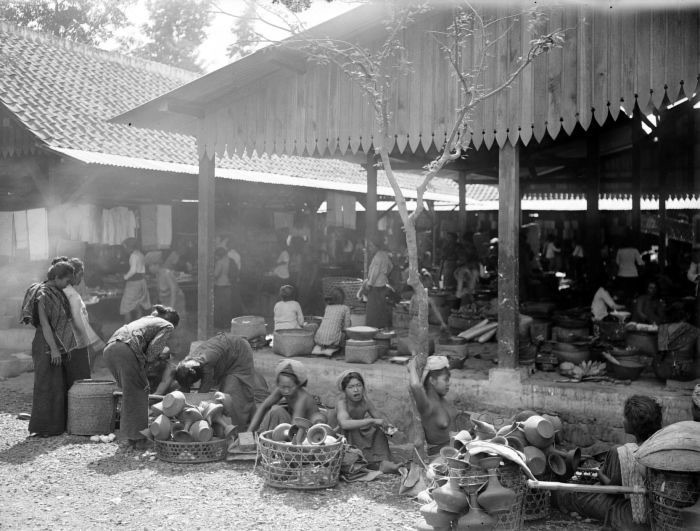 Potters selling water jars at the Singaraja market, photographed between 1907 and 1931. Photo: Unknown author, Tropenmuseum / Wikimedia Commons (CC BY-SA 3.0)
Pasar Anyar
Pasar Anyar is the city's main traditional market, on Jalan Diponegoro in the heart of the old town. This is where Singaraja does its real shopping. Produce comes down from the hills, alongside spices, Balinese cakes and snacks, offering materials, cheap clothes and sandals, and the small food stalls that feed the traders. Prices are local, and bargaining is expected, done with a smile and without hurry.
It is a big market. Local press in September 2026 put the number of traders at around 3,000, and it is also an old building. The same reports describe cracks on the second floor that have made some traders reluctant to use it, and the regency council has asked for the market to be revitalised. Alongside that, the regency government is reorganising the Pasar Anyar and Jalan Diponegoro area, including the roadside trading around it, with a completion target of December 2026. Expect some disruption on the street outside while the works run, and check with your host before a visit.
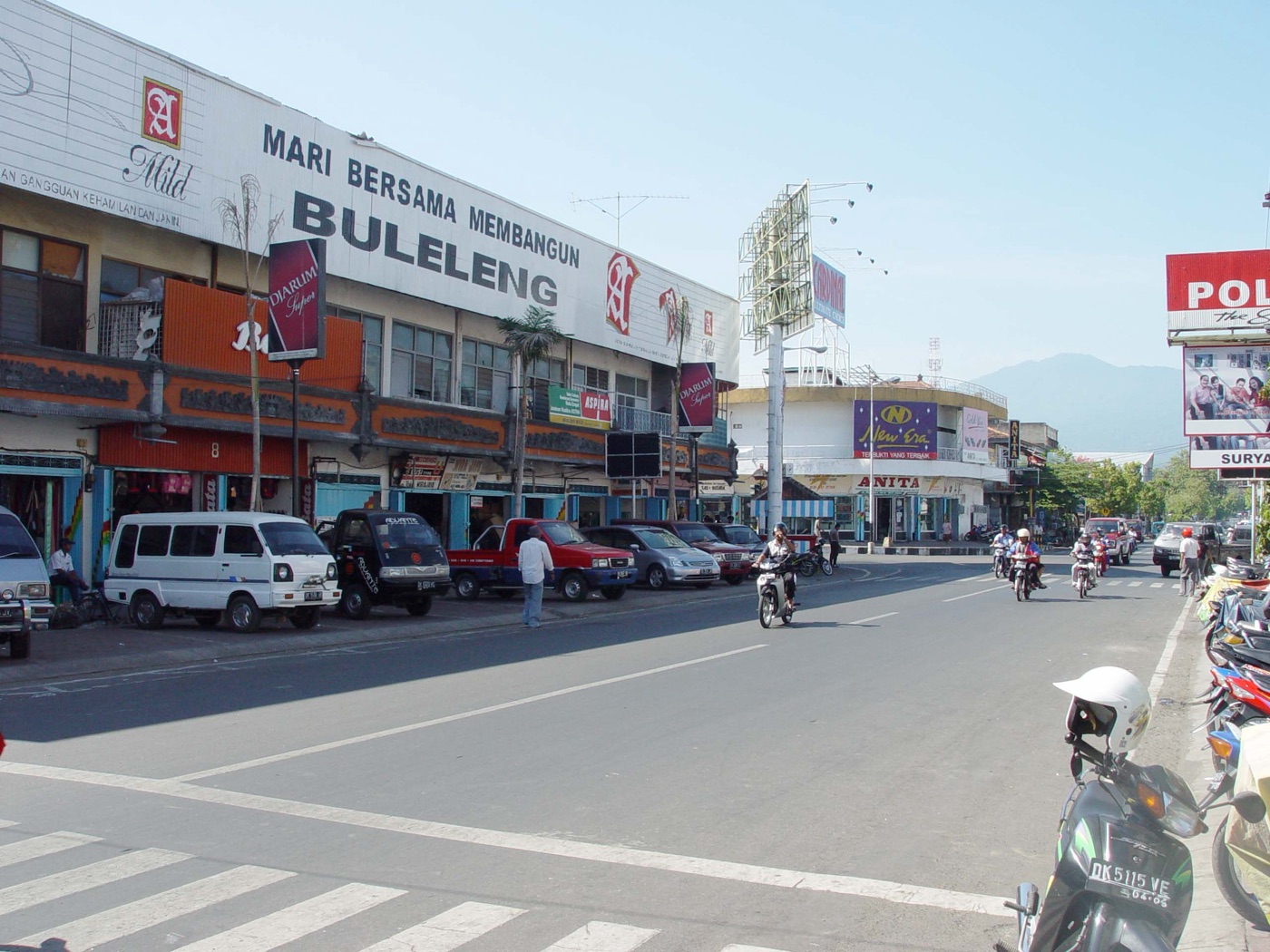 Shopfronts near the junction of Jalan Ahmad Yani and Jalan Diponegoro, the Pasar Anyar side of Singaraja, in 2005. Photo: っ / Wikimedia Commons (CC BY-SA 3.0)
For a visitor, Pasar Anyar is also the honest place to buy something to take home from Buleleng: clothes, spices or ceremony goods, far from anything made for tourists. Slot it into a morning walk around the old harbour and the Chinese temple, covered in the Singaraja guide.
Pasar Banyuasri
Pasar Banyuasri sits on the western edge of Singaraja, on the road toward Lovina, and it is the easier of the two to find your way around. The old market was rebuilt as a three-storey, semi-modern building with lifts and escalators, and it opened on 30 March 2021 to mark the city's 417th anniversary. It opened with QRIS, the Indonesian QR payment standard, alongside cash.
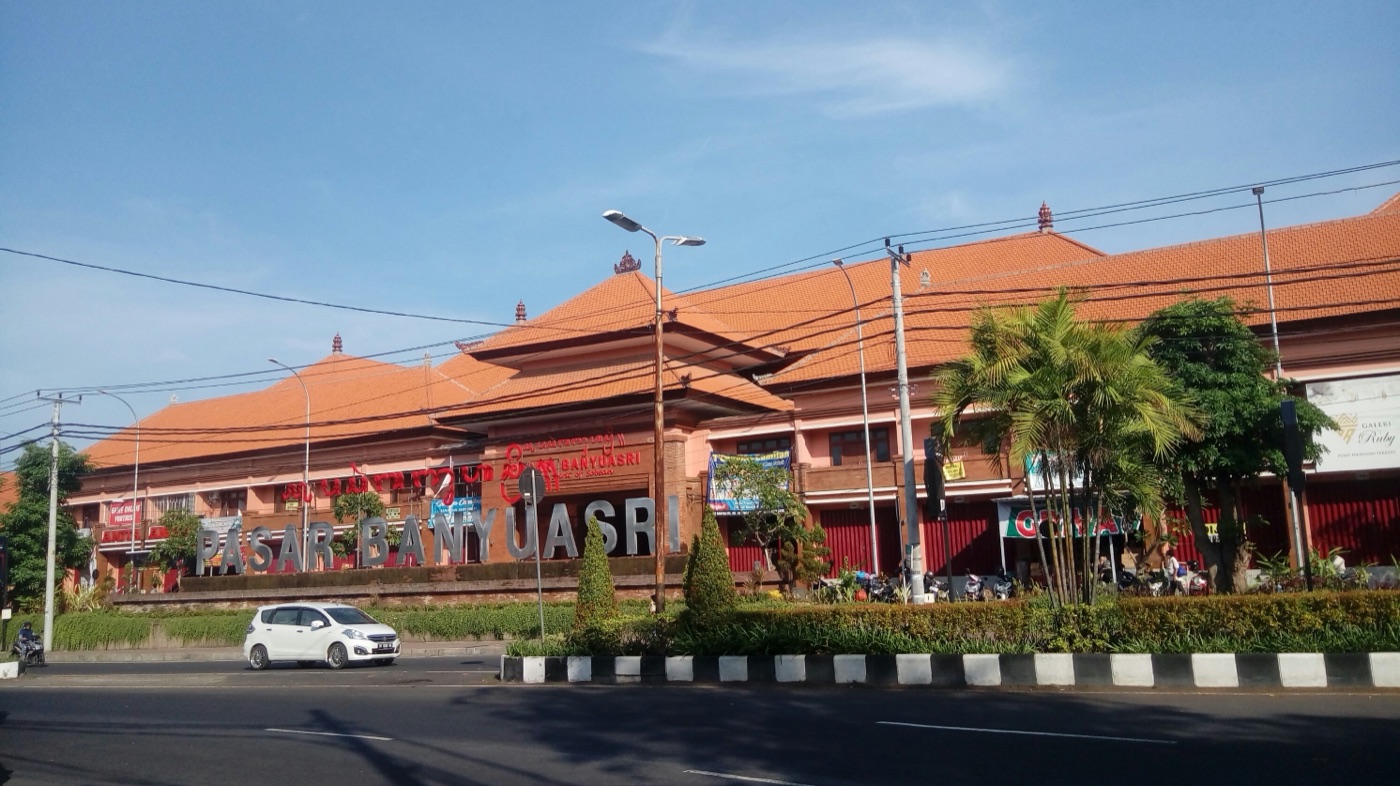 The rebuilt Pasar Banyuasri on the Lovina side of Singaraja, in 2022. Photo: DayakSibiriak / Wikimedia Commons (CC BY-SA 4.0)
In the morning it is a produce market for meat, vegetables, fruit and household goods. The market has also long had an evening life, when stalls open again for a night food scene. If you are driving back to Lovina in the late afternoon, it is the natural last stop.
Evening stalls in Lovina
Lovina has no market on the scale of the Singaraja two. Evening food carts and small stalls do set up around the villages, and where they gather shifts over time, so ask your villa host where people are eating this season.
Supermarkets and Daily Needs: What Replaced Hardys
Older guides to the north still send shoppers to Hardys, the Bali supermarket chain. Its three Buleleng outlets closed in early 2018, and the company was declared bankrupt by the commercial court in Surabaya. The Carrefour that traded inside Hardys Plaza on Jalan Surapati is also gone.
Here is what north Bali uses now.
Pepito Market. The Bali supermarket chain lists two stores in the north on its own site. Pepito Market Lovina is on Jalan Raya Seririt–Singaraja, the main coast road, open 07:00 to 22:00. Pepito Market Singaraja is at Jalan Surapati No. 98, open 07:00 to 23:00. Both carry fresh produce and the imported foods that are hard to find elsewhere in the north.
Clandy's. A Singaraja discount store for broad, cheap shopping, with a supermarket alongside clothes, shoes, household basics and baby goods. It trades from more than one address in the city, including Jalan Ngurah Rai.
ABD Foodmart. A food and ingredients store on Jalan Udayana Barat in Singaraja, known for baking, pastry and chocolate supplies and for supplying hotels and restaurants along the coast. It is the place to try for bulk ingredients and kitchen supplies.
Minimarkets. Minimarkets cover water, snacks, toiletries, phone credit and cold drinks, and village warungs cover the rest.
Bring a shopping bag. Bali restricts single-use plastic bags, so carry your own.
Craft and Souvenirs: Buy Close to the Source
The north makes things, and the best of it is sold by the people who make it. Our guide to the traditional crafts of north Bali covers the traditions in depth. Here is where to spend.
Songket and endek from Beratan and Jinengdalem
Singaraja has its own weaving history, and textile collections hold silk songket sarongs from the city woven with metallic thread. Beratan, an urban ward of Singaraja, is home to what Balinese press describes as the oldest endek and songket weavers in Buleleng, who once wove for the Buleleng royal household. Beratan is also known for gold and silver work, so it is the first place to ask about north Bali silver.
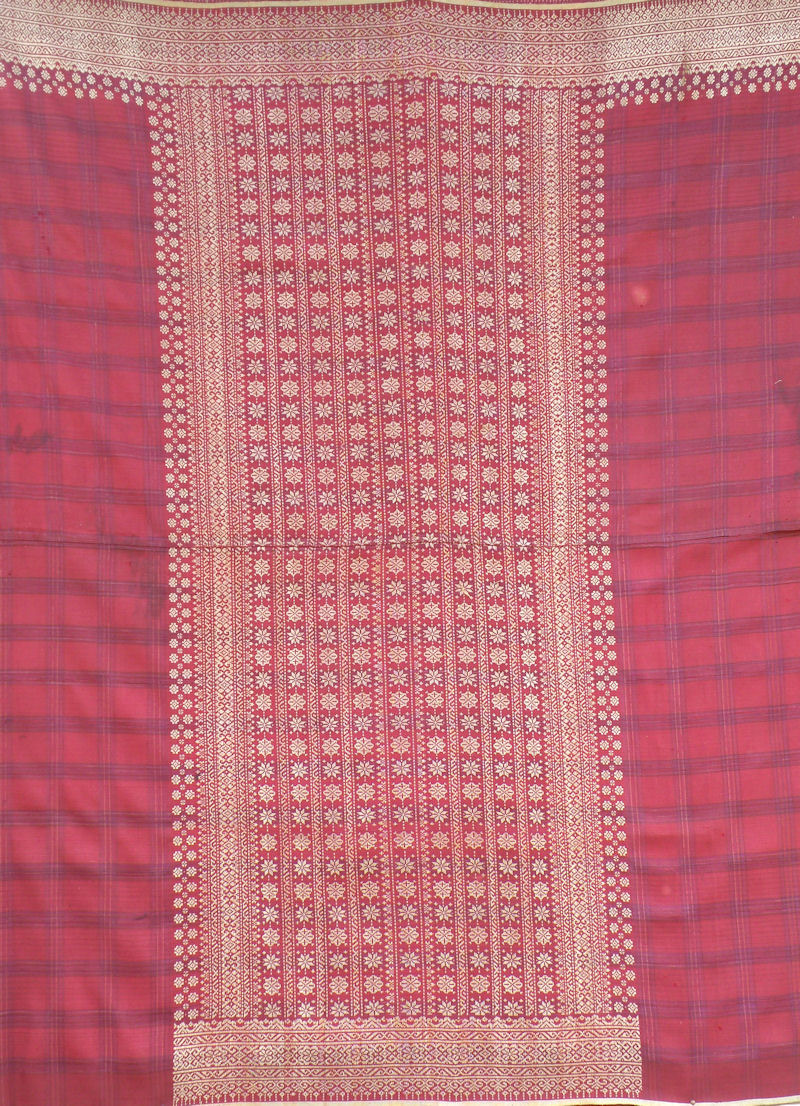 A silk songket sarong from Singaraja, thought to date from the 1920s. Photo: Chris Hazzard, Balique Arts of Indonesia / Wikimedia Commons (CC BY-SA 3.0)
Jinengdalem, around eight kilometres from central Singaraja, is a songket village whose weaving was revived from 2011. A single cloth takes a weaver one to one and a half months, which is the context for the price of a real handwoven songket. Some weavers sell from a gallery in their own home.
Songket is expensive for good reason: gold or silver thread, a slow and intricate weave, and a thick, heavy cloth. If a "songket" costs the same as a printed sarong, it is a printed sarong.
Bamboo from Sidatapa and Tigawasa
In the Bali Aga villages of the Banjar hills, bamboo weaving is everyday work. Sidatapa weavers make grass baskets, rice-winnowing trays, chicken coops and decorative pieces for homes and villas, and most of it leaves the village through middlemen who sell to traditional markets across Bali and into East Java. Tigawasa is known for its sokasi, the lidded bamboo boxes used to carry offerings, and for woven bamboo wall panels. Buying in the village puts more of the price in the weaver's hand.
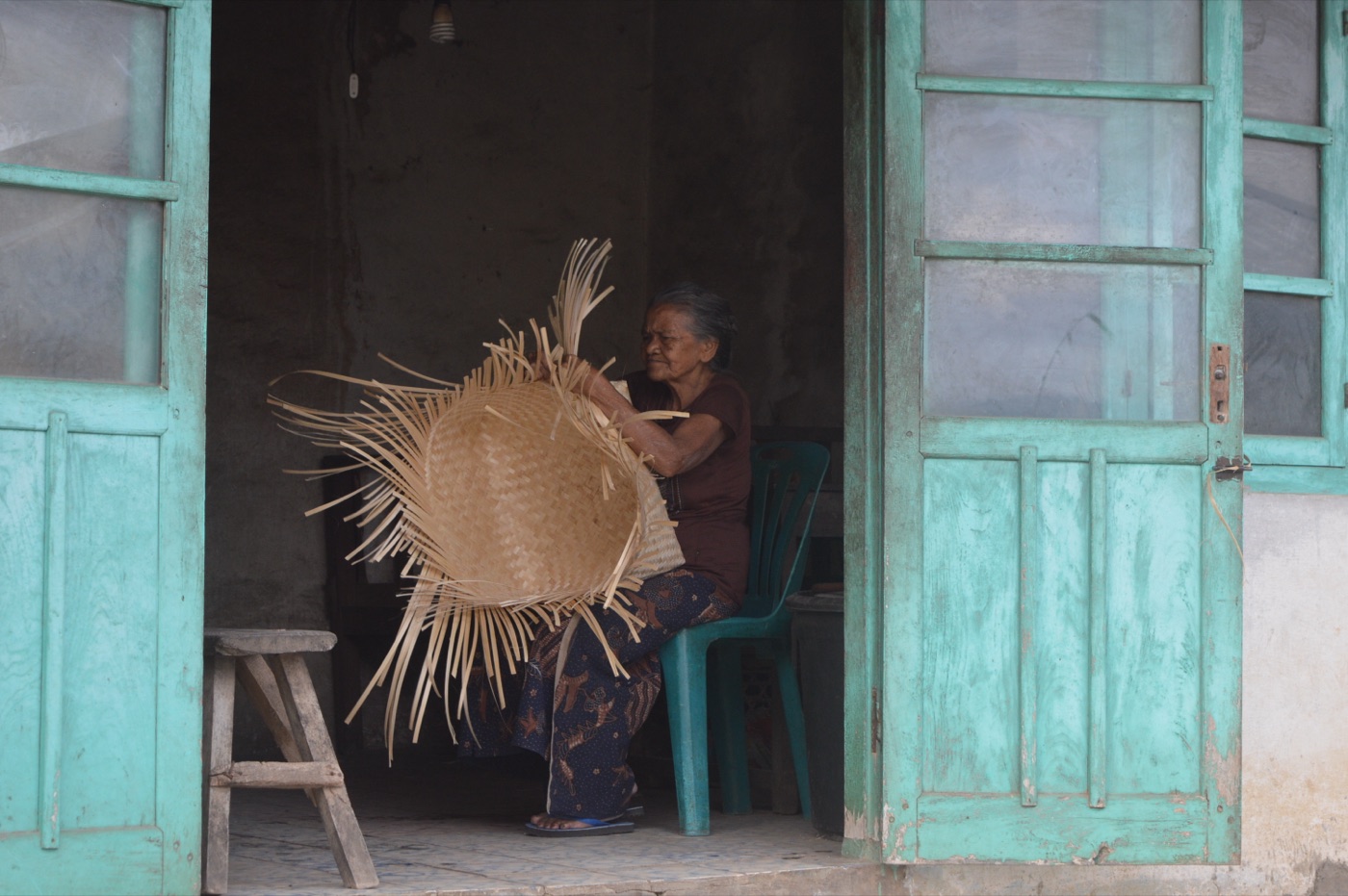 Bamboo weaving in a Sidatapa doorway. Photo: Dinata Juan / Wikimedia Commons (CC BY-SA 4.0)
The villages themselves, their houses and ceremonies, are in our guide to the Bali Aga villages of north Bali, which also covers Julah on the east coast and its own weaving tradition.
Packaged souvenirs
For packaged snacks, spa scrubs, sandals, T-shirts and wooden souvenirs to fill a suitcase, Krisna Oleh-Oleh, the big Bali souvenir chain, has its north Bali outlet on the Seririt–Singaraja road in Temukus, Banjar district. It is convenient and cheap, and the craft villages above are where north Bali's own craft is made.
Pharmacies, ATMs and Phone Credit
Pharmacies. Apotek (pharmacies) are easy to find in Lovina and all over Singaraja, and many common medicines are sold over the counter. In Singaraja, the national chain Kimia Farma has a branch at Jalan Ahmad Yani 46A. For what to do beyond the pharmacy, see our guide to healthcare in north Bali.
ATMs and money. ATMs cluster in Kalibukbuk in Lovina and across Singaraja, and they thin out quickly beyond. Markets, warungs and village craft sellers are mostly cash, though QRIS codes are spreading. Withdraw in town before you head into the hills. The full picture of fees, limits and money changers is in Bali currency and ATMs.
SIM cards and phone credit. Top-up credit and data packages are sold at minimarkets and phone kiosks. For a new SIM, a registration problem or a contract, Telkomsel's service centre, GraPARI Singaraja, is at Jalan Ahmad Yani No. 72, open 08:00 to 17:00 Monday to Friday and 08:00 to 12:00 on Saturday, closed Sundays and public holidays.
Buying Furniture and Building Materials
If you are setting up a home or building on the north coast, Singaraja covers more than people expect.
Household goods and tools. AZKO Singaraja, from the Kawan Lama group, is at Jalan Ahmad Yani No. 85B, open 09:00 to 22:00, and stocks household goods, tools and lifestyle products. It is the nearest thing in the north to a big-box home store.
Building materials. Singaraja has independent toko bangunan (building-materials shops), and local sourcing is the cheaper path for a build in the north. Your contractor will have suppliers they already use.
Furniture. Ask your builder or villa manager about local carpenters and workshops that make furniture to order.
The north has fewer specialist trades and suppliers on hand than the south, so anything unusual or imported can take longer to source and reach a site. Our build costs guide explains how that affects budget and timeline, and moving to north Bali covers the bigger relocation picture.
What You Cannot Buy in the North, and Where to Go Instead
Be honest with yourself about this list before you move. The north does daily life well and specialist shopping badly.
- Building-materials superstores. The big warehouse chains are in Denpasar, including Mitra10 on Jalan Gatot Subroto Barat. For large or specialist orders, plan a day trip south.
- A wide range of imported and specialty food. Pepito covers the basics. Beyond them, imported and specialty foods are easier to find in the south, and anything that comes up from there carries a premium.
- Malls and big fashion shopping. Singaraja has no large shopping mall. For international brands, electronics showrooms and department stores, Denpasar and the south are the answer.
- Specialist medical supplies and specific medications. Bring an adequate supply of anything unusual from home or the south.
On the drive back north through the mountains, the Candikuning market near Lake Beratan is worth a stop for highland fruit, vegetables, flowers and strawberries, covered in our Bedugul guide. For the drive itself, see getting to north Bali.
Practical Notes
Shop names, hours and addresses change. The details below were checked against the businesses' own listings and local press in September 2026. Confirm before a special trip.
- Pepito Market Lovina: Jalan Raya Seririt–Singaraja, 07:00 to 22:00
- Pepito Market Singaraja: Jalan Surapati No. 98, 07:00 to 23:00
- AZKO Singaraja: Jalan Ahmad Yani No. 85B, Kaliuntu, 09:00 to 22:00
- GraPARI Telkomsel Singaraja: Jalan Ahmad Yani No. 72, Monday to Friday 08:00 to 17:00, Saturday 08:00 to 12:00
- Kimia Farma Singaraja: Jalan Ahmad Yani 46A
- Markets: go early, carry small notes, bargain gently, and bring your own bag
- Pasar Anyar: expect area works around Jalan Diponegoro through late 2026
- Craft villages: ask your host or a local guide to arrange a visit, since workshops are family homes
FAQ
Is there a mall in Singaraja?
No large shopping mall. The old Hardys Plaza anchor has closed, and Singaraja shopping now runs through its traditional markets, Pepito, Clandy's, AZKO and independent shops. For malls and international brands, you need to go to Denpasar.
Where do expats shop in Lovina?
For daily groceries, Pepito Market Lovina and the minimarkets on the main road are the usual stops. For bigger shops, people drive into Singaraja for Pasar Banyuasri or Pasar Anyar, Clandy's and AZKO. Specialist or imported items still come from the south.
What is the best market in north Bali?
Pasar Anyar in Singaraja's old town is the most traditional and the best for local goods and atmosphere, especially early in the morning. Pasar Banyuasri, rebuilt in 2021 on the Lovina side of the city, is easier to navigate and has lifts and escalators.
Is there a supermarket in Lovina?
Yes. Pepito Market Lovina is on the main Seririt–Singaraja road and opens 07:00 to 22:00, with fresh produce and imported foods. Minimarkets along the same road cover everyday basics.
What happened to Hardys in Singaraja?
Hardys closed its three Buleleng outlets in early 2018, and the company was declared bankrupt. Pepito, Clandy's and the Singaraja markets now fill the gap.
Where can I buy authentic north Bali souvenirs?
Buy close to the source: handwoven songket and endek in Beratan or Jinengdalem near Singaraja, bamboo baskets and offering boxes from Sidatapa and Tigawasa, and local goods at Pasar Anyar. Krisna Oleh-Oleh in Temukus is the easy stop for packaged snacks and gifts.