On this page
- In Brief
- Ulun Danu Beratan at a Glance
- Why the Temple Stands Here: Dewi Danu and the Lake
- Water Temples, the Subak and the UNESCO Listing
- What You See at Ulun Danu Beratan
- When to Go: Mornings, Mist and Ceremony Days
- Getting There from Lovina, Munduk and the South
- Tickets and Entry
- Dress and Temple Etiquette
- What Else Is Nearby
- How to Fit It In
- Where to Stay
- Practical Notes
- FAQ
- Sources
In Brief
Pura Ulun Danu Beratan is a Hindu water temple on the shore of Lake Beratan in Candikuning village, Bedugul, in Bali's central highlands. Records in the Babad Mengwi chronicle date it to 1634, when the King of Mengwi, I Gusti Agung Putu, built it. It is dedicated to Dewi Danu, the goddess of the lake, and its management counts it among the nine most important temples for Balinese Hindus, the Kahyangan Jagat. Its tiered meru shrines stand on small islands at the water's edge, which is why it looks as if it floats when the lake is high. Go early in the morning, dress for a temple, buy your ticket from the temple's management at the gate or on its official site, and pair it with the botanic garden, the Candikuning market and the two smaller lakes to the west. It sits about an hour up the mountain from Lovina.
Ulun Danu Beratan at a Glance
- What it is: A Hindu water temple to Dewi Danu, goddess of the lake, and one of Bali's Kahyangan Jagat temples
- Where: Candikuning village, Baturiti district, Tabanan regency, on the main Denpasar to Singaraja road at Bedugul. Map
- Altitude: About 1,200 metres above sea level, so it is cool, often misty, and can rain by midday
- Built: 1634 CE by I Gusti Agung Putu, King of Mengwi, according to the Babad Mengwi palm-leaf chronicle
- Looked after by: Four community groups (satakan) drawn from the customary villages around the lake
- Entry: A ticket from the temple's management, DTW Ulun Danu Beratan, with separate weekday and weekend rates; current prices are on its site
- Best time: Early morning, on a weekday
- How long: An hour or two for the temple and gardens; half a day with the market and botanic garden
- From Lovina: About 38 km over the mountains, roughly an hour to an hour and a quarter by car
Why the Temple Stands Here: Dewi Danu and the Lake
Ulun danu means the head of the lake, and Beratan is the lake. The name tells you what the temple is for. Indonesia's tourism ministry describes it as a guardian of water sources and the centre of worship of Dewi Danu for the fertility of Bali's land. On an island that grows its rice on terraces fed from the mountains, these highland lakes sit at the top of the system.
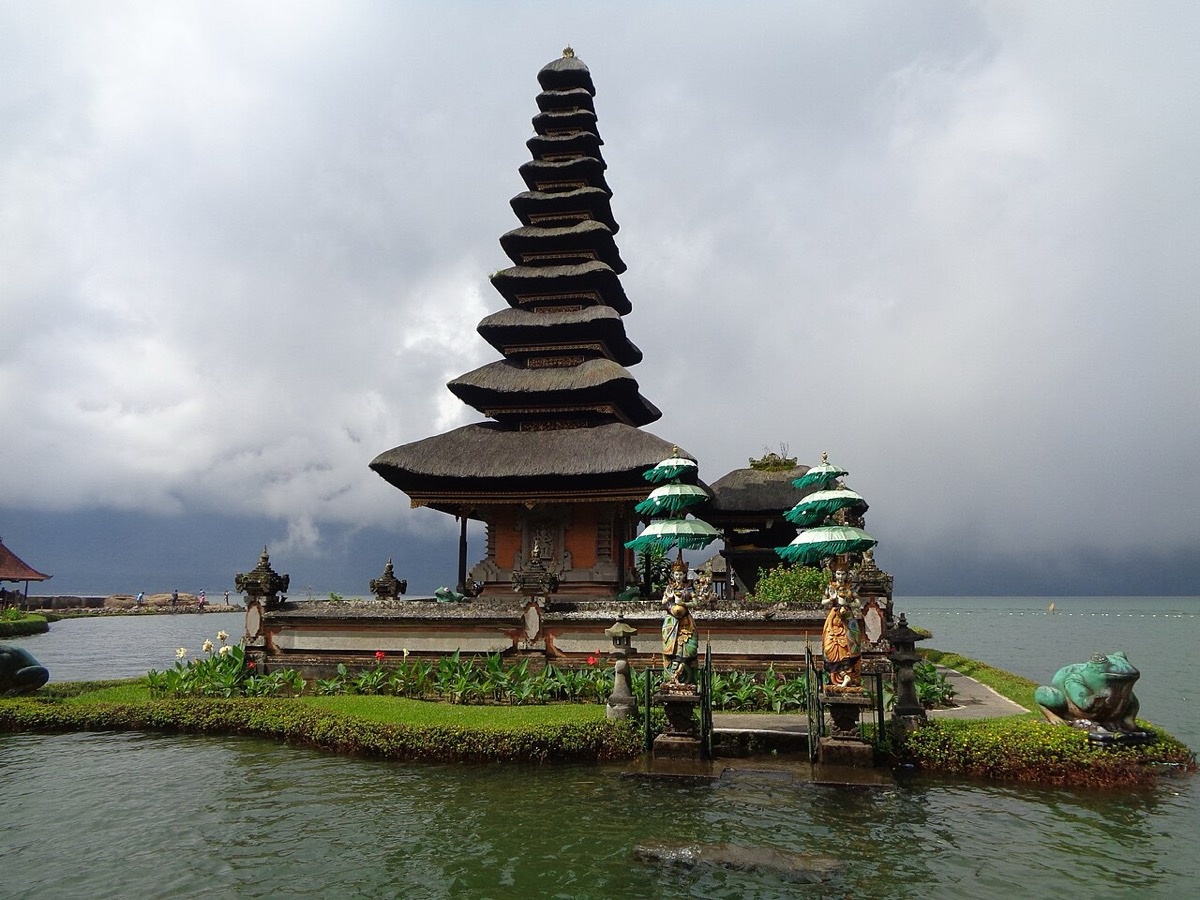 The meru towers of Pura Ulun Danu Beratan. Photo: Susan.wibowo / Wikimedia Commons (CC BY-SA 4.0)
The history comes from the Babad Mengwi, the palm-leaf chronicle of the Mengwi kingdom, which records that the king, I Gusti Agung Putu, built the temple around 1556 in the Balinese Saka calendar, or 1634 CE. The temple's management and the tourism ministry both give that date; the 1633 on some sites is out by a year.
Its management describes it as one of the nine most significant temples for Balinese Hindus, the Kahyangan Jagat, and the tourism ministry gives it a vital place in keeping the island's natural balance. Day to day, though, it belongs to its neighbours. The management says four satakan, community groups from the customary villages around the temple, look after it. When the temple held its anniversary ceremony in December 2022, the regional paper NusaBali reported that the custodians came from eighteen customary villages across four administrative villages: Candikuning, Batunya, Baturiti and Antapan.
The view is familiar even to people who have never been to Bali: the temple was printed on Indonesia's 50,000 rupiah note issued in 2005.
Water Temples, the Subak and the UNESCO Listing
Balinese rice farmers share water through the subak, associations of farmers who divide the flow from one canal among their fields and hold their ceremonies together at their own water temples. Above them sits a chain of larger temples, up to the lakes where the water begins.
The best account of how this works is by the anthropologist J. Stephen Lansing in Priests and Programmers (Princeton University Press). He describes the network of water temples that managed irrigation in the name of the Goddess of the Crater Lake, and, using ecological simulation models, argued that temple ritual is a basic ingredient in how the rice is grown. Farmers who plant together on the temples' schedule leave large areas fallow at the same time, which starves rice pests. When the Green Revolution programme of the 1970s pushed farmers to plant continuously instead, pest losses rose sharply.
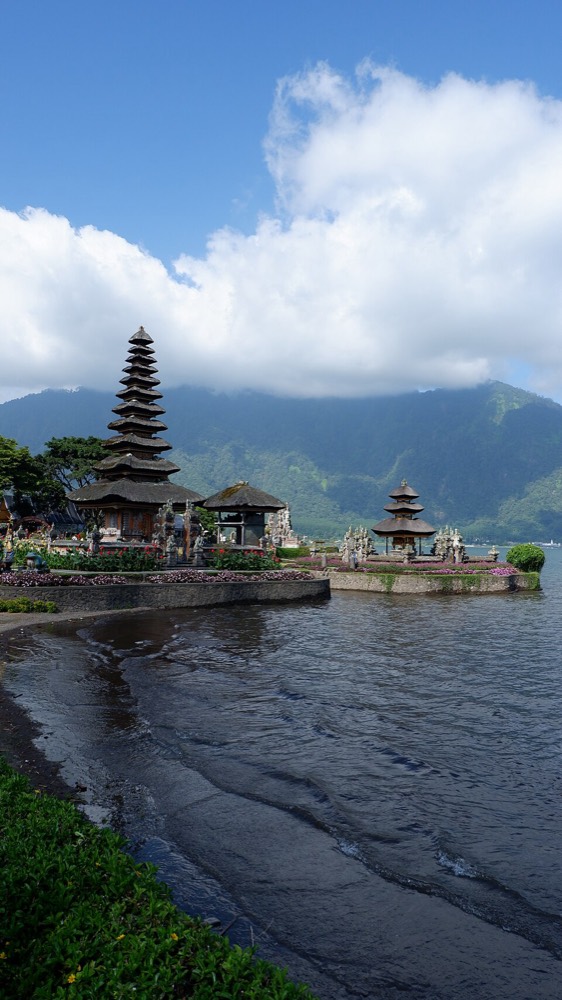 Pura Ulun Danu Beratan on Lake Beratan. Photo: Alharomain354 / Wikimedia Commons (CC BY-SA 4.0)
In 2012 UNESCO inscribed the Cultural Landscape of Bali Province: the Subak System as a Manifestation of the Tri Hita Karana Philosophy on the World Heritage List. Tri Hita Karana is the Balinese idea of wellbeing through harmony with God, with other people and with nature. The listing covers five parts: the supreme water temple of Pura Ulun Danu Batur, Lake Batur in its crater, the subak landscape of the Pakerisan watershed, the subak landscape of Catur Angga Batukaru, and the royal water temple of Pura Taman Ayun.
Ulun Danu Beratan is not one of the listed sites. The lake temple in the UNESCO property is Ulun Danu Batur, on the rim of the Batur crater at Kintamani. Beratan plays the same role for its own lake and the land below it. The wider story is in the subak system explained.
What You See at Ulun Danu Beratan
The grounds are laid out as gardens, with lawns, clipped hedges, flower beds and tall cypress trees that look more like a hill station than the tropics. The shrines everyone photographs stand along the lakeshore beyond them.
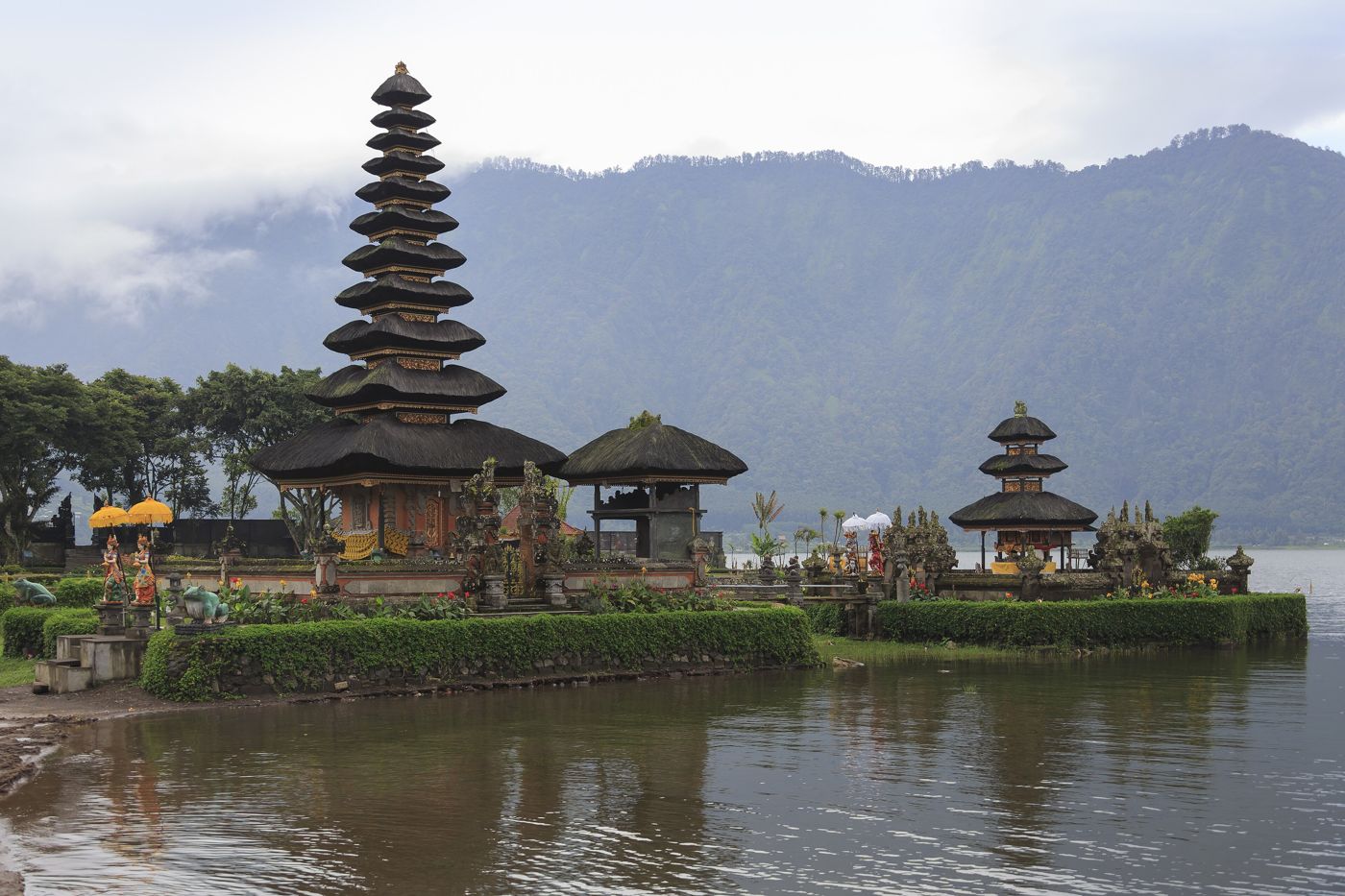 The two island shrines, with the mountains behind. Photo: CEphoto, Uwe Aranas / Wikimedia Commons (CC BY-SA 3.0)
The meru on the water. A meru is a Balinese shrine with a stack of thatched roofs. The tall one here has eleven roofs and a smaller one beside it has three. Each stands on its own patch of land just off the shore. When the lake is full the water comes right up around them, and on a still morning they sit on their own reflections. When the water is low the stone bases show and the effect is plainer. Either way, you view them from the shore.
The courtyards. The tourism ministry lists six parts to the complex:
- Pura Penataran Agung, the main temple, for the worship of Dewi Danu
- Pura Dalem Purwa, tied to the cycle of life and death
- Pura Taman Beji, by a spring, used in purification with holy water
- Pura Lingga Petak, which holds the lingga, a symbol of creation and fertility
- Pura Prajapati, for protection of the continuing line of families
- A Buddhist stupa, standing on the lawns
Much of the complex is for worship only, so follow the signs and the temple staff about where visitors may go.
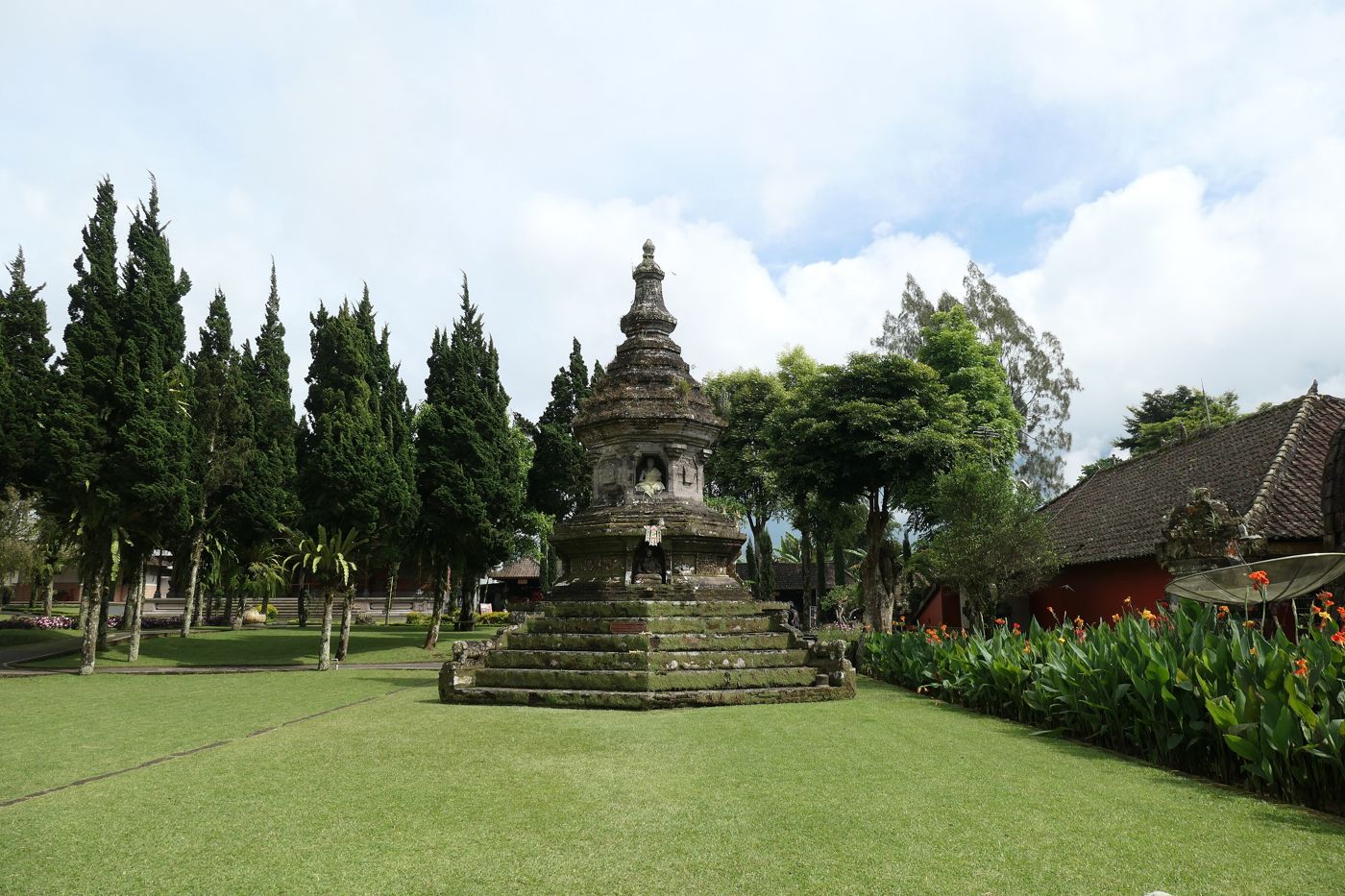 The Buddhist stupa in the temple gardens. Photo: Anandajoti / Wikimedia Commons (CC BY-SA 4.0)
The stupa. Few visitors expect a Buddhist monument inside a Hindu temple. The ministry reads it as a mark of the long coexistence of Hindu and Buddhist traditions in the archipelago. Seated Buddhas look out from its niches.
The lake itself. The management runs boats from the temple grounds: speedboats, rowing boats and pedal boats. Look for them on the offers page. A slow row past the shrines gives you the view from the water.
When to Go: Mornings, Mist and Ceremony Days
Go early. Highland mornings are usually the stillest part of the day, and cloud tends to build over the hills as the day goes on. Early light on still water gives the best reflections, and you are there before the day-trippers from the south. Check the current opening time with the management before you set out, via the contact page or the temple's Instagram below.
Mist is part of it. At 1,200 metres the lake is often under cloud. A misty morning with the shrines half-hidden is as good as a clear one, and many photographers prefer it. Bring a warm layer and something for rain in any month. For the seasons across the island, see the best time to visit north Bali.
Weekdays are quieter. The management prices weekends and public holidays separately from weekdays, and those are the busier days. A weekday morning is the calmest time to come.
Ceremony days. The temple's anniversary, its piodalan, falls on Anggara Kliwon of the week Julungwangi in the Balinese 210-day pawukon calendar. That is a Tuesday, a little over two weeks before Galungan, so it comes round twice in most western years. In December 2022 NusaBali reported the rites running for about a week around the main day, Tuesday 20 December, with visitors welcome to watch the procession of offerings and the Rejang and Pendet dances. The temple's Instagram also describes it as a main destination of the Nyegara Gunung rite, when communities bring their temples' sacred figures to be purified after a temple consecration. The Balinese calendar explained shows how these dates are counted.
Getting There from Lovina, Munduk and the South
The temple is on the main Denpasar to Singaraja road, the route most people take across the island. Times below are rough, by car; mountain roads, rain and southern traffic change them.
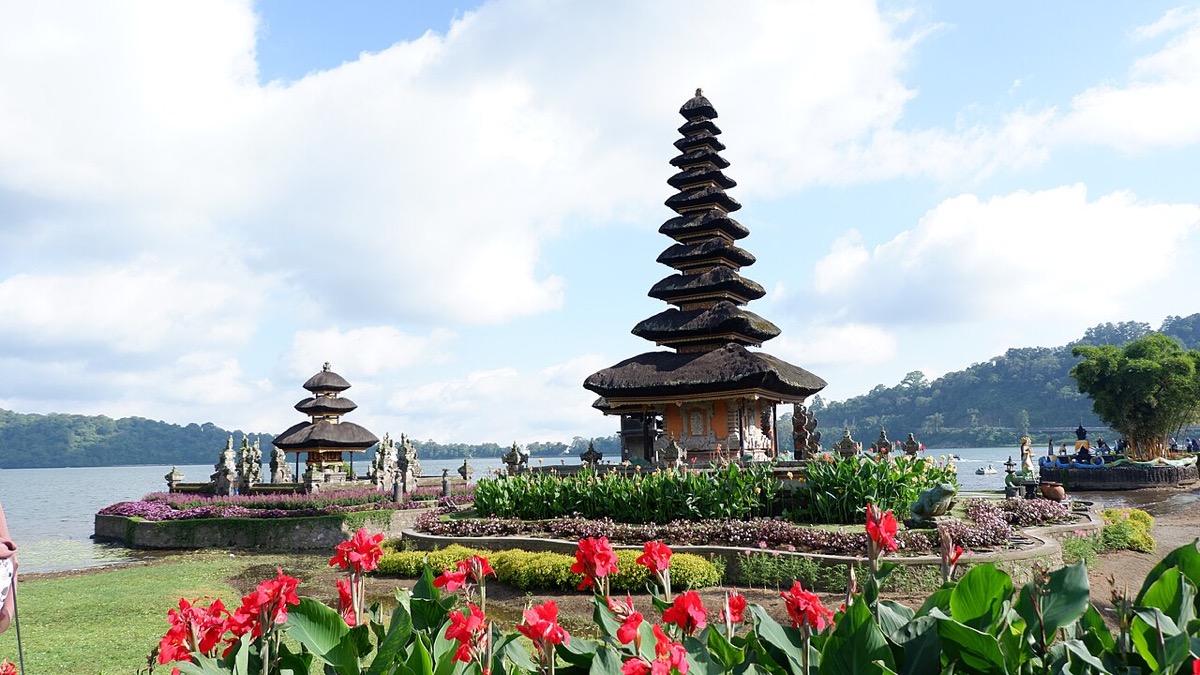 Ulun Danu Beratan on the Bedugul road. Photo: Alharomain354 / Wikimedia Commons (CC BY-SA 4.0)
- From Lovina (about 38 km): Roughly an hour to an hour and a quarter. The road runs east to Singaraja's edge, then climbs south past Gitgit Waterfall and up the switchbacks to Pancasari and the lakes.
- From Munduk (about 19 km): Around 40 minutes along the crater rim, past Lake Tamblingan and Lake Buyan and down to the main road at Pancasari.
- From Ubud (about 45 km): About an hour and a half.
- From the airport, Canggu or Seminyak (50 to 60 km): Allow two hours or more. The temple's management puts it about 60 km from the airport; how long it takes depends mostly on the traffic before you reach the hills.
Most people see it on the way between the south and the north, which is why it is a fixture on the drive to north Bali. A day with a private driver in north Bali is the simplest way to fit it in with the lakes and waterfalls around it. Scooters manage the road too, but it is long and steep, and cold in the rain.
Tickets and Entry
Visits are run by the management association DTW Ulun Danu Beratan. You buy a ticket at the entrance or book ahead on its offers page, which lists:
- a weekday ticket, Monday to Friday
- a weekend ticket for Saturdays, Sundays and public holidays
- combined tickets with The Blooms Garden nearby, priced separately for Indonesian and foreign visitors
- speedboat, rowing boat and pedal boat rides on the lake
Prices change, so this page does not quote them; the official page carries the current ones.
Bali also charges foreign tourists a one-off provincial levy, paid through the government's Love Bali system. It is separate from the temple's ticket.
DTW Ulun Danu Beratan on Instagram
Dress and Temple Etiquette
The tourism ministry's list for this temple comes down to these:
- Wear temple dress. Cover your legs and shoulders. A sarong and a sash (selendang) are expected; the management provides them at the entrance if you do not have your own.
- Women who are menstruating are asked not to enter the sacred areas.
- Keep your voice down, especially near people praying.
- Ask before photographing a ceremony or the people in it.
- Do not touch or climb on shrines, statues or old stonework, and keep out of areas marked as closed.
- Follow the signs and the staff, and do not make light of what you see.
Two more habits apply anywhere on the island: never stand above someone who is praying, and step around the small offerings on the ground. The reasons are in Bali temple etiquette and Balinese offerings.
What Else Is Nearby
Much of the Bedugul highlands lies within a few kilometres of the temple. The Bedugul guide covers the area as a whole.
Candikuning Market (Bedugul Market)
The produce market at Jl. Kebun Raya in Candikuning, on the main road near the botanic garden. The highlands grow much of Bali's fruit and vegetables, and the market sells them: strawberries, passion fruit, avocados, bananas, papaya and salak, alongside Balinese souvenirs. The regional news site Kumparan notes that haggling is normal and it is open from morning into the evening. It is a good place to buy fruit for the drive. Map
Bali Botanic Garden (Kebun Raya Bali)
Next to the market, Kebun Raya Bali covers 157.5 hectares at about 1,240 metres, according to the provincial government's Love Bali directory, which calls it well suited to a family picnic in the cool air. Tickets are on the garden's own site. Map
Lake Buyan and Lake Tamblingan
West of Beratan, two smaller lakes lie side by side below the rim road to Munduk. Buleleng's tourism office describes Buyan, at Pancasari, as ringed by forest with light mist on the water in the morning, and Tamblingan, near Munduk, as formed in a large caldera on the northern slope of Mount Lesung. Our guide to the twin lakes covers them in full, and the viewpoints above them are in Wanagiri Hidden Hills. Map
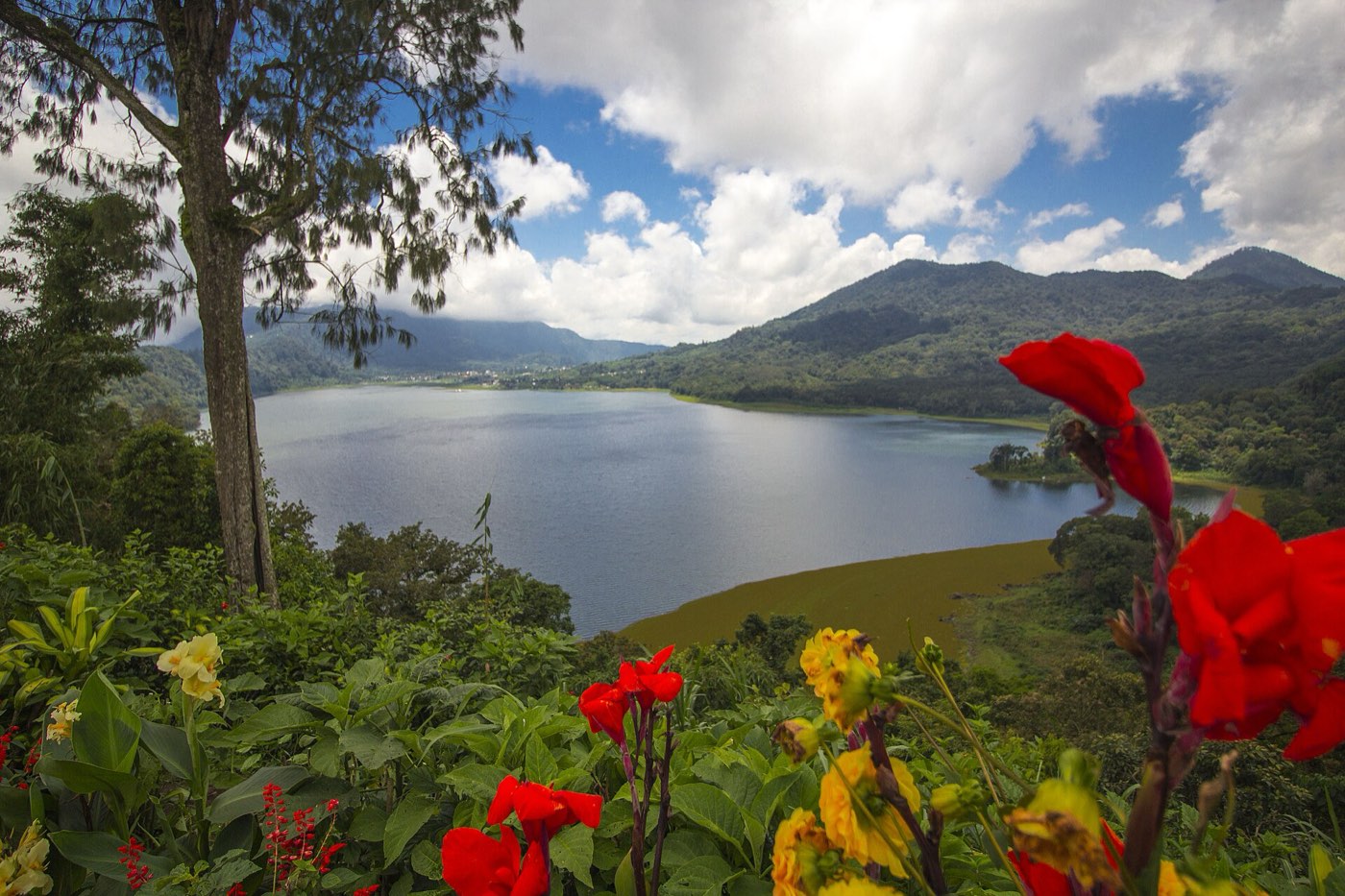 Lake Buyan from its shoreline. Photo: Suranegara88 / Wikimedia Commons (CC BY-SA 4.0)
Handara Gate
The carved split gate at the entrance to Handara Golf & Resort, on the main road at Pancasari between Lake Beratan and Lake Buyan, has become a favourite photo stop. It is the resort's own entrance, so check with the resort how visits and photos work before you go; its feed is below. Map
The queue, the best light and the lakes around it are in our Handara Gate guide.
Handara Golf & Resort on Instagram
Banyumala Waterfall
In Wanagiri village, on the hills above Lake Buyan, Banyumala is run by the village's own tourism group. Buleleng's tourism office describes a curtain of water falling from green cliffs into a clear pool that people swim in, reached on paths through the forest. It is one of the nearest waterfalls to the temple; the others around Munduk are in the Munduk waterfalls guide. Map
How to Fit It In
On the way north. Leave the south early, reach the temple by mid-morning, then take the market, the lakes and one waterfall on the way down to the coast.
As a day trip from Lovina. Leave around dawn to beat the cloud, see the temple first, then the botanic garden or Banyumala, and be back on the coast by mid-afternoon. It fits into a three-day north Bali itinerary or a week in the north.
From Munduk. It is a morning's outing, and the twin lakes are on the road there and back. The Munduk guide has the rest of the ridge.
For the rest of the island's great temples, see the best temples in Bali, and for the ones on the north coast, the best temples in north Bali.
Where to Stay
The two natural bases are Munduk, about 40 minutes west along the rim, for cool air and walks, and the coast around Lovina, about an hour down the mountain, for the sea and warmer nights. Where to stay in north Bali compares the areas.
If you want a villa on the coast, Palm Living, the company behind Northbound, rents villas around Lovina, about an hour's drive from the temple. The best villas in Lovina lists what is on that stretch of coast.
Practical Notes
- Bring: A warm layer, a rain jacket, and small notes for the market and the smaller sights around the lakes.
- Wear: Sarong and sash with shoulders covered; the entrance provides them if you have none.
- Arrive: Early, on a weekday if you can, after confirming the opening time with the management.
- On ceremony days: Watch from the edges and never walk through a procession.
FAQ
Where is Ulun Danu Beratan Temple? On the shore of Lake Beratan in Candikuning village, Bedugul, in the central highlands of Bali. It is in Tabanan regency, on the main road between Denpasar and Singaraja, about 60 km from the airport and about 38 km from Lovina.
Is Ulun Danu Beratan the same as Ulun Danu Bratan? Yes. Beratan and Bratan are two spellings of the same lake's name, and the temple appears under both.
Who is the temple dedicated to? To Dewi Danu, the Balinese goddess of the lake, worshipped for the water that makes the land fertile. The complex also holds other shrines and a Buddhist stupa.
Is Ulun Danu Beratan a UNESCO World Heritage Site? No. UNESCO's 2012 listing of Bali's subak system names Ulun Danu Batur at Kintamani as its lake temple. Ulun Danu Beratan belongs to the same tradition of water temples but is not one of the listed sites.
What is the best time to visit Ulun Danu Beratan? Early morning on a weekday, before the cloud builds and the crowds arrive, when the water is stillest. Check the opening time with the management first.
How much is the entrance fee? The management sells separate weekday and weekend tickets and publishes current prices on its official site.
Sources
- DTW Ulun Danu Beratan (the temple's management), official site, offers and tickets and contact, read September 2026
- Indonesia Ministry of Tourism, Pura Ulun Danu Beratan Bedugul: history and features, read September 2026 (in Indonesian)
- NusaBali, Pura Ulun Danu Beratan holds its piodalan, 21 December 2022 (in Indonesian)
- DTW Ulun Danu Beratan on Instagram, post on the Nyegara Gunung rite, read September 2026 (in Indonesian)
- J. Stephen Lansing, Priests and Programmers: Technologies of Power in the Engineered Landscape of Bali, Princeton University Press, first published 1991, revised edition 2007
- Wikipedia, Subak (irrigation), for the summary of Lansing's findings on synchronised planting and pests, read September 2026
- UNESCO World Heritage Centre, Cultural Landscape of Bali Province, inscribed 2012
- Indonesian National Commission for UNESCO, Cultural Landscape of Bali Province: the Subak System, for the listed components, read September 2026
- Love Bali (Bali provincial government), Kebun Raya Eka Karya Bedugul, read September 2026
- Kumparan, Pasar Candi Kuning Bedugul, 28 February 2024 (in Indonesian)
- Buleleng Tourism Office, Visit North Bali: Buyan Lake, Tamblingan Lake and Banyumala Waterfall, read September 2026
- Road distances measured on OpenStreetMap routing, September 2026; drive times are the publication's own rough estimates for the mountain roads
Carry on through the highlands: the twin lakes of Buyan and Tamblingan, Munduk, or down the mountain to Lovina.



.jpg)

.jpg)
