On this page
- In Brief
- Singa Ambara Raja at a Glance
- The Lion Stands for Panji Sakti, and the Corn Stands for Buleleng
- The Name Means Lion, Sky and King
- Two Birthdays Are Counted Into the Lion
- The Winged Lion Is Also Buleleng's Coat of Arms
- Built in 1971 by a Regency Committee, on a Date the Sources Give Two Ways
- In Balinese Understanding the Monument Has Its Own Odalan
- The Square Around the Lion Reopened in July 2026 as Praja Mandala Singa Ambara Raja
- A Second, Very Large Golden Lion Stands in Taman Bung Karno
- How to See the Lion
- How to Fit It In
- FAQ
- Sources
In Brief
Singa Ambara Raja, the Tugu Singa Ambara Raja in Indonesian, is the winged lion monument of Singaraja, the capital of Buleleng regency in north Bali. It stands at the city's zero point, the junction of Jalan Veteran, Jalan Pahlawan and Jalan Ngurah Rai, in front of the Regent's office. The lion faces north, gripping an ear of corn above a lotus.
It honours Ki Gusti Ngurah Panji Sakti, the founder of the kingdom of Buleleng. The same lion is the regency's coat of arms, fixed by a regional regulation in 1968.
Its parts carry numbers. In the regency's reading they spell 30 March 1604, the founding of Singaraja, and 17 August 1945, Indonesia's independence. The monument was consecrated in 1971. In July 2026 the square around it reopened as Praja Mandala Singa Ambara Raja.
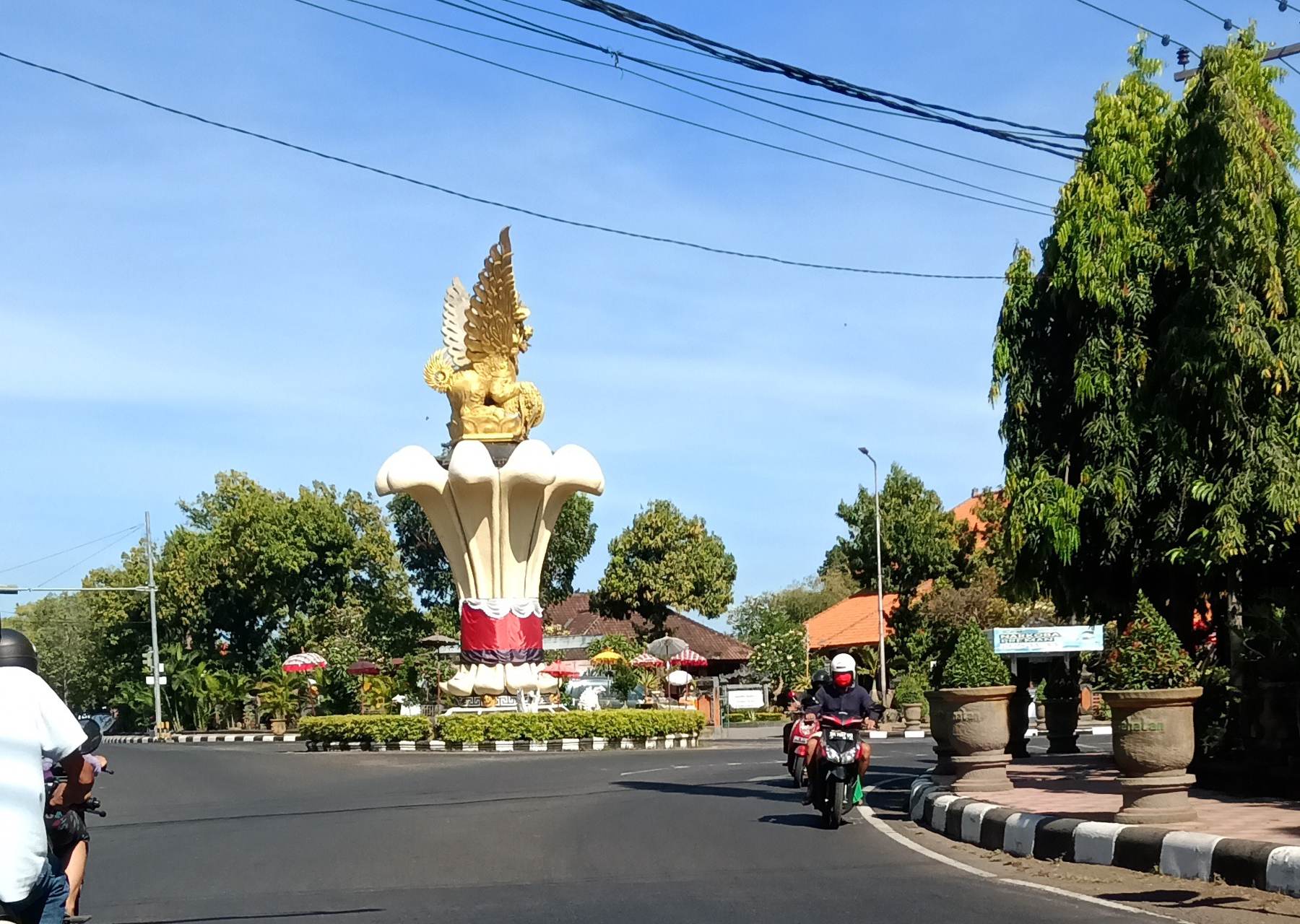 Singa Ambara Raja at Singaraja's central junction, photographed in 2020, before the square was rebuilt. Photo: Anggabuana / Wikimedia Commons (CC BY-SA 4.0)
Singa Ambara Raja at a Glance
- What it is: a winged lion, singa bersayap, on a lotus pedestal, the mascot of Singaraja
- Where: the junction of Jalan Veteran, Jalan Pahlawan and Jalan Ngurah Rai, Kelurahan Banjar Tegal (Map)
- Honours: Ki Gusti Ngurah Panji Sakti, founder of the kingdom of Buleleng
- Holds: an ear of jagung gembal, the plant whose old name is buleleng
- The emblem: set by a Buleleng regional regulation of 25 April 1968
- Consecrated: 1971, under Regent Hartawan Mataram
- Its own ceremony: a piodalan on Purnama Sasih Katiga, the full moon of the third Balinese month
- The square: reopened as Praja Mandala Singa Ambara Raja in July 2026
- A second lion: a very large golden statue in Taman Bung Karno, Sukasada, by I Wayan Winten
The Lion Stands for Panji Sakti, and the Corn Stands for Buleleng
The statue is a portrait of a king's courage.
The Buleleng culture and tourism office says it was built to remember the might of Ki Gusti Ngurah Panji Sakti. He made the north advanced and respected. The lion gripping the corn stands for the strength, chivalry and power of a brave northern leader.
The regency's history of the city explains both halves of the image. In 1604 Panji Sakti built a new palace on a grassy field where people grew buleleng. He called the palace Singaraja, because his valour was like a lion's.
Buleleng was the old name of jagung gambal, a corn the people planted widely at the time. So the lion is Singaraja, and the plant in its claw is Buleleng.
The regency's emblem reading says it directly. The corn held in the lion's right hand stands for the regency, held by the city of Singaraja. A Universitas Pendidikan Ganesha study identifies the plant as a sorghum that once grew well in Buleleng and fed its people.
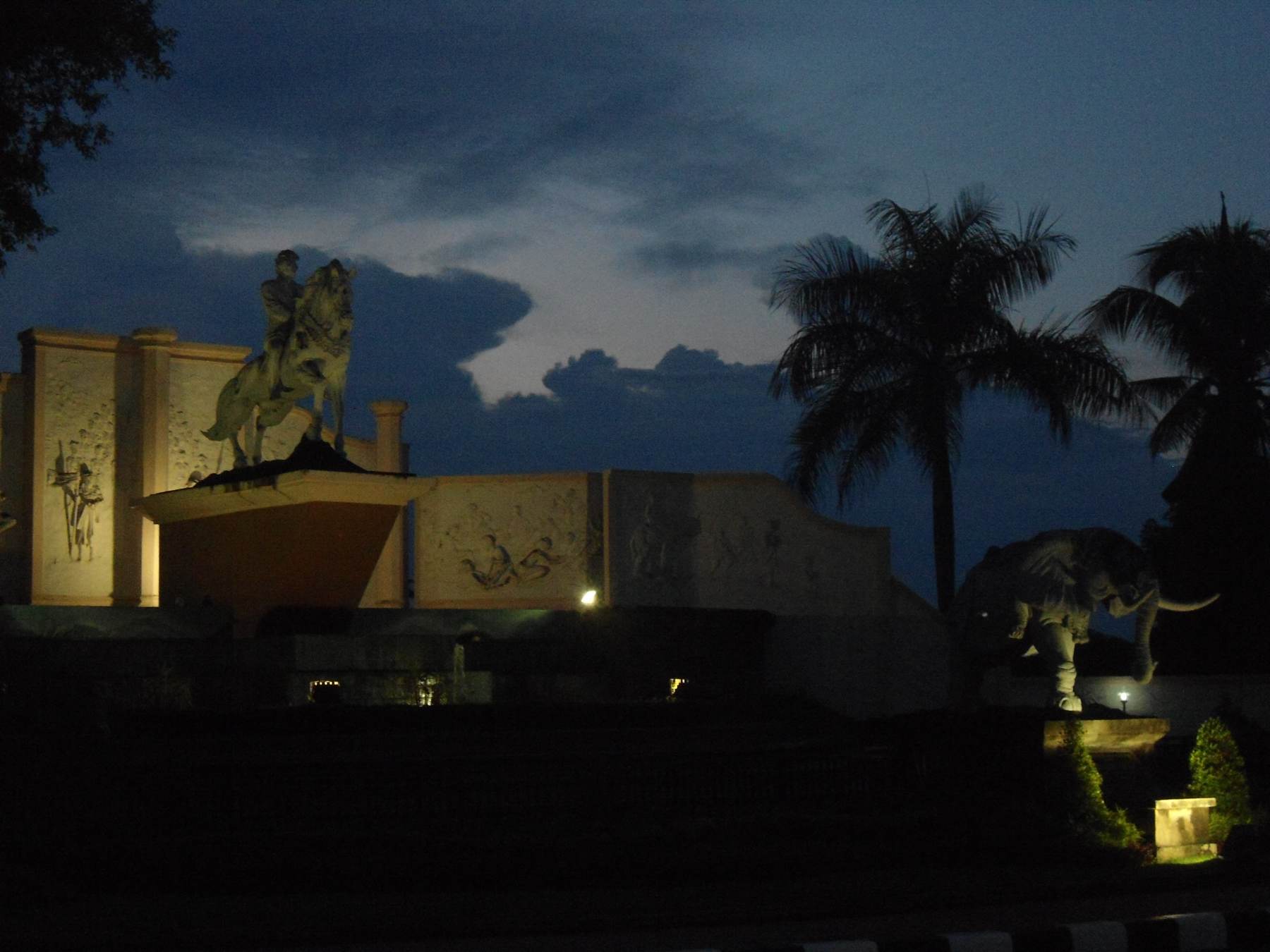 A monument to Panji Sakti in Singaraja at nightfall. Photo: DayakSibiriak / Wikimedia Commons (CC BY-SA 4.0)
The full story of the kingdom is in north Bali's history.
The Name Means Lion, Sky and King
The three words are old ones.
Singa is lion and raja is king. Buleleng's government office traces both to Sanskrit and reads the city's own name as "lion king".
Ambara is the sky. Indonesia's national dictionary, KBBI, lists it as an old Kawi word for the open air above.
The regency gives the phrase its own meaning as a motto. According to the Kubutambahan district office, "Singa Ambara Raja" stands for the agility and heroic spirit of the people of Buleleng.
Two Birthdays Are Counted Into the Lion
The regency reads the lion in two layers, one national and one regional.
The national reading spells 17 August 1945
The emblem's official reading, published by the Kubutambahan district office, starts with Indonesia:
- The five-sided base, the yupa, stands for Pancasila, the five principles of the Indonesian state.
- Seventeen wing feathers stand for the 17th, the day of the Proclamation.
- Eight leaves on the corn stand for August, the eighth month.
- Forty-five grains on the corn stand for 1945.
Read together, they give 17 August 1945, the day Indonesia declared independence.
The regional reading spells 30 March 1604
The second layer counts the city's own founding:
- Nine lotus petals stand for Buleleng's nine districts.
- Thirty wing feathers, large and small, stand for the 30th. They sit in four rows of five, seven, eight and ten.
- The wing bones that hold the feathers stand for March, the third month.
- 1,604 hairs of the mane, the curls and the long tail stand for the year.
Two more details carry the people's character. Three gajah mina, the elephant-fish, stand for strength, wisdom and intelligence. Three shining jewels stand for vigilance and readiness.
The culture office describes the monument's count a little differently. It gives 30 long feathers on the wings, growing from three wing bones, and 1,604 fine feathers covering the body.
The Winged Lion Is Also Buleleng's Coat of Arms
The lion you see at the junction is the regency's emblem in three dimensions.
Buleleng set the emblem in a regional regulation of 25 April 1968. The Minister of Home Affairs approved it on 19 November 1968, as the district office records.
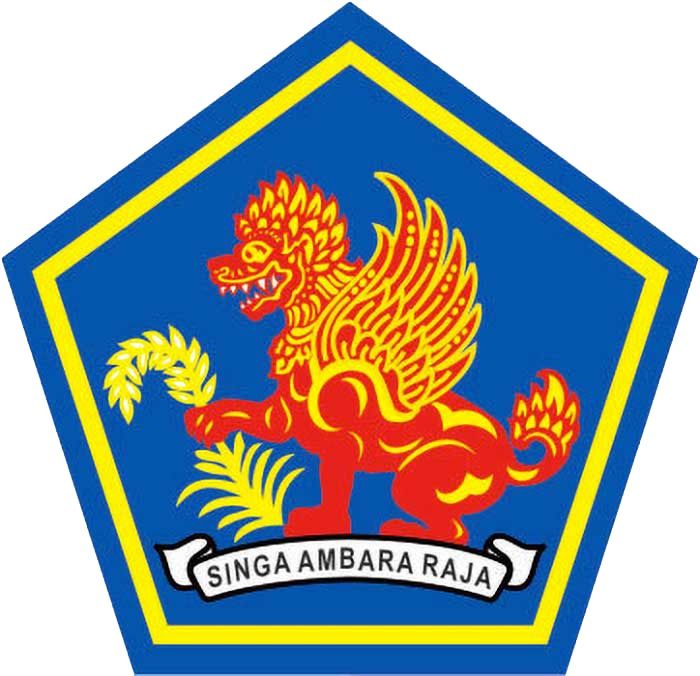 The coat of arms of Buleleng regency. Photo: Meursault2004 / Wikimedia Commons (public domain)
Its colours have meanings too:
- Bright blue ground: a mind that is obedient, loving and devoted to Ida Sang Hyang Widhi Wasa, God.
- Living red lion: a mind full of heroic spirit.
- Clean white: a pure and honest conscience.
- Black: anger, ready to advance if disturbed.
The lion has travelled beyond the regency. A 2009 Indonesian stamp, part of a joint issue with Singapore, shows the Singaraja statue against the sky.
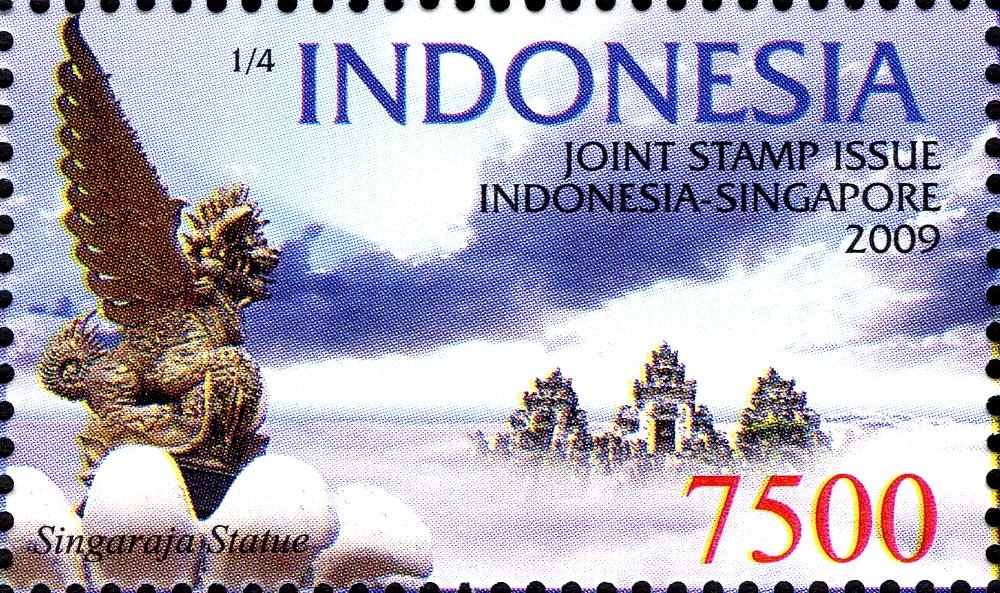 The Singaraja statue on a 2009 Indonesia and Singapore joint stamp issue. Photo: Post of Indonesia / Wikimedia Commons (public domain)
Built in 1971 by a Regency Committee, on a Date the Sources Give Two Ways
The monument is younger than it looks.
Regent Hartawan Mataram formed the committee that planned the city's emblem, according to the regency's fire and rescue office. Gede Putu Rijasa chaired it day to day. The work was carried out by Rokhim B.A.E. and the artist Subroto, helped by the undagi, or master builder, Made Rudita.
Two dates are given for the opening:
- 5 September 1971: the fire office and the Undiksha study give this as the day of the plaspas, the consecration rite. It fell on the full moon of the third Balinese month.
- 30 March 1971: the culture and tourism office gives this date, the city's birthday.
The Undiksha study adds that work began on 16 February 1968, in the spirit of researching the city's founding.
In Balinese Understanding the Monument Has Its Own Odalan
The lion is honoured with ceremony, like a temple.
Its piodalan, the anniversary ceremony, falls on Purnama Sasih Katiga, the full moon of the third month. Dewata News reported the ceremony at the monument in September 2017. The junction was partly closed to traffic for it.
The fire office records the teaching on what dwells there. According to Nyoman Sutrisna, the presence seated at the monument is Ratu Gede Panji Landung Singa Sakti Manggala.
In 2006, under Regent Putu Bagiada, the regency held a padudusan alit to reawaken the monument's taksu, its spiritual power. It was held on 7 September 2006, again on the full moon of the third month.
The seen and unseen sides of Balinese life are explained in sekala and niskala.
The Square Around the Lion Reopened in July 2026 as Praja Mandala Singa Ambara Raja
The zero point was rebuilt as a heritage square between February and July 2026.
Work began on 20 February 2026 with the ngeruak and mecaru rites, held to honour the site in sekala and niskala. The regency's research and innovation agency listed what the works would cover:
- the surrounding environment
- sanitation
- underground utilities
- new green open space
Carvers from Buleleng dressed the new pillars and gates. Nyoman Arta Sunada, an undagi from Banyuning, told Radar Buleleng that Buleleng carving has broad leaves and free folds. He worked the ulanda motif with patra cina.
Before it opened, the square was purified with the Melaspas, Ngenteg Linggih and Pedudusan Agung ceremonies. Radar Buleleng reported the opening for 29 July 2026.
The new name came from a public competition. Kadek Dika Wirawan, a student at IAHN Mpu Kuturan Singaraja, proposed it, the regency announced. Praja means the seat of government and mandala the area. Puri elders and the culture office helped settle the choice.
A Second, Very Large Golden Lion Stands in Taman Bung Karno
Singaraja has a second Singa Ambara Raja, on the way into the city.
The second is in Taman Bung Karno, the city park in Sukasada on the road in from Denpasar. The Undiksha study describes it as very large, golden and full of character. It went up after the park's fourth building phase in 2021.
The sculptor is I Wayan Winten, born in 1962 in Teges, Peliatan, near Ubud. He has worked in concrete since 1992. His other works include the Gatotkaca statue at the entrance to Ngurah Rai airport.
The lion is built from concrete over a frame of steel and wire mesh, carved while half dry, then painted gold. Brick-red frames carved in the Buleleng style, the gayor, stand at its sides and back.
It also works as a gateway to an open-air stage. The regency holds art performance nights there, and the park hosts stage nights at the Buleleng Rhythm Festival.
The park opened on 30 March 2022, the city's birthday. Its statue of Sukarno stands on a relief of his father, the teacher who met Nyoman Rai in Buleleng (Map).
How to See the Lion
The monument sits at a working junction, so see it from the square.
- Go early or late. Radar Buleleng found the new pedestrian square busy in the morning and late afternoon, when people come for the sunset light.
- Look from the north. The lion faces north, so its face, wings and corn read best from that side.
- Respect the ceremony days. On the full moon of the third month the monument holds its piodalan, and the junction may close to traffic.
- Come in August for the festival. The Buleleng Festival set its main stage in Praja Mandala in August 2026, as the regency announced.
How to Fit It In
The lion is the natural start or end of a morning in Singaraja's old town, with its harbour, Chinese temple and lontar library.
Coming up from the south, you pass the Taman Bung Karno lion first, so a short stop there pairs the two statues. The routes over the mountains are in getting to north Bali.
For the wider regency the lion stands for, read Buleleng regency explained.
FAQ
What does Singa Ambara Raja mean?
Singa means lion and raja means king, the two words in the city's name. Ambara is an old Kawi word for the sky. The regency reads the phrase as a motto for the agility and heroic spirit of the people of Buleleng.
Where is the Singa Ambara Raja statue?
At the zero point of Singaraja, the junction of Jalan Veteran, Jalan Pahlawan and Jalan Ngurah Rai, in front of the Buleleng Regent's office. The square around it is now named Praja Mandala Singa Ambara Raja. A second, very large golden lion stands in Taman Bung Karno in Sukasada.
What do the numbers on the Singa Ambara Raja mean?
They spell two dates. Thirty wing feathers, the wing bones for March and 1,604 hairs give 30 March 1604, the founding of Singaraja. Seventeen feathers, eight corn leaves and 45 grains give 17 August 1945, Indonesia's independence. The nine lotus petals stand for Buleleng's nine districts.
Is Singa Ambara Raja the logo of Buleleng?
Yes. The winged lion holding corn, inside a blue pentagon with the motto "Singa Ambara Raja", is the coat of arms of Buleleng regency. It was set by a regional regulation of 25 April 1968 and approved by the Minister of Home Affairs that November.
When was the Singa Ambara Raja monument built?
It was consecrated in 1971, under Regent Hartawan Mataram. The fire office and a university study give 5 September 1971, the full moon of the third Balinese month. The culture office gives 30 March 1971.
Who is the winged lion for?
For Ki Gusti Ngurah Panji Sakti, the founder of the kingdom of Buleleng. The regency's history says he named his palace Singaraja because his valour was like a lion's.
Who made the golden lion in Taman Bung Karno?
The sculptor I Wayan Winten, born in Peliatan near Ubud in 1962. He built it in concrete over a steel frame and painted it gold. It stands as the gateway to the park's open-air stage.
Sources
- Dinas Kebudayaan dan Pariwisata Kabupaten Buleleng, Tugu Singa Ambara Raja (the monument honours Panji Sakti, its feather count, its place in front of the Regent's office, the 30 March 1971 date), Indonesian, read October 2026
- Kecamatan Kubutambahan, Kabupaten Buleleng, Lambang Daerah Singa Ambara Raja (the 1968 regulation and ministerial approval, the national and regional readings, the colours and the motto), Indonesian, read October 2026
- Dinas Pemadam Kebakaran dan Penyelamatan Kabupaten Buleleng, Asal usul Tugu Singa Ambara Raja (the planning committee and builders, the plaspas of 5 September 1971, Ratu Gede Panji Landung Singa Sakti Manggala, the 2006 padudusan alit), Indonesian, read October 2026
- Pemerintah Kabupaten Buleleng, Sejarah Kota Singaraja (the palace of 1604 on the buleleng field, the name Singaraja, buleleng as the old name of jagung gambal), Indonesian, read October 2026
- Bagian Tata Pemerintahan, Setda Kabupaten Buleleng, Sejarah Kota Singaraja: Jejak Sejarah di Bali Utara (the Sanskrit roots of the name), Indonesian, read October 2026
- Kamus Besar Bahasa Indonesia, ambara (an archaic Kawi word for the sky), Indonesian, read October 2026
- Kusumantara, Sudita and Sutrisno, Universitas Pendidikan Ganesha, Patung Singa Ambara Raja karya I Wayan Winten di Taman Bung Karno Singaraja, 2024 (the second lion, its sculptor, materials and stage, the park, the 1968 start and 5 September 1971 consecration, the corn as sorghum), Indonesian, read October 2026
- Dewata News, Purnama Sasih Ketiga, piodalan Tugu Singa Ambara Raja, September 2017 (the piodalan, the three streets, Kelurahan Banjar Tegal, the lion facing north, the traffic closure), Indonesian, read October 2026
- Badan Riset dan Inovasi Daerah Kabupaten Buleleng, Buleleng mulai titik nol Tugu Singa Ambara Raja, February 2026 (the ngeruak and mecaru rites and the scope of the works), Indonesian, read October 2026
- Radar Buleleng, Titik Nol Singaraja kini dipenuhi ukiran khas Buleleng, 5 May 2026; Sucikan Titik Nol Singaraja, 28 July 2026; and Titik Nol Singaraja jadi spot nongkrong baru, 19 June 2026, Indonesian, read October 2026
- Pemerintah Kabupaten Buleleng, Praja Mandala Singa Ambara Raja, nama baru kawasan Titik Nol Singaraja, July 2026, and Bulfest 2026 hidupkan kembali rasa Buleleng tempo dulu, August 2026, Indonesian, read October 2026
- Images credited at each caption, from Wikimedia Commons: Singaraja.jpg, I Gusti Anglurah Panji Sakti monument, Lambang Kabupaten Buleleng and Stamps of Indonesia, 066-09
Read next: Singaraja old town for the walk around the lion, the Buleleng Festival for August in the square, and north Bali's history for the kingdom it remembers.