
On this page
In Brief
Purnama is the full moon and tilem the new moon, and both are holy days in Balinese Hinduism. On purnama the moon, Sang Hyang Candra, is worshipped; on tilem the sun, Sang Hyang Surya; together they are the pair of opposites whose purification the old text Sundarigama asks every priest and household to mark. Families pray at their house shrines and village temples, offer a pejati and canang sari, and bathe to clean body and mind. Each falls once in every Balinese month, or sasih, of the lunar Saka calendar, so each comes round every 29 or 30 days. Some are major festivals: Siwaratri on the eve of Tilem Kapitu, the Tawur Kesanga sacrifice on Tilem Kesanga before Nyepi, and the gathering of the gods at Besakih on Purnama Kadasa. The dates are fixed by a traditional reckoning called pengalantaka, which does not always match the astronomical full moon, so check a Balinese calendar or the north Bali events calendar for the day itself.
Purnama and Tilem at a Glance
- Purnama: full moon, the fifteenth day of the waxing half of the month
- Tilem: new moon, the fifteenth day of the waning half
- How often: each once per sasih, every 29 or 30 days, twelve of each in a normal year
- Worshipped: Sang Hyang Candra, the moon, on purnama; Sang Hyang Surya, the sun, on tilem
- What people do: pray at home and temple shrines, make offerings, bathe for purification
- Great ceremonies: Siwaratri (eve of Tilem Kapitu), Tawur Kesanga (Tilem Kesanga), Bhatara Turun Kabeh at Besakih (Purnama Kadasa)
- How the date is set: the pengalantaka reckoning of the Balinese Saka calendar
- Where to find this month's dates: a Balinese calendar, or the events calendar
What Purnama and Tilem Mean
The Buleleng district office in Singaraja and the Ministry of Religious Affairs in Bali both quote the same passage from the Sundarigama to explain the two days. Purnama and tilem, it says, are the chief days of purification of Sang Hyang Rwa Bhineda, the sun and the moon. On purnama the moon is in yoga, on tilem the sun, and on those days priests and all people should clear their minds, offer fragrances and the ordinary canang to all the gods at their shrines and temples, and take holy water and flowers. Both lights, in the ministry's words, are manifestations of God that burn away impurity. The idea of the paired opposites is explained in Rwa Bhineda.
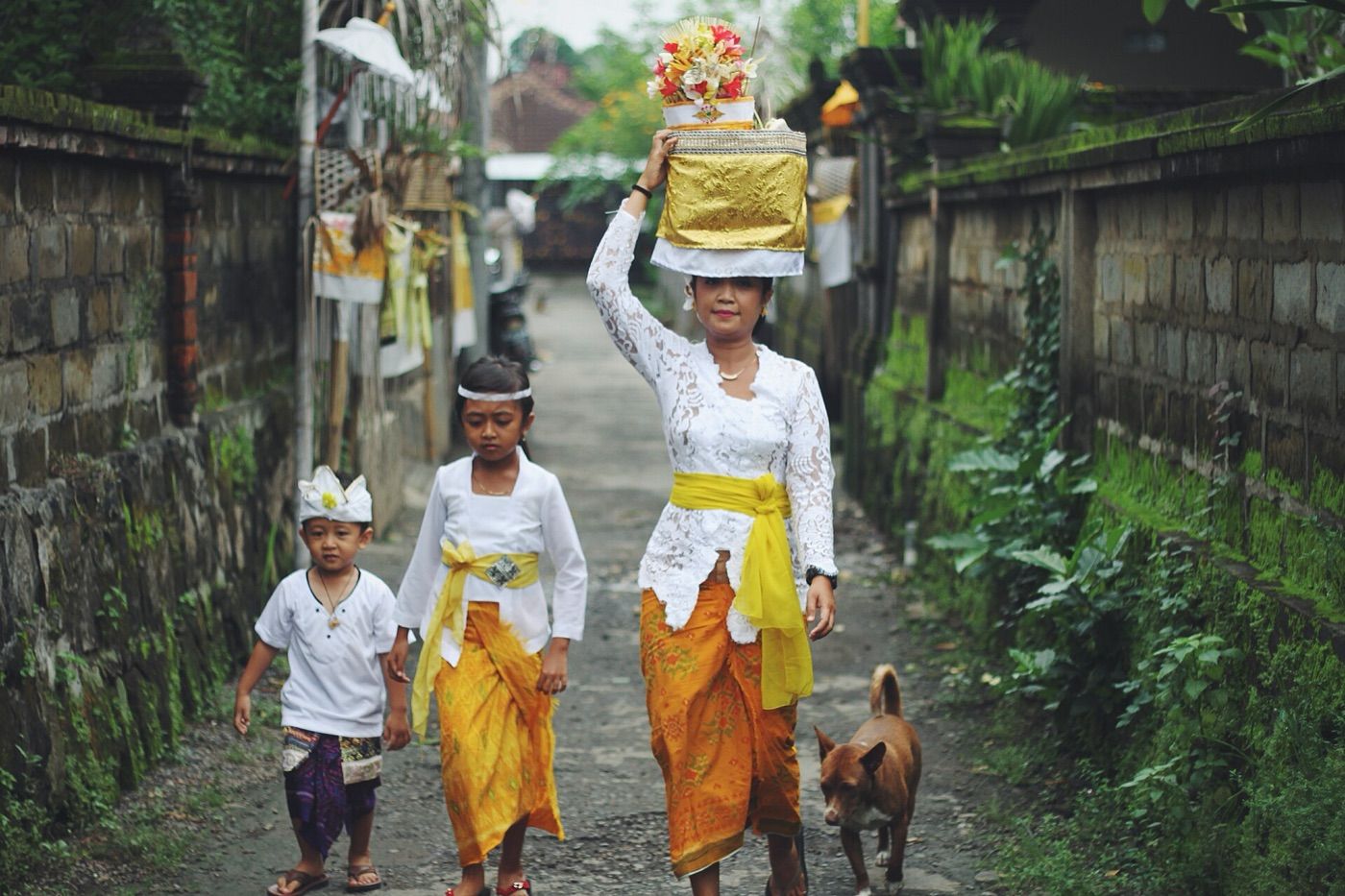 A mother and her children walking to prayer with offerings. Photo: P Manuada Mersana Surya / Wikimedia Commons (CC BY-SA 4.0)
The ministry adds a second line from the same text: an offering made on purnama or tilem returns tenfold. Purnama is widely held to be a dewasa ayu, an auspicious day, and a holy day that falls on a full moon, such as a temple anniversary or Galungan, is called nadi and marked with larger offerings. The Buleleng office adds a caution from the lontar Purwana Tattwa Wariga: not every full moon is good. A purnama that falls on a Saturday that is also Kajeng Kliwon is berek tawukan, a day when no ceremony may be held.
Tilem has its own weight. The Buleleng office describes it as the day of the power of Sang Hyang Rudra in the form of Yamadipati, lord of death, and quotes the Purwana Tattwa Wariga: those who make offerings faithfully on tilem are shown the road to heaven when they die.
The moon has its story too. The ministry retells the tale of Kala Rahu, the demon who slipped in among the gods to drink the elixir of immortality and was beheaded by Wisnu's discus before it passed his throat. His head lives on and swallows the moon in revenge, which is an eclipse. More of these stories are in Balinese mythology.
What People Do on a Full Moon
Purnama is a household day first. The ministry's guidance for a family's main shrine, the padmasari or rong tiga, is a pejati: a set of offerings including a daksina, peras, soda, tipat kelanan, penyeneng, pasucian and canang sari. The shapes of offerings differ between regions, the ministry notes, and the meaning stays the same. How these offerings are made and what they mean is in Balinese offerings explained.
Then the temple. After prayer at a village temple the priest sprinkles holy water, tirta, over the worshippers, who then press grains of rice, bija, to the forehead. Why the rice is pressed to the forehead is in bija, the rice on the forehead.
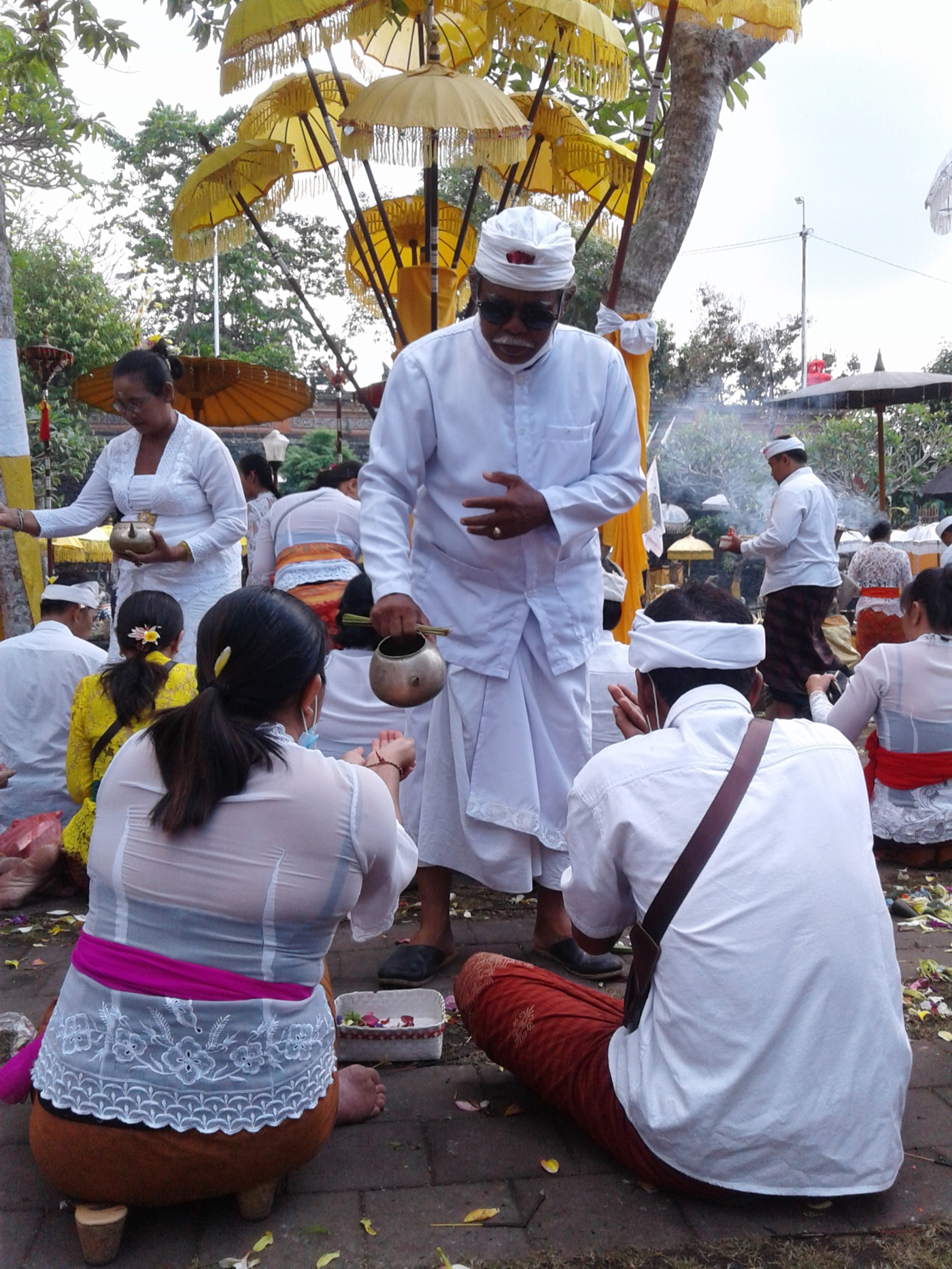 A pemangku brings tirta along the rows after prayer; the bija follows. Photo: MiracleLoveLife / Wikimedia Commons (CC BY-SA 4.0)

And water. Both the ministry and the Buleleng office ask the faithful to clean the body with water on purnama as well as to pray, citing the Manawa Dharmasastra: the body is cleansed with water, the mind with truth. The fuller ritual bath at a sacred spring is described in melukat, Bali's water purification.
The Great Full Moons and New Moons of the Year
Most months, purnama and tilem are quiet days of prayer. A few carry the island's largest rites. The Buleleng office lists them:
- Purnama Kapat, the full moon of the fourth month, when Bhatara Parameswara is worshipped, attended by the gods, the heavenly beings and the sages.
- Siwaratri, on the eve of Tilem Kapitu, the new moon of the seventh month: the night of Siwa, kept awake, known as the night that dissolves sins.
- Tilem Kesanga, the new moon of the ninth month, the day of the Tawur Agung Kesanga, the great offering to the forces of the lower world. Nyepi, the Day of Silence, follows the next day. The rites of that night are in mecaru and ogoh-ogoh, and the day itself in Nyepi.
- Purnama Kadasa, the full moon of the tenth month, when the anniversary of Bhatara Turun Kabeh, "the gods all descend", is held at Pura Besakih, Bali's mother temple.
How the Date Follows the Sasih Calendar
Bali runs two calendars side by side: the 210-day pawukon and the lunar Saka calendar, which carries purnama and tilem. Both are explained in the Balinese calendar explained.
The Saka year has twelve months, the sasih: Kasa, Karo, Katiga, Kapat, Kalima, Kanem, Kapitu, Kawalu, Kasanga, Kadasa, Jyestha and Sadha. Each begins the day after a new moon. Its first fifteen days, the penanggal, run from new moon to full; its second fifteen, the panglong, run from full moon back to new. Purnama is the fifteenth day of the first half and tilem the fifteenth of the second. A lunar year is shorter than a solar one, so from time to time a leap month is added after the eleventh or twelfth month to keep the calendar in step with the seasons. That is why Nyepi, which falls on the first day of Kadasa, moves from year to year, usually within March.
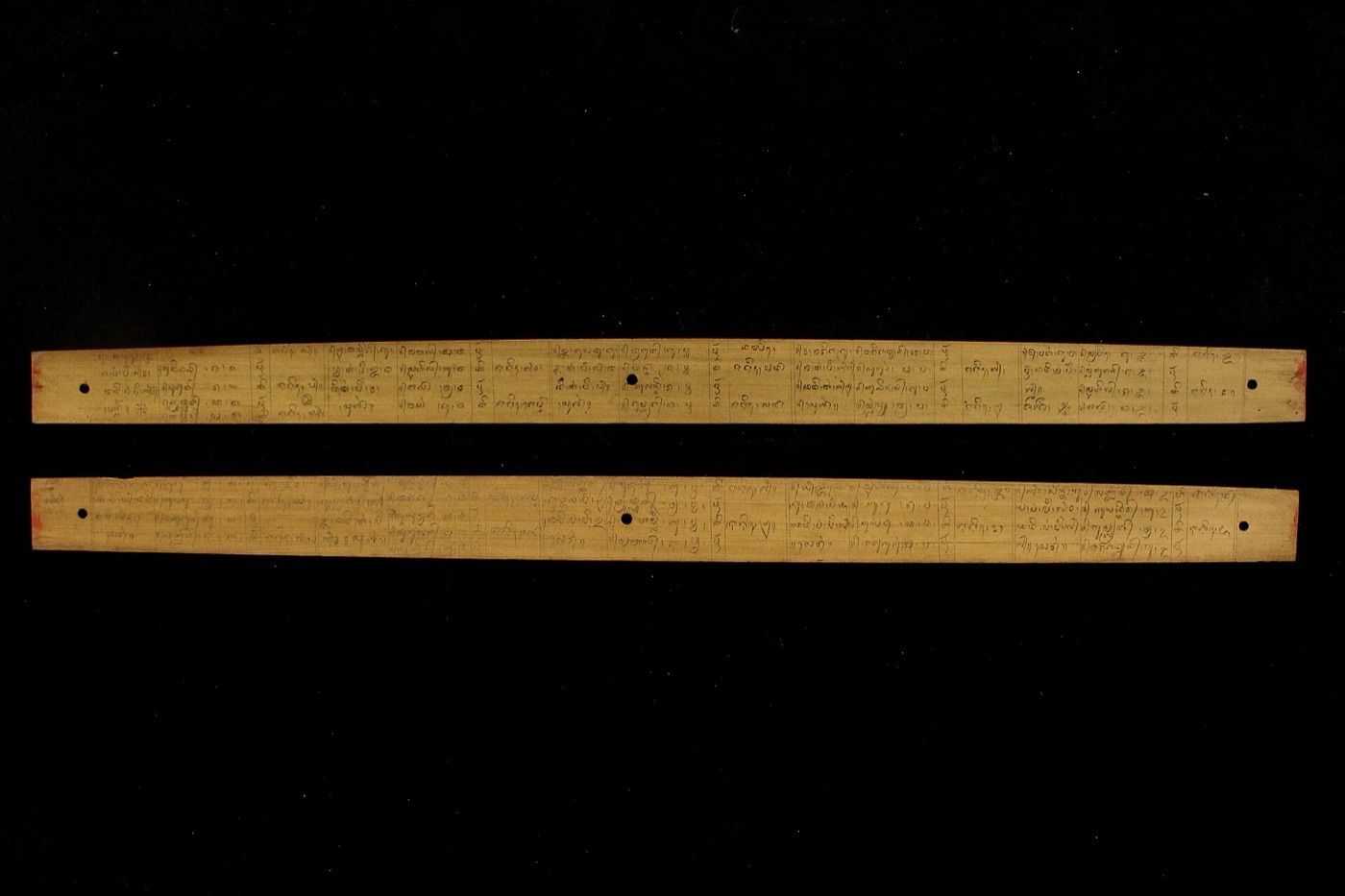 A lontar of pangalihan purnama tilem, the reckoning of full and new moons, in the village of Kemenuh. Photo: Eka343 / Wikimedia Commons (CC BY-SA 4.0)

Pengalantaka, and a calendar-maker from Buleleng
Which day is purnama is worked out, not simply observed. The method is called pengalantaka; the old lontar, a Mahasaraswati University inventory made in Buleleng notes, call it pangalihan purnama tilem, "the search for the full and new moon". Because it is a calculation, the Balinese calendar is, in the words of the Buleleng researchers, a conventional one: close to the astronomical moon, though not strictly tied to it.
The north has had a large hand in it. NusaBali tells the story of I Gede Marayana of Banjar Adat Galiran in Baktiseraga, Singaraja, a retired staff member of the regency's public works office who began studying wariga, the science of auspicious days, in 1975 and spent about ten years working the pengalantaka into mathematical form, drawing on the manuscripts of Gedong Kirtya in Singaraja and the calendar work of Ida Bagus Sugriwa of Buleleng. The first calendar with Balinese dates, published by the Parisada Hindu council in 1959, had to reconcile two ways of counting purnama and tilem, one in the north and one in the south. In 1991 the council switched to an Indian system, nirayana, which soon produced errors; one sign was Tilem Kesanga, and with it Nyepi, sliding from March into April. Councils of high priests met in 1998 and again in 2001 to settle the reckoning, and at the second Marayana presented his diagram. His pengalantaka was recognised as national intangible cultural heritage in 2019.
By his reckoning, purnama and tilem return to the same day, the same weekday cycle and the same wuku week every nine oton, about five years. And the first month, Kasa, begins after the rising of the star Kartika, the Pleiades, which Marayana says can be seen from the beach at Ponjok Batu in Tejakula, on Buleleng's east coast. The history of the Singaraja library he worked from is in Gedong Kirtya.
Visiting a Temple on Purnama
A full moon is a good day to see a village temple in use. Go in the late afternoon or evening, wear a sarong and sash with shoulders covered, stand back from the rows of worshippers, and do not step over offerings on the ground. Visitors are guests, so ask before photographing anyone at prayer. The rules are in Bali temple etiquette, and the temples of the north in the best temples of north Bali.
If you are staying around Lovina, where most of Palm Living's villas are, your hosts will know which village temple nearby is busiest on the night. For the wider picture, start with Balinese culture.
Practical Notes
- Check the date on a Balinese calendar or the events calendar; the Balinese purnama does not always fall on the astronomical full moon.
- Expect busier roads near temples in the evening, and processions on the great full moons.
- Temple dress is sarong, sash and covered shoulders.
- Keep to the edges of the temple courtyard and away from the priest's path.
- Menstruating women are traditionally asked not to enter temples; follow any sign at the gate.
FAQ
What is purnama in Bali? Purnama is the full moon, a holy day in Balinese Hinduism when the moon, Sang Hyang Candra, is worshipped. Families pray at home and at the village temple, make offerings and bathe for purification. It falls once in every Balinese month.
What is tilem? Tilem is the new moon, the dark of the month, when the sun, Sang Hyang Surya, is worshipped. Like purnama it comes once a month and is a day for prayer and offerings. Tilem Kesanga, the new moon before Nyepi, is the most important.
How often is purnama in Bali? Once in each sasih, every 29 or 30 days, so twelve times in a normal year.
Is the Balinese full moon on the same day as the astronomical full moon? Usually, but not always. The Balinese date is calculated by a traditional method, pengalantaka, and the calendar is conventional rather than strictly astronomical. Use a Balinese calendar for the religious date.
What offerings are made on purnama? The Ministry of Religious Affairs in Bali suggests a pejati at the family's main shrine, a set that includes daksina, peras, soda, tipat kelanan, penyeneng, pasucian and canang sari, along with canang and flowers at other shrines.
Can tourists visit a temple on the full moon? Yes, respectfully. Wear a sarong and sash, cover your shoulders, stay at the edges during prayer and ask before taking photographs.
Sources
- Buleleng district office, The meaning of purnama and tilem in Hinduism, for the Sundarigama, the Purwana Tattwa Wariga, nadi and berek tawukan days, and the great full and new moons, read September 2026 (in Indonesian)
- Ministry of Religious Affairs, Bangli office, The nature of the purnama holy day, for the offerings, the tenfold reward, bathing and the Kala Rahu story, read September 2026 (in Indonesian)
- NusaBali, The creator of the pengalantaka, for I Gede Marayana, the history of the calendar and the Kartika star, read September 2026 (in Indonesian)
- I Made Suarsana and colleagues, Inventarisasi pengalantaka: the system for setting purnama and tilem in the Balinese calendar in Buleleng, Mahasaraswati University Denpasar, for the lontar name and definition, read September 2026 (in Indonesian)
- I Made Sumerta and colleagues, Pengalantaka: the basis for setting purnama and tilem in the Balinese calendar, Dinamika Bali, for the calendar as a conventional reckoning and the formulas since 1959, read September 2026 (in Indonesian)
- Wikipedia, Balinese saka calendar, for the months, the halves of the month and the leap month, read September 2026 (in English)
Read next: the Balinese calendar explained, melukat and Galungan and Kuningan.