
On this page
In Brief
Bengkala is a village in Kubutambahan district of Buleleng regency, on the north coast of Bali, where a hereditary form of deafness has been present for many generations. Balinese call it Desa Kolok, the deaf village, from kolok, the Balinese word for deaf. The deafness is congenital and inherited recessively at a gene locus called DFNB3; a 1995 study found it in 2.2% of the 2,185 people then living there. In response, Bengkala developed its own sign language, Kata Kolok ("deaf talk"), which is unrelated to spoken Balinese and to other sign languages and is used by deaf and hearing villagers alike: one linguist counted between 1,200 and 1,800 signers, of whom only about 4% are deaf. The village school teaches in it, and since around 1969 Bengkala's deaf villagers have danced the Janger Kolok, a janger performed in sign in place of song, which Indonesia has recognised as national intangible heritage.
Bengkala at a Glance
- Where: Bengkala village, Kubutambahan district, Buleleng, east of Singaraja
- Also called: Desa Kolok, "deaf village"
- The deafness: congenital, profound, inherited recessively at the DFNB3 locus, since mapped to the MYO15A gene
- The language: Kata Kolok, "deaf talk", also called Bengkala Sign Language
- Who signs: deaf villagers and a majority of hearing ones, with varying fluency
- The dance: Janger Kolok, started by the late I Wayan Nedeng around 1969
- School: SDN 2 Bengkala, an inclusive primary school since 2007
- Visiting: by arrangement with the village; performances are staged on request
A Village With Deafness in Its Families
Bengkala is an old village. A team from Udayana University and Michigan State University, writing in the Journal of Medical Genetics in 1995, described it as having existed on Bali's north shore for over 700 years. They found that 2.2% of its 2,185 people had profound deafness from birth: sensorineural, affecting nothing else in the body, and caused by a fully penetrant recessive mutation at the DFNB3 locus. A child is born deaf only when it inherits the mutation from both parents, and the team estimated that 17.2% of hearing villagers carried one copy.
The same researchers mapped DFNB3 to chromosome 17 the same year, in Nature Genetics. The locus was later identified as the MYO15A gene, which is now known to cause deafness in families far from Bali. Bengkala is where it was first found.
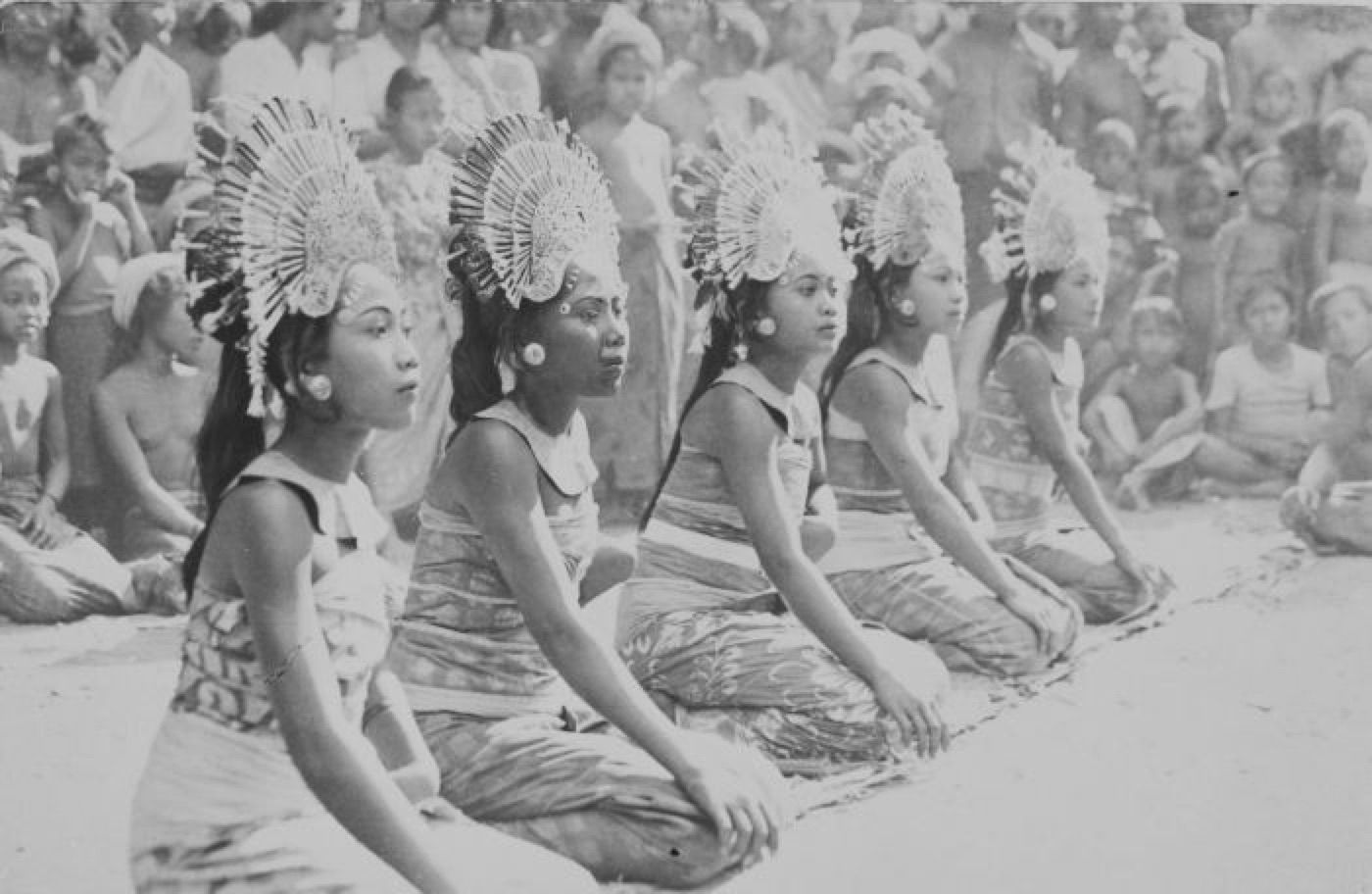 Janger dancers before a village audience, Bali, early twentieth century. Janger Kolok is Bengkala's own version of this dance. Photo: EFA Studio Bali, Tropenmuseum / Wikimedia Commons (CC BY-SA 3.0)
Village life has made room for its deaf members in particular ways. The researcher Erin Moriarty, writing for the MobileDeaf research project and drawing on I Gede Marsaja's study of the village, describes roles held by deaf men: fitting and repairing the water pipes, acting as security at village festivals, catching and butchering animals for feasts, carrying the wadah, the tall tower in which the dead are taken to cremation, and digging graves, which in Bengkala is done only by deaf men. Some villagers say deaf men are unafraid of the spirits of the graveyard because they cannot hear them. Researchers also record a belief, shared by deaf and hearing villagers, in a deaf god. The cremation rites the wadah belongs to are in ngaben, the Balinese cremation.
Kata Kolok, the Village Sign Language
Kata Kolok is a full language. The Dutch linguist Connie de Vos, who spent more than a year in Bengkala and recorded over a hundred hours of conversation for her doctorate at the Max Planck Institute for Psycholinguistics, found that 57% of the village's almost 3,000 people sign with some fluency, between 1,200 and 1,800 people depending on how a signer is defined, and that only 4% of them are deaf. Deaf children acquire it from birth, as hearing children acquire speech, and it is used in every part of village life, from politics and work to temple ceremonies.
It is also unusual among the world's sign languages. Most sign languages describe where things are in relative terms, like "left" and "right". Kata Kolok signers use the real compass: east and west, and the true location of the places they talk about. "Kata Kolok signers appear to have an internal compass," de Vos told the institute. It has no finger-spelling. It is unrelated to spoken Balinese and to the sign language used elsewhere in Bali, and its structure differs from BISINDO, the Indonesian sign language used across the country.
For hearing Balinese, directions are part of everyday speech in any case, organised around the mountains and the sea; the wider world-view is in Balinese culture and Tri Hita Karana.
School in two languages
Bengkala's primary school, SDN 2 Bengkala, became an inclusive school in 2007, and de Vos helped start the programme that made Kata Kolok a language of instruction. When detikBali visited, deaf pupils in the first three years had their own class, and older deaf and hearing children learned together, with two teachers in the room: one speaking, one signing in Kata Kolok. The hearing children, as a result, learn to sign with their deaf classmates. The school's one teacher fluent in Kata Kolok, I Made Wisnugiri, told the reporter he was then the only inclusive teacher left.
Janger Kolok, the Dance Without Song
Janger grew up as a social dance in several parts of Bali, and its dancers usually sing as they dance. In Bengkala it is danced in sign. The Buleleng government credits the late I Wayan Nedeng with founding the Janger Kolok in 1969 (the province's culture portal gives 1970), to give the village's kolok a place in the arts equal to their hearing neighbours. At the time, according to the province, deaf villagers earned a living carrying and selling water in a village that had little of it, while hearing villagers took part in drama and janger.
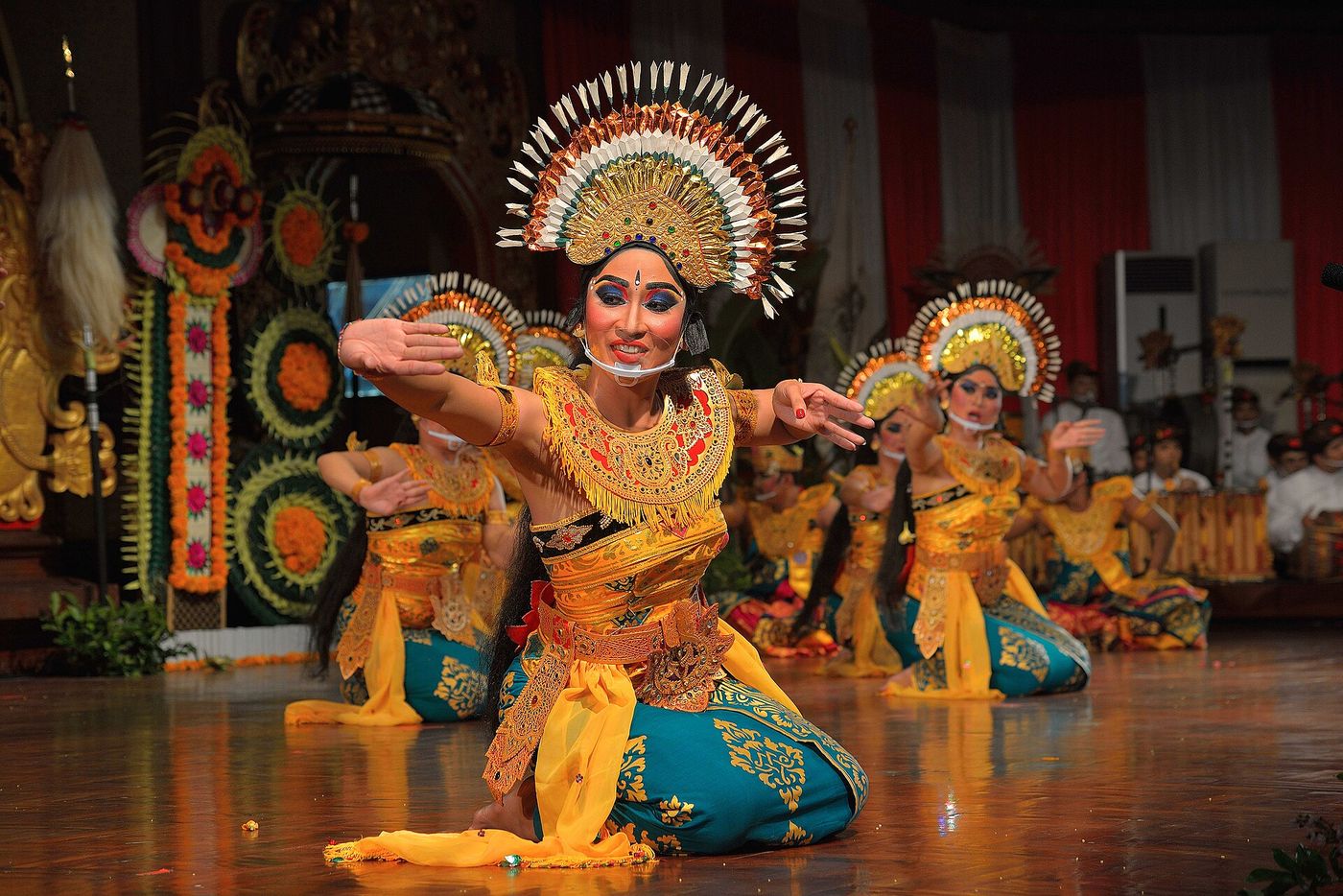 Janger dancers on stage. Photo: Hendri Suhandi / Wikimedia Commons (CC BY-SA 4.0)

The Janger Kolok combines janger with martial arts, including pencak silat moves with bladed weapons, and tells the story of the Kakawin Arjuna Wiwaha. Ten dancers perform it to the drum and cymbals, and where ordinary janger dancers sing, these dancers sign. The group's coordinator, I Kadek Sriparjana, told the regency that it rehearses once a week at an open pavilion built in the village's community economic zone with help from the state oil company Pertamina, and performs at government events and for visitors on request. Indonesia's Ministry of Culture has listed it as national intangible cultural heritage.
For where janger sits among Bali's dances, and why the north shaped modern Balinese music, see Balinese dance and gong kebyar and Balinese gamelan.
Visiting Bengkala With Respect
Bengkala has become well known, and visitors come: deaf travellers from abroad, often with a deaf Indonesian guide from south Bali, as well as hearing tourists, bloggers and film crews. Erin Moriarty's research is a useful corrective to how it is often described. Bengkala is connected to neighbouring villages by kinship, and several nearby villages have deaf residents who sign in a similar way, so the "isolated deaf utopia" of travel videos is a romance. Many deaf villagers are among the poorest in the village, because for generations they had little access to school or steady work.
Some practical points follow from that. Arrange a visit through the village or a guide the village knows, and ask before filming anyone. A Janger Kolok performance is organised on request, so ask whoever arranges your visit whether one can be staged. Learning a few signs from the people you meet goes further than photographing them, and buying the woven cloth made by the village's deaf women is a direct way to support their work.
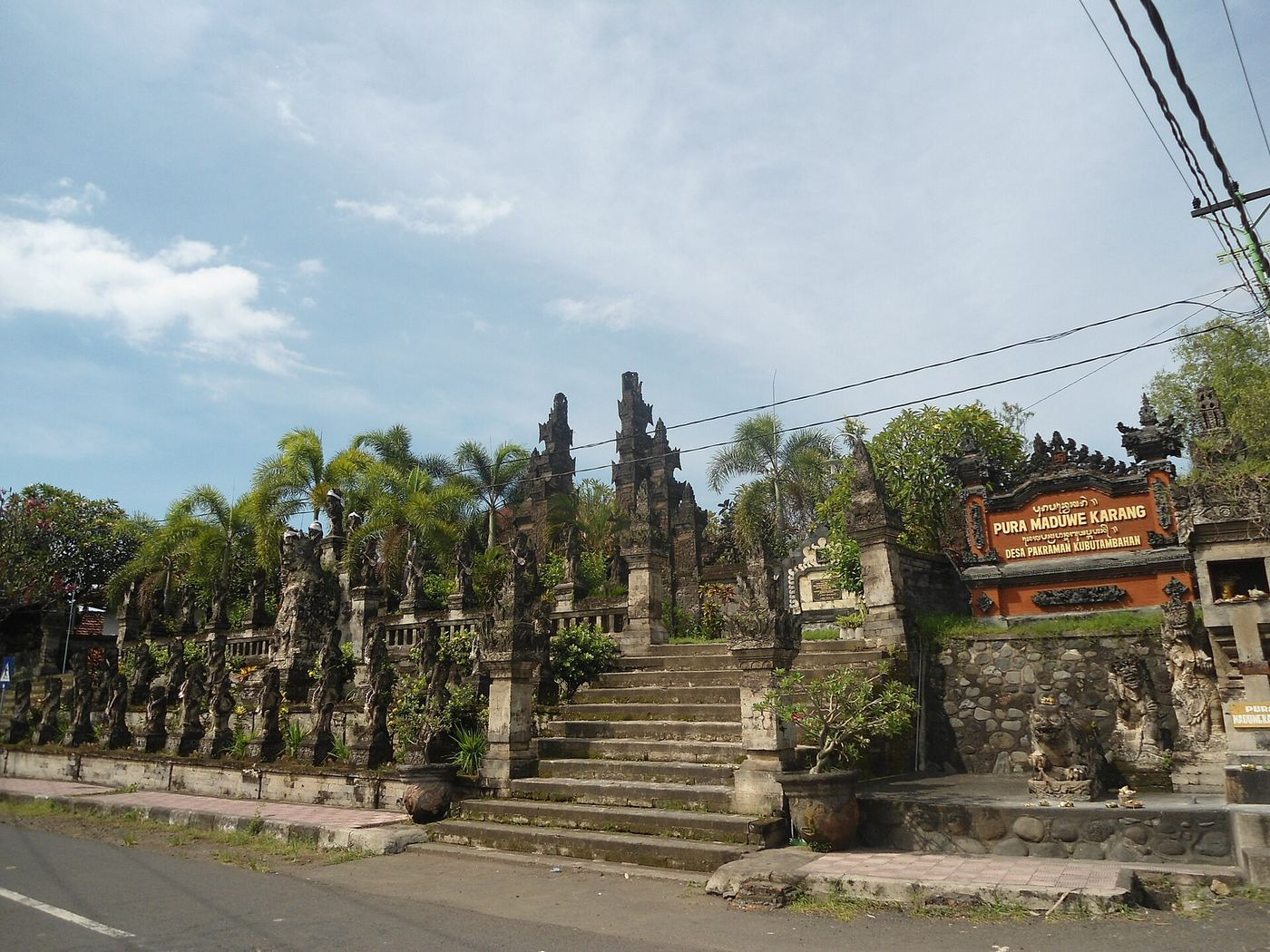 Pura Maduwe Karang at Kubutambahan, in Buleleng. Photo: DayakSibiriak / Wikimedia Commons (CC BY-SA 4.0)

How to Fit It In
Bengkala sits just off one of the main roads that link the north coast with the south. Kubutambahan district is also home to Pura Maduwe Karang, the temple with the carved relief of a man on a bicycle, which pairs naturally with a morning in Bengkala; it is in the best temples of north Bali. Singaraja's old town is a short drive west (Singaraja old town), and things to do in north Bali has the rest of the region.
From Lovina, where most of Palm Living's villas are, Bengkala lies on the far side of Singaraja, so allow a half day with a driver; see private drivers in north Bali.
Practical Notes
- Arrange ahead. Performances and home visits are organised through the village, not on the spot.
- Ask before you film. Villagers are used to cameras, which is a reason for more courtesy.
- Use the village's words. "Kolok" is what Bengkala calls its deaf members; in English, "deaf" is the respectful word, and "deaf-mute" is outdated.
- Dress as for a village temple if a ceremony is on: sarong and sash, shoulders covered.
- Bring cash if you want to buy weaving.
FAQ
Where is the deaf village in Bali? Bengkala, in Kubutambahan district of Buleleng regency in north Bali, east of Singaraja. Balinese call it Desa Kolok, the deaf village.
Why are so many people deaf in Bengkala? Because of a recessive inherited mutation at the DFNB3 locus, since identified as the MYO15A gene. A child is born deaf when it inherits the mutation from both parents. A 1995 study found profound congenital deafness in 2.2% of the village's population.
What is Kata Kolok? Kata Kolok, "deaf talk", is Bengkala's own sign language. It is unrelated to spoken Balinese and to the sign language used elsewhere in Bali, uses real compass directions to describe space, and is signed by deaf villagers and by many hearing ones.
Do hearing people in Bengkala use sign language? Yes. The linguist Connie de Vos found that 57% of villagers sign with some fluency, between 1,200 and 1,800 people, of whom only about 4% are deaf.
What is Janger Kolok? A version of the Balinese janger dance performed by Bengkala's deaf villagers, in which sign replaces the songs of ordinary janger. It was founded around 1969 by the late I Wayan Nedeng, mixes dance with martial arts, and tells the story of Arjuna Wiwaha.
Can tourists visit Bengkala? Yes, by arrangement with the village or a guide it knows. Performances of the Janger Kolok are staged on request. Ask before filming, and treat it as a visit to people's homes.
Sources
- S. Winata and colleagues, Congenital non-syndromal autosomal recessive deafness in Bengkala, an isolated Balinese village, Journal of Medical Genetics, May 1995, for the village's age, the rate of deafness and carriers, and the sign language, read September 2026 (in English)
- T. B. Friedman and colleagues, A gene for congenital, recessive deafness DFNB3 maps to the pericentromeric region of chromosome 17, Nature Genetics, January 1995, read September 2026 (in English)
- Mutational spectrum of MYO15A and the molecular mechanisms of DFNB3 human deafness, Human Mutation, 2016, for DFNB3 as the MYO15A gene, read September 2026 (in English)
- Max Planck Institute for Psycholinguistics, Sign-spatiality in Kata Kolok, on Connie de Vos's doctorate, for the numbers of signers, the absolute frame of reference and inclusive education, read September 2026 (in English)
- Erin Moriarty, MobileDeaf, "Seeing how they live": deaf village tourism in Bengkala, March 2020, for the roles of deaf men, tourism in the village and its connections, read September 2026 (in English)
- Wikipedia, Kata Kolok, for the generations of signers, the absence of finger-spelling and the deaf god, read September 2026 (in English)
- Buleleng Regency, Janger Kolok Bengkala, equality for disabled citizens in the arts, for the founder, story, heritage listing and rehearsals, read September 2026 (in Indonesian)
- Bali Province, Ceraken Kebudayaan Bali, Janger Kolok Desa Bengkala, for the dance's origins and movements, read September 2026 (in Indonesian)
- Buleleng Culture and Tourism Office, Janger Kolok, read September 2026 (in Indonesian)
- detikBali, Inclusive school in Bengkala village, February 2023, for SDN 2 Bengkala, read September 2026 (in Indonesian)
Read next: Balinese dance and gong kebyar, the best temples of north Bali and Balinese culture.