
On this page
- In Brief
- Gebogan at a Glance
- The Gebogan Is Shaped Like a Mountain of Thanks
- Five Kinds of Fruit Make It Complete: the Panca Rengga
- The Rice Cakes Carry Meanings from a Palm-Leaf Text
- A Gebogan Is Built Upward from a Wooden Tray
- Bali Asks for Local Fruit, Already Blessed on Tumpek Uduh
- Canned Drinks, Orchids and Staples Have Entered the Modern Gebogan
- Gebogan Contests Have Run Since Bali's First Arts Festival
- Each Family Brings One, Several Times a Year
- Practical Notes
- FAQ
- Sources
In Brief
A gebogan, also called pajegan, is a Balinese Hindu offering of fruit, cakes and flowers. It is stacked into a cone on a wooden tray called a dulang. Women and girls carry it on their heads to the temple for its festival, the piodalan, and other ceremonies for the gods.
Its heart is the panca rengga, five kinds of fruit grouped by how they grow. Two rice cakes belong in it too, jaja begina and jaja uli. A crown of palm leaf, the sampian gebogan, sits on top.
Bali's Hindu council and its council of customary villages have asked families to build it from local fruit. Contests across the island have judged it as an art since 1978.
Gebogan at a Glance
- Names: Gebogan, or pajegan, the name Buleleng's culture office puts first
- What it is: A cone of fruit, cakes and flowers on a dulang, offered at temple ceremonies
- Height: From half a metre to one metre
- The core: The panca rengga, five kinds of fruit, with jaja begina and jaja uli
- The crown: The sampian gebogan of palm leaf, with flowers pinned on top
- Who makes it: Women and girls of each family, for the temple festivals and for Galungan and Kuningan
- On stage: A gebogan contest has been part of the Bali Arts Festival since its first year
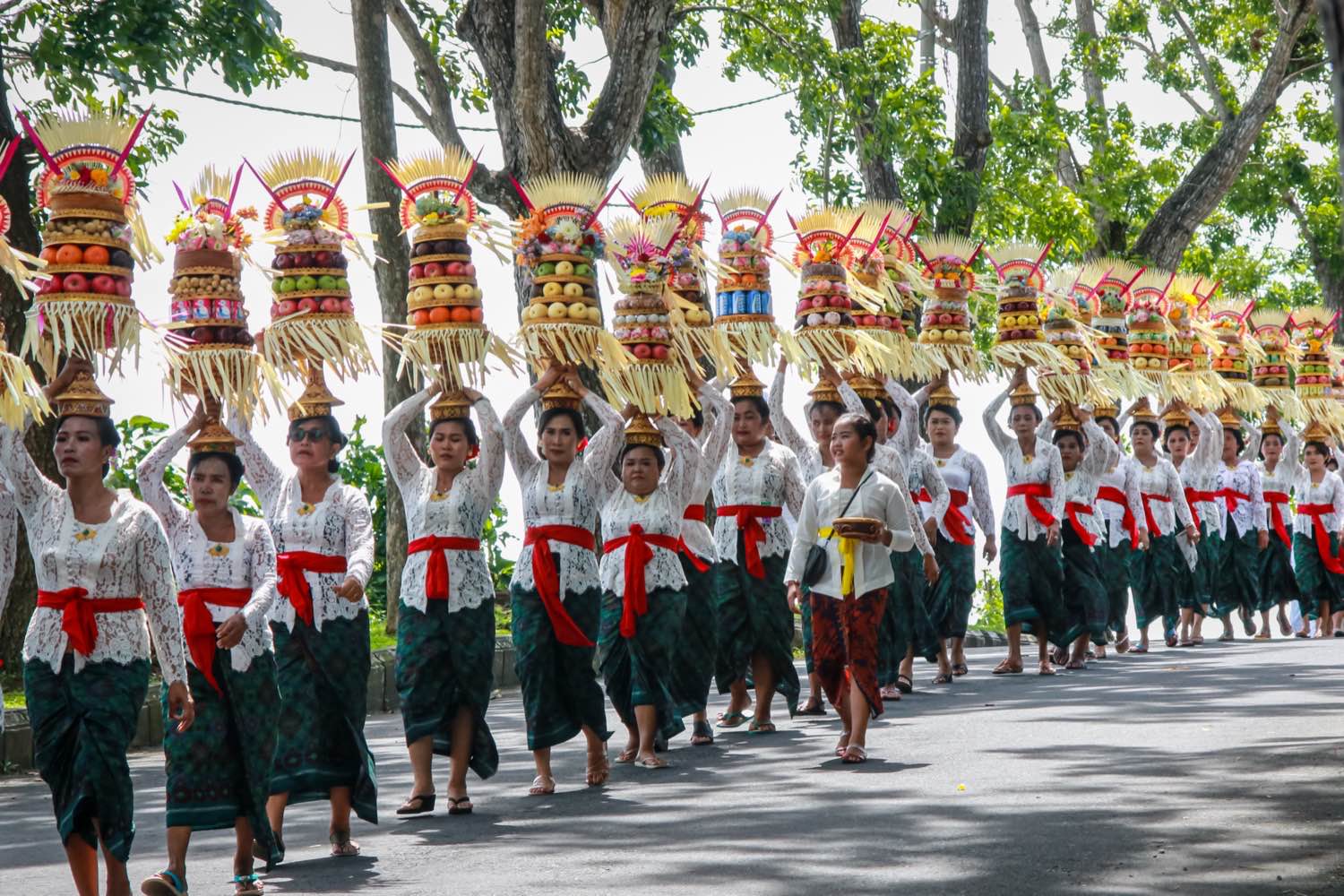 A mapeed procession of women carrying gebogan in Bali. Several towers hold rows of canned drinks among the apples and oranges. Photo: Jonatanbagus / Wikimedia Commons (CC BY-SA 4.0)
The Gebogan Is Shaped Like a Mountain of Thanks
A gebogan rises like a mountain, narrowing toward the top.
That is how the culture and tourism office of Buleleng, north Bali's regency, describes it. On top sit a canang and a sampian, as an offering and an act of devotion to God, the creator of the universe. Mothers and girls carry it to the temple in thanks to Ida Sang Hyang Widhi for blessings received.
The occasion is a temple's piodalan or another ceremony of Dewa Yadnya, the offerings to the gods. Dewa Yadnya is one of the five great classes of ceremony set out in Panca Yadnya.
RRI Denpasar, the public broadcaster, gives the Balinese meaning of the word as a pile or a stack. Its tall form, RRI adds, carries the hope that the gods' blessings come down to people. The guide to Balinese offerings gives a second reading of the name, "sum".
Five Kinds of Fruit Make It Complete: the Panca Rengga
The essence of a gebogan is the panca rengga, five kinds of fruit from five kinds of birth.
The priest Ida Rsi Bhujangga Waisnawa Putra Sara Shri Satya Jyoti explained it to Bali Express in 2017. The five run from fruit born of a flower to fruit born of a root. All five belong in the gebogan, he said, so the offering holds its full spiritual value. Bali Express adds that a gebogan need not be large.
Indonesian Wikipedia's entry on gebogan lists the five with examples:
- Born of a flower: mango, apple, orange and jambu
- From a plant that fruits once and dies: banana
- Growing straight from the trunk: jackfruit, durian, duku and lychee
- Scaled fruit: pineapple, salak and dragon fruit
- From the root: yam bean and cassava
The Rice Cakes Carry Meanings from a Palm-Leaf Text
A gebogan holds cakes as well as fruit, and two are expected.
The same priest named them as jaja begina and jaja uli, both made from glutinous rice.
Writing in tatkala.co, Abdi Jaya Prawira describes Panyajan, the day for making jaja. It falls on Senin Pon of the week Dungulan, just before Galungan. As a boy he pounded the glutinous rice for his grandmother's jaja uli.
He quotes the meanings given in the lontar Teges ing Sarwa Bebanten, a palm-leaf text on offerings:
- Jaja gina: knowledge
- Satuh or tempani: reckoning
- Wajik: the flavour of sacred literature
- Dodol: faithfulness
- Red and white jaja uli: bright happiness and harmonious bonds
- Bantal: being and not-being
He notes that shop cakes in plastic now fill many offerings, with one small packet of uli and begina tucked in to keep the tradition. In his reading, the measure of an offering is the sincerity and care with which it is arranged.
A Gebogan Is Built Upward from a Wooden Tray
The base is the dulang, a wooden tray whose round top narrows below to the size of a head.
Antara, the national news agency, describes this shape, made so the dulang sits well when carried. Besides fruit and cakes, some gebogan carry rice and roast chicken.
The palm-leaf parts are fastened with semat, sharp pins of bamboo, as tatkala.co explains. Contest judges expect the colours in three levels, following tri angga. The phrase means "three bodies", and Balinese tradition uses it for an order of three levels, as in its architecture (Wikipedia).
At the top the builder sets the sampian gebogan and pins on flowers. The priest in Bali Express gives the flowers two roles: an offering, and the beauty of the universe itself.
Buleleng's culture office puts the height at half a metre to a metre. It depends on the sincerity and the means of each family.
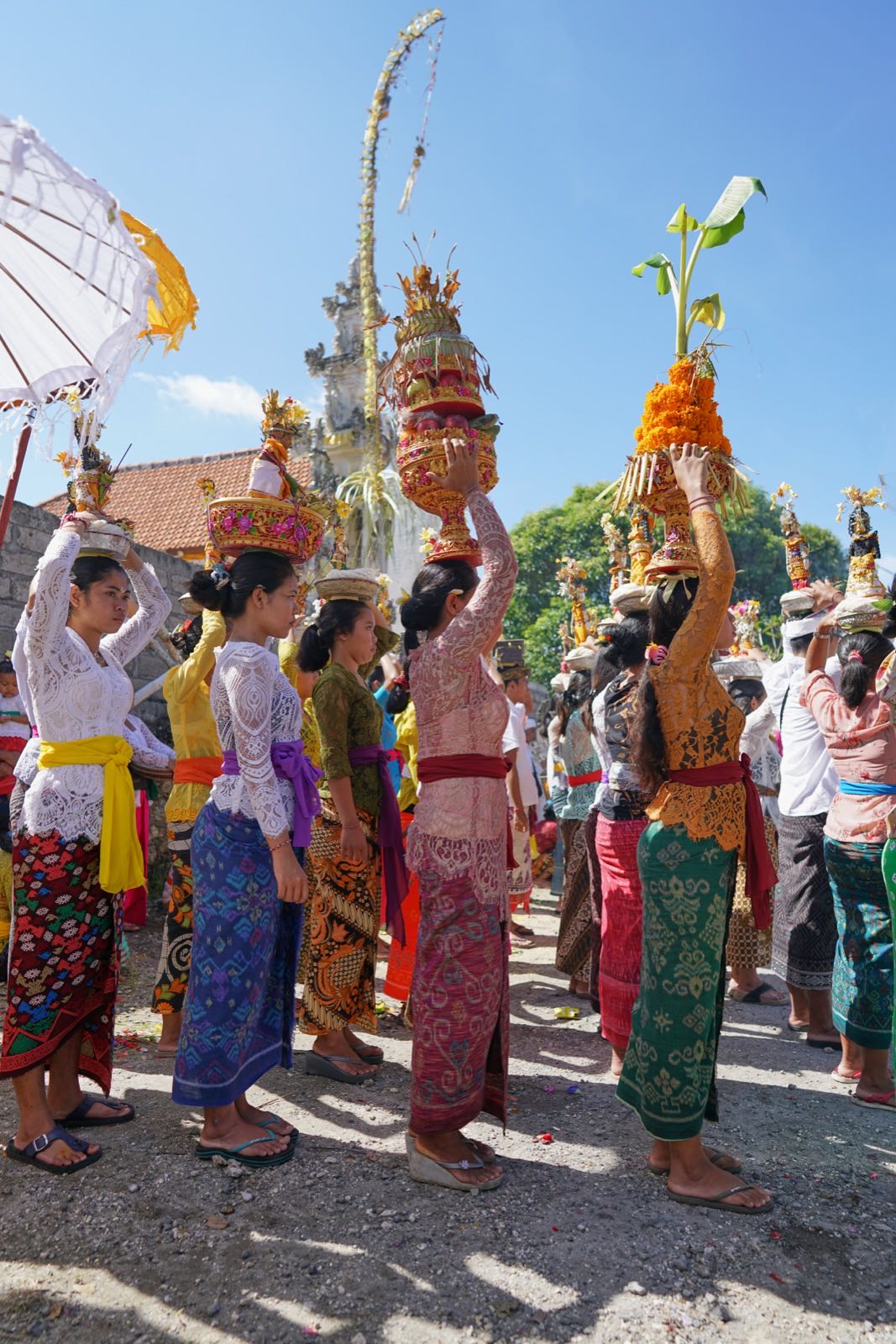 Women line up with their gebogan before a mepeed, the walk together to the temple. Photo: Gunawansidik / Wikimedia Commons (CC BY-SA 4.0)

Bali Asks for Local Fruit, Already Blessed on Tumpek Uduh
Before Galungan in 2021, Bali's Hindu council and its council of customary villages made a joint call.
The Parisada Hindu Dharma Indonesia (PHDI) Bali and the Majelis Desa Adat asked Hindus in every customary village to offer local fruit. The provincial government published it, tied to Governor's Regulation 99 of 2018 on Bali's local farm produce.
PHDI Bali's chairman, Prof. I Gusti Ngurah Sudiana, gave a reason beyond the farm economy. Bali's fruit trees are honoured in ceremony at Tumpek Pengatag, also called Tumpek Uduh. So in Balinese understanding local fruit has been purified before it is offered, which makes it fitting for God and the ancestors.
The same call asked families to carry holy water home without plastic bags, so the tirta keeps its taksu, its spiritual power.
Local fruit asks more of the builder. Antara noted in 2011 that imported fruit is easier to stack because it comes in even sizes. Men Sumiarti of Banjar Ole in Marga, Tabanan, finds local fruit harder but more satisfying. What she offers is the fruit of her own work, she told the agency.
Long before a festival, her husband picks bananas from their own garden. They ripen them by nyekeb, closing them in with mistletoe leaves, so they are ready on the day.
Canned Drinks, Orchids and Staples Have Entered the Modern Gebogan
The gebogan keeps changing with the island.
Two researchers from the state Hindu university in Denpasar, Pande Putu Toya Wisuda and I Nyoman Subrata, studied it in Abiantuwung, a village in Tabanan. Their 2021 paper in Sanjiwani, a philosophy journal, found factory canned drinks built into the tower. Families gave three reasons: gratitude to God, art and beauty, and practicality. The authors name the consequences as spiritual decline and cultural change.
RRI describes other new materials. Imported apples, grapes and oranges now appear in many gebogan, though local produce still dominates. Roses, lilies and orchids join the flowers, and some builders use artificial ones.
Since the 2000s, many makers of offerings have swapped bamboo semat for metal staples. Some priestly households object, tatkala.co reports, because metal is slow to break down.
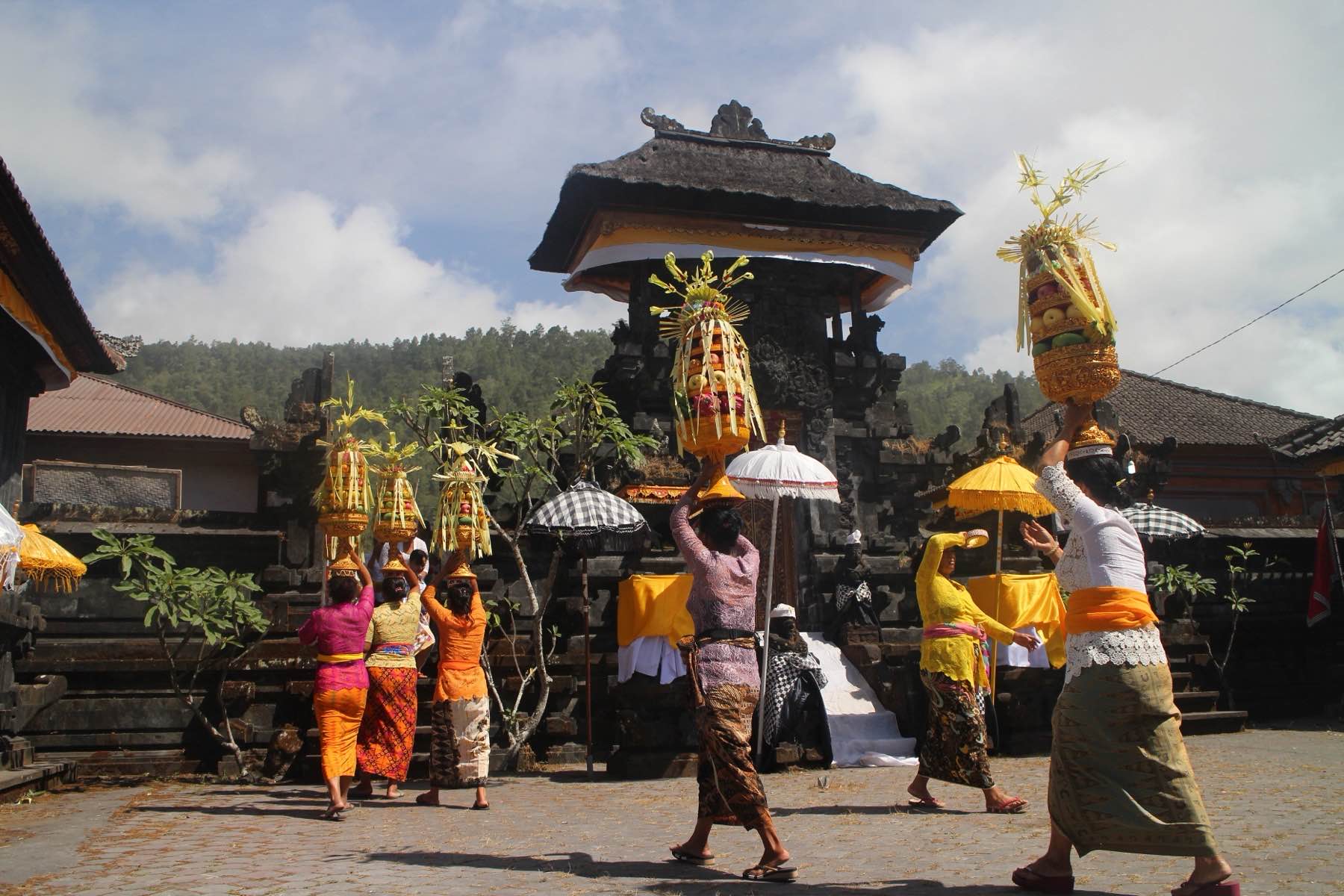 Women carry offerings into a temple for a ceremony. Photo: Michaelparikesit / Wikimedia Commons (CC BY-SA 4.0)

Gebogan Contests Have Run Since Bali's First Arts Festival
Bali judges the gebogan as an art as well as an offering.
The contest began at the first Bali Arts Festival (Pesta Kesenian Bali) in 1978, Antara reports. Prof. Ida Bagus Mantra, the cultural scholar who was then governor, conceived the festival. Over the decades the contest turned simple gebogan into works of art.
Ketut Winaya, a long-time organiser of the women's movement PKK, told Antara why it matters at home. The contest spurs young women to learn the craft, she said, so a new mother-in-law will not look down on them.
The province held a gebogan contest in Denpasar in 2023, as Buleleng's government reported. The judges set four rules:
- local fruit and vegetables, unpolished
- colours arranged in the three levels of tri angga
- semat pins only
- one metre from the dulang to the tip
Teams had one hour, half the time of earlier contests. Denpasar won, Karangasem came second, and Buleleng's team, Ketut Budartini and Luh Dewi, took third.
Each Family Brings One, Several Times a Year
At a piodalan, each head of a family makes a gebogan. Antara reports this is why a temple can fill with hundreds or even thousands.
One woman told Antara she makes five or six in each six-month round. They go to her family temple's festival and to the festivals of the three village temples, Pura Desa, Pura Puseh and Pura Dalem. Galungan and Kuningan take the rest.
Two pages help you find one. The Balinese calendar explains how festival dates are set, and Galungan and Kuningan covers the island-wide holidays. The places and moments to watch in the north are set out in where to see gebogan.
Practical Notes
- Ask before you photograph a woman carrying or placing a gebogan, and keep the procession's path clear.
- Dress for the temple if you follow a procession inside. The temple etiquette guide has the details.
- Do not touch a gebogan. It is an offering on its way to the gods.
- See the craft up close at the Bali Arts Festival in Denpasar, where the gebogan contest began. Check its programme for the year.
- At Galungan, look for the penjor too, the tall curved bamboo poles raised for the same festival.
FAQ
What is a gebogan? A gebogan is a Balinese Hindu offering of fruit, cakes and flowers built into a tapering tower on a wooden tray, the dulang. Women carry it on their heads to the temple for festivals and ceremonies for the gods, as thanks to God.
Is pajegan the same as gebogan? Yes. Pajegan and gebogan are two names for the same offering. Buleleng's culture office titles its explanation "Pajegan atau Gebogan", pajegan or gebogan.
What fruit goes in a gebogan? The core is the panca rengga, five kinds of fruit grouped by how they grow. Fruit born of a flower, such as mango or orange. Banana, from a plant that fruits once. Trunk-borne fruit such as jackfruit or durian. Scaled fruit such as salak or pineapple. Root crops such as cassava. Bali's councils ask for local fruit.
What does a gebogan symbolise? Its shape is a mountain, narrowing as it rises, with a canang and sampian on top as devotion to God. It gives thanks for the blessings received. The cakes inside carry their own meanings, such as knowledge for jaja gina and harmony for red and white jaja uli.
How tall is a gebogan? Buleleng's culture office gives half a metre to one metre. The 2023 provincial contest set exactly one metre from tray to tip. Its value is measured by the giver's sincerity, so a small gebogan is a full offering.
Who makes the gebogan? The women and girls of each family. One woman told Antara she makes five or six every six months, for her family temple, the three village temples, and Galungan and Kuningan.
Sources
- Dinas Kebudayaan dan Pariwisata Kabupaten Buleleng, Pajegan atau Gebogan, 11 February 2021 (mountain shape, canang and sampian on top, carried by mothers and girls for piodalan and Dewa Yadnya, half a metre to one metre, value in sincerity, contests), read October 2026 (in Indonesian)
- Bali Express, I Putu Suyatra, Banten Gebogan: the panca rengga composition, 16 July 2017 (Ida Rsi Bhujangga Waisnawa Putra Sara Shri Satya Jyoti on the panca rengga, jaja begina and uli, sampian gebogan, the flowers), read October 2026 (in Indonesian)
- Wikipedia, Gebogan (the five kinds of panca rengga fruit with examples) and Tri Angga, read October 2026 (in Indonesian)
- RRI Denpasar, Ida Ayu Putu Widya Indah Sari, The development of banten gebogan, 18 March 2025 (meaning of the word, imported fruit, new flowers), read October 2026 (in Indonesian)
- Antara Bali, I Ketut Sutika, Local fruit now the main requirement for gebogan, 24 July 2011 (the dulang, contest since 1978, one gebogan per family, five or six a season, nyekeb, local fruit since 1985), read October 2026 (in Indonesian)
- Pemerintah Provinsi Bali, PHDI and MDA Bali ask Hindus to use local fruit for Galungan and Kuningan, 9 November 2021 (Pergub 99/2018, Tumpek Pengatag, holy water without plastic), read October 2026 (in Indonesian)
- Pemerintah Kabupaten Buleleng, Gebogan contest at the KBS Festival promotes local fruit, 15 August 2023 (judging rules, results), read October 2026 (in Indonesian)
- Wisuda P.P.T. and Subrata I.N., Konstruksi banten gebogan pada era globalisasi di Desa Abiantuwung, Sanjiwani: Jurnal Filsafat 12(1), 2021, abstract read October 2026 (in English)
- tatkala.co, Abdi Jaya Prawira, Kudapan dan kesungguhan: jaja on the day of Panyajan, 21 April 2025 (Panyajan, the lontar Teges ing Sarwa Bebanten), read October 2026 (in Indonesian)
- tatkala.co, From semat to staples in majejaitan, 10 January 2021, read October 2026 (in Indonesian)
Read next: Balinese offerings explained, Galungan and Kuningan, the penjor and the elements of a Balinese ceremony.